The entire hangar went silent when Lieutenant Colonel Vance looked at my maintenance badge with open contempt
Part 2
Lieutenant Colonel Vance led me into the small briefing room beside the hangar, but the door never fully closed because half the squadron seemed to have found a reason to pass by it.
He placed his tablet on the table and folded his arms.
“Do you understand what that callsign means to this unit?”
“I understand what it meant during the mission, sir.”
“That’s not an answer.”
“It is the answer I have, sir.”
He studied me for a long moment, perhaps waiting for the arrogance he expected from a decorated combat pilot, or the defensiveness of someone caught hiding something shameful.
I offered him neither.
Finally, he turned the tablet toward me.
My record displayed the official summary of the Lindara extraction, with entire sections redacted and a series of technical notes beneath them.
“You disobeyed a direct order to withdraw,” he said.
“Yes, sir.”
“You remained on station after reaching your bingo fuel threshold.”
“Yes, sir.”
“You continued circling an active threat area while your aircraft was running dangerously low.”
“Yes, sir.”
“And you landed with virtually nothing left in your tanks.”
“Not virtually, sir. Nothing.”
His eyebrows rose.
I could still remember the fuel warning, the vibration in the stick, and the way the horizon had tilted when I pulled the jet into another turn.
I could remember the voice of the controller telling me to leave.
I could remember the desperate calm in my own voice as I answered that I would leave when the last helicopter was airborne.
What I could not remember clearly was the exact moment I had decided that my own survival had become less important than the men waiting below.
Perhaps that was because there had never been a single moment.
It had been a hundred small decisions, each one buying another minute for people who had run out of time.
“Why?” Vance asked.
The question was quieter than I expected.
I looked through the narrow window toward the hangar, where the nose of aircraft 047 gleamed beneath the fluorescent lights.
“Because they were still down there.”
“That simple?”
“No, sir. It was terrifying.”
For the first time, his expression softened, though only slightly.
I pulled out a chair but did not sit.
“Lindara was supposed to be a routine extraction. The helicopters went in under cover, the ground teams secured the pickup zone, and we were there to keep hostile aircraft and ground fire away from them.”
I paused, feeling the memory return in fragments.
“The weather deteriorated faster than expected. Communications became unreliable, and the evacuation corridor turned into a mess. One helicopter was damaged on approach. Another couldn’t lift while the troops were pinned down. The rest were trying to keep the landing zone clear.”
I could almost hear the rotor blades again, beating against the smoke.
“Then the order came to withdraw.”
“Because you were low on fuel,” Vance said.
“Because the entire operation was collapsing, sir. I understood the order.”
“Yet you ignored it.”
“I asked for more time. I was denied.”
“And you stayed.”
“I stayed.”
I remembered the first soldier I saw running toward a helicopter, carrying another man whose boots dragged across the ground.
I remembered the heat blooming against the underside of my aircraft as enemy fire forced me into a hard turn.
I remembered the warning tones, the red lights, and the cold certainty that the jet would not forgive me if I made one more mistake.
But the worst memory was not the danger.
It was the radio.
There had been voices on that frequency, young voices trying to sound brave while the world came apart around them.
One of them had called for his mother.
Another had kept reporting positions even after his transmission broke into static.
I had listened to them and understood that if I left, some of those voices would never return to the people waiting for them at home.
“I kept circling the extraction zone,” I told Vance. “Every time the helicopters tried to move, I pushed the threat away long enough for them to get another group aboard. I was not saving the whole operation. I was buying seconds.”
“And the fuel?”
“The fuel kept getting lower.”
“You knew you might not make it back.”
“Yes, sir.”
“Then why didn’t you eject?”
I finally met his eyes.
“Because I was still useful.”
The room went quiet.
It was the same answer I had given myself in the years that followed, though I had never spoken it aloud so plainly.
The colonel sat down.
“What happened after the final evacuation?”
“The last helicopter lifted with the remaining troops. I turned for home.”
“Your aircraft?”
“Lost power on final approach. I made the runway, barely.”
I could still feel the violent shudder as the engine died, the runway rushing toward me, and the jet settling onto the concrete with a weight that seemed to shake the bones in my chest.
I had survived the mission.
That was the part everyone told afterward.
They did not talk as much about what survival cost.
The extreme G-forces I had endured during the engagement had damaged my inner ear. At first, the doctors thought the dizziness would fade with rest and rehabilitation. They ran tests, repeated examinations, and sent me through recovery exercises until I could barely stand to look at another spinning chair.
The damage remained.
I could walk without falling most days, but rapid head movement could leave the room tilting beneath my feet. My balance was unreliable under conditions that demanded absolute precision, and the medical board eventually removed me from flight status.
The first time I heard the decision, I had stared at the paperwork until the words blurred.
I had trained for years to become a fighter pilot.
I had spent my life learning to trust my hands, my eyes, and the machine around me.
Then a doctor told me I could never safely return to the cockpit.
I asked for another assessment.
I appealed.
I trained until my muscles shook and my head throbbed.
Nothing changed the results.
My flying career ended not with an explosion or a final heroic maneuver, but with a quiet signature beneath a medical determination.
Vance glanced at the record.
“You were offered an administrative position after your medical separation from flying duties.”
“Yes, sir.”
“A senior staff position.”
“Yes, sir.”
“Why turn it down?”
Because I could not bear the thought of sitting behind a desk, watching aircraft take off while pretending the part of me that belonged in the sky had not been buried alive.
Because I had spent months feeling like a broken tool placed on a shelf.
Because the men and women who climbed into those jets deserved someone who understood what a failure meant when there was no room to correct it.
But I did not say all of that.
“I wanted to remain useful, sir.”
“By repairing hydraulic lines?”
“By making sure a pilot doesn’t discover a preventable failure when the aircraft is already airborne.”
Vance leaned back.
“You could have told people who you were.”
I looked down at my hands.
“Would that have made the aircraft safer?”
He had no immediate answer.
Outside, the hangar was strangely quiet.
I could see Captain Derek Vance through the window, standing near the F-16 with his arms at his sides.
He had not returned to his squadron.
He had not even pretended to check his phone.
He was watching the briefing room door.
The colonel followed my gaze.
“Captain Vance has been asking questions about you since he saw the record.”
“I don’t know him, sir.”
“He knows your name.”
That was when the briefing room door opened.
Captain Derek Vance stepped inside, stopped two paces from the table, and looked at me with an expression I could not quite read.
“Ma’am,” he said, his voice unsteady despite the effort he made to control it. “May I speak?”
The colonel nodded.
Derek swallowed.
“I heard the Lindara tapes during flight school.”
I felt the room narrow around those words.
The radio recordings had been classified. They were never meant to become entertainment or inspirational material for young pilots.
“They used them in an advanced decision-making course,” he continued. “Not the whole mission. Just selected portions, with the callsigns removed. We were told to listen to the communications and decide what we would do.”
He looked at me.
“I recognized your voice the first time I heard it.”
For eighteen months, I had lived beside people who knew nothing about the worst night of my life.
Now a young captain stood before me, telling me that a part of that night had followed him through his own training.
“What did they teach you?” I asked.
“That a pilot has to know when to follow an order and when the situation has changed beyond what the person giving the order can see.”
He hesitated.
“And that you never get to pretend the consequences belong to someone else.”
I felt something tighten in my throat.
The colonel’s expression turned cautious.
“Captain, the recordings were not intended for general discussion.”
“I understand, sir.”
“Then you understand why we need to be careful.”
“Yes, sir.”
Derek looked at me again.
“But I also understand that there are people alive today because she stayed.”
He did not say it loudly.
He did not need to.
Outside the room, someone shifted their boots against the floor.
Then another person stepped closer to the door.
And I realized the entire squadron was listening.
I had spent years trying to make the past small enough to carry.
Now the past was standing in the doorway, and I could no longer tell whether I wanted to run from it or finally let someone see how heavy it had been.
Part 3
Captain Derek Vance stepped away from the door and stood directly in front of me.
For a moment, he looked like a young pilot waiting for an evaluation, uncertain whether the next words out of his mouth would change the rest of his career.
Then he straightened his back, brought his right hand up, and rendered a sharp, formal salute.
I stared at him.
I had been saluted before.
I had received medals, citations, and official commendations that people photographed and filed away.
But this was different.
There was no ceremony, no commanding general, no flag hanging behind me, and no audience invited to applaud.
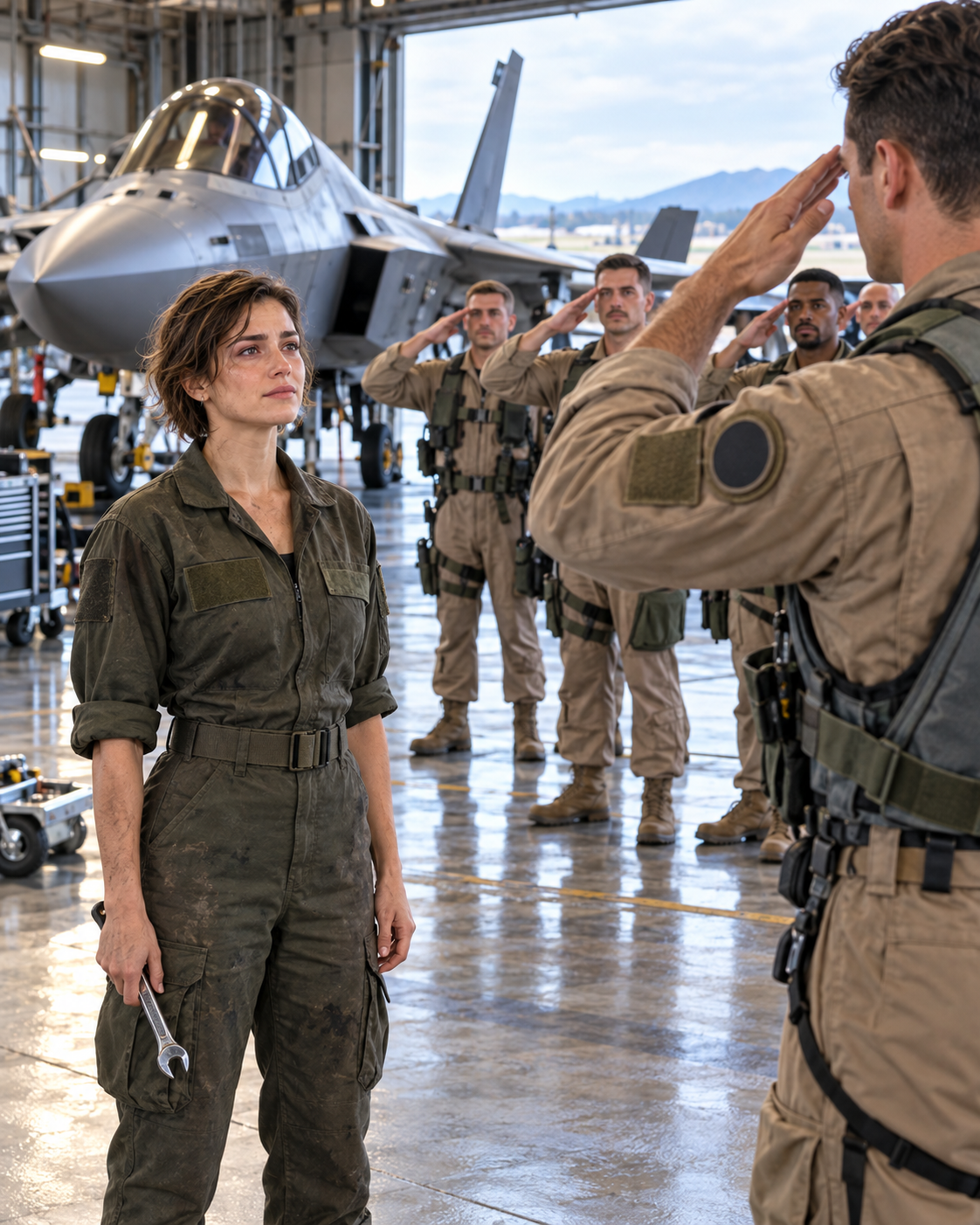
There was only a captain standing in a maintenance briefing room, honoring a staff sergeant whose hands were stained with hydraulic fluid.
“Thank you, ma’am,” he said.
His voice cracked on the last word.
I felt my throat tighten, and for one terrifying second, I was back in the cockpit at Lindara, hearing the last helicopter report that it was clear.
Only this time, the radio was silent.
I had no idea what to do with the emotion rising inside me.
I had spent so long keeping it locked away that even gratitude felt like something dangerous.
“Captain,” I managed, “you don’t have to do that.”
“Respectfully, ma’am, I do.”
The colonel looked at him.
“Captain Vance, lower your hand.”
Derek held the salute for one more heartbeat, then lowered it.
But before he could step back, the door opened wider.
Sergeant Miller stood there with half a dozen maintainers behind him.
One of the pilots had followed them.
Then another.
No one spoke.
Miller looked at me, his face stripped of the easy humor he usually wore.
He lifted his hand to his brow and saluted.
The pilot beside him did the same.
Then another.
The movement spread through the hangar, visible through the glass, until the entire squadron seemed to have stopped in the middle of its ordinary morning.
Pilots in flight suits.
Crew chiefs in grease-stained coveralls.
Airmen holding tools.
Officers who had arrived expecting a routine orientation.
One by one, they raised their hands.
The sound of the rain against the roof seemed to grow louder.
I stood there with my arms hanging at my sides, unable to breathe properly.
I had spent eighteen months trying to become invisible because being seen hurt.
Now every person in the hangar was looking at me, and none of them looked away.
Lieutenant Colonel Vance rose slowly from his chair.
For a moment, I thought he might order everyone back to work.
Instead, he walked around the table and stopped in front of me.
His expression had changed.
The contempt was gone, replaced by something less comfortable and far more human.
“I owe you an apology, Staff Sergeant.”
I looked at him carefully.
“For what, sir?”
“For assuming that the value of your service could be measured by the job title on your uniform.”
He paused.
“And for speaking to you as if you needed to justify your place here.”
I had imagined receiving apologies from people who had questioned my decision to remain in uniform.
In those private fantasies, I always had the perfect answer.
I would explain the loneliness, the grief, the endless struggle to find a reason to get out of bed after the cockpit had been taken from me.
I would make them understand that I had not come to maintenance because I lacked ambition.
I had come because I still had something to give.
But standing there, with an entire squadron watching, I discovered that I did not need to explain everything.
“Thank you, sir,” I said.
My voice sounded steadier than I felt.
Then I glanced through the window.
Aircraft 047 was still sitting beneath the hangar lights, its maintenance panel open and its hydraulic line unfinished.
I could almost hear the fitting waiting for me.
I wiped my palms on the rag at my waist.
“Now, if everyone is finished turning my morning into a memorial service, I’d like to get back to work.”
For half a second, nobody reacted.
Then Miller let out a startled laugh.
I pointed toward the F-16.
“That aircraft is not going to fix itself, Sergeant.”
“Yes, ma’am,” he said immediately, his grin returning through the emotion on his face.
“And if anyone touches my tools without asking, Reaper 9 or not, I will personally assign them to inventory every washer in this hangar.”
A ripple of laughter moved through the room.
It was not loud.
It did not erase what had happened.
But it gave all of us somewhere to breathe.
The salutes lowered.
The shoulders relaxed.
People began moving again, though the atmosphere had changed in a way I could feel more clearly than I could describe.
I crawled beneath aircraft 047 and reached for my wrench.
For a few seconds, the world returned to its familiar shape.
Cold concrete beneath my back.
Metal above my face.
The sharp smell of hydraulic fluid.
Then another pair of hands appeared beside mine.
It was Captain Derek Vance.
“Need an extra set of hands, ma’am?”
I glanced at his immaculate flight suit.
“You know anything about hydraulic maintenance, Captain?”
“Not enough to embarrass myself confidently.”
“That’s honest, at least.”
He knelt beside me.
I showed him the fitting, explained the alignment, and told him how a tiny mistake could become a serious problem under pressure.
He listened without interrupting.
A few minutes later, Miller joined us, followed by two younger maintainers who had suddenly become very interested in learning the proper way to inspect a hydraulic connection.
No one asked me to retell Lindara.
No one demanded a dramatic account of the fuel warnings or the final landing.
They asked about the aircraft.
They asked about the maintenance procedure.
They listened when I explained why a second inspection mattered, even when the first had found nothing wrong.
For the first time since losing my flight status, I felt the familiar satisfaction of being exactly where I was supposed to be.
Not because the squadron had discovered I was once a famous pilot.
Because the people around me were beginning to understand what it meant to trust one another.
The change did not happen through one speech or one dramatic salute.
It happened in the days that followed.
Pilots started coming into the maintenance bay before flights, not to demand updates, but to ask questions and listen to the answers.
The youngest airmen began speaking up when something looked wrong instead of worrying that a senior person might think they were overreacting.
Crew chiefs and pilots started reviewing recurring maintenance problems together, with the understanding that rank did not make a person immune to error.
The officers who had once hurried past the maintenance crews began learning names.
Lieutenant Colonel Vance made it clear that no one would be mocked for raising a safety concern, and he began attending maintenance briefings himself.
He never tried to turn my experience into a motivational presentation.
I was grateful for that.
The story of Lindara remained complicated, and I had no interest in becoming a poster on the wall.
There had been mistakes, impossible decisions, and consequences that no official report could fully capture.
The men and women who survived were not props in my story.
They had their own scars, their own memories, and their own reasons for being grateful to have made it home.
I had simply been the pilot in the sky who bought them enough time to leave.
And afterward, I had been the woman on the ground who wanted to make sure the next pilot came home too.
Several weeks after that morning, Captain Derek found me inspecting an aircraft before a scheduled training flight.
He held out a paper cup of coffee.
“I brought you something.”
I looked at it suspiciously.
“Is this an apology for the hydraulic lesson?”
“No, ma’am. It’s an apology for the coffee machine.”
I took a sip and immediately regretted it.
“This tastes like someone boiled a boot.”
“That’s the premium blend.”
“Then I would hate to meet the budget blend.”
He laughed, and for a while we stood beside the aircraft, watching sunlight spill across the concrete.
After a moment, he became serious.
“Can I ask you something about Lindara?”
I looked at him.
“You can ask.”
“When you heard the final helicopter was clear, did you feel relieved?”
I considered the question.
For years, people had imagined that moment as the triumphant end of a heroic mission.
They pictured a pilot raising a fist, cheering into the radio, or smiling as the aircraft returned safely to base.
The truth had been quieter.
“I felt empty,” I told him. “I was glad they were gone, but I knew I still had to get the jet home. I was so focused on the next thing that I didn’t have room to feel anything else.”
“And afterward?”
“Afterward, I kept thinking about all the things that could have gone differently.”
He lowered his gaze.
“Is that why you stopped talking about it?”
“Partly.”
I watched a pair of maintainers moving a service cart across the hangar.
“I didn’t want the worst night of my life to become the only thing people knew about me. I wanted to do something useful without having to explain why I couldn’t fly anymore.”
Derek nodded slowly.
“I think I understand.”
“Maybe,” I said. “But understanding doesn’t mean you have to carry the same weight.”
He was quiet for a while.
Then he said, “When I listened to those tapes in flight school, I thought courage meant being willing to die.”
I looked at him.
“What do you think now?”
He watched the pilots preparing for their next sortie.
“I think courage might also mean trusting the people who tell you when something is wrong. And remembering that getting everyone home matters more than looking fearless.”
I smiled.
“That’s a better lesson than most people learn.”
He took a breath.
“There’s something else. I hope you know we don’t respect you only because of what you did at Lindara.”
I felt an old instinct rise inside me, the urge to deflect the compliment or change the subject.
But this time, I let him finish.
“We respect you because you show up. Because you check the work twice. Because you don’t let people take shortcuts when someone else’s life depends on the result. Lindara explains part of your story, ma’am, but it doesn’t explain all of you.”
I looked away before he could see how deeply the words had reached me.
For eighteen months, I had believed that if I kept my past hidden, I could protect the small life I had built from the pain of losing the one that came before it.
I had been wrong about that.
The past did not disappear just because I refused to speak its name.
But it did not have to define every moment of my future, either.
The following morning, I arrived at the hangar before sunrise.
The rain had finally stopped, leaving the runway dark and shining beneath a pale gray sky.
Aircraft 047 waited in its bay, ready for inspection.
I walked beneath the wing, checked the panels, and ran my hand along the edge of the maintenance checklist.
Everything was where it belonged.
As I reached for my tools, I heard boots approaching behind me.
It was Lieutenant Colonel Vance.
He stopped beside the aircraft and looked up at the cockpit.
“Staff Sergeant, I wanted to tell you something before the day gets busy.”
I waited.
“I reviewed the maintenance reports from the past six months. Your inspection records are exceptional.”
“Thank you, sir.”
“I also spoke with the flight commanders. They tell me the squadron’s communication between pilots and maintainers has improved considerably.”
I raised an eyebrow.
“Are you about to give me another speech, sir?”
He almost smiled.
“No. I am about to ask whether you would be willing to help develop a joint training program for pilots and maintenance personnel.”
I considered it.
“Will I have to stand in front of a room and tell the Lindara story?”
“No.”
“Will I have to wear my medals?”
“No.”
“Will I still get to work on aircraft?”
“Absolutely.”
“Then I can consider it.”
He nodded, apparently relieved that I had not dismissed the idea outright.
Before he left, he glanced toward the cockpit again.
“Do you ever miss flying?”
The question settled between us.
I could have given him the easy answer.
I could have said that I had made peace with the decision, that I was grateful to still serve, that everything had worked out the way it was supposed to.
Instead, I told the truth.
“Every day, sir.”
He looked at me for a long moment.
“I’m sorry.”
“So am I.”
There was nothing else to say.
He offered a quiet nod and walked away.
I stood beside the aircraft, listening as the first engines of the morning began to rumble outside.
Somewhere beyond the hangar doors, a pilot was preparing to climb into a cockpit and trust the machine beneath their hands.
That pilot would never know how many people had checked the aircraft before sunrise.
They would never see the hours spent tracing a fault through a hydraulic system, tightening a connection, or repeating an inspection because something did not feel right.
They would not know how often the person beneath the wing had to fight the urge to look up at the sky and remember the life she had lost.
And that was all right.
The work had never required an audience.
Still, when the squadron gathered for the first joint safety briefing a few weeks later, I stood at the front of the room beside Captain Derek and looked out at the faces watching me.
For once, I did not hide the old callsign.
I did not begin with Lindara or the fuel warnings or the order I had disobeyed.
I began with a question about responsibility.
“What is the most important part of an aircraft?” I asked.
A young lieutenant answered, “The engine, ma’am.”
Someone else said, “The flight controls.”
Derek considered it before offering, “The pilot.”
I shook my head.
“The most important part is the part that fails when nobody is paying attention.”
The room grew quiet.
“Sometimes that’s a hydraulic fitting. Sometimes it’s a warning light. Sometimes it’s a person who knows something is wrong but is afraid to speak up. Our job is to make sure none of those things get ignored.”
I let the words settle.
“A pilot depends on the people who maintain the aircraft. The people who maintain the aircraft depend on pilots who tell the truth about what they experience. None of us gets to do this alone, and none of us is too important to listen.”
I looked around the room.
“Lindara taught me that a life can depend on a few extra seconds. This job has taught me that those seconds are often earned long before an aircraft ever leaves the ground.”
Nobody applauded.
They did not need to.
People took notes, asked questions, and began discussing changes they could make immediately.
Afterward, Miller caught up with me near the hangar doors.
“You know, Brooks, things have been different around here since that morning.”
“I noticed.”
“People listen more.”
“Good.”
He studied me, then smiled.
“Still weird thinking that the person yelling at me about torque specifications is Reaper 9.”
I handed him a clipboard.
“Then stop making it weird and finish your inspection.”
He laughed and walked away.
I watched him go, feeling something settle inside me that had been unsettled for years.
I had spent so long believing that my life had divided into two pieces: the pilot I used to be and the mechanic I had become.
I thought one belonged to the sky and the other to the ground, and that the space between them was a kind of failure I would never overcome.
But standing in that hangar, surrounded by people who understood the value of both kinds of service, I finally saw the truth.
I had not stopped protecting the people who flew.
I had simply changed where I stood when I did it.
Sometimes, when an F-16 lifted into the morning sky, I still felt the old ache in my chest.
I still followed the aircraft with my eyes until it disappeared into the clouds.
I still dreamed about Lindara, about the voices on the radio, and about the terrible arithmetic of fuel, distance, and time.
Those memories would never become easy.
But they no longer felt like evidence that I had lost everything.
They were proof that I had once carried a responsibility larger than myself, and that I had found a way to carry it forward.
On a clear morning late that autumn, aircraft 047 returned from a training sortie and rolled to a stop in front of the hangar.
The pilot climbed down, removed the helmet, and walked straight toward the maintenance crew.
“Brooks,” she called, “the jet flew beautifully.”
I gave the aircraft a final glance.
“That’s what it’s supposed to do, Lieutenant.”
She smiled.
“Still, thank you.”
I nodded and reached for the inspection sheet.
Above us, the sky stretched wide and blue, bright enough to make the runway shimmer.
For a moment, I imagined what it would feel like to climb into a cockpit again, to close the canopy, hear the familiar systems come alive, and feel the aircraft rise beneath me.
The ache came.
Then it passed.
I turned back to the jet and began my inspection.
I was Staff Sergeant Maya Brooks.
I was the woman who had stayed over Lindara when leaving would have been safer.
I was the pilot who had lost her flight status, the mechanic who checked every line twice, and the person who understood that saving a life did not always look like a dramatic maneuver against a burning horizon.
Sometimes, it looked like a quiet hand tightening a fitting beneath a wing.
Sometimes, it looked like a young captain saluting someone he had never met because he had finally understood what her sacrifice meant.
And sometimes, it looked like a whole squadron learning that respect was not something reserved for the people who sat in the cockpit.
I had once believed that the sky was the only place where my life could matter.
Now I knew better.
The sky would always be part of me, but it was no longer the only place I belonged.
Above the hangar, another fighter crossed the morning light, its engine leaving a deep, fading thunder in its wake.
I watched until it vanished.
Then I lowered my eyes, picked up my wrench, and returned to work.
Somewhere up there, a pilot trusted the aircraft beneath them.
And somewhere down here, someone had made certain that trust would not be misplaced.
For the first time in years, I no longer needed the world to remember Reaper 9.
I only needed to know that the people who climbed into those cockpits would have a better chance of coming home.
That was the promise I had made over Lindara, long before anyone knew my name.
And it was the promise I would keep for as long as my hands could do the work.