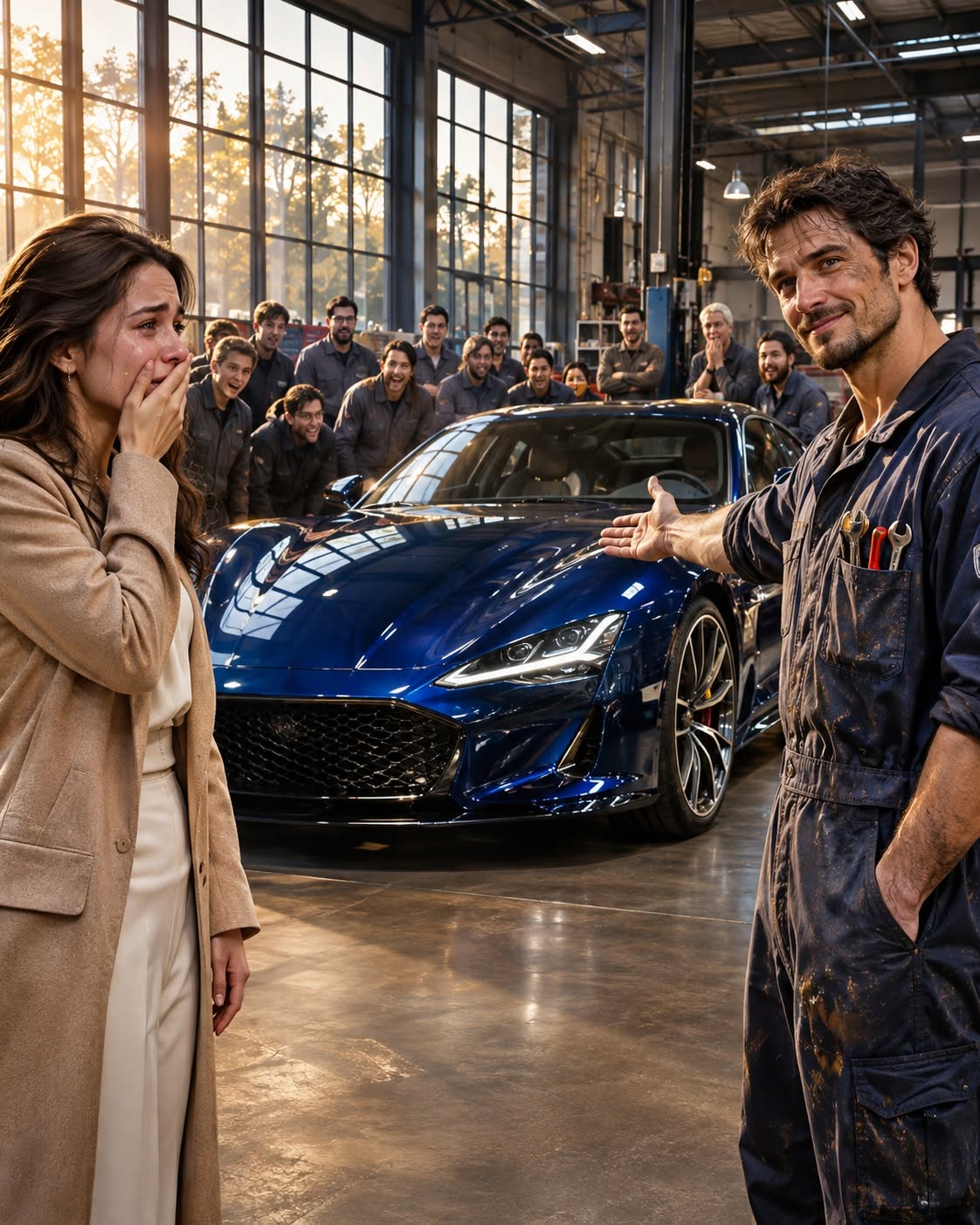
The entire engineering team laughed when I pointed out the problem with their billionaire boss’s $2 million sports car.
She looked at me for a long moment before asking, “If I offered you the chance to build something here, something bigger than a maintenance position, would you be willing to take it?”
For a second, I thought I had misunderstood her.
I glanced at the workshop manager, who was still standing beside the sports car with his face drained of color.
“Ma’am, I’m not sure I understand.”
The CEO smiled faintly.
“My name is Eleanor Whitmore. And I believe my father would have wanted me to ask you this question.”
I didn’t know what to say.
I was a mechanic in faded overalls. I had a modest apartment, an old pickup truck, and a seven-year-old daughter who sometimes had to wait for me to finish work before I could pick her up from school.
I wasn’t used to people offering me opportunities.
“Before I answer, could I ask what you mean?”
Eleanor nodded.
“I mean a permanent position leading a new diagnostic and maintenance division. You would work directly with our senior engineering team. You’d also have the authority to recommend improvements to the way we inspect and repair our vehicles.”
I stared at her.
The engineers around us exchanged uncomfortable glances.
The man who had laughed loudest when I mentioned the ground connection suddenly found something fascinating on the workshop floor.
Eleanor continued.
“But I want to understand something first. Why did you notice a problem that our specialists missed?”
I took a breath.
“Because I wasn’t looking at the car the way they were.”
“What does that mean?”
“They were looking for something broken. I was listening for something that wasn’t behaving normally.”
She tilted her head.
“Explain.”
I pointed toward the steering wheel.
“Every time it turned, the electrical reading changed. Not enough to trigger an obvious warning, but enough to tell me the system was losing stability somewhere. I remembered a similar issue from my years working on long-distance service vehicles.”
One of the senior engineers, a gray-haired man named Richard, stepped forward.
“He’s right. We focused on the control modules and major electrical components. We didn’t investigate that particular ground connection because its resistance was within an acceptable range during our initial static tests.”
I nodded.
“That’s the problem with intermittent faults. Sometimes a component behaves perfectly until the vehicle moves, vibrates, or experiences a particular load.”
Richard looked at me thoughtfully.
“That’s actually a very good point.”
Eleanor folded her arms.
“And the manager fired you for saying it.”
Nobody spoke.
She turned toward him.
“Mr. Collins, would you care to explain?”
The manager cleared his throat.
“Mrs. Whitmore, I was simply maintaining discipline. The workshop was under tremendous pressure, and an unqualified employee was interrupting a specialist team.”
“An unqualified employee?”
His eyes flickered toward the car.
“I didn’t mean—”
“You meant exactly what you said.”
Her voice wasn’t loud, but something about it made the room feel colder.
“My father built this company on one principle. A good idea deserves attention regardless of who speaks it. You just demonstrated that you don’t understand that principle.”
Collins tried to defend himself.
“One mistake shouldn’t erase years of service.”
Eleanor looked at him.
“You’re right. One mistake shouldn’t. But humiliating an employee, refusing to investigate a legitimate safety concern, and dismissing someone without hearing them out are not one mistake.”
She turned to the security supervisor.
“Please escort Mr. Collins to his office. He will remain on administrative leave until Human Resources completes its investigation.”
The manager opened his mouth, but no words came.
A few minutes later, he was gone.
I stood awkwardly beside the vehicle.
I had expected an apology, perhaps permission to return to my old position.
I hadn’t expected any of this.
Eleanor approached me again.
“Now, about that offer.”
I looked down at my hands. They were rough, with small scars from years of working around machinery.
“There’s something you should know, ma’am.”
“Go ahead.”
“I have a daughter. She’s seven. Her mother passed away three years ago, and I’m the only parent she has. I can’t travel constantly or work every weekend. I need to be home when she needs me.”
For the first time, Eleanor’s expression softened.
“What’s her name?”
“Lily.”
“How old did you say?”
“Seven.”
She nodded slowly.
“Then I think we can work something out.”
I hesitated.
“Most companies say that until the schedule becomes inconvenient.”
She didn’t take offense.
Instead, she looked toward the car her father had loved so much.
“Before he died, my father spent his final months trying to convince the board that we needed to change how this company treated its employees. He believed we were becoming too focused on impressive credentials and expensive equipment. He used to say that the person closest to a problem often understood it better than the person with the biggest office.”
She paused.
“He never managed to finish that project.”
I listened quietly.
“I think you might be the person who can help me finish it.”
That was how my life began to change.
But the biggest surprise wasn’t the job offer.
It was what happened three days later.
The following Monday, I arrived at the Whitmore Automotive headquarters wearing the only suit I owned.
It was slightly too large around the shoulders, and the sleeves were a little short.
I had bought it for my daughter’s school presentation the previous year.
When I entered the building, the receptionist looked at me, then checked her computer.
“Good morning. Can I help you?”
“I’m here to see Mrs. Whitmore.”
“Do you have an appointment?”
Before I could answer, a familiar voice called from behind her.
“He’s with me.”
Eleanor approached, carrying a tablet and a cup of coffee.
“Good morning, Daniel.”
“Good morning, ma’am.”
She smiled.
“Please, call me Eleanor.”
She led me through a glass hallway into a conference room overlooking the workshop.
There were six people waiting inside.
Richard, the senior engineer, was among them.
He stood and shook my hand.
“Good to see you again.”
The others introduced themselves as department heads, financial officers, and technical supervisors.
Eleanor took her place at the head of the table.
“Everyone, this is Daniel Carter. He will be joining us as the director of field diagnostics and workshop reliability.”
A woman in a navy suit raised her eyebrows.
“Director?”
Eleanor nodded.
“Yes.”
The woman glanced at my suit.
“May I ask what qualifications he holds?”
I felt my stomach tighten.
I had anticipated that question.
Eleanor answered before I could.
“Twenty years of practical experience, including long-distance vehicle maintenance, electrical troubleshooting, and emergency mechanical repairs.”
“Does he have an engineering degree?”
“No.”
The woman leaned back.
“Then I think we need to be careful about putting someone without formal engineering credentials in charge of a technical division.”
Eleanor didn’t argue.
She simply turned toward me.
“Daniel, would you explain your proposed approach?”
I opened the notebook I’d brought.
I had spent most of the previous night preparing.
I explained that our biggest weakness wasn’t necessarily a lack of technology. It was a lack of communication between people who operated machines and people who designed them.
Drivers noticed unusual sounds.
Maintenance workers noticed patterns.
Technicians observed failures under real conditions.
But that information rarely reached the engineers responsible for designing solutions.
I proposed a reporting system that connected all those observations.
I also suggested practical diagnostic training for maintenance workers, better inspection procedures, and a small mobile team capable of investigating recurring faults before they became expensive failures.
When I finished, the room was quiet.
Richard was the first to speak.
“That’s actually something we’ve needed for years.”
Another engineer nodded.
“We’ve lost considerable money replacing components that weren’t the original source of the problem.”
The woman in the navy suit looked through my notes again.
“How much would this cost?”
I showed her my estimates.
“Less than the amount the company spent last year on unnecessary component replacements and repeat repairs.”
She looked up.
“These figures need to be independently verified.”
“Absolutely,” I replied. “They should be.”
Eleanor smiled.
“Then let’s verify them.”
For the first time, I realized that she wasn’t asking the company to trust me blindly.
She was giving me the opportunity to prove what I could do.
And I was determined not to waste it.
The first month was harder than I expected.
Some engineers treated me with genuine respect.
Others remained convinced that I had been promoted because of one lucky observation.
I understood their concerns.
I had no interest in demanding respect simply because I had been given a title.
I wanted to earn it.
I spent my days moving between departments, examining repair histories, speaking with technicians, and studying recurring equipment failures.
At night, I returned home to Lily.
She usually waited for me at the kitchen table, drawing pictures or finishing her homework.
One evening, she looked up as I entered.
“Daddy, are you a boss now?”
I laughed.
“Something like that.”
“Does that mean you can tell people what to do?”
“Sometimes.”
She thought about it.
“Then can you tell yourself to come home earlier?”
Her question caught me off guard.
I sat beside her.
“Is that what you want?”
She nodded.
“I like that you have a good job. But I don’t want you to become one of those dads who are always too busy.”
I felt a familiar ache in my chest.
I had accepted the promotion because I wanted to give her a better life.
But somewhere along the way, I had started measuring success by how much responsibility I could carry.
I hugged her.
“I promise I’ll try to do better.”
The next morning, I spoke with Eleanor about my schedule.
She listened without interrupting.
Then she said something I hadn’t expected.
“Daniel, I didn’t hire you because I wanted another person who would sacrifice everything for this company. We already have too many of those.”
She adjusted the schedule so I could leave early enough to pick Lily up several days a week.
She also approved a flexible arrangement for emergencies.
It wasn’t a special favor.
It became part of the new department’s working policy.
I realized she was trying to build the kind of workplace her father had envisioned.
And for the first time in years, I could imagine having both a meaningful career and a happy home.
Two months later, our new diagnostic program was ready for its first major test.
The company had been preparing a fleet of premium electric service vehicles for a major commercial client.
Everything had passed the standard inspections.
But during the final testing period, one technician noticed that a cooling pump was vibrating slightly more than usual.
He entered the observation into our new reporting system.
The initial review classified it as a minor concern.
The engineering department believed the vibration was within normal operating limits.
I wasn’t convinced.
I asked for the vehicle to be tested under heavier load conditions.
The request annoyed the production director.
“We’re already behind schedule,” he told me. “We can’t stop an entire delivery over a vibration that nobody can even hear.”
I studied the diagnostic readings.
“Then let us test it for one more hour.”
He shook his head.
“You’ve made your point. We have qualified engineers handling this.”
I recognized the tone immediately.
It was the same attitude I had encountered in the workshop.
But this time, I had authority.
I signed the hold order.
The vehicle would not be released until we understood the vibration.
Within thirty minutes, the testing team discovered that the pump mounting bracket had a hairline fracture.
Under normal conditions, it was almost impossible to detect.
Under sustained pressure, the fracture widened, causing the pump to shift.
If the vehicle had entered commercial service, the cooling system could eventually have failed.
The consequences could have been extremely expensive.
Richard came to my office that afternoon.
“Daniel, you just saved us from a serious recall.”
I shook my head.
“No. A technician noticed something unusual. The system gave him a place to report it. We listened. That’s what worked.”
Richard smiled.
“That’s exactly why Eleanor hired you.”
The discovery changed the way people viewed my department.
But it also created an unexpected enemy.
The production director, Martin Hale, had been pushing to meet the delivery deadline for months.
The delay made him look bad.
He believed I had deliberately embarrassed him.
And he wasn’t the sort of man who accepted embarrassment quietly.
Three weeks later, an anonymous complaint appeared in the company’s internal reporting system.
It accused me of falsifying maintenance findings to justify unnecessary inspections.
The complaint also claimed I had exaggerated my professional experience to obtain a senior position.
Human Resources opened an investigation.
I was asked to provide documentation of my previous employment.
That wasn’t difficult.
I had kept most of my old service records.
However, the next accusation was more serious.
Someone claimed I had approved the release of a vehicle despite an unresolved electrical fault.
The incident report contained my name.
I immediately recognized the vehicle.
It was a demonstration car that had been inspected by another department before I joined the company.
The date on the report was two weeks before my promotion.
I hadn’t even been involved.
I requested the original inspection records.
They were missing.
The digital archive contained only a scanned copy of the final report.
Someone had altered the document.
I brought the evidence to Eleanor.
She studied it carefully.
“Do you believe someone is trying to frame you?”
“I don’t know.”
“Daniel, you need to be honest with me.”
I met her eyes.
“I know what I signed and what I didn’t. I won’t accept responsibility for something I never approved.”
She nodded.
“Then we’ll find out who changed the records.”
That evening, I returned home exhausted.
Lily was sitting on the couch with a drawing.
She held it up.
It showed a little house, a car, and two people holding hands.
At the top, in uneven letters, she had written:
MY DADDY IS THE BEST.
I smiled.
“That’s beautiful.”
She studied my face.
“Are you sad?”
“No, sweetheart. Just tired.”
“Did someone at work say something mean to you?”
I hesitated.
“Why do you ask?”
“Because you look like you did when Mommy got sick.”
I sat beside her and pulled her into my arms.
I hadn’t realized how much my face had been revealing.
“Sometimes grown-ups have problems they need to solve,” I told her. “But that doesn’t mean everything is going to be bad.”
She rested her head against my chest.
“Promise?”
“Promise.”
I hoped I was right.
The investigation took another week.
During that time, Martin Hale continued to undermine my department.
He told several managers that our new diagnostic procedures were slowing production and creating unnecessary costs.
He also requested that my authority to suspend vehicle releases be temporarily removed.
Eleanor refused.
Then, on a Thursday afternoon, the company received an urgent message.
The Whitmore Heritage Collection was scheduled to be transported to a prestigious automotive exhibition.
Among the vehicles was the sports car belonging to Eleanor’s late father.
The same car I had helped bring back to life.
During a final inspection, a technician discovered an unexplained fluctuation in the steering system.
It was similar to the issue we had encountered months earlier.
The vehicle was immediately placed on hold.
But Martin was furious.
The exhibition was less than twenty-four hours away.
“Do you understand what this delay means?” he shouted during the emergency meeting.
Eleanor remained calm.
“I understand that we have a possible electrical fault.”
“It’s a minor fluctuation.”
“Then prove it.”
Martin turned toward me.
“Perhaps our director of diagnostics can explain why a car that was supposedly repaired by his department is suddenly showing another problem.”
I looked at the inspection records.
Something didn’t add up.
The voltage drop appeared only when the steering wheel was turned while the headlights and cooling system were operating simultaneously.
It was a load-related issue.
I asked the technicians to repeat the test.
The readings changed.
I asked them to isolate the electrical circuits.
The problem became more pronounced.
Then I noticed something.
The replacement ground cable installed during the original repair had been routed differently from the factory design.
It was touching a bracket near the front bodywork.
Under certain steering movements, the cable shifted slightly and lost consistent contact.
The connection itself was secure.
The problem was the cable’s position.
I showed Richard.
He examined it, then looked at me.
“That could explain everything.”
Martin interrupted.
“Are you going to blame the repair team again?”
“No,” I said. “I’m saying we need to understand why the cable was routed differently.”
We checked the repair photographs.
The cable had originally been installed according to the manufacturer’s service instructions.
Someone had changed its position afterward.
Richard examined the maintenance log.
A second inspection had been performed two weeks earlier.
The signature belonged to Martin Hale.
The room went silent.
Martin’s expression changed.
“That’s an administrative signature. I don’t personally work on vehicles.”
“Then who changed the cable?” Eleanor asked.
He looked away.
“I don’t know.”
I requested the security footage from the storage area.
Martin objected immediately.
“That’s excessive.”
Eleanor turned toward him.
“Why?”
“Because we have a vehicle to prepare, not a criminal investigation.”
“Then you shouldn’t have a problem with us reviewing the footage.”
The security team recovered the recording.
It showed a contractor entering the collection area after hours.
He opened the vehicle’s front compartment and moved the cable.
The contractor was identified as someone who had been hired by Martin’s department.
When questioned, he initially claimed he had been instructed to perform a routine inspection.
But after reviewing the footage and the work order, he admitted that Martin had asked him to make an adjustment to the cable routing.
He said Martin had told him the change would make the vehicle easier to prepare for transport.
The contractor hadn’t understood the technical implications.
Martin denied wrongdoing.
He insisted that the adjustment was harmless.
But the digital records told a different story.
The altered maintenance report from the earlier investigation had also been accessed using credentials associated with Martin’s office.
Human Resources discovered that the original document had been changed shortly after I refused to release the commercial vehicles without further testing.
The accusations against me had been fabricated.
Martin had tried to discredit the department because he feared the new inspection process would expose shortcuts and poor decisions made under his leadership.
Eleanor listened to the findings without speaking.
Then she stood.
“Mr. Hale, your employment is terminated, effective immediately. Our legal department will handle the remaining matters.”
Martin looked around the room.
Nobody defended him.
As security escorted him away, he turned toward me.
“You have no idea how much trouble you’ve caused.”
I met his eyes.
“All I wanted was for people to check a problem before pretending it didn’t exist.”
He had no answer.
The sports car was repaired again, this time with the original cable routing restored and additional protective insulation installed.
Every system was tested under different operating conditions.
When the engine finally started, Eleanor stood beside the vehicle with a photograph in her hand.
It was an old picture of her father sitting behind the steering wheel.
She looked at it for a moment.
Then she looked at me.
“He would have liked you.”
I smiled.
“I think I would have liked him too.”
She handed me the photograph.
“There’s something else I want to show you.”
She led me to a small office at the end of the hallway.
Inside were several boxes filled with documents, old notebooks, and photographs.
“My father kept records of every major decision he made in this company,” she explained. “After he died, I found these notes. I hadn’t known what to do with them.”
She opened a leather notebook.
On one page, there was a handwritten sentence:
A company is only as strong as the people who are allowed to tell it the truth.
I read it twice.
Eleanor smiled sadly.
“He wrote that after a mechanic found a dangerous fault in one of our early production vehicles. The mechanic was ignored by management. My father later discovered the problem and changed the inspection policy.”
She closed the notebook.
“I’ve been trying to understand why we drifted away from that.”
I thought about the workshop, the laughter, and the moment I had been fired for speaking up.
“Maybe it’s because people become more concerned with protecting their positions than protecting the work.”
Eleanor nodded.
“That’s what I think too.”
Then she placed a folder on the desk.
Inside was a new proposal.
The company would establish the Whitmore Technical Apprenticeship and Innovation Program.
It would provide paid training to maintenance workers, workshop assistants, and young people who wanted to build careers in automotive engineering.
The program would also create a confidential reporting system for employees who noticed potential safety problems.
Eleanor wanted me to lead it.
I stared at the proposal.
“Why me?”
“Because you understand what it’s like to have an idea dismissed because of the clothes you’re wearing or the title on your badge.”
I looked at the folder.
For years, I had believed that giving up my old career to raise Lily meant I had left something important behind.
Now I realized that my experience hadn’t disappeared.
It had simply taken a different path.
I accepted the offer.
Six months later, the first group of apprentices arrived.
There were twelve of them.
Some were recent graduates.
Others were experienced maintenance workers who had never been given the opportunity to study advanced diagnostics.
One young man, barely twenty years old, stood near the entrance wearing a pair of worn work boots.
He looked nervous.
When I approached him, he quickly straightened his back.
“Sir, I’m sorry. I know I’m early.”
I smiled.
“Being early isn’t something you need to apologize for.”
He looked around the workshop.
“Do you think someone like me can really become an engineer?”
I recognized the uncertainty in his voice.
I had once asked myself the same question.
“Tell me something,” I said. “When you hear a machine making a sound that nobody else notices, what do you do?”
“I try to find out what’s causing it.”
“Good. Never lose that habit.”
He nodded.
I continued.
“But remember something. Being right doesn’t mean you know everything. Listen to the people around you. Test your ideas. Admit when you’re wrong. And never be afraid to ask questions.”
He smiled.
“I’ll remember that.”
I looked across the workshop.
Richard was helping another apprentice examine an electrical assembly.
Two senior technicians were demonstrating how to document an intermittent fault.
And Eleanor was standing near the entrance, watching the program take shape.
The workshop had changed.
People who once stayed silent were now speaking openly.
Supervisors were expected to listen.
Technical observations were recorded, investigated, and shared.
It wasn’t perfect.
There were still disagreements, mistakes, and difficult days.
But nobody was laughed out of the room for noticing something unusual.
My life outside the company changed too.
I moved Lily into a slightly bigger apartment with a small garden.
She planted flowers beside the front steps and insisted that one corner belonged to a tiny vegetable garden.
I bought a secondhand bicycle for her.
On weekends, we rode through the neighborhood, stopping for ice cream and visiting the library.
One Saturday, she came running into the kitchen holding a school assignment.
“Daddy! Look!”
It was a drawing of a large building with people working inside.
At the top, she had written:
THE PLACE WHERE MY DADDY HELPS PEOPLE.
I smiled.
“That’s a wonderful picture.”
She pointed toward a small figure wearing a blue shirt.
“That’s you.”
Then she pointed toward another figure.
“That’s me when I grow up.”
I laughed.
“What do you want to be?”
She thought for a moment.
“Someone who fixes things.”
“Like a mechanic?”
“Maybe. Or a doctor. Or someone who fixes broken hearts.”
I pulled her into a hug.
“That sounds like a pretty important job.”
She nodded seriously.
“Because everyone needs help sometimes.”
I held her for a little longer than usual.
Her mother would have been proud.
A year after the day I was fired, Eleanor invited me to the annual company gathering.
The event was held in the same luxury workshop where everything had begun.
The sports car stood in the center of the room, polished and shining under the lights.
Beside it was a large photograph of Eleanor’s father.
The company had decided to dedicate the new training center in his memory.
Eleanor stepped onto the stage.
She spoke about her father’s legacy, the company’s future, and the importance of listening to people at every level.
Then she invited me forward.
I wasn’t comfortable standing in front of a crowd.
I preferred engines, tools, and practical problems.
But I walked onto the stage anyway.
Eleanor handed me a small plaque.
It read:
THE WHITMORE AWARD FOR COURAGEOUS THINKING.
I looked at it, then at the people in front of me.
Several of the engineers who had laughed at me that first morning were sitting in the audience.
Richard was smiling.
The young apprentices were watching closely.
I took the microphone.
“I used to think that being respected meant having the right title, the right education, and the right clothes.”
A few people laughed softly.
“But I learned something important. Knowledge doesn’t always announce itself. Sometimes it comes from years of experience, from mistakes, from paying attention, and from being willing to ask one more question when everyone else has stopped looking.”
I paused.
“That day, I didn’t save a two-million-dollar car. I noticed something small that everyone else had overlooked. And the person who gave me a chance didn’t do it because I was extraordinary. She did it because she understood that every person deserves to be heard.”
I looked toward the apprentices.
“Never confuse someone’s position with the value of their ideas. And if you’re ever the person in charge, remember that your most important responsibility might be listening to the person nobody else is listening to.”
The applause began slowly, then filled the workshop.
I glanced toward the entrance.
Lily was standing beside Eleanor, wearing a little blue dress.
She was clapping harder than anyone.
After the event, she ran toward me.
“Daddy! You were on the big stage!”
I laughed and lifted her into my arms.
“Did you like it?”
She nodded.
“Yes. But I liked the part about listening.”
“Why?”
“Because you always listen to me.”
I looked at her and felt something settle inside me.
For a long time, I had believed that success meant earning enough money to make sure my daughter never had to worry about anything.
I still wanted that for her.
But I understood now that success meant something more.
It meant being present.
It meant doing honest work.
It meant showing her that dignity wasn’t something other people could give or take away.
And it meant teaching her that even the smallest voice could make a difference.
As we walked out of the workshop, the sports car’s engine started behind us.
Its deep, powerful roar echoed through the building.
Lily looked back and smiled.
“That sounds amazing, Daddy.”
“It does.”
She rested her head against my shoulder.
“Are you happy?”
I looked at the building, at the people who had become my colleagues, and at the little girl whose future had always been the most important thing in my life.
“Yes, sweetheart. I really am.”
And for the first time in a very long time, I wasn’t thinking about what I had lost when I gave up my old career.
I was thinking about everything I had gained.
The world had once looked at my faded overalls and decided I wasn’t important enough to be heard.
But one woman had stopped long enough to listen.
That small decision changed a company, created opportunities for people who had been overlooked, and gave a little girl a future filled with possibilities.
I learned that day that real leadership isn’t measured by how many people stand when you enter a room.
It’s measured by whether people feel safe enough to speak when something is wrong.
And sometimes, the most valuable person in the room isn’t the one with the most impressive title.
It’s the one who notices the little things, has the courage to speak up, and refuses to stay silent when doing the right thing matters.
Because a great company can build expensive machines.
But only good people can build a legacy worth remembering.