The entire briefing room burst into laughter when my F-35 simulator mission ended in a fiery crash. But nobody in that room knew
Colonel Hayes took a breath and began reading the first line.
“On September 17, three years ago, Captain Daniel Carter demonstrated extraordinary courage under hostile fire during Operation Silent Horizon, an operation conducted deep inside enemy-controlled territory. His actions prevented the loss of an entire ground unit and saved the lives of seventeen American service members.”
Nobody moved.
The colonel continued.
“Despite sustaining severe damage to his aircraft, Captain Carter deliberately diverted enemy missile systems away from a trapped extraction convoy. When his aircraft became critically compromised, he maintained the diversion long enough for the ground team to reach safety. He then ejected moments before the aircraft impacted enemy territory.”
Ryan stared at me.
“Captain Carter?” he whispered.
Colonel Hayes nodded.
“That’s right. The pilot you’ve been calling inexperienced spent two years flying combat missions before he ever arrived at this squadron.”
A murmur spread through the room.
But the colonel wasn’t finished.
He turned another page.
“There’s something else. The operation was officially recorded as a failed air-support mission. The aircraft was lost. The pilot was listed as injured during an emergency ejection. The ground team’s survival was never publicly attributed to his actions.”
I looked down at the table.
There it was.
The part I had spent three years trying not to remember.
“Sir,” Ryan said cautiously, “why was all of this classified?”
Hayes closed the folder halfway.
“Because the operation involved intelligence assets whose identities remain protected. Revealing the details could put living personnel at risk.”
He paused.
“And because someone made a decision afterward that was never supposed to become public.”
That last sentence changed everything.
I finally raised my eyes.
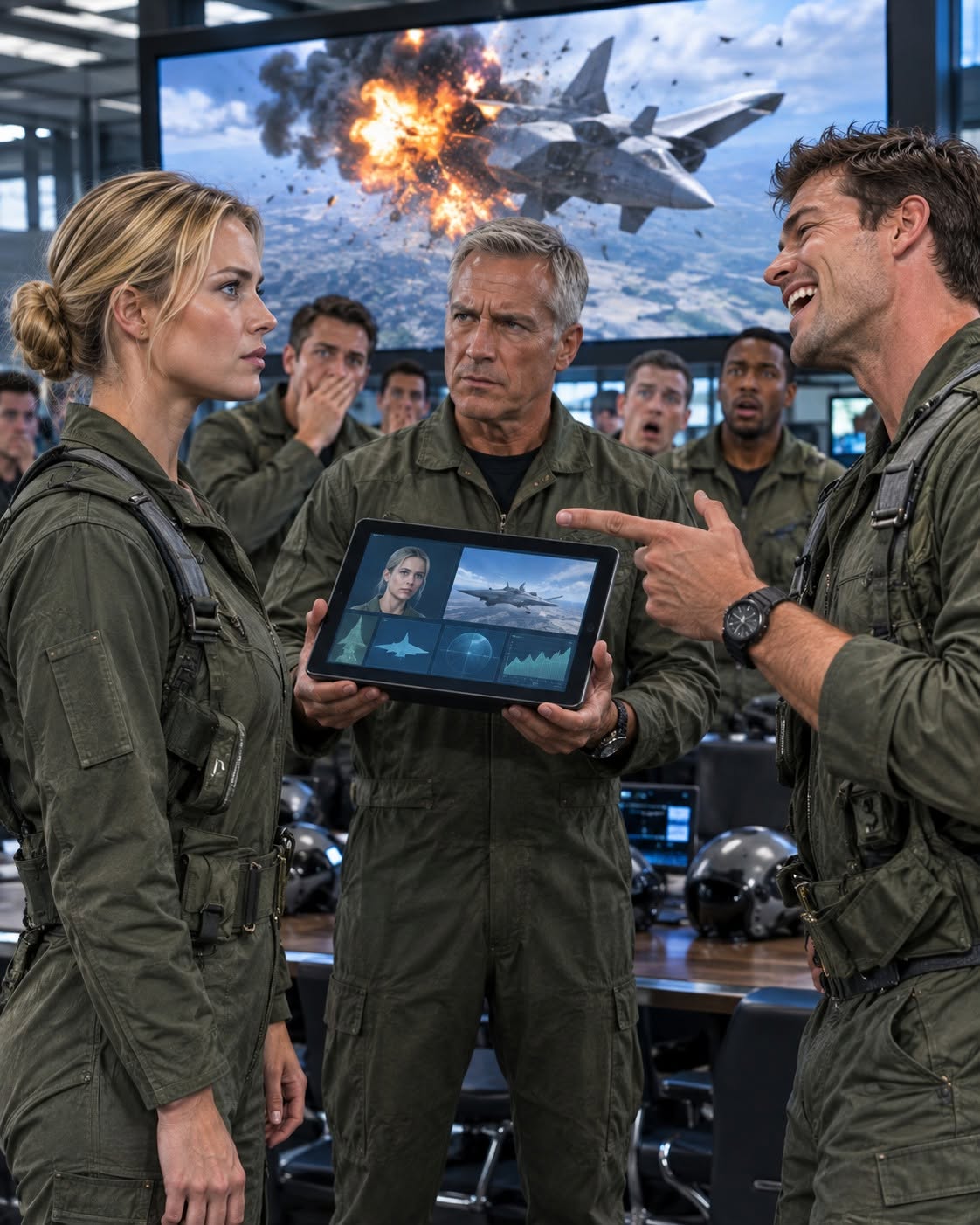
“Colonel, I think that’s enough.”
Hayes looked at me.
For the first time that morning, he didn’t sound like my commanding officer.
He sounded like someone who had been carrying a burden for far too long.
“Not yet, Carter. They deserve to know why you made that decision in the simulator.”
He turned to the final page.
“Especially because the man who ordered you to abandon that ground unit is sitting in this room.”
Silence.
Ryan slowly turned toward the colonel.
“What?”
Hayes placed the document on the table.
The signature at the bottom belonged to Brigadier General Thomas Whitaker, the former commander of the operation.
And beside it was another signature.
Captain Ryan Mitchell.
Ryan went completely pale.
I could hear the air-conditioning humming above us.
For a moment, I wondered whether I had somehow returned to that desert battlefield, where the radio had crackled with orders nobody wanted to hear.
Then Ryan stood abruptly.
“That’s impossible.”
Hayes didn’t blink.
“Is it?”
Ryan shook his head.
“I wasn’t a combat pilot during Silent Horizon. I was working in tactical coordination.”
“Correct,” Hayes replied. “You were assigned to the forward operations command center.”
Ryan’s eyes moved toward me.
“What does he have to do with this?”
I finally spoke.
“Everything.”
Three years earlier, I hadn’t been the quiet pilot sitting at the end of a briefing table.
I had been Lieutenant Daniel Carter, flying an older strike aircraft with a small unit tasked with supporting an American reconnaissance team.
The mission was supposed to last less than forty minutes.
Our ground team consisted of seventeen personnel operating near an abandoned communications facility. Their task was to recover a piece of intelligence equipment before enemy forces discovered their location.
Everything went wrong when the enemy intercepted their transmission.
Suddenly, the extraction route was compromised.
Their vehicles were disabled.
Their position was surrounded.
And the enemy had brought mobile missile systems into the area.
I was the only aircraft close enough to help.
I remember the radio call as clearly as if it had happened yesterday.
“Viper One, this is Ground Actual. We have wounded personnel. Request immediate cover. We cannot move.”
I looked at the tactical display.
Three enemy vehicles were approaching their position.
A fourth was setting up a missile launcher.
I had enough fuel for one more attack.
Then headquarters transmitted an order.
“Viper One, disengage immediately. Return to base. Further engagement is not authorized.”
I remember staring at the ground team’s position.
“Ground Actual, confirm your status.”
The response came through with static.
“Viper One, we have seventeen people here. Please don’t leave us.”
I requested permission to remain.
Denied.
I requested a revised extraction route.
Denied.
Then I heard another voice on the command frequency.
It was the tactical coordinator.
Captain Ryan Mitchell.
His voice was calm, almost bored.
“Viper One, you’re risking an aircraft for a situation that is already lost. Follow your orders and disengage.”
I had never met him.
I didn’t know his face.
I only knew his voice.
And I remembered it.
The ground team transmitted again.
This time, a young sergeant was speaking.
“Tell my wife I tried.”
Something inside me went cold.
I looked at the enemy radar positions.
Then I saw an opportunity.
The enemy missile systems were tracking my aircraft because I was the only threat in the sky. If I descended toward their position, they would focus on me instead of the ground team.
It was dangerous.
It was against the disengagement order.
And it would probably cost me my aircraft.
But it might give seventeen people enough time to escape.
I made the decision.
I switched to the emergency frequency.
“Ground Actual, this is Viper One. When I say move, you move. Do not wait for another instruction.”
Then I turned toward the enemy.
Missile warnings filled my cockpit.
The aircraft shook violently.
I descended lower, forcing the enemy systems to redirect their attention toward me.
One missile passed close enough to damage the left engine.
Another struck the rear section.
Warning lights flashed across the instrument panel.
I could barely keep the aircraft level.
But the ground team was moving.
“Viper One, we’re clear of the eastern ridge!”
I remember smiling.
Just a little.
“Copy that, Ground Actual. Keep moving.”
Then the aircraft began to lose power.
I knew I wouldn’t make it back.
I ejected seconds before impact.
The parachute opened over hostile territory.
I landed hard, injured my shoulder, and spent the next several hours avoiding enemy patrols before a rescue team reached me.
I survived.
The aircraft didn’t.
And neither did the official story.
According to the report, I had violated operational orders and unnecessarily endangered a military asset.
The ground team’s successful extraction was attributed to favorable circumstances and the actions of another support unit.
I was awarded a classified commendation, but the citation was heavily restricted.
I was told never to discuss the details.
I agreed.
Not because I was afraid.
Because the people I had saved deserved to return home without their identities becoming public.
But there was one thing I had never understood.
Why had Ryan signed the order that condemned the ground team?
Back in the briefing room, Colonel Hayes turned toward him.
“Would you like to explain?”
Ryan’s jaw tightened.
“I was following General Whitaker’s instructions. The intelligence indicated the ground team had already been compromised.”
“That wasn’t the question.”
“I was responsible for the tactical picture. I made the best decision with the information available.”
I studied his face.
He looked older than he had an hour earlier.
“Did you know we were still alive?” I asked.
Ryan didn’t answer.
“Did you know we were moving?”
Still nothing.
I leaned forward.
“Did you hear the sergeant on the radio?”
Ryan looked away.
Colonel Hayes opened another section of the folder.
“Captain Mitchell, the review board recovered the original communications logs six months ago. They show that you received three separate updates confirming the ground team was still alive.”
Ryan swallowed.
“The intelligence feed was unreliable.”
“Then why did you recommend abandoning them?”
Ryan slammed his hand against the table.
“Because we were losing aircraft! Because the entire operation was falling apart! I had a hundred people depending on my decisions, not just seventeen soldiers on the ground!”
His voice echoed through the room.
For the first time, I saw something beneath his arrogance.
Fear.
He had spent three years building a reputation as a decisive officer. He had been promoted, praised, and trusted with responsibility.
But he had never told anyone what happened that night.
Hayes placed another document in front of him.
“There’s a second reason your name appears in this investigation.”
Ryan looked down.
His expression changed immediately.
The document contained an email exchange from the night of the operation.
One message had been sent eleven minutes after my aircraft crashed.
It read:
“Recommend classifying the loss as pilot deviation. Ground personnel survival should not be included in the operational assessment until intelligence sources are secured.”
The message was signed by Ryan.
But underneath it was a reply from General Whitaker.
“Agreed. Maintain current reporting structure. No further discussion.”
Nobody spoke.
Ryan stared at the page.
Then he whispered, “I was protecting the operation.”
Hayes shook his head.
“No. You were protecting the report.”
That sentence landed harder than anything else.
I had spent three years believing I was the only person in that operation who remembered the truth.
Now I understood that someone else had remembered it too.
He had simply chosen to bury it.
Ryan looked at me.
“Why didn’t you tell anyone?”
I considered the question.
Because there had been nights when I wanted to.
Because I had spent months waking up to the sound of missile warnings that weren’t there.
Because I had watched my fellow pilots laugh when I hesitated during training exercises, and every time I opened my mouth to explain, I remembered the classified briefing where I had been ordered to remain silent.
But none of those were the real answer.
“Because the people I brought home were more important than my reputation.”
Ryan looked down.
For several seconds, the room remained completely still.
Then a voice came from the back.
“Captain Carter?”
It was Lieutenant Mason, one of the youngest pilots in the squadron.
He had barely spoken during the entire meeting.
“Is it true that the ground team all survived?”
I nodded.
“All seventeen?”
“All seventeen.”
Mason looked at the burned challenge coin.
“Then why does that coin look like that?”
I reached toward it.
The metal was darkened, its edges worn and uneven.
I picked it up carefully.
“It belonged to Sergeant First Class Daniel Brooks. He was the ground team’s leader.”
I turned it over.
There was a small inscription on the back.
SEVENTEEN HOME.
“Brooks gave it to me when I visited him at the hospital,” I explained. “He said I should keep it until I stopped blaming myself for losing the aircraft.”
My voice caught slightly.
“He died last year.”
Mason lowered his eyes.
“How?”
“Complications from injuries he sustained during the operation.”
I turned the coin over again.
“He survived the battlefield. He made it home. But he never got to live the life he had planned.”
Nobody knew what to say.
I placed the coin back beside the folder.
“That’s why I don’t celebrate that mission. I did what I thought was necessary. But I lost a friend, and I lost an aircraft. There was nothing glorious about it.”
Colonel Hayes watched me quietly.
Then he turned toward the squadron.
“Let me make something clear. Courage isn’t measured by how many missions you complete without taking damage. And it certainly isn’t measured by how loudly you criticize someone else’s decisions.”
His eyes settled on Ryan.
“Leadership is about accepting responsibility when the consequences are uncomfortable.”
Ryan remained standing.
His hands were trembling.
“Sir, I understand.”
Hayes shook his head.
“I don’t think you do. Not yet.”
He closed the folder.
“Captain Mitchell, you are relieved of your training leadership duties pending a formal investigation. Your access to the classified operational review will be handled through the appropriate channels.”
Two security officers waiting outside the room entered.
Ryan looked around as if expecting someone to defend him.
Nobody did.
As he passed my chair, he stopped.
For a moment, I thought he might apologize.
Instead, he said quietly, “You could have told me.”
I looked up.
“I tried.”
He frowned.
“When?”
“Every time you asked why I hated losing an aircraft. Every time you called me a coward for refusing to take unnecessary risks. Every time you laughed about that mission.”
He had no answer.
Then he walked out.
The door closed behind him.
And somehow, that sound was louder than all the laughter from earlier.
The meeting ended twenty minutes later.
Most of the pilots left without speaking.
A few approached me, offering awkward apologies.
I accepted them, but I didn’t pretend everything had suddenly changed.
Respect isn’t something that appears because a folder is opened.
It has to be earned through actions.
As I was leaving, Colonel Hayes called me back.
“Carter. Stay a moment.”
I turned.
He was standing beside the window, holding the challenge coin.
“I should have done this sooner,” he said.
“Sir?”
“I knew about the original investigation. I reviewed the classified report when I took command here. I recognized your name immediately.”
I waited.
“Then why didn’t you say anything?”
He looked down at the coin.
“Because I was waiting for the proper review process. I convinced myself that keeping quiet was the safest option.”
He paused.
“But I watched what happened to you in this squadron. I watched people question your judgment without understanding what you had been through. And I let it continue.”
For the first time, the colonel looked genuinely ashamed.
“I failed you.”
I shook my head.
“You didn’t make the decision in that cockpit, sir.”
“No. But I had a responsibility to make sure the truth wasn’t used against you.”
He placed the coin in my hand.
“I think this belongs with you.”
I closed my fingers around it.
“Sergeant Brooks gave it to me.”
“And now I’m giving it back.”
I looked at him.
He smiled faintly.
“Maybe it’s time you stopped carrying the weight alone.”
I didn’t have an answer.
So I simply nodded.
The following weeks were difficult.
The investigation into Silent Horizon reopened, and several retired officers were interviewed.
The original mission recordings were recovered.
The seventeen members of the ground team were contacted.
Some were living quiet lives.
Some had left the military.
One was working as a firefighter.
Another had become a high school teacher.
And one, Sergeant Brooks’s younger brother, was still serving.
His name was Michael.
He requested a meeting with me.
We met at a small restaurant outside the base.
When he arrived, he carried a photograph.
It showed seventeen soldiers standing together in front of a military vehicle.
I recognized every face.
Brooks was in the middle, smiling with his arms around two other men.
Michael slid the photograph across the table.
“My brother talked about you.”
I looked at the picture.
“He did?”
“All the time.”
Michael smiled.
“He said there was this stubborn pilot who refused to leave them behind.”
I swallowed.
“He was the stubborn one.”
Michael laughed softly.
“That’s what he said about you.”
Then he reached into his jacket and removed a small envelope.
“My brother wrote this before he died. He asked me to give it to you if I ever found you.”
My hands felt strangely heavy as I opened it.
Inside was a handwritten note.
Daniel,
If you’re reading this, I hope you’ve finally stopped looking at that missing aircraft as something you failed to bring home.
You brought something more important home that night.
Seventeen people.
I know you still remember the sound of that last radio transmission. I remember it too. But I also remember hearing your voice telling us to move.
You didn’t promise us that everything would be okay.
You just gave us a chance.
That’s all any of us could ask.
Don’t spend the rest of your life punishing yourself for making a choice that allowed us to keep ours.
Tell the young pilots what happened.
Not so they’ll think you’re a hero.
So they’ll understand that the person on the other end of the radio is never just a symbol on a screen.
They’re someone’s father.
Someone’s brother.
Someone’s friend.
And sometimes, they’re the reason you get to go home.
Brooks.
I read the letter twice.
Then a third time.
By the time I reached the last line, my eyes were burning.
Michael waited without speaking.
Finally, I folded the paper carefully.
“Thank you,” I whispered.
He nodded.
“He wanted you to have that.”
I looked through the restaurant window at the passing traffic.
For three years, I had carried the memory of that mission like a punishment.
Now, for the first time, I wondered whether I could carry it as something else.
A responsibility.
A reminder.
A reason to become a better pilot.
When I returned to base, the investigation had already begun changing things.
The squadron introduced a new debriefing policy.
Every failed simulation would be examined for decision-making, not simply its final outcome.
Pilots were encouraged to explain their reasoning without fear of humiliation.
Mistakes would still be challenged.
Bad decisions would still have consequences.
But nobody would be allowed to confuse public embarrassment with professional instruction.
Colonel Hayes also asked me to take over a portion of the advanced tactical training program.
I initially refused.
“Sir, I’m not sure I’m the right person.”
He raised an eyebrow.
“Why not?”
“Because I don’t want the younger pilots thinking the lesson is to ignore orders and sacrifice their aircraft.”
Hayes smiled.
“Good. That means you’re exactly the person I want teaching them.”
He leaned back.
“Tell them the truth. There are situations where following an order is essential. There are situations where asking for clarification is necessary. And there are situations where leadership means recognizing that the information you’re receiving is incomplete.”
He paused.
“Teach them to think. Don’t teach them to imitate you.”
I accepted.
My first class began on a Monday morning.
Twenty-four pilots sat in front of me.
Some were experienced.
Others were barely out of training.
A few looked nervous.
I recognized the expression.
It was the same one I had worn during my first month at the squadron.
I displayed the recording of my simulator mission.
The aircraft descended toward enemy fire.
The warning systems activated.
The simulated missile struck.
The screen went black.
A young pilot raised his hand.
“Sir, why didn’t you pull away?”
I looked at the frozen screen.
“Because there were people below who needed time.”
“But you knew the aircraft was going to be destroyed?”
“I knew there was a significant possibility.”
“Then why take the risk?”
I turned toward the class.
“That’s the question you should ask. But you shouldn’t stop there.”
I walked to the screen.
“What information did I have? What information was missing? What alternatives existed? What were the consequences of each decision?”
I looked at the pilots one by one.
“Never confuse bravery with recklessness. And never confuse survival with success. Your responsibility is to understand the mission, protect the people involved, and make the best decision you can with the information available.”
I paused.
“And if you make the wrong decision, own it. Learn from it. Don’t hide behind your rank.”
The room remained quiet.
Then someone in the back raised a hand.
It was Ryan.
He had returned to the squadron after completing his initial investigation interviews. He was no longer in charge of training, and his future assignment remained under review.
His expression was different.
No grin.
No sarcasm.
Just a tired man trying to find the right words.
“Captain Carter, may I ask something?”
I nodded.
“When you heard the ground team on the radio that night, were you afraid?”
The question surprised me.
I looked at the photograph I had placed beside the simulator console.
It showed Brooks and the other sixteen soldiers.
“Yes,” I answered.
Ryan looked down.
“I was afraid too.”
“I know.”
He looked up.
“That’s not an excuse.”
“No,” I said. “It isn’t.”
For a moment, neither of us spoke.
Then he continued.
“I’ve submitted a full statement to the review board. I included the messages I sent and the decisions I made. I can’t undo what happened, but I won’t pretend I wasn’t responsible anymore.”
I studied him.
“Why now?”
He took a long breath.
“Because I finally understood something. I spent three years convincing myself that I had protected the mission. But every time I looked at that report, I remembered that seventeen people had survived despite my decision, not because of it.”
His voice weakened.
“I was afraid that if I admitted the truth, everyone would know I wasn’t the leader I claimed to be.”
I nodded slowly.
“Maybe admitting it is where you start becoming one.”
Ryan didn’t ask me to forgive him.
I respected him for that.
The class continued.
At the end, the pilots left in small groups, discussing the exercise.
Ryan remained behind.
He approached the photograph.
“Is that Sergeant Brooks?”
“Yes.”
“He looks happy.”
“He was.”
Ryan stared at the photograph for a long time.
Then he said something I hadn’t expected.
“I’d like to meet his family someday. If they’d allow it.”
I looked at him.
“That’s something you’ll have to ask them.”
He nodded.
And for the first time, I believed he might actually do it.
Six months later, the final review of Operation Silent Horizon was completed.
The findings were not released publicly in full, but the official record was amended.
The ground team’s survival was formally attributed to the air-support actions taken by Lieutenant Daniel Carter.
The report also acknowledged serious failures in command communication and decision-making.
General Whitaker was removed from his advisory position.
Ryan received a formal reprimand and was reassigned after completing additional leadership review.
He would not return to his former training role.
I received an amended citation.
There was no grand ceremony.
No television cameras.
No dramatic speech.
Just a small gathering on the base, where Colonel Hayes read the corrected record.
When he finished, he handed me a framed copy.
I looked at the words.
For three years, I had thought I needed that document to prove that I wasn’t a failure.
Now, holding it in my hands, I realized something.
The truth hadn’t changed.
The seventeen people had survived whether anyone acknowledged my actions or not.
Brooks had mattered whether his name appeared in a report or not.
And my decision had carried its consequences long before anyone opened that folder.
That evening, I visited the memorial wall outside the base.
I placed the burned challenge coin beneath the photograph of Sergeant Brooks.
A small plaque had recently been added beside his name.
It listed the seventeen members of the team who had made it home.
I stood there for several minutes.
Then I heard footsteps behind me.
It was Colonel Hayes.
“Thought I’d find you here.”
I nodded.
He looked at the memorial.
“Do you regret it?”
I knew exactly what he meant.
I thought about the aircraft.
The damaged engine.
The warning lights.
The moment I had made the decision.
Then I thought about Brooks’s letter.
“No, sir. I regret that we were put in that position. I regret that Brooks never got to come home completely healthy. I regret that the people making decisions never understood what was happening on the ground.”
I paused.
“But I don’t regret giving them a chance.”
Hayes nodded.
“That’s a difficult distinction.”
“It took me three years to understand it.”
We stood quietly as the desert sun disappeared beyond the horizon.
The next morning, I received an unexpected message.
It was from Michael Brooks.
He had attached a photograph of his brother’s old flight jacket.
Underneath it, he had written:
My brother’s daughter starts flight school next month. She says she wants to fly because of the stories her father told her about the people who protected him.
I thought you’d like to know.
I read the message twice.
Then I smiled.
For the first time in years, I felt something close to peace.
Not because the past had been repaired.
It hadn’t.
Not because everyone had apologized.
They hadn’t.
But because the story of that night was no longer buried beneath a classified report and a collection of signatures.
It belonged to the people who had lived it.
And it could finally teach something worth remembering.
A week later, I returned to the simulator.
The same aircraft model.
The same desert terrain.
The same simulated ground unit trapped beneath enemy fire.
This time, twenty-four young pilots watched from the observation room.
I climbed into the seat and secured my helmet.
The instructor’s voice came through the headset.
“Captain Carter, your mission parameters are loaded. Are you ready?”
I looked at the challenge coin resting beside the console.
SEVENTEEN HOME.
I touched it once.
“Ready.”
The simulation began.
Enemy radar appeared.
The ground unit requested assistance.
And somewhere in the back of my mind, I could almost hear Brooks laughing over the radio.
But this time, I didn’t fly the same mission.
I assessed the available routes.
I coordinated with the support aircraft.
I requested updated intelligence.
I identified a safer approach and directed the ground unit toward a viable extraction corridor.
No unnecessary sacrifice.
No dramatic crash.
No attempt to prove anything.
The mission ended with the entire team extracted and the aircraft safely back at base.
When I removed my helmet, the observation room was quiet.
One of the younger pilots approached.
“Sir, I thought you were going to make the same decision as last time.”
I smiled.
“Why would I?”
“Because that’s what made you famous.”
I looked at him carefully.
“Son, the point of remembering a mistake isn’t to repeat it.”
He nodded.
I continued.
“That day, I made the best decision I could with the information I had. Today, I had better information and better options. A good pilot learns the difference.”
The young man considered that.
Then he asked, “So what makes someone a real fighter pilot?”
I glanced toward the simulator screen.
For years, I had heard people define that title through speed, accuracy, confidence, and the ability to bring an aircraft home.
Those things mattered.
But they weren’t the whole answer.
“A real fighter pilot understands that the aircraft is a tool, the mission is a responsibility, and the people involved are never expendable numbers on a screen.”
I picked up the challenge coin.
“And the best pilots aren’t the ones who never make mistakes. They’re the ones who have the courage to examine them, learn from them, and make sure the next person doesn’t have to pay for the same mistake.”
The young pilot nodded.
As I walked out of the simulator building, I passed the briefing room where everything had started.
The door was open.
Inside, a new group of pilots were gathering around a screen.
Someone had written a sentence across the whiteboard:
NEVER JUDGE A DECISION UNTIL YOU UNDERSTAND THE INFORMATION, THE PEOPLE, AND THE COST BEHIND IT.
I stopped for a moment.
Then I continued down the hallway.
I no longer needed the squadron to know what I had done three years earlier.
I no longer needed Ryan Mitchell to respect me.
And I no longer needed a classified folder to remind me that I had once been a capable pilot.
Because the greatest lesson of Silent Horizon had never been about the aircraft I lost.
It was about the seventeen people who made it home.
And the one man who never stopped believing they deserved that chance.
Somewhere, a little girl was preparing for her first flight lesson, carrying stories about a father who had survived because someone refused to abandon him.
That was enough.
More than enough.
I slipped the challenge coin into my pocket and stepped into the desert sunlight.
Behind me, the simulator hummed to life.
Ahead of me, another generation of pilots was learning what it meant to lead.
And this time, they would know something I had learned the hardest possible way:
A uniform may give you authority. A rank may give you responsibility. But neither will ever make you a true leader unless you remember the human lives behind every decision.
The mission isn’t always about bringing the aircraft home.
Sometimes, it’s about making sure the people below get to go home instead.