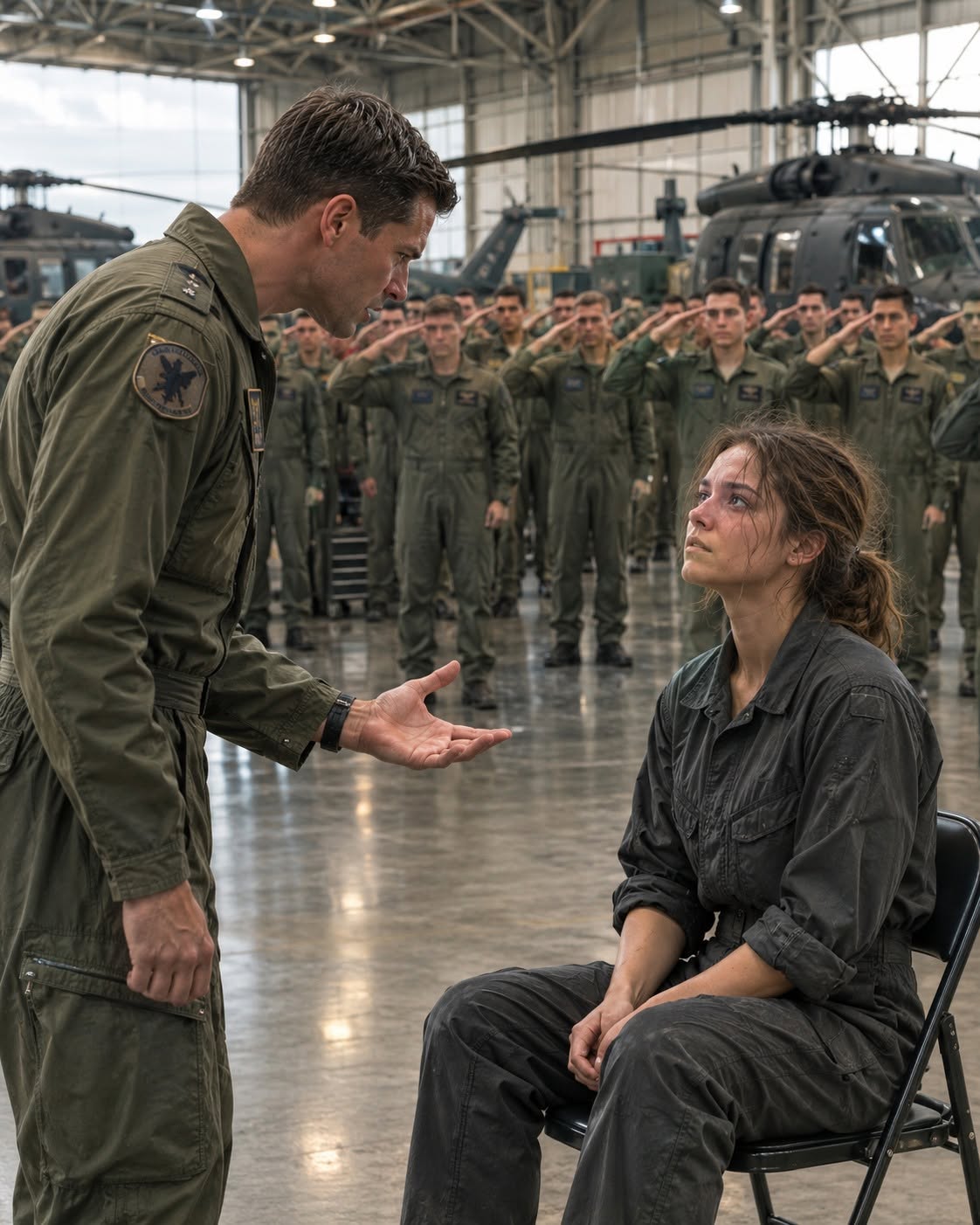
The entire briefing room burst into laughter when I told the woman in the gray maintenance jumpsuit that she was sitting in the wrong place
For a moment, I thought she was about to show me another page from her service record. Instead, she unfolded a faded tactical map covered in handwritten markings, red circles, and several notes written in a language of military abbreviations I hadn’t seen in years.
“Do you recognize this corridor?” she asked.
I leaned closer.
It was the eastern corridor from my training exercise.
“Of course,” I replied. “That’s the route we used today.”
She shook her head.
“No, Colonel. That’s the route someone wanted you to use.”
I looked at her sharply.
“What exactly are you suggesting?”
Diana placed her finger on a small section of the map, just beyond the simulated strike zone.
“Your exercise wasn’t simply difficult. It was built around a tactical vulnerability that should never have existed in the first place.”
I studied the markings. At first, they looked like ordinary planning notes. Then I noticed something disturbing. The coordinates matched the exact point where our formation had nearly collapsed during the simulation.
“Where did you get this?”
“From the original Iron Veil mission files.”
I stared at her.
“Those files are classified.”
“Exactly.”
She folded the map carefully.
“Which is why I think you should listen before you dismiss what I’m about to tell you.”
I had spent twenty-six years in military aviation. I had trained hundreds of pilots, participated in combat operations, and watched young officers make mistakes that could have cost lives. I believed I could recognize danger before it became a crisis.
But standing beside that woman, I suddenly felt like a student again.
“Start from the beginning,” I said.
Diana looked toward the distant hangars.
“Three weeks ago, someone accessed the original Iron Veil tactical archive. They downloaded an outdated version of our flight coordination protocol. That version contains a flaw that was discovered during the operation but never released into general training materials.”
My stomach tightened.
“And you think someone inserted it into my exercise?”
“I don’t think. I know.”
She handed me the folded document.
It was a printed access report containing a series of authorization records. Several entries had been highlighted in yellow.
One belonged to a contractor responsible for maintaining our simulation systems.
Another belonged to a senior training officer.
The third name made my blood run cold.
Major General Robert Harlan.
He was the director of our entire training center.
I looked at Diana.
“Are you telling me the general is involved?”
“I’m telling you that his credentials were used to authorize the changes. Whether he approved them himself is something we still need to establish.”
I wanted to reject the accusation immediately. Harlan had been my commanding officer for nearly eight years. He had recommended me for instructor duty and personally approved my promotion.
But the evidence in my hands was difficult to ignore.
“Why didn’t you report this directly?”
“I did.”
“To whom?”
“Your general.”
She paused.
“He told me the records were inconclusive and advised me to stop investigating.”
A cold wind swept across the tarmac.
“Then why come here?”
“Because your candidates nearly repeated the same mistake that killed three aircraft during Iron Veil.”
I looked at the map again.
Three aircraft.
Her words hung in the air.
“What happened on that mission?”
For the first time since I had met her, Diana’s expression changed. The calm confidence in her eyes gave way to something older, something painful.
“That mission was supposed to be routine.”
She took a breath.
“Fourteen aircraft entered the operational corridor under rapidly deteriorating weather conditions. Our command network began receiving conflicting position updates. Two aircraft were ordered to turn north while another group received instructions to maintain its original heading.”
“That sounds like a communication failure.”
“It was. But not the kind you think.”
She pointed at a red circle on the map.
“Our navigation feeds were delayed. The system displayed aircraft positions several seconds behind their actual locations. Under normal circumstances, that delay was manageable. Under extreme conditions, it became deadly.”
I remembered the chaos in the simulation.
Conflicting instructions. Delayed responses. Pilots trying to correct positions using information that was already outdated.
The same pattern.
“How did you get fourteen aircraft out of there?”
“I stopped treating the central display as the only source of truth. I listened to the pilots, compared independent reports, and rebuilt our shared understanding of the situation.”
She looked directly at me.
“Sometimes the most dangerous thing in a command room isn’t a bad decision. It’s the assumption that the information everyone is looking at must be correct.”
I didn’t answer.
Before I could ask another question, my radio crackled.
“Colonel, report to the command center immediately. General Harlan is requesting your presence.”
I glanced at Diana.
She had already folded the document.
“He’s heard about this conversation,” she said.
“How could he?”
“Because someone has been watching the archive access records.”
I keyed my radio.
“Understood. I’m on my way.”
Then I turned toward her.
“Come with me.”
She shook her head.
“Not yet. If we walk in together, he’ll know exactly what we’ve found.”
“Then what do you suggest?”
She slipped the map into my hand.
“Go in there as the instructor who made a mistake. Let him believe you’re still trying to understand what happened.”
“And you?”
“I’ll find out who changed the simulation.”
She started walking toward the hangars.
I watched her disappear between two parked helicopters, wondering how someone I had mistaken for maintenance staff could understand the machinery of command better than almost everyone I knew.
When I entered the command center, General Harlan was waiting beside the main operations display.
He wasn’t alone.
Two intelligence officers stood behind him, along with the civilian contractor whose name appeared in Diana’s report.
“Colonel,” Harlan said, “I understand today’s exercise experienced some technical irregularities.”
“More than irregularities, sir.”
“Your candidates lost formation.”
“Because the simulation provided contradictory information.”
The general folded his arms.
“That is an interesting interpretation.”
I placed the printed access report on the table.
“Someone modified the Iron Veil coordination protocol.”
The room became quiet.
The contractor shifted uncomfortably.
Harlan didn’t even look at the document.
“Those files were used for historical training research.”
“Without the correction notes?”
“Those notes were considered unnecessary for the exercise.”
“Three aircraft were lost because of that flaw.”
“Twenty years ago,” he replied coldly. “We’re not discussing a combat operation. We’re discussing a training exercise.”
I felt anger rising inside me.
“With respect, sir, our pilots were placed in a situation where they couldn’t trust their own instruments.”
Harlan stepped closer.
“Your job was to train them, not question the system.”
That sentence told me more than he intended.
I glanced at the intelligence officers.
“Have you reviewed the access records?”
One of them looked at Harlan before answering.
“We’re conducting an internal review.”
The general picked up the document.
“I’ll take this from here.”
I hesitated.
“Sir, I believe Chief Warrant Officer Diana should be included in the investigation.”
His expression changed.
Only slightly, but enough.
“Diana is not assigned to this facility.”
“She has direct operational experience with the protocol.”
“Her involvement is unnecessary.”
The contractor suddenly spoke.
“Actually, General, she may have already accessed the secondary archive.”
Everyone turned toward him.
Harlan’s face hardened.
“Explain.”
The contractor swallowed.
“The original Iron Veil files were stored in two separate systems. One was used for training development. The other contained the final mission debriefings. Someone attempted to access the second archive yesterday.”
“Who?” I asked.
The contractor looked at his tablet.
“The request was submitted under Colonel Mason’s authorization.”
My name.
For several seconds, I couldn’t speak.
“I never accessed that archive.”
The general slowly turned toward me.
“Then perhaps you should explain why your credentials were used.”
Before I could respond, one of the intelligence officers received a message.
He read it twice.
Then he looked up.
“Sir, we’ve got a problem.”
Harlan turned.
“What now?”
“The simulation server recorded another unauthorized access attempt. It’s happening right now.”
The contractor grabbed his tablet.
“That’s impossible. We locked the system after the exercise.”
“Apparently not,” the intelligence officer replied.
A second message appeared.
Then another.
The main display flickered.
A warning appeared across the screen.UNAUTHORIZED ARCHIVE TRANSFER IN PROGRESSThe contractor went pale.
“Someone is copying the original mission files.”
Harlan immediately ordered the room secured.
“Disconnect the external network.”
The technician moved toward the control console.
“Sir, the transfer is coming from an internal terminal.”
“Find it!”
The room erupted into activity.
I looked at the access report, then at the system display.
The transfer was moving through a training network that should have been isolated from classified records.
Someone had built a bridge between the two systems.
And whoever was doing it knew exactly how our security procedures worked.
I reached for my radio.
“Diana, do you copy?”
Static.
I tried again.
“Diana, this is Mason. We have an active breach.”
Her voice finally came through.
“I know.”
I froze.
“Where are you?”
“Hangar three.”
“What are you doing there?”
“Looking at something that shouldn’t be there.”
I heard metal clatter in the background.
Then she said something that made my heart race.
“Colonel, you need to get everyone away from the command network. The breach isn’t coming from the archive.”
“Then where?”
“The simulation itself.”
The connection ended.
I turned toward the technician.
“Shut down the training simulation.”
He hesitated.
“General, we need authorization.”
Harlan stepped forward.
“Nobody touches that system until I say so.”
I looked at him.
“Sir, if Diana is correct, we’re allowing the breach to continue.”
“Colonel, stand down.”
For the first time in my career, I openly disobeyed a direct instruction from a superior officer.
“Technician, isolate the simulation servers. Now.”
He looked at Harlan.
Then at me.
Finally, he reached for the controls.
The screens went dark.
A few seconds later, the warning disappeared.
The transfer had stopped.
But something else appeared on the security monitor.
A single internal terminal remained active.
Its location was displayed in red.
Hangar three.
I looked at the general.
“Sir, I believe we should find out who’s there.”
He didn’t answer.
Instead, he ordered the intelligence officers to accompany him.
I followed.
The walk to Hangar Three felt longer than it should have.
The facility was unusually quiet. Most of the evening maintenance crews had already gone home. Only the distant hum of ventilation systems could be heard.
As we entered the hangar, I spotted Diana standing beside a maintenance workstation.
Her gray jumpsuit was slightly stained with grease. A small flashlight rested on the table.
But she wasn’t alone.
A young civilian technician was sitting on the floor with his hands visible.
The contractor from the command center stopped walking.
“Oh, no.”
Diana turned toward us.
“You’re late.”
Harlan stepped forward.
“Chief Warrant Officer, what exactly are you doing here?”
“Stopping someone from making a very expensive mistake.”
She pointed at the workstation.
On the screen was a list of recent system commands.
The contractor approached slowly.
“That’s my terminal.”
Diana nodded.
“Your credentials were used to initiate the archive transfer.”
“I didn’t do that.”
“Perhaps not personally.”
She turned toward the young technician.
“Tell them what you told me.”
The technician looked terrified.
“I was instructed to install a diagnostic package two days ago. I was told it was part of the general’s modernization project.”
Harlan’s face darkened.
“Who instructed you?”
The young man hesitated.
Then he pointed at the contractor.
“He gave me the files.”
The contractor immediately shook his head.
“That’s a lie.”
Diana opened a folder on the workstation.
Inside were several authorization documents, email records, and a series of digital signatures.
“These records show that someone used the contractor’s credentials to access the simulation network. The same credentials were used to install the diagnostic package.”
She paused.
“But the package was not designed to improve the simulation.”
She opened another file.
It contained an internal report titled IRON VEIL: OPERATIONAL FAILURE ANALYSIS.
I recognized the document immediately.
It was the report Diana had shown me on the tarmac.
Only this version contained additional pages.
The final section described an internal investigation into the original mission.
One paragraph had been highlighted.
The report concluded that the three aircraft lost during Iron Veil had not been victims of unavoidable technical failure. Their positions had been deliberately misrepresented by an unauthorized command update.
I felt the room tilt.
“Someone deliberately caused the communication failure?”
Diana nodded.
“We discovered the manipulation after the operation. But the person responsible was never identified publicly.”
Harlan took a step forward.
“That’s enough.”
Diana didn’t move.
“Is it?”
The general’s voice became sharper.
“You’re making accusations based on incomplete records.”
“Then perhaps you can explain why your authorization credentials were used to reopen the archived investigation.”
Silence.
I looked at Harlan.
“Sir?”
For several seconds, he said nothing.
Then he gave a tired sigh.
“You don’t understand what you’re looking at.”
“Then help us understand.”
He glanced toward the intelligence officers.
“Dismiss the civilian personnel.”
Nobody moved.
Harlan’s eyes narrowed.
“That was an order.”
One of the intelligence officers stepped forward.
“General, we’re going to need you to remain here while we verify these records.”
The general stared at him.
“You have no authority to detain me.”
“We’re not detaining you, sir. We’re preserving the scene.”
Diana finally spoke again.
“There’s one more thing.”
She opened a recording file.
The date on the screen was nearly twenty years old.
The recording came from the original Iron Veil mission.
At first, all we heard was radio static.
Then a man’s voice emerged.
“All units, adjust to the northern corridor. Repeat, all units adjust north.”
Another voice responded.
“Negative. Our instruments indicate the southern corridor is clear.”
The first voice returned.
“Ignore your instruments. Follow command.”
Diana closed her eyes.
“I remember that transmission.”
The recording continued.
A third voice broke through.
“Command, your coordinates are inconsistent. We have visual confirmation that the northern corridor is blocked.”
There was a brief pause.
Then the original voice replied.
“Maintain the order.”
The recording ended with a sudden burst of static.
I looked at Diana.
“Whose voice was that?”
She didn’t answer immediately.
Then she looked at Harlan.
“His.”
The room went completely still.
General Harlan’s face had lost its color.
I stared at him.
“You were the command officer?”
“I was a major at the time.”
“Why were you giving those instructions?”
Harlan’s jaw tightened.
“The mission was under extreme pressure. We had conflicting intelligence, deteriorating weather, and an unstable communication network. I made the best decision available.”
Diana stepped closer.
“You were warned that the northern corridor was blocked.”
“I was receiving information from headquarters.”
“And you ignored the pilots who were actually flying through it.”
“I had command responsibility!”
“Three aircraft went down.”
Her voice remained quiet, but every word carried the weight of twenty years.
“Three families received folded flags because someone believed his authority was more important than the truth.”
Harlan looked away.
For a moment, I thought he might finally admit what had happened.
Instead, he pointed at Diana.
“She was responsible for that mission’s final flight coordination. She made changes without authorization.”
Diana didn’t flinch.
“Yes. I did.”
The general looked almost triumphant.
“Then you admit it.”
“I admit that I stopped following your orders when I realized they were sending more aircraft into a blocked corridor.”
She placed another document on the table.
“This is the final mission transcript. It shows that I switched our formation to an independently verified navigation reference after command information became unreliable. I got eleven aircraft out safely. Three were already lost before I could reach them.”
Her voice broke slightly.
“And I spent the next twenty years wondering whether I could have saved them sooner.”
No one spoke.
I looked down at the report.
A signature appeared at the bottom.
It belonged to Diana.
But beside it was another signature.
Robert Harlan.
His approval was attached to a statement claiming that the navigation failure had been unavoidable.
He had signed it.
He had helped bury the truth.
And now he had brought the same flawed protocol into my training center.
“Why?” I asked.
Harlan looked at me.
“Because the original report threatened to destroy careers, reputations, and the entire command structure responsible for that operation.”
“That doesn’t answer my question.”
He took a long breath.
“The simulation was supposed to demonstrate that the Iron Veil failure could happen again if pilots ignored centralized command instructions. I wanted to prove that the old system was still necessary.”
Diana shook her head.
“You wanted to prove that people should obey you even when the evidence says you’re wrong.”
Harlan’s eyes flashed.
“I wanted to protect this institution.”
“No,” she replied. “You wanted to protect your version of history.”
The intelligence officers moved in.
The contractor was escorted away for questioning. The young technician was taken to provide a formal statement. Harlan was relieved of his duties pending investigation.
As he passed me, he stopped.
“Colonel, you should remember who gave you your position.”
I met his eyes.
“I remember, sir. I also remember who almost lost fourteen aircraft because he refused to listen.”
He walked away without another word.
For the first time that evening, I felt the weight of the room begin to lift.
But the story wasn’t over.
The following morning, an official investigation was opened.
Diana was asked to provide a complete account of the original Iron Veil operation, including the events that had led to the loss of three aircraft.
I attended every session.
What I learned changed the way I understood leadership.
The pilots who survived Iron Veil had not been reckless or disobedient. They had been forced to make decisions using incomplete information while senior command refused to acknowledge that the system was failing.
Diana had not saved eleven aircraft because she possessed some extraordinary secret.
She had saved them because she listened.
She listened to the voices on the radio. She questioned the information that didn’t make sense. She trusted trained professionals who were closer to the danger than she was.
And when the situation demanded it, she accepted responsibility for making an unpopular decision.
That was what made her exceptional.
Not her medals.
Not her rank.
Not even the classified operation attached to her name.
It was her willingness to place the lives of others above her own reputation.
Three weeks later, the training center held a special review.
The entire instructor staff was present. Every candidate from the original exercise attended, including Lieutenant Aaron Chase.
Diana stood at the front of the room.
This time, no one questioned her uniform.
She wore her formal service dress, with a row of decorations that seemed to tell a different story than the quiet woman I had first encountered.
I stood beside her.
“Before we begin,” I said, “there’s something I need to address.”
The room became silent.
“Three weeks ago, I made a serious mistake. I judged a fellow service member based on her appearance and assumed that her uniform told me everything I needed to know about her abilities.”
I looked directly at Diana.
“I was wrong.”
Then I turned toward the candidates.
“Some of you laughed. I don’t blame you for following the atmosphere I created. But I want you to remember something. If you ever become officers responsible for other people’s lives, the first thing you must learn is that respect cannot depend on someone’s position.”
I stepped aside.
Diana approached the display.
She showed the candidates the original Iron Veil recordings, the flawed training scenario, and the corrected investigation findings.
Then she asked a question.
“How many of you believe that following orders is the most important quality of a military pilot?”
Almost every hand went up.
She nodded.
“Good. Now, how many of you believe that following an order without questioning obviously contradictory information is good leadership?”
This time, only a few hands remained raised.
She smiled faintly.
“That’s where the real training begins.”
She spent the next two hours teaching them how to recognize unreliable information, communicate clearly under pressure, and maintain trust when systems failed.
She didn’t teach them to disregard command.
She taught them to understand the difference between discipline and blind obedience.
At the end of the session, Chase approached her.
“Ma’am, can I ask you something?”
“Of course.”
“How did you know our formation was going to collapse before the simulation even reached its worst point?”
Diana looked at him.
“Because I recognized the pattern.”
“But how?”
She smiled.
“Your instructor made the same mistake I once made.”
I frowned.
“What mistake?”
She turned toward me.
“You designed the exercise around what you wanted the pilots to do. You assumed that if they followed your plan, the mission would succeed.”
I considered that.
“And what should I have done?”
“Designed it around what they might encounter when the plan stopped working.”
She paused.
“A good instructor doesn’t train people to succeed under perfect conditions. He prepares them to make intelligent decisions when perfect conditions disappear.”
I nodded slowly.
It was a lesson I had needed for years.
After the investigation, the training center underwent a complete review of its simulation systems. Every archived operational protocol was checked. Several outdated procedures were removed, and an independent team was established to investigate discrepancies between training data and actual field reports.
The Iron Veil records were eventually declassified in part.
General Harlan’s role in the original mission and the subsequent cover-up became the subject of a formal military inquiry. The findings confirmed that his decisions had contributed to the loss of the three aircraft and that his later actions had concealed critical information.
He was removed from command and faced disciplinary proceedings.
The contractor was found to have knowingly assisted in the unauthorized transfer of classified files.
But the most important change happened inside the training center.
We stopped treating questions as signs of weakness.
We began encouraging candidates to challenge assumptions, explain their reasoning, and speak up when something didn’t add up.
A few months later, Diana returned for another training session.
This time, she walked into the briefing room wearing the same gray maintenance jumpsuit.
I was standing near the front row when she entered.
I immediately stepped aside.
“Chief Warrant Officer, your seat is ready.”
She looked at the chair.
Then at me.
“Are you sure? I wouldn’t want to take someone’s place.”
A few candidates smiled.
I laughed.
“That seat has been waiting for you.”
She sat down.
The exercise that day was harder than anything we had attempted before. It involved changing conditions, unreliable information, and a series of unexpected complications designed to test the candidates’ judgment.
When the first major problem appeared, the room became tense.
A young pilot hesitated before making a decision.
I watched him struggle.
Then I heard Diana’s voice from the front row.
“What do you know?”
The candidate looked at her.
“Ma’am?”
“Not what the screen says. Not what you think command wants to hear. What do you actually know?”
He looked back at the display.
He reviewed the available information, requested confirmation from another aircraft, and identified a contradiction that everyone else had overlooked.
He adjusted his recommendation.
The formation recovered.
The exercise continued.
When it ended, the candidate removed his headset and exhaled.
“I almost made the wrong call.”
Diana nodded.
“Almost is a good place to learn.”
After the candidates left, I found her standing beside the hangar doors.
The evening sunlight stretched across the concrete.
“Can I ask you something?” I said.
“You’re becoming quite good at that.”
I smiled.
“Why did you stay in service after Iron Veil? After everything that happened?”
She looked toward the helicopters.
“For a long time, I thought I stayed because I needed to prove that I had been right.”
She paused.
“But eventually I realized that wasn’t enough.”
“What changed?”
“One of the pilots who survived Iron Veil sent me a letter. He told me that because I questioned the command information that night, he was alive to watch his daughter graduate.”
Her eyes softened.
“He said he hoped that someday he would have the courage to question something when someone’s life depended on it.”
She looked back at me.
“That’s when I understood. The people we save don’t always know what happened. Sometimes they never even learn our names. But that doesn’t make the responsibility any smaller.”
I stood beside her in silence.
For years, I had believed that leadership meant having the answer before anyone else.
Diana had shown me that sometimes leadership meant admitting you didn’t have one.
It meant listening to the person who noticed something you missed.
It meant having enough confidence to let someone else be right.
And perhaps most importantly, it meant understanding that rank gave you authority, but never guaranteed wisdom.
Before she left, I handed her a small envelope.
Inside was a formal invitation to become a permanent senior advisor to our advanced aviation training program.
She read it carefully.
Then she looked up.
“You’re asking me to teach your instructors?”
“I’m asking you to teach all of us.”
She considered the invitation for a moment.
“Only if I can keep the gray jumpsuit.”
I laughed.
“Wouldn’t have it any other way.”
She accepted.
Months passed.
The new training program became one of the most respected courses at the center. Candidates learned to communicate under pressure, evaluate conflicting information, and take responsibility for decisions rather than hide behind authority.
Lieutenant Chase eventually became one of our strongest instructors.
During his first independent briefing, he reserved the front row for visiting technical personnel, maintenance crews, and support specialists.
When someone questioned the arrangement, he simply said, “The people who keep aircraft flying deserve to hear what the pilots are being taught.”
I watched him from the back of the room and felt a quiet sense of pride.
Then, one afternoon, a package arrived at my office.
There was no return address.
Inside was an old photograph from the Iron Veil operation.
Fourteen aircraft were lined up on a runway beneath a cloudy sky. Diana stood near the center, younger, wearing a flight suit and holding a helmet under one arm.
On the back, someone had written:
“Fourteen aircraft took off that night. Eleven came home. Never let the world forget the three who didn’t.”
I turned the photograph over again.
Beneath the handwriting was a second note.
It was from Diana.
“Colonel, the best pilots are not the ones who never make mistakes. They are the ones who recognize when something is wrong, have the courage to speak, and never stop learning.”
I placed the photograph on the shelf behind my desk.
It remained there for years.
Whenever a new instructor joined the program, I showed them that photograph and told them the story of the woman who had once walked into my briefing room wearing a gray maintenance jumpsuit.
I told them how I had embarrassed her in front of a room full of candidates.
I told them how she had saved a failing exercise, exposed a hidden truth, and forced an entire training center to confront its mistakes.
But I always ended with the same question.
“How many times have you overlooked someone because they didn’t look important enough to deserve your attention?”
Most people didn’t answer immediately.
They didn’t need to.
Because by then, they understood.
The most dangerous mistake an instructor can make isn’t designing a difficult exercise.
It isn’t choosing the wrong route or giving an imperfect order.
It’s believing that the person standing across from you has nothing to teach you.
Years after that first encounter, I still remember the laughter that filled the briefing room when I told Diana she was sitting in the wrong place.
I remember her silence.
I remember the confidence in my own voice.
And I remember how quickly that confidence disappeared when the truth was revealed.
I used to believe that respect had to be earned through rank, achievement, and recognition.
Diana taught me something far more important.
Respect should be the starting point, not the reward.
Because the person you underestimate today might be the one who saves your team tomorrow.
And sometimes, the greatest lesson in a room full of highly trained pilots comes from the quiet woman everyone assumed didn’t belong there.