The dealership mechanic looked me straight in the eye outside my dying John Deere harvester and said my $48,000 repair bill
The man opened the document case, and I watched Donald Vance’s face as he realized I could see what was inside.
Beneath several foreclosure notices lay a stack of dealership inspection reports, internal emails, and photographs of my John Deere combine taken inside the service bay. Each page carried a date, a reference number, and the same company name printed across the top.
I reached for the nearest sheet.
Vance caught the edge before I could lift it.
“Those are confidential business records,” he said.
“Then why are they in a foreclosure representative’s case?”
“Because the dealership is one of our service partners.”
The answer came too quickly.
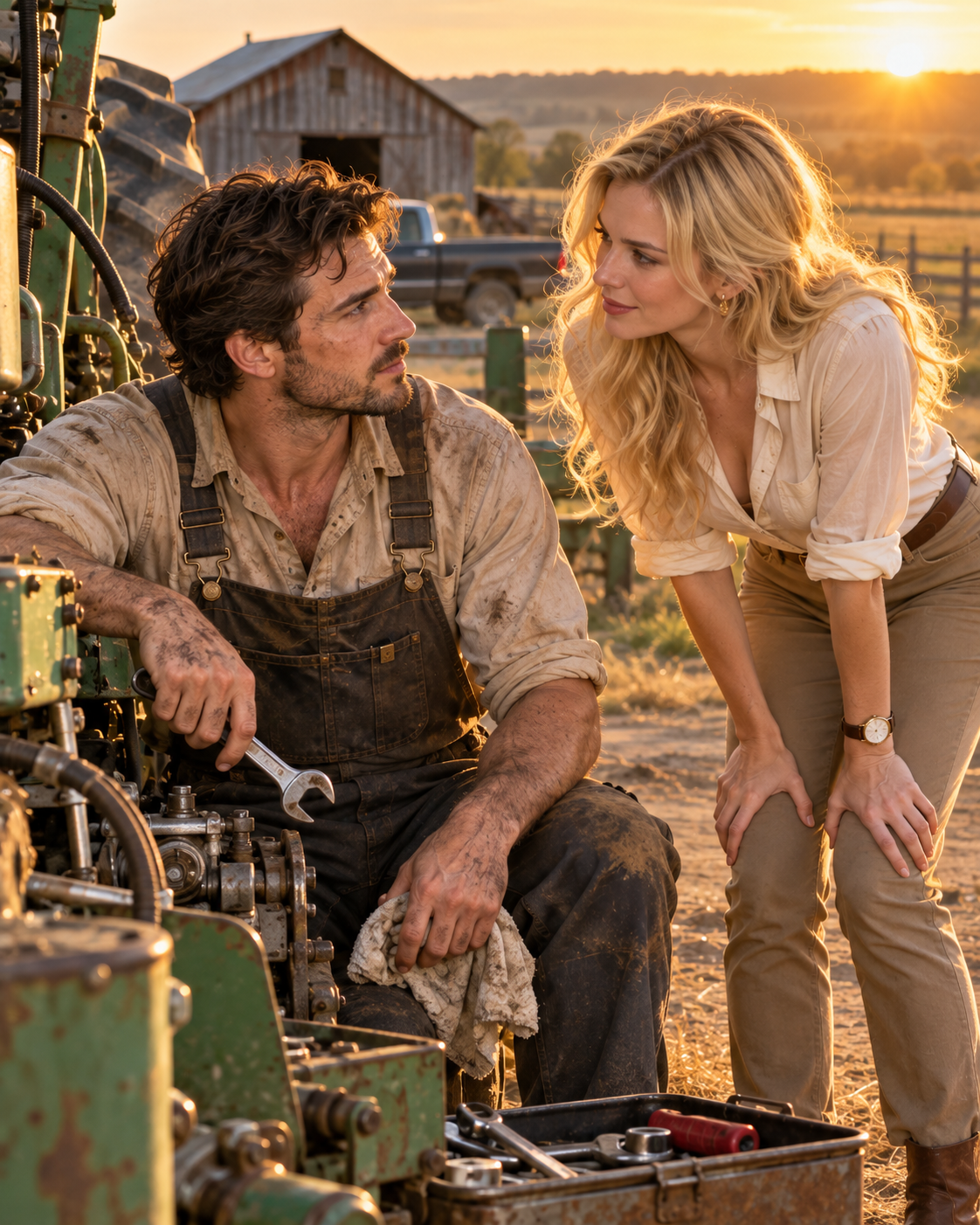
I looked at Caleb, who stood with his hands resting on his hips, his work shirt dark with sweat and rainwater.
“Can you read the dates?” I asked him.
He leaned closer without touching the papers.
“The first inspection was three days before you took the machine in.”
Vance shut the case.
“That’s enough.”
But it wasn’t enough for me. Not anymore.
For months, I had believed I was fighting a simple financial disaster: a bad harvest, a crushing loan, and a deadline I couldn’t meet. Now I was beginning to suspect that someone had known exactly where to press until Blackwood Valley broke.
And if the papers in that case were what I thought they were, my combine hadn’t been the only thing someone had tried to put out of commission.
“You’re not taking another step onto my property until my attorney has seen those records,” I told Vance.
He gave a short laugh.
“Your attorney? The one you can afford after missing your payment?”
The insult landed, but I refused to let him see it.
“I’ll find one.”
“You have until five o’clock today to cure your default. After that, the property will be subject to the remedies in your loan agreement.”
He turned toward his SUV.
Before climbing in, he glanced at the combine again.
“Enjoy the harvest while you can.”
The convoy disappeared down the ranch road, leaving a ribbon of dust behind it.
For several seconds, nobody spoke.
Then Caleb let out a breath.
“Well, he’s a pleasant fellow.”
I laughed, though there was no humor in it.
My hands were shaking so badly that I had to set the papers on the hood of the truck before I could straighten them.
“Why would a financier care whether my combine worked?”
Caleb looked toward the road.
“Maybe he doesn’t. Maybe he cares about what happens if it doesn’t.”
That was the first time I considered that Vance might not need to break anything himself.
He only needed me to fail at the right moment.
By ten that morning, the last of our corn had been moved into storage, and my farm manager had confirmed that the crop was safe. We had harvested far more than I had dared hope during the previous night’s storm, though the final yield still needed to be weighed and verified.
My crew was exhausted. Several men had fallen asleep in the break room with their boots still on, and the coffee pot had been empty since dawn.
I should have been celebrating.
Instead, I sat in my grandfather’s office, surrounded by loan statements, production records, and a pile of unopened mail I had been avoiding for weeks.
The debt had begun three years earlier when drought ruined two harvests in succession. I borrowed to pay wages, repair irrigation equipment, and keep the ranch from selling off cattle and machinery at a loss.
Then fertilizer prices climbed.
Then another season came in below expectations.
When Donald Vance’s investment company offered to refinance the loans, I had accepted because the alternative was to let the bank begin selling parcels of land.
The new agreement gave me time, or so I believed.
The interest rate was higher than I liked, and the penalties were severe, but I had calculated that two decent harvests would bring us back to stable ground.
What I hadn’t understood was how much control the refinancing agreement gave Vance’s company over the ranch’s future.
I pulled the contract from my desk drawer and spread it across the blotter.
A clause on page twenty-seven caught my eye. If I defaulted on a payment and failed to cure it within the specified period, the lender could exercise remedies against the collateral listed in an attached schedule.
I had read that clause before.
What I hadn’t examined closely was the schedule.
The collateral included not just the equipment and a portion of the land, but a controlling interest in Blackwood Valley Agricultural Holdings, the family company that owned the ranch’s operating assets.
I stared at the page until the words blurred.
My grandfather had created that company so that the ranch would never be divided by a single bad year. My father had maintained it. I had inherited it after his death, along with the responsibility of keeping the business alive.
And I had pledged its future to a man who seemed to have anticipated every possible way I might stumble.
A knock sounded at the office door.
Caleb stood in the doorway holding two mugs of coffee.
“Lily’s asleep in the truck,” he said. “I figured you might need this.”
I accepted the mug.
“How much do I owe you?”
He frowned.
“For what?”
“For the work last night. The machining, the repair, all of it.”
“Nothing crazy. Pay me for the materials and a fair day’s labor.”
“Caleb, you worked through a storm and saved a crop worth hundreds of thousands of dollars.”
“I fixed a machine.”
“You fixed my future.”
He looked uncomfortable.
“Don’t put that on me. You still have a lot of work to do.”
I glanced down at the contract.
“That’s what I’m trying to figure out.”
He pulled a chair toward the desk.
“Can I ask you something?”
“Of course.”
“Did you know the foreclosure deadline was yesterday?”
I nodded.
“And the dealership gave you that estimate the same day?”
“Yes.”
He rubbed his jaw.
“That’s a mighty convenient coincidence.”
I had been thinking the same thing.
“What would you do?”
He took a slow sip of coffee.
“I’d stop guessing and start collecting proof.”
It was simple advice, but I needed to hear it from someone who had nothing to gain from telling me what I wanted to hear.
I called my attorney, Margaret Ellis, who had handled our land leases and family trust documents for nearly twenty years.
She answered on the third ring.
“Tell me you have good news, Evelyn.”
“I have a working combine, a harvested crop, and a foreclosure notice that doesn’t sit right with me.”
Her tone changed.
“Has Vance contacted you?”
“He came to the ranch this morning. His representative had dealership inspection reports in a document case.”
“Did you see the contents?”
“Only briefly. I recognized the dealership name and a few dates.”
“Don’t sign anything he gives you. Don’t transfer ownership, don’t agree to a voluntary surrender, and don’t assume his deadlines mean what he says they mean until I’ve reviewed the actual contract and notices.”
I looked at the wall clock.
“Can you come out today?”
“I can be there by noon. Send me scans of every document you have.”
After the call, I spent the next hour scanning loan records, maintenance invoices, and correspondence.
Caleb sat quietly in the corner, sorting the papers by date whenever I asked him to help. He had a way of noticing small details without making a performance of it.
At one point, he held up a dealership invoice.
“This says the transmission housing was inspected at 8:12 a.m.”
“Yes.”
“But the technician’s notes say the diagnostic test started at 9:46.”
I leaned over his shoulder.
He was right.
The first entry listed the machine’s serial number, mileage, and an inspection code. The second documented a test performed almost two hours later.
“Could be an administrative mistake,” I said.
“Could be.”
He placed the invoice beside another page.
“But this one says they found internal transmission damage before the test was performed.”
I felt a chill despite the warm office.
The reports contradicted one another.
And each contradiction made it harder to believe that the forty-eight-thousand-dollar estimate had been an honest mistake.
Margaret arrived shortly after noon with a leather briefcase and the expression of a woman who had already read enough to dislike what she was seeing.
She spent twenty minutes examining the loan agreement, then another twenty reviewing the dealership records.
Finally, she removed her glasses.
“Evelyn, I need you to understand something. A suspicious invoice isn’t proof of a conspiracy. But these inconsistencies are serious enough that we should preserve everything and demand an explanation.”
“Can Vance take the ranch today?”
“That depends on the contract, the notices, and the applicable law. We need to verify the exact default provisions and whether every required notice was properly delivered. He cannot simply declare himself owner because he says so.”
She tapped the foreclosure notice.
“Also, this document identifies a deadline, but the supporting paperwork is incomplete. I want the full payment history, the assignment records, and the original servicing statements.”
“Can we stop him?”
“We can challenge what is improper. I won’t promise an outcome before I’ve examined the evidence.”
That answer frightened me more than an easy promise would have, but it was honest.
Margaret asked for the name of the dealership.
When I told her, she paused.
“That company serviced equipment for another farm client of mine last year. There was a dispute over a repair estimate, but I never saw enough evidence to know whether anything improper had occurred.”
“Did Vance have an interest in that farm?”
“I don’t know. I’ll check.”
For the first time since the storm, I felt that the situation was larger than my own troubles.
That afternoon, Margaret sent a formal preservation notice to the dealership and Vance’s company, demanding that they retain all inspection records, internal communications, and documents relating to my combine and loan.
She also contacted an independent agricultural mechanic to inspect the machine and document the broken shear pin, the linkage, and the repairs Caleb had performed.
By evening, the independent mechanic had confirmed that the failure was consistent with a broken shear pin and that he had found no evidence supporting the dealership’s claim of catastrophic transmission damage.
He was careful not to accuse anyone of deliberately misleading me.
He didn’t need to.
The report gave us something we could prove.
The following morning, Margaret returned with a new development.
“Vance’s company filed a notice of its claimed interest in the operating company six months ago,” she said. “Your office received a copy, but it was sent to an old mailing address.”
I stared at her.
“How is that possible? I’ve lived at the ranch my entire life.”
“The notice went to the address listed in an old corporate filing. That doesn’t automatically make the notice invalid, but it raises questions about what they knew and when.”
She spread the filing across my desk.
The address was for a small post office box my father had used years earlier.
I remembered closing it after his death.
Nobody at Blackwood Valley had used it since.
“Who gave them that address?”
“We don’t know yet.”
I called our accountant, who had helped manage the company records after my father died.
He was out of town and promised to review his files.
Meanwhile, Margaret requested a complete copy of the corporate filing history.
By late afternoon, she had found another troubling detail.
The filing that listed the old mailing address had been submitted shortly before Vance’s company finalized the refinancing agreement.
It had not been signed by me.
It carried the electronic signature of a former administrative contractor who had worked for our office for three months and left nearly two years earlier.
I barely remembered the woman.
Her name was Melissa Grant.
She had handled invoices, scanned documents, and helped organize records during a period when my father-in-law’s estate was being settled and the ranch office was overwhelmed.
“Could she have had authority to make that filing?” Margaret asked.
“Not to change the ownership records without my approval.”
“Do you have anything showing you refused or approved it?”
“I’d have to check.”
Margaret wrote down Melissa’s name.
“We’ll need to find her. But we must be careful. A filing made without proper authority may be challengeable, and an electronic signature can be misused or misunderstood. We need the original submission records before we draw conclusions.”
That evening, I walked through the old machine shed alone.
My grandfather had built it from timber he hauled himself. My father had added the metal workshop, the service pit, and the shelves where every bolt and bearing had its place.
The old International Harvester stood in the back corner, its paint faded and its tires cracked.
Caleb had already left for home with Lily, but he had promised to return the next morning to check the repaired linkage after the machine had cooled.
I ran my hand along the combine’s dusty side.
For years, I had thought of the old machine as a relic we kept because my father couldn’t bear to scrap it.
Now it had helped save the harvest that might keep us on the land.
I found a small notebook on the workshop bench, its cover stained with oil.
It belonged to my father.
Inside were handwritten records of repairs, part numbers, and maintenance schedules. Near the back, he had listed the serial numbers of equipment stored in the shed, including the International Harvester.
Beneath the list was a note in his handwriting.
“Keep the old parts. The new ones aren’t always better, and a machine will tell you what it needs if you learn to listen.”
I sat on the bench and read the sentence twice.
My father had spent his life teaching me to trust the evidence in front of me instead of the person who spoke the loudest.
I had forgotten that lesson when Vance offered to rescue the ranch.
The next morning, Caleb arrived with Lily and a small toolbox.
She carried her stuffed rabbit under one arm and a paper bag under the other.
“My daddy said you might forget breakfast,” she announced, placing a muffin on my desk.
“I might have.”
“That’s what he said.”
Caleb gave her a look.
“I said you were busy. I didn’t say she forgot breakfast.”
Lily shrugged.
“You said grown-ups forget things when they’re worried.”
I smiled at her.
“Your daddy sounds like a wise man.”
“He forgets his coffee on the truck roof sometimes.”
“Nobody’s perfect,” I said.
Caleb laughed, and for a few seconds the office felt like a normal place again.
Then Margaret called.
She had obtained a copy of the dealership’s internal service record through a formal document request, along with a preliminary response from Vance’s company.
The service record showed that the dealership had logged the combine’s serial number before my appointment. It also included a note from a service manager instructing a technician to prepare a high-cost transmission estimate.
The note did not explain why.
There was no documentation of a full transmission teardown, no photographs of internal damage, and no parts order corresponding to the claimed repair.
Worse, the estimate had been prepared before the technician’s diagnostic report was completed.
Margaret read the entries aloud over the phone.
“I want an independent examiner to authenticate these records, and I want the dealership to explain the sequence. This is potentially significant, but we need to establish who wrote the note and why.”
I looked through the office window toward the fields.
“What about Vance?”
“His company says the dealership acted independently and that the loan default has nothing to do with equipment repairs. They deny any coordination.”
I let out a bitter laugh.
“Of course they do.”
“There’s another issue. The loan servicing history shows a payment posted to your account, then reversed two days later. The explanation is incomplete.”
My laughter disappeared.
“What payment?”
“A payment from the ranch operating account. It was large enough that, if it had remained credited, it would have reduced the arrears considerably.”
I pulled the bank statements from my desk.
I remembered making that payment. I had authorized it electronically after selling a small parcel of equipment, and the money had left our account.
But the lender’s records showed it had been returned.
“Why?”
“That’s what I’m trying to find out.”
I called our bank and requested a trace of the transfer.
The representative promised an investigation and gave me a reference number.
For the rest of the day, I worked with Margaret to gather every record connected to the payment, the loan, and the dealership.
By late afternoon, we had a timeline.
The payment had been initiated correctly.
The funds had reached an intermediary account associated with the loan servicer.
Then the transaction had been reversed under a code indicating a processing issue.
No one could explain why the problem had not been corrected.
It might have been an administrative error.
It might have been a mistake in the account information.
Or it might have been something else.
For the first time, I understood that the ranch’s survival would depend on more than harvesting corn and earning enough money to satisfy a lender.
We needed to know whether the financial records themselves could be trusted.
Three days later, Margaret received a call from the dealership’s corporate office.
The company agreed to provide additional records and conduct an internal review. The service manager who had authorized the estimate had been placed on leave pending that review.
No one admitted wrongdoing.
But no one could explain why a technician had been instructed to prepare a transmission replacement estimate before completing the diagnostic work.
That same afternoon, our bank confirmed that the payment reversal had not originated from our account.
The funds had been received by the servicer and then returned because the receiving account had been flagged for a manual review.
The bank’s records identified the request that triggered the review.
It came from a third-party servicing administrator used by Vance’s investment company.
Margaret read the confirmation twice.
“This doesn’t prove anyone deliberately blocked your payment,” she said. “But it gives us a specific transaction to investigate.”
I sat very still.
For months, I had blamed myself for failing to manage the ranch well enough.
Now there were records suggesting that the payment I had made might have been prevented from reaching the account where it belonged.
I called Vance’s office.
His assistant offered to schedule a meeting the following week.
“I need to speak with Mr. Vance today.”
“I’m afraid he’s unavailable.”
“Then tell him my attorney has the bank’s transaction records and the dealership’s service documents.”
There was a pause.
“I’ll pass along the message.”
He called back twenty minutes later.
“Ms. Blackwood,” Vance said, his voice smooth and measured, “I understand you’re upset, but I think you’ve allowed a simple repair dispute to distract you from your financial obligations.”
“Your servicing administrator requested a review that caused my payment to be reversed.”
“Administrative reviews happen all the time.”
“Then you should have no trouble explaining this one.”
“Your account was in default before that payment. The foreclosure process was already underway.”
“That doesn’t answer my question.”
He sighed.
“Evelyn, you inherited a substantial property and an enormous responsibility. You tried to operate it as though tradition could protect you from changing economic realities. My company offered you a lifeline.”
“And now you’re trying to take the ranch.”
“We’re enforcing an agreement you signed.”
I gripped the phone.
“Did you know the dealership planned to charge me forty-eight thousand dollars for a broken shear pin?”
He said nothing for a moment.
Then he replied, “I don’t manage dealership service departments.”
“Did anyone at your company speak to them before my appointment?”
“Have your attorney send any formal questions through the proper channels.”
He ended the call.
I sat in silence until Margaret walked into the office.
“He didn’t deny it,” I said.
“Not denying something isn’t proof. But his response tells us we should keep pressing for the records.”
She placed a folder on my desk.
“The independent examiner has authenticated the service documents. We’ve also received the servicer’s preliminary response. They claim the payment reversal was an automated compliance hold.”
“Can they do that?”
“Sometimes a lender or servicer can place a hold for legitimate reasons. The question is whether the hold was properly applied, whether you were notified, and whether they followed the contract and applicable law. We’re demanding the underlying records.”
I looked down at the folder.
For the first time, I had enough evidence to challenge the story Vance had been telling.
But the case was not over.
The crop had been harvested, yet the money from its sale would not arrive in a single payment. Storage fees, transport costs, payroll, and operating expenses had to be covered before I could determine exactly how much remained for the lender.
Our debt was still substantial.
And Vance still had lawyers, money, and a contract I had signed.
That evening, I walked out to the porch and found Caleb sitting on the steps while Lily chased fireflies in the yard.
He had brought back the tools he’d left in the machine shed.
“Margaret says we’ve got a fight ahead of us,” I told him.
He nodded.
“Most worthwhile things do.”
I sat beside him.
“I keep thinking about what you said that first day. About how a machine tells you what it needs if you listen.”
He glanced at me.
“Did I say that?”
“No. My father did.”
Caleb smiled faintly.
“Sounds like a smart man.”
“He was. I wish I’d listened to him more when he was alive.”
“You probably listened more than you think.”
We watched Lily catch a firefly and release it.
“Why did you stop working at the repair shop?” I asked.
He took a moment before answering.
“My wife died four years ago. Cancer. I tried to keep the shop going while raising Lily, but I was working twelve-hour days and missing things I couldn’t get back. School programs, dinners, all the ordinary stuff.”
He rubbed his palms together.
“I sold my share and started taking smaller jobs. Less money, but I get to be home.”
“I’m sorry.”
“Thank you.”
He looked toward his daughter.
“She doesn’t remember much about her mother now. I keep pictures around because I want her to know that part of her life mattered.”
I understood then why he never rushed Lily when she asked questions or complained about being tired.
He had learned what it cost to miss the moments that could never be repeated.
“I’ve spent so long trying to keep this ranch that I don’t know what I’d be without it,” I admitted.
Caleb didn’t answer immediately.
“Maybe that’s worth thinking about, too.”
I looked at him.
“What do you mean?”
“I mean the land matters. Your family’s history matters. But if saving the place costs you every other part of your life, you might want to ask what you’re really saving it for.”
I had no answer.
For years, I’d measured my worth by the condition of the fields, the number of cattle, and whether the ranch accounts balanced at the end of the season.
I couldn’t remember the last time I’d sat on the porch simply because the evening was beautiful.
The next morning, my accountant called with the results of his review.
He had located the original corporate filing authorizing the change to our mailing address.
The document contained Melissa Grant’s electronic signature, but the accompanying authorization form appeared to have been altered.
My accountant remembered the incident because Melissa had requested access to the company records shortly before leaving her position.
He had refused to grant her authority to make corporate changes without my approval.
He had documented that refusal in an email.
The email was still in his archive.
Margaret obtained a copy and compared it with the filing record.
The timestamps did not match the sequence described in the submission.
It was not proof of fraud by itself, but it was enough to justify a formal challenge to the filing and a request for the electronic audit trail.
We contacted Melissa through an attorney.
At first, she refused to speak with us.
Then, two days later, she agreed to meet Margaret at a law office in the nearest town.
I went with her.
Melissa arrived in a plain blue blouse, carrying a canvas bag and looking as though she had not slept well.
She was in her early thirties, with dark circles beneath her eyes.
“I didn’t know what happened to the ranch until I saw the foreclosure notice online,” she said.
“Did you submit the filing that changed our mailing address?” Margaret asked.
Melissa stared at the table.
“I uploaded a document. I didn’t create it.”
“Who gave it to you?”
She hesitated.
“A consultant who was helping organize the refinancing paperwork. He said it was an administrative correction and that Evelyn had approved it.”
“Did you see my approval?” I asked.
“No.”
“Then why did you submit it?”
Her eyes filled with tears.
“I was new. I was afraid of losing the job. He said it was routine, and I believed him.”
“Who was the consultant?”
She gave us a name.
It was a man who had worked for Vance’s investment company during the refinancing process.
Margaret asked whether Melissa had kept any emails or messages.
“I deleted most of them when I left,” she said. “But I still have an old laptop. There might be something on it.”
We arranged to have the device examined by a qualified forensic specialist with Melissa’s consent.
Before we left, she turned to me.
“I should have asked you. I know that now.”
I wanted to be angry with her.
Part of me was.
But I remembered how many times I had signed a stack of documents after a fourteen-hour workday because someone assured me everything was routine.
“I need you to tell the truth about what you did,” I said. “Whatever that truth is.”
She nodded.
“I will.”
The forensic review took several days.
During that time, Margaret filed a formal objection to the corporate filing and notified Vance’s counsel that we were investigating the disputed authorization, the payment reversal, and the dealership estimate.
Vance’s company responded by accelerating its efforts to take control of the collateral.
They demanded immediate payment and threatened to seek emergency relief if we interfered with the process.
Margaret prepared for a hearing.
I sold a small parcel of surplus equipment and negotiated a short-term operating facility with our bank, using the expected crop proceeds as part of the financial plan.
It was not enough to clear the entire debt, but it gave us room to pay wages and keep the ranch operating while the dispute moved forward.
For the first time in months, I was making decisions based on a plan rather than panic.
Caleb continued helping with the combine, checking the linkage and making sure the repair held under a full load.
I paid him for the materials and his labor, then offered him additional work maintaining the older equipment.
He accepted, provided the arrangement stayed flexible enough for him to pick Lily up from school.
“She’s got a science fair coming up,” he explained. “I promised I’d help her build something.”
“Then we’ll work around it.”
He smiled.
“You sure?”
“Caleb, you saved my harvest. I can manage a schedule.”
Lily’s science project turned out to be a model irrigation system made from plastic tubing, a hand pump, and a shoebox.
She brought it to the ranch office one afternoon and demonstrated how water traveled from a small reservoir through the channels.
“It works better if you don’t squeeze the pump too hard,” she explained.
I watched the water trickle into a row of tiny paper crops.
“That’s a good lesson for farming.”
She beamed.
“Daddy said the same thing.”
The simple joy of that afternoon stayed with me long after she and Caleb had gone home.
For the first time, I began to imagine Blackwood Valley as something more than an inheritance I had to defend.
It could be a place where people built a life together, where children could learn, and where work mattered without consuming every waking hour.
Then the forensic examiner called.
He had recovered several deleted emails from Melissa’s laptop.
One message showed the consultant instructing her to upload the corporate filing with the revised mailing address.
Another referred to a “collateral enforcement timeline” and asked whether the refinancing documents had been completed.
The sender’s company email matched the domain used by Vance’s investment firm.
The messages did not prove that Vance himself had directed the activity, but they established a connection between his company’s consultant and the disputed filing.
There was more.
An attachment included a spreadsheet listing several farms, their debt balances, estimated property values, and dates when each loan might enter default.
Blackwood Valley appeared near the top.
Beside our name was a column labeled “Acquisition Opportunity.”
I read the phrase three times.
The spreadsheet did not say that anyone had manufactured a default, but it showed that our property had been evaluated as a potential acquisition well before Vance claimed he was simply responding to an ordinary loan failure.
Other farms appeared on the list, too.
Margaret contacted the attorneys for two of those landowners, and they agreed to compare their records.
One had received a disputed repair estimate shortly before a foreclosure notice. The other had experienced a payment-processing problem that was never adequately explained.
Their cases were not identical, and none of us knew whether the same people had been involved in every dispute.
But the pattern justified further investigation.
We submitted the evidence to the appropriate authorities and preserved the original files, email headers, and audit records.
Vance’s lawyers responded aggressively, accusing us of mischaracterizing ordinary business documents.
They demanded that we withdraw our allegations.
Margaret refused to make public accusations beyond what the evidence supported.
“We don’t need to prove everything in a newspaper,” she told me. “We need to prove what happened in your case.”
The hearing was scheduled for the following week.
On the morning of the hearing, I stood in front of the mirror in my bedroom and struggled with the clasp of my father’s old watch.
I had not worn it in years.
He had given it to me on my twenty-first birthday, telling me that time was the one thing a person could spend only once.
I slipped it onto my wrist.
Downstairs, Caleb was waiting by the truck with Lily.
He had offered to drive me to the courthouse because Margaret needed to arrive early.
“You don’t have to come,” I told him.
“I know.”
“Vance’s lawyers may try to make this ugly.”
“Probably.”
“You could lose work over getting involved in all this.”
Caleb opened the passenger door.
“Evelyn, I spent a long time believing that keeping my head down was the same as staying out of trouble. Sometimes it is. Sometimes it just means the trouble lands on someone who doesn’t have help.”
I climbed into the truck.
At the courthouse, Margaret met us on the steps.
She carried two thick binders and a sealed envelope containing the forensic examiner’s report.
The hearing concerned the disputed filing, the payment records, and whether Vance’s company had followed the procedures required to enforce its claimed rights.
It was not a final trial on every allegation, and Margaret warned me that the judge might limit the relief we could obtain that day.
Inside the courtroom, Vance sat with two attorneys at a polished table.
He looked composed, almost bored.
When I took my seat, he glanced at Caleb and then turned away.
His lawyer argued that I had defaulted on a valid loan and was now attempting to delay enforcement by blaming a dealership and an administrative contractor.
He described the payment reversal as a routine servicing issue and the disputed mailing address as an inconsequential clerical matter.
Margaret waited until he finished.
Then she presented the timeline.
She showed the original payment leaving our account, the servicing records documenting its receipt, and the reversal request that followed.
She introduced the independent mechanic’s findings and the dealership records showing that the costly repair estimate had been prepared before the diagnostic process was complete.
Finally, she presented the electronic audit trail associated with the corporate filing.
The judge studied the documents.
“Mr. Vance,” he said, turning toward the lender’s attorney, “your client appears to have relied on a change of address that the borrower disputes and a payment reversal that has not been fully explained. Why should I allow enforcement to proceed without resolving these issues?”
Vance’s attorney requested additional time to review the evidence.
Margaret objected to any action that would transfer control of the ranch before the disputed records could be examined.
The judge did not declare the loan invalid or decide that Vance had committed fraud.
Instead, he ordered the parties to preserve the relevant records, directed them to provide a complete accounting of the disputed payment, and temporarily restrained the lender from taking specified steps to transfer control of the contested operating assets while the court reviewed the evidence.
It was a limited ruling.
But it was enough to stop the immediate threat.
Outside the courtroom, I leaned against the stone wall and let myself breathe.
Margaret reminded me that the case would continue and that the order was not a final victory.
“I understand,” I said.
“But we have time.”
“Yes. And time is useful if we use it well.”
Caleb stood a few feet away, holding Lily’s hand.
She ran over to me.
“Did the judge say you can keep the ranch?”
I crouched so I could look her in the eyes.
“He said we have a chance to sort everything out before anyone can take it away.”
She considered that.
“Then we should do that.”
I laughed and hugged her.
“Yes, sweetheart. We should.”
The following month was the hardest period I had faced since inheriting Blackwood Valley.
The court’s order bought us time, but it did not erase the debt. I still had to pay wages, settle fuel bills, maintain the equipment, and negotiate with the bank.
The corn proceeds arrived in stages, and I worked with our accountant to establish exactly what we could afford.
I cut unnecessary expenses, postponed a planned renovation, and sold a few pieces of machinery we no longer needed.
For the first time, I also invited the ranch managers to review the books with me.
I had always believed it was my responsibility to carry the financial burden alone.
That belief had made it easier for problems to remain hidden until they became emergencies.
We created a monthly reporting system and required independent review of major transactions.
It was humbling to admit how much I had missed.
It was also a relief.
Meanwhile, the investigation continued.
The dealership’s corporate review found that its service manager had authorized a preliminary transmission estimate without sufficient diagnostic support. The company refunded the inspection charge and agreed to cooperate with the authorities, though it denied that its employees had knowingly participated in a foreclosure scheme.
The servicing administrator corrected the payment record after its review found that the reversal had been processed without adequate documentation.
That correction reduced the arrears.
It did not eliminate them.
The disputed corporate filing was withdrawn pending further review, and the company that had submitted it agreed to produce its internal communications.
The consultant named in Melissa’s emails was no longer employed by Vance’s firm.
His departure was not proof of wrongdoing, but his role became a central subject of the investigation.
The evidence never established that Vance had personally ordered anyone to sabotage my combine. What it did establish was that his company had pursued the acquisition of distressed farms while relying on records and procedures that, in my case, had serious unresolved defects.
That distinction mattered.
I wanted justice, not a story I could tell myself because it made the world easier to understand.
The case eventually moved toward a negotiated resolution.
Vance’s company agreed to a full independent accounting of the loan and to withdraw its immediate foreclosure claim while the parties corrected the disputed servicing entries and resolved the corporate filing.
In exchange, I agreed to a repayment plan based on verified balances, realistic crop projections, and scheduled reviews.
The arrangement required me to sell a small portion of land that had once belonged to my grandfather.
Signing that agreement hurt more than I expected.
I sat alone in my father’s office after Margaret left, holding the pen above the final page.
For years, I had thought that losing any piece of Blackwood Valley would mean I had failed my family.
But my grandfather had bought and sold parcels throughout his life. He had expanded the ranch when it made sense and sold land when doing so protected the rest.
I had remembered the expansion and forgotten the judgment.
The parcel we sold was far from the main ranch, separated from the central fields by a county road and a strip of privately owned pasture.
Its sale reduced the debt enough to make the repayment plan workable without sacrificing the operating land that supported our employees and cattle.
When the transaction closed, I drove out to the boundary fence and stood beside the old gate.
The grass moved in the wind, and a hawk circled over the far field.
I felt grief, but I also felt something I had not experienced in years.
Room to breathe.
The final legal dispute took several more months to resolve.
Vance’s company denied wrongdoing throughout the proceedings, but the corrected account, the disputed filing, and the dealership’s unsupported estimate weakened its position.
With the payment history reconciled and the corporate filing withdrawn, the lender no longer had the same basis for its immediate enforcement effort.
The parties reached a settlement under which the loan would continue under revised terms, the contested penalties would be reviewed, and the foreclosure action would be dismissed once the agreed conditions were satisfied.
The settlement did not make me wealthy.
It did not erase the difficult seasons or return every dollar we had spent.
But it gave Blackwood Valley a future.
On the day Margaret brought the final documents to my office, I read each page before signing.
Then I put the papers into the safe and went outside.
Caleb was repairing a feed conveyor near the machine shed. Lily sat on an overturned bucket, drawing a picture of the ranch.
I watched them for a moment before walking over.
“I have some news,” I said.
Caleb set down his wrench.
“Good news?”
“The foreclosure action is dismissed under the settlement. The repayment plan is in place, and the disputed account has been corrected.”
He smiled slowly.
“Then you did it.”
“We did.”
He shook his head.
“You made the decisions. You did the work.”
“You helped me see what needed fixing.”
He looked back at the conveyor.
“That pin was a small problem compared with everything else.”
“Maybe. But I might have lost the ranch before anyone noticed it.”
I took a folded document from my pocket.
“I’ve been thinking about something.”
Caleb’s expression grew cautious.
“Evelyn, if this is about paying me more for the repair, we already settled that.”
“It’s not.”
I handed him the document.
It was a proposal to establish a new agricultural partnership, with Caleb receiving a substantial ownership interest in a separate machinery and maintenance business that would operate from the ranch under a long-term agreement.
The arrangement would give him a stable income, a share of the business’s profits, and the opportunity to build something of his own without sacrificing the time he wanted with Lily.
It would not give away half of the ranch or make him responsible for my old debts.
The land would remain protected under the family company, and Margaret had drafted the terms so that both of us would have clear rights and responsibilities.
Caleb read the first page, then looked at me.
“Why?”
“Because I trust your judgment. Because you’re good at what you do. And because I’d like Blackwood Valley to become a place where people can build something lasting instead of just trying to survive one emergency after another.”
He looked down at the paper again.
“I don’t want charity.”
“Neither do I. This is a business proposal. You would invest your labor, expertise, and time. I would provide the workshop, equipment access, and initial capital. We would share the risks and the profits according to the agreement.”
He was quiet for a long time.
“What happens if we disagree?”
“Then we follow the terms Margaret drafted and work it out like adults.”
“What if the business loses money?”
“Then we account for it honestly and decide whether it can continue.”
He looked toward Lily.
“And what about her?”
“She gets a father who can come home for dinner more often.”
His mouth tightened, and he looked away.
I realized I had touched something more personal than a business decision.
“I can’t promise this will always be easy,” I said. “But I can promise that I’m not asking you to save me. I’m asking you to build something with me.”
Caleb folded the proposal carefully.
“I need time to think about it.”
“Take all the time you need.”
He went back to the conveyor, and I returned to the house.
For several days, he said nothing about the offer.
We continued working together, repairing equipment and preparing the fields for the next planting season.
Lily visited the office after school, where she had acquired the habit of leaving drawings on my desk.
One showed the ranch house beneath an enormous yellow sun.
Another showed three figures standing beside a red pickup and a green combine.
I kept them all.
A week later, Caleb knocked on my office door.
“I’ve read the agreement,” he said.
“And?”
“I want to change a few things.”
I smiled.
“Good. That means you took it seriously.”
We spent the afternoon reviewing the proposal with Margaret.
Caleb asked for a clear limit on his personal liability, a provision protecting his ability to care for Lily, and a fair process for resolving disputes.
Margaret revised the agreement, and we scheduled another meeting to review the final version.
When we finished, Caleb held out his hand.
“I’d be proud to work with you.”
I shook it.
“So would I.”
We signed the partnership papers the following Monday.
There was no grand ceremony, no newspaper announcement, and no speech about destiny.
Just two people at a desk, a lawyer checking the final pages, and a little girl coloring quietly in the next room.
When Lily realized what we had done, she ran toward me with her drawing in both hands.
“Does this mean Daddy gets to stay?”
I knelt beside her.
“He was already allowed to stay, sweetheart.”
She frowned, considering the distinction.
“But now he’ll work here?”
“Yes.”
She threw her arms around my neck.
“Then I want to draw a bigger picture.”
I held her close and looked over her shoulder at Caleb.
He stood in the doorway, smiling with the tired, careful expression of someone who had learned not to trust good things too quickly.
I understood that feeling.
The ranch did not become a perfect place overnight.
We had another difficult growing season, and a pump failed during a week of punishing heat. The machinery business took time to find its footing, and Caleb and I disagreed over whether to rebuild an old tractor or sell it for parts.
We learned to argue without turning every disagreement into a contest.
We learned to ask for help before a problem became a crisis.
And we learned that a good partnership required more than trust. It required clear expectations, honest records, and the willingness to admit when either of us was wrong.
Caleb’s workshop grew steadily. Local farmers began bringing him equipment that larger dealerships were unwilling to repair economically.
He hired a young mechanic from the next county and eventually added a small fabrication shop.
Lily spent afternoons doing homework at the office or helping her father sort bolts into labeled drawers.
She still carried her stuffed rabbit, though its missing ear had been repaired with a patch of blue fabric.
As for me, I began leaving the office before dark at least twice a week.
Sometimes I drove the fence lines with Caleb. Sometimes we sat on the porch and watched the sun settle behind the fields.
We talked about our families, our mistakes, and the futures we had once been too frightened to imagine.
Neither of us rushed to give those conversations a name.
There were practical matters to consider, and Lily’s happiness came first for Caleb. I respected that.
Over time, though, our lives became intertwined in ways neither of us had planned.
He learned how I took my coffee.
I learned that he hummed old country songs when concentrating on a difficult repair.
He began keeping a spare pair of work gloves in my truck, and I found myself buying the cereal Lily liked whenever I went into town.
The changes were small enough that I barely noticed them until one evening, when Lily fell asleep on the porch swing with her head resting against my arm.
Caleb came outside carrying a blanket.
He draped it over her, then sat beside me.
“She trusts you,” he said quietly.
“I love having her around.”
He watched his daughter sleep.
“That means a lot.”
I wanted to tell him that he meant a lot, too.
Instead, I rested my hand on the porch rail beside his.
He moved his fingers until they touched mine.
Neither of us pulled away.
The following spring, Blackwood Valley held its first community equipment day.
Farmers brought tractors, planters, and old combines to the workshop for safety checks and basic maintenance. Caleb’s crew helped identify problems before they became expensive failures.
We invited families to bring their children, and Lily insisted on making a sign for the entrance.
She painted a green tractor, a red pickup, and a large yellow sun.
Beneath them, in uneven letters, she wrote, “EVERYTHING DESERVES A CHANCE TO BE FIXED.”
Caleb laughed when he saw it.
“That’s a big statement for a six-year-old.”
“She has strong opinions,” I said.
“She gets them from her mother.”
He said it with a smile, but there was tenderness in his voice.
I touched his arm.
“I wish I’d known her.”
He nodded.
“She would’ve liked you.”
For a moment, the noise of the workshop seemed to fade around us.
Then Lily called from the entrance, asking us to help carry a table.
We went together.
By harvest time, the ranch was on firmer ground than it had been in years.
Our debt remained manageable, our employees knew what to expect, and the new business provided a second source of income.
The land still demanded hard work, and the weather remained unpredictable, but I no longer faced every uncertainty alone.
On the anniversary of the night Caleb repaired the combine, I drove out to the old barn just before sunset.
The portable halogen light still hung from a hook near the workbench.
I had kept it there because I couldn’t bear to forget the night it had illuminated the first real chance I had seen in months.
Caleb found me standing beside the old International Harvester.
“Thinking about that storm?” he asked.
“Every time I come in here.”
He ran his hand along the machine’s faded paint.
“My dad would’ve liked this old thing.”
“My father would’ve liked you.”
Caleb looked at me.
“Would he?”
“He believed a person’s character showed in what they did when nobody was watching. You crawled under that machine without knowing who I was or whether I could pay you.”
“I knew you needed help.”
“That’s exactly what I mean.”
He lowered his eyes, then reached for my hand.
“I didn’t save Blackwood Valley by myself, Evelyn.”
“No,” I said. “You gave me a reason to believe it could be saved.”
We stood there while the last light slipped through the barn doors.
Outside, Lily was calling to us from the yard.
She had found a box of old photographs in the office and wanted to know which one showed my grandfather standing beside the first tractor he had bought.
Caleb squeezed my hand.
“Come on. We’d better go see.”
I followed him out of the barn.
For years, I had believed that protecting my family’s legacy meant keeping every acre, every machine, and every tradition exactly as I had inherited it.
Now I understood that a legacy was not a museum.
It was something living, something that could change without losing its heart.
Blackwood Valley had survived drought, debt, a devastating storm, and a fight that had nearly taken away my ability to choose its future.
But the most important thing I had gained was not the land or the machinery business.
It was the knowledge that I no longer had to carry the weight of the place alone.
Lily ran toward us, waving a photograph above her head.
“Look! Grandpa Blackwood had a tractor just like the one Daddy fixed!”
Caleb caught her before she collided with his legs, and I laughed as she pulled us both toward the porch.
The old photograph showed my grandfather standing in a field, one hand resting on the hood of a weathered tractor, his face bright with the kind of pride that came from building something with his own hands.
I placed it on the mantel beside a picture of my father.
Then I added Lily’s drawing of the ranch, with the red pickup parked beside the green combine.
The drawing was crooked, the colors ran outside the lines, and the sun took up nearly half the page.
I left it exactly as it was.
Because when I looked at that picture, I no longer saw an empire I had to defend against the world.
I saw a place where a good man could raise his daughter, where hard work could become a shared purpose, and where the future might be kinder than the past.
That evening, as the three of us sat on the porch listening to the crickets rise from the fields, Caleb rested his shoulder against mine.
Lily fell asleep between us, her rabbit tucked beneath her chin.
I looked across the darkening acres of Blackwood Valley and thought of the broken shear pin that had brought us together.
It had cost forty dollars to replace.
The life it helped me find was worth more than I could ever calculate.