The day my parents showed up asking to move into my lake house, they brought a folder of paperwork and the confidence of people
Oren held the envelope for a moment without opening it. His thumb moved slowly across the faded handwriting on the front.
My name was written there.
Not the name I used on business contracts or the name printed on the sign outside my workshop, but the name Maren had always called me when I was a boy.
“Before I give you this,” Oren said, “I need you to understand something. Maren never believed that people should be judged by the worst thing they had ever done. But she also believed that forgiveness without honesty was just another way of allowing people to hurt you.”
My father shifted his weight.
“I’m not sure why we’re being brought into this,” he muttered.
Oren looked at him.
“Because twenty years ago, someone came to our workshop asking us to do something. And until recently, I never knew the full story behind that visit.”
My stomach tightened.
“What visit?”
Oren opened the envelope and removed two folded sheets of paper.
The first was a letter in Maren’s handwriting.
The second was a photograph.
He placed the photograph on the table.
I leaned forward.
It showed me at seventeen, standing outside the old workshop with a broom in one hand and a crooked metal bird in the other. My hair was too long, my jeans were covered in grease, and I was smiling in a way I hadn’t smiled at home in years.
I remembered that afternoon.
It had been the first time someone had told me I was good at something.
But I didn’t understand why Oren was showing it to my parents.
“Read the letter,” he said.
I unfolded it carefully.
The date was written at the top, twenty years earlier.
And the first sentence made my heart stop.
Dear Mr. and Mrs. Carter,
I know you may not want to hear from us, but I believe there is something you deserve to know about your son.
I looked up.
My mother had gone completely still.
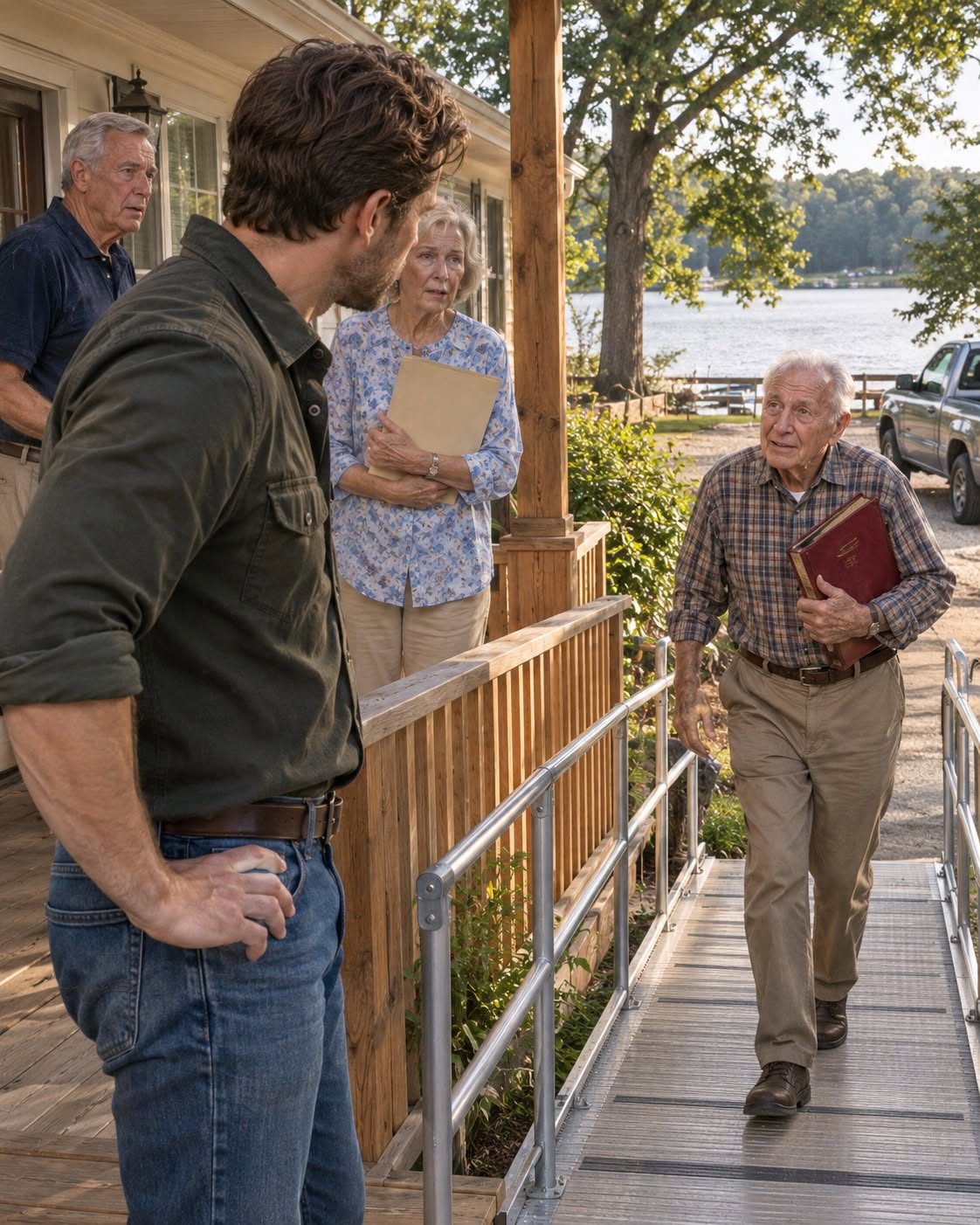
Oren continued.
“Maren wrote this after your son had been working with us for about six months. She wanted to tell you how much progress he was making. She thought you might be proud of him.”
I looked down again.
He has a remarkable talent for working with his hands. More importantly, he has a kind heart. He often gives away his lunch to younger workers who forget theirs, and he stays late to finish jobs even when nobody asks him to.
Last week, he made a small bird out of scrap metal. He told me he wanted to give it to his mother because he thought she might like something he had made himself.
My throat tightened.
I remembered that bird.
I had wrapped it in an old newspaper and carried it home on my bicycle. I had imagined placing it on the kitchen counter and watching my mother smile.
But when I arrived, Damon was complaining about a new pair of athletic shoes he wanted.
Mom had been busy arranging his upcoming birthday party.
I had put the bird in my bedroom drawer.
A week later, I gave it to Maren.
She had kept it on her kitchen windowsill for years.
I continued reading.
We would love for you to visit the workshop sometime. Your son has found something here that gives him confidence, and I suspect he would be very happy to show you what he is learning.
Every young person deserves to know that someone is proud of them.
The letter ended with Maren’s signature.
I slowly lowered the paper.
“Did you send this?” I asked.
Oren nodded.
“Twice. The first letter was sent by regular mail. When we received no answer, Maren sent another one.”
My father stared at the floor.
My mother suddenly became interested in the envelope.
“What does that have to do with us now?” she asked.
Oren didn’t answer immediately.
Instead, he picked up the photograph and turned it over.
There was another message written on the back.
The boy who thinks nobody is watching is becoming a man worth knowing.
Underneath it was a date.
Then, in different handwriting, someone had written a short sentence.
Please don’t tell him we came.
I recognized my father’s handwriting immediately.
The room seemed to tilt.
I looked at him.
“What is this?”
He rubbed his forehead.
“It’s nothing.”
“Dad. What does it mean?”
He glanced at my mother.
She looked away.
Oren folded his hands on the table.
“Your father visited our workshop about a month after Maren sent the second letter. He came alone.”
I couldn’t move.
My father had been there?
All those years, I had believed my parents never knew where I worked. I thought they had never cared enough to ask.
But apparently, my father had stood in that very workshop.
“What did he want?” I whispered.
Oren took a breath.
“He wanted to know whether you were being paid. Whether you had a future there. Whether we intended to keep you.”
My father finally spoke.
“I was worried about you.”
The words sounded so strange coming from him that I almost laughed.
“You were worried about me?”
“You were spending all your time there. You weren’t home much. I didn’t know what you were getting yourself into.”
Oren nodded slowly.
“Your father asked me whether we could give him the money you were earning. He said it would be better for the family if your wages were put toward household expenses.”
I stared at him.
My father had asked for my wages?
“Yes,” Oren continued. “I told him your money belonged to you. I also explained that we were teaching you a trade and paying you fairly. Your father wasn’t happy about that.”
My father raised his voice.
“That isn’t how it happened.”
“Then tell us how it happened,” I said.
He opened his mouth, but no explanation came.
Oren continued, his voice calm.
“He told me that Damon was preparing for an expensive sports program and that the family needed every dollar. He thought you should contribute because you weren’t the one with the bright future.”
The words hit harder than I expected.
Because I had heard something almost identical throughout my childhood.
Damon needed the opportunity.
Damon had potential.
Damon deserved the investment.
And I was supposed to understand.
I looked at my mother.
“Did you know?”
She pressed her lips together.
“Your father was trying to do what was best for everyone.”
“For everyone?” I repeated. “Or for Damon?”
Her eyes filled with tears.
“You don’t understand how difficult things were back then.”
“No,” I said quietly. “I don’t think I ever did.”
For a moment, nobody spoke.
Then Oren reached for the second sheet of paper.
“This is why Maren kept the letter and photograph together. She wrote a note after your father left.”
He handed it to me.
It was short.
Some parents see their children as separate people. Others see them as investments that must produce the results they expect. I hope this boy grows old enough to understand that he is not required to earn his place in the world.
I read it twice.
Then I folded the paper and placed it beside the ledger.
My father looked uncomfortable.
“That’s a very unfair interpretation of things,” he said.
“Perhaps,” Oren replied. “But I have another question. Why are you here today?”
My mother looked at him sharply.
“We already explained that. We are retiring. We need somewhere comfortable to live.”
Oren glanced at the folder.
“Is that all?”
My father held it tighter.
I had noticed the folder from the moment they arrived. I assumed it contained retirement paperwork or perhaps a list of modifications they wanted for the downstairs suite.
But now I noticed something else.
The top page had my address printed across it.
And beneath that was a heading.
Proposed Residential Transfer Agreement.
I took the folder from my father’s hands.
He immediately tried to pull it back.
“That’s private.”
“It’s about my house.”
I opened it.
The first page contained a proposed agreement giving my parents permanent residential rights to the downstairs suite, including access to the garden, driveway, and shared living spaces.
The second page was worse.
It contained a financial proposal.
My parents wanted me to pay for their living expenses, utilities, maintenance, and medical costs.
The agreement also included language suggesting that the arrangement would be considered an advance on my future inheritance.
I looked up.
“You want me to sign this?”
My mother nodded quickly.
“It’s just a formality. We thought it would make everything easier.”
“An advance on my inheritance?”
“Well, you know, eventually everything goes to the children.”
I stared at her.
“What inheritance?”
She looked toward my father.
He cleared his throat.
“Your mother’s family home.”
I almost smiled.
Their house.
The one I had helped repair after a storm when I was twenty-two.
The one where I had painted the fence for free every summer.
The one where I had been told there wasn’t enough money to help me buy my first welding equipment.
“You’re asking me to provide you with a permanent home,” I said slowly, “and you’re calling it an advance on an inheritance I might receive someday?”
My father became defensive.
“We’re your parents. We shouldn’t have to negotiate every little thing with our own son.”
I closed the folder.
“Then you shouldn’t have brought a contract.”
Oren said nothing.
He simply watched me, allowing me to make my own decision.
My mother began crying.
It wasn’t the quiet kind of crying I remembered from childhood. This was louder, more urgent, as if she believed tears might still change the outcome.
“We never imagined you would treat us like strangers.”
I looked at her for a long time.
“Mom, I didn’t treat you like strangers. I invited you inside. I listened to you. I even considered whether I could help. But you arrived with paperwork that would give you control over a house you never helped me build.”
She wiped her cheeks.
“We’re getting older. We don’t have forever.”
Neither did Maren.
Neither did the years I had spent hoping my parents would notice me.
I didn’t say that aloud.
Instead, I asked the question that had been bothering me since they arrived.
“Where is Damon?”
My father looked surprised.
“Why?”
“Because I assumed you would have asked your favorite son before coming to me.”
My mother stiffened.
“Damon has his own responsibilities.”
I waited.
My father finally sighed.
“His business didn’t work out. He and his wife have been having financial problems.”
There it was.
The familiar explanation.
Damon needed help.
Damon had circumstances.
Damon had responsibilities.
“And you sold your house?” I asked.
My mother looked down.
“We’re planning to.”
“Planning to?”
My father hesitated.
“We already signed the agreement. The sale closes next month.”
I felt something cold settle in my stomach.
“You sold your house before asking me whether you could live here?”
My mother nodded weakly.
“We thought you would say yes.”
I looked at the two people standing in my doorway.
They had made a decision about their future using a room that belonged to me.
They had counted on my silence, my old habit of accommodating everyone, and the guilt they had spent years teaching me to carry.
“Does Damon know you’re coming here?”
My father nodded.
“He knows we’re looking for somewhere to stay.”
“Did he offer you his home?”
My mother shook her head.
“He has children. It’s complicated.”
I nearly laughed.
Of course it was.
It had always been complicated when Damon was expected to give something.
But it had always been simple when I was expected to sacrifice.
I walked to the window overlooking the lake.
The afternoon sun was reflecting off the water, and a pair of ducks were moving slowly along the shoreline.
I remembered being seventeen, riding my bicycle past this same stretch of countryside, wondering whether I would ever have a place that felt like mine.
I had built this house for one reason.
To have a place where nobody could make me feel like I didn’t belong.
And now the people who had taught me that feeling were standing in my doorway asking to move in.
I turned around.
“I won’t sign this agreement.”
My mother’s face fell.
“But where are we supposed to go?”
I looked at Oren.
He gave the smallest nod, almost as if he were reminding me that kindness and surrender were not the same thing.
“I’ll help you find somewhere safe,” I said. “I’ll help you understand your options. I’ll even contribute to a reasonable short-term arrangement if necessary.”
My father looked relieved.
“But you cannot move into my house. And I won’t give you permanent rights to a room here.”
His expression changed immediately.
“So that’s it? After everything we did for you?”
The question landed like an old wound.
For years, I had imagined hearing those words and finally having the perfect response.
But when the moment arrived, I didn’t feel angry.
I felt tired.
“You fed me. You gave me clothes. You sent me to school. I know those things mattered. But being a parent isn’t a lifetime loan that your child has to repay by giving up his boundaries.”
My father shook his head.
“You’ve changed.”
“Yes,” I said. “I had to.”
My mother looked at Oren.
“You seem to have a lot of influence over him.”
Oren smiled sadly.
“No, ma’am. I simply taught him that he had value before anyone else agreed.”
My mother turned away.
I thought the conversation was over.
Then Oren reached into his coat again.
“There is one more thing,” he said.
He placed a third document on the table.
It was an old business certificate, accompanied by a letter bearing the official seal of the county.
My name appeared at the top.
“What is this?”
Oren looked at me.
“Maren and I created a trust when the company began expanding. It was intended to protect the portion of the business that belonged to you. We updated it when you became a full partner.”
I nodded.
I remembered the arrangement. It had been one of the first lessons Oren taught me about building something that could survive beyond the people who created it.
“What about it?”
“Three months ago, we received a letter from an attorney representing someone who claimed to be a member of your immediate family. They requested information about your ownership and suggested that your parents had a financial interest in the business.”
My father went pale.
I looked at him.
“Did you contact my attorney?”
He shook his head too quickly.
Oren placed another paper beside the certificate.
It was a copy of the request.
The signature at the bottom belonged to Damon.
I stared at it.
“Why would Damon do that?”
Oren answered carefully.
“Apparently, he had been telling people that your business was built with family money. He also suggested that your parents had provided the original investment.”
My mother sat down.
“That can’t be right.”
Oren looked at her.
“Isn’t it?”
She didn’t answer.
My father suddenly became very interested in the lake outside.
I felt the last pieces of the story begin to connect.
The folder.
The proposed inheritance agreement.
The assumption that I would provide them with a home.
And Damon’s sudden interest in my business.
“Is this why you came?” I asked.
My father looked offended.
“Don’t be ridiculous.”
“Then why did Damon contact my attorney?”
“He was just trying to understand things,” my mother said.
“Understand what?”
She hesitated.
Then she spoke so softly I almost didn’t hear her.
“He thought perhaps you could help him get back on his feet.”
I stared at her.
“By claiming my company was partly funded by the family?”
“He didn’t mean any harm.”
Oren closed the ledger.
“Intentions don’t erase consequences.”
My father stood abruptly.
“This is getting out of hand. We came here because we needed help. Now we’re being accused of things we never intended.”
I looked at the documents.
Then I looked at the little metal bird beside the front door.
For the first time, I understood that the real test wasn’t whether I could finally tell my parents no.
It was whether I could do it without becoming the kind of person they had taught me to fear.
I picked up my phone and called my attorney.
I put the call on speaker.
When he answered, I explained that my parents were present and that I wanted clarification about the letter Damon had sent.
My attorney was quiet for a moment.
Then he said something that made my father sit back down.
“Your brother’s representative requested a valuation of the company and copies of the original partnership agreements. They also suggested that your parents might be entitled to a share because they had supported your education and early development.”
I closed my eyes.
There it was.
They had not simply come looking for a spare bedroom.
They had begun building a story in which my success belonged partly to them.
“Is there any basis for that claim?” I asked.
“No. Your records are complete. Your ownership is documented. The original partnership agreement, investment records, and tax filings establish the source of the business assets.”
My attorney paused.
“I’ve already sent a formal response. There is no legal basis for the claim.”
My father stood again.
“We never said we wanted his business.”
I looked at him.
“Then why did you let Damon make that claim?”
He didn’t answer.
The call ended.
For a few seconds, the only sound was the soft movement of the lake against the wooden dock.
Then my mother said something I had never expected to hear.
“Your father was afraid.”
I turned toward her.
“Of what?”
She looked at him, then back at me.
“Of how successful you became.”
My father stared at her.
“Don’t start.”
But she continued.
“When you left home, we thought you would come back eventually. We thought the workshop was just a phase. Then you started making money. You bought equipment. You bought that first building. Every year, you seemed to need us less.”
I didn’t know what to say.
She wiped her eyes.
“Damon was always struggling. We kept trying to help him because we thought he needed us. And when you became successful, your father couldn’t understand why you never came home to share it.”
I looked at her.
“You mean why I never came home to give you some of it?”
She flinched.
“Maybe.”
That was the closest thing to honesty I had heard from her in decades.
My father finally spoke.
“We made mistakes.”
I waited.
He looked at the red ledger.
“I suppose we didn’t realize how much.”
Oren leaned back in his chair.
“Realizing something is the beginning. It isn’t the same as repairing it.”
My father nodded slowly.
For once, he didn’t argue.
My mother looked toward the downstairs suite.
It was a beautiful space. A bedroom with large windows, a small sitting area, a private bathroom, and a door that opened directly onto the garden. I had designed it with accessibility in mind after watching Maren struggle with the stairs during her final illness.
She had once told me that a home should make life easier for the people living in it.
That was why I had built the ramp.
Not because I expected anyone to demand a place there.
But because I wanted the people I loved to be able to come and go without pain.
My mother followed my gaze.
“Is that where Maren would have stayed?”
I nodded.
“She helped me design it.”
Mom looked at the room for a long moment.
“She must have been very special.”
“She was.”
“More than we were?”
The question surprised me.
I thought carefully before answering.
“She never asked me to prove I deserved a place at her table.”
My mother looked down.
I could see that she understood.
But understanding and changing were two different things.
Oren stood and picked up the ledger.
“I think it’s time for me to head home.”
I walked him to the door.
Before he stepped outside, he turned toward me.
“Maren used to say that a family is measured by what people are willing to give each other without keeping score.”
He smiled faintly.
“She would have been proud of you today.”
I swallowed hard.
“I wish she were here.”
“So do I.”
He touched my shoulder.
Then he looked back toward my parents.
“Remember something. You can offer someone a second chance without handing them the keys to everything you’ve built.”
And with that, he walked down the ramp.
I watched him until he disappeared behind the trees.
When I returned to the entrance, my parents were still standing there.
My father had put the folder under his arm.
My mother was holding her purse with both hands.
“Can we at least talk about somewhere else?” she asked.
I nodded.
“Of course.”
I brought them into the kitchen and made coffee.
It was strange, sitting across from them at my own table. I had spent so many years imagining this moment that I hadn’t considered what it would actually feel like.
There was no dramatic music.
No sudden apology that healed everything.
Just three people sitting around a wooden table, finally forced to acknowledge the distance between them.
We talked about their financial situation.
They had sold their house to pay off debts connected to Damon’s failed business. He had borrowed money, fallen behind on payments, and convinced them to use their savings to help him keep the business open.
When it eventually collapsed, he had moved into a rental apartment with his family.
My parents had assumed they would have enough money from the house sale to retire comfortably.
But after paying off the loans and other obligations, they had far less than expected.
They had come to me because they believed I had plenty.
And because, in their minds, I had always been the child who could be asked to sacrifice without making a scene.
I listened.
I didn’t interrupt.
When they finished, I asked whether they had spoken to a financial adviser.
They hadn’t.
So I offered to arrange an appointment with an independent adviser and help them compare several retirement communities.
I also offered to pay for one month of temporary accommodation while they made a decision, provided they agreed to a written budget and didn’t involve Damon in any financial arrangements without professional advice.
My father looked surprised.
“You’d still help us?”
“I said I wouldn’t give you my house. I didn’t say I wanted you to suffer.”
My mother began crying again, but this time she didn’t try to use the tears to change my decision.
She simply sat there and let them fall.
Then my father did something I had never seen him do.
He apologized.
Not with a speech.
Not with an excuse.
He looked at me and said, “I should have protected you when you were young. Instead, I kept asking you to understand why your brother needed more. I never asked what you needed.”
I stared at him.
Those were the words I had wanted to hear since I was a child.
I thought they would make everything feel better.
They didn’t.
But they mattered.
My mother reached across the table.
“I should have noticed you were lonely.”
I looked at her hand.
For a moment, I considered taking it.
Then I placed my own hand over hers.
“I was,” I said. “For a very long time.”
She nodded.
And for once, she didn’t tell me I was being dramatic.
They left just before sunset.
My father carried the folder.
My mother paused at the door and looked at the metal bird hanging beside it.
“Did you make that?”
I nodded.
She touched its little steel wings.
“It’s beautiful.”
“It’s a reminder.”
“Of what?”
“That broken pieces can become something useful. But somebody has to be willing to put in the work.”
She looked at me.
“I hope someday you’ll let us try.”
I didn’t promise anything.
I simply said, “We’ll see.”
After they drove away, I sat on the porch until the sky turned dark.
I thought the story would end there.
But it didn’t.
Three days later, Damon called.
I almost didn’t answer.
His name appeared on my phone, and I stared at it long enough for the screen to dim.
Eventually, curiosity won.
“Hello?”
“Hey,” he said.
His voice was exactly as I remembered: confident, casual, as if we had spoken yesterday.
“I heard Mom and Dad visited you.”
“They did.”
“And you wouldn’t let them stay?”
I leaned back in my chair.
“They asked me to sign a permanent residential agreement. I said no.”
He sighed.
“Come on. They’re our parents.”
I looked out at the lake.
“Where were you when they needed somewhere to live?”
“That’s different.”
“Why?”
“I have kids. I have a family.”
I closed my eyes.
There it was again.
The old argument.
The same one that had followed me through childhood.
“Damon, I have a family too. Even if it isn’t the one you remember.”
He went quiet.
Then he said, “Look, I need to ask you something.”
I waited.
“Could you invest in a new business idea?”
I actually laughed.
Not because it was funny.
Because it was so familiar that it almost hurt.
“What kind of business?”
“An outdoor recreation company. I’ve got a great plan. I just need some starting capital.”
“How much?”
“Maybe two hundred thousand.”
I stared at the phone.
Two hundred thousand dollars.
He had not called to apologize.
He had not called to ask how I was.
He wanted money.
Again.
“I can’t help you with that.”
“You haven’t even heard the plan.”
“I don’t need to.”
“You’ve got plenty of money. What are you going to do with all of it?”
I thought about Oren.
About Maren.
About the years I had spent learning how to turn discarded pieces of steel into something strong.
“I’ll use it to build things that matter to me.”
Damon laughed bitterly.
“You’ve become selfish.”
“No,” I replied. “I’ve finally become responsible for my own life.”
He hung up.
I didn’t call him back.
That evening, I took the little metal bird from the shelf and carried it down to the workshop.
It was the original one.
The crooked bird I had made when I was seventeen.
Maren had kept it in a glass cabinet for years, and Oren had given it to me after she passed away.
Its wings were uneven.
One leg was shorter than the other.
There were tiny marks where I had struck the metal too hard.
But it was still beautiful.
I placed it on my workbench.
Then I had an idea.
For the next several months, I worked on something new.
I spoke with Oren about creating a training program for young people who had grown up without much support. We would teach them welding, metal fabrication, equipment maintenance, and practical business skills.
We would pay them.
Not promise them future opportunities.
Not ask them to work for free.
Pay them.
We would also provide transportation assistance and meals for those who needed them.
Oren loved the idea.
He said Maren would have called it the best project we had ever built.
We named it The Little Bird Project.
The first class began in the spring.
There were twelve students.
Some had left school early. Some had been raised by relatives. One young man had spent most of his childhood moving between foster homes.
I recognized the look in his eyes immediately.
It was the same look I had carried at seventeen.
He rarely spoke.
He worked carefully, stayed late, and apologized whenever he made a mistake.
One afternoon, I found him trying to repair a piece of scrap metal that had bent under pressure.
“It’s ruined,” he said.
I picked it up and examined the damage.
“No, it’s just different from what you expected.”
He frowned.
“Can it still be used?”
I smiled.
“That’s usually the interesting part.”
I showed him how to heat the metal, reshape it, and reinforce the weak point.
He watched closely.
Then he tried again.
By the end of the afternoon, he had made a small bird.
It wasn’t perfect.
One wing was slightly crooked.
But when he held it up, his face lit with a smile.
“Can I keep it?”
I looked at him.
“It’s yours.”
He stared at me as if he wasn’t sure he had heard correctly.
“Really?”
“Really.”
He tucked it carefully into his backpack.
And I remembered Maren.
I remembered the lunches, the quiet encouragement, the way she had never made me feel like a burden.
Sometimes the most important thing someone gives you isn’t money or opportunity.
It’s the feeling that you matter.
About six months later, my parents visited again.
This time, they called first.
I was in the workshop when my assistant told me they were waiting outside.
I walked to the entrance.
They looked different.
My father had lost weight. My mother carried a small paper bag.
Neither of them had a folder.
“Hello,” I said.
My mother smiled nervously.
“We were wondering if you had a few minutes.”
I nodded.
We sat in the small garden beside the workshop.
My mother opened the bag and took out a little metal bird.
It was clumsy and uneven.
Its wings were slightly too large, and its tail leaned to one side.
But it was clearly made with care.
“I made this,” she said.
I picked it up.
“You made it?”
She nodded.
“I signed up for a beginner’s metalworking class at the community center. Your father came with me.”
My father gave a small, embarrassed smile.
“We weren’t very good.”
I turned the bird over.
There were tiny letters scratched into its underside.
For the son we should have seen.
I felt my throat tighten.
My mother looked down.
“I don’t expect this to fix anything. I just wanted to make something for you. Something that came from my own hands.”
I held the bird for a long time.
It wasn’t an apology that erased the past.
It couldn’t return the money they had taken or the birthdays I had spent feeling invisible.
But it was the first thing they had ever made for me without expecting something in return.
“Thank you,” I said.
My father cleared his throat.
“We’ve been thinking about what you said. About the retirement arrangements.”
I nodded.
“We found a small apartment in a senior community. It’s affordable, and there are people around.”
“That’s good.”
“We’re managing,” he added. “Your mother has started volunteering at the local food pantry.”
My mother smiled.
“Your father helps repair things there.”
I looked at him.
“Repair things?”
He nodded.
“Shelves. Chairs. A few broken cabinets. Nothing complicated.”
For the first time, I saw something in his expression that I had never seen when I was growing up.
Humility.
He wasn’t telling me how useful he was.
He was simply describing something he had learned to do.
“We don’t want to ask you for money anymore,” he said. “We want to try to have a relationship with you.”
I studied his face.
“And what does that look like?”
He thought for a moment.
“I suppose it starts with asking how you’re doing.”
I smiled faintly.
“That’s a good place to start.”
We talked for nearly an hour.
They asked about the business.
They asked about the students.
My mother wanted to know about Oren.
And for the first time, they listened without trying to turn every conversation toward Damon.
Before leaving, my father stood beside me.
“Do you think you could ever forgive us?”
I looked at him.
I could have given him an easy answer.
I could have said yes and made everyone feel better.
But I had learned that honesty was worth more than a comfortable lie.
“I don’t know,” I said. “But I think I can get to know you again. If we’re both willing to start from the beginning.”
He nodded.
“That’s fair.”
They left without asking to see the downstairs suite.
And I noticed something important.
I didn’t feel guilty watching their car disappear down the road.
I felt peaceful.
That evening, I called Oren and told him about the visit.
He listened quietly.
Then he chuckled.
“So, they made you a bird?”
“Yes.”
“Was it crooked?”
“Very.”
“Good,” he said. “The perfect ones are usually the least interesting.”
I laughed.
Then I told him about the little message underneath it.
He was silent for a moment.
“Maren would have liked that.”
I looked toward the lake.
The sun was setting behind the hills, painting the water in shades of gold and orange.
“Do you think she would have forgiven them?”
Oren took a long breath.
“I think she would have given them the chance to show they had changed. But she would never have confused that chance with an obligation.”
I wrote those words down after we hung up.
I wanted to remember them.
A year passed.
The Little Bird Project grew from twelve students to thirty.
We opened a second workshop and partnered with a local technical school. Several of our graduates found full-time jobs. Two started small businesses of their own.
One of them eventually became our youngest instructor.
Every year, we held a gathering at the lake house.
Not a fancy event.
Just a meal, some music, and a table filled with metal birds made by the students.
Oren always sat near the end of the table.
He brought Maren’s old red ledger and told stories about the early days.
And every year, I added a new entry.
Not about contracts or profits.
About people.
About the young woman who had arrived terrified of using welding equipment and left with a job offer.
About the quiet boy who had made his first bird and later returned to teach another student.
About the father who had learned to listen.
And about the mother who had finally discovered that love was not measured by what a child could provide.
My parents came to the second gathering.
They brought a homemade dessert and helped arrange the chairs.
They didn’t ask for special treatment.
They didn’t expect me to introduce them as the most important people in my life.
They simply showed up.
And that was enough for that day.
My relationship with them never became perfect.
There were still uncomfortable conversations. There were still moments when old habits appeared.
Sometimes my mother slipped into comparing me with Damon. Sometimes my father became defensive when I mentioned the past.
But I learned to speak up without shouting.
And they slowly learned that being allowed into my life was a privilege, not a right.
Damon never joined the project.
He eventually found work in another industry and moved his family to a different state. We exchanged occasional messages, mostly around holidays.
I stopped waiting for him to become the brother I had needed as a child.
That was another kind of freedom.
On the third anniversary of Maren’s passing, Oren came to the lake house carrying the red ledger.
We sat on the porch together as the evening settled around us.
He opened to the last page.
There was a blank space beneath the final entry.
“Your turn,” he said.
I took the pen.
For a moment, I didn’t know what to write.
Then I thought about the boy on the bicycle.
The one who had believed he needed to become successful before he deserved to be loved.
The one who had thought a beautiful house, a successful business, and a bank account could somehow prove that he had always been worth something.
I finally wrote:
The greatest thing we built was never the company, the workshop, or the house by the lake.
It was a place where people could arrive feeling unwanted and leave knowing they mattered.
I put the pen down.
Oren read the words and smiled.
“That’s a good entry.”
I looked toward the front door.
The original crooked bird was still hanging beside it, moving gently in the evening breeze.
The downstairs suite remained empty.
Not because I was waiting for someone to earn the right to live there.
Not because I was punishing my parents.
But because I had built that room for a purpose, and I had finally learned that I was allowed to decide what that purpose would be.
Sometimes people mistake forgiveness for opening every door.
They think loving someone means giving them unlimited access to your life.
But I had learned something different.
You can forgive without forgetting.
You can help without surrendering.
You can love people while refusing to repeat the patterns that once hurt you.
And you can build a family from people who choose to show up, even when they have no obligation to stay.
That night, before going to bed, I touched the little metal bird beside the entrance.
Its crooked wings caught the porch light.
I thought about Maren’s words.
The strongest things weren’t always made from perfect materials.
They were made from pieces that had survived being broken.
And perhaps that was what my life had become.
Not a perfect story.
Not a story without pain.
Just something meaningful, built carefully from what remained.
For the first time in my life, I didn’t feel like the child standing outside someone else’s home, hoping to be invited in.
I was home.
And this time, I knew I belonged.