The day my mother demanded money inside my own workshop, she looked at me with the same cold contempt she
I didn’t sleep that night.
The photograph remained open on my phone, showing the cardboard box, the dark porch, and the front door that had marked the end of my childhood.
Whoever had taken it had been standing across the street, far enough away to remain unnoticed.
I enlarged the image until the details dissolved into blurry pixels.
Then I noticed something I hadn’t seen before.
A second envelope was tucked beneath the box, partly hidden by the porch railing.
It wasn’t the note my mother had left for me.
Someone had placed something else there.
I called the unknown number, but the phone rang once before switching to voicemail.
I tried again.
Nothing.
At six the next morning, I drove to Rafael’s garage.
He was opening the bay doors when my van pulled into the lot.
He took one look at my face and put down his coffee.
“What’s happened?”
I showed him the photograph.
He studied it longer than I expected.
“Where did you get this?”
“Someone sent it last night.”
Rafael walked into his office without answering.
When he returned, he carried a dusty metal toolbox that I recognized immediately.
It had been among the broken tools in the cardboard box on my birthday.
I’d left it at his garage years ago after buying better equipment, and he’d kept it because he believed old tools deserved a second chance.
“Your mother didn’t give you everything that was in that box,” he said quietly.
I stared at him.
“What does that mean?”
He placed the toolbox on the workbench and ran his fingers over a dent near the handle.
“On the night you arrived here, you told me your family had thrown you out. A week later, a woman came asking whether I’d seen a teenage boy carrying a blue metal toolbox.”
“My mother?”
“I thought so. She said you’d stolen something from the house.”
My stomach tightened.
“Why didn’t you tell me?”
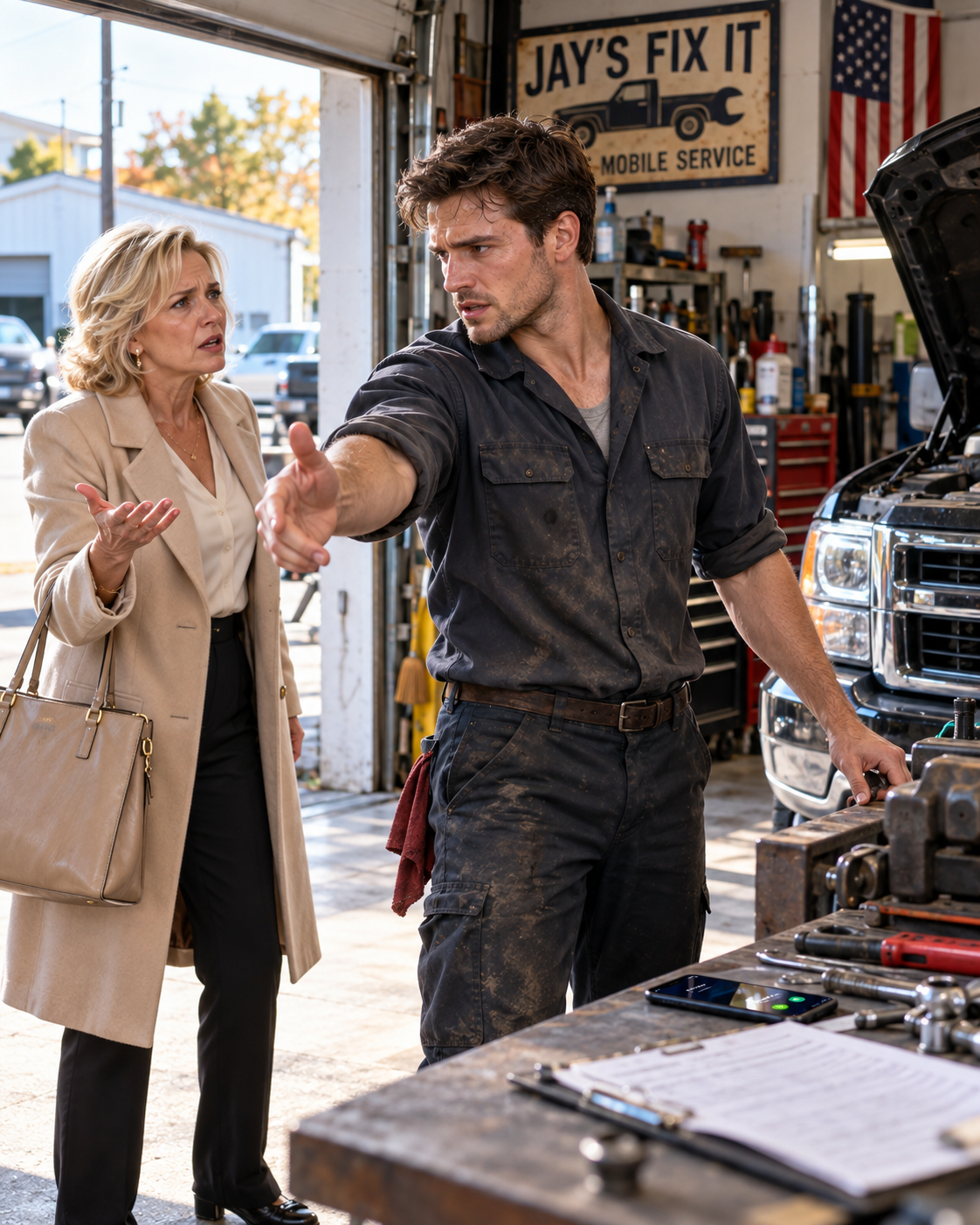
“Because I didn’t know what was true, and you were barely holding yourself together. You needed somewhere safe to sleep, not another reason to believe the world was against you.”
He turned the toolbox over.
One of its metal panels had been replaced with a thinner sheet, fastened by four small screws.
I’d repaired engines for years, yet somehow never noticed it.
Rafael handed me a screwdriver.
Inside the panel was a small envelope wrapped in plastic.
My name was written across it in my father’s handwriting.
My father had died when I was twelve.
I had spent years believing that he left behind little more than an old watch, a handful of photographs, and debts my mother complained about whenever Tommy wanted something expensive.
My fingers trembled as I opened the envelope.
The letter was brief.
“Jay, if you’re reading this, something has happened that I feared but couldn’t prevent. Your mother knows about the money I set aside for your future. I told her it was yours alone, to be used for your education or to help you start a trade. Tommy has already asked for it, and I’ve refused him. Keep the account documents safe. Don’t let anyone convince you that being born into this family means surrendering what belongs to you.”
A bank account number was written at the bottom.
I read the letter three times.
Then I looked at Rafael.
“Did you know about this?”
“No,” he answered. “But I remember your father. He came into the garage once when you were little. He talked about how proud he was that you liked taking things apart to understand how they worked.”
I sat down.
My father had known what Tommy was becoming long before I understood it myself.
But the letter raised a question that hurt more than the discovery itself.
If my mother knew about the money, had she thrown me out to take it?
I called the bank listed on the letter.
After a lengthy verification process, a representative confirmed that an account had once existed in my name, established by my father, but had been closed years earlier.
I asked where the funds had gone.
She couldn’t disclose the details over the phone, but she explained that the bank could provide historical records after verifying my identity and reviewing the account’s legal documentation.
I arranged an appointment.
For the next two days, I tried to work normally.
I replaced a customer’s alternator, repaired a delivery van, and answered calls from people who trusted me to show up when their vehicles failed.
Yet every time my phone buzzed, I wondered whether the next message would reveal another piece of the past.
Meanwhile, the sabotage continued.
A commercial client canceled a contract worth thousands of dollars, claiming they had received evidence that I was overcharging customers.
The allegations were fabricated, but the damage had already begun.
I called the client and requested a meeting.
Instead of arguing, I brought copies of my invoices, service records, and customer references.
By the time I finished explaining the discrepancies, the manager looked embarrassed.
“Someone called us from a number registered under your brother’s name,” he admitted. “They claimed they used to handle your books.”
I had never allowed Tommy near my accounts.
I thanked the manager and left with the contract restored, but the incident confirmed what I had suspected.
My family wasn’t simply asking for help.
They were trying to make me financially vulnerable so that I would eventually turn to them, negotiate with them, or pay them to stop.
That evening, Mary Ann called.
“Your brother tells me you’re spreading lies about us.”
“I haven’t spoken to Tommy.”
“Then why is he saying you’ve accused him of stealing?”
“Because I asked the bank about an account my father opened for me.”
Silence settled between us.
It was only a second, perhaps two, but it told me more than any confession could have.
“What account?” she asked.
I closed my eyes.
“You know exactly what account.”
Her voice changed.
“Jay, there are things about your father’s finances that you don’t understand.”
“Then explain them.”
“Not over the phone.”
“Fine. Send me the records.”
She hung up.
The next morning, I went to the bank.
A representative reviewed the documents I brought and explained that the account had been closed when I was seventeen.
The withdrawal had been authorized by my legal guardian, and the funds had been transferred to another account.
The surviving records showed the destination account’s last digits and the name of the institution that received the transfer.
It was enough to establish a trail, but not enough to prove where every dollar had ultimately gone.
I requested certified copies of the available records and asked what further steps were possible.
The representative gave me the information for the bank’s records department and recommended that I consult an attorney if I suspected unauthorized use of the funds.
Outside, I sat in my van and stared at the paperwork.
My father had saved money so I could build a future.
Someone had emptied that account while I was still a child.
And when I needed a home, the people responsible had left me sleeping beneath a park shelter.
I wanted to drive straight to my mother’s house and demand answers.
Instead, I called Trevor.
He listened without interrupting, then asked one question.
“What do you want most, Jay? The money, or the truth?”
I looked at the documents resting on the passenger seat.
“Both.”
“Then don’t let anger make you careless. Get proof. Protect your business. And don’t give them anything they can twist against you.”
Trevor had helped me build a budget when I could barely afford groceries.
Now he reminded me of another lesson.
Desperation makes people easy to manipulate.
I wasn’t going to let my family use my anger against me.
I hired an attorney named Melissa Grant, who reviewed the account records and explained what we could investigate legally.
She made no promises about recovering the money.
The account had been closed years earlier, and the available records were incomplete.
But she agreed that the timing deserved closer examination, especially given the threats and interference with my business.
Then she asked whether I had kept any documents from my childhood.
I thought about the toolbox.
And the letter.
A week later, another message arrived from the unknown number.
This time, it contained a photograph of an old family gathering.
My father stood beside a birthday cake, one hand resting on my shoulder.
Tommy stood on his other side, smiling at the camera.
Behind them, my mother was watching my father rather than the photographer.
On the back of the photograph, someone had written a date and a short sentence.
“Your father changed his will three weeks before he died.”
I felt the room tilt.
My father had been sick for months before his death, but nobody had ever mentioned a will.
Melissa examined the photograph and suggested we obtain the relevant probate records.
The records revealed that my father had left specific instructions concerning the money intended for my future.
The documents didn’t prove that my mother had committed a crime, but they raised serious questions about whether his wishes had been followed.
There was also a reference to a letter held by the attorney who had handled his estate.
We contacted the law office.
The original attorney had retired, but his successor located a sealed file in storage.
Inside was a copy of my father’s will, along with a letter addressed to me.
Melissa read the legal documents first, then slid the personal letter across her desk.
I recognized my father’s handwriting immediately.
“Jay, I know your mother loves you, but love can become confused with fear, and fear can make people choose the wrong things. If anyone ever tells you that your future belongs to the family, remember that I set aside this money because I wanted you to have choices. You owe nobody your freedom in exchange for being allowed to exist.”
I had to stop reading.
For years, I had imagined my father as someone who might have protected me if he had lived.
Now I was discovering that he had tried to protect me even after he was gone.
The will named me as the beneficiary of the funds intended for my future, subject to the arrangements described in the estate documents.
Melissa explained that the next step was to establish exactly how those funds had been transferred and whether any legal claim remained available.
We would need more records.
We would need patience.
And we would need to keep my family from learning everything before we were ready.
But Tommy had already begun to panic.
Two days later, he appeared at my workshop.
He came alone, wearing an expensive jacket that didn’t fit his shoulders and carrying the expression of a man who had rehearsed an apology in the car.
“Can we talk?”
I kept working.
“You have five minutes.”
He glanced at the employees moving around the garage, then lowered his voice.
“Mom says you’re digging into Dad’s finances.”
“I’m asking questions about my own account.”
“You don’t understand what happened back then.”
“Then help me understand.”
Tommy rubbed his jaw.
“Dad was sick. There were bills. Mom was scared we’d lose everything.”
“So you took the money?”
His eyes flashed.
“I didn’t take anything.”
“Then why did the account disappear?”
He looked toward the office, where my business magazine article hung beside the framed license.
“You’ve got a good life now, Jay. You should let this go.”
There it was again.
The same demand disguised as advice.
I stepped away from the vehicle I was repairing.
“Did you contact my customers?”
He said nothing.
“Did you tell people I was dishonest?”
“I was trying to get your attention.”
“You could have called.”
“You never answer Mom.”
“Because she calls when she wants money.”
His face reddened.
“You think you’re better than us because you have a business?”
“No. I think I’m different because I don’t believe being family gives me the right to hurt people.”
For a moment, I saw something in him that looked almost like shame.
Then it vanished.
“Mom is going to lose her house,” he said. “The bank is coming after her. If you help us now, we can put everything behind us.”
I studied him.
“How much do you owe?”
He named a figure that made my stomach tighten.
It was far more than a family emergency.
It was the kind of debt that could swallow years of careful work.
“Where did the money go, Tommy?”
He stared at the concrete.
“Investments. A business deal. Things didn’t work out.”
“And you thought you could use my name to fix it?”
“I thought you’d help if you knew how bad it was.”
“You didn’t tell me how bad it was. You tried to ruin my business.”
He took a step toward me.
“Just give me a chance to make this right.”
I wanted to believe him.
Some small part of me still remembered the boy who had once shared a bedroom with me, who had sneaked me extra dessert when our father wasn’t watching, who had laughed with me before money and resentment poisoned everything.
But memories weren’t proof of change.
“What would you do if I gave you the money?” I asked.
He hesitated.
That hesitation answered me.
“I can’t save you from choices you refuse to face.”
He left without apologizing.
That evening, Melissa called with an update.
The records we had obtained suggested that a substantial portion of the original funds had been transferred to an account associated with my mother, then moved again.
We still couldn’t establish the final destination of every dollar, and the evidence wasn’t sufficient to accuse anyone publicly.
But Melissa believed there was enough to request additional documentation and determine whether further legal action was warranted.
Then she told me something else.
My father had arranged for a separate letter to be delivered to me when I turned eighteen.
The letter had never reached me.
The law office’s archived correspondence showed that it had been returned as undeliverable.
The address on the envelope was our old house.
Someone had written a note across the front.
“Recipient no longer lives here.”
The handwriting belonged to my mother.
I sat in silence as Melissa explained what the document could and couldn’t prove.
It didn’t establish why the letter had been returned, but it showed that someone had known my father wanted me contacted and that I had not received the message.
I asked for a copy.
Then I drove to the park where I’d spent my first nights alone.
The shelter had been replaced, and the old picnic tables were gone.
Children played near the path while a man walked his dog beneath the trees.
I sat on a bench and unfolded the letter.
My father had written about practical things first: the importance of learning a trade, keeping promises, and never spending money simply to impress people who didn’t care about me.
Near the end, his handwriting grew unsteady.
“If your mother tells you that leaving was necessary, ask her what she was afraid of. I hope she never makes you choose between protecting yourself and being loved. But if she does, protect yourself. Love should never require you to disappear.”
I cried there, quietly, with the letter trembling in my hands.
Not because I wanted my old life back.
Because I finally understood how long I had spent believing that being abandoned meant I hadn’t been worth keeping.
It didn’t.
I had been a child who deserved protection.
The failure had never been mine.
The following week, Melissa sent formal requests for the remaining records and advised me to preserve every message connected to the threats against my business.
I changed my account passwords, strengthened access to my scheduling system, and spoke with my staff about verifying all customer changes directly.
I also sent a written notice to Tommy and Mary Ann telling them to stop contacting my clients and to direct any financial or legal matters through my attorney.
I didn’t threaten them.
I didn’t insult them.
I simply established a boundary they could no longer pretend not to understand.
For several days, nothing happened.
Then my mother arrived at the workshop again.
This time, she wasn’t carrying her expensive handbag.
She held a manila folder against her chest, and her face looked older than I remembered.
“I brought something you should see,” she said.
I didn’t invite her inside.
“Leave it there.”
“Jay, please. Just listen to me.”
I watched her fingers tighten around the folder.
For the first time, she looked less angry than frightened.
“Your father wanted you to have that money,” she whispered. “Tommy was falling apart, and I thought I could help him without hurting you.”
“You knew what Dad had written.”
Her eyes filled with tears.
“I thought I’d replace it before you ever found out.”
“But you didn’t.”
“No.”
The word came out so softly that I almost missed it.
She looked down at the folder.
“Tommy kept telling me he could recover everything. Then the debts grew. I kept covering them because I thought if I stopped, he’d destroy himself.”
“And when I needed you?”
She closed her eyes.
“I told myself you were strong enough to survive.”
I felt something cold settle in my chest.
“You didn’t know that. You just needed to believe it.”
She began to cry.
I didn’t move to comfort her.
For years, I had been the one who needed someone to tell him everything would be all right.
Nobody had.
My mother held out the folder.
Inside were bank statements, old correspondence, and a handwritten page containing figures and dates.
They might help Melissa establish a clearer financial trail, but they weren’t a complete confession, and they didn’t answer every question.
I accepted the folder without accepting the apology she seemed to expect in return.
“I’m sorry,” she said. “I know that doesn’t fix anything.”
“No,” I replied. “It doesn’t.”
She looked at me with an expression I couldn’t quite name.
“Can you ever forgive me?”
I thought about the park shelter, the gas station restroom, and the first night I had slept in my rented room without worrying that someone would chase me away.
I thought about Rafael offering me work when I had nothing to offer him.
I thought about Trevor teaching me to save money because he wanted me to have a future.
Then I looked at my mother.
“Maybe one day,” I said. “But forgiveness doesn’t mean you get access to my life.”
She nodded slowly.
For once, she didn’t argue.
After she left, I gave the folder to Melissa.
The investigation continued for months.
Some questions were answered, while others remained buried beneath incomplete records and conflicting memories.
We pursued the avenues available to us, but I learned that discovering a painful truth and proving every part of it were two different things.
I didn’t get my seventeenth birthday back.
I didn’t recover the years I had spent believing I was disposable.
And I couldn’t force Tommy to become the person my father had hoped he would be.
But I could protect my business.
I could refuse to fund his debts.
I could tell the truth without turning my pain into another weapon.
Eventually, Tommy entered a debt-repayment arrangement and was forced to sell several things he had bought to maintain appearances.
Mary Ann downsized her home.
Neither of them received money from my company, and neither was allowed to contact my customers again.
I didn’t celebrate their losses.
I simply stopped treating their problems as obligations I had to solve.
Months later, I returned to Rafael’s garage with a new set of tools for his apprentices.
He protested that I had spent too much.
I told him it was an investment in people who needed a chance.
He smiled.
“Funny how life works, isn’t it?”
I looked around the garage where my adult life had begun.
“Sometimes someone gives you one good day, and you spend years learning how to build a future out of it.”
He put a hand on my shoulder.
“You did the building, Jay.”
That night, I placed my father’s letter in a frame beside the business magazine article.
The two pieces of paper told the story of my life better than any photograph could.
One reminded me that someone had believed in my future before I knew how to imagine one.
The other reminded me that I had built that future with my own hands.
I no longer needed my mother to admit every detail of what she had done.
I no longer needed Tommy to confess before I could move forward.
Their choices belonged to them.
My life belonged to me.
Still, some nights, when I locked the workshop and turned off the lights, I remembered the boy standing on a dark porch with a cupcake in one hand and a box of broken tools at his feet.
I wished I could go back and tell him that the night would not last forever.
That strangers would become family in ways he couldn’t yet understand.
That one day, he would own a business, help other people rebuild their lives, and learn that surviving cruelty did not mean he had to become cruel himself.
But most of all, I would tell him this.
Being abandoned by the people who should have loved you is not proof that you are unworthy of love.
Sometimes, the people who teach you the deepest lessons about family are the ones who show you what family should never be.
I thought the story had ended there.
Then, nearly a year after Mary Ann’s last visit, an envelope arrived at my workshop with no return address.
Inside was a photograph of my father standing beside a woman I had never seen before.
On the back, in unfamiliar handwriting, were six words.
“Your father wasn’t the only one.”
Beneath them was a phone number.
I stared at it for a long time before placing the photograph in my desk drawer.
For once, I didn’t feel afraid of what the truth might cost me.
I only wondered who else had been left standing outside a locked door, waiting for someone to explain why.