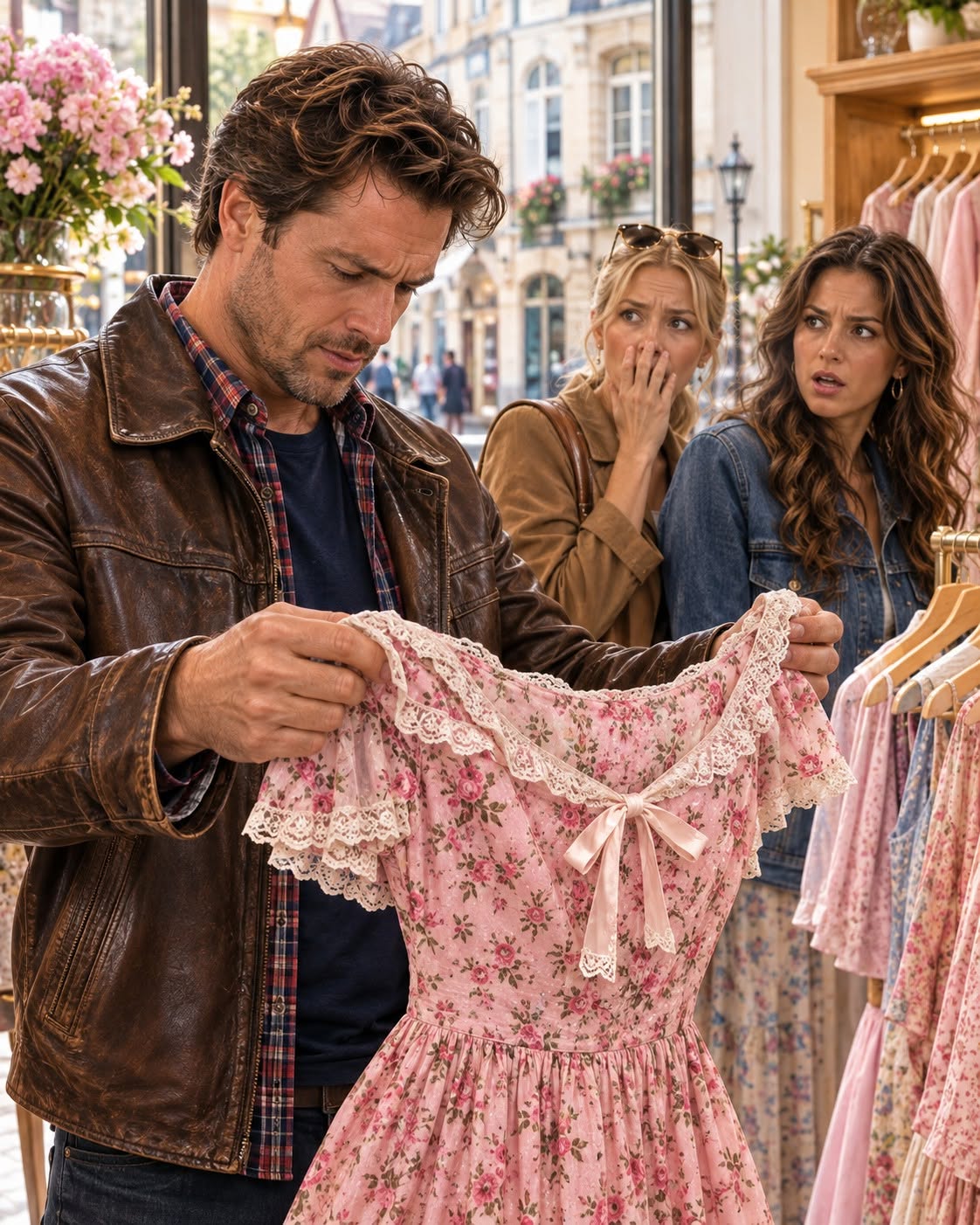
The day my boss caught me buying a woman’s dress, she gave me a strange look. By the next morning, half the town believed I was secretly dating someone.
The photograph lay between us like a warning.
I stared at it, unable to take my eyes away from my father’s face. He looked younger than I remembered, standing outside Sterling Properties in his old brown coat, one hand holding a leather briefcase.
The handwriting on the back was unmistakable.
“He should have stopped asking questions.”
For several seconds, I couldn’t speak.
Richard Hale watched me carefully.
“Interesting photograph, isn’t it?” he said.
I slowly lifted my eyes.
“Where did you get this?”
“That isn’t important.”
“It became important the moment you put it on my desk.”
Richard smiled, but there was nothing friendly about it.
“Your father was a difficult man. Brilliant, perhaps, but he had a habit of involving himself in matters that weren’t his concern.”
I felt my jaw tighten.
“My father spent thirty years making sure buildings didn’t collapse on the people inside them.”
“And look where that got him.”
The words struck harder than I expected.
I stepped forward, but forced myself to remain calm. I had spent too many years learning that anger could make a person careless.
“Are you threatening me?”
Richard adjusted his expensive watch.
“I’m giving you friendly advice. You’re a maintenance supervisor, not an investigator. You have a daughter to raise. I would think twice before risking your future over some old paperwork.”
He turned toward the door.
Before leaving, he glanced over his shoulder.
“By the way, I heard about the woman you’re buying dresses for. A generous hobby. Just make sure you don’t become distracted by other people’s problems.”
The door closed behind him.
I stood motionless.
Then I noticed something.
The photograph had a small crease along its lower edge. Someone had folded it before placing it on the desk.
I turned it over again.
Under the handwritten warning, barely visible in the fading ink, were three additional words.
“Check the foundation.”
My father’s handwriting.
I knew it immediately.
Richard had not simply brought me an old photograph.
He had brought me a message my father had left behind.
And suddenly, I understood that the story of Sterling Properties had started long before I ever worked there.
I carefully slipped the photograph into my notebook and gathered the documents.
There was only one person I could trust enough to speak with.
Clara.
When I entered her office, she was on the phone. She stopped talking as soon as she saw my expression.
“What’s happened?”
I placed the photograph on her desk.
She looked at it, then slowly sat down.
“Richard gave you this?”
I nodded.
“Do you know what it means?”
Clara stared at the picture for several seconds.
“I think I do.”
She walked to a filing cabinet and unlocked a drawer I had never seen her use.
From inside, she removed a small envelope.
“I found this three weeks ago, hidden inside an old maintenance manual. I wasn’t sure whether it was genuine.”
She handed it to me.
My father’s name was written across the front.
My hands began to shake.
Inside was a single folded sheet of paper.
The handwriting was unmistakable.
“To whoever finds this: The eastern foundation is not what the reports claim. The original inspection was altered. If anything happens to me, look for the blue ledger beneath the old boiler room.”
I read the message twice.
Then I looked at Clara.
“Why didn’t you tell me?”
“Because I didn’t know if you were involved.”
The answer surprised me.
She continued.
“Richard has spent years making sure nobody asks questions. Two months ago, I discovered that millions of dollars had been transferred through companies supposedly responsible for structural repairs. When I questioned him, he reminded me that my position depended on the board’s confidence.”
“And you believed him?”
“I believed he could destroy my career. I have two children, a mortgage, and an elderly mother living with me. I couldn’t afford to lose everything.”
Her voice cracked slightly.
For the first time, I saw that Clara wasn’t simply a powerful executive protecting her position.
She was frightened.
I pulled out a chair.
“Then we need to stop being afraid separately.”
She looked at me.
“What are you suggesting?”
“First, we find the ledger. Then we take everything to someone who can’t be bought.”
Clara hesitated.
“What if Richard gets there before us?”
I thought about the photograph.
“Then we’ll have to make sure he doesn’t know we’re looking.”
That afternoon, I went home earlier than usual.
Maya was sitting on the living room rug, arranging colored pencils into little piles. When she saw me, she immediately held up a drawing.
It showed three people standing in front of a large building.
One was a little girl.
One was a man with dark hair.
The third was a woman wearing a blue dress.
“Who’s this?” I asked, pointing to the woman.
“Mrs. Clara.”
I raised an eyebrow.
“Why is she in our family picture?”
Maya shrugged.
“Because she looks lonely.”
I laughed softly.
“That’s a very interesting reason.”
She returned to coloring.
“Daddy, are you worried about something?”
I sat beside her.
“Sometimes grown-ups have problems they need to solve.”
“Like when the sink leaks?”
“Something like that. Only bigger.”
She considered this.
“Then you should fix it before it gets worse.”
I smiled and kissed her forehead.
If only every problem in the world could be solved as simply as a leaking sink.
That evening, after Maya went to bed, I searched through the old photographs and papers I had inherited from my father.
I hadn’t opened most of those boxes since his funeral.
His tools were still wrapped in the same cloth. His engineering textbooks stood in neat rows. There were old certificates, newspaper clippings, and handwritten notes filled with calculations.
At the bottom of one box, I found a small metal key.
A faded tag was attached to it.
B-17.
I remembered the old boiler room.
Before Sterling Properties had been renovated, the basement contained several abandoned service chambers. Most had been sealed off after the previous management took over.
My father had once taken me there when I was a teenager.
He had shown me how the building’s original stone supports were connected.
I remembered him saying something that seemed ordinary at the time.
“A building can survive a lot of things, son. But it cannot survive people pretending its weaknesses don’t exist.”
I held the key in my palm.
Tomorrow, I would find out what he had discovered.
The following morning, Clara and I met in the underground parking garage before sunrise.
She carried a flashlight and a folder of documents.
I brought my father’s key, my notebook, and a small inspection camera.
We entered the basement through an old service corridor.
The air smelled of dust, damp concrete, and rust.
The boiler room was located beneath the eastern wing, directly under the oldest section of Sterling Properties.
Several pipes ran along the ceiling. Old machinery stood abandoned against the walls.
I found a narrow metal door behind a stack of broken maintenance panels.
The number B-17 was barely visible.
The key turned with a loud metallic click.
Inside was a small storage chamber.
There were shelves, damaged electrical equipment, and a desk covered in dust.
Clara shone her flashlight toward the back wall.
“Look.”
A rectangular section of the wall had been recently disturbed.
I moved the loose panel aside.
Behind it was a blue metal ledger.
For a moment, neither of us spoke.
I opened it carefully.
The pages were filled with handwritten entries, contractor names, payment amounts, inspection dates, and notes about structural defects.
Several entries were signed by my father.
Others were initialed by Richard Hale.
The most disturbing pages described repairs that had supposedly been completed on the eastern foundation.
According to the ledger, the original contractor had discovered severe water damage and cracks in several support areas.
The recommended repairs had been approved.
But the work had never happened.
Instead, the money had been redirected through three different companies.
One of those companies had been registered to Richard’s brother-in-law.
I turned another page.
My father’s handwriting appeared again.
“Management has been informed. They refuse to suspend occupancy. Further investigation required.”
Below it was a date.
Six days before his death.
Clara covered her mouth.
“Oh, my God.”
I kept reading.
Then I found something that made my blood run cold.
A handwritten note described a temporary support system that had been installed to prevent further movement in the eastern foundation.
The note included a warning.
“Temporary stabilization only. Building requires permanent structural intervention. Do not remove supports.”
But the recent inspection reports claimed the entire area had been fully repaired.
Someone had not only stolen the repair money.
They had allowed people to continue living and working in a potentially dangerous building.
I took photographs of every page.
Clara carefully placed the ledger inside her folder.
Then a noise came from the corridor.
Footsteps.
Someone was coming.
I turned off my flashlight.
Clara stepped behind the metal shelves.
The door opened.
A man’s silhouette appeared in the doorway.
“Looking for something?”
Richard.
He stepped inside and switched on the overhead light.
His gaze immediately landed on the open ledger.
For the first time since I had met him, he looked genuinely angry.
“Put that down.”
I closed the book.
“This belongs to the building.”
“It belongs to management.”
“Management has been stealing from the building.”
Richard laughed nervously.
“You have absolutely no idea what you’re talking about.”
Clara stepped out from behind the shelves.
“I think we have a fairly good idea.”
Richard turned toward her.
“You?”
She held the folder tightly against her chest.
“Yes. Me.”
He looked between us, then slowly closed the door.
“You should both understand something. There are people on the board who have benefited from these arrangements. People with influence. People who won’t appreciate what you’re doing.”
I looked at him.
“Then perhaps they should explain why they signed off on repairs that never happened.”
His expression hardened.
“You think you’re going to walk out of here and expose me?”
“No,” I answered. “I think we’re going to make sure nobody gets hurt.”
For a few seconds, the only sound was the distant vibration of the building’s heating system.
Then Richard did something unexpected.
He pulled a small device from his pocket and pressed a button.
The overhead lights went out.
Clara gasped.
I heard a metallic crash.
Someone grabbed my arm.
I pulled away, stumbling against the shelves.
“Clara!”
“I’m here!”
A door slammed.
When I managed to switch on my flashlight, Richard was gone.
The blue ledger was still in Clara’s hands.
But something else was missing.
My notebook.
The one containing weeks of inspection photographs, measurements, and handwritten observations.
I looked toward the corridor.
Richard had taken it.
And he now had enough information to know exactly what we had discovered.
We left the basement and went directly to the local police station.
But before we could speak to anyone, my phone rang.
It was Maya’s school.
Her teacher sounded unusually distressed.
“Mr. Bennett, I’m sorry to bother you, but there’s been an incident. Your daughter is safe, but someone came to the school claiming to be a family friend and asking to take her home.”
My heart seemed to stop.
“Who?”
“He said his name was Richard.”
I gripped the steering wheel.
“Did you let him near her?”
“No. We followed our safety procedures. He couldn’t provide the correct authorization, so we refused.”
I closed my eyes.
“Please keep her inside. I’m coming.”
Clara was already reaching for her phone.
“I’ll call the police.”
I drove to the school faster than I should have.
When I arrived, Maya was sitting in the principal’s office with her teacher beside her.
She ran toward me the moment she saw me.
“Daddy!”
I dropped to my knees and wrapped my arms around her.
“You’re okay. You’re okay.”
She held me tightly.
“That man said you asked him to pick me up.”
I pulled back and looked at her.
“Did you believe him?”
She shook her head.
“No. You always tell me when someone else is picking me up.”
I kissed her forehead.
“You did exactly the right thing.”
The school had already provided the police with the visitor’s description and security footage.
I watched the recording.
Richard had entered the building, spoken to the receptionist, and waited near the office.
When the teacher refused to release Maya, he left without creating a scene.
It was calculated.
He hadn’t wanted to attract attention.
He wanted to frighten me.
And it worked.
But it also changed something inside me.
Until that moment, I had thought I was investigating an old crime and protecting a building.
Now I understood that Richard was willing to use my daughter to silence me.
I would no longer handle this quietly.
That evening, I contacted a lawyer named Daniel Brooks.
He had represented my father during an unrelated engineering dispute years earlier.
I explained everything, including the attempted school pickup.
Daniel listened without interrupting.
When I finished, he said something that gave me hope.
“Your father once brought me a file about Sterling Properties. He believed the company was concealing a serious structural problem. I told him he needed more evidence before making a formal complaint.”
“Did he give you anything?”
“Yes. But I never understood what it meant.”
He paused.
“I still have the original.”
The next morning, Daniel arrived at our apartment carrying a sealed envelope.
Inside were copies of engineering drawings from the original construction of Sterling Properties.
He spread them across my kitchen table.
“Look at this section,” he said.
I leaned closer.
The eastern foundation was supposed to contain a reinforced support system beneath the central stone columns.
But the drawings in the current maintenance archive showed something different.
The original specifications had been altered.
A critical support structure had been replaced with a cheaper design during a renovation nearly a decade earlier.
The change had never received proper approval.
My father had discovered it.
And he had suspected that the replacement work was being covered up through fraudulent inspection reports.
Daniel tapped a handwritten note in the margin.
“Your father believed the altered foundation design was the beginning of everything.”
I looked at the drawings.
“Can we prove the current building is unsafe?”
“Not without an independent structural assessment. And we need to move quickly.”
He looked at me seriously.
“There’s something else. Your father didn’t just investigate this company. He prepared a complaint for the state building safety authority. He never submitted it.”
“Why?”
Daniel opened the envelope again.
“Because he received a letter threatening to accuse him of professional misconduct if he continued.”
My throat tightened.
“Who sent it?”
Daniel turned the letter around.
Richard Hale’s name appeared at the bottom.
For several moments, I couldn’t speak.
My father had not died because he was careless.
He had spent his final months fighting people who knew exactly how to make the truth disappear.
And now those same people were trying to do it again.
Daniel placed a hand on my shoulder.
“We will submit everything through the proper channels. But I want you to understand that this may take time.”
I nodded.
“I understand.”
Then Clara called.
Her voice was shaking.
“You need to come to Sterling immediately.”
“What happened?”
“Richard has called an emergency board meeting. He’s accusing you of stealing confidential company documents and compromising building security.”
I looked at Daniel.
“When?”
“An hour from now.”
I glanced toward Maya’s bedroom.
She was drawing at her little desk, completely unaware of the storm gathering around us.
For a moment, I considered staying home.
Then I remembered my father’s final warning.
A building could look safe on paper while quietly being destroyed from within.
I couldn’t allow that to happen again.
I arranged for my neighbor to stay with Maya and drove to Sterling Properties with Daniel.
When we entered the boardroom, nearly everyone was already seated.
Richard stood near the head of the table.
He looked confident again.
Beside him sat the company’s legal adviser and two senior directors.
Clara sat at the far end, pale but determined.
Richard began speaking before I had even taken my seat.
“Mr. Bennett has repeatedly accessed restricted files without authorization. He has removed company property and spread unfounded allegations about senior management.”
He placed my photograph on the table.
Then he produced my handwritten notebook.
My stomach tightened.
He had brought it.
“I believe his actions represent a serious breach of trust,” Richard continued. “I recommend immediate termination and referral for criminal investigation.”
One director nodded.
Another looked uncomfortable.
I stood.
“Before anyone makes a decision, I would like to show you something.”
Richard smiled.
“Do you have permission to present company documents?”
“No. But the evidence concerning public safety should be reviewed by the appropriate authorities.”
Daniel placed a copy of the original engineering drawings on the table.
Then he placed the blue ledger beside them.
Richard’s smile disappeared.
“Where did you get that?”
“From a locked maintenance chamber beneath the eastern wing.”
“Those documents are fabricated.”
Clara finally spoke.
“Then you won’t mind explaining why your initials appear beside payments for repairs that were never completed.”
Richard turned toward her.
“Sit down, Clara.”
“No.”
Her voice was quiet, but firm.
“I have spent three years watching you threaten employees, alter reports, and intimidate anyone who questioned your contractors. I’m finished being afraid.”
The boardroom fell silent.
Daniel opened another folder.
“We have already submitted copies of these records to the state building safety authority. We have also requested an independent structural inspection.”
Richard’s face changed.
“You cannot do that without authorization.”
“Public safety does not depend on your authorization,” Daniel replied.
One of the directors slowly removed his glasses.
“Richard, what exactly is in those documents?”
Richard looked around the room.
For the first time, he seemed to realize that the people he had controlled for years were no longer willing to protect him.
But he wasn’t finished.
He reached into his briefcase and removed another folder.
“Perhaps you should all know something about Mr. Bennett’s father.”
He opened it and slid a document across the table.
It was a disciplinary report bearing my father’s name.
According to the report, my father had been investigated for falsifying engineering results shortly before his death.
I stared at the paper.
Richard leaned forward.
“Your father wasn’t the honest man you believe he was. He was removed from several projects because of professional misconduct.”
The room seemed to tilt.
For years, I had carried the memory of my father as a man who always did the right thing.
Now Richard was trying to destroy that memory in front of everyone.
I picked up the document.
The signature looked genuine.
But something was wrong.
The report listed a professional registration number.
I remembered my father’s old license.
I knew the number by heart because he had taught it to me when I was a teenager.
The number on the document was incorrect.
I looked at Daniel.
He noticed my expression.
“May I?” he asked.
He examined the report carefully.
Then he turned to the board.
“This document contains a serious inconsistency. The registration number belongs to a different engineer, who was not employed by this company.”
Richard’s face went pale.
Daniel continued.
“And the date is impossible. Your report claims the investigation occurred after Mr. Bennett’s death.”
Nobody moved.
I looked directly at Richard.
“You didn’t just steal money. You tried to erase my father’s reputation because he refused to help you.”
Richard stood abruptly.
“This meeting is over.”
But before he could leave, two investigators entered the room.
Behind them was a representative from the state building safety authority.
One of the investigators introduced himself and asked Richard Hale to remain where he was.
Richard looked toward the directors.
Nobody defended him.
For the next several hours, the building’s records were secured, the eastern wing was restricted, and an emergency structural inspection was ordered.
The inspectors found exactly what my father had feared.
Several support sections had deteriorated significantly.
Water had weakened portions of the masonry, and temporary reinforcement had been improperly removed during a previous renovation.
The building wasn’t on the verge of immediate collapse, but it was no longer safe to operate normally.
The eastern offices were evacuated.
Residents in the affected section were temporarily relocated while engineers installed emergency stabilization supports.
The investigation uncovered something even worse.
Richard had been working with two former executives and a network of contractors to divert repair funds for years.
False invoices, altered inspection reports, and fabricated signatures had allowed them to collect millions of dollars.
My father’s name had been used to make several fraudulent reports appear legitimate.
The authorities eventually recovered emails showing that Richard had personally ordered the documents to be altered.
They also found the original correspondence threatening my father.
But the most important discovery came from an old audio recording stored on a damaged office computer.
It was a conversation between Richard and a former executive discussing my father’s refusal to approve the altered foundation design.
In the recording, Richard said something that made the investigators stop listening and replay it.
“He won’t sign it. Find another way to make the report look complete.”
It was the first direct evidence connecting him to the fraud.
Richard Hale was arrested several weeks later.
Two executives resigned before charges were filed against them.
Several contractors lost their licenses.
And Sterling Properties began a complete independent review of every major repair project.
For the first time in years, the building’s safety mattered more than the company’s reputation.
But the consequences weren’t limited to Richard.
Clara was asked to testify about what she had known and when she had known it.
She admitted that she had delayed reporting certain irregularities because she feared losing her position.
She also provided investigators with every document she had kept.
The board suspended her temporarily while the investigation continued.
I thought she would be angry with me.
Instead, she found me outside the building one evening.
“I wanted to thank you,” she said.
“For what?”
“For reminding me that doing the right thing doesn’t become easier if you keep postponing it.”
I looked at her.
“You were brave enough to finally speak.”
She shook her head.
“I should have spoken sooner.”
We stood quietly as workers removed damaged stone panels from the eastern entrance.
Then she looked toward the parking lot.
“How is Maya?”
“She’s doing well. Still convinced that you’re secretly dating me.”
Clara laughed for the first time in weeks.
“Perhaps I should explain that to her.”
“Good luck. She’s very difficult to convince once she’s made up her mind.”
We both smiled.
For the next six months, life was far from simple.
Sterling Properties remained partially closed while engineers repaired the foundation.
I was offered a new position as safety and maintenance director, with responsibility for independent inspections and long-term building preservation.
I accepted, but only after the board agreed to establish a transparent reporting system that protected employees who raised safety concerns.
Clara was eventually cleared of criminal wrongdoing, although she received a formal reprimand for failing to report the initial irregularities sooner.
She chose to remain with the company.
She told me she wanted to help rebuild something she had once been too frightened to defend.
Meanwhile, the rumors about us had not completely disappeared.
Some people still assumed Clara and I were secretly together.
At first, I found it amusing.
Then, one Saturday morning, something happened that made me see the situation differently.
Maya and I were visiting the women’s shelter where Nora had volunteered.
I had brought several bags of professional clothing, shoes, and handbags.
The woman in charge, Mrs. Evelyn Carter, greeted us at the entrance.
“You’re just in time,” she said. “We have three women preparing for interviews next week.”
Maya immediately volunteered to help organize the clothes.
While we were arranging the donations, a young woman named Sarah approached me.
She was holding a navy-blue dress.
“Excuse me,” she said softly. “Is this one available?”
I nodded.
“Of course.”
She looked down at the dress.
“I haven’t worn anything like this in years. I left an abusive relationship with almost nothing. I’ve been sleeping in my sister’s spare room, and I’ve been trying to find work.”
Her eyes filled with tears.
“I have an interview on Monday. I was going to wear the only sweater I own.”
I looked at the dress.
It was the same kind of dress I had purchased on the afternoon Clara saw me at the boutique.
Sarah held it against herself.
“Do you think this is too nice?”
I smiled.
“No. I think it’s exactly right.”
She laughed nervously.
“I don’t even remember the last time I felt confident.”
Maya, who had been listening nearby, walked over.
“You look pretty already,” she said.
Sarah knelt down and hugged her.
“Thank you, sweetheart.”
For a moment, I couldn’t speak.
I remembered Nora standing in this very room years earlier, helping women choose clothes before interviews.
I could almost hear her voice.
She had never believed that a dress could solve someone’s problems.
She simply understood that when people had lost almost everything, sometimes a small act of kindness could remind them that they still deserved a future.
Mrs. Carter approached me later.
“We’ve been discussing something,” she said.
I looked at her.
“What is it?”
“We’d like to create a permanent career support program in Nora’s memory. Clothing, interview preparation, transportation assistance, and help with job applications.”
I looked around the room.
There were women sorting clothes, volunteers arranging shoes, and Maya carefully folding shirts on a table.
“What would you need from me?”
“Someone who understands why this matters.”
I nodded.
“Then count me in.”
Three weeks later, the program officially opened.
We called it Nora’s Second Chance Closet.
It started with a few racks of donated clothing in a small room.
Within months, local businesses began contributing professional outfits, interview shoes, and financial support.
A retired teacher volunteered to help women prepare resumes.
A local photographer offered free professional headshots.
A nearby transportation company donated ride vouchers for job interviews.
And Sarah?
She got the job.
She returned to the shelter one afternoon carrying a small box of pastries.
“I wanted to thank everyone,” she said.
She had found stable work, rented a small apartment, and was slowly rebuilding her life.
Then she placed a handwritten note in the donation box.
It read:
“Someone once helped me feel like I was worth hiring. I hope I can do the same for someone else.”
I kept that note in my desk.
It reminded me that kindness rarely ends with the person who receives it.
It travels.
Sometimes farther than we can imagine.
One Sunday afternoon, Clara visited our apartment.
She brought a small gift for Maya.
A box of colored pencils.
Maya opened it and immediately hugged her.
“You’re my favorite boss!”
Clara laughed.
“That’s a very specific title.”
We had lunch together.
There was no awkwardness, no romantic tension, and no need to explain ourselves.
Clara told Maya about her own children, who were beginning to ask questions about the repairs at Sterling.
Maya listened carefully, then announced that she wanted to become an engineer.
Clara raised an eyebrow.
“Why an engineer?”
Maya looked at me.
“Because Daddy fixes buildings, and engineers make sure they don’t fall down.”
I smiled.
“That’s a pretty good reason.”
After lunch, Clara helped Maya put away her crayons.
Before leaving, she stood beside me near the front door.
“I used to think being a good manager meant protecting the company,” she said.
“And now?”
“Now I think it means protecting the people who depend on it.”
I nodded.
She glanced toward Maya, who was waving from the living room.
“Your wife would be proud of what you’ve done.”
I looked down for a moment.
“Thank you.”
Clara smiled.
Then she left.
There were no dramatic confessions, no sudden declarations of love, and no fairy-tale ending between us.
There was something better.
Respect.
Trust.
And the understanding that two people could help each other become braver without needing to become anything more.
Nearly a year after the investigation began, Sterling Properties reopened its eastern wing.
The restoration had taken months.
Engineers replaced damaged supports, repaired the stonework, installed a modern drainage system, and documented every stage of the work.
At the reopening ceremony, the board invited me to speak.
I stood in the restored entrance hall, looking at the polished floors and the old stone columns that had once concealed so much damage.
Behind me were workers, residents, engineers, and members of the local community.
I had prepared a speech about maintenance standards and safety procedures.
But when I looked at the audience, I thought about my father.
I thought about Nora.
And I thought about the women who had walked into the shelter believing their lives were over.
So I put my notes aside.
“A year ago, many people believed this building was safe because the paperwork said it was safe,” I began.
“But paperwork doesn’t hold up a wall. A signature doesn’t repair a foundation. And a title doesn’t make someone trustworthy.”
The room became quiet.
“Buildings stand because people do the work that others may never see. They inspect what is hidden. They repair what is damaged. And they speak up when something is wrong, even when speaking up comes at a cost.”
I paused.
“My father taught me that lesson. My wife taught me that people deserve the same care we give to the places they call home.”
I looked toward the front row.
Clara was standing beside Maya.
“Both of them are gone, but the things they believed in are still here.”
When I finished, the applause was warm and sustained.
But the moment I remembered most came afterward.
Maya ran toward me carrying a folded piece of paper.
“Daddy, I made something for you.”
It was another drawing.
This time, it showed a tall building with strong stone walls.
Beside it stood a man holding a little girl’s hand.
A woman stood nearby, holding a blue dress.
Above them, Maya had written:
“People make buildings strong. Love makes people strong.”
I swallowed the lump in my throat.
“That’s beautiful, sweetheart.”
She looked up at me.
“Do you think Mommy can see it?”
I knelt and hugged her.
“I think she would have loved it.”
That evening, after Maya had fallen asleep, I sat alone at the kitchen table.
The photograph of my father was beside Nora’s old wedding picture.
For months, I had thought the most important thing I could do was uncover what had happened at Sterling Properties.
I had been determined to find the truth, expose the people responsible, and protect the building.
I had done those things.
But I had also discovered something I hadn’t expected.
My father had spent his life protecting structures because he understood that people depended on them.
Nora had spent hers helping people because she understood that a person’s future could collapse just as easily as a building.
Neither of them had measured the value of their work by recognition.
They simply did what they believed was right.
I picked up the photograph of my father and turned it over.
The threatening sentence was still there.
“He should have stopped asking questions.”
For the first time, those words no longer frightened me.
I placed the photograph beside the drawing Maya had made.
Then I opened my father’s old notebook and wrote one sentence beneath his final entry.
“He didn’t stop asking questions. And because he didn’t, we finally found the truth.”
The next morning, I took Maya to school before heading to work.
As we walked toward the entrance, she slipped her hand into mine.
“Daddy?”
“Yes?”
“Are you going to buy another dress today?”
I laughed.
“Why do you ask?”
“Because Mrs. Carter said someone new is coming to the shelter.”
I squeezed her hand.
“Then I suppose we should see what we can do.”
She smiled.
And as we crossed the parking lot, I realized something.
For a long time, I had believed that moving forward meant leaving the past behind.
But perhaps that wasn’t true.
Perhaps moving forward meant carrying the best parts of the people we had lost and allowing those parts to shape the lives we still had time to live.
The town eventually forgot the rumors about Clara and me.
It stopped whispering about the mysterious dress purchases.
People began talking instead about the restored building, the new safety program, and the shelter that was helping women rebuild their lives.
Richard Hale’s trial lasted several months. He was eventually convicted of fraud, falsification of safety records, and conspiracy related to the diversion of construction funds. The false reports bearing my father’s name were formally discredited.
My father’s professional reputation was restored.
And the company established a scholarship for young structural engineers in his honor.
But none of those things mattered as much as what happened one rainy afternoon, nearly two years later.
A young woman walked into Nora’s Second Chance Closet carrying a small child.
She was nervous and visibly exhausted.
Mrs. Carter welcomed her, offered her a seat, and asked what she needed.
The woman hesitated before answering.
“I have an interview tomorrow. I left home last week, and I don’t have anything suitable to wear.”
Maya, now old enough to understand what the shelter meant, was helping organize donations.
She heard the woman’s words and immediately walked toward the clothing racks.
“Come with me,” she said.
“We have lots of pretty dresses.”
The woman followed her.
I watched from the doorway as Maya helped her choose an outfit.
She even found a pair of shoes and asked Mrs. Carter to help with the woman’s resume.
When the woman looked in the mirror, her expression changed.
She stood a little straighter.
Her shoulders relaxed.
And for the first time since entering the room, she smiled.
I looked up at the framed photograph of Nora hanging above the donation shelves.
It showed her laughing, with her sleeves rolled up and a rack of clothes behind her.
Underneath were the words:
“Sometimes a second chance begins with someone believing you deserve one.”
I understood then why I had never stopped buying those dresses.
They were never just dresses.
They were reminders that people could begin again.
That a person’s worst day didn’t have to become the rest of their life.
That doing the right thing might be difficult, inconvenient, and sometimes frightening, but it was still worth doing.
And perhaps the greatest lesson my father and Nora had left me was this:
You don’t need to be famous to change someone’s life.
You don’t need to be powerful to stand against wrongdoing.
And you don’t need to have everything figured out before you offer someone a helping hand.
Sometimes, all it takes is the courage to notice what others ignore.
A crack in a wall.
A signature that doesn’t belong.
A person standing in front of a mirror, wondering whether they still have a chance.
And sometimes, the smallest act of kindness becomes the strongest foundation of all.