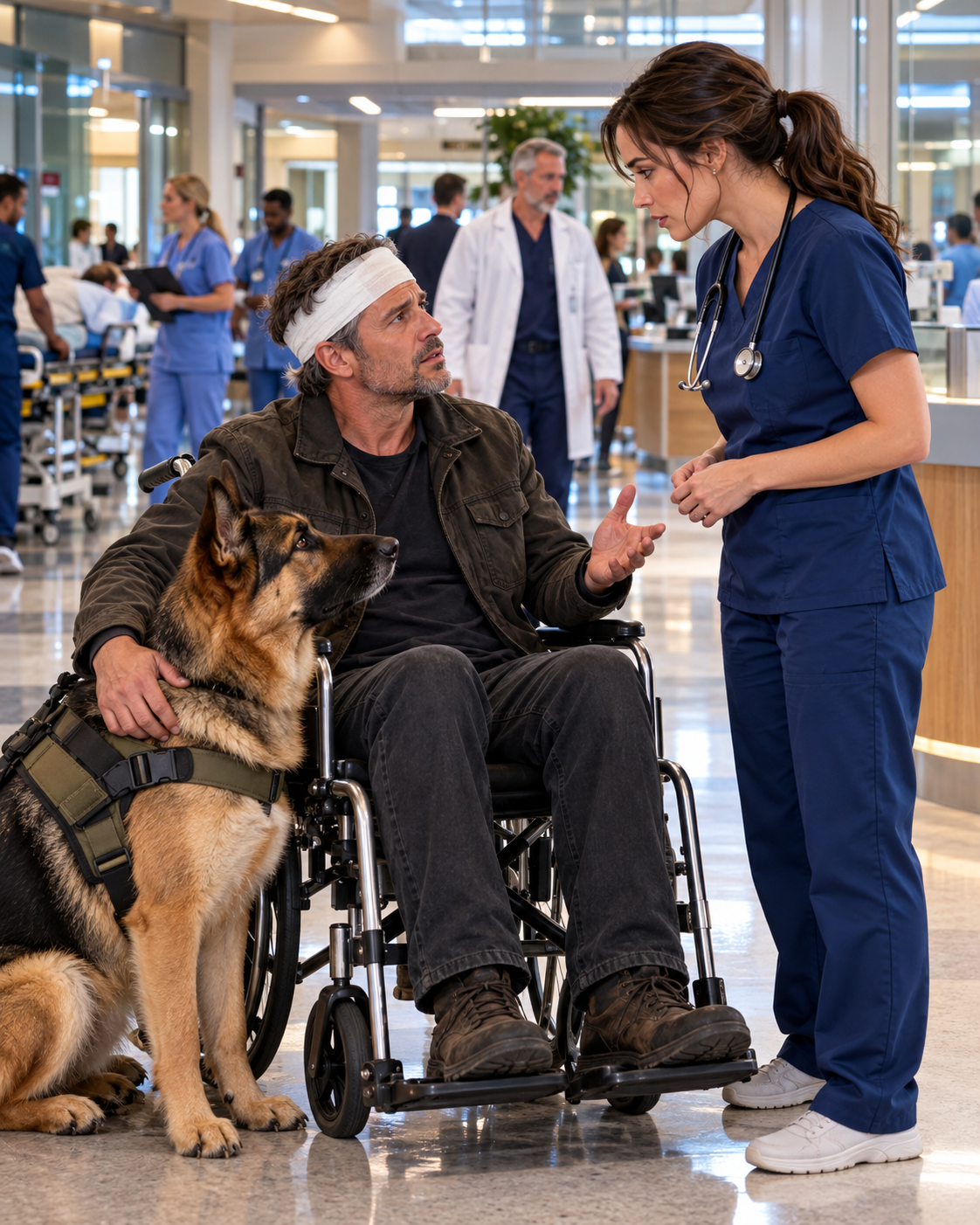
The day I was left shaking in my wheelchair at Redwood Point Naval Medical Center, a senior administrator looked
Claire did not tell me what was inside the second file over the phone.
She told me to come back to Redwood Point the next morning, and there was something in her voice that made me understand this was not a routine medical conversation.
I barely slept that night.
Bruno sensed it before I said a word.
He stayed beside my bed, his body pressed against the side of my wheelchair, waking whenever I moved.
At 5:40 in the morning, I finally whispered, “You remember him, don’t you?”
Bruno lifted his head.
I didn’t need to say Noah’s name.
He had never forgotten it.
By the time we reached the medical center, Claire was waiting near a side entrance with Elias.
Neither of them smiled.
Elias held a thin brown folder against his chest.
“I found this in an old records room,” he said.
“Why was it sealed?”
“Because someone requested restricted access the day after the mission.”
I looked at Claire.
“Who?”
She shook her head.
“We’re still trying to confirm that.”
Inside the folder was a single page of typed notes, several medical forms, and a photograph of our old unit standing beside two military working dogs.
Noah stood behind me in the photograph.
One hand rested on Bruno’s harness.
He was smiling.
I hadn’t looked at that picture in years.
The sight of him nearly took the air from my lungs.
Then Elias turned the page.
The first note described the mission in clinical language, but one sentence had been highlighted in yellow.
“Subject and K9 separated during emergency extraction.”
I stared at it.
“That’s wrong.”
Elias nodded.
“You and Bruno were never separated.”
“Exactly.”
I remembered that night with painful clarity.
The explosion had thrown me against a concrete barrier.
My spine had gone numb.
Everything afterward had become noise, smoke, shouting, and blood.
But Bruno had stayed beside me.
He had dragged himself through the debris and refused to leave until the evacuation team reached us.
There had been no separation.
Not then.
Not once.
Claire pointed to another document.
“This is where it gets strange.”
The report claimed Bruno had shown signs of “excessive attachment” and that my physical condition made continued operational partnership questionable.
I laughed once, but there was no humor in it.
“They were already building a case.”
“Before your rehabilitation was even complete,” Claire said.
Elias’s jaw tightened.
“Someone wanted Bruno transferred.”
“And they needed a reason.”
Claire nodded.
I looked down at my hands.
They were trembling again.
Not from fear this time.
From anger.
“Who benefits from taking him?”
No one answered.
Then Bruno stood.
His ears pointed toward the hallway.
He began pulling gently against his harness.
“Bruno?”
He moved toward a locked records door.
Elias followed him.
“He’s never done that.”
Claire watched the dog carefully.
“Let him lead.”
The door opened after a security officer arrived, and Bruno walked inside as though he had been there yesterday.
He stopped beside an old filing cabinet.
Then he sat.
I felt a chill move through me.
“What is it?”
Elias opened the drawer.
Nothing.
He checked another.
Still nothing.
Then Bruno pawed at the bottom cabinet.
There was a narrow envelope taped behind it.
My name was written across the front.
My hands started shaking harder.
I knew the handwriting before I touched it.
Noah.
Inside was a short letter.
Not an official document.
Not a report.
Just Noah talking to me the way he always had.
He wrote that if I was reading it, then something had gone terribly wrong.
He wrote that he didn’t trust everyone involved in our mission.
He wrote that there had been pressure to retire Bruno after the operation because certain people considered him too valuable to remain attached to a wounded handler.
Then he wrote something that made my chest ache.
“Don’t let them convince you that needing Bruno makes you weak.”
I had to stop reading.
For years, I had hated my own body for betraying me.
I had measured every limitation against the man I used to be.
Noah had apparently understood that battle before I ever admitted it existed.
Claire placed a hand gently on my shoulder.
“You don’t have to finish.”
“I do.”
So I continued.
Noah explained that Bruno had been trained to recognize my movements, my breathing, and even subtle changes in my balance.
He said Bruno wasn’t simply a dog assigned to me.
He was part of the way I functioned.
Then came the final sentence.
“If they separate you, don’t believe it’s because you failed.”
I closed my eyes.
Because I suddenly understood.
Someone had been trying to make me believe that my disability was the reason I was losing Bruno.
But the records suggested something different.
They wanted the dog.
And I was the obstacle.
Elias found the missing piece two days later.
It was buried inside an administrative transfer request submitted shortly after the mission.
The document recommended moving Bruno into a specialized K9 program where he could be “reallocated according to institutional need.”
There was no mention of me.
No mention of our history.
No mention of Noah’s letter.
Just numbers.
Assets.
Training value.
Operational usefulness.
Bruno had been turned into a line item.
And I had been turned into a liability.
Claire was furious.
But she did something more powerful than getting angry.
She documented everything.
She requested independent evaluations.
She brought in a rehabilitation specialist who observed Bruno and me together.
She asked Elias to testify about Noah’s final weeks.
She even requested footage from our previous training sessions.
For the first time since my injury, I stopped trying to prove I was the man I had been.
Instead, I started showing them who I was now.
The evaluation took place in a large training hall.
There were cones, stairs, uneven flooring, simulated doorways, and a series of mobility obstacles.
I sat in my wheelchair while the panel watched.
One officer asked, “Can you command the dog effectively from your current position?”
I looked at Bruno.
“Bruno.”
He came to my side.
“Left.”
He moved left.
“Stay.”
He stayed.
Then the specialist introduced an unfamiliar command sequence.
Bruno looked at me.
I gave him a hand signal.
He understood immediately.
The room became quiet.
The specialist changed the exercise.
She deliberately placed an obstacle behind me, forcing Bruno to adjust his position.
He did.
Then my wheelchair caught slightly on the edge of a mat.
Before I could react, Bruno shifted his weight and braced against the chair.
The wheelchair stabilized.
Someone on the panel whispered, “Interesting.”
I almost smiled.
Noah would have laughed.
He used to say Bruno was smarter than all of us and knew it.
Then the test became harder.
I had to navigate a narrow corridor while carrying a medical bag.
My right hand weakened halfway through.
The bag slipped.
Bruno caught the strap.
Not because I commanded him.
Because he noticed.
The panel watched in silence.
The rehabilitation specialist finally turned toward them.
“That isn’t dependence.”
She paused.
“That’s coordinated independence.”
Those words stayed with me.
For years, I had believed independence meant refusing help.
I thought strength meant doing everything alone.
But sitting there with Bruno beside me, I realized how badly I had misunderstood both.
The board recessed for nearly three hours.
I waited outside with Bruno’s head resting against my leg.
Elias sat beside me.
“You know Noah would be proud.”
I looked at him.
“I wish he were here.”
“Me too.”
Neither of us spoke for a while.
Then Elias said, “There’s one thing you should know.”
My stomach tightened.
“What?”
“Before the mission, Noah asked me to watch you.”
I stared at him.
“He knew something might happen?”
“He didn’t know what.”
Elias looked down at his hands.
“But he knew people were making decisions about the unit that none of us understood.”
That was the moment the entire story changed again.
The hidden file wasn’t just about Bruno.
It wasn’t just about me.
Noah had suspected that someone inside the system was quietly removing certain records and redirecting certain personnel.
The mission itself had been investigated, but parts of the investigation had never been made public.
And now we had evidence that administrative decisions affecting Bruno had begun almost immediately afterward.
Claire refused to let the questions disappear.
She submitted the evidence to an independent review authority.
Weeks passed.
Then months.
The review eventually confirmed that the original reassignment process had relied on incomplete records and that Noah’s letter had been improperly withheld from the decision-makers.
The people involved faced formal scrutiny.
Some claimed they had only followed procedure.
Others said they had never known about the letter.
Maybe that was true.
Maybe it wasn’t.
I learned something during that process.
Sometimes the hardest battles aren’t fought against one cruel person.
Sometimes they are fought against silence, paperwork, fear, and the assumption that nobody will challenge what has already been decided.
The final board ruling arrived on a rainy afternoon.
I opened the envelope with shaking hands.
Bruno sat beside me.
The ruling recognized him as my companion and mobility canine and permanently documented the operational and rehabilitative basis for our partnership.
The reassignment order was erased.
The old classification was corrected.
And Noah’s letter was entered into the official record.
I read that last part twice.
Then I started crying.
Not loudly.
Not dramatically.
Just the quiet kind of crying that comes when your body finally releases something it has been carrying for years.
Bruno leaned against me.
I pressed my forehead against his.
“You stayed.”
His tail moved once.
I laughed through the tears.
“Of course you did.”
Claire stood nearby, watching us.
“You didn’t need to prove you were the same person you were before.”
I looked at her.
“What did I need to prove?”
She smiled gently.
“That you were still here.”
Those words changed something inside me.
Recovery was never going to return me to the man I had been.
It was going to teach me how to become someone I hadn’t yet met.
I began rehabilitation again with a different attitude.
When my arm failed, I accepted help.
When my hands shook, I rested.
When Bruno needed a break, we stopped.
When I couldn’t reach something, I asked.
None of those things made me less independent.
They made my independence sustainable.
Months later, Bruno and I returned to the same lobby where nobody had answered me.
The fluorescent lights were still there.
The reception desk was still there.
People still hurried past carrying folders and coffee.
But I was different.
Bruno walked beside my chair with his harness secured properly.
The old patch Claire had discovered was no longer hidden beneath it.
I had placed it on the inside of a small case attached to his gear.
DO NOT SEPARATE.
Not because I was afraid anymore.
Because I wanted to remember.
As we reached the doors, I stopped.
Through the glass, I could see the rain falling over the parking lot.
For a moment, I thought about Noah.
About the mission.
About the man I had been before everything changed.
Then Bruno touched his nose against my hand.
I looked down.
“Ready?”
He stood.
We went outside together.
I used to think Noah’s greatest gift to me was saving my life.
Now I understand it was something else.
He taught me that surviving is not the same as living, and needing someone beside you is not the same as losing yourself.
Sometimes the strongest person in the room is the one who finally admits, “I can’t do this alone.”
And sometimes the hand that reaches for you is not there to pull you out of your life.
It is there to help you find your way back into it.
For a long time, I thought Noah’s story ended the day he died.
I was wrong.
Because every morning Bruno wakes me by resting his head against my bed, and every time I move forward despite the pain, a little piece of Noah moves with me.
But there is one thing I still haven’t told Claire.
A few weeks after the board ruling, I found another envelope inside Noah’s old belongings.
It had my name on it.
And beneath my name were four words that made my blood run cold.
“Read this when ready.”
I haven’t opened it yet.
Not because I’m afraid of what it might say.
Because somewhere inside me, I already know that whatever Noah left behind may finally explain why he never trusted the mission in the first place.
And when I open that envelope, Bruno will be beside me.