The day a millionaire executive laughed at my cracked-concrete garage and offered me $100,000 to fake a repair
Part 2
For a few seconds, nobody spoke.
Rain tapped against the garage roof, and the Vesper XR’s warning display cast a pale reflection across the concrete.
I turned back to the vehicle and studied the service interface.
The authorization message was not a generic security prompt.
It was part of a recovery architecture developed to prevent a dangerous drive-system mismatch from being overridden by someone who lacked the original engineering authority.
I had designed that safeguard with my colleagues at Asterion Dynamics.
Back then, we had been a small team with limited funding, outdated equipment, and more ambition than common sense.
We believed electric performance technology would eventually transform the automotive industry, but we also knew that power without reliable control was simply another way to hurt people.
Our prototype used independent drive modules whose outputs had to remain within tightly controlled calibration tolerances.
If the system detected conflicting values, it would shut down rather than allow the vehicle to operate unpredictably.
The recovery protocol was intentionally difficult to bypass.
It required a verified engineering signature associated with the original architecture.
Mine.
I had not built that safeguard to protect my reputation.
I had built it because a car traveling at high speed could turn a tiny software error into a tragedy.
And now the safeguard was doing exactly what it had been designed to do.
I connected my diagnostic equipment through the authorized service interface and began reading the available records.
The first layer confirmed the calibration mismatch.
The second showed a sequence of firmware events that did not match the official service report.
The third was restricted.
I looked at Preston.
“I need the full calibration history.”
“Our engineers have already reviewed it.”
“Then they can provide it.”
“They determined the problem is an internal compatibility issue.”
I turned the tablet toward him.
“An internal compatibility issue doesn’t explain why the drive modules received inconsistent calibration values within the same update sequence.”
Duncan pushed himself away from the workbench.
“Could you speak English instead of trying to impress us?”
I glanced at him.
“I’m speaking about the reason your twelve-million-dollar car won’t move.”
His mouth tightened.
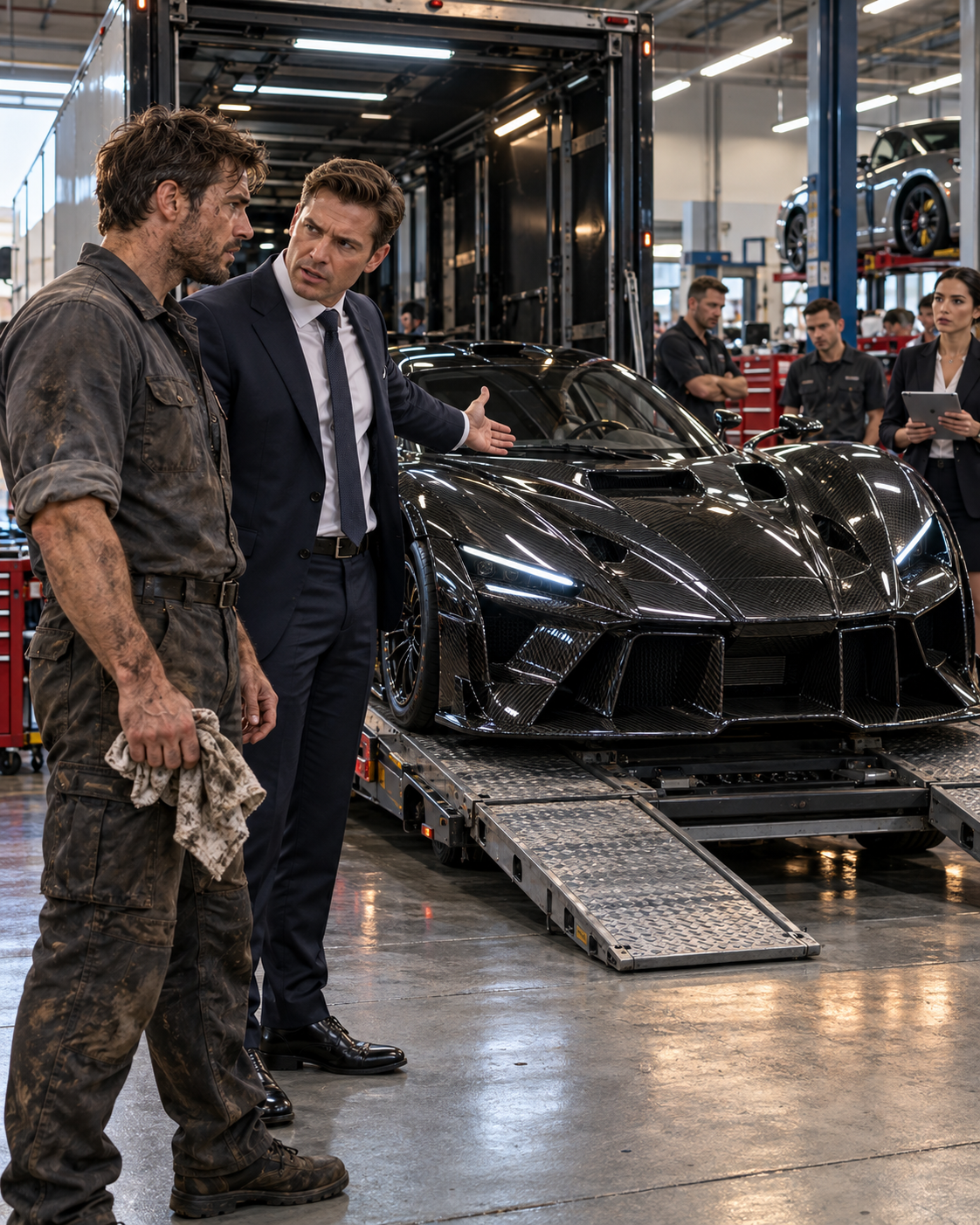
I continued.
“The safety system detected a conflict and locked the drive. Until I know why those values changed, I won’t clear the lockout.”
Preston stepped closer.
“How long will that take?”
“Depends on whether I can access the complete logs.”
“We have an investor exhibition tomorrow morning.”
“Then you should have arranged a proper diagnostic window before bringing the car here.”
His expression darkened.
“You don’t understand the commercial pressure we’re under.”
“I understand that a locked drive system has a reason for being locked.”
For the first time, Duncan didn’t laugh.
He looked at the car as if he had only just realized it was more than an expensive object that had embarrassed its owners.
Preston took out his phone and walked several steps away.
I couldn’t hear every word, but I caught fragments.
“Still locked… Reed’s name… no, he recognized the architecture… I need the complete update record.”
He turned away from me and lowered his voice.
That was enough to tell me the problem had moved beyond a routine repair.
I opened a separate diagnostic window and examined the timestamps available in the service history.
The latest calibration package had been installed shortly before the transport truck left Wickliffe’s testing facility.
The official notes described it as a routine adjustment.
But the recorded values suggested that someone had altered the relationship between the drive modules without completing the validation process required by the original architecture.
That could explain the lockout.
It could also explain why the security system had rejected the ordinary recovery procedure.
I searched the update record for a signed authorization.
The signature was valid.
The change itself, however, appeared inconsistent with the documented calibration requirements.
Someone with legitimate access had used a valid credential to introduce a configuration the system could not safely accept.
That was not proof of deliberate tampering.
It was, however, a serious discrepancy that required a formal investigation.
I saved a copy of the diagnostic report and documented the state of the vehicle before making any changes.
Then I called out to Preston.
“I’ve found evidence of an unauthorized or incorrectly approved calibration change. I need the full signed update package and the audit trail before I proceed.”
He ended his phone call.
“Unauthorized?”
“That’s one possibility. An improperly approved change is another. I won’t know which until I see the records.”
“You are not qualified to investigate our internal engineering process.”
“I’m qualified to tell you what the diagnostic evidence shows.”
“You were qualified twenty years ago, perhaps.”
The words struck harder than I expected.
I looked at him carefully.
“How much do you know about Asterion Dynamics?”
For the first time, he appeared unable to decide whether to answer.
Duncan looked from him to me.
“Asterion? What’s that?”
I kept my eyes on Preston.
“It was a startup. We developed an electric performance platform long before Wickliffe bought the company.”
Preston’s jaw tightened.
“Asterion’s assets were acquired as part of a broader technology transaction.”
“Assets,” I repeated.
He said nothing.
I could see the old pattern emerging.
The company I had helped build had become a line in a corporate acquisition document.
The engineers who had worked nights and weekends had become footnotes.
The safety architecture we had developed had survived, but the names of the people who built it had slowly disappeared from the public story.
I had never expected the world to remember me.
When Asterion ran out of funding, I had made my choice.
I could have chased investors, argued with lawyers, and spent years trying to recover money that might never come.
Instead, I took what I could, returned to ordinary mechanical work, and built a life that paid the bills.
My daughter, Avery, had been young enough to remember the garage where I first started repairing customers’ cars.
She had grown up around toolboxes, invoices, and the smell of hot metal.
Now she was nineteen and studying engineering at college, with a mind that could dismantle a complicated problem faster than most people could explain it.
She still believed the world could reward people for doing good work.
I wanted her to keep believing that.
So I had never told her how bitterly I sometimes regretted walking away from Asterion.
I had told myself that raising her was worth more than winning an argument with a corporation.
Most days, I believed it.
Today, standing beside a machine that still carried the bones of my work, I wasn’t so certain what I had lost.
Preston finally spoke.
“The Vesper program is built on several generations of technology. It isn’t accurate to say you designed this vehicle.”
“I didn’t say I designed this vehicle.”
“Then let’s be clear about that.”
“Let’s also be clear that your vehicle is refusing to operate because its safety system detected a calibration conflict.”
His face reddened.
Duncan cleared his throat.
“Preston, perhaps we should call your engineering team back.”
“They’re already involved.”
“Then perhaps they should be here.”
Preston looked at him with open irritation.
“You wanted to see the Vesper before the exhibition. You said it would be good publicity for the showroom.”
Duncan fell silent.
I looked between them and began to understand why Preston had brought the car to my garage rather than a Wickliffe service center.
A local repair shop offered privacy.
A corporate service center would have generated formal records, notified the engineering chain of command, and potentially delayed the exhibition.
Here, he could hope for a quiet fix.
If I cleared the lockout without asking too many questions, he could put the car back on the truck and tell everyone the problem had been resolved.
If I refused, he would have to explain why the company’s flagship prototype had failed at the last moment.
I returned to the diagnostic screen.
“Mr. Wickliffe, I need the original firmware package and the authorization record. Until those are reviewed, the vehicle stays locked.”
His voice dropped.
“You seem to be forgetting who you’re talking to.”
“No. I’m remembering exactly who I’m talking to.”
He stared at me.
For the first time, I saw that my refusal frightened him more than my technical knowledge.
He wasn’t simply worried about a broken car.
He was worried about what the car might reveal.
I continued documenting the fault sequence.
The garage had become so quiet that I could hear water dripping from the truck’s rear ramp.
Then Preston stepped close enough that Duncan couldn’t hear him clearly.
“Let’s discuss this privately.”
I straightened.
“There’s nothing about the diagnostic findings that needs to be private.”
“You’re a small-business owner, Mr. Reed. You have bills. You have a family.”
My stomach tightened.
He knew about Avery.
I wasn’t sure how much he knew, but the mention of my family changed the conversation from pressure to something much uglier.
He glanced around the garage.
“How much does this place bring in during a good month?”
I didn’t answer.
“How much tuition does your daughter need next semester?”
My hands went cold.
“Leave my daughter out of this.”
“I’m trying to offer you a solution.”
“No. You’re trying to find out what it costs to make me stop asking questions.”
His eyes narrowed.
The polite mask finally slipped.
“Be careful, Reed. You’re standing in a room full of equipment you can barely afford to replace, telling a company worth billions how to run its business.”
I looked at the Vesper XR.
“No, Mr. Wickliffe. I’m telling you that I won’t make a dangerous machine appear safe just because your schedule is inconvenient.”
His lips pressed into a thin line.
He glanced toward the service display, where my name still appeared beneath the recovery warning.
Then he made his offer.
“One hundred thousand dollars.”
For a moment, I thought I had misheard him.
He continued in a low, controlled voice.
“You clear the lockout, make the system appear operational long enough for tomorrow’s presentation, and sign a report stating that the fault was an isolated software incompatibility.”
I stared at him.
“Without resolving the underlying calibration problem?”
“Your job is to restore the vehicle. Our engineering team can complete the deeper work later.”
“That is not a repair.”
“It’s a temporary recovery.”
“It’s a lie.”
His face hardened.
“One hundred thousand dollars could change your life.”
He was right about the money.
It could replace the roof over my garage, pay my suppliers, settle the debts I had accumulated during slow months, and put Avery through college without forcing her to choose between textbooks and rent.
It could give us breathing room.
It could give me back the security I had spent years pretending I didn’t miss.
For a single, shameful second, I imagined accepting it.
I pictured Avery opening an email confirming that her tuition was covered.
I pictured the garage with a new lift, a clean floor, and equipment that didn’t require me to repair the tools I used to repair other people’s cars.
I pictured the relief on my daughter’s face when I told her she wouldn’t have to take another part-time job during finals.
Then I looked at the warning on the screen.
The car had shut itself down because the software detected a condition it could not safely verify.
If I bypassed that safeguard without correcting the underlying issue, I could help put an unstable machine back on the road.
I could not know what would happen when it was pushed hard during the exhibition.
I could not know who might be injured if the drive system behaved unpredictably.
And if something went wrong, my signature would sit beneath a report claiming I had found the problem and resolved it.
Preston would have his demonstration.
I would have his money.
And someone else might pay the price.
I stepped away from him.
“No.”
The word sounded small in the enormous quiet of the garage.
Preston blinked.
“What did you say?”
“I won’t falsify a repair report, and I won’t bypass a safety lock to make your prototype look healthy.”
He laughed once, without humor.
“Think carefully.”
“I have.”
“You have no idea what refusing this offer will cost you.”
I looked at him and thought about all the years I’d spent worrying that poverty had made me less of a man.
Then I thought about Avery, sitting at our kitchen table with engineering textbooks spread around her, asking me why some machines failed and how people could design them to fail safely.
She had never asked me how much money I made.
She had asked me whether I trusted my own work.
“I know exactly what it costs,” I told him. “That’s why my answer is no.”
Preston’s expression became cold enough to make the room feel smaller.
“Then perhaps you should consider what happens when a company like ours decides you’ve become a problem.”
I met his gaze.
“Perhaps you should consider what happens when someone finally documents the problem you’ve been trying to hide.”
For the first time that afternoon, Preston Wickliffe had nothing to say.
But as he looked at the diagnostic display, I realized he was no longer wondering whether I could repair the Vesper XR.
He was wondering how much I had already discovered.
Part 3
Preston stepped away and called someone from the corporate office.
He spoke in clipped phrases, pacing between the transport truck and the workbench, while Duncan stood near the garage door pretending not to listen.
I returned to the vehicle and continued documenting everything I could access through the authorized diagnostic interface.
I did not attempt to bypass the lockout.
I did not alter the firmware.
I preserved the current fault state, saved the available logs, and recorded the discrepancies that required further review.
The more I examined the records, the more troubling the sequence became.
The calibration change had been applied shortly before the Vesper XR was scheduled to leave the testing facility.
The update carried a valid authorization credential, but the resulting values did not match the documented configuration requirements.
The system had detected the mismatch and shut down before the car could be demonstrated.
That sequence was consistent with deliberate tampering, although I still needed the complete audit trail to establish who had made the change and why.
I wasn’t going to accuse someone based on suspicion alone.
But I wasn’t going to pretend the evidence meant nothing, either.
Preston ended his call and returned to the workbench.
“Our legal department will contact you,” he said.
“Fine.”
“You will not discuss this vehicle with anyone.”
“I won’t disclose confidential information improperly. But I’m not signing a false report or concealing evidence of a potential safety issue.”
His eyes narrowed.
“You think you’re some kind of hero?”
“No. I think I’m a mechanic who has been asked to do something dishonest.”
Duncan shifted uncomfortably.
For years, he had treated my financial struggles as proof that I was a lesser man.
He had seen my old truck, my stained shirts, my cracked concrete floor, and my aging tools.
He had never once asked why I had chosen this life.
Now he was standing beside a twelve-million-dollar prototype that had recognized my name when it rejected everyone else’s credentials.
He looked as though the world had quietly rearranged itself without asking his permission.
Preston walked toward the car.
“Can you at least make it safe to transport?”
“Yes, if the required procedures allow it. I can document its current state and help your authorized transport crew secure it without altering the drive system.”
He stared at me.
“That’s all?”
“That’s what I can responsibly do.”
He turned away, muttering something I couldn’t hear.
I continued working, and for the next hour the garage was filled with the sounds of careful documentation, phone calls, and rain dripping from the roof.
Eventually, a senior engineer from Wickliffe’s high-performance division arrived.
His name was Daniel Cho, and unlike Preston, he entered the garage carrying a notebook instead of an attitude.
He examined the diagnostic logs and asked me to walk him through the fault sequence.
I did.
He listened without interrupting, then requested the complete calibration package from the company’s secure system.
When the files arrived, he compared the signed update with the documented configuration.
His expression changed.
“These values shouldn’t have been deployed together,” he said quietly.
“That’s what the system appears to have detected,” I replied.
He checked the timestamps.
“Someone approved this shortly before transport.”
“Can you identify the account?”
“Not from this copy. I need the complete audit record.”
Preston appeared beside him.
“Daniel, we have already discussed this. The update was authorized.”
Daniel looked up.
“An authorization credential was used. That does not establish that the resulting configuration was safe or correctly approved.”
Preston’s jaw tightened.
“We don’t need a lecture.”
“No,” Daniel replied. “We need to know why our flagship prototype locked itself down hours before a public demonstration.”
The words hung in the air.
I watched Preston’s face, and I saw the first crack in his confidence.
Daniel continued examining the data.
“The protection system did exactly what it was designed to do. It detected an invalid combination and refused to release the drive modules.”
He glanced toward me.
“Whoever built this recovery architecture understood what could happen if the vehicle continued operating with inconsistent calibration.”
I looked at the screen.
“We were worried about a drive system behaving unpredictably under high load. The shutdown was supposed to be inconvenient. That was the point.”
Daniel nodded slowly.
“Then the shutdown may have prevented a much more serious incident.”
Nobody spoke for several seconds.
I thought about the demonstration scheduled for the next morning.
A crowd of investors.
Cameras.
A polished stage.
A car expected to accelerate beneath bright lights while executives explained how carefully the company had engineered every detail.
If the safety system had not intervened, the presentation might have gone ahead with a configuration that had never been properly validated.
I felt a cold weight settle in my stomach.
The danger had not been a broken car sitting harmlessly in my garage.
The danger had been what someone wanted to do with it.
Daniel asked Preston to authorize an immediate preservation of the relevant records and a formal safety investigation.
Preston resisted.
He argued that the calibration might have been the result of an ordinary process error, that the team needed more time, and that escalating the matter before the facts were established could damage the program.
Some of his concerns were reasonable.
An investigation should not become a public accusation before the evidence was complete.
But his insistence that the issue remain quiet had become impossible to ignore.
Daniel remained firm.
“We can investigate discreetly without pretending the fault doesn’t exist. The vehicle is not cleared for operation, and the logs must be preserved.”
Preston looked at me.
I said nothing.
I had no interest in watching his career collapse.
I had no interest in humiliating him in front of Duncan or proving that the man who had mocked my garage was now the one being questioned.
I wanted the truth established, the safety system respected, and the people responsible held accountable through the proper process.
Anything less would turn my own work into another tool for someone else’s ambition.
At last, Preston agreed to the formal review.
The Vesper XR remained locked down.
Its transport and handling would proceed under the manufacturer’s safety procedures, and the relevant records would be preserved for the investigation.
Daniel thanked me for the diagnostic report.
Then he asked a question that took me by surprise.
“Mr. Reed, would you be willing to consult with our engineering team while we review the original platform architecture?”
I studied him.
“Why?”
“Because you understand the original recovery system, and we need to separate the legitimate safety mechanisms from the changes introduced in the latest firmware.”
I glanced at Preston.
He was staring at the floor.
“I’ll consider it,” I said. “But everything needs to be documented, and I won’t sign off on anything I haven’t independently verified.”
Daniel nodded.
“That’s fair.”
When the truck was finally prepared to leave, the rain had stopped.
The clouds were breaking over Briar Glen, allowing a thin band of sunlight to fall across the garage floor.
Preston stood near the loading ramp, speaking quietly with his driver.
I was cleaning my diagnostic equipment when he approached me one last time.
“I suppose you think you won,” he said.
I put the equipment away before answering.
“This isn’t a contest.”
“You could have taken the money and made everyone’s life easier.”
“Only if nothing went wrong.”
He looked toward the Vesper XR.
“And if the investigation proves this was a mistake?”
“Then the evidence will show it was a mistake.”
“And if it proves something else?”
“Then the evidence will show that, too.”
He stared at me, perhaps searching for anger or satisfaction.
I gave him neither.
“You don’t understand how much pressure there is at my level,” he said.
I believed him.
Pressure could make a person desperate, frightened, and capable of terrible decisions.
It could explain why someone wanted a problem to disappear.
It could not make a lie into a repair.
“I understand pressure,” I told him. “I’ve spent years trying to keep a small business alive. I’ve worried about payroll, parts bills, and whether I could afford to replace a tool when it broke. I know what it feels like to need money badly enough that you can almost hear it calling your name.”
His expression softened for the briefest moment.
“Then you understand why I made the offer.”
“I understand why you wanted me to accept it. That doesn’t make it right.”
He looked away.
For a moment, I thought he might apologize.
Instead, he walked toward the truck.
I watched the Vesper XR disappear behind the closing doors.
The machine that had brought two powerful men into my garage had left without moving under its own power.
And for the first time in a long while, I felt no shame about the place where I stood.
The next morning, Avery arrived at the garage carrying a paper bag and a stack of engineering notes.
She was wearing her college sweatshirt, her hair tied back, and the tired expression of someone who had spent too much of the previous night studying.
“I brought breakfast,” she said. “And before you tell me you’re not hungry, I brought enough for two.”
I smiled.
“You’re getting too good at this.”
“Somebody has to make sure you remember you’re human.”
She set the bag on the workbench, then noticed the diagnostic equipment laid out beside the computer.
“What happened here?”
I hesitated.
For years, I had protected Avery from the uncertainty that followed me home from work.
I had told her when business was slow, but not how often I lay awake calculating bills.
I had told her that my old engineering career hadn’t worked out, but not how much of myself I had left behind when Asterion collapsed.
Now I found myself wanting to tell her the truth.
So I did.
I told her about the Vesper XR, the locked recovery protocol, and the name that had appeared on its display.
I told her about the calibration discrepancy and the money Preston had offered me.
I told her how close I had come to imagining what that money could do for us.
Avery listened without interrupting.
When I finished, she looked at the diagnostic report.
“They wanted you to make it look fixed without actually fixing it?”
“That’s right.”
She shook her head.
“That’s not engineering.”
“No,” I said. “It isn’t.”
She studied the logs for a while, reading the entries and tracing the timestamps with her finger.
Then she looked up at me.
“You know, when my professors talk about engineering ethics, they make it sound like a list of rules you memorize before an exam.”
She paused.
“But this is the part that matters, isn’t it? When doing the right thing costs you something.”
I looked at my daughter and felt something inside me loosen.
For years, I had worried that my struggles had taught her the wrong lesson.
I had worried that she saw the old garage as evidence of failure, that she believed her father’s life had become smaller because he had lacked the courage or ability to do something greater.
But she wasn’t looking at me with pity.
She was looking at me as if I had shown her something worth remembering.
“I don’t know if refusing the money was the smartest financial decision,” I admitted.
“It probably wasn’t.”
She smiled slightly.
“But you didn’t sell your name.”
I looked at the service report on the screen.
Calder Reed.
For twenty years, I had thought of that name as belonging to a younger man whose best work had disappeared into a corporate acquisition.
Now it was attached to a safety system that had refused to compromise when someone tried to push it beyond what it could verify.
Maybe my work had not vanished after all.
Maybe it had been waiting quietly inside the machine, doing exactly what we had built it to do.
A few days later, Wickliffe Automotive announced that the Vesper XR demonstration had been postponed pending additional engineering validation.
The company did not publicly identify the cause while the investigation remained underway.
The review continued through the proper channels, examining the firmware history, the approval records, and the circumstances surrounding the calibration change.
I was asked to provide technical information about the original platform architecture, and I agreed under a written consulting arrangement that protected the integrity of my findings.
I never received the hundred thousand dollars Preston had offered.
I never asked for it.
The investigation eventually established that the deployed calibration had been introduced through a process that violated the program’s documented validation requirements.
The audit trail identified the accounts and approvals involved, and the company took corrective action through its internal process.
I did not learn every private detail, and I did not need to.
What mattered was that the vehicle remained out of operation until the underlying issue had been properly resolved and independently verified.
The safety system had not been the enemy of the program.
It had been the last honest thing standing between the program and a potentially dangerous mistake.
Wickliffe later offered me a paid role advising its engineering team on legacy platform safety and recovery architecture.
The offer included a clear scope of work, independent review procedures, and compensation for my time.
I accepted after reviewing the terms.
Not because I wanted revenge.
Not because I wanted to wear an expensive suit and walk into a boardroom where people finally knew my name.
I accepted because the work mattered, and because I could help ensure the engineers who inherited that technology understood why its safeguards had been designed the way they were.
My garage stayed open.
I kept repairing pickups, work vans, and old sedans for people who needed a mechanic they could trust.
I replaced the worst of the cracked flooring when I could afford to, bought a better diagnostic system, and finally repaired the sign that had hung crooked above my entrance for years.
Duncan Shaw came by one afternoon.
He stood near the door, looking at the sign and then at me.
“I owe you an apology,” he said.
I set down the wrench in my hand.
“For what?”
He looked uncomfortable.
“For the way I treated you. The things I said about this place.”
I waited.
“I thought success looked a certain way,” he continued. “Expensive cars, expensive clothes, the right people knowing your name. I thought if someone had fallen out of that world, there must be a reason.”
“And now?”
He glanced at the workbench, where an ordinary customer’s engine waited to be reassembled.
“Now I think I may have been looking at the wrong things.”
I nodded.
It was not a perfect apology, but it was an honest beginning.
“You don’t have to like my garage, Duncan,” I said. “You just have to stop confusing its condition with the value of the person working in it.”
He lowered his eyes.
“I understand.”
I hoped he did.
But I had learned that people could say the right words in a single afternoon and still need years to change the habits that made the wrong words feel natural.
I returned to the engine, and Duncan left without asking for anything.
That evening, Avery and I sat outside the garage as the sun sank behind the rooftops.
The air smelled of rain-soaked pavement and warm metal.
She was talking about a design project at college, describing a control system her team was building and the arguments they’d had over how it should fail safely when something went wrong.
I listened, asking questions when I could follow the details and admitting when I couldn’t.
At one point, she stopped and looked at me.
“Do you ever miss it?”
“Miss what?”
“Building things like the Vesper platform. Being part of something huge.”
I thought about the young engineer I had been, sitting beneath fluorescent lights with a notebook full of calculations and the foolish certainty that hard work would always be recognized.
“I miss parts of it,” I said. “I miss the people who believed in the work. I miss the feeling that we were building something nobody had built before.”
She waited.
“But I don’t think a life has to look impressive from the outside to mean something.”
I looked toward the garage.
The floor was still cracked in places.
The old workbench still carried scars from years of repairs.
There were unpaid invoices in a drawer, a stubborn compressor that needed attention, and a customer waiting for me to call about his truck.
It was not a glamorous life.
It was an honest one.
“And if the Vesper had never come here?” Avery asked.
I smiled.
“Then tomorrow morning I’d still open the door, turn on the lights, and fix somebody’s car.”
She leaned her head against my shoulder.
“Good.”
The word was so simple that it nearly broke my heart.
I had spent so many years measuring my life against what I had lost that I had forgotten how much remained.
I had a daughter who believed in me.
I had work I could stand behind.
I had a name that belonged to me, regardless of whether a corporation remembered it.
And I had learned that the value of a person could not be calculated by the price of his tools, the condition of his garage, or the number of people willing to applaud him.
Sometimes the only thing standing between a powerful person and a dangerous lie was someone who could not afford to be careless.
Sometimes integrity looked like a mechanic in stained work clothes refusing a fortune.
And sometimes the most important repair was not the one that made a machine move again, but the one that stopped everyone involved from pretending it was safe.
The next morning, I unlocked the garage before sunrise.
I switched on the lights, raised the old door, and listened as the familiar sounds of the shop returned around me.
A customer was already waiting outside with a dead battery.
I waved him in.
Then I rolled up my sleeves, reached for my tools, and got to work.
My name was Calder Reed.
I had once helped build a machine worth twelve million dollars.
But the thing I was proudest of was not the car, the technology, or the money I had refused.
It was that when someone tried to buy my silence, I had looked at my daughter, at my work, and at the truth—and I had not sold any of them.
Because a man’s worth is not measured by what he can afford to own.
It is measured by what he refuses to betray when the price is high enough to tempt him.