The crash cart slammed into the trauma bay wall as Dr. Gregory Sterling laughed in front of twenty stunned staff
Part 2
I grabbed the second windlass and moved closer to Nolan.
The room narrowed until there was nothing in it but the patient’s skin, the bleeding, and the seconds disappearing from the monitor.
“Leo, with me,” I said.
He nodded.
Sterling’s voice rose behind us.
“Do not touch that tourniquet until we have more fluids running.”
I ignored him.
The first tourniquet had failed.
Nolan’s pulse was fading beneath my fingertips.
I positioned the second windlass higher, above the ruined one, and cranked until the bleeding slowed.
Once.
Twice.
Three times.
Nolan’s body jerked.
The monitor screamed.
“There,” I said.
“Pressure is still falling,” Leo said.
“Because he’s empty.”
Sterling stepped closer.
“Warm him.”
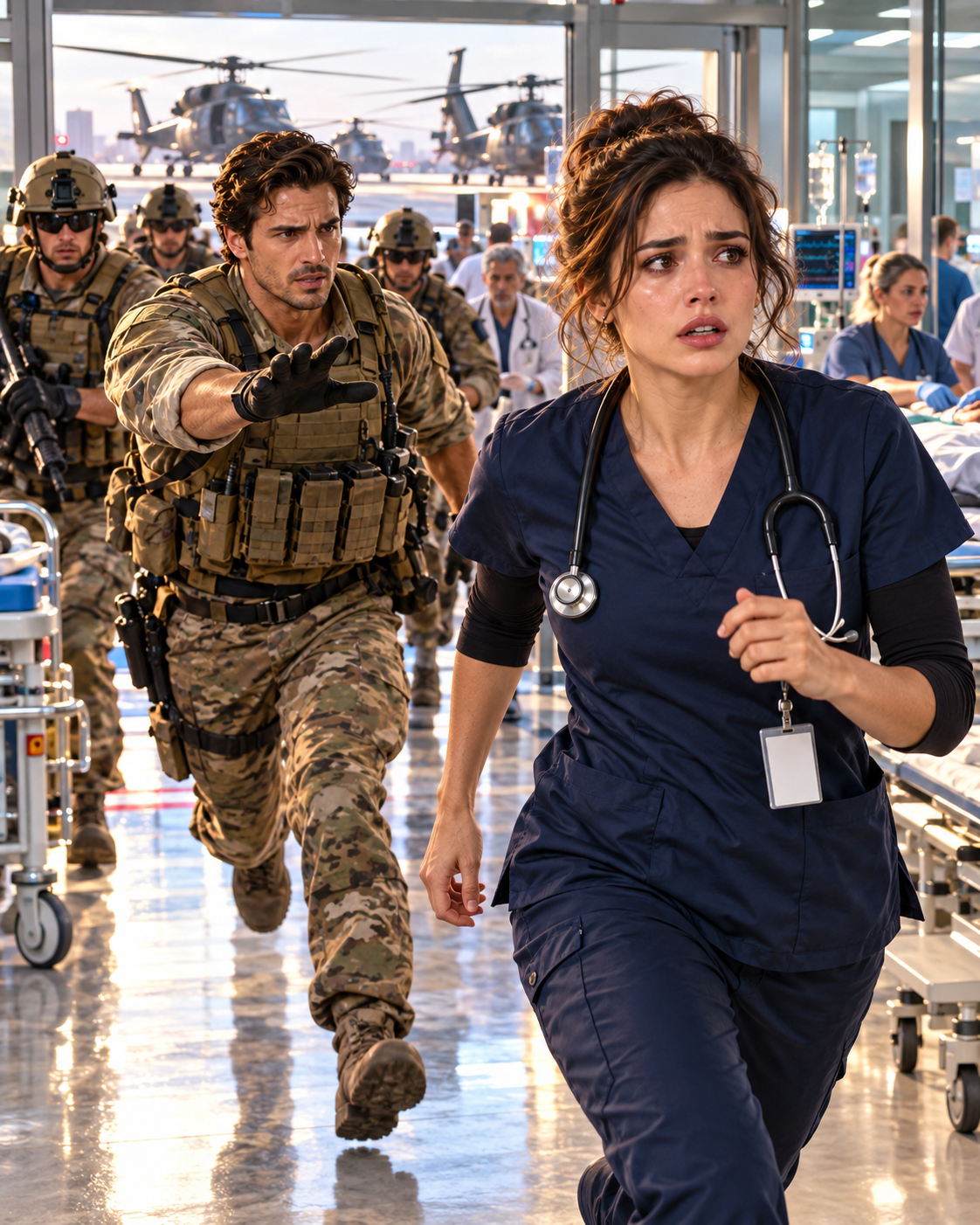
I looked at him.
“With what?”
He pointed toward the saline.
“Cold fluid now. We can fix the temperature later.”
“No.”
His expression hardened.
“Excuse me?”
“Cold crystalloid is not going to replace what he’s lost.”
I heard my own voice steadying.
“We need blood.”
Sterling folded his arms.
“We have a protocol.”
“Then your protocol is behind the patient.”
He stared at me like I had committed a crime.
Leo looked from him to me.
“His temperature’s dropping.”
“Exactly,” I said.
I turned toward the operators.
“I need his teammates.”
One of them stepped forward.
The major came with him.
“What’s your name?” I asked.
“Nolan Vance,” the major said.
“Nolan, can you hear me?”
His eyelids fluttered.
Nothing.
I looked at the major.
“You said maritime training accident?”
“Yes.”
“Any known blood type?”
“One of the team leaders knows.”
Another operator answered.
“O positive.”
I looked around the room.
“Who else is O positive?”
Three hands went up.
Sterling’s face changed.
“You cannot just draw blood from staff in an emergency department.”
“I’m not drawing from staff.”
I looked at the operators.
“I’m drawing from his team.”
Sterling stepped forward.
“Absolutely not.”
The word cracked through the room.
I stared at him.
“He will be dead before your paperwork is finished.”
“You will stand down.”
“No.”
It was the first time I had ever refused him.
His eyes narrowed.
“You are suspended.”
“Fine.”
“You are suspended effective immediately.”
“Fine.”
“Security will escort you out.”
“After we save him.”
The room went still.
Major Paul Garrett looked at Sterling.
Then at me.
Then at Nolan.
“Doctor,” he said quietly, “we brought our own medical history, our own transport, and our own blood donors.”
Sterling snapped, “This hospital follows hospital policy.”
Garrett’s jaw tightened.
“Your policy doesn’t outrank a dying man’s heartbeat.”
Sterling turned to Leo.
“Do not assist her.”
Leo looked at Nolan.
Then he looked at me.
“I’m assisting her.”
Sterling’s face reddened.
“Dr. Park, think very carefully.”
Leo didn’t.
He moved the equipment closer.
I saw Sterling’s anger flare, but something bigger was happening now.
The room had begun to remember that survival came before pride.
Then Sterling said the one thing that nearly made me lose control.
“You are acting on trauma, not medicine.”
I looked at him.
“You’re wrong.”
My voice came out quiet.
“I’m acting on experience.”
I pulled back the cuff of my sleeve.
The room changed instantly.
There were scars everywhere.
Thin white lines.
Deep ridges.
Old burns.
A crescent near my wrist.
The faded marks of surgeries.
The evidence of years I had spent putting other people back together while barely recognizing myself.
Then more of my sleeve slid upward.
The tattoo appeared.
A small sparrow with its wings spread wide across my forearm.
No one spoke.
Major Garrett straightened.
The three operators stared.
Then, one by one, every battle-hardened sailor in the room saluted.
I felt my throat close.
I hadn’t seen that salute in six years.
“Chief,” Garrett said.
I shook my head.
“Don’t.”
He lowered his hand.
“You earned it.”
Sterling looked at the tattoo, then at me.
“You’re military?”
“Former military.”
“Special Operations?”
“Yes.”
“Combat medic?”
“Yes.”
He took a step back.
“And your credentials?”
“Decorated.”
I swallowed.
“Retired.”
He stared at the scars.
For the first time since I had met him, he looked uncertain.
I turned away.
“Let’s save him.”
The team donors were lined up.
Dr. Arthur Vance, our Chief Medical Officer, was called from upstairs and arrived just as the first collection began.
He took one look at Nolan’s condition and understood.
“What’s your plan?” he asked.
“Whole blood,” I said.
“Direct, warm, emergency walking blood bank.”
He looked at Sterling.
Sterling opened his mouth.
Arthur raised one hand.
“Not now, Gregory.”
It was the first time I had heard anyone speak to Sterling like that.
Dr. Elena Silva arrived moments later, already gloving up.
She checked the field, the tourniquets, the monitor, and Nolan’s pupils.
“Operating room is almost ready,” she said.
“Then keep him alive until it is.”
She looked at me.
“You know what you’re doing?”
The question did not sound skeptical.
It sounded respectful.
“Yes.”
“Good.”
We started.
The donors gave directly under supervision while the nurses worked around them.
Fresh blood entered Nolan’s line.
His core temperature began to climb.
His pulse stayed weak, but it stayed.
For a few minutes, it looked like we had bought enough time.
Then the monitor changed.
The rhythm collapsed into a jagged line.
“Pressure’s gone.”
“Nolan!”
I checked for a pulse.
Nothing.
“PEA arrest.”
Leo called for the cart.
Someone asked for the defibrillator.
I shook my head.
“Not a shockable rhythm.”
I looked at Leo.
“Calcium.”
He understood immediately.
“Calcium ready.”
I climbed onto the side rail.
“Start compressions.”
Then I heard Sterling behind me.
“You are not authorized—”
I stopped hearing him.
My hands were already moving.
One hundred.
One hundred ten.
One hundred twenty.
I pressed down again and again, each compression driving my weight through his chest.
The entire room disappeared.
No helicopters.
No hospital.
No Sterling.
Only Nolan.
Only the impossible demand I knew too well.
Stay.
“Calcium now!”
The medication went in.
I kept compressing.
My shoulders burned.
My wrists screamed.
Sweat ran into my eyes.
Leo counted.
I stopped counting.
I had learned a long time ago that the body does not care how exhausted the person fighting for it has become.
At seventy seconds, nothing.
At eighty, nothing.
At ninety, I almost heard my brother’s voice.
Then the monitor changed.
A narrow complex appeared.
Then another.
Then another.
“Pulse!”
Someone shouted it.
I checked again.
There it was.
Weak.
Fast.
Real.
Nolan was alive.
I stepped backward.
My legs nearly gave out.
Major Garrett caught my shoulder.
“Stay with us, Chief.”
I looked at him.
“No.”
I corrected myself.
“I’m staying.”
The operating room doors opened.
Dr. Silva and the surgical team moved Nolan through.
The blood bag swung beside the stretcher.
The tourniquet stayed tight.
The room exploded back into motion.
And for the first time in six years, I realized the past had not been waiting to punish me.
It had been waiting to remind me who I was.
Part 3
The surgery lasted hours.
I stayed outside the operating room with blood drying on my sleeves and Nolan’s pulse echoing in my head.
Nobody asked me to leave.
Nobody called me Mouse.
Around midnight, Dr. Silva came through the doors.
“He made it.”
I closed my eyes.
“The limb?”
“Saved enough circulation that we’re not doing the amputation we feared.”
I let out a breath that felt like it had been trapped in my chest for six years.
“He’ll have a long recovery,” she said.
“But he’s alive.”
Alive.
The word hit harder than any medal ever had.
I sat down.
Major Garrett took the chair beside me.
For several minutes, neither of us spoke.
Then he said, “You never told me where you went.”
“I didn’t know where I was going.”
He looked at my hands.
“You blamed yourself.”
I stared at the floor.
“My brother died.”
“I know.”
“You weren’t there.”
“I wasn’t.”
He paused.
“But I know what happened after.”
I looked at him.
He reached into his jacket and pulled out a folded photograph.
I did not recognize the woman at first.
Then I saw the eyes.
My stomach dropped.
“That is his mother.”
I couldn’t breathe.
Garrett nodded.
“She spent years trying to find the medic who stayed with her son.”
My lips trembled.
“I thought she hated me.”
“She didn’t.”
He opened the photograph.
On the back was a handwritten note.
I did not read it immediately.
I was afraid of the words.
Finally, I looked.
It said, “Tell the medic who held my son that he was not alone.”
My vision blurred.
Garrett quietly continued.
“She said that whatever happened on that ridge, the last person your brother saw was someone who refused to leave.”
I covered my mouth.
For six years, I had carried one memory.
My brother dying.
For six years, I had forgotten another.
I had stayed.
I had talked to him.
I had held his hand.
I had been there when nobody else could be.
Maybe saving a life had never been the only measure of being a medic.
Maybe sometimes the final act of medicine was refusing to let someone die alone.
The next morning, Sterling was removed from the directorship.
There were investigations into his handling of the emergency, his disregard for updated trauma practices, and his retaliation against staff who challenged him.
He found me in an empty conference room.
For once, he looked smaller than the man in the framed photograph downstairs.
He closed the door.
“I owe you an apology.”
I said nothing.
“I was wrong about you.”
“You were wrong about a lot of things.”
He nodded.
“I know.”
He looked at my forearm.
“You should never have had to hide that.”
I pulled my sleeve down halfway.
“That part was my decision.”
He lowered his eyes.
“I made it harder.”
“Yes.”
He took a slow breath.
“I am sorry.”
I believed he meant it.
That did not erase the years.
But it mattered.
Before he left, he turned.
“You saved his life.”
I looked toward the hallway.
“No.”
I shook my head.
“We all did.”
A month later, Major Garrett came back.
He had an offer.
The Navy wanted me back.
There was a desk, a command position, a training role, a fast-track promotion, and a uniform waiting if I wanted it.
I held the envelope in my hands and felt something unexpected.
Peace.
For years, I had thought healing meant finding a way back to who I had been.
Now I understood.
Healing meant becoming someone I had never been before.
I declined the recall.
Not because I hated the military.
Not because I was afraid.
Because I finally knew where I belonged.
I belonged beside the beds of frightened patients.
I belonged teaching young nurses how to recognize the moment when silence became dangerous.
I belonged teaching residents that humility was not weakness.
I belonged on the hospital floor.
A few weeks later, Dr. Park asked me to teach a trauma session.
I rolled up my sleeves in front of thirty people.
Nobody laughed.
I showed them the scars.
I told them what had happened.
Not every detail.
Not every grief.
Just enough.
“Do not confuse quiet with weak,” I said.
“Some people are quiet because they have survived things you cannot see.”
Leo smiled.
“That sounds like something the Mouse would say.”
The room went silent.
Then I laughed.
A real laugh.
Not the one I used to survive Sterling.
“The Mouse is dead,” I said.
They laughed with me.
That evening, I walked out of Crestview Memorial as the sun dropped behind the city.
The air was warm.
For the first time, I did not reach for my sleeves.
I rolled them past my elbows and kept walking.
The sparrow on my forearm caught the last orange light of the day.
Its wings looked almost alive.
I thought about Nolan breathing in the operating room.
I thought about my brother on the ridge.
I thought about the woman who had spent years thanking the medic she believed had stayed.
Then I understood something that should have been obvious all along.
A scar is not proof that you failed.
Sometimes it is proof that you carried something heavy and still found a way forward.
I had spent six years hiding the promises written into my skin because I thought they belonged to a person I had lost.
They did not.
They belonged to me.
I stopped at the edge of the parking lot and lifted my face toward the setting sun.
No one was watching.
No one was mocking me.
No one was waiting for me to become smaller.
And for the first time in six years, I let my arms stay bare as I walked into the evening, carrying every scar, every promise, and every life I had touched without shame.