The company had already given up on its $20 million production machine. More than a dozen engineers had failed to fix it
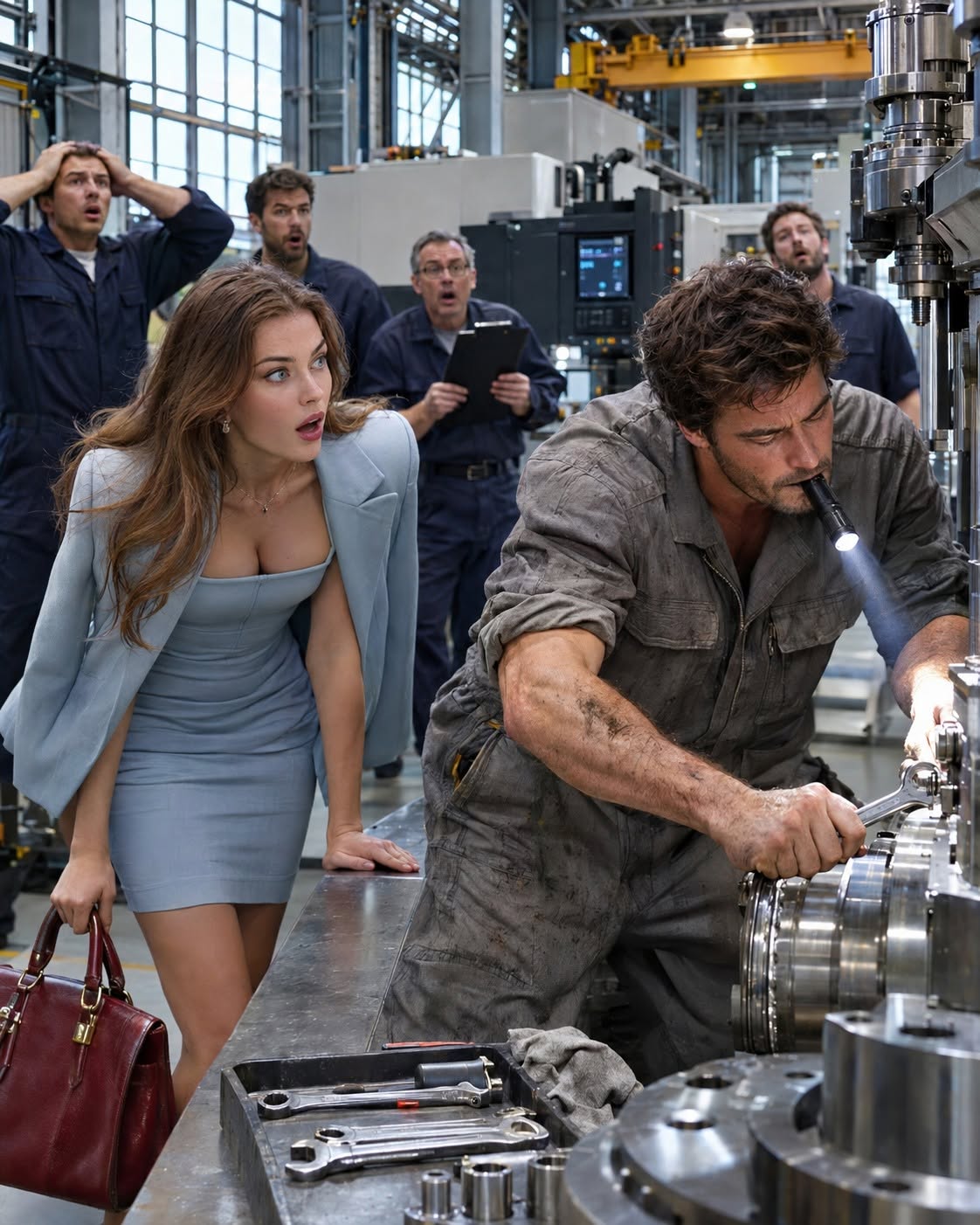
The CEO reached the control panel before anyone could stop her.
“Don’t touch that switch!” I shouted.
Everyone froze.
She turned toward me, her expression hardening. “Excuse me?”
I pointed at the secondary monitoring screen. “The pressure isn’t coming from the regulator anymore. Look at the flow readings. Something is forcing pressure backward through the auxiliary line.”
The plant supervisor leaned closer to the screen. His hands moved quickly across the control panel.
“He’s right,” he whispered. “The return pressure is increasing.”
The CEO looked at him. “What does that mean?”
“It means if we keep running the system, the pressure could build inside the main chamber. If it reaches the safety limit, we could have a serious failure.”
A cold silence settled over the factory.
I stared at the readings, trying to understand what I was seeing. The regulator we’d replaced was working perfectly. The primary pressure was stable. But the secondary line was behaving as if something was deliberately preventing the system from releasing excess pressure.
“Shut down the test,” I said. “Slowly. Don’t trigger the emergency release until we know what’s happening.”
The supervisor followed my instructions.
Within seconds, the machine returned to silence.
The CEO folded her arms.
“Explain what you just found.”
I walked toward the secondary monitoring screen and opened the maintenance history.
“There are two pressure-control systems connected to this machine. The first one regulates production pressure. That’s the component I repaired. The second one handles the return flow. If the second system is blocked, the first can work perfectly and the entire machine can still fail.”
I enlarged the diagram.
Then I noticed something that made my stomach tighten.
The auxiliary valve had been replaced six months earlier.
But the replacement part listed in the maintenance records didn’t match the original manufacturer’s specifications.
“Who approved this?” I asked.
The supervisor looked uncomfortable.
“That installation was handled by the engineering department. I wasn’t involved.”
The CEO’s face changed.
“Bring me the complete maintenance records. Every inspection, every purchase order, and every authorization.”
She looked at me again.
“And nobody leaves until we understand what happened.”
I had expected to be sent home that morning. Instead, I found myself standing in a room full of executives, engineers, and supervisors, watching a multimillion-dollar machine become the center of an investigation.
But what happened next was something none of us had anticipated.
THE SIGNATURE
At eight o’clock, the factory conference room was packed.
Three senior engineers sat across from me. They had expensive laptops, professional certifications, and years of experience.
I had a worn notebook, a pair of safety boots, and a pen that barely worked.
The CEO entered carrying a thick folder.
“Let’s begin.”
She placed several documents on the table.
“Six months ago, the auxiliary pressure valve was replaced. The supplier charged us nearly $180,000 for the entire installation. According to these records, the work passed inspection.”
One of the senior engineers cleared his throat.
“That was a complicated installation. The original valve was discontinued, and we had to use an alternative component.”
“Was the alternative approved by the manufacturer?” she asked.
He hesitated.
“It met the general operating requirements.”
“That wasn’t my question.”
Nobody answered.
The CEO turned another page.
“Who signed the final approval?”
The plant supervisor examined the document.
Then his face went pale.
“That’s Daniel’s signature.”
Everyone looked at the engineering director.
Daniel Mercer was a man in his late fifties. He had worked for the company for nearly twenty years and had a reputation for being brilliant, demanding, and fiercely protective of his department.
He adjusted his glasses.
“I approved the installation based on the information provided to me.”
The CEO studied him.
“Did you personally inspect the valve?”
“Of course not. That’s what my engineers are for.”
“Then why did you certify that it met the manufacturer’s specifications?”
Daniel leaned forward.
“With all due respect, we have a maintenance technician sitting here questioning an engineering decision made by an entire department.”
His eyes moved toward me.
“I don’t think that’s a reasonable basis for this investigation.”
I felt my face grow warm.
He wasn’t entirely wrong. I wasn’t an engineer. I didn’t have a university degree. I had spent most of my adult life fixing equipment, replacing worn components, and keeping production lines moving.
But I knew what I had seen.
I opened my notebook.
“May I show you something?”
The CEO nodded.
I placed two photographs on the table. One showed the original valve specification. The other showed the replacement part currently installed.
“These components look almost identical,” I explained. “But the internal passage diameter is different. The replacement valve allows less return flow than the original.”
One engineer leaned forward.
“How much less?”
“Approximately twenty-three percent under the operating conditions we’ve measured.”
Daniel shook his head.
“That’s within an acceptable tolerance.”
“Not with this machine’s production cycle,” I replied.
I turned another page.
“I calculated the return-flow requirements using the machine’s operating manual. At maximum production pressure, the replacement valve cannot release excess pressure quickly enough. The system gradually becomes unstable.”
The room went quiet.
The CEO looked at the engineers.
“Can someone verify these calculations?”
One of them took my notebook.
He examined the figures for several minutes, then opened a simulation on his laptop.
After running the numbers twice, he looked up.
“The technician’s calculations are correct.”
Daniel’s expression tightened.
“That’s impossible.”
The engineer turned his laptop toward him.
“The replacement valve is undersized for this configuration. We should never have approved it.”
For the first time that morning, I saw fear in Daniel’s eyes.
But the CEO wasn’t finished.
She opened the last page of the folder.
“There’s something else.”
She placed a purchase order in front of everyone.
The replacement valve had been purchased from a supplier that wasn’t on the company’s approved vendor list.
And the price was nearly three times higher than the original component.
The CEO looked directly at Daniel.
“Would you care to explain that?”
He stared at the document.
“I’ll need time to review the records.”
“You’ve had six months.”
Nobody spoke.
Then she instructed the legal and compliance teams to begin an independent investigation.
I thought that would be the end of it.
I was wrong.
THE PRICE OF BEING RIGHT
By lunchtime, the entire factory knew that I had discovered a serious flaw in the machine.
Some coworkers congratulated me. Others looked at me with concern.
One of the older technicians approached me near the maintenance workshop.
“Be careful,” he whispered.
“Why?”
He glanced around before answering.
“People don’t like being proven wrong. Especially people who have spent twenty years convincing everyone they’re always right.”
I laughed nervously.
“I’m just trying to keep the factory running.”
He shook his head.
“That’s what you think this is about.”
Later that afternoon, I received a message from the human resources department asking me to attend a meeting.
I walked into the office expecting congratulations or perhaps a discussion about a promotion.
Instead, a woman from HR handed me a document.
“Effective immediately, you’re being placed on administrative leave while we review your unauthorized access to restricted equipment.”
I stared at her.
“Unauthorized access?”
“You performed an independent inspection outside your assigned responsibilities.”
“But I was trying to repair the machine.”
“We understand. However, the company must follow established procedures.”
I felt something collapse inside my chest.
Three weeks of unpaid overtime. Sleepless nights. Every calculation I’d made.
And now I was being treated like a problem.
“Am I losing my job?”
She avoided my eyes.
“That decision hasn’t been made.”
I walked out of the office with a document in my hand and a terrible feeling in my stomach.
My son was waiting for me at home that evening.
He was seven years old, small for his age, with a habit of asking questions that adults weren’t always prepared to answer.
He was sitting at the kitchen table drawing.
When I entered, he looked up.
“Daddy! You’re home early!”
I forced a smile.
“Yeah, buddy. A little earlier than usual.”
He showed me a picture of a rocket ship.
“Do you think I could build something like this when I grow up?”
“Absolutely.”
“Even if I’m not the smartest kid in class?”
I knelt beside him.
“Being smart isn’t about knowing everything. It’s about being curious enough to keep learning.”
He thought about that for a moment.
Then he reached into his schoolbag and pulled out another drawing.
It was the same picture from my notebook, the one showing the two of us standing together.
Underneath, he’d added a new sentence.
“Daddy fixes broken things.”
I felt my eyes sting.
That night, after he went to bed, I sat alone at the kitchen table.
My savings weren’t much. My rent was due in ten days. I had no idea whether I’d have a paycheck next month.
For the first time since discovering the fracture, I wondered whether I should have simply walked away.
Then my phone rang.
It was the plant supervisor.
“I need to tell you something,” he said quietly.
“What is it?”
“The CEO reviewed the camera footage from the maintenance floor.”
I sat up.
“And?”
“She saw you working on that machine for three weeks. She also saw Daniel entering the control room several times after the shutdown.”
I frowned.
“Why would that matter?”
“Because he told the investigation team he’d never inspected the machine after it failed.”
I felt my stomach tighten.
The supervisor continued.
“They found something on the security footage. Something you need to know.”
THE HIDDEN RECORDING
The following morning, I received a call from the CEO’s office.
She wanted me back at the factory.
I arrived at nine, expecting another disciplinary meeting.
Instead, she invited me into her private office.
She was standing beside the window, looking down at the production floor.
“Sit down,” she said.
I did.
She placed a tablet on the desk.
“Watch this.”
The video showed Daniel entering the machine’s control room at 11:43 p.m. on the night before the production system was officially shut down.
He carried a small equipment case.
He opened the control cabinet, worked inside it for several minutes, and left.
The footage was grainy, but his face was unmistakable.
“Do you know what he was doing?” she asked.
“No, ma’am.”
“Neither did we. But the investigation team found that he accessed the machine’s diagnostic system without recording the work.”
She played another video.
This time, Daniel was standing beside the auxiliary valve with a younger engineer.
They were talking, but the camera had no audio.
The younger engineer handed him a document.
Daniel examined it, folded it, and placed it inside his jacket.
The CEO paused the footage.
“That engineer has agreed to speak with us.”
She opened a folder.
His name was Michael Reeves. He had joined the company two years earlier and had been responsible for the original valve installation.
According to his statement, he had discovered that the replacement component was incompatible with the machine’s operating requirements.
He had raised the issue before the installation was completed.
But Daniel had instructed him to proceed.
When Michael refused, he was removed from the project and reassigned.
“Why didn’t he report it?” I asked.
“He tried,” the CEO replied. “His complaint was closed internally. He was told there was insufficient evidence.”
I looked at the screen again.
“So someone knew the machine was unsafe?”
“Apparently.”
She walked around her desk and sat opposite me.
“There’s another problem. The replacement valve was not the only unauthorized change. Someone modified the safety monitoring software to suppress certain pressure warnings.”
I stared at her.
“Why would anyone do that?”
“That’s what we’re trying to establish.”
She paused.
“Do you remember the unusual reading from yesterday?”
“Yes.”
“It was generated by a monitoring system that had been partially disabled. The machine’s safety controls were no longer reporting everything they should have.”
I felt a chill run down my spine.
“Then we shouldn’t restart it.”
“Not until every modification has been investigated.”
She studied me for a moment.
“I also want to apologize.”
I wasn’t expecting that.
“For what?”
“For allowing the company to treat your work as a disciplinary issue before understanding what you had discovered.”
I looked down at my hands.
“I wasn’t trying to break any rules. I just didn’t want hundreds of people losing their jobs.”
“I know.”
She opened another folder.
“Your suspension has been lifted. You’ll receive full pay for the period you were removed from work.”
I nodded, unable to find the right words.
Then she said something that surprised me even more.
“I want you to help lead the technical recovery team.”
I almost laughed.
“Ma’am, I’m a maintenance technician.”
“And you understand this machine better than anyone in this building right now.”
She leaned forward.
“Experience doesn’t become less valuable because it comes without an expensive certificate.”
For the first time in weeks, I felt like I could breathe.
But the hardest part was still ahead.
THE NIGHT EVERYTHING ALMOST WENT WRONG
The company hired an independent industrial safety team to inspect the entire production system.
They discovered several unauthorized modifications, including incorrect valve specifications, altered pressure thresholds, and a damaged emergency bypass.
The machine wasn’t simply broken.
It had been operating under conditions that could have caused a catastrophic accident.
The original engineers had spent weeks trying to repair the symptoms without understanding the underlying changes.
And the more they investigated, the more complicated the situation became.
Daniel was placed on leave pending the investigation. His access to the facility was revoked.
But before the company could finish its review, another problem appeared.
The independent team discovered that the replacement valve had damaged part of the return-flow assembly.
Even after replacing the valve, the machine couldn’t safely resume full production.
A complete replacement would take at least four months.
The company had already lost millions.
Four more months could mean closing the plant.
The CEO called an emergency meeting.
“We need a safe solution,” she said. “Not a shortcut. Not a temporary fix that puts people at risk. A solution.”
The engineers discussed importing a new assembly.
The estimated cost was $3.8 million, with delivery expected in sixteen weeks.
I listened quietly.
Then I raised my hand.
“I think we may have another option.”
Everyone turned toward me.
I opened my notebook to a diagram I’d been working on.
“The return-flow assembly is damaged, but the main housing is still within its structural limits. If we replace the damaged internal components with manufacturer-approved parts and recalibrate the system, we may be able to restore the original design.”
One engineer frowned.
“That’s a major reconstruction.”
“I know.”
“Have you done this before?”
“Not on this scale.”
He exchanged a look with his colleague.
The CEO didn’t interrupt.
I continued.
“I’m not suggesting we improvise. We’d need the manufacturer’s engineering team to inspect the housing, approve the components, and certify the final assembly. But it might save us months.”
The room remained silent.
Finally, the CEO asked, “What would you need?”
“Access to the original technical drawings. A complete inspection. And permission to work directly with the manufacturer’s specialists.”
She nodded.
“Make it happen.”
The next two weeks were the most exhausting of my life.
I worked alongside engineers who had initially doubted me. We measured every surface, inspected every connection, and documented every damaged component.
The manufacturer’s specialists reviewed our findings remotely before sending two engineers to the factory.
At first, they were skeptical.
One of them examined my calculations and asked, “Who designed this recovery plan?”
I pointed to myself.
He looked surprised.
“You developed this?”
“With help from the team.”
He spent the next hour checking every measurement.
Finally, he closed his tablet.
“The approach is technically sound, provided we follow the approved replacement specifications and complete the required validation tests.”
I felt a weight lift from my shoulders.
But there was one final obstacle.
The repaired machine would need to pass a full-load stress test.
And nobody would be allowed near the operating area while it ran.
The test was scheduled for a Friday evening.
By then, nearly the entire factory was watching.
THE TEST
At 6:30 p.m., the safety team completed its final inspection.
The production floor was quiet.
Every worker had been moved to the designated safe area. Emergency systems were active. Independent monitoring equipment had been installed.
I stood beside the control panel with the manufacturer’s engineer.
My palms were sweating.
The CEO approached.
“Are you ready?”
I looked at the readings.
“No one is ever completely ready for a test like this. But we’ve checked everything we can.”
She gave a small nod.
“Then let’s proceed.”
The supervisor activated the system.
At first, nothing happened.
Then the main motor began turning.
A deep mechanical vibration traveled through the floor.
The pressure gauge rose slowly.
Twenty percent.
Forty percent.
Sixty percent.
The auxiliary return line began operating.
I watched the secondary monitoring screen.
Every reading remained within the approved range.
Seventy percent.
Eighty percent.
Ninety percent.
Then the alarm sounded.
A sharp red warning appeared on the monitoring system.
Everyone froze.
The manufacturer’s engineer immediately reached for the emergency controls.
“Hold on!”
I leaned toward the display.
The pressure itself was stable.
The warning was coming from the vibration sensor attached to the reconstructed housing.
I examined the reading.
It was fluctuating in a pattern that didn’t match the machine’s normal operating cycle.
“Stop the test,” I said.
The supervisor shut down the system.
The factory fell silent again.
The CEO walked toward us.
“What happened?”
I pointed at the vibration graph.
“We’ve got an abnormal oscillation. It might be a mounting issue, but we need to investigate before continuing.”
One of the engineers looked frustrated.
“We followed the specifications exactly.”
“I know. That’s why we need to understand the difference between the drawing and the actual installation.”
We spent another three hours inspecting the assembly.
Eventually, we found the problem.
A support bracket had been installed with a small alignment offset. It was barely noticeable, but under high pressure, the vibration was amplified throughout the housing.
It wasn’t a manufacturing defect.
It was an installation tolerance issue.
We corrected the alignment using the manufacturer’s approved procedure.
Then we repeated the inspection.
At 11:18 p.m., the test resumed.
The motor started.
The pressure increased.
The return-flow system worked.
The vibration readings remained stable.
One hundred percent.
The machine had reached its rated operating capacity.
The manufacturer’s engineer looked at the monitoring panel and smiled.
“That’s it. She’s running.”
For a moment, nobody moved.
Then the factory erupted in applause.
Workers hugged one another. Some wiped tears from their eyes.
The CEO stood beside the control panel, watching the numbers.
She turned toward me.
“You did it.”
I shook my head.
“We did it.”
She smiled.
“That’s the right answer.”
But my greatest surprise came a few minutes later.
The CEO asked everyone to remain in the production area.
She stepped onto a small platform near the control room.
“I want to make something clear,” she announced.
“This factory almost closed because we failed to listen. We had experienced people raising concerns, but we allowed titles, departments, and internal politics to become more important than the truth.”
She looked toward the engineers.
“Technical knowledge matters. Experience matters. But neither means anything if we stop asking questions.”
Then she turned toward me.
“And sometimes, the person who notices the problem is not the person anyone expects.”
The entire factory applauded.
I stood there, embarrassed, not knowing where to look.
I wasn’t thinking about promotions or money.
I was thinking about the little boy who had drawn a picture of his father fixing broken things.
THE TRUTH COMES OUT
The machine returned to production the following Monday.
Hundreds of workers came back to their stations.
Orders that had been delayed for months began moving again.
The company avoided a closure that would have devastated the entire community.
But the investigation into Daniel continued.
Over the next several weeks, auditors uncovered evidence of serious misconduct.
The replacement valve had been purchased through a supplier connected to a private consulting company owned by one of Daniel’s relatives.
The inflated contract had generated payments that were never disclosed to the company.
Investigators also found that Daniel had authorized the suppression of several pressure warnings after Michael raised concerns.
The purpose had been to avoid delays, protect the department’s performance numbers, and conceal the consequences of an improper installation.
When Daniel was confronted with the evidence, he initially denied everything.
But the purchase records, internal emails, and financial documents told a different story.
He was eventually dismissed and referred to the appropriate authorities.
Michael, the young engineer who had first questioned the installation, was cleared of wrongdoing.
The company also reopened several complaints that had been ignored.
The CEO introduced a new safety reporting system that allowed any employee to raise concerns directly with an independent review team.
No worker would be punished simply for reporting a potential hazard in good faith.
The changes weren’t just about protecting the company.
They were about protecting the people who worked inside it.
A month later, I was called into the CEO’s office again.
This time, she wasn’t holding a disciplinary document.
She handed me a letter.
“Read it.”
I opened the envelope.
The company was offering me a promotion to Senior Maintenance and Reliability Specialist.
The position came with a substantial salary increase, paid technical training, and responsibility for helping develop maintenance procedures across the plant.
I stared at the letter.
“I don’t know what to say.”
“Say yes,” she replied with a smile.
I laughed.
Then she added something I hadn’t expected.
“We’d also like to sponsor your engineering education. If you want to pursue a formal qualification, the company will cover the tuition and provide a flexible schedule.”
I looked at her.
“Why would you do that?”
She leaned back in her chair.
“Because I don’t want the next person with your ability to spend twenty years believing a lack of formal credentials means they have nothing more to offer.”
My eyes began to sting.
I accepted the offer.
But when I got home that evening, I didn’t tell my son about the promotion first.
I put the letter on the kitchen table and asked him to close his eyes.
He covered them with both hands.
I placed the letter in front of him.
“Okay. Open them.”
He looked at the paper.
Then at me.
“What’s this?”
“Daddy got a new job.”
His face lit up.
“Does that mean you fixed the big machine?”
I smiled.
“Yes, buddy. We fixed it.”
He jumped into my arms.
“I knew you could!”
I held him tightly.
And for the first time in a long while, I wasn’t worried about the next rent payment or whether I would still have a job next month.
I was simply grateful.
THE DRAWING
Several months passed.
The factory was running better than it had in years.
Maintenance inspections were more thorough. Workers had received additional safety training. Engineers and technicians were working together instead of blaming one another when something went wrong.
I had started taking evening engineering classes.
Some subjects were difficult. There were nights when I sat at the kitchen table staring at equations long after my son had gone to bed.
But I kept going.
Whenever I felt overwhelmed, I looked at the old crayon drawing I had carried in my notebook.
One afternoon, the CEO visited the maintenance workshop.
She noticed the drawing taped beside my desk.
“Is that your son?”
I nodded.
“Yes. He made it for me before all this happened.”
She stepped closer and read the words underneath.
“Daddy is my hero.”
She smiled.
“Does he know what happened here?”
“Some of it. I told him we had a big problem at work and a lot of people needed help.”
“And what did he say?”
I laughed softly.
“He asked if the machine was sad when it stopped working.”
The CEO chuckled.
“Children have a way of seeing things differently.”
She looked at the drawing for another moment.
Then she asked, “Have you ever considered teaching?”
I turned toward her.
“Teaching?”
“We’re developing an apprenticeship program. We want experienced technicians to train younger workers. Not just how to replace parts, but how to think, how to investigate, and how to recognize when something doesn’t make sense.”
She paused.
“I think you’d be good at it.”
I looked around the workshop.
For years, I’d believed my job was simply to keep machines running.
Now I understood that the more important responsibility was helping people recognize problems before they became disasters.
“I’d like that,” I said.
And I meant it.
ONE YEAR LATER
On the anniversary of the machine’s return to production, the company organized a small ceremony.
The factory floor had been cleaned, the equipment polished, and a banner hung above the main production line.
It read:
“ONE YEAR. ZERO UNSCHEDULED SHUTDOWNS.”
The CEO invited employees and their families.
My son came wearing his favorite blue shirt.
He held my hand as we walked through the entrance.
“Is this where you work, Daddy?”
“That’s right.”
He looked up at the enormous machine.
“That’s the one?”
I nodded.
He stared at it for several seconds.
Then he whispered, “It’s really big.”
I laughed.
“It is.”
The CEO approached us.
“Well, this must be the famous young man.”
My son hid slightly behind my leg.
She crouched down to his level.
“Your father has told us a lot about you.”
He looked at me.
“Did you tell her about my drawing?”
“I did.”
She smiled.
“Actually, I think your drawing helped your father more than you realize.”
My son looked confused.
“How?”
I knelt beside him.
“Because when Daddy was tired and didn’t know what to do, I remembered that you believed in me.”
He thought about that.
Then he reached into his small backpack and pulled out a folded piece of paper.
“I made you a new one.”
I opened it.
This time, he had drawn three people standing beside a giant machine.
Himself.
Me.
And the CEO.
Above us, he’d drawn a bright yellow sun.
Underneath, in uneven letters, were the words:
“PEOPLE CAN FIX BIG THINGS TOGETHER.”
I couldn’t help laughing.
The CEO read it and smiled.
“Your son might understand leadership better than most executives.”
We both laughed.
But I kept looking at that drawing.
Because somewhere along the way, the story had stopped being about a broken machine.
It had become a story about a workplace that had forgotten to listen, a father who refused to give up, an engineer who finally found the courage to tell the truth, and hundreds of families who got to keep their livelihoods.
That afternoon, standing beside the machine that had nearly ended my career, I realized something.
The most expensive mistake a company can make isn’t always buying the wrong equipment.
Sometimes it’s overlooking the people who know how to keep it working.
A degree can teach you the principles of engineering. Experience can teach you what those principles look like in the real world. Courage gives you the strength to speak when something doesn’t seem right.
But humility is what allows everyone else to listen.
I had walked into that factory as an ordinary maintenance technician, worried about paying rent and raising my son.
I had walked out of the crisis with a new career, a stronger team, and a future I had never imagined.
And my son?
He still called me his hero.
But I knew the truth.
I wasn’t a hero because I had fixed a twenty-million-dollar machine.
I was a father who had refused to stop trying because the people he loved were counting on him.
And perhaps that is what being a hero really means.
Not knowing that you can fix everything.
Not being the smartest person in the room.
But having the courage to keep looking for an answer, even when everyone else has decided there isn’t one.
Sometimes, the smallest voice in the factory deserves to be heard.
And sometimes, listening to that voice can save an entire world.