The colonel had twelve officers in that briefing room, and not one of them could figure out how to protect our perimeter.
THE COLONEL’S LAST ORDER
The person named in that report wasn’t an ordinary officer. He was someone trusted with protecting the very intelligence operation he had allegedly betrayed.
And when Colonel Bride ordered him brought in, the entire camp was about to discover just how deep the betrayal went.
The name on the report was Lieutenant Colonel Daniel Reeves.
For a moment, Major Holt simply stared at the screen.
Reeves was the senior intelligence officer at Camp Ridgeline. He had served in the Navy for twenty-three years, received multiple commendations, and personally supervised the security protocols that protected classified operational data.
He was also Colonel Bride’s closest friend.
“That can’t be right,” Holt whispered.
I stood across from his desk, keeping my expression neutral.
“The authentication trail is complete, sir. Three separate transmissions. Different dates. Same credentials. Same encryption signature.”
Holt slowly closed the dossier.
“Do you understand what you’re accusing him of?”
“I’m not accusing anyone, Major. I’m showing you what the evidence says.”
He looked at me for a long moment.
Then he reached for the secure telephone.
“Get Colonel Bride in here. Immediately.”
Within fifteen minutes, Colonel Bride entered the command tent.
He was still wearing his morning uniform, his expression hard with irritation.
“What is this emergency, Holt?”
The major slid the dossier across the table.
“Sir, we have a problem with our intelligence network.”
Bride opened the folder.
At first, he seemed impatient. He flipped through the pages quickly, expecting another technical malfunction or administrative mistake.
Then he reached the final authentication record.
His hand stopped.
“Where did you get this?”
“From the perimeter listening network,” Holt answered.
Bride looked toward me.
“You’re the one who made these adjustments?”
“Yes, sir.”
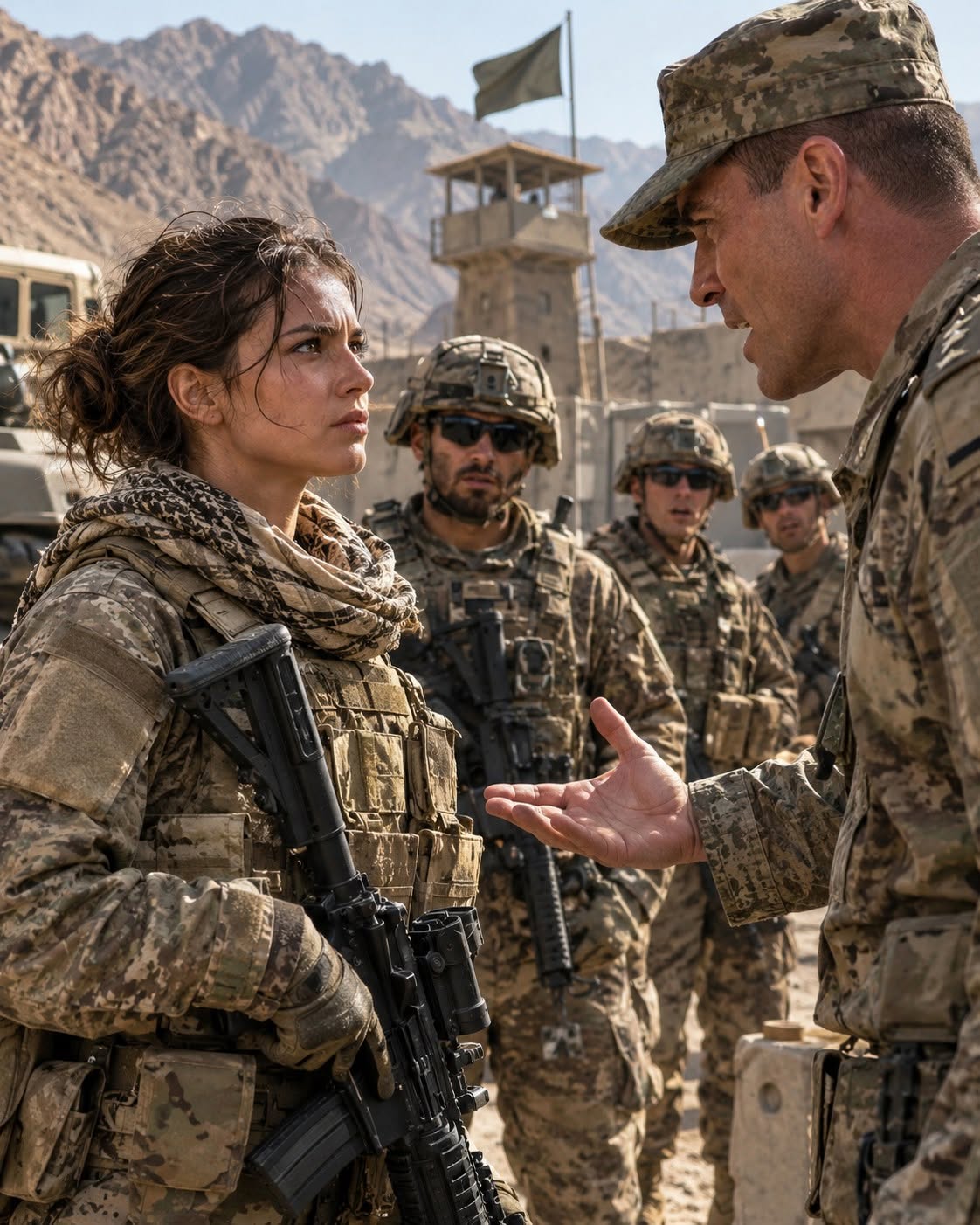
His eyes narrowed.
“You were ordered to work on perimeter security, not investigate senior intelligence officers.”
“With respect, sir, the perimeter was compromised because someone was providing our operational information to the enemy. The two problems were connected.”
Nobody spoke.
Bride returned his attention to the dossier.
“Bring Reeves here.”
Holt hesitated.
“Sir, perhaps we should contact headquarters first.”
“No. I want to hear his explanation before this goes any further.”
Twenty minutes later, Lieutenant Colonel Daniel Reeves walked into the command tent.
He was tall, impeccably dressed, and carried himself with the confidence of someone who had spent decades giving orders.
He glanced at the officers assembled around the table.
“What’s going on?”
Colonel Bride pushed the dossier toward him.
“Daniel, explain this.”
Reeves looked down.
For the first few seconds, his expression barely changed.
Then he smiled.
“Someone has fabricated these records.”
Major Holt stepped forward.
“Three transmissions. Your credentials. Your authorization signature.”
“Credentials can be stolen.”
“Not when the authentication requires your personal verification key,” I replied.
Reeves finally turned toward me.
His eyes moved over my uniform, stopping at my nameplate.
“And who exactly are you?”
“Petty Officer First Class Elena Cross, sir.”
“I know who you are. I’m asking why you’re standing in a classified intelligence briefing.”
Colonel Bride interrupted.
“She discovered the breach.”
Reeves gave a short laugh.
“With all due respect, Marcus, are we seriously allowing a junior enlisted operator to investigate an intelligence officer?”
I didn’t respond.
I had learned a long time ago that people who underestimated you often gave away more information than they intended.
Reeves continued.
“This is embarrassing. Someone manipulates a few security logs, and suddenly everyone wants to believe there’s a traitor in command.”
I watched his right hand.
It was resting on the edge of the table.
His thumb kept moving against his index finger.
A small, repetitive motion.
I had seen the same movement in the transmission authentication records.
Three seconds before each classified packet had been released, the system registered a manual override.
It wasn’t a random technical habit.
It was a confirmation sequence.
“Sir,” I said quietly, “there’s one more thing.”
Bride looked at me.
“What?”
“The final packet wasn’t transmitted from Lieutenant Colonel Reeves’s office.”
Reeves immediately straightened.
“Exactly. Which proves my credentials were stolen.”
“No, sir. It proves someone wanted us to think they were stolen.”
I opened my tablet and displayed the last transmission.
“Every packet contained an operational detail that wasn’t available to the public network. But the final transmission included a location that had been removed from the official schedule forty-eight hours earlier.”
Holt leaned closer.
“What location?”
“Observation Post Seven.”
Bride frowned.
“That post was abandoned two days ago.”
“Yes, sir. Which means the person sending the information had access to the updated intelligence schedule.”
I enlarged the transmission record.
“Someone also accessed the physical security terminal at the same time the packet was sent.”
Reeves’s smile disappeared.
Bride stared at the screen.
“Whose access card?”
I hesitated.
“Colonel, the card belonged to you.”
The silence that followed was absolute.
Bride slowly turned toward Reeves.
“Daniel?”
Reeves shook his head.
“This is ridiculous.”
But I wasn’t finished.
“The card was cloned. The original never left your office. Someone duplicated its authorization signature using a maintenance terminal.”
Holt looked alarmed.
“Can you identify the terminal?”
“Yes, sir.”
I brought up the location.
It was inside the intelligence operations building.
Specifically, a restricted equipment room accessible only to three people.
Reeves.
Colonel Bride.
And the chief systems administrator.
Commander Nathan Cole.
Bride’s face hardened.
“Where is Cole?”
No one answered.
Holt immediately contacted security.
“Locate Commander Cole. Restrict his access. Nobody leaves the compound without authorization.”
Reeves took a step toward the door.
“I think we’ve had enough of this.”
Two armed security personnel moved into his path.
“Sir, you’re required to remain here.”
His expression changed.
“Do you have any idea who I am?”
“Yes, sir,” the guard answered. “That’s why we’re asking you to stay.”
For the first time that morning, Lieutenant Colonel Reeves looked genuinely afraid.
But the most important discovery was still waiting.
I returned to my tablet and opened the original packet.
“Colonel, there’s another encrypted section.”
Bride leaned forward.
“Why wasn’t it in the report?”
“Because it wasn’t part of the transmission. It was hidden inside the authentication handshake.”
I entered the decryption sequence.
A new window appeared.
It contained coordinates, a time, and a single sentence.
TRANSFER CONFIRMATION: RIDGELINE PACKAGE WILL BE COLLECTED TONIGHT.
My stomach tightened.
“Sir, I don’t think this operation is finished.”
Bride read the message.
“Collected by whom?”
“I don’t know yet.”
He looked at Holt.
“Lock down the entire intelligence network. No external transmissions without my approval.”
Then he looked at me.
“Petty Officer Cross, you’re going to show us exactly how you found this.”
“Yes, sir.”
For the next four hours, I worked alongside the intelligence team.
It was strange watching officers who had dismissed my ideas only days earlier now waiting for me to explain every detail.
But I wasn’t interested in proving them wrong.
We had a much bigger problem.
The encrypted message suggested that someone planned to collect a physical package from Camp Ridgeline that evening.
I examined the transmission timing, the compromised access points, and the patrol schedules.
Then I noticed something.
The message had been transmitted using an encryption key associated with an old military logistics program.
That program had been discontinued five years earlier.
Only a handful of people had retained access to its archived records.
One of them was Commander Nathan Cole.
At 11:40 that morning, security personnel located him in the maintenance hangar.
He was standing beside an armored communications vehicle, holding a small black case.
When the guards approached, he didn’t resist.
He simply looked at them and said, “You’re too late.”
Colonel Bride arrived minutes later.
“What does that mean, Commander?”
Cole glanced at the black case.
“It means the information has already left this camp.”
Bride stepped closer.
“Where did you send it?”
Cole smiled bitterly.
“Ask your intelligence officer.”
Reeves, who had been placed under temporary guard, was brought into the hangar.
The two men looked at each other.
For several seconds, neither spoke.
Then Reeves said something that made my blood run cold.
“You weren’t supposed to involve the colonel.”
Cole lowered his eyes.
“That wasn’t the agreement.”
Holt immediately stepped between them.
“What agreement?”
Cole looked toward the armed guards.
“You’re looking at the wrong enemy.”
Bride’s voice became dangerously quiet.
“Then tell me who we’re supposed to be looking at.”
Cole took a slow breath.
“Reeves wasn’t the one who started this.”
He turned toward the colonel.
“Someone at headquarters ordered the intelligence transfers.”
The hangar went silent.
“You’re lying,” Bride said.
“I wish I were.”
Cole opened the black case.
Inside was a compact encrypted storage device.
“I was instructed to maintain the channel. Reeves provided the credentials. But the orders came from someone above both of us.”
I moved closer.
“Do you have proof?”
Cole nodded.
“Everything is on that device. Names, payment records, communications, and the original authorization.”
Bride looked at Holt.
“Secure it. Nobody touches anything until intelligence forensics arrives.”
But before the case could be sealed, a loud alarm echoed through the hangar.
The lights flickered.
Then every screen in the building went black.
Someone had triggered a remote system shutdown.
“Get everyone away from the equipment!” Holt shouted.
I immediately recognized the pattern.
It wasn’t a power failure.
It was a coordinated attempt to erase the evidence.
“Colonel, the storage device!”
Cole had already grabbed the case.
He looked toward a side exit.
Two guards moved to intercept him.
But instead of running, he dropped the case.
The device slid across the concrete floor.
I caught it just before it disappeared beneath a parked vehicle.
Then the emergency lights came on.
Outside, the compound’s security sirens began sounding.
A patrol officer rushed into the hangar.
“Sir! We have an unidentified vehicle approaching the eastern checkpoint!”
Bride turned sharply.
“Stop it.”
The officer shook his head.
“The checkpoint cameras are down.”
I felt my pulse quicken.
The entire perimeter system had just been disabled.
The same perimeter I had spent three days rebuilding.
Someone had found a way around it.
“Colonel,” I said, “we need to assume the shutdown was designed to create a distraction.”
Bride looked at me.
“Meaning?”
“Someone is trying to reach a specific location while we’re occupied here.”
I opened the backup map on my tablet.
The eastern approach wasn’t the only point experiencing interference.
A second alert was coming from the old medical storage building.
It was a facility that had been closed for months.
And it was directly connected to the abandoned logistics corridor.
I remembered the message.
The package would be collected tonight.
But the collection point wasn’t the eastern checkpoint.
It was the old medical building.
“Sir, I need permission to inspect the logistics corridor.”
Bride nodded.
“Take a security team. Don’t go alone.”
I looked toward the colonel.
“Understood.”
He paused.
Then he added something I hadn’t expected.
“Cross, I was wrong about you.”
I gave a small nod.
“Let’s get through tonight first, sir.”
We moved toward the medical building with four security personnel.
The compound was unusually quiet.
Emergency lighting cast long shadows across the concrete walkways.
My radio crackled.
“Cross, this is Holt. We have movement near the northern service road.”
“How many?”
“Unable to confirm. Cameras are still offline.”
I looked at the ground.
There were fresh tire marks near the maintenance entrance.
Someone had recently driven through.
I raised my hand, signaling the team to stop.
The building’s rear door was slightly open.
That was the first thing that bothered me.
The second was the faint blue light coming from inside.
I approached carefully.
The room beyond contained old medical equipment, stacked supply crates, and several disconnected computer terminals.
But one terminal was active.
A digital countdown was displayed across its screen.
00:08:41.
I stepped closer.
It was connected to an external transmission relay.
Someone had configured the system to send a final package at midnight.
I immediately contacted Holt.
“Major, we found the transmission point. It’s inside the medical storage building.”
“Can you shut it down?”
“I’m examining it now.”
A second screen flickered.
A new message appeared.
AUTHORIZATION RECEIVED. FINAL TRANSFER CONFIRMED.
My heart dropped.
The system had already received the final command.
I examined the terminal’s activity log.
There were two separate authentication signatures.
One belonged to Reeves.
The other belonged to a user identified only as DIRECTOR.
I had seen that designation before.
It appeared in the original classified packet.
But I hadn’t been able to identify it.
Now I understood why.
The DIRECTOR account wasn’t connected to Camp Ridgeline.
It belonged to a senior official at Naval Intelligence Headquarters.
I copied the information.
Then I heard footsteps behind me.
“Step away from the terminal.”
I turned.
Commander Cole was standing in the doorway.
He had escaped the security personnel during the blackout.
His right hand was trembling.
“Commander, put your hands where I can see them.”
He shook his head.
“You don’t understand what you’re interfering with.”
“Then explain it.”
He laughed without humor.
“They promised us this would be simple. A few documents. A few coordinates. Nobody would get hurt.”
“People could have died because of those coordinates.”
His face tightened.
“You think I don’t know that?”
For a moment, I saw something unexpected in his expression.
Regret.
Then he looked at the countdown.
“We’re out of time.”
He moved toward the terminal.
I stepped into his path.
“Don’t.”
He stopped.
“Cross, listen to me. The people behind this have influence you can’t imagine. They can destroy your career before breakfast.”
I held his gaze.
“Then they’ll have to explain why they were willing to sacrifice an entire camp.”
His expression hardened.
“You have no idea what you’re dealing with.”
“Maybe not. But I know what I’m protecting.”
He lunged toward the terminal.
I reacted immediately.
A brief struggle followed.
A metal chair crashed against the floor.
The storage device slipped from my hand and skidded beneath a cabinet.
Cole reached for the console.
I managed to pull him away before he could complete the command.
We collided with a supply rack.
Several boxes fell around us.
He was stronger, but he was exhausted and frightened.
I pushed him away and called for assistance.
Within seconds, the security team entered.
Cole was restrained.
But the countdown continued.
00:02:16.
I returned to the terminal.
The shutdown command was being rejected.
Whoever had designed the system had built in an additional security layer.
I examined the configuration.
It was a remote release system. Shutting down the terminal would not stop the transmission because the final authorization had already been distributed to another server.
I needed to locate the secondary relay.
My eyes moved across the screen.
Then I noticed a familiar identifier.
The same maintenance gateway I had discovered during my original perimeter investigation.
The one I had deliberately left under observation.
I understood.
The enemy hadn’t simply entered our network.
They had been using our own security adjustments to test whether we could detect them.
The entire time, someone had been watching how we responded.
I accessed the isolated monitoring record.
There it was.
A second relay, hidden inside the old communications archive.
“Major Holt, I need the archive room secured immediately!”
“What’s happening?”
“The final transmission is being routed through a secondary server. I need someone to physically isolate it.”
“Copy. Security is moving.”
The countdown reached one minute.
I opened the archived system map.
The relay had two independent connections.
One was digital.
The other was a physical communications line.
If I disconnected the wrong one, the transmission could still proceed.
I studied the architecture.
Then I saw the maintenance notation.
A small warning beneath the relay configuration.
BACKUP CHANNEL ACTIVE DURING PRIMARY INTERRUPTION.
I remembered the original security blueprint.
The backup channel had been installed during an earlier upgrade.
It wasn’t visible on the standard map because it was classified as a maintenance circuit.
I had found it three days earlier.
At the time, I had assumed it was obsolete.
Now it was the only thing keeping the transmission alive.
“Colonel!” I shouted over the radio. “The archive relay has a secondary maintenance connection. It needs to be isolated from the physical line.”
Bride answered immediately.
“Can you stop it?”
“Yes, sir. But I need another minute.”
“Take whatever time you need.”
00:00:38.
I located the maintenance connection.
The console requested an additional authorization.
I entered my security credentials.
Access denied.
I tried the emergency override.
Access denied.
The system was still recognizing the compromised intelligence account as its controlling authority.
I looked at the authentication history.
Then I noticed the final signature.
The original system administrator had included an emergency authorization path for situations exactly like this.
It required a command-level confirmation and two independent security witnesses.
I contacted Bride.
“Sir, I need your authorization to isolate the archive relay.”
“Granted.”
“Major Holt, I need your confirmation as the second witness.”
“Confirmed.”
I entered both credentials.
The screen changed.
00:00:12.
The isolation command appeared.
I pressed it.
For one terrible second, nothing happened.
Then the countdown disappeared.
The screen went black.
A moment later, a single line appeared.
TRANSMISSION CANCELLED.
I leaned against the desk and closed my eyes.
For the first time in three days, I allowed myself to breathe.
But the operation wasn’t over.
Not even close.
By midnight, Naval Intelligence had been notified.
The encrypted storage device was transferred to a federal investigative team, and both Reeves and Cole were placed under formal custody.
The investigation lasted several weeks.
What they uncovered was worse than anyone had expected.
Lieutenant Colonel Reeves had been receiving payments through a network of shell companies for nearly eighteen months.
He had initially provided limited logistical information, convincing himself that the recipients were private contractors conducting unauthorized intelligence assessments.
Eventually, he discovered that the information was being sold to a hostile foreign intelligence service.
By then, he was too deeply involved to walk away without exposing himself.
Commander Cole had helped maintain the transmission infrastructure and conceal the unauthorized access.
But the investigation revealed something even more disturbing.
The DIRECTOR account belonged to Deputy Director Adrian Voss, a senior intelligence official who had used his position to authorize the operation.
Voss had been manipulating information from multiple military installations, creating false security incidents and selling operational intelligence to foreign buyers.
He believed his influence would protect him.
It didn’t.
The records recovered from the storage device connected him to the entire operation.
Within days, federal investigators arrested him.
Several other officials were suspended pending investigation.
Camp Ridgeline was placed under temporary external oversight.
And Colonel Marcus Bride was ordered to submit a complete review of the security failures.
I was called into his office three days after the arrests.
He was standing beside the window, looking across the compound.
On his desk sat the original security map from our first briefing.
The red markings had disappeared.
Every major vulnerability had been corrected.
“Close the door, Cross.”
I did.
He gestured toward the chair.
“Sit down.”
I remained standing.
“With respect, sir, I’d rather stand.”
He almost smiled.
“Still stubborn.”
“Only when necessary.”
He studied me for a moment.
Then he opened a folder.
“Your security modifications prevented a serious breach. Your investigation exposed an internal intelligence network. And your actions during the shutdown prevented the final transmission.”
I said nothing.
He continued.
“I’ve read every report. I’ve also read the original briefing notes.”
He turned one page.
“Major Holt wrote that your proposal was unnecessary and that you lacked the experience to manage a perimeter-wide security adjustment.”
I recognized the words.
I remembered the laughter.
The whispers.
The looks exchanged when I had raised my hand.
Bride closed the folder.
“I want you to know that I regret allowing those assumptions to influence my judgment.”
“Sir, I wasn’t looking for an apology.”
“I know. That’s part of why I’m giving you one.”
He stood and walked around his desk.
“When you volunteered, I thought you were taking on more than you could handle. I was wrong.”
I finally met his eyes.
“With respect, Colonel, I didn’t need anyone to believe I could do it. I just needed the opportunity to prove it.”
He nodded slowly.
“That’s a lesson I should have learned a long time ago.”
Then he handed me another document.
It was a formal commendation recommending me for an advanced leadership assignment.
I looked at it carefully.
“Sir, this is unexpected.”
“Your work wasn’t.”
I accepted the document.
But before I left, I asked him something.
“Colonel, can I say something?”
“Go ahead.”
“During the first briefing, everyone was focused on finding the person responsible for the security failures. Nobody stopped to ask why the system had been designed in a way that made those failures possible.”
Bride listened without interrupting.
“We caught the people involved. But if we don’t change how information is protected, someone else will eventually find another way in.”
He nodded.
“You’re suggesting a permanent security review.”
“Yes, sir. Not just for Ridgeline. Every installation using the same infrastructure.”
He looked at the document in his hand.
Then he smiled.
“I was wondering how long it would take you to ask for something bigger.”
Within a month, the Navy established a review team to examine vulnerabilities across several forward operating installations.
I was offered a position on that team.
It meant leaving Camp Ridgeline.
It meant working with senior officers who had once questioned whether I belonged in the room.
And it meant accepting responsibility for a program much larger than the one I had volunteered to fix.
I accepted.
But before I left, there was one more thing I needed to do.
I requested permission to address the personnel at the next command briefing.
Colonel Bride approved.
On my final morning, I entered the same briefing room where everything had started.
The same long table.
The same digital display.
The same twelve officers.
Major Holt was sitting near the front.
He looked up when I entered.
“Cross.”
“Major.”
He stood.
“I owe you something.”
I waited.
“An apology. I dismissed your proposal because I thought I understood your capabilities before I understood the problem.”
He paused.
“I was wrong.”
I nodded.
“Thank you, sir.”
Then I turned toward the room.
There were several new faces, along with the officers who had attended the original briefing.
I placed my tablet on the table.
“I won’t take much of your time,” I began.
“Three weeks ago, this room was looking at a perimeter map full of security gaps. We had twelve officers, multiple specialists, and a system that was supposed to protect everyone inside this compound.”
I paused.
“Yet we couldn’t identify the weakness because we kept looking at the perimeter as if the danger only existed outside it.”
Nobody moved.
“The person who compromised our security didn’t need to overpower our defenses. He needed our trust. He needed access. And he needed us to believe that the person sitting beside us could never be the problem.”
I looked around the room.
“That is the most dangerous vulnerability any organization can have.”
Major Holt lowered his eyes.
I continued.
“Rank matters. Experience matters. Procedures matter. But none of those things should ever become excuses for ignoring evidence or silencing someone who sees a problem differently.”
I closed my tablet.
“The next time someone raises a concern, don’t ask whether they have the rank to speak. Ask whether what they’re saying could save someone’s life.”
For a moment, the room remained silent.
Then Colonel Bride stood and began to applaud.
Major Holt followed.
One by one, the others joined.
I didn’t feel triumphant.
I felt relieved.
Because the applause wasn’t what mattered.
What mattered was that the next person who noticed something wrong might not have to fight so hard to be heard.
After the briefing, I walked outside.
The sun was rising over the mountains beyond Camp Ridgeline.
A group of young sailors was preparing for their morning assignments.
One of them, a young woman with a fresh uniform and nervous eyes, approached me.
“Petty Officer Cross?”
“Yes?”
“I heard what happened here.”
I smiled.
“Then you’ve probably heard several different versions.”
She laughed nervously.
“Maybe. But I wanted to ask you something.”
“Go ahead.”
“How did you keep going when everyone thought you were wrong?”
I considered the question.
I could have told her about the equipment, the technical training, the security procedures, or the nights I spent working alone.
But none of those things answered what she was really asking.
So I gave her the truth.
“Because I knew what I was responsible for. I wasn’t trying to prove I was better than anyone else. I was trying to make sure the people around me came home.”
She looked down at her boots.
“Sometimes I feel like I have to work twice as hard just to be taken seriously.”
I understood that feeling more than I wanted to admit.
“Then work hard,” I told her. “But don’t make the mistake of thinking you have to be perfect to deserve a place here.”
She looked up.
“You’re allowed to ask questions. You’re allowed to disagree. And you’re allowed to be the first person in the room who sees something everyone else has missed.”
I paused.
“Just make sure you have the courage to back up what you say with preparation, evidence, and integrity.”
She nodded.
“Thank you, ma’am.”
As she walked away, I watched her join the others.
For the first time since arriving at Ridgeline, I felt that something meaningful had changed.
Not because a traitor had been exposed.
Not because a colonel had apologized.
And certainly not because twelve officers had finally applauded me.
It was because a young sailor who might once have remained silent now knew that her voice mattered.
Three months later, Camp Ridgeline completed its new security program.
The updated system included independent monitoring, stricter access controls, and a reporting process that allowed personnel at every rank to raise concerns without fear of retaliation.
The old security map was retired.
Colonel Bride had it framed and placed outside the command center.
Beneath it, he added a small brass plaque.
It read:
THE FIRST STEP TOWARD SECURITY IS THE COURAGE TO QUESTION WHAT EVERYONE ELSE ACCEPTS.
I saw it during my final visit to the camp.
Bride stood beside me.
“Do you like it?”
“It’s a little dramatic, sir.”
He laughed.
“After everything that happened here, I think we’ve earned a little drama.”
We stood quietly for a moment.
Then he turned toward me.
“One question, Cross. If you had walked into that first briefing again, knowing everything you know now, would you still have raised your hand?”
I looked at the framed map.
I remembered the laughter.
The doubt.
The three nights of exhaustion.
The moment I discovered that the danger wasn’t outside the perimeter.
And the moment I realized that someone inside our own command structure had betrayed us.
“Yes, sir,” I answered.
“Without hesitation?”
“With more preparation, perhaps. But yes.”
He nodded.
“Why?”
I looked toward the young sailors crossing the compound.
“Because someone had to be willing to see the problem differently.”
Bride smiled.
“Fair enough.”
I left Camp Ridgeline that afternoon.
My next assignment was waiting, and there would undoubtedly be new challenges, new skeptics, and new rooms where people would decide what I could accomplish before I ever opened my mouth.
But I carried one lesson with me.
The greatest threat to a team isn’t always the enemy outside its walls.
Sometimes it’s the arrogance that prevents good people from listening, the fear that keeps honest people silent, and the misplaced trust that allows wrongdoing to hide behind a uniform.
I had entered that briefing room as the officer nobody expected to have an answer.
I left knowing that leadership wasn’t about being the loudest voice, holding the highest rank, or receiving the most recognition.
It was about accepting responsibility when everyone else was waiting for someone to move.
And sometimes, the person who saves the entire team is simply the one brave enough to raise a hand when the room goes silent.
THE END