The coffee was still steaming when Lieutenant Blake Harrison dumped it over the head of the quiet woman sitting in the back of the briefing room.
THE WEIGHT OF THE WINGS
Blake Harrison stared at the empty coffee cup in his hand.
For the first time in his life, he had no clever response, no confident remark, and no powerful name he could use to make a difficult situation disappear.
Commander Evelyn Ross stood before him, her wet flight suit clinging to her shoulders. A thin stream of coffee still ran from the ends of her hair. The torn pieces of her notebook lay on the table between them.
Captain Vance remained beside the doorway, his expression hard.
“Lieutenant Harrison,” Ross said, “I’m waiting.”
Blake slowly placed the cup on the nearest desk.
“Commander, I apologize. I didn’t know who you were.”
Ross looked at him for several seconds.
Then she asked a question that made his stomach tighten.
“Would you have treated me differently if you had known?”
Blake opened his mouth.
Nothing came out.
“That’s what I thought.”
She turned toward Captain Vance.
“Captain, please have the medical officer examine the burns. After that, I want the entire class assembled in the tactical auditorium. Nobody leaves until we’ve completed the opening evaluation.”
“Yes, Commander.”
Vance glanced at Blake.
“And Lieutenant Harrison, surrender your training access card temporarily. You’ll receive further instructions.”
Blake stiffened.
“Sir, with respect, my father—”
“Your father is not standing in this room, Lieutenant.”
The captain’s voice was quiet, but it carried enough authority to silence everyone.
“Your actions are yours. Your consequences will be yours as well.”
Blake handed over his card.
For the first time, his father’s name had failed to open a door.
But Commander Ross had no intention of ending the lesson there.
Twenty minutes later, the twelve pilots sat in the tactical auditorium.
Commander Ross had changed into a clean flight suit. A medical officer had examined her scalp and face, treating several areas of irritated skin. The burns were thankfully superficial, but the humiliation of the incident had left a deeper impression on everyone who had witnessed it.
Ross entered carrying her battered leather notebook.
She placed it on the instructor’s desk.
“Before we begin, I want to establish something. This school is not a place where people come to demonstrate how impressive they already are. It’s where we discover whether they’re capable of becoming better.”
She activated the projector.
A photograph appeared on the enormous screen.
It showed a Navy fighter jet flying through a dark sky, its silhouette barely visible against a distant horizon.
“Eleven years ago, I was flying a night training mission over the Pacific. My wingman was a young pilot named Daniel Mercer. He was talented, ambitious, and exceptionally confident.”
She paused.
“Unfortunately, he was also convinced that admitting uncertainty was a sign of weakness.”
Theo leaned forward.
Ross continued.
“During the mission, our aircraft encountered deteriorating weather and unexpected equipment failures. I instructed Daniel to break formation and follow the emergency procedure. He hesitated. He believed he could handle the situation himself.”
The next photograph showed a damaged aircraft resting on a runway.
“His aircraft made it back. Barely. But another crew member involved in the recovery suffered serious injuries because Daniel had ignored an instruction that could have prevented the incident.”
The room was completely silent.
“Daniel was not a bad pilot. He was a skilled pilot who had forgotten that skill without judgment can become dangerous.”
Ross looked around the auditorium.
“Two years later, he became one of the finest instructors I ever worked with. Why? Because he accepted responsibility, learned from his mistakes, and stopped confusing authority with superiority.”
She turned off the projector.
“That’s what this school is designed to discover.”
Blake stared at the floor.
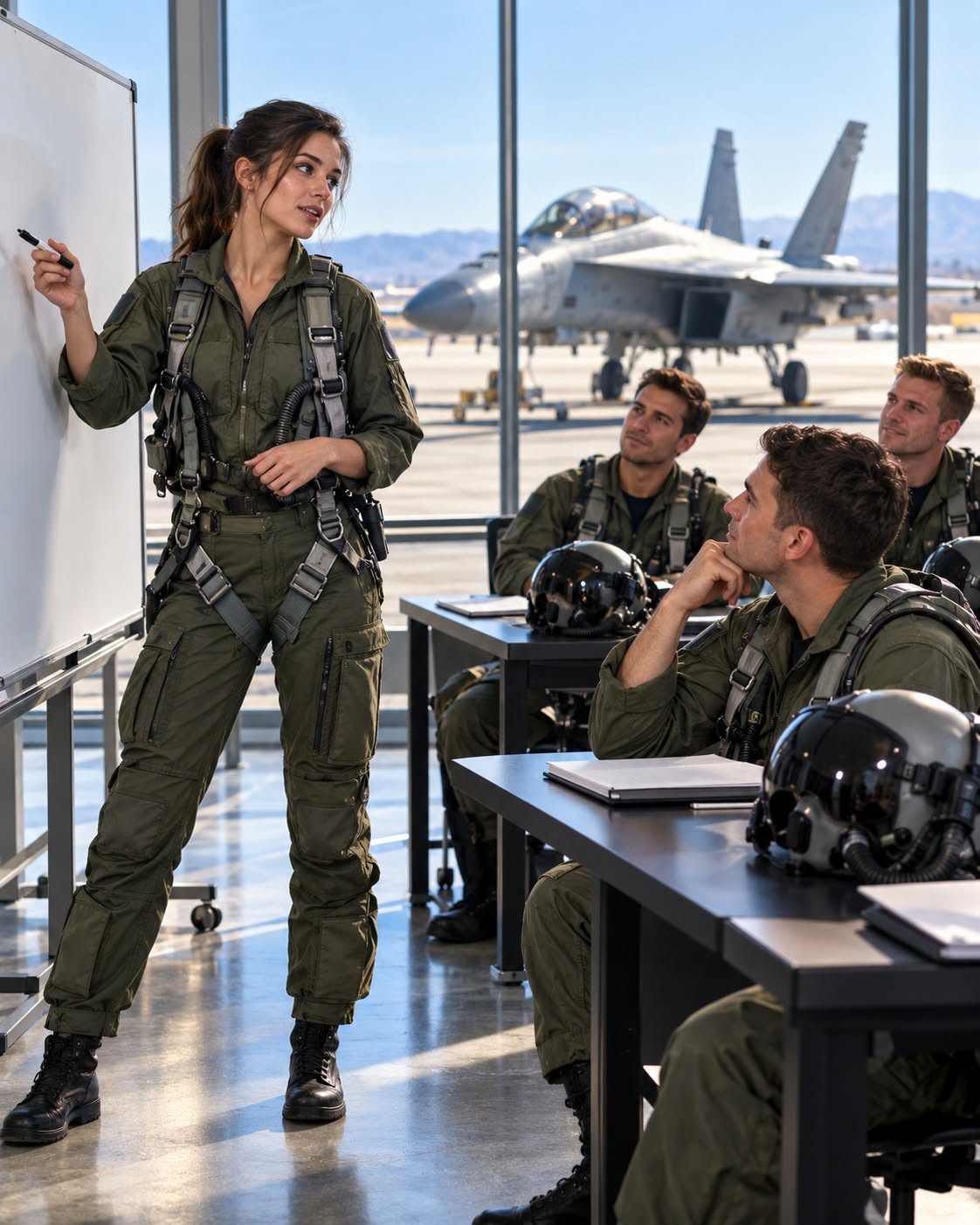
Ross picked up a marker.
“Now, let’s discuss this morning.”
She wrote three words on the whiteboard:
CHARACTER.
JUDGMENT.
ACCOUNTABILITY.
“Lieutenant Harrison, stand up.”
Blake rose.
“Tell the class what happened.”
He swallowed.
“I saw an unauthorized person sitting in the briefing room. I asked her to leave. When she didn’t cooperate, I became frustrated. I poured coffee on her and escorted her out.”
Ross tilted her head.
“Is that an accurate description?”
Blake hesitated.
“No, ma’am.”
“Then try again.”
His voice became quieter.
“I insulted you. I tore your notebook. I deliberately poured hot coffee over you, and I physically pushed you toward the door.”
“Why?”
“I was angry.”
“Anger is an emotion, Lieutenant. It isn’t an explanation.”
Blake looked up.
“I thought you didn’t belong there.”
“And what gave you the authority to decide that?”
He had no answer.
Ross nodded.
“Sit down.”
Then she addressed the entire class.
“Your first examination begins now. But it isn’t a flying examination. It’s a judgment examination.”
A new image appeared.
It showed a simulated carrier approach with several conflicting radio calls and a developing emergency.
“You have ninety minutes to analyze this scenario. Work together. You will receive incomplete information, conflicting instructions, and pressure from multiple directions. Your objective is to make the safest decision, not the most impressive one.”
She looked directly at Blake.
“And nobody in this room gets to command simply because he believes he deserves to.”
The pilots divided into two teams.
Theo naturally took the lead in organizing the first group. Cole immediately began suggesting aggressive solutions, emphasizing speed and confidence.
Blake remained unusually quiet.
For the first twenty minutes, he barely spoke.
Then the simulation introduced an unexpected complication. A fictional aircraft reported a fuel emergency while another aircraft experienced a communications failure. The available landing sequence could no longer accommodate every pilot without changing the original plan.
Cole pointed at the display.
“We can push the damaged aircraft to the end of the sequence. The other two can recover first.”
Theo shook his head.
“That aircraft has the least fuel.”
“It’s a simulation,” Cole replied. “We’re supposed to make decisions.”
“And we’re supposed to make the right ones.”
Their argument grew louder.
Blake finally leaned toward the screen.
“Wait.”
Everyone turned.
“The fuel readings don’t match the reported flight time.”
Theo examined the figures.
Blake continued.
“Someone entered the wrong departure timestamp. If we calculate using the corrected time, that aircraft has less reserve than the simulation initially suggests.”
Cole frowned.
“Are you sure?”
“Check the secondary data.”
Theo did.
Blake was right.
For the first time that morning, his contribution helped the team rather than himself.
They adjusted the recovery sequence, coordinated the emergency response, and completed the simulation with all aircraft safely accounted for.
The instructor monitoring the exercise made a note.
Ross watched from behind the observation glass.
She had seen something important.
Blake could think under pressure.
He could recognize danger.
His problem was not a lack of intelligence.
It was the belief that intelligence gave him permission to look down on others.
At noon, the pilots were dismissed for lunch.
Blake remained behind.
He approached Commander Ross, who was reviewing the morning’s evaluation reports.
“Ma’am, may I speak with you?”
She continued writing.
“You may.”
“I want to apologize again.”
Ross finally looked up.
“You already apologized.”
“I know. But I don’t think I understood what I was apologizing for.”
She closed the notebook.
“Go on.”
Blake took a breath.
“I thought respect was something people owed me because of my position and my family. I treated you like you were beneath me because I assumed you had no authority.”
Ross studied him.
“That’s part of it.”
He frowned.
“There’s more?”
“Much more.”
She stood and walked toward the window overlooking the airfield.
“Lieutenant, I have spent years flying with people whose lives depended on trusting me. Some were senior officers. Some were junior enlisted crew members. Some had more experience than I did. Others had barely begun their careers.”
She turned.
“Do you know what all of them had in common?”
Blake shook his head.
“They deserved to be treated like human beings.”
Her words landed harder than he expected.
“I once had a mechanic stay awake for thirty-six hours repairing an aircraft so my squadron could complete a mission. He had no golden wings. He had no command authority. But when something went wrong, he was the person I trusted most.”
She returned to her desk.
“Rank tells people who is responsible for making a decision. It does not tell you whose dignity matters.”
Blake lowered his eyes.
“I understand, ma’am.”
“I hope you do. But understanding is easy when you’re sitting in front of someone who can affect your career. The real test comes when you meet someone who cannot do anything for you.”
She opened the door.
“You’re dismissed.”
Blake left without another word.
That afternoon, something happened that nobody in the training class had anticipated.
An emergency alert sounded across the base.
A Navy transport helicopter conducting a routine training flight had reported a mechanical problem and was returning to Fallon. Its crew included two pilots and a flight engineer.
The aircraft was stable, but one of its hydraulic systems had begun losing pressure.
Captain Vance immediately ordered the training personnel to remain clear of the operational hangar.
Commander Ross was already moving.
“Get me the aircraft status.”
A technician hurried over with a tablet.
“Primary system is holding, ma’am, but pressure is dropping. The crew has requested emergency assistance.”
Ross examined the information.
“Have the maintenance team prepare the recovery equipment. Notify the emergency response unit.”
She turned toward the pilots, who had gathered near the hangar entrance.
“Stay behind the safety line.”
Then the radio crackled.
“Tower, this is Navy Two-Seven. We have reduced hydraulic control and unstable pressure. Requesting emergency landing guidance.”
Ross picked up the headset.
“Two-Seven, this is Commander Ross. Confirm your current flight configuration.”
The pilot reported the aircraft’s condition.
Ross listened carefully.
“Understood. Follow the emergency checklist. Do not attempt any additional maneuver unless necessary. We have personnel standing by.”
She looked at the display.
The aircraft was approaching the runway, but the weather had changed. A sudden desert gust had created crosswinds that made the recovery more difficult.
The captain approached her.
“Commander, should we close the runway?”
“Not yet. The crew still has a manageable approach window. Keep the emergency vehicles ready.”
Then a second radio transmission interrupted them.
“Commander, we’ve got a discrepancy in the aircraft configuration report.”
Ross looked toward the technician.
“What discrepancy?”
“The flight engineer reports that the backup system isn’t responding as expected. The maintenance record indicates a previous repair, but the documentation is incomplete.”
Ross’s expression tightened.
“Get me the last maintenance entry.”
The technician hurried away.
Behind them, Blake was watching the situation unfold.
He recognized something in the numbers.
He stepped forward.
“Commander?”
Ross didn’t turn.
“Stay behind the line, Lieutenant.”
“Ma’am, I think the configuration report has an error.”
She looked at him.
“Explain.”
Blake pointed at the tablet.
“The maintenance record lists the auxiliary pressure test under the wrong system identification. The values match the secondary circuit, not the primary one.”
The technician returned.
He checked the record.
Blake was correct.
“That’s it,” the technician said. “The previous entry was filed incorrectly.”
Ross examined the corrected information and immediately relayed it to the crew.
The updated data allowed the maintenance team to prepare the proper emergency support.
The helicopter continued its approach.
Inside the cockpit, the pilots were fighting to maintain control.
The radio crackled again.
“Two-Seven, we’ve got a developing vibration. Requesting immediate guidance.”
Ross kept her voice steady.
“Two-Seven, maintain your current recovery procedure. Emergency crews are ready. You’re not alone.”
A gust pushed the helicopter slightly off its approach path.
The room seemed to hold its breath.
Then the aircraft corrected.
Its wheels touched the runway.
For a moment, it bounced.
Then it settled onto the concrete and rolled safely toward the waiting emergency vehicles.
Nobody spoke until the helicopter came to a complete stop.
The crew emerged.
All three members were alive.
One pilot had a minor shoulder injury, but there were no life-threatening injuries.
The hangar erupted in relieved applause.
Captain Vance exhaled.
“Good work, Commander.”
Ross removed her headset.
“Good work by everyone.”
She glanced toward Blake.
“You identified the documentation error quickly.”
“Thank you, ma’am.”
“Don’t thank me. Remember why it mattered.”
Blake nodded.
Because three people had been depending on that information.
Not because he had an opportunity to impress her.
The following morning, Blake received a phone call.
His father was on the line.
Admiral Harrison had spent decades building a reputation as one of the Navy’s most influential senior officers. He was known for his uncompromising standards, political connections, and expectations of absolute excellence.
“Blake, I’ve heard about the incident.”
Blake closed his office door.
“Sir.”
“Do you understand what you’ve done?”
“Yes.”
“Commander Ross has filed a preliminary report. The captain has informed me that your position in the program is under review.”
Blake said nothing.
His father continued.
“I’ve spoken with several people. We may be able to arrange a transfer before this becomes a permanent mark on your record.”
Blake stared at the floor.
A week earlier, he would have accepted immediately.
He would have considered it a victory.
Now, something about the offer made him feel sick.
“No, sir.”
Silence.
“What did you say?”
“I said no.”
“Blake, don’t be foolish. You have worked your entire life for this career.”
“I know.”
“Then let me handle it.”
Blake took a breath.
“That’s the problem, Father. You’ve always handled it.”
The silence on the other end became heavier.
“What exactly are you suggesting?”
“I need to answer for what I did. I don’t want you calling anyone. I don’t want special treatment.”
His father sounded genuinely surprised.
“You’re willing to risk your career over one mistake?”
Blake looked through the window at the aircraft parked outside.
“It wasn’t one mistake. It was a choice. Several choices.”
He paused.
“And I don’t want to become the kind of officer who needs his father’s rank to protect him from the consequences of his own behavior.”
His father didn’t respond immediately.
Finally, he said, “You sound different.”
“I think I’m starting to understand something.”
The call ended.
Blake remained standing for several minutes.
He knew refusing his father’s help might cost him everything he had once believed mattered.
But for the first time, the decision felt like his own.
Three days later, the official disciplinary hearing took place.
Commander Ross sat at one end of the table. Captain Vance sat beside her, along with two senior officers appointed to review the incident.
Blake stood before them in his dress uniform.
His father had been invited to provide background information but had declined to intervene in the decision.
The hearing began with the morning’s events.
Witnesses described the insults, the torn notebook, the coffee, and the physical force used to remove Ross from the briefing room.
Theo testified without hesitation.
Cole admitted that he had witnessed the incident and had failed to intervene.
That admission appeared to trouble him more than he expected.
When Blake was asked to speak, he stood straight.
“I accept responsibility for everything described in the report.”
One officer leaned forward.
“Do you dispute any of the witness statements?”
“No, sir.”
“Do you believe your conduct was justified because you were unaware of Commander Ross’s identity?”
“No, sir.”
“Then why did you do it?”
Blake looked at Ross.
“Because I believed I was more important than someone I didn’t recognize. I used my position, my family name, and my physical strength to intimidate someone I thought couldn’t challenge me.”
The room remained silent.
“I was wrong. Not because she turned out to be a commander, but because she was a person. I should have treated her with dignity regardless of her rank.”
The senior officer exchanged a glance with Captain Vance.
“Do you believe you deserve to remain in the Navy?”
Blake hesitated.
“I don’t know if I deserve it, sir. But I know I want to become someone worthy of wearing this uniform.”
Ross finally spoke.
“Lieutenant Harrison, if the decision were entirely yours, what punishment would you consider appropriate?”
Blake swallowed.
“Removal from the training program, at least temporarily. A formal disciplinary record. And whatever additional consequences the review board considers necessary.”
“Would you accept reassignment?”
“Yes, ma’am.”
“Even if it means losing your place here?”
“Yes.”
Ross studied him.
“Why?”
“Because if I remain here without facing the consequences, I’ll learn the wrong lesson again.”
For several seconds, nobody moved.
Then Ross closed the file.
“The board has reached a decision.”
Blake felt his pulse quicken.
“You are suspended from the advanced flight evaluation program for thirty days, pending completion of a formal leadership and conduct review. Your record will reflect the disciplinary finding. You will also be assigned to a maintenance support and safety coordination team during that period.”
Blake nodded.
“Understood, ma’am.”
“You will not receive preferential treatment because of your father. You will not receive additional punishment because of him either. Your performance and conduct from this point forward will determine whether you return to the program.”
“Yes, ma’am.”
Ross stood.
“One more thing, Lieutenant.”
He looked up.
“You are not being offered forgiveness today. You are being given an opportunity to earn back trust.”
Blake nodded again.
“I understand.”
The next thirty days were unlike anything Blake had experienced.
Instead of spending his mornings in a fighter cockpit, he worked alongside the maintenance crews.
He learned how many hands were required to keep a squadron operational.
He carried equipment, reviewed inspection records, helped document maintenance discrepancies, and spent hours listening to technicians explain problems that pilots rarely noticed.
One afternoon, he met an older mechanic named Chief Petty Officer Raymond Ellis.
Ellis had served in the Navy for twenty-seven years. His hands were scarred, his uniform was faded, and his voice carried the authority of someone who had earned respect without ever demanding it.
Blake was assigned to help him inspect a training aircraft.
“Hand me the inspection light,” Ellis said.
Blake passed it over.
The chief examined a panel, then shook his head.
“You pilots spend a lot of time looking at the sky.”
Blake gave a small smile.
“That’s generally where we’re supposed to look, Chief.”
Ellis chuckled.
“Fair enough. But somebody has to make sure the aircraft can get you back down.”
They worked in silence for a while.
Then Ellis asked, “Heard about your little incident in the briefing room.”
Blake’s smile disappeared.
“Yes, Chief.”
“Coffee, wasn’t it?”
“Yes.”
“Expensive coffee?”
Blake looked confused.
“I don’t know, Chief.”
Ellis shrugged.
“Waste of perfectly good coffee.”
For the first time in weeks, Blake almost laughed.
Then Ellis became serious.
“You know what bothers me about that story?”
Blake shook his head.
“You thought the woman wasn’t important because she wasn’t wearing the right things. I’ve worked with people like that. They look at a mechanic and see somebody who changes tires. They don’t see the person who might save their life when something breaks at thirty thousand feet.”
Blake looked down at his hands.
“I know, Chief.”
“Do you?”
Ellis pointed toward the aircraft.
“Every bolt, every inspection, every report has somebody’s life attached to it. You want to be a good pilot? Start by respecting the people who make flying possible.”
Blake nodded.
That evening, he stayed late to help complete the inspection records.
It was the first time he had ever volunteered for work that nobody would applaud.
Meanwhile, Commander Ross had been quietly following his progress.
She had not spoken to him beyond official instructions.
She wanted to see whether his behavior would change when he was no longer trying to earn her approval.
One afternoon, she visited the maintenance hangar.
Blake was kneeling beside Chief Ellis, helping him inspect a component.
He noticed her and immediately stood.
“Commander.”
“Lieutenant.”
Ellis straightened.
“Ma’am.”
Ross examined the aircraft.
“How is the inspection going?”
“Almost complete,” Ellis replied. “Your young pilot here caught a documentation discrepancy this morning.”
Ross looked at Blake.
“Did he?”
“Yes, ma’am.”
“What happened?”
Blake explained the issue and how the team had corrected it.
Ross listened without interrupting.
When he finished, she nodded.
“Good work.”
Then she turned to Ellis.
“Chief, thank you for keeping these aircraft safe.”
Ellis smiled.
“Just doing the job, Commander.”
Ross walked toward the hangar entrance.
Blake watched her go.
Then he returned to the inspection.
He didn’t follow her.
He didn’t ask for praise.
And that, more than anything, made Ross reconsider what she had seen in him.
On the twenty-ninth day, the training class received an unexpected announcement.
A final evaluation exercise would take place the following morning.
All twelve pilots would participate.
Blake’s name appeared on the roster.
He was still suspended from advanced flight evaluation, but he had been invited to observe and assist with the ground coordination portion.
Cole approached him near the lockers.
“Looks like you’re not flying tomorrow.”
“No.”
“You must be disappointed.”
Blake shrugged.
“I’ll fly when I’m cleared.”
Cole leaned against the locker.
“You know, I thought you were untouchable. Your father, your reputation, all of it.”
Blake closed his locker.
“I thought so too.”
Cole lowered his voice.
“I should’ve said something that morning.”
Blake looked at him.
“Yes, you should have.”
“I was afraid of getting on your bad side.”
“That’s not an excuse.”
“I know.”
The two men stood quietly.
Then Cole extended his hand.
“I’ll try to do better.”
Blake shook it.
“So will I.”
The next morning, the twelve pilots gathered at the briefing room.
Commander Ross stood before the whiteboard.
The word GHOST had been erased, but Blake could still see its outline in his memory.
“Today’s exercise will test your ability to respond to an evolving emergency. You will receive changing information, limited time, and difficult choices. There will be no perfect solution.”
She distributed the mission packets.
“Your job is to protect the people involved, communicate clearly, and make decisions based on evidence rather than ego.”
The pilots moved toward the simulation stations.
Blake took his place with the ground coordination team.
The exercise began smoothly.
Then, halfway through, a new emergency appeared.
One of the simulated aircraft had suffered a navigation malfunction. Another had reported an unexpected fuel discrepancy. At the same time, the exercise controller introduced a communications failure between the lead aircraft and the recovery team.
The room became chaotic.
Cole began issuing suggestions.
Theo requested clarification.
Several pilots talked over one another.
Then a red warning appeared on the central display.
SIMULATED EMERGENCY
A third aircraft had entered the scenario with a damaged control system.
Blake examined the information.
Something was wrong.
The aircraft’s reported condition did not match its telemetry.
He looked toward the instructor.
“Ma’am, I believe the scenario data contains a secondary fault.”
Ross approached.
“Explain.”
“The aircraft isn’t just experiencing a navigation failure. The power readings suggest an additional electrical problem. If we continue using the original recovery plan, we could send the aircraft into an unsafe approach.”
Ross studied the screen.
“Can you confirm that?”
Blake pointed to two independent readings.
“The values are inconsistent, but they support the same conclusion.”
Theo turned toward him.
“Then we need to change the sequence.”
Blake nodded.
“Yes. But we also need to tell the lead pilot why, not simply issue a new instruction.”
Ross watched them.
The team adjusted the recovery plan.
They assigned one person to communications, another to monitoring the aircraft data, and another to coordinating the emergency response.
The simulation continued.
The damaged aircraft reached the recovery area.
A warning sounded.
For several tense seconds, the display showed unstable readings.
Then the aircraft completed the simulated emergency landing.
All three aircraft were accounted for.
The exercise ended.
The room erupted in conversation.
Ross allowed the pilots a moment to collect themselves.
Then she asked Blake to stand.
“Lieutenant, why did you question the original recovery plan?”
He answered carefully.
“Because the available information suggested the aircraft was in a different condition from the one initially reported.”
“And why didn’t you simply take control of the exercise?”
Blake paused.
“Because I wasn’t the person responsible for making that decision. I had information that could help the team, so I communicated it. The decision belonged to the designated lead.”
Ross nodded.
“That’s correct.”
She turned toward the class.
“Leadership does not mean having the loudest voice in the room. It means knowing when to speak, when to listen, and when someone else has better information than you do.”
Her gaze briefly met Blake’s.
“Especially when your pride would prefer otherwise.”
After the exercise, Ross asked Blake to meet her on the observation deck overlooking the runway.
The sun was beginning to set, painting the desert in shades of gold and orange.
For a while, neither spoke.
Then Ross opened her leather notebook.
It was the same notebook Blake had torn several weeks earlier.
The damaged page had been carefully repaired with a narrow strip of transparent tape.
Blake stared at it.
“You kept it.”
“Of course.”
“Why?”
Ross turned the notebook toward him.
On the page were several handwritten words:
THE GHOST TEST.
Underneath them were notes about observation, discipline, and the importance of judging character without the influence of rank or reputation.
Blake read the final sentence.
The person who believes nobody is watching is often the person who reveals the most.
Ross closed the notebook.
“I wrote that after an incident early in my career. I had been treated unfairly by someone who believed I had no authority. I promised myself that one day I would create an evaluation that measured how people behaved when they believed status didn’t matter.”
Blake looked toward the runway.
“I gave you a pretty clear answer.”
“You did.”
“Do you think people can change?”
Ross considered the question.
“I’ve seen people change in ways I never expected. I’ve also seen people make the same mistake for decades.”
“What makes the difference?”
“Whether they’re willing to be uncomfortable long enough to learn.”
She placed the notebook under her arm.
“Blake, I want you to understand something. Your mistake was serious. The people you humiliated, including me, deserved better. Nothing you’ve done during the past month erases that morning.”
He nodded.
“I know.”
“But your behavior since then suggests that you may finally understand the responsibility that comes with wearing that uniform.”
She looked directly at him.
“The board has approved your return to the advanced training program, under continued probation and additional conduct evaluations.”
Blake’s eyes widened.
“Ma’am?”
“You will not receive special treatment. Your performance will be judged by the same standards as everyone else’s. If you fail those standards, you will be removed.”
He swallowed.
“Yes, ma’am.”
Ross extended her hand.
“Welcome back to the work, Lieutenant.”
Blake shook it.
“Thank you, Commander.”
Then, after a moment, he added, “I know I haven’t earned your forgiveness.”
Ross gave a small nod.
“That’s not something you can demand. It’s something you earn through your actions, one day at a time.”
Several months passed.
The twelve pilots continued their training.
Some succeeded.
Some struggled.
One was removed from the program after repeatedly ignoring safety instructions. Another voluntarily withdrew after realizing that the pressure was not what he wanted from his life.
Theo became one of the strongest performers in the class.
Cole improved dramatically, learning to replace showmanship with preparation.
And Blake changed in ways that his classmates noticed long before he did.
He stopped interrupting people.
He began asking maintenance crews for their opinions.
He learned the names of junior personnel and made a point of thanking them.
When a new pilot arrived late to a briefing because of a family emergency, Blake was the first to help him catch up.
Nobody announced these changes.
Nobody awarded him a medal for them.
But they became part of who he was.
One evening, after a particularly difficult training mission, Theo found Blake sitting alone outside the hangar.
“Something wrong?”
Blake shook his head.
“Just thinking.”
“About what?”
Blake looked at the aircraft parked beneath the lights.
“I used to think the hardest part of becoming a fighter pilot was learning how to fly.”
Theo smiled.
“And now?”
“Now I think it’s learning how to trust people, especially when you don’t agree with them.”
Theo sat beside him.
“You’ve come a long way.”
Blake gave a quiet laugh.
“Not far enough.”
“Maybe not. But you’re moving in the right direction.”
The final evaluation arrived on a clear morning.
The twelve pilots stood in formation outside the training facility.
Commander Ross approached with Captain Vance.
She carried a folder containing the results.
“Over the past several months, each of you has demonstrated different strengths and weaknesses. Some of you have exceptional technical ability. Others have shown remarkable judgment under pressure.”
She paused.
“But this school does not graduate pilots simply because they can fly an aircraft. It graduates professionals who understand the responsibility attached to that ability.”
She opened the folder.
Theo was called first.
He had earned one of the highest overall evaluations.
Cole followed.
His results showed significant improvement in teamwork and decision-making.
Then came Blake.
“Lieutenant Blake Harrison.”
He stepped forward.
“Your technical performance is strong. Your situational awareness has improved considerably, and your teamwork evaluations are among the most improved in the class.”
Ross looked at him over the folder.
“Your disciplinary record remains part of your professional history. It will not disappear because you completed this course.”
Blake nodded.
“Understood, ma’am.”
“However, your conduct during the probationary period demonstrates sustained improvement. The board has approved your graduation.”
For a moment, Blake couldn’t speak.
Then he saluted.
“Thank you, Commander.”
Ross returned the salute.
“Don’t thank me. Make it mean something.”
The ceremony continued.
Twelve pilots stood before the assembled officers, each receiving recognition for completing one of the Navy’s most demanding training programs.
But Blake’s attention remained fixed on one person standing at the back of the formation.
Chief Ellis.
The mechanic had taken time away from his work to attend.
When the ceremony ended, Blake approached him.
“Chief.”
Ellis smiled.
“Congratulations, Lieutenant.”
“Thank you for everything.”
The chief waved a hand.
“Don’t make me regret it.”
Blake laughed.
“I’ll try not to.”
Then he noticed Commander Ross approaching.
She was carrying the same leather notebook.
“Lieutenant Harrison.”
“Ma’am.”
“I have something for you.”
She opened the notebook and removed a small photograph.
It showed the twelve pilots standing together after their first successful team evaluation.
On the back, she had written a short message:
Never confuse the value of a person with the rank they wear.
She handed it to him.
Blake read the words twice.
“I won’t forget this.”
Ross looked toward the runway.
“Good. Because one day, you may be responsible for a room full of young pilots who believe they already know everything.”
Blake smiled faintly.
“And you expect me to teach them?”
“I expect you to remember what happens when nobody teaches them.”
He nodded.
“Yes, ma’am.”
Six months later, Blake was assigned to assist with the orientation of a new group of trainee pilots.
The morning was cold.
The briefing room was quiet.
Twelve young aviators sat in their seats, wearing fresh uniforms and expressions full of ambition.
Blake entered carrying a folder and a cup of coffee.
For a moment, the room reminded him of that morning at Fallon.
He walked toward the instructor’s desk.
Then he noticed a young woman standing near the back wall.
She wore a faded flight suit.
Her boots were scuffed.
She carried a battered notebook and a thermos that looked as though it had survived several decades.
One of the new pilots glanced at her and whispered something to his neighbor.
Blake heard it.
He stopped.
The young woman looked uncertain.
“Excuse me, sir. I was told to wait here for the evaluation team.”
Blake set down his coffee.
“Then you’re in the right place.”
He pulled out a chair.
“Please, have a seat.”
The young pilot who had whispered earlier smirked.
“Sir, are we really letting anyone walk into these briefings now?”
Blake turned toward him.
There was no anger in his expression.
Only the unmistakable seriousness of someone who had learned a difficult lesson.
“What’s your name, Lieutenant?”
The young man answered.
“Parker, sir.”
“Lieutenant Parker, let me tell you something before we begin.”
Blake looked around the room.
“A uniform can tell you someone’s position. A set of wings can tell you they’ve earned certain qualifications. A rank can tell you who has authority to make decisions.”
He paused.
“But none of those things tells you whether a person deserves your basic respect. That part is your responsibility.”
The room fell silent.
Blake turned back toward the young woman.
“Would you like some coffee?”
She smiled.
“Thank you. I’d appreciate that.”
He poured a fresh cup and handed it to her.
Then he noticed the small golden wings pinned inside her jacket pocket.
His eyes widened slightly.
She smiled again.
“Commander Ross sends her regards.”
Blake looked at the notebook in her hands.
“Is she here?”
The woman nodded toward the doorway.
“Right behind you.”
Blake turned.
Commander Evelyn Ross stood there, wearing her familiar flight suit and carrying the same battered leather notebook.
For a second, neither spoke.
Then Blake smiled.
“Good morning, Commander.”
“Good morning, Lieutenant.”
She glanced at the coffee in his hand.
“Still serving it hot?”
Blake laughed softly.
“Only to people who want it, ma’am.”
Ross looked around the room.
Then she nodded toward the whiteboard.
“Ready to begin?”
Blake picked up the marker.
He walked to the board and wrote a single word:
GHOST.
The young pilots stared at it.
“What’s that supposed to mean?” one asked.
Blake turned toward them.
“It means that today, you’re going to learn something more important than how to fly.”
He looked briefly at Commander Ross.
Then back at the class.
“Today, you’re going to learn who you are when you think nobody important is watching.”
Outside, the morning sun rose over the Nevada desert.
The aircraft waited on the runway.
The engines would start soon.
And somewhere in the briefing room, a young officer who once believed power was something inherited had finally begun to understand what leadership actually meant.
It wasn’t the ability to make people afraid of you.
It wasn’t the privilege of giving orders.
And it certainly wasn’t the right to humiliate someone simply because you believed they stood beneath you.
Leadership was the responsibility to protect people who trusted you.
It was the courage to admit when you were wrong.
It was the humility to listen to someone whose name you didn’t know.
And sometimes, it began with something as simple as offering a cup of coffee instead of throwing one.
Commander Ross watched Blake address the new class.
For the first time since that terrible morning, she allowed herself a genuine smile.
She had not forgotten what he had done.
She had not erased his punishment.
And she had never pretended that one good decision could undo a cruel one.
But she had witnessed something equally important.
A man who had been given every advantage had finally discovered that character could not be inherited, purchased, or demanded.
It had to be built.
One decision at a time.
One act of respect at a time.
One difficult moment at a time.
And as the twelve new pilots listened, Blake delivered the final words of the briefing.
“Remember this. One day, you may find yourself sitting across from someone who has no rank, no reputation, and no power to help your career. That may be the most important person you ever meet.”
He placed the marker down.
“Treat them accordingly.”
Nobody spoke.
Then Commander Ross stepped forward.
“Excellent briefing, Lieutenant.”
Blake saluted.
She returned it.
And in that quiet exchange, the lesson that had begun with a cup of boiling coffee finally reached its conclusion.
Because the true measure of a person is never how they treat those who can reward them. It is how they treat those who cannot.
And the greatest officers are not the ones who demand respect because of the wings on their chest. They are the ones who understand that those wings give them an even greater responsibility to show respect to everyone around them.