I turned down a $2,500 Thanksgiving bonus in front of nearly two hundred coworkers. With three kids at home and a wife who depended on my paycheck
“I don’t know, Nolan,” I finally said. “I wish I could tell you.”
He was quiet for a moment.
“Well, that’s a better answer than most people would give me.”
I heard a television playing somewhere in the background. His wife, Elaine, asked him who was calling, and he told her it was one of the boys from the plant.
I was forty-one years old, but Nolan had always called the younger maintenance technicians his boys.
“How’s your family?” he asked.
I told him everyone was doing fine. Our oldest had started high school, our middle child was playing basketball, and the youngest had recently discovered that permanent markers worked beautifully on bedroom walls.
He laughed.
“Sounds like you’re keeping busy.”
We talked for another few minutes before returning to the reason I’d called.
I explained that Clara wanted to recognize the eleven former employees without reducing the bonuses already distributed to current workers.
Nolan seemed relieved about that part.
“Those folks have bills,” he said. “Don’t let anybody take their money on our account.”
I promised him I wouldn’t.
He agreed to speak with the other former employees he could reach, but he wouldn’t promise they’d come back to the plant.
I understood.
When I got home, my wife, Rachel, was standing at the kitchen counter sorting through a stack of mail.
She knew about the bonus. I’d told her everything the evening after the luncheon, and she’d spent most of that night trying to understand how I’d managed to turn down money we had already mentally spent.
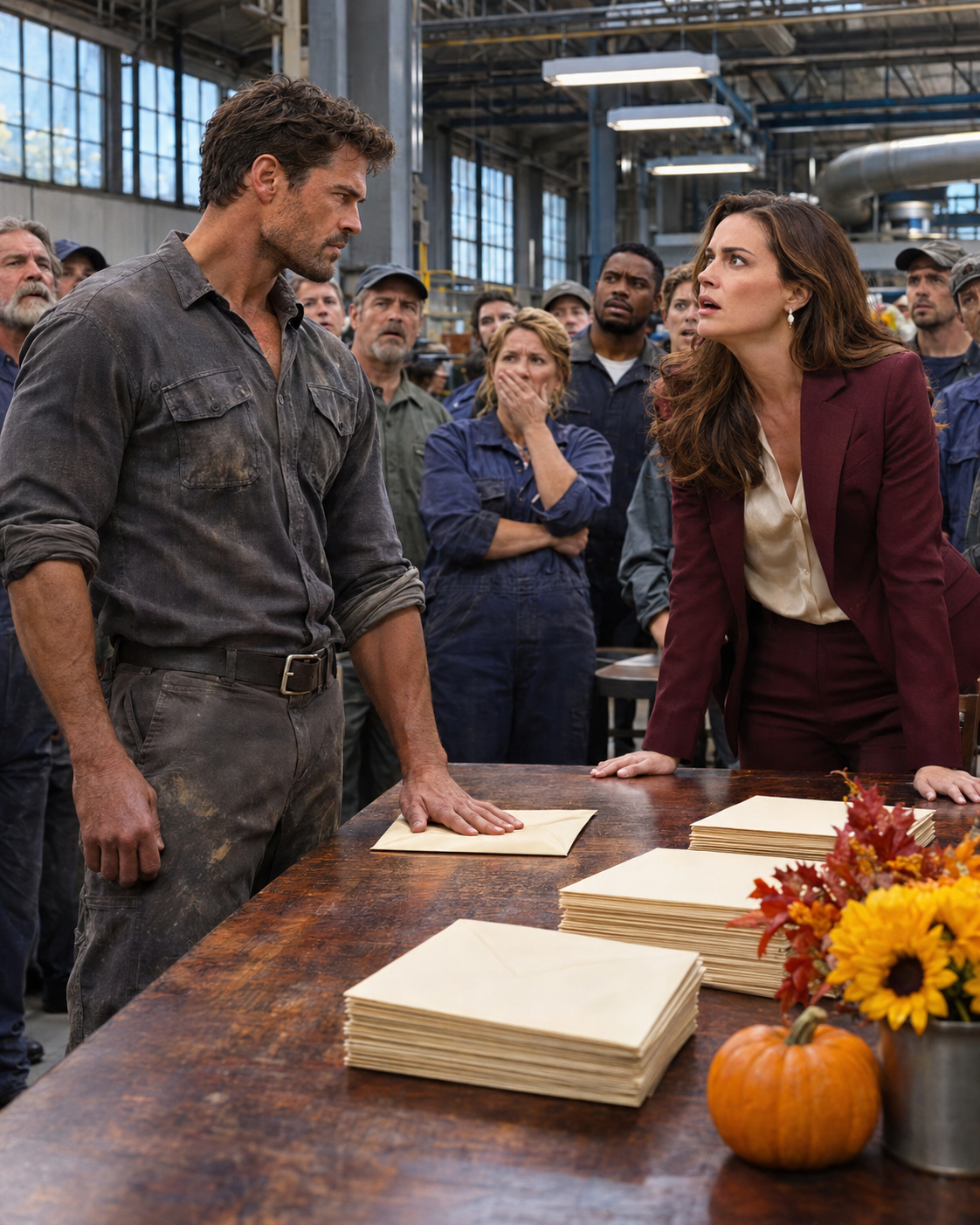
She wasn’t angry about what Nolan and the others deserved.
She was angry that I had made a financial decision affecting our entire household without talking to her.
And she had every right to be.
“Did you get your check back?” she asked.
“Not yet.”
She nodded toward an envelope from the electric company.
“Well, they haven’t forgotten about us.”
I took off my jacket and sat beside her.
For the first time since the luncheon, I explained what those eleven workers had actually given up.
During the slowdown, Nolan had gone from working a full week with occasional overtime to spending several weekdays at home. The others had accepted similar arrangements.
Some had taken temporary jobs. Others had dipped into savings they had spent decades building.
Nolan had never told me exactly how much money he’d lost, but I remembered him bringing peanut butter sandwiches to work instead of buying lunch from the food truck.
I remembered his truck sitting in the parking lot with a cracked windshield for months.
And I remembered asking him whether he was worried about losing his house.
“Everybody’s worried about something,” he’d told me. “Just keep showing up.”
Rachel listened without interrupting.
When I finished, she folded the electric bill and placed it back inside its envelope.
“I understand why you did it,” she said. “But understanding doesn’t mean I wasn’t scared.”
I reached across the table and took her hand.
“I should have talked to you first.”
“Yes, you should have.”
There wasn’t much else to say.
The following morning, I arrived at the plant before sunrise. One of our edge-banding machines had been making an intermittent grinding noise, and the production supervisor wanted it checked before the first shift.
I was underneath the machine when Hannah appeared.
She waited until I finished tightening a bracket before asking whether I had a few minutes.
We walked to a small conference room near the administrative offices.
She had several folders arranged across the table.
“I’ve been reviewing the personnel records,” she said. “There are some things you should know before we move forward.”
Of the eleven former workers, two had passed away since leaving the company.
I already knew about one of them, a sanding department employee named Curtis. His funeral had been attended by several people from the plant.
The other was a woman named Marlene who had worked in finishing for more than twenty years.
I hadn’t heard about her death.
She used to keep peppermint candies in her apron pocket and hand them to anyone who looked particularly miserable.
I sat staring at her name.
“When?” I asked.
“Last spring.”
I thought about all the months we’d spent discussing improved production numbers, new customer accounts, and equipment purchases.
Somewhere during those months, Marlene had died without knowing whether the company would ever acknowledge what she’d done.
Hannah gave me a moment before continuing.
She explained that the recognition plan would include all eleven workers. For the two who had passed away, the company would work with their families and legal representatives to determine how the payments could properly be distributed.
Nobody’s name would simply be removed from the list.
That mattered to me.
Later that morning, Clara and Miriam joined us.
Miriam was a composed woman who asked direct questions and seemed perfectly comfortable allowing a room to remain silent while she waited for an answer.
She had read the original agreement.
It didn’t specify a dollar amount, but it clearly established that the employees’ voluntary concessions would receive priority consideration when the company’s financial position improved.
“Who was responsible for following up on this?” she asked.
Hannah explained that several leadership changes had occurred between the slowdown and the restructuring.
Responsibilities had shifted. Records had been transferred. The agreement had remained on file without anyone being specifically assigned to ensure it was honored.
Victor had been aware of it, however.
That much was established by his handling of my proposal.
Miriam removed her glasses.
“An obligation doesn’t disappear because the people responsible for remembering it change jobs.”
Clara nodded.
They reviewed several funding options.
The simplest would have been to postpone the recognition payments until the next financial year, but Clara rejected that approach.
The workers had already waited long enough.
Instead, they discussed reallocating money from the executive incentive budget. Clara offered to reduce her own year-end compensation to help cover the difference.
Miriam explained that the necessary adjustments would require proper board approval and documentation.
She didn’t make promises she couldn’t keep.
But she made it clear that she supported the proposal.
I sat there in my work clothes, with a small grease stain on my sleeve, listening to people discuss sums of money that were usually far beyond anything I dealt with.
Eventually, Miriam turned toward me.
“What would meaningful recognition look like to these employees?”
I thought about Nolan’s question from the previous evening.
“Money matters,” I said. “But I don’t think they’d want to be treated like the company is doing them a favor.”
Miriam wrote something down.
“They earned it?”
“Yes, ma’am.”
“Then that’s how we should present it.”
Over the next several days, the atmosphere inside the plant gradually changed.
People stopped worrying about their Thanksgiving checks once Clara’s guarantee was communicated in writing.
The coworker who had confronted me near the loading dock apologized while we were waiting for coffee.
“I thought you were trying to make some kind of point at everybody else’s expense,” he admitted.
“I understand.”
He rubbed his forehead.
“My daughter’s been dealing with that tooth for months.”
“Get her taken care of.”
He smiled and offered me the last powdered doughnut from a box someone had brought in.
That was about as formal as apologies got on our production floor.
Not everyone was pleased, though.
A few employees questioned why people who no longer worked for the company should receive anything.
One man argued that everybody had struggled during the slowdown, not just those eleven.
He wasn’t entirely wrong.
We had all worried about our jobs. Some of us had lost overtime, and others had gone months without raises.
But there was a difference between experiencing a difficult period and voluntarily accepting a specific financial sacrifice under a written agreement.
I explained that whenever someone asked.
Eventually, most people understood.
Victor avoided me for several days.
When we finally spoke, it happened beside a storage cabinet where I kept replacement bearings and electrical components.
He asked whether I had a minute.
I expected another lecture about professional conduct.
Instead, he looked tired.
“You put me in a difficult position,” he said.
I closed the cabinet.
“I submitted the proposal through the proper channels.”
“I know.”
“Then what was I supposed to do?”
He looked toward the production floor.
He explained that management had been under pressure to demonstrate improved operating margins. The Thanksgiving bonus program had been designed around current staffing numbers and a defined budget.
Including former employees would have required additional approvals and explanations.
He had decided to simplify the proposal.
I listened until he finished.
“Victor, you could have told me it wasn’t approved.”
He nodded.
“You could have shown Clara the original and recommended against that section.”
Another nod.
“But you took it out before she ever saw it.”
He didn’t argue.
For a moment, neither of us spoke.
“I thought I was making the practical decision,” he said.
I looked at the machinery around us.
Years earlier, Nolan had taught me that a temporary repair could become an expensive permanent problem if nobody documented it.
You couldn’t simply remove a warning label because it complicated the job.
“You made it easier for yourself,” I told Victor. “That’s not the same thing.”
He accepted that without responding.
I didn’t know whether he was genuinely reconsidering his actions or simply worried about the consequences.
Maybe it was both.
A week later, Hannah informed me that the board had approved the funding arrangement.
The executive incentive adjustments were sufficient to provide meaningful recognition payments to all eleven former employees or their eligible representatives.
The current workforce’s Thanksgiving bonuses remained untouched.
Clara had also asked Hannah to prepare individual letters acknowledging the employees’ original contributions.
She wanted the wording to reflect an obligation being honored, rather than a charitable gift.
When I called Nolan again, he already knew some of the details.
Apparently, the former employees had been talking among themselves.
A few were willing to attend a recognition gathering. Others weren’t sure they could walk back into the building without remembering the day they’d been told to clear their lockers.
One man, Dennis, had struggled to find steady employment after the restructuring.
He was approaching retirement age when he lost his position. Several companies had interviewed him, but none had offered work comparable to what he’d done at our plant.
He eventually found a part-time warehouse job.
According to Nolan, Dennis wasn’t particularly interested in shaking hands with executives.
“I can’t blame him,” I said.
“Neither can I.”
Nolan agreed to attend, provided nobody was pressured into appearing grateful.
I carried that condition directly to Clara.
She accepted it immediately.
The gathering was scheduled for a Friday afternoon in early December.
There would be no elaborate stage, no outside publicity, and no requirement that former employees participate in photographs.
Those who preferred private arrangements could receive their recognition separately.
On the morning of the gathering, I arrived to find the breakroom being cleaned.
Someone had moved the old table from the corner.
For a moment, I thought it had finally been thrown away.
Then I noticed it near the center of the room.
The cleaning crew had wiped down the surface, but the scratches and worn edges were still visible.
I recognized a dark circular mark left by Nolan’s old metal coffee mug.
Several chairs had been arranged around it.
I stood there longer than I intended.
By early afternoon, employees began gathering in the breakroom.
Production had been adjusted so people could attend without creating problems on the floor.
I was standing near the doorway when Nolan walked in.
He looked older than I remembered.
His shoulders were slightly rounded, and his hair had gone almost completely gray. He wore a clean flannel shirt beneath a brown jacket that looked familiar enough to have been hanging in his locker years earlier.
He spotted me and smiled.
“Still keeping those machines running?”
“Most of the time.”
“Good enough.”
We shook hands, and then he pulled me into a brief hug.
Several other former employees arrived behind him.
There was Lorraine from upholstery, Eddie from assembly, and Frank, who had once been able to identify a failing motor simply by listening to it.
Watching them greet one another was strange.
They slipped back into familiar conversations almost immediately, asking about grandchildren, knees, retirement, and people who had transferred to different departments.
But there were moments when their eyes wandered around the room.
Things had changed.
New vending machines occupied the wall where an old bulletin board had hung. The company logo had been updated. Some of the supervisors they remembered were gone.
They belonged to the history of the place without quite belonging to its present.
Dennis didn’t attend.
Hannah had arranged to meet with him privately.
Clara began the gathering by introducing herself to the former employees.
She didn’t pretend to have known them during the difficult winter.
Instead, she acknowledged that she had inherited a company whose survival depended partly on decisions made before her arrival.
She explained the funding arrangement and confirmed that the current employees’ bonuses had not been reduced.
Then she addressed something I hadn’t expected her to discuss publicly.
She told everyone that the original recognition proposal had been submitted months earlier by a maintenance technician.
She acknowledged that she had received an incomplete version and had therefore approved the Thanksgiving program without knowing the full recommendation.
She didn’t turn the gathering into a public disciplinary hearing for Victor.
She simply made it clear that the company’s internal process had failed.
“When I first read the complete proposal,” she said, “I realized it wasn’t primarily about distributing bonuses. It was about remembering the people who made it possible for us to distribute them.”
She looked toward me.
I suddenly found the floor tiles very interesting.
Nolan glanced in my direction.
“You wrote that?” he whispered.
I nodded.
He didn’t say anything else.
Clara read all eleven names, including Curtis and Marlene.
She spoke briefly about the sacrifices the group had made and acknowledged that the company’s recognition had come much later than it should have.
There was applause, but it wasn’t particularly loud at first.
People seemed uncertain whether clapping was appropriate.
Then Lorraine began crying.
She covered her face with one hand, and Eddie quietly passed her a napkin.
The applause grew.
I watched Nolan.
He wasn’t crying or smiling broadly. He was looking around at the people who had kept their jobs, some of whom had since become supervisors, homeowners, parents, and grandparents.
Eventually, Clara invited him to speak.
He stood beside the old table and rested one hand on its surface.
“We weren’t trying to save a company logo,” he said. “We were trying to save jobs for people we knew.”
He pointed toward several employees.
“Some of you had babies coming. Some had just bought houses. Some were taking care of parents. We figured we’d get through a bad winter together.”
He stopped and looked down at the table.
“What happened afterward hurt. I won’t pretend it didn’t.”
Nobody moved.
“But I’m glad the people working here today aren’t being asked to pay for making things right.”
He sat down.
There was nothing dramatic about his speech.
That was what made it difficult to hear.
After the gathering, Clara asked me to remain behind.
She handed me the same Thanksgiving bonus envelope I had refused.
“Your family deserves this,” she said.
I hesitated.
She explained that my payment had remained available and that accepting it would not affect the former employees’ recognition funds.
I thought about Rachel sorting bills at our kitchen counter.
This time, I took the envelope.
Nolan was waiting near the exit when I caught up with him.
I told him I’d finally accepted my bonus.
“About time,” he said.
He asked whether I understood that the sacrifices his group had made weren’t intended to leave me feeling indebted forever.
I told him I did.
He studied my face.
“Then take care of your family.”
We walked outside together.
Before leaving, he admitted that he still didn’t know how he felt about the company.
The recognition meant something to him. So did the money.
But neither could return the years he had expected to spend working alongside people he considered friends.
He wasn’t ready to call everything forgiven.
I told him nobody should expect him to.
That evening, Rachel and I sat at our kitchen table and worked through the bills.
We paid the overdue electric balance, set aside money for tires, and agreed on a modest Christmas budget.
There wasn’t much left afterward.
Still, for the first time in several weeks, we weren’t wondering which expense would have to wait.
Rachel asked how Nolan had reacted.
I told her about the gathering, the old table, and the two names belonging to people who hadn’t lived long enough to hear the company’s acknowledgment.
She looked down at the paperwork.
“That’s the part that gets me,” she said.
It got to me, too.
The following Monday, the plant returned to its ordinary routine.
Machines broke down. Production schedules changed. Someone complained that the coffee tasted like burnt cardboard.
Clara continued working with Hannah and the board to improve how commitments to employees were documented and reviewed.
Victor remained part of management, although the handling of the proposal was subject to internal review.
I wasn’t involved in deciding his consequences.
And I didn’t pretend that one recognition gathering had transformed every part of our workplace.
There would still be disagreements. There would still be difficult financial decisions.
What mattered was whether the company would remember this experience the next time honoring a commitment became inconvenient.
A few days before Christmas, Nolan called me.
He said he’d received his recognition payment and the accompanying letter.
He had read the letter several times.
“It’s strange,” he admitted. “For years, I wanted somebody to acknowledge what happened. Now that they have, I don’t quite know what to do with it.”
I asked whether he regretted attending.
“No,” he said. “I just wish they’d remembered us without needing you to remind them.”
I couldn’t disagree.
He invited Rachel and me to visit sometime after the holidays.
Before hanging up, he asked me to promise him something.
If the plant ever faced another difficult winter, and management asked employees to make sacrifices, he wanted me to insist that those commitments were recorded, protected, and followed through.
He didn’t want another group of workers spending years wondering whether their generosity had simply made them easier to forget.
I promised him I would.
At lunch the next day, I carried my sandwich toward the old breakroom table.
A newly hired technician was sitting there alone, scrolling through his phone.
He moved his lunch bag to make room for me.
“Anybody usually sit here?” he asked.
I looked at the empty chairs.
“There used to be a group.”
He asked what happened to them.
I sat down, unwrapped my sandwich, and began telling him about a winter when eleven people decided that keeping their coworkers employed mattered enough to accept less for themselves.
He listened.
By the time our lunch break ended, he knew Nolan’s name.
He knew why the company had survived.
And he knew that the table wasn’t empty because those workers had never mattered.
It was empty because, for too long, the people who benefited from their sacrifice had stopped telling their story.