The day I found out my parents had spent my entire college fund on my older brother’s restaurant, my mother looked me straight in the eyes and said
It was a stack of bank statements, a copy of my grandparents’ original savings agreement, and a document with my signature at the bottom.
Except I had never signed it.
Connor placed everything on the dining room table.
“Mom told me that Emily had agreed to invest her college money in the restaurant,” he said. “She told me Emily wanted to be a silent partner.”
I stared at him.
“A silent partner?”
He nodded slowly.
“I thought you were getting twenty percent of the business.”
My mother rushed toward the table.
“Connor, put those papers away. This is a private family matter.”
Uncle Leo stepped forward and picked up the document before she could reach it.
He adjusted his glasses and read the first page.
“Diane, what exactly have you done?”
My father stood near the window, his face unusually pale.
Nobody touched the food anymore.
Connor turned toward me.
“How much did Grandma and Grandpa save for you?”
“Mom never told me the exact amount.”
He pointed to one of the statements.
“Seventy-eight thousand, four hundred dollars.”
I felt something tighten inside my chest.
For years, I had imagined the fund contained perhaps twenty or thirty thousand dollars. Enough to make college manageable, but not enough to cover everything.
Seventy-eight thousand dollars would have changed my entire life.
I wouldn’t have spent nights working until two in the morning, worrying about tuition payments. I wouldn’t have skipped meals to replace a broken laptop. I wouldn’t have needed to choose between textbooks and groceries.
My mother crossed her arms.
“It was sitting there doing nothing.”
Uncle Leo looked at her in disbelief.
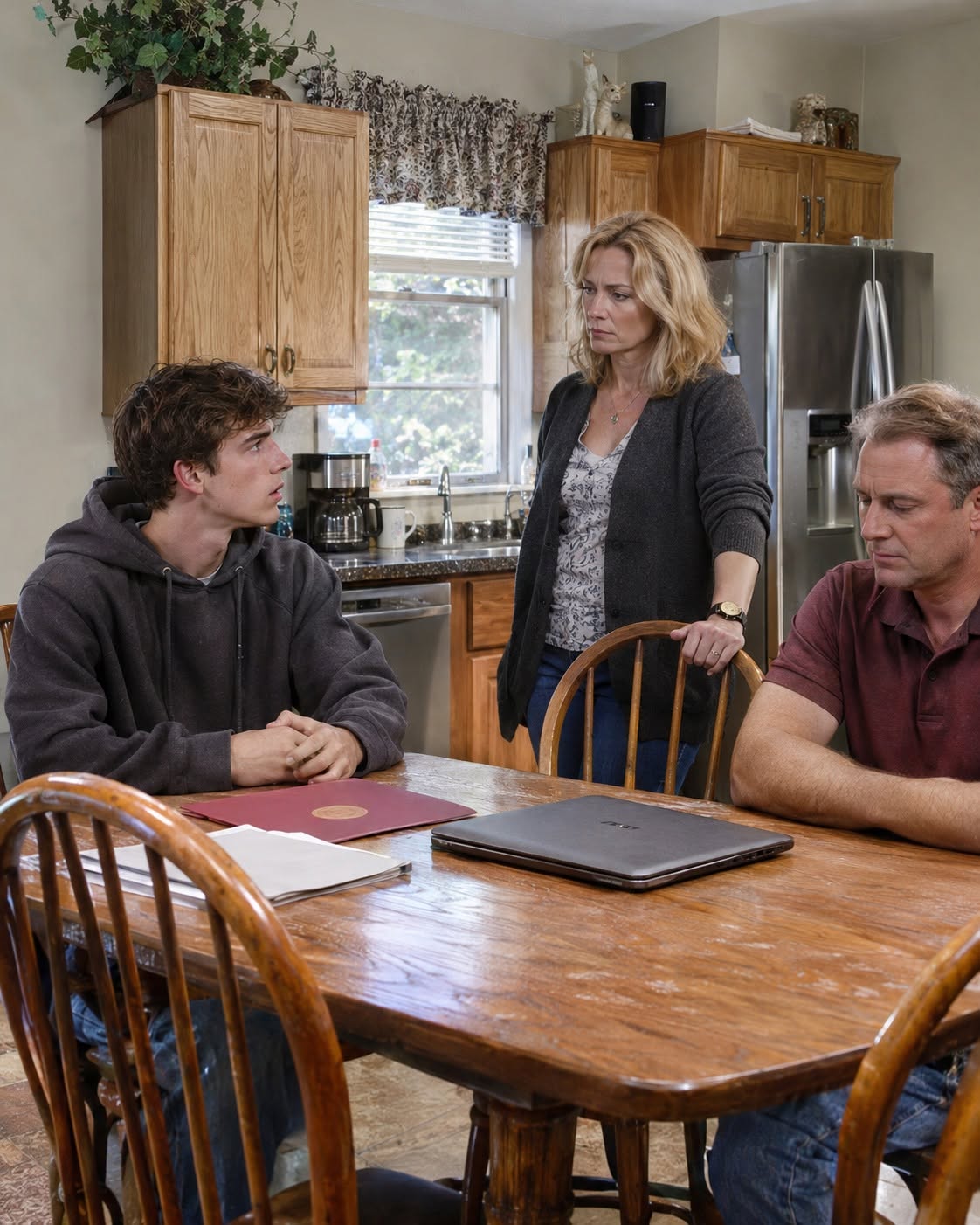
“It was waiting for Emily to go to college. That’s what education savings are supposed to do.”
“Connor needed it immediately!”
“And Emily didn’t?”
My mother ignored him.
I picked up the document bearing my supposed signature.
It described my voluntary investment in Connor’s restaurant and acknowledged that I understood the financial risks.
There was even a paragraph stating that I would not hold my parents responsible if the business failed.
“Who signed my name?”
Nobody answered.
I looked at my father.
“Dad?”
He rubbed the back of his neck.
“Your mother handled the paperwork.”
Diane immediately turned on him.
“Don’t you dare put this entirely on me. You agreed!”
Connor pulled another document from the envelope.
“There’s more.”
My mother suddenly shouted his name.
But he continued.
“The restaurant only received forty-six thousand dollars from Emily’s college fund.”
I looked down at the statements again.
“What happened to the rest?”
Connor looked at our parents.
“That’s what I’ve been trying to find out.”
My father sat down heavily.
My mother began talking about household expenses, rising costs, and how difficult things had been financially.
But Uncle Leo interrupted her.
“You bought a new SUV that summer.”
“That has nothing to do with this.”
“And you took that vacation to Hawaii.”
My mother’s silence answered the question.
I remembered seeing photographs from that vacation while sitting in my apartment above Leo’s garage, eating instant noodles and trying to finish a programming assignment.
She had captioned one photograph, “Finally enjoying the rewards of our hard work.”
Apparently, those rewards had come from mine.
Connor looked sick.
“I knew you were helping me. I didn’t know you were taking money for yourselves.”
My mother pointed at him.
“Everything we did was for you children!”
I finally spoke.
“Then why did you need to forge my signature?”
She stared at me.
For once, she couldn’t produce an answer.
I gathered the documents and asked Connor whether I could keep them.
He agreed.
My mother demanded that I leave them behind.
I walked out anyway.
Uncle Leo followed me to my car.
“Emily, I’m sorry,” he said. “Your grandparents would be devastated.”
I nodded, afraid that speaking would make me cry.
That evening, I spread the paperwork across my kitchen table.
Tessa came over with dinner and found me staring at the same bank statement I’d been reading for nearly an hour.
After I explained everything, she sat beside me.
“What are you going to do?”
“I don’t know.”
“Well, whatever you decide, don’t let them make you feel guilty for asking questions.”
I wished it were that simple.
My parents had spent my entire childhood teaching me that Connor’s needs came first. Whenever I complained, I was selfish. Whenever I succeeded, I was reminded not to make him feel inadequate.
Even now, part of me felt uncomfortable holding evidence that could cause them trouble.
The following morning, I contacted an attorney named Rachel Bennett.
She specialized in financial disputes and reviewed the documents carefully.
She explained that the original account had been established under a custodial arrangement for my benefit. My parents’ authority over the money did not necessarily give them the right to use it for themselves.
The forged agreement made the situation considerably more serious.
“We’ll need complete records before determining your options,” she said.
Then she asked whether I had checked my credit recently.
I hadn’t.
I had always paid my bills on time and rarely borrowed money.
Rachel recommended that I review everything.
That afternoon, I discovered a credit card account I didn’t recognize.
It had been opened shortly after my nineteenth birthday.
The outstanding balance was $11,600.
Several payments were overdue.
I called the issuer and began disputing the account.
Then I called my father.
“Did you open a credit card in my name?”
His breathing changed.
“Emily, your mother was trying to manage some temporary expenses.”
“That’s not what I asked.”
“We were going to pay it off.”
I closed my eyes.
They hadn’t simply taken money from my past.
They had borrowed against my future.
I ended the call and immediately began taking steps to protect my identity and finances.
For the next several days, my mother sent messages accusing me of overreacting.
She reminded me that she had raised me, fed me, and provided a roof over my head.
When those arguments failed, she switched tactics.
She told me my father wasn’t sleeping. She claimed Connor was depressed. She suggested that pursuing the matter could destroy the family permanently.
I forwarded the relevant messages to Rachel and stopped responding.
Meanwhile, Tessa and I were preparing for the biggest opportunity our agency had ever received.
A regional healthcare network was looking for a company to redesign its public websites and appointment interfaces.
The contract was worth enough to allow us to hire several employees and move into a proper office.
We had spent three months developing our proposal.
Then, two days before our final presentation, the network’s procurement manager called.
“Emily, we’ve received a concerning communication regarding your financial situation.”
My stomach dropped.
“What kind of communication?”
“Someone claiming to be a member of your family contacted us. They suggested your company might be facing legal and financial difficulties.”
I couldn’t believe it.
My mother knew about the opportunity because Uncle Leo had mentioned it during a conversation weeks earlier.
Apparently, she had decided that if I wouldn’t share my success willingly, she could threaten it.
The procurement manager explained that the network needed clarification before proceeding.
I provided documentation demonstrating that our agency was financially sound and explained that I was dealing with an unrelated personal identity dispute.
Tessa remained beside me throughout the entire process.
When we finally finished submitting everything, I broke down.
“They already took my education. Why can’t they leave this alone?”
Tessa pushed a box of tissues toward me.
“Because you’ve stopped letting them decide what happens to you.”
The following day, Connor called.
He asked whether we could meet.
I almost refused, but something in his voice sounded different.
We met at a coffee shop near his closed restaurant.
He looked exhausted. His expensive watch was gone, and he was wearing an old sweatshirt instead of the designer clothes he usually preferred.
“Mom contacted your client,” he admitted.
“How do you know?”
“She asked me to find the procurement manager’s email address. I refused, but she found it herself.”
I stared at him.
“Why would she do that?”
“She thinks if your business struggles, you’ll need the family again.”
The cruelty of that explanation left me speechless.
Connor looked down at his coffee.
“I spent my whole life thinking I was the successful one. Every time I messed up, they told me somebody else was responsible.”
He admitted that he had ignored his restaurant manager’s advice, purchased unnecessary equipment, and hired friends who lacked experience.
When customers complained, he blamed the staff.
When profits disappeared, he blamed the economy.
Our parents had encouraged every excuse.
“Then I started reviewing the accounts after we closed,” he continued. “That’s when I realized how much money they’d actually taken from you.”
I studied his face.
“Did you really believe I wanted to invest?”
“At first, yes.”
“At first?”
He hesitated.
“When you moved out, I knew something wasn’t right. But I didn’t ask questions because I was afraid they’d stop funding the restaurant.”
His admission hurt more than I expected.
He hadn’t understood everything, but he had deliberately avoided learning anything that might threaten his comfortable position.
“I’m sorry,” he said.
I looked through the window at the empty restaurant across the street.
“Being sorry doesn’t make me responsible for helping you.”
“I know.”
For the first time, Connor didn’t ask me for anything.
Instead, he handed me a flash drive containing the restaurant’s financial records.
“Rachel might need these.”
Then he left.
Two weeks later, our agency received the healthcare contract.
Tessa screamed when she opened the email.
I laughed, cried, and hugged her so tightly that she complained she couldn’t breathe.
We celebrated with takeout pizza in our cramped office.
It wasn’t glamorous, but it was ours.
My mother’s attempt to interfere had failed.
Unfortunately, the situation at home continued deteriorating.
My parents had missed several loan payments, and their lender had begun taking steps toward foreclosure.
They contacted relatives asking for money.
When people refused, Diane told them I was wealthy enough to save the house but had chosen to punish her.
Eventually, Uncle Leo organized a family meeting.
I agreed to attend on one condition: Rachel would come with me.
My parents arrived carrying folders of bills and loan statements.
My mother immediately began crying.
“Emily, you’re going to let your own parents become homeless?”
Rachel calmly asked whether they had considered selling the property voluntarily before foreclosure progressed.
My mother looked offended.
“That’s our family home.”
Uncle Leo folded his arms.
“It was also your collateral. You made that decision.”
My father finally spoke.
“We could keep the house if Emily helped us refinance.”
Rachel asked how much they needed.
My father slid a document across the table.
One hundred and forty thousand dollars.
I stared at the number.
They wanted me to risk everything I had built to preserve the lifestyle they had financed by sacrificing my education.
“No,” I said.
My mother slammed her hand against the table.
“After everything we’ve done for you?”
I felt years of anger rising inside me.
“Name one thing you sacrificed for my future that you didn’t eventually expect me to repay.”
She opened her mouth.
Nothing came out.
I continued.
“Grandma and Grandpa saved that money because they believed in me. You took it because you didn’t. Now that I’m successful, you want to act like my success belongs to you.”
My father lowered his head.
Rachel explained that we were seeking repayment of the improperly used funds and resolution of the unauthorized credit account.
My mother stared at her.
“You’re actually going to sue your parents?”
“I’m trying to recover what belongs to me.”
Then Connor arrived.
He placed a small envelope in front of me.
Inside was a cashier’s check for $8,200.
“I sold my car,” he said.
My mother looked horrified.
“You did what?”
Connor ignored her.
“I’ve accepted a job managing inventory at a grocery distribution center. I’m going to start paying Emily back.”
“You don’t owe her anything!” Diane shouted.
“Yes, I do.”
He turned toward me.
“I know this isn’t much compared to what you lost. But it’s a start.”
I accepted the check.
Not because it erased anything, but because it represented something my family had rarely offered me.
Actual responsibility.
My mother stood abruptly.
“This family is falling apart because of money!”
Uncle Leo shook his head.
“No, Diane. It’s falling apart because you decided one child’s future was worth more than the other’s.”
She grabbed her handbag and left.
My father remained seated.
He looked at the paperwork for a long time before asking Rachel what would happen next.
The negotiations lasted nearly four months.
The unauthorized credit account was eventually resolved through the issuer’s investigation, and the related negative information was removed from my credit records.
My parents agreed to a financial settlement rather than proceed with a lengthy civil dispute.
They sold their house before foreclosure was completed, paid off the secured loan, and used part of the remaining proceeds to reimburse me.
It wasn’t enough to recover every dollar immediately, so a structured repayment arrangement covered the balance.
They moved into a modest two-bedroom apartment.
My mother described the move as the greatest humiliation of her life.
I remembered the apartment above Uncle Leo’s garage.
It had a leaking window, unreliable heating, and barely enough room for a desk.
Yet somehow, I had never considered living there humiliating.
It was where I had discovered what I could accomplish when nobody was constantly telling me to expect less.
One evening, my father asked whether he could visit my new office.
I agreed.
He arrived wearing work clothes and carrying a cardboard box.
Inside were my childhood school projects, programming competition certificates, and photographs my grandparents had collected.
At the bottom was a birthday card from my grandmother.
I recognized her handwriting immediately.
“Emily, never let anybody convince you that your curiosity is a foolish thing. The world needs people who ask questions and have the courage to find answers.”
I had never seen the card before.
“Where did you find this?”
“In your mother’s dresser.”
He looked around the office.
There were six employees working at their desks, meeting rooms decorated with client projects, and a large whiteboard covered with development plans.
“I didn’t understand any of this,” he admitted.
“You didn’t have to understand it to support me.”
He nodded.
“I know that now.”
He told me he had taken a part-time job at a hardware store to help cover their expenses.
My mother was still angry about the settlement and refused to discuss my business.
“She thinks you’ll eventually apologize,” he said.
“For what?”
He gave a sad little smile.
“I don’t know anymore.”
Before leaving, he asked whether I could forgive him.
I told him forgiveness wasn’t something he could schedule or negotiate.
He would have to demonstrate that he understood what he had done.
He accepted that.
Over the next year, Connor kept making payments.
He rented a small apartment, worked regular hours, and gradually stopped expecting our parents to solve his problems.
Eventually, he started taking evening classes in business management.
One Saturday, he invited me to a community food festival.
He had rented a small booth selling sandwiches based on recipes from his former restaurant.
There were no expensive decorations, custom furniture, or unnecessary equipment.
Just good food, reasonable prices, and a surprisingly long line of customers.
When he spotted me, he smiled.
“Turns out people care more about the sandwiches than imported Italian lighting.”
I laughed.
It was the first genuinely comfortable moment we’d shared in years.
He told me he was considering starting a small catering business someday, but only after saving enough money himself.
Then he asked whether my agency could build him a website.
“At your normal rates,” he added quickly.
I told him to contact our sales department.
He did.
He even paid the deposit early.
As for my mother, our relationship remained distant.
She occasionally sent messages on holidays, usually accompanied by reminders that life was short and family was important.
I stopped arguing with her.
I had learned that some people interpreted reconciliation as permission to return to their old behavior.
I wasn’t willing to offer that permission.
Two years after discovering the truth about my college fund, I received an acceptance letter from the university I had originally dreamed of attending.
I had completed my foundational courses locally and decided to finish my computer science degree through a flexible program while continuing to run the agency.
I no longer needed the degree to prove I could succeed.
I wanted it because it was something I had always dreamed of accomplishing.
When graduation day finally arrived, Tessa and Uncle Leo sat in the audience.
Connor was there, too.
My father attended quietly, sitting several rows behind them.
My mother chose not to come.
As I crossed the stage, I heard Uncle Leo cheering louder than anyone else in the auditorium.
Afterward, he handed me a small photograph of my grandparents.
“They would’ve loved seeing this,” he said.
I held the photograph against my graduation gown and cried.
Later that summer, Tessa and I established an annual scholarship through our agency for students pursuing technology degrees who lacked financial support at home.
We named it after my grandparents.
Our first recipient was a young woman whose family believed studying engineering was a waste of time.
When I told her she had been selected, she asked whether there were any conditions beyond the academic requirements.
“Do I have to work for your company afterward?”
“No.”
“Do I have to pay it back?”
“No.”
She looked at me with the same uncertainty I had once felt whenever somebody offered me something kind.
“Then why are you doing this?”
I smiled.
“Because your future deserves a chance before anyone decides what it’s worth.”
Driving home that evening, I thought about the day my mother had told me to be realistic.
She had believed Connor’s restaurant represented a real future, while my education represented an unnecessary expense.
In the end, Connor had learned that dreams required discipline, not unlimited financial rescue.
My father had learned that providing for your children did not entitle you to their achievements.
And I had learned that supporting someone should never mean sacrificing another person’s opportunity without their consent.
I didn’t become successful to prove my mother wrong.
I didn’t finish college to make my parents regret their decisions.
And I didn’t establish that scholarship because I wanted strangers to admire me.
I did those things because I finally understood that my life was mine to direct.
My parents had taken seventy-eight thousand, four hundred dollars from my education fund.
For a while, I believed they had stolen my future along with it.
But money can delay a dream without destroying it. Betrayal can change your direction without determining your destination.
The greatest thing I recovered wasn’t the money.
It was the freedom to pursue something simply because it mattered to me.
And somewhere, I hoped my grandparents knew that their faith in me had never been wasted.
Their savings had disappeared.
Their belief in me never did.