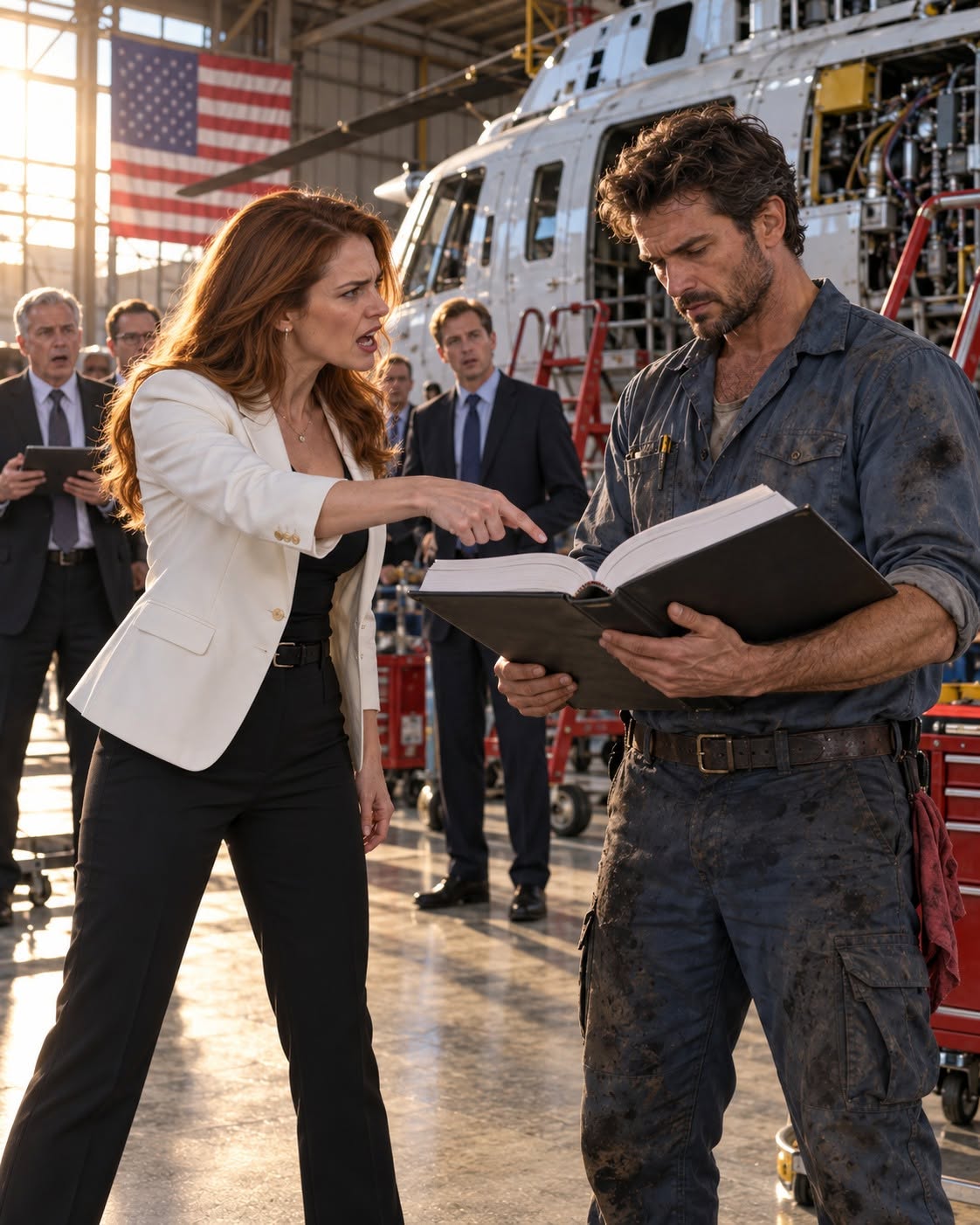
The CEO threw the technical manual against my chest in front of dozens of investors and screamed
THE MAN WHO REFUSED TO BE BROKEN
I sat behind the wheel of my old truck, staring at Victoria Sterling’s message.
The offer was everything I had once wanted.
My old title restored. Six years of lost compensation reviewed. A leadership position overseeing the very engineering department that had once pushed me out. And, perhaps most importantly, the chance to put my name back on the work I had created.
But there was something Victoria’s message couldn’t give me.
Those six years back.
I looked at the photograph taped to my dashboard. My daughter, Emily, was smiling with a pancake in each hand, her front teeth still missing. She had been four years old when Harrison Cole destroyed my career. Now she was ten.
For six years, I had told her that everything would eventually work out. I had never told her how badly I had been betrayed.
My phone vibrated again.
It was another message from Victoria.
“We need your answer, Nathaniel. The board meets tomorrow morning. I want you there.”
I started the engine.
Then I drove home.
When I arrived, Emily was sitting at the kitchen table with her homework spread around her. She looked up immediately.
“Dad! Did you get my pancakes?”
I held up the paper bag.
“Chocolate chip. Extra butter. Just like you ordered.”
She jumped out of her chair and wrapped her arms around my waist.
For a moment, the entire world felt wonderfully ordinary.
Then she noticed my expression.
“Something happened at work, didn’t it?”
I hesitated.
Children have a way of recognizing the things adults spend years trying to hide.
“Something important happened,” I said.
“Good important or bad important?”
I pulled out a chair and sat beside her.
“Both, probably.”
I told her what had happened at the demonstration. I explained how the manual had revealed my name, how the stolen records had been recovered, and how the company wanted me to return.
I didn’t tell her every ugly detail. She was still a child, and she deserved to remain one a little longer.
When I finished, she stared at me thoughtfully.
“So they’re giving you your job back?”
“Something like that.”
“Then why do you look sad?”
I looked down at my hands.
“Because sometimes getting something back doesn’t mean you should go back to where you lost it.”
Emily considered that for a few seconds.
Then she asked a question I hadn’t expected.
“Dad, if you don’t go back, does that mean Mr. Harrison wins?”
I felt something tighten in my chest.
“No. Not anymore.”
“Then why are you scared?”
I almost laughed.
Ten years old, and she had managed to ask the one question I had been avoiding.
“I’m not sure I know how to trust those people again.”
Emily reached across the table and took my hand.
“You always tell me that doing the right thing is more important than being scared.”
I stared at her.
She smiled.
“Maybe you should listen to your own advice.”
That night, I barely slept.
At six the following morning, I sent Victoria a message.
“I’ll attend the board meeting. But I’m not coming back under the old conditions.”
Her response arrived less than a minute later.
“Name your conditions.”
I put my phone down.
For the first time in six years, I wasn’t asking someone else for permission to determine my future.
THE BOARDROOM
Sterling Aerotech’s headquarters looked exactly as I remembered.
Glass walls. Polished marble. Expensive furniture. Employees moving quickly through the corridors, pretending that every conversation was urgent.
I had spent years walking through those same hallways carrying toolboxes while people stepped around me without making eye contact.
This time, the receptionist stood up when I approached.
“Mr. Hayes? Ms. Sterling is expecting you.”
I nodded.
The boardroom doors opened.
Victoria sat at the head of the table. Beside her were seven directors, two legal representatives, and Samuel, the senior engineer who had finally spoken up during the demonstration.
A chair had been placed at the opposite end.
Nobody asked me to wait.
That alone told me something had changed.
Victoria stood.
“Thank you for coming, Nathaniel.”
I took my seat.
She began by explaining that the company had launched an internal investigation. Federal investigators had secured the recovered archives, and several senior employees had been interviewed.
Harrison Cole had been formally suspended.
His access to company systems had been revoked, his corporate devices confiscated, and his travel privileges restricted while the investigation continued.
But Victoria wasn’t finished.
“Before we discuss your position, I owe you an apology.”
She stood with both hands resting on the table.
“What happened to you was not simply an administrative mistake. You were deliberately discredited. Your work was stolen, your professional reputation was destroyed, and the company benefited from your silence for six years.”
The room was completely still.
“I should have questioned the evidence. I should have listened when you raised concerns. Instead, I allowed someone with a senior title to convince me that a talented employee was a liability.”
She looked directly at me.
“I failed you.”
I appreciated that she didn’t try to excuse herself.
But I wasn’t there to collect apologies.
I opened my folder and placed three pages on the table.
“These are my conditions.”
The first page concerned my professional record.
I wanted my original design patents and engineering contributions properly restored, with the appropriate legal recognition and compensation.
The second page concerned the engineering department.
I wanted an independent technical oversight committee with authority to investigate safety complaints without interference from executives.
Every engineer, technician, and maintenance worker would have a documented way to report dangerous decisions without fearing retaliation.
The third page was the most important.
“I will not return as a permanent employee under the existing management structure,” I said. “I’ll agree to lead an independent reconstruction of the Aerlock 7 program for six months. My authority will be limited to technical integrity, safety, and engineering practices. I won’t be responsible for protecting anyone’s reputation.”
One of the directors frowned.
“You’re asking for considerable authority.”
“I’m asking for enough authority to prevent another person from suffering what I did.”
He leaned back.
“And if we refuse?”
I closed my folder.
“Then I’ll leave. But this time, I’ll leave with my name intact.”
Victoria studied me.
Then she turned to the directors.
“I support his terms.”
A lengthy discussion followed.
There were questions about cost, liability, the military contract, and the possibility of reputational damage.
One director argued that giving a former maintenance technician such authority would create an unusual precedent.
I looked at him.
“You’re right. It would be unusual to give the person who understands the machinery more authority than the person who understands the boardroom.”
Samuel lowered his head, hiding a smile.
The director didn’t respond.
After forty minutes, the board approved the arrangement.
I signed the agreement.
But as I was leaving, Samuel caught up with me.
“Nathaniel, there’s something else you need to know.”
His expression was serious.
“The recovered archives show that Harrison wasn’t working alone.”
I stopped.
“What do you mean?”
Samuel glanced toward the boardroom.
“There are revision approvals under other people’s names. Some of them belong to executives who are still here.”
I felt the old anger beginning to return.
“Who?”
He shook his head.
“I don’t know yet. But Harrison wasn’t the only person who knew what happened to you.”
THE SECOND BETRAYAL
Over the next three weeks, I worked with the independent investigators to reconstruct the Aerlock 7 development history.
The deeper we looked, the uglier the picture became.
Harrison had stolen more than my design.
He had manipulated test reports, altered revision histories, and convinced several employees to sign documents that concealed his involvement.
But the most disturbing discovery involved the original simulated failure.
The test that had destroyed my career had never been a legitimate failure of my design.
It had been deliberately manufactured.
Harrison had introduced an unauthorized software change before the simulation, then restored the original version afterward. The resulting discrepancy made it appear that I had overlooked a dangerous instability.
He had planned it carefully.
But there was another name in the approval chain.
Richard Voss.
Sterling Aerotech’s former chief operating officer.
He had retired two years earlier, supposedly for personal reasons.
Investigators discovered that Voss had authorized the internal review that blamed me. He had also approved a substantial performance bonus for Harrison shortly afterward.
I sat in Samuel’s office reading the documents.
“Why would Voss help him?”
Samuel rubbed his forehead.
“Because Harrison promised him something.”
“What?”
“Access to the licensing rights for Aerlock 7. Voss had been negotiating with an overseas manufacturer. If Harrison became the recognized inventor, Voss could arrange a private licensing deal without involving you.”
I stared at the papers.
They hadn’t simply wanted to take credit.
They had wanted control of the technology.
And when I became inconvenient, they had destroyed my reputation.
The following morning, Victoria called an emergency meeting.
She had learned about Voss.
Her expression was colder than I had ever seen it.
“He’s been contacted by our legal department,” she said. “He claims he had no knowledge of Harrison’s actions.”
“Of course he does.”
“We need to be careful. He knows the company’s internal structure better than anyone.”
I leaned forward.
“Then don’t warn him again.”
Victoria frowned.
“What are you suggesting?”
“Preserve every document. Secure every server. Let the investigators follow the evidence. And don’t let anyone negotiate with him privately.”
She nodded.
For the first time, I noticed something different about Victoria.
She wasn’t trying to control the situation anymore.
She was listening.
That afternoon, Harrison’s attorney requested a meeting with me.
I refused.
The next morning, I received an email from Harrison himself.
It contained only four sentences.
“You think you’ve won, Nathaniel. You have no idea how much damage this company is about to suffer. If you keep pushing, people you care about will pay the price.”
I read it twice.
Then I forwarded it to the investigators.
I had spent six years afraid of this man.
I wasn’t going to give him another day of my life.
THE NIGHT EVERYTHING CHANGED
Two days later, the aircraft’s independent safety review encountered an unexpected problem.
A critical section of the recovered firmware was missing.
Not corrupted.
Not damaged.
Missing.
Someone had accessed a secondary archive using credentials that should have been disabled.
The investigators immediately locked down the facility.
Victoria called me at 9:40 that evening.
“Can you come in?”
I arrived twenty minutes later.
The hangar was almost empty. Security personnel stood near the server room, and Samuel was waiting beside the diagnostic station.
He looked exhausted.
“Someone tried to remove the original calibration records,” he said.
“Did they succeed?”
“Not completely. We recovered most of them.”
He pointed to the screen.
A series of access logs appeared.
The credentials belonged to a former systems administrator named Daniel Mercer.
Daniel had left Sterling Aerotech four years earlier.
But his account had been used that evening from inside the building.
I examined the timestamps.
Then I noticed something strange.
The access had originated from the maintenance network.
My old network.
“Someone used a physical maintenance terminal,” I said.
Samuel looked at me.
“Can they do that?”
“Only if they have access to the diagnostic credentials.”
I studied the logs again.
Then I saw it.
The terminal had been activated using a temporary access code assigned to a contractor working in the hangar.
A contractor who had been hired just three days earlier.
Security found him in the parking garage.
His name was Martin Reeves.
He initially claimed he had been asked to perform routine equipment checks. But when investigators showed him the access logs, his story changed.
He admitted that someone had paid him to enter the server room and remove the records.
The person who hired him was Richard Voss.
Before leaving the facility, Martin handed investigators a small storage device containing the payment instructions.
But the most important evidence wasn’t on that device.
It was in a voice recording he had accidentally made during a phone call with Voss.
I stood in the conference room as the recording played.
Voss’s voice came through the speakers.
“Once the original calibration files are gone, there won’t be enough evidence to distinguish a software defect from an engineering mistake. The company will have no choice but to settle quietly.”
Martin asked whether Harrison knew about the plan.
Voss replied:
“Harrison has already done enough damage. He’s expendable now.”
Nobody spoke when the recording ended.
Victoria slowly sat down.
She had spent years trusting men like Harrison and Voss because they made her company look successful.
Now she was discovering what that success had actually cost.
The investigators took the recording.
By the following morning, Richard Voss had been detained for questioning.
Harrison’s position became even worse.
The evidence showed that he had coordinated the original theft, while Voss had helped conceal it and later attempted to destroy the remaining records.
The case was no longer simply about a stolen design.
It was about a deliberate cover-up involving a potentially dangerous aircraft system.
For the first time, Sterling Aerotech had to face the consequences of its own culture.
And I had to decide what kind of company I was willing to help build in its place.
THE OFFER I NEVER EXPECTED
A month passed.
The investigation continued, and the military contract was temporarily suspended pending a complete safety certification.
Some investors threatened to withdraw.
Several employees resigned.
The company’s reputation was badly damaged.
Victoria never blamed me.
Instead, she held regular meetings with the engineering teams and allowed the independent investigators full access to company records.
I spent most of my days reviewing technical documentation, interviewing employees, and helping reconstruct the original Aerlock 7 system.
It was difficult work.
But it was meaningful.
I also discovered something I hadn’t expected.
Many of the people who worked in maintenance had noticed problems years earlier. They had reported unusual vibrations, inconsistent calibration readings, and unexplained software changes.
Their complaints had gone nowhere.
Some had been told to stop interfering with engineering.
Others had been warned that their jobs were replaceable.
One afternoon, a young technician named Olivia approached my office.
She was holding a small notebook.
“Mr. Hayes, could I show you something?”
I invited her inside.
She opened the notebook to several pages of handwritten observations.
“I’ve been recording irregularities in the test equipment for months,” she said. “I didn’t report them because I thought nobody would listen.”
I examined the notes.
They were detailed, accurate, and remarkably insightful.
“You should have reported these.”
She looked uncomfortable.
“I didn’t want to lose my job.”
I remembered exactly what that fear felt like.
I closed the notebook.
“Olivia, I want you to present these findings at the next engineering review.”
Her eyes widened.
“Me?”
“Yes. You.”
“But I’m only a junior technician.”
I smiled.
“That has nothing to do with whether you’re right.”
She left my office carrying the notebook against her chest.
That evening, I realized something important.
If I returned to Sterling only to restore my own reputation, I would be repeating the same mistake the company had made for years.
The problem had never been just Harrison.
It was a system that rewarded confidence over competence and titles over truth.
I wasn’t going to rebuild that system.
I was going to change it.
A DIFFERENT KIND OF LEGACY
Six months after the demonstration, the board held a special meeting to review the reconstruction program.
The independent committee had completed its initial assessment.
Aerlock 7 had been redesigned, retested, and independently validated. Every critical software change now required multiple approvals and a permanent audit record.
The new reporting system allowed employees to raise safety concerns directly to the oversight committee.
No manager could erase a complaint simply because it was inconvenient.
The board also approved a compensation package for me.
It included back pay, damages related to the wrongful dismissal, restored intellectual property recognition, and royalties associated with the commercial use of my original design, subject to the final legal settlement.
The amount was more money than I had ever imagined earning.
But when the chairman asked whether I would accept the permanent position of chief engineering officer, I surprised everyone.
“No.”
Victoria looked at me.
“You’ve spent six months rebuilding this department. You’ve earned the position.”
“I appreciate that.”
“Then why refuse?”
I placed a document on the table.
It was a proposal for an independent engineering and safety division.
I wanted it to operate with its own oversight authority, separate from executive sales targets. I wanted experienced technicians to have a formal path into engineering leadership. And I wanted a portion of the company’s annual training budget dedicated to employees who had the ability but lacked traditional qualifications.
I also proposed that the company fund an engineering scholarship for students from working-class families.
The chairman read through the document.
“This will cost money.”
“Yes.”
“And it may slow down development.”
“Sometimes slowing down is how you prevent a disaster.”
Victoria studied the proposal.
Then she smiled faintly.
“You’re not asking for a position anymore, are you?”
“No. I’m asking for a better company.”
The board approved the proposal.
They also appointed me director of the new independent engineering safety division, with authority protected by the company’s revised governance charter.
I accepted.
Not because I needed Sterling Aerotech.
But because I believed there were people inside those walls who deserved a workplace where telling the truth wouldn’t cost them their future.
THE MAN WHO FINALLY SPOKE
Three weeks later, Harrison’s attorney contacted the investigators.
Harrison wanted to cooperate.
He had initially denied everything, but the recovered communications, financial records, and witness statements had made his position increasingly difficult to defend.
He agreed to provide a full statement.
As part of that process, he requested to meet me.
I considered refusing.
Then I decided I had nothing to lose.
We met in a conference room at the federal building.
Harrison looked different.
His expensive suit was gone. His hair was uncombed, and there were dark circles beneath his eyes.
For a few seconds, neither of us spoke.
Finally, he said, “I never thought it would go this far.”
I almost laughed.
“Which part? Stealing my design? Destroying my career? Or nearly causing an aircraft accident?”
He lowered his eyes.
“I thought I could fix things.”
“You had six years.”
“I know.”
“No, Harrison. You don’t know.”
My voice remained calm, but every word carried the weight of years.
“You know what it was like to lose a promotion. You know what it’s like to have investors stop returning your calls. But you don’t know what it feels like to explain to a four-year-old girl why her father can’t afford the things her friends have.”
He said nothing.
“I used to work late repairing machinery because overtime meant I could buy Emily a birthday cake. I stopped applying for engineering jobs because every background check brought up the same accusation. I watched people with half my ability receive opportunities I had earned.”
Harrison rubbed his hands together.
“I was afraid.”
I looked at him.
“So was I.”
He finally met my eyes.
“I wanted to be recognized. You were better than me, and everyone knew it. I thought if I took the design, I could finally become someone important.”
“You were already someone, Harrison. You just decided that being someone wasn’t enough unless I became nobody.”
His eyes filled with tears.
For a moment, I saw the man I had once considered a colleague.
Then I remembered the manual striking my chest.
I remembered Victoria ordering security to restrain me.
I remembered my daughter’s empty birthday savings jar and the years I had spent believing I would never be allowed to work as an engineer again.
“Do you forgive me?” he asked.
I stood.
“That’s not something you get to demand.”
He lowered his head.
“I understand.”
“No, you don’t. But maybe someday you will.”
I walked toward the door.
Behind me, he said my name.
I stopped but didn’t turn around.
“I really am sorry, Nathaniel.”
I took a breath.
“I hope you become a better man than the one who did this.”
Then I left.
I didn’t feel victorious.
I didn’t feel relieved.
But for the first time, I realized I no longer needed Harrison to admit what he had done in order to know who I was.
THE DAY MY DAUGHTER WALKED INTO THE HANGAR
One year after the original demonstration, Sterling Aerotech held another public event.
This time, there were no dramatic speeches about impossible achievements.
No executives promising revolutionary breakthroughs.
No carefully rehearsed demonstrations designed to impress investors.
Instead, the company invited engineers, technicians, safety inspectors, and families.
The redesigned Aerlock 7 stood in the center of the hangar.
Its exterior gleamed beneath the overhead lights.
But I was more interested in the people standing around it.
Olivia was now leading a small diagnostic team.
Samuel had become the head of technical training.
Several former maintenance workers had enrolled in engineering certification programs.
And Victoria had changed the way she ran the company.
She still demanded results.
But now she asked a different question before approving major projects.
“Has everyone responsible for safety had the opportunity to speak?”
It was a small question.
Yet it had changed everything.
Emily stood beside me, holding my hand.
She wore a blue dress and the same sneakers she insisted on wearing to every special occasion.
“That’s the airplane you designed?” she asked.
“Part of it.”
“And they’re letting you stand next to it?”
I laughed.
“They’re letting me do a little more than that.”
She looked up at me.
“Are you happy now?”
I considered the question.
The truth was that I still remembered those six years.
Some wounds didn’t disappear simply because justice finally arrived.
But I no longer woke up angry.
I no longer wondered whether I had imagined the injustice.
And I no longer believed that my worth depended on the approval of people who had never bothered to understand my work.
“Yes,” I told her. “I think I am.”
The demonstration began.
The engines started smoothly.
The stabilization system engaged.
The aircraft lifted into the air, held its position, and completed the test sequence without a single irregularity.
The crowd applauded.
Victoria stepped toward the microphone.
“Today, we’re not celebrating a machine alone,” she said. “We’re celebrating the people who had the courage to tell us when we were wrong. We’re celebrating the technicians whose warnings were ignored, the engineers whose work was overlooked, and the employees who continued doing their jobs with integrity even when the organization failed them.”
She paused.
Then she turned toward me.
“And we’re recognizing the original designer of Aerlock 7, Nathaniel Hayes.”
The applause grew louder.
I felt Emily squeeze my hand.
But the most meaningful moment came afterward.
A young boy approached us with his father.
He looked about eight years old and held a small notebook.
“Mr. Hayes?”
“Yes?”
“My dad says you used to fix things here.”
I smiled.
“I still do.”
The boy looked toward the aircraft.
“Did you build that?”
“Some of the important parts.”
He hesitated.
“How do you become an engineer?”
I crouched so we were at eye level.
“First, you learn how things work. Then you learn how to ask questions. And when something seems wrong, you don’t stay quiet just because someone older or more important tells you to.”
His father smiled.
The boy wrote something in his notebook.
Then he ran back toward the crowd.
Emily looked at me.
“That was a pretty good answer, Dad.”
“I’ve had a lot of practice.”
She laughed.
And for the first time in years, the sound of a crowd applauding didn’t remind me of what I had lost.
It reminded me of what was possible.
WHAT I CHOSE TO KEEP
A few months later, the legal proceedings against Harrison and Richard Voss reached their conclusion.
The evidence established their roles in the theft, falsification of engineering records, and subsequent attempts to conceal the misconduct. Both faced serious legal consequences, and Sterling Aerotech reached settlements with those whose careers had been damaged by the scheme.
My name was formally restored to the original Aerlock 7 documentation.
The company also issued a public statement acknowledging that its earlier investigation had been fundamentally flawed.
I received the compensation I was owed.
I bought a modest house with a small backyard for Emily. I paid off the debts that had followed us for years and set aside enough money for her education.
But I didn’t buy a mansion.
I didn’t purchase an expensive sports car.
I didn’t suddenly become the kind of person who needed everyone to know how much money he had.
One Saturday morning, Emily found me in the garage cleaning my old toolbox.
She picked up the screwdriver I had carried during my first year at Sterling.
“Why do you still keep this?”
I looked at the worn handle.
“Because it reminds me where I started.”
She turned it over in her hands.
“But you have better tools now.”
“That’s true.”
“Then why not throw it away?”
I smiled.
“Because better tools don’t make the old ones worthless.”
She placed it carefully back in the box.
Then she asked, “Dad, do you ever wish you had fought harder six years ago?”
I thought about it.
Sometimes, yes.
I wished I had gone straight to the authorities. I wished I had known how to protect my intellectual property. I wished I had been brave enough to challenge people who had more money, more influence, and more power.
But I also knew something else.
I had a little girl who needed a father.
I had bills to pay.
I had responsibilities that didn’t disappear just because someone had treated me unfairly.
Surviving wasn’t the same as surrendering.
And I refused to judge the man I had been for doing whatever he could to keep his family safe.
“I wish things had happened differently,” I told her. “But I don’t wish I had been someone else.”
Emily leaned against my shoulder.
“Good. Because I like you exactly the way you are.”
I kissed the top of her head.
Outside, the afternoon sunlight fell across the driveway.
For six years, I had believed that Harrison had taken the most important part of my life.
My career.
My reputation.
My future.
But he hadn’t taken everything.
He hadn’t taken the years I spent raising my daughter. He hadn’t taken the pride I felt when I fixed something that nobody else could repair. And he hadn’t taken the values that had kept me moving when the world seemed determined to push me down.
He had taken opportunities.
He had stolen credit.
He had made me question myself.
But he had never owned my identity.
And that was the difference I finally understood.
A person’s worth isn’t determined by the title printed on a business card, the size of an office, or the number of people who stand up when they enter a room.
It’s determined by what they do when nobody is watching.
It’s determined by whether they tell the truth when lying would be easier.
And sometimes, it’s determined by whether they have the courage to walk away from a place that offers them everything they once wanted but still expects them to forget what happened.
I had returned to Sterling Aerotech.
But I hadn’t returned as the frightened technician who once kept his head down and hoped someone would eventually notice his work.
I returned because I had something to contribute, and because I wanted to make sure no other employee had to endure what I had endured.
I didn’t need revenge.
I didn’t need Harrison to lose everything.
I needed my daughter to grow up knowing that doing the right thing was worth more than winning at someone else’s expense.
That evening, Emily and I sat at the kitchen table eating pancakes.
She had covered hers in chocolate syrup.
I had mine with butter and maple syrup.
“Dad?”
“Yes?”
“When I grow up, I want to build something important.”
I smiled.
“What do you want to build?”
She thought for a moment.
“Something that helps people. Maybe a rescue plane. Maybe a hospital machine. I haven’t decided.”
“That’s a good place to start.”
She took another bite.
“And if someone tries to steal my work?”
I looked at her.
“Document everything. Ask questions. Find people who will stand with you. And never let anyone convince you that your voice doesn’t matter.”
She nodded seriously.
Then she grinned.
“Also, don’t throw technical manuals at people.”
I laughed so hard that I nearly spilled my coffee.
“No. Definitely don’t do that.”
Outside, the evening settled over our little house.
My phone buzzed with a message from Victoria about the next engineering review.
I glanced at it, then turned the phone face down.
There would always be another meeting, another problem, another deadline.
But tonight, I had nowhere else I needed to be.
I had spent six years trying to get my old life back.
In the end, I discovered that the better choice was to build a new one.
And if there was one thing I hoped Emily would remember when she grew up, it was this:
Never confuse the person who has the power to give you a position with the person who has the power to define your worth.
Someone may steal your credit. Someone may damage your reputation. Someone may even convince an entire room that you are the problem.
But as long as you refuse to abandon your integrity, they haven’t taken everything.
Sometimes the greatest victory isn’t getting your old place back.
It’s becoming someone who no longer needs that place to prove who they are.
And sometimes, the most important thing you can build isn’t an aircraft, a company, or a career.
It’s a life in which the people you love never have to wonder whether you chose them over your pride.
That was the life I chose.
And for the first time in a very long time, I knew I had finally built something worth keeping.