The CEO ordered security to throw me out of the building. Twenty minutes later, a four-star admiral walked into her office
I looked at the screen, then at the admiral.
“Before I touch anything, there’s something you all need to know.”
The room fell silent.
Victoria stood behind me, her arms folded tightly across her chest. The lead engineer, Daniel Mercer, hovered near the secondary console, his face pale.
I took a slow breath.
“This failure wasn’t caused by the synchronization error alone. Someone attempted to override the system’s safety restrictions after the initial warning appeared. That override activated a secondary process, and now the platform is trying to reconcile two conflicting sets of combat data.”
The admiral stepped closer.
“Are you saying someone deliberately interfered with the demonstration?”
“I’m saying the evidence points to an unauthorized command. Whether it was intentional or reckless is something we need to establish.”
I turned toward the main display.
A red countdown flashed in the upper-right corner.
DATA INTEGRITY FAILURE: 08:42
Eight minutes and forty-two seconds.
That was how long we had before the platform permanently committed the corrupted synchronization state to its primary database.
Once that happened, restoring the system wouldn’t be a matter of restarting a server. The corrupted information would propagate through every connected training environment, and the entire platform would have to be isolated.
The demonstration would be over.
Worse, the Navy’s confidence in the company’s technology would be gone.
“Can you stop it?” the admiral asked.
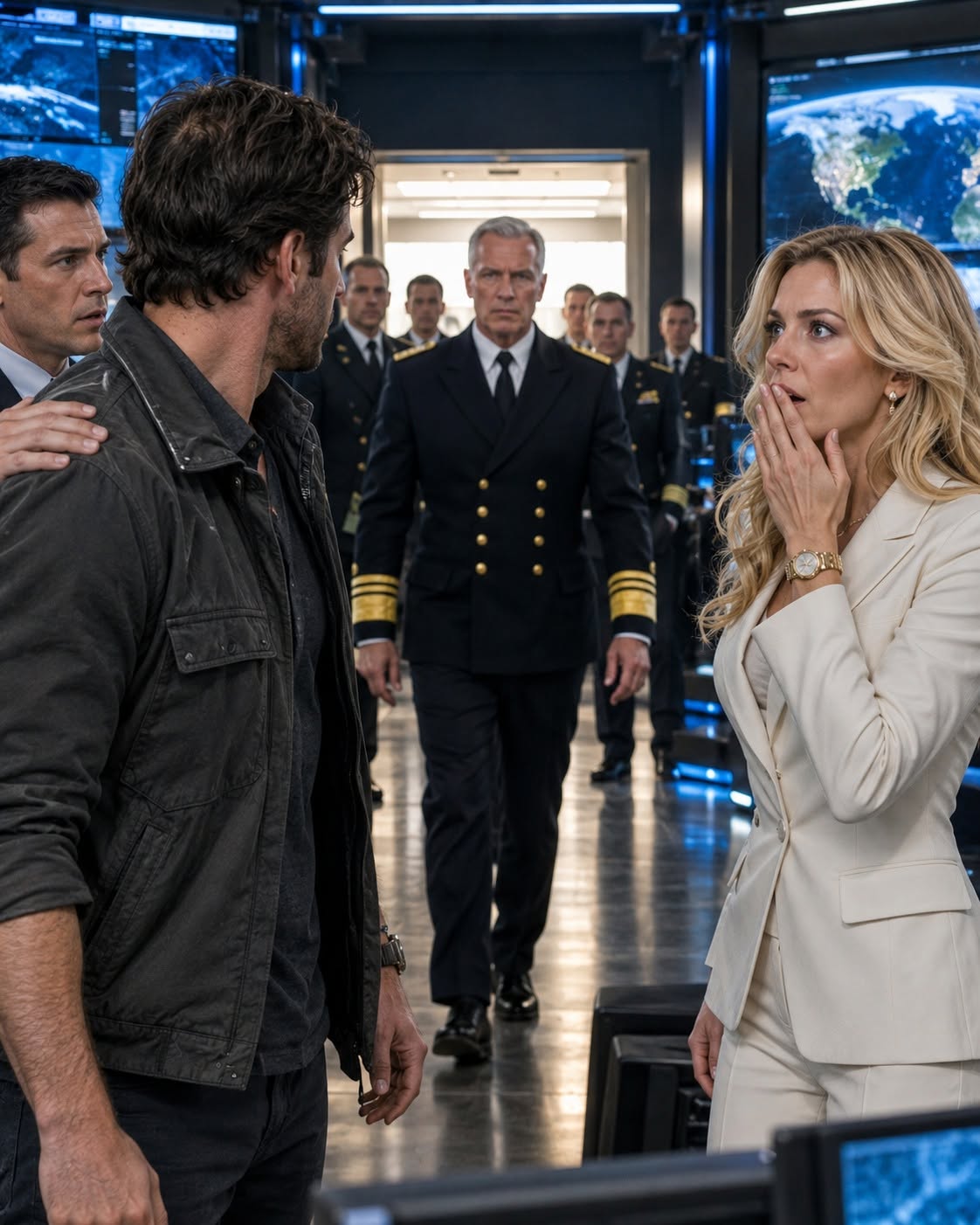
I nodded.
“But I need everyone to follow my instructions exactly. No one touches the secondary console. No one sends another override command. And I need the original diagnostic logs from before the demonstration began.”
Daniel immediately stepped forward.
“That’s impossible. The logs are stored on an isolated engineering server.”
I looked at him.
“Then why is the isolated server communicating with the demonstration network?”
His mouth opened.
Nothing came out.
Victoria turned toward him.
“Daniel?”
He avoided her eyes.
I didn’t have time to investigate his reaction.
“Admiral, I need authorization to place the platform in diagnostic isolation.”
The admiral glanced at his communications officer, who gave a small nod.
“Authorized. Proceed.”
I entered the first command.
The countdown stopped.
For the first time in nearly ten minutes, the room exhaled.
But the system remained unstable.
I studied the data streams, following the sequence of events backward. The synchronization error had appeared at 6:14 that morning. The unauthorized override had followed at 6:19.
Someone had attempted to force the system to ignore the warning.
And the command hadn’t come from the demonstration console.
It had come from an internal administrative account.
I recognized the account identifier immediately.
It belonged to Daniel Mercer.
“That’s not possible,” he whispered when I displayed it.
I turned around.
“You told everyone this morning that the synchronization issue was a harmless display error.”
“It was a preliminary assessment.”
“You approved an override five minutes after the warning appeared.”
“I was trying to keep the demonstration on schedule.”
“By bypassing a safety restriction?”
Daniel’s face reddened.
“You don’t understand the pressure we were under. The board wanted results. The Navy wanted a flawless presentation. We couldn’t shut down the platform over one warning.”
I stared at him.
“One warning is exactly why safety systems exist.”
Victoria looked between us.
“Daniel, did you authorize that override?”
He didn’t answer.
The admiral’s voice cut through the room.
“Mr. Mercer, I suggest you answer.”
Daniel swallowed.
“Yes. But I never intended to damage anything.”
I turned back to the console.
Intentions wouldn’t repair the platform.
I had spent enough years around military systems to understand that the difference between an accident and a disaster was sometimes just one ignored warning.
I opened a separate diagnostic channel.
There it was.
A second process was still running beneath the main synchronization service. It was attempting to rebuild the combat simulation from a corrupted temporary archive.
If it completed, it would overwrite the clean reference data.
I knew what needed to happen.
But it would require something the company’s engineers had repeatedly refused to authorize.
A complete rollback to the last verified system state.
Victoria approached me.
“How long will that take?”
“Approximately six minutes, if the recovery partition is intact.”
“And if it isn’t?”
“Then we lose the demonstration and spend the next several weeks rebuilding the platform.”
Her eyes widened.
“Several weeks?”
I didn’t look away from the screen.
“That’s the price of not taking shortcuts.”
The admiral moved beside me.
“Do what you need to do, Commander.”
I entered the recovery sequence.
The system rejected it.
ACCESS DENIED.
I tried again through the secondary authorization channel.
ACCESS DENIED.
Someone had changed the recovery permissions.
I leaned closer.
That wasn’t an ordinary configuration change. The recovery partition had been deliberately locked from the inside.
“Who has administrator authority over this environment?” I asked.
Daniel said nothing.
Victoria turned toward him.
“Answer him.”
“Three people,” he finally admitted. “Myself, the chief security officer, and the executive systems administrator.”
“Names?”
Daniel gave them.
The third name made me stop.
It belonged to someone I had worked with years earlier.
A man named Richard Hale.
He had once been my commanding officer during a military technology evaluation program.
He had also been the last person I expected to find inside this company.
“Is Richard here?” I asked.
Victoria looked confused.
“He’s our chief technology officer. He was supposed to attend the demonstration, but he called in sick this morning.”
I looked at the authorization record.
The recovery lock had been activated at 6:27.
The command originated from Richard’s office.
That was not a coincidence.
“Admiral,” I said quietly, “I need you to contact your security liaison. Tell them to preserve every access record associated with this platform. Nobody deletes anything.”
The admiral nodded to his communications officer.
Victoria stepped closer.
“What are you suggesting?”
I hesitated.
“I don’t know yet. But someone didn’t just make a mistake. Someone made sure we couldn’t easily correct it.”
Daniel suddenly spoke.
“You’re making this sound like a conspiracy.”
I turned toward him.
“I’m not making it sound like anything. I’m reading the system records.”
A new notification appeared.
REMOTE ADMINISTRATIVE SESSION DETECTED.
The source was outside the building.
Someone was trying to reconnect.
I immediately isolated the external gateway.
The attempt failed.
But before the connection disappeared, a single command reached the platform.
INITIATE FULL DATA PURGE.
For a second, nobody moved.
Then every engineer in the room began speaking at once.
“Kill the process!”
“Disconnect the server!”
“That’s impossible!”
I raised my hand.
“Everyone stop.”
The room fell quiet.
The purge command had not executed.
It was waiting for final authorization.
I checked the originating session.
Richard Hale.
Victoria stepped backward.
“Richard?”
Daniel looked like he might collapse.
I turned toward the admiral.
“I need to know whether the Navy has received any external requests to transfer demonstration data.”
The admiral’s expression changed.
“Why?”
“Because whoever is trying to erase this platform may also be trying to remove evidence of what happened.”
He looked at his communications officer.
“Check immediately.”
The officer left the room.
I returned to the console.
The purge command was still waiting.
I had less than three minutes before its authorization window expired and the system automatically attempted another recovery cycle.
I opened the command history.
There was a detail I hadn’t noticed before.
The purge wasn’t designed to erase everything.
It was designed to erase one specific dataset.
The original combat architecture.
The very dataset that contained the verified synchronization parameters.
Someone wanted the platform to retain the corrupted version.
That changed everything.
I looked at Victoria.
“Your company didn’t just build a system with a dangerous defect. Someone has been trying to replace its verified architecture with an untested version.”
She shook her head.
“Why would anyone do that?”
“That’s what we’re about to find out.”
I entered a command that suspended the purge authorization without activating the damaged recovery process.
Then I opened the protected audit trail.
A file appeared.
It contained dozens of records.
I read the first few lines.
Then I stopped.
There were approval signatures from Daniel.
There were approval signatures from Richard.
And there was one more name.
Victoria’s.
She stared at the screen.
“That can’t be right.”
I turned the display toward her.
The records showed that six weeks earlier, the executive office had approved a proposal to replace the original synchronization architecture with a cheaper commercial package.
The proposal had been labeled as a routine efficiency upgrade.
But the package had never passed the required military validation process.
“Did you approve this?” I asked.
Victoria looked at the documents.
“I approved a budget reduction. I was told the replacement software had already been tested.”
“Who told you that?”
“Richard.”
“And did you read the technical assessment?”
She looked down.
“No.”
Nobody spoke.
The admiral removed his glasses.
“Ms. Victoria, this is a serious matter.”
She nodded slowly.
“I understand.”
I wasn’t interested in humiliating her.
I had seen what happened when executives treated technical warnings as inconveniences. The consequences were rarely confined to the people who signed the paperwork.
“Commander,” the admiral said, “can you restore the original architecture?”
“Yes. But I need to know whether the replacement package has already transferred data outside this environment.”
The communications officer returned.
“Admiral, we found something.”
He handed over a secure tablet.
“An external transfer was initiated at 6:31 this morning. The destination was a private server registered to a subcontractor.”
The admiral read the report.
“Who owns the subcontractor?”
The officer hesitated.
“Richard Hale is listed as its principal beneficiary.”
Victoria’s face went completely still.
Daniel sat down.
For several seconds, the only sound was the steady hum of the server racks.
Then Victoria whispered, “He was going to sell it.”
I shook my head.
“Not necessarily. But he was moving data through an unauthorized channel. That’s enough to justify a full investigation.”
The admiral handed the tablet back.
“Commander, finish securing the system. My people will handle the rest.”
I returned to work.
This time, nobody interrupted me.
I rebuilt the recovery chain using the last verified reference image. I separated the damaged demonstration environment from the protected data repository, then began restoring the original synchronization parameters.
The engineers watched every step.
Some took notes.
Others simply stood there.
Daniel remained seated, staring at his hands.
When the recovery process reached 72 percent, a new error appeared.
REFERENCE VALIDATION FAILED.
I frowned.
That wasn’t supposed to happen.
I opened the recovery manifest.
One of the verification keys was missing.
Without it, the platform couldn’t confirm that the restored architecture matched the original.
I searched the protected archive.
Nothing.
Then I remembered something.
Years earlier, during the original development program, we had designed an independent validation key. It wasn’t stored on the company network. It was kept separately to prevent a compromised administrator from rewriting the entire platform.
I looked at the admiral.
“Do you still maintain the original validation archive from the Navy evaluation?”
He nodded.
“We do.”
“I need the reference signature.”
He turned to his communications officer.
“Contact the evaluation archive. Priority authorization.”
The officer made the call.
I waited.
The recovery process was now at 81 percent, but it could not proceed without the signature.
Two minutes passed.
Then three.
Victoria stood beside the console.
“How much time do we have?”
“Four minutes before the recovery session expires.”
She looked at the admiral.
“Can you get it?”
The admiral didn’t answer immediately.
He was listening to his communications officer.
Finally, the officer turned toward him.
“Sir, the original archive is available. They’re transmitting the validation package through the secure channel.”
I nodded.
“Good. Don’t send anything else.”
A file arrived.
I checked its digital signature.
It matched.
For the first time that afternoon, I allowed myself a small smile.
“All right. Now we can finish.”
I entered the final recovery command.
The screen went black.
Every engineer in the room froze.
Then a single line appeared.
REFERENCE ARCHITECTURE VERIFIED.
The system began rebuilding.
Twenty seconds.
Forty seconds.
One minute.
The red warning indicators disappeared one by one.
Then the main display came back online.
The simulation environment loaded.
The synchronization monitor showed green across every channel.
No corrupted data.
No cascading errors.
No unauthorized processes.
The platform was stable.
Nobody cheered immediately.
I think they were afraid to believe it.
Then the admiral placed a hand on my shoulder.
“Well done, Commander.”
The room erupted in applause.
Not the polite applause of a corporate presentation.
This was different.
These were people who had just watched a system teeter on the edge of failure and come back because one person refused to ignore what the evidence was telling him.
Victoria remained silent.
I closed the diagnostic session and stepped away from the console.
“That’s it,” I said. “The platform is stable, but it needs a full independent security audit before anyone uses it operationally.”
The admiral nodded.
“Agreed.”
He turned toward the executives.
“This demonstration is suspended until the audit is complete. I will not accept a product whose safety warnings can be overridden for the sake of a sales presentation.”
Victoria looked at him.
“Admiral, I understand. But we can explain what happened.”
“You can explain it to the investigators.”
Her shoulders dropped.
The meeting was over.
But the story wasn’t.
As the officers began leaving the control center, Victoria approached me.
“Commander Callan, could I speak with you privately?”
I glanced at the admiral.
He gave a slight nod.
I followed her into the adjoining conference room.
She closed the door.
For the first time since I had met her, she didn’t look like the CEO of a billion-dollar company.
She looked like someone who had just realized how badly she had failed.
“I owe you an apology,” she said.
“You already gave me one.”
“Not the kind you deserve.”
I waited.
She sat down.
“When I saw you this morning, I made a decision based on your appearance and your job title. I didn’t even give you the opportunity to finish explaining the problem.”
“That’s true.”
“I’ve spent years building this company. I thought I understood what made it successful. Growth, contracts, deadlines, investor confidence. I convinced myself that the people who questioned our decisions were slowing us down.”
She looked up.
“And I nearly destroyed the most important contract we’ve ever had because I refused to listen.”
I didn’t immediately respond.
She continued.
“Daniel has been suspended. Richard is being investigated. The board has been notified. But I know none of that changes what happened to you.”
“No,” I said. “It doesn’t.”
She nodded.
“I’d like to offer you your position back. Not as an operations contractor. I want you to lead our independent systems integrity division. Direct access to the board, full authority to stop any deployment that fails its safety requirements, and no more reporting through Daniel.”
I studied her face.
It was a generous offer.
But there was something more important I needed to know.
“Would I have that authority when it becomes inconvenient?”
She blinked.
“What do you mean?”
“I mean the next time I tell you a billion-dollar contract has to be delayed because the system isn’t safe, will you listen? Or will you remove me from the building again?”
She looked down at the table.
Then she answered.
“I can’t promise I’ll always agree with you. But I can promise that your findings will be heard, documented, and independently reviewed. And no one will be punished for raising a legitimate safety concern.”
I considered her answer.
It wasn’t perfect.
But it was honest.
“I’ll think about it.”
She nodded.
“That’s fair.”
When I walked back into the control center, the admiral was waiting.
He handed me a small envelope.
“Something I thought you should have.”
Inside was a photograph.
It showed a younger version of me standing beside a group of military engineers at an evaluation facility almost ten years earlier.
I remembered the day immediately.
It had been the first successful demonstration of the original platform.
The admiral pointed to the photograph.
“That was the day I first saw you solve a problem nobody else could identify.”
I smiled faintly.
“You were there?”
“I was a captain then. I remember asking your supervisor who had designed the recovery architecture. He told me it was some quiet contractor who never wanted credit.”
I looked at the photograph again.
The man standing beside me was Richard Hale.
The admiral noticed my expression.
“There’s something else you should know. Richard was removed from that program after an internal investigation. He had attempted to conceal a failed validation report.”
I looked up.
“Why was he hired here?”
“That’s a question the board and the investigators will have to answer.”
He paused.
“There’s a reason I asked where you were when the demonstration failed. I didn’t just expect you to be here. I specifically requested that you lead the technical evaluation.”
I stared at him.
“You requested me?”
“Six months ago. I was told you had been assigned to the operations team.”
I understood then.
My position at the company had never reflected my actual responsibility.
The Navy had trusted my expertise.
The company had simply never bothered to understand it.
The admiral shook my hand again.
“One more thing, Commander. The Navy has a position available at our independent technology assessment office. If you ever decide you’ve had enough of corporate life, I’d like you to consider it.”
I smiled.
“I’ll keep that in mind.”
He left with his delegation.
I returned to the café later that afternoon.
My coffee cup was still on the table, and the snow had begun covering the sidewalks.
I sat by the window for a while, thinking about everything that had happened.
My phone buzzed.
It was a message from an unknown number.
I heard what happened. You should have kept your head down. People who make trouble don’t last long.
I read it twice.
Then I forwarded it to the admiral’s security officer.
I had learned a long time ago that threats weren’t something to answer emotionally.
They were something to document.
The following weeks were difficult.
The company launched an internal investigation. Federal authorities examined the unauthorized data transfer, the altered recovery permissions, and the false validation reports.
Daniel admitted that he had bypassed the safety warning under pressure from Richard. He claimed he hadn’t known about the planned data transfer.
The investigators eventually confirmed that Richard had created a private consulting company and had been attempting to obtain control of the original combat architecture.
He had planned to sell access to a modified version of the platform through an overseas intermediary.
The investigation also uncovered years of misleading internal reports.
Several engineers had raised concerns before me.
Their warnings had been buried.
Some had been reassigned.
Others had resigned.
And one had been dismissed after refusing to approve an earlier version of the same software.
Victoria had signed off on several executive summaries without reading the technical findings attached to them.
She wasn’t the mastermind behind the scheme.
But she had helped create the environment in which it could happen.
That distinction mattered.
It didn’t excuse her.
The board eventually placed her on administrative leave while an independent review examined her decisions.
Richard was arrested after investigators established that he had knowingly attempted to transfer restricted technical information and destroy records connected to the unauthorized modification.
Daniel cooperated with the investigation.
He lost his position and faced professional consequences.
As for me, I declined Victoria’s first offer.
Not because I wanted revenge.
I simply didn’t want another title that sounded impressive while leaving me powerless when it mattered.
Instead, I accepted the admiral’s invitation to join an independent military technology assessment office.
My role was to review critical systems before they were approved for operational use.
I would have the authority to raise safety concerns without needing permission from the people selling the technology.
It was exactly the kind of work I had wanted to do for years.
Three months later, I received a letter from Victoria.
It wasn’t a corporate invitation.
It wasn’t a job offer.
It was handwritten.
She wrote that the investigation had forced her to reconsider the way she ran the company. She had begun meeting with engineers directly, and she had created an independent safety committee with authority to stop projects regardless of their commercial value.
She also wrote something that stayed with me.
I used to think leadership meant having the final word. Now I understand that sometimes leadership means knowing when not to speak.
I folded the letter and put it in my desk.
A few weeks later, I was invited to attend the company’s first independent safety review.
I almost declined.
But something made me go.
The conference room was different now.
The executive table had been rearranged. Engineers sat beside directors. Safety reports were displayed openly, and every concern had to be addressed before a project could proceed.
Victoria was there.
She wasn’t the CEO anymore.
The board had accepted her resignation after the investigation, but she had remained with the company as an adviser during its restructuring.
When she saw me, she stood.
“Commander Callan. Thank you for coming.”
I shook her hand.
“How are things?”
“Slower,” she said with a small smile. “More complicated. And considerably more honest.”
I looked around the room.
A young engineer was presenting a report. His voice shook slightly as he described a flaw he had discovered in a new subsystem.
One of the senior executives interrupted.
“That’s a minor issue. We can address it after the next milestone.”
Victoria raised her hand.
“Let him finish.”
The engineer continued.
He explained the problem, showed the test results, and recommended delaying the release.
The room listened.
When he finished, Victoria asked one question.
“What do you need to prove your concern?”
The engineer looked surprised.
“Another two days of testing.”
“Then you have two days.”
The meeting moved on.
I watched her for a moment.
She noticed me looking.
After the meeting, she approached.
“I hope you saw that.”
“I did.”
“I can’t undo what happened that morning,” she said. “But I can make sure the next person who raises a warning isn’t treated the way you were.”
I nodded.
“That’s a better way to measure success.”
She smiled faintly.
Before I left, she handed me a copy of the company’s new safety charter.
At the top was a sentence printed in bold:
No deadline, contract, promotion, or executive decision is more important than the people who depend on our systems working safely.
I read it twice.
Then I handed the document back.
“Make sure it stays that way when the next billion-dollar contract is on the table.”
“I will,” she said.
Outside, the weather was clear.
I walked down the steps and stopped beside the parking lot.
My old gray jacket was still the same one I had worn the morning security escorted me out.
The cuffs were frayed.
The zipper stuck sometimes.
And the left pocket still had a small tear.
I had considered replacing it several times.
But I never did.
Not because I wanted to remember the humiliation.
Because I wanted to remember what happened afterward.
I had walked into that building with a warning that nobody wanted to hear.
I had walked out without a badge, without a title, and without anyone defending me.
Yet the truth hadn’t changed simply because someone powerful refused to acknowledge it.
And when the moment came, the system didn’t care who had the biggest office, the most expensive suit, or the loudest voice.
It only cared whether someone understood the problem well enough to fix it.
A month later, the admiral invited me to a small ceremony at the Navy’s technology assessment center.
I assumed it was a routine appointment.
Instead, he presented me with a civilian service award for exceptional technical contribution and professional integrity.
I wasn’t particularly comfortable standing in front of a room full of people.
But when he handed me the certificate, he said something I would never forget.
“Most people think courage is the willingness to walk into danger. Sometimes, Commander, courage is the willingness to tell powerful people that they’re wrong, even when you know they can make your life difficult.”
I looked around the room.
There were young engineers, military officers, researchers, and contractors.
People who spent their lives building things that others would eventually depend on.
I thought about the young engineer at Victoria’s meeting.
I thought about the warnings that had been buried for years.
And I thought about the morning I had been told that I wasn’t qualified to understand the system I had helped build.
When the ceremony ended, a young technician approached me.
“Sir, can I ask you something?”
“Of course.”
“What should someone do when they know something is wrong, but nobody important wants to listen?”
I considered the question.
Then I answered.
“First, make sure you’re right. Document what you find. Explain the risk clearly. Give people every reasonable opportunity to understand it. And if they still refuse to listen, don’t let their authority convince you that the facts have changed.”
He nodded.
I continued.
“But remember something else. Being right doesn’t give you permission to be careless. Protect the people who depend on your work. That’s the reason you’re speaking up in the first place.”
He thanked me and walked away.
I watched him disappear into the crowd.
For years, I had believed that doing good work quietly was enough.
I thought that if I stayed professional, avoided politics, and focused on solving problems, people would eventually recognize the value of what I did.
That day taught me something different.
Integrity isn’t just about doing your job correctly.
It’s also about refusing to let other people turn silence into a substitute for responsibility.
And leadership isn’t measured by how many people stand when you enter a room.
It’s measured by what you do when the person standing in front of you has something important to say.
Victoria had once looked at my old gray jacket and decided I didn’t belong in her building.
Twenty minutes later, a four-star admiral had walked into her office and asked where I was.
She had thought my lack of a prestigious title meant I had nothing important to contribute.
But the real lesson wasn’t that I had secretly held a powerful position.
It was that my warning had been valid before the admiral arrived.
My knowledge had mattered before anyone discovered my military background.
And the system had needed fixing whether or not the CEO respected the person pointing out the flaw.
I still keep that old jacket.
Sometimes, when I put it on, I remember the snow falling outside that little café.
I remember the frozen screens, the frantic engineers, and the silence that followed the admiral’s question.
But most of all, I remember the choice I made when Victoria asked me to come back.
I could have walked away and let the company face the consequences of its own arrogance.
Instead, I returned because innocent people would eventually depend on that technology.
That was the difference between proving someone wrong and doing what was right.
And if there’s one thing I hope people remember from my story, it’s this:
Never measure someone’s value by their appearance, their job title, or how quietly they carry themselves. The person you dismiss today may be the very person whose knowledge, honesty, and courage you desperately need tomorrow.
Sometimes, the most important voice in the room belongs to the person nobody thought to listen to.