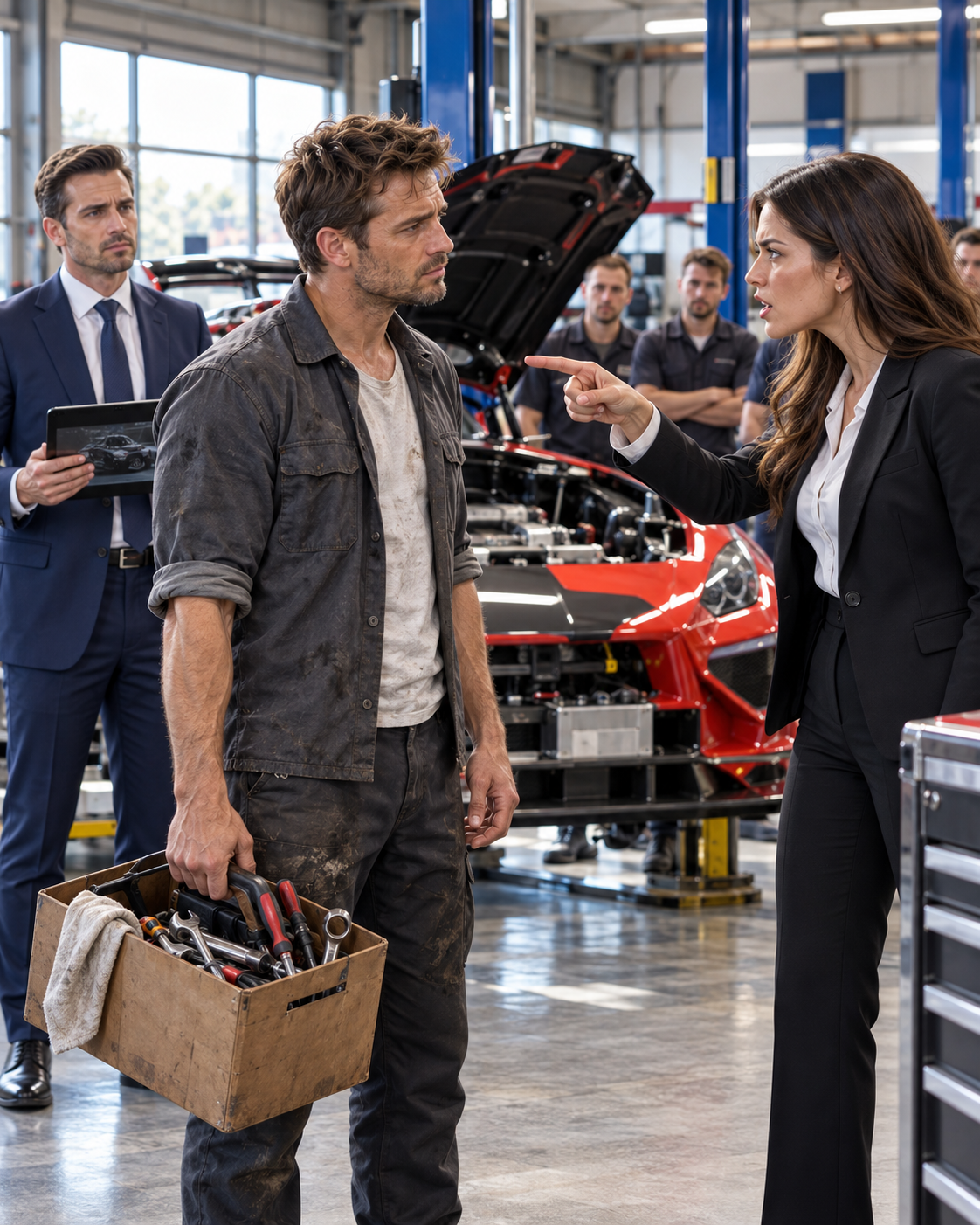
The CEO of Vortex Motorsport fired me in front of twenty engineers for touching a $12 million race car
Evelyn stood in my doorway as though she had rehearsed a hundred different speeches on the drive over and forgotten every one of them the moment she saw my daughter’s small shoes scattered across the floor.
Behind her, the black sedan idled at the curb, its polished surface reflecting the cracked sidewalk and the old apartment building I had spent years trying to make feel like home.
I kept one hand on the door.
“Did you come to fire me again?”
Her face tightened.
“No.”
“Then I assume this isn’t about the toy car.”
Luna looked up from the floor, holding a tiny plastic wheel between her fingers.
“Daddy, is that the lady from your old job?”
Evelyn glanced at her, and something in her expression softened.
“Yes,” she said. “I am.”
Luna considered her for a moment.
“Did you make my daddy sad?”
The question landed harder than any accusation I could have made.
Evelyn lowered her eyes.
“Yes,” she answered. “I think I did.”
I had expected excuses, perhaps an offer of money, maybe a carefully worded apology designed to protect the company.
I hadn’t expected her to answer a six-year-old honestly.
I stepped aside.
“Come in.”
She entered cautiously, looking around the small living room where a secondhand sofa faced a television that worked only when the cable was held at a certain angle.
On the refrigerator hung Luna’s drawings, most of them featuring three people holding hands beneath an enormous yellow sun.
Sarah was still there in those drawings, even though Luna had been too young to remember much about her mother.
I kept the pictures because I was afraid that if I stopped displaying them, the world might forget Sarah had ever existed.
Evelyn noticed a framed photograph on the bookshelf.
Sarah was laughing in it, her hair blowing across her face, one hand resting on my shoulder while I pretended to look annoyed.
“She was beautiful,” Evelyn said quietly.
“She was.”
“I am sorry.”
I looked away.
People had offered me sympathy for years, and most of them meant well.
But grief did not become smaller simply because someone acknowledged it.
Evelyn placed the folder on the coffee table.
“I found your original designs in my father’s private archive. I also found the letter you sent him before you left.”
My chest tightened.
“Richard kept that?”
“He kept everything.”
She opened the folder and revealed a set of aging engineering drawings, their edges softened by time.
I recognized the handwriting immediately.
Mine.
There were calculations in the margins, diagrams of the original combustion architecture, and the small symbol I used to mark a component that had been tested beyond its expected operating limits.
For a moment, I could almost smell the old workshop, the hot metal, the burnt coffee, and the rain coming through the broken roof.
Then I saw the contract amendment.
Cameron’s signature was at the bottom.
I felt the old anger rise, sharp and familiar.
“He told your father he had developed the architecture,” Evelyn said. “He used your disappearance to make the transfer appear legitimate.”
“Richard knew?”
“He suspected. He was already seriously ill when the final paperwork came through. He tried to challenge it, but Cameron controlled the internal records and convinced the board that reopening the matter would destroy the company’s credibility.”
I stared at the document.
“Your father promised me he’d protect the work.”
“He did,” she replied. “He kept your original drawings and the letter that explained why you left. But he failed to stop Cameron from taking control of the story.”
She paused.
“And I failed you again by trusting the version of that story I inherited.”
I looked at her carefully.
“Why are you telling me this now?”
“Because I found the evidence, and because you deserved to know the truth before anyone asked you to return.”
The word return seemed to hang in the room.
I had spent ten years building a life that did not depend on Vortex, Richard Vance, or anyone’s recognition.
I had learned to repair machines without needing people to know who had designed them.
I had learned to be Luna’s father without being the man I had once planned to become.
I had learned to survive.
“I don’t want my old job back,” I said.
Evelyn nodded slowly, as though she had expected the answer.
“I understand.”
“No, you don’t.”
My voice came out harder than I intended.
“You have a company with lawyers, security, private offices, and a board that listens when you speak. I have a daughter who asks whether I’m good enough because she saw me come home carrying a box of my things. I don’t get to treat this as an interesting business dispute.”
Evelyn absorbed every word without interrupting.
“You’re right,” she said. “I don’t know what it’s like to lose what you lost.”
Her eyes moved to the photographs on the refrigerator.
“But I can stop pretending that your work belongs to someone else.”
Luna tugged at my sleeve.
“Daddy, can I show her my car?”
I looked at the broken toy in her hands.
“Of course.”
She carried it to Evelyn, who crouched beside her without hesitation.
“The wheel keeps falling off,” Luna explained. “Daddy says the little piece inside is broken, but he can fix it.”
Evelyn studied the toy as though it were a championship machine.
“What do you think is wrong with it?”
Luna pointed to the axle.
“It’s supposed to hold the wheel straight, but it keeps slipping.”
Evelyn smiled faintly.
“That sounds like a difficult problem.”
“Daddy fixes difficult problems.”
I felt something twist behind my ribs.
Evelyn looked up at me.
“Yes,” she said softly. “I think he does.”
After she left, I sat beside Luna until she fell asleep.
The folder remained on the coffee table.
I didn’t open it again that night.
I knew what the drawings meant, and I knew what Cameron had taken.
But I also knew how easily a man could become trapped by the thing he once loved.
When Sarah died, I had been halfway through developing the engine architecture that would eventually define Vortex’s entire GT series.
I had spent months chasing a solution to a thermal instability that caused power to collapse under sustained high loads.
The breakthrough came on a night when Sarah brought dinner to the workshop and found me asleep beneath a drafting table.
She had placed a sandwich beside my hand and drawn a small smiley face on the corner of my notes.
“You’re going to change the world,” she had whispered when she thought I was still asleep.
I had opened one eye.
“I’d settle for changing this engine.”
She laughed.
“Then start with that.”
The next morning, she left for work.
She never came home.
The accident happened on a wet stretch of highway, and the phone call arrived while I was reviewing test data.
I remembered the words but not the face of the person who spoke them.
After the funeral, I returned to the workshop and found the sandwich wrapper still tucked inside my notebook.
I couldn’t bring myself to touch the engine.
Every diagram reminded me of the life I had expected to share with Sarah.
Every successful test felt like a celebration she would never see.
So I walked away.
I gave Richard the designs, told him to protect them, and disappeared before anyone could convince me that work was a substitute for mourning.
Luna was born the following year.
For a while, I couldn’t even look at her without remembering everything Sarah had lost by not being there.
Then Luna wrapped her tiny hand around my finger, and I understood that love had not ended.
It had simply become a responsibility I could not abandon.
I took whatever work I could find.
I repaired heating systems, maintained industrial equipment, and fixed broken machinery in garages where nobody asked about my past.
When Vortex offered me a maintenance position, I accepted because the pay was steady and the benefits covered Luna’s medical visits.
I never imagined I would stand beside my own engine again.
The following afternoon, Dominic called.
I nearly let the phone ring out.
Then I answered.
“You’re on speaker,” he said. “Evelyn is here.”
I heard papers moving in the background.
“Claire told me you found the archive,” I replied.
“I did,” Evelyn said. “And I need to tell you something else.”
I waited.
“The board has called an emergency meeting. Cameron claims your work on the GT7 was an unauthorized alteration that exposed the company to enormous liability.”
I laughed without humor.
“Of course he does.”
“He is trying to make the issue about the repair rather than the stolen designs. He says the original drawings were preliminary concepts and that the current engine was developed independently.”
“Can he prove it?”
“He has technical reports, patent filings, and years of company records on his side.”
“And you have my original drawings.”
“Yes, but I need more than a signature and an old letter. I need someone who can explain the architecture, the development history, and how the original design connects to the GT7.”
I looked toward Luna’s bedroom.
She was sleeping after a long day at school, one hand still wrapped around the little toy car I had repaired.
I had promised myself I would never let Vortex take over our lives again.
But Cameron had turned my disappearance into a weapon, and his deception had affected everyone who had worked honestly to build the company.
“I won’t go back to work for you,” I said.
“I am not asking you to.”
“Then what are you asking?”
“To tell the truth.”
I closed my eyes.
That, at least, was something I could do.
“I’ll attend the meeting,” I said. “But I’m not coming to save your company. I’m coming to make sure nobody can erase what happened.”
“I understand.”
“And Luna stays out of it.”
“Of course.”
I ended the call and looked at the folder again.
For the first time in ten years, I opened the letter I had sent Richard.
The handwriting was hurried, the paper creased from being folded and unfolded.
I had written that I could no longer bear to work on the engine, that I needed time to become a father before I could think about being an engineer again, and that I trusted him to protect the truth until I was ready to face it.
At the bottom, Richard had written a note in blue ink.
You don’t owe the world your brilliance, Daniel. But one day, when you are ready, don’t let grief convince you that your gifts died with Sarah.
I sat there for a long time.
I had spent years believing that leaving Vortex was the only way to keep Sarah’s memory safe.
Maybe I had confused protecting her memory with protecting myself from pain.
The next morning, I arrived at Vortex Motorsport’s headquarters carrying the folder and wearing the same plain jacket I used for school meetings and grocery shopping.
The lobby had changed.
The walls displayed championship photographs, trophies, and enormous images of the GT series cars.
At the center stood the GT7, polished and silent, its second-place trophy resting nearby.
People moved through the lobby, speaking in low voices about the board meeting.
When I approached the reception desk, the receptionist looked up and froze.
“Mr. Bennett?”
“Yes.”
She stood so quickly that her chair rolled backward.
“Ms. Vance is expecting you.”
Word spread faster than I could walk.
Engineers who had ignored me in the workshop turned from their conversations.
One young technician stared at my hands, then at the engine display.
Dominic waited outside the conference room.
He looked as though he had not slept.
“You don’t have to do this,” he said.
“I know.”
“Cameron has been telling everyone you deliberately interfered with the car to embarrass the engineering team.”
“Then let’s give everyone a chance to examine the evidence.”
Dominic nodded and opened the door.
Inside, Evelyn sat at the head of the table.
Cameron stood beside a large screen displaying the GT7’s engine specifications.
Several board members watched me enter with open curiosity.
Cameron smiled.
“Here comes the maintenance worker who believes he invented our flagship engine.”
I placed the folder on the table.
“No,” I said. “Here comes the person who actually did.”
The room fell silent.
Cameron’s smile faded.
Evelyn motioned for me to sit, but I remained standing.
“I want the original design history examined independently,” I said. “I want the patent records compared with the dated drawings, and I want the people who worked on the original engine allowed to speak without pressure.”
One board member frowned.
“That could take months.”
“It took ten years for the truth to reach this room. I don’t think another week of honest work will destroy you.”
Cameron stepped forward.
“These drawings are meaningless without the company’s subsequent development. The GT7 is the product of hundreds of engineers, not one man’s old sketches.”
“That’s true,” I replied.
He looked surprised.
“The engineers who refined the GT7 deserve credit for their work. The manufacturing teams deserve credit for building it. The mechanics deserve credit for keeping it running. None of that makes it acceptable to erase the person who created its original architecture.”
I opened the folder and laid the drawings beside the current engine specifications.
Then I explained the original design, the thermal instability we had encountered, and the structural changes that allowed the engine to maintain performance under sustained load.
I described the prototype failures, the revised cooling channels, and the relationship between the original injection system and the later GT series.
I did not claim to have designed every component.
I did not pretend the GT7 would have existed in its current form without the engineers who had developed it after I left.
I simply showed how the architecture had evolved from my original work.
The technical director leaned forward, examining the diagrams.
“Can you explain the secondary seal specification?”
I pointed to the marked section.
“The original ring was selected for its behavior under sustained heat and pressure. The replacement introduced a small instability that became significant only during extended high-load testing.”
He studied the notes.
“That would explain the intermittent fuel pressure fluctuations.”
“It would explain them if the test data confirms the same failure pattern.”
The room became quiet again.
The technical director looked at Evelyn.
“I want an independent review.”
“Approved,” she said.
Cameron slammed his palm against the table.
“This is absurd. You cannot hand control of a multibillion-dollar company to a man who walked away a decade ago.”
“No one is handing me control,” I replied.
I turned toward him.
“You’re the one who made this about control. I came here to correct the record.”
Evelyn stood.
“The company will preserve all relevant records and cooperate with an independent review. Cameron, your access to the engineering archives is suspended pending the investigation.”
His face reddened.
“You can’t do this.”
“I can,” she said. “And I should have done it sooner.”
Cameron looked around the room, searching for someone who would defend him.
No one spoke.
For the first time, he appeared to understand that the story he had controlled for ten years was no longer his to tell.
The independent review began that afternoon.
Original prototypes were examined, patent histories compared, and former engineers contacted.
Several recalled the young designer who had spent nights testing an engine that kept failing.
One former technician still had a photograph of me beside the first running prototype, my hair covered in dust and my face bright with exhaustion.
The date matched the original drawings.
A retired accountant produced correspondence showing that Richard had questioned the transfer of intellectual property years earlier.
Another file revealed that Cameron had repeatedly described the design as his own while keeping the original authorship records out of the board’s standard archive.
The evidence did not prove every suspicion anyone had raised about his motives, but it established a clear pattern of misrepresentation and concealment.
When the preliminary findings were presented, the board removed Cameron from his executive position and referred the intellectual property dispute for formal legal review.
Vortex issued a statement acknowledging my original contribution to the GT architecture and promising a transparent process to determine appropriate credit and compensation.
I read the statement on my phone while sitting in the parking lot.
There was no sudden feeling of triumph.
No music played.
No crowd gathered to applaud.
I thought about the years I had spent maintaining other people’s machines while the company built an empire around my work.
I thought about the people who had developed the GT series after I left, and about the engineers whose names had also been overlooked in the rush to celebrate a single executive.
Most of all, I thought about Sarah.
She had believed in my work before it had become valuable.
She had never cared whether the world knew my name.
She had cared that I loved what I was doing and that I remembered to come home.
I put the phone down and drove to Luna’s school.
She came running toward me with a drawing in her hand.
“Daddy! We made cars today!”
I knelt to look at it.
Her drawing showed a bright red race car with enormous wheels and a driver who looked suspiciously like a smiling stick figure.
Across the top, she had written, MY DAD FIXES THINGS.
I swallowed hard.
“That’s a pretty amazing car.”
She grinned.
“It’s the fastest in the world.”
“Is it?”
“No,” she admitted. “But it has the best driver.”
I laughed and lifted her into my arms.
For the first time in years, the future did not feel like something I had to defend against.
It felt like something I might actually build.
The weeks that followed brought difficult negotiations, legal meetings, and more attention than I wanted.
Vortex offered compensation for the misuse of my intellectual property and proposed a formal engineering role.
I declined the executive title the board suggested.
I had no desire to spend my days in glass offices or become a symbol in someone else’s corporate redemption story.
Instead, I proposed something different.
I wanted an independent engineering development group within Vortex, with clear authorship records, fair recognition for collaborative work, and a training program for young technicians who had the skill but not the credentials to get through the door.
I wanted mechanics to be invited into design reviews when their hands-on experience could help solve a problem.
I wanted engineers to be able to challenge a senior executive without risking their livelihoods.
And I wanted a schedule that allowed me to pick Luna up from school.
Evelyn listened to every condition.
Then she agreed.
“You could ask for much more,” she said.
“I am asking for what matters to me.”
She looked through the glass wall toward the workshop.
“My father used to say that the best engineers were the ones who remembered the people who would live with their decisions.”
“Then he understood more than most executives.”
She smiled faintly.
“He would have liked you saying that.”
“I think he knew me well enough already.”
The new program opened three months later.
I returned to the workshop, not as a maintenance mechanic who had to hide his past, but as an engineer responsible for helping a team build better machines.
Dominic was the first person to greet me.
He shook my hand, then pulled me into a rough embrace.
“Welcome home,” he said.
The word struck me unexpectedly.
Home.
I had spent so long believing that home was a place I had lost when Sarah died.
But home was not only the house where her photographs hung.
It was the place where I could work without pretending I was someone else, where Luna could see that her father had a life beyond survival, and where the memory of Sarah could exist without turning every dream into a source of pain.
On my first day, a young technician brought me a drawing of a cooling assembly.
“I think this part could be improved,” he said nervously. “But the senior team rejected it.”
“Why?”
“They said it wasn’t worth testing.”
I studied the diagram.
It was rough, but the idea had promise.
“Have you tested it?”
“No.”
“Then neither of us knows whether it works.”
His shoulders relaxed.
I pulled a chair beside him.
“Show me what you were thinking.”
Across the room, an engineer watched us and began to approach.
For a moment, I saw the old workshop as it had been ten years earlier, full of impossible ideas and people trying to prove they belonged.
Then I looked at the young technician’s face and recognized something I had once seen in my own reflection.
Hope, mixed with the fear of being dismissed.
I knew then that the most important thing I could leave behind was not an engine, a trophy, or a name on a patent.
It was a place where the next person with a good idea would be allowed to finish the sentence.
Months later, the GT team invited me to stand beside the car before its next major race.
The bodywork gleamed beneath the workshop lights, and the engine gave a low, steady growl during its final systems check.
Evelyn stood beside me.
“Do you ever wish you had stayed?” she asked.
I thought about the years I had missed, the grief I had carried, and the daughter waiting at home for me to read her a bedtime story.
“No,” I said. “I wish I had learned sooner that walking away was not the same as healing.”
She nodded.
“And now?”
I watched the engineers gather around the car, arguing about small details with the intensity of people who cared deeply about getting them right.
“Now I know I can love the work without sacrificing everything else.”
That evening, I arrived home to find Luna waiting at the door with her toy car.
She had painted it red and attached a small paper number to its side.
“It’s ready for the race,” she announced.
I crouched beside her.
“Does it need anything else?”
She considered the car seriously.
“A driver.”
I picked up the toy and placed it in her hand.
“Then I think you’re ready.”
She raced it across the living-room floor, laughing as it rolled beneath the sofa.
I watched her crawl after it, her hair falling across her face in a way that reminded me so sharply of Sarah that I had to close my eyes.
For years, I had believed the best way to honor my wife was to keep moving, keep providing, and never let grief slow me down.
Now I understood that honoring her also meant allowing myself to be happy.
It meant letting Luna see that a person could lose something precious and still build a meaningful life afterward.
It meant remembering that our worth was not measured by the titles other people gave us, or by the credit they withheld, or by how loudly the world applauded our achievements.
Our worth was visible in what we created, how we treated people, and whether we made room for others to become more than the world expected of them.
The next morning, I returned to the workshop and found the GT7 waiting beneath the lights.
A small plaque had been placed beside the original engine display.
It read: ORIGINAL ARCHITECTURE BY DANIEL BENNETT, DEVELOPED THROUGH THE WORK OF MANY.
I ran my fingers along the edge of the plaque.
For the first time, my name appeared where it belonged, without erasing the people who had carried the work forward.
I thought of Richard, who had preserved the evidence.
I thought of Evelyn, who had finally chosen the truth over convenience.
I thought of Dominic, who had recognized me when I was trying to disappear.
And I thought of Sarah, who had believed in a dream before the world could assign it a price.
I could almost hear her laugh beneath the sound of the engine.
Then my phone vibrated.
It was a message from the engineering team.
They had discovered an unusual vibration in the next-generation prototype, one that appeared only under a specific combination of temperature and load.
The senior engineers had already proposed several explanations, but none matched all the available data.
I read the report twice.
Then I smiled.
Somewhere inside that machine was a problem waiting for someone to notice the detail everyone else had overlooked.
I put my phone away, rolled up my sleeves, and walked toward the workshop.
This time, I did not have to hide who I was.
And this time, I knew exactly why I had come back.