The CEO of Sterling Motors watched her arrogant chief engineer laugh at my worn-out boots and threaten to throw my six-year-old
For several seconds, I said nothing.
The morning sun fell across my kitchen table, illuminating Isaac’s abandoned cereal bowl and a small plastic wrench he had left beside it.
Everything around me looked ordinary.
Yet Evelyn’s words had opened a door to a life I had spent years trying to leave behind.
“Send me the access log,” I said.
“I already have.”
“And don’t touch the car.”
“Jason wants to move it to the exhibition hall.”
“Tell him no.”
A pause followed.
“Daniel, he says you have no authority over our vehicle.”
“Then tell him the person who got it running has advised against moving it until we understand what happened.”
Evelyn exhaled sharply.
“I’ll handle Jason.”
When the call ended, I opened the file she had sent.
The access had occurred at 7:12 p.m. Wednesday, several hours before I arrived at the showroom to collect my parts order.
The credentials belonged to Maurizio Rinaldi, the Italian engineer whose acoustic modifications had made the Miura one of the most distinctive examples of its kind.
Rinaldi had died seven years earlier.
I knew because I had attended his memorial in Modena, standing beside the people who had spent decades protecting his designs.
I had also helped secure his final technical archives.
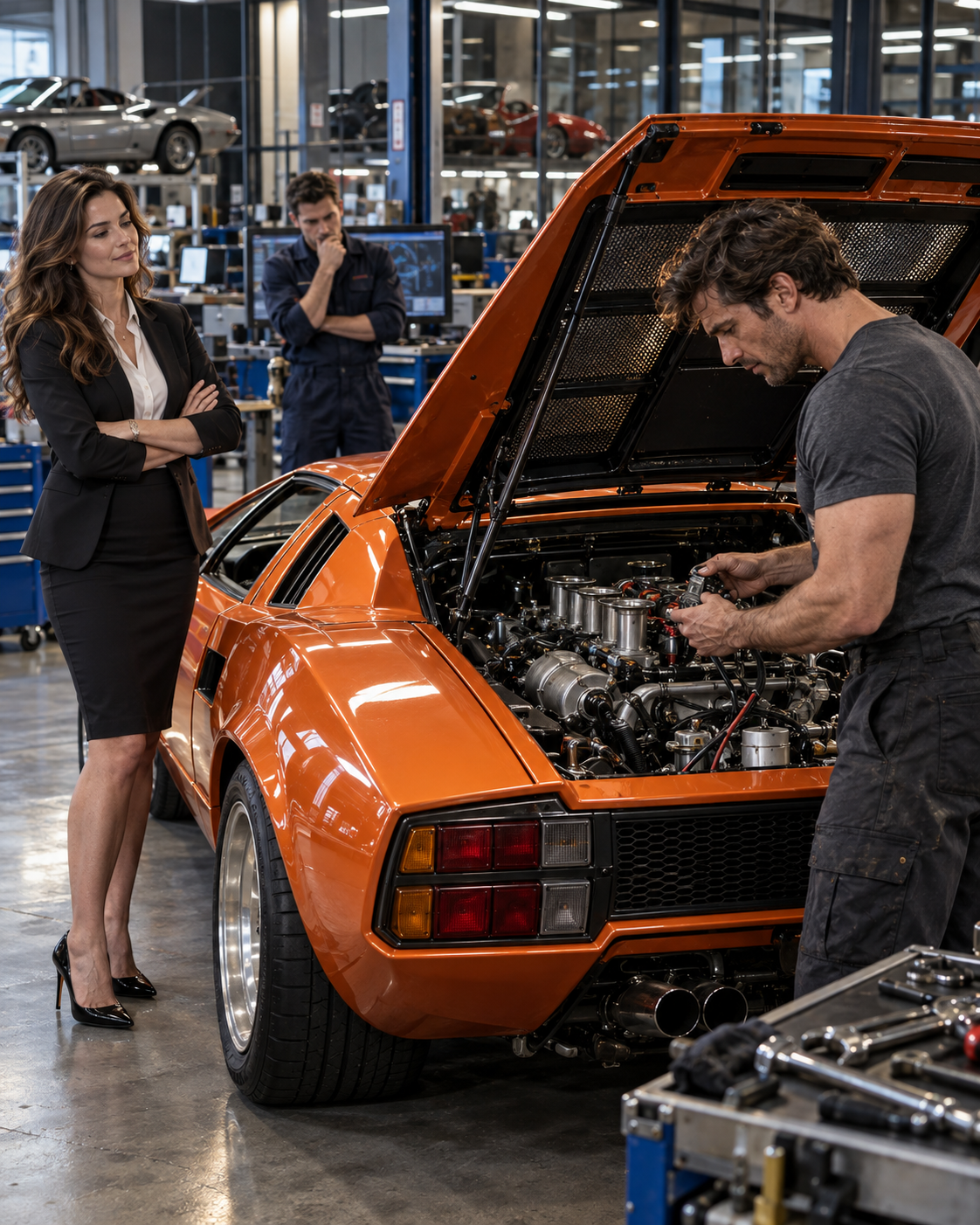
Those credentials were not supposed to exist outside a sealed legacy system.
Someone had accessed the records using an identity that should have been impossible to use.
And they had done it shortly before the engine failed.
I called Evelyn back.
“Was anything missing from the car?”
“Not according to the inventory.”
“Any unauthorized repairs?”
“Jason says his team performed a routine inspection.”
“That’s not what I asked.”
Silence.
Finally, she admitted that a technician had removed a protective panel and reinstalled it the previous afternoon.
The technician had reported nothing unusual.
“What’s his name?” I asked.
“Evan Price. He’s one of Jason’s senior specialists.”
I wrote it down.
“Don’t accuse him of anything yet. Get the work order, the access logs, and the security footage.”
“You think someone sabotaged the car?”
“I think someone accessed a restricted system, and the engine developed a problem after an inspection. That’s enough reason to ask questions.”
I glanced toward the living room, where Isaac was drawing a picture of a red race car.
“I’m not coming back until I know this won’t turn into an endless mess.”
Evelyn’s voice softened.
“I understand.”
I wasn’t sure she did.
People who built their lives around expensive machines often believed every problem could be solved by throwing enough money at it.
My experience had taught me that the most dangerous failures were the ones people refused to admit existed.
That afternoon, I picked Isaac up from school and took him to the park.
He ran across the grass with a paper airplane while I sat on a bench, trying to keep my mind away from Sterling Motors.
Then he returned and climbed beside me.
“Dad, why do you look sad?”
I brushed a strand of hair from his forehead.
“I’m thinking about work.”
“Did the car break again?”
“No. I think the car is fine.”
“Then why are you worried?”
I searched for an answer a six-year-old could understand.
“Sometimes, when something strange happens, you have to figure out whether it’s an accident or whether somebody did it on purpose.”
Isaac considered this.
“Like when someone breaks your toy and says they didn’t?”
I laughed softly.
“Exactly like that.”
He held up his red toy toolbox.
“If somebody breaks something, we should fix it.”
“Sometimes,” I told him. “But first we need to find out what happened.”
That evening, Evelyn sent me the records.
The inspection report showed that Evan Price had removed the protective panel at 6:41 p.m. Wednesday.
The panel was designed to shield a delicate part of Rinaldi’s custom acoustic assembly from heat transfer and vibration.
When I had examined the engine, I had found evidence that the isolation plate had been displaced during an earlier check.
The report, however, claimed the panel had been removed only to inspect an electrical connector.
The security footage showed Evan entering the service bay carrying a narrow black case.
He left twenty-three minutes later.
There was no footage of him touching the isolation plate, but the camera’s angle left the lower section of the engine obscured.
I watched the recording twice.
On the second viewing, I noticed something else.
As Evan exited, he glanced toward the ceiling camera, stopped, and adjusted his jacket.
It was an ordinary movement.
But he had done it at precisely the moment the camera’s recording skipped three frames.
I called Evelyn.
“Your security system has a blind spot.”
“It’s an old camera.”
“Someone knew where it was.”
She was quiet for a moment.
“What do you want to do?”
“Ask Evan what he inspected. Don’t tell him what we suspect, and don’t let Jason conduct the interview.”
“Jason won’t like that.”
“Then he can dislike it somewhere else.”
The next morning, Evelyn arranged a meeting in her private conference room.
I arrived wearing the same work jacket I had worn the night before, with my old diagnostic notebook tucked beneath my arm.
Jason was already there.
He looked as though he had spent the night rehearsing an argument.
“This is getting ridiculous,” he said. “The engine is running, the exhibition is tomorrow, and we’re allowing an outsider to interfere with internal procedures.”
Evelyn remained standing.
“Daniel is here because he identified a fault your entire department missed.”
“A fault that may have been caused by his own repair.”
I looked at him.
“If you believe I damaged the engine, produce the measurements from before and after my work.”
He opened his mouth, then closed it.
“I don’t have them.”
“Then you have no evidence.”
Evelyn gestured toward a chair.
“Sit down, Jason.”
He remained standing for another second before obeying.
Evan Price entered shortly afterward.
He was in his early thirties, with tired eyes and a habit of pressing his thumb against the side of his index finger.
Evelyn asked him to describe the inspection.
He explained that he had checked the electrical connector and found nothing unusual.
“Did you remove the acoustic isolation assembly?” I asked.
“No.”
“Did you open your black case?”
His eyes flickered toward Jason.
“I don’t remember.”
“You were inside the service bay for twenty-three minutes. You remember what you did.”
Jason leaned forward.
“This questioning is inappropriate.”
Evelyn’s voice sharpened.
“Then you can leave.”
He stared at her.
For years, he had apparently assumed that the authority attached to his position was permanent.
Now, for the first time, he seemed to realize that she could take it away.
He sat back.
I placed a photograph of the displaced plate on the table.
“Did you see this component during your inspection?”
Evan studied the image.
“I might have.”
“Was it in this position when you found it?”
“I don’t know.”
“Did you move it?”
“No.”
His answer came too quickly.
I closed the notebook.
“Then we have a problem, because the physical marks indicate that it was disturbed before I arrived.”
Evan’s fingers began tapping against his knee.
Evelyn noticed.
“Evan, if you made a mistake, tell us now.”
He looked at Jason again.
That single glance told me there was more to this than a technician hiding an error.
Finally, Evan said, “I was instructed to examine the system.”
“By whom?” Evelyn asked.
He swallowed.
“Mr. Caldwell.”
Jason’s face reddened.
“I authorized a routine inspection. Nothing more.”
“Did you ask him to access Rinaldi’s archived specifications?” I asked.
“No,” Jason said.
Evan looked down.
“I was told there was a discrepancy in the original design records. Mr. Caldwell said we needed to verify the assembly before the exhibition.”
“Then why didn’t you document the inspection?”
“I was told not to add anything to the official service log until the review was complete.”
Evelyn turned toward Jason.
“You told me the team had exhausted every diagnostic option.”
“We had.”
“You concealed an inspection of the engine’s most sensitive component.”
“I was protecting the company.”
The words hung in the room.
I recognized them.
People used that phrase whenever they wanted to make fear sound noble.
Evelyn dismissed Evan and asked Jason to remain.
Then she looked at me.
“Do you think he deliberately damaged the engine?”
“I don’t know.”
“Could he have moved the plate accidentally?”
“Yes.”
“Then why does this feel wrong?”
“Because an accident should leave a documented trail, not a missing one.”
She looked toward the window, where the exhibition staff were beginning to assemble display stands.
“I built this company believing competence was enough. I hired the best people, paid for the best equipment, and trusted my department to protect what we own.”
“Competence isn’t the same as integrity,” I said.
She looked back at me.
“And what do you trust?”
I thought of Sarah.
I thought of the years after her death, when I had learned that love could not be measured by the number of hours you stayed at someone’s bedside or the promises you made in a hospital room.
“I trust people who tell the truth when lying would be easier.”
For the first time, Evelyn looked at me without the distance of a CEO evaluating a consultant.
She looked like a person who had discovered that the foundation beneath her feet might not be as solid as she believed.
The exhibition opened the following evening.
Sterling Motors’ showroom had been transformed into a glittering gallery, with spotlights illuminating rare vehicles and guests arriving in tailored suits and evening dresses.
The Miura stood on a raised platform at the center of the hall.
Its engine started flawlessly for the demonstration.
The crowd applauded as the V12 settled into its unmistakable idle.
Evelyn stood beside the car, smiling for the cameras.
Jason remained several feet behind her.
I had planned to stay home with Isaac, but Evelyn had invited me to attend as her technical consultant.
I declined the offer of a suit and arrived in clean work clothes.
Isaac came with me, holding my hand and carrying his red toolbox.
He stared at the Lamborghini in wonder.
“Dad, is that the car you fixed?”
“That’s the one.”
“Can I hear it?”
“Maybe after the speeches.”
Before I could lead him toward the viewing area, a man in a dark suit approached Evelyn.
He was older, perhaps in his late sixties, with silver hair and an expression that seemed permanently displeased.
She stiffened when she saw him.
“Mr. Whitmore,” she said.
He nodded without warmth.
“Miss Hartwell. I understand you had some trouble with the engine.”
“It has been repaired.”
“By whom?”
Evelyn glanced at me.
“Daniel Mercer.”
The man looked me up and down.
“This is the mechanic?”
I recognized the tone.
It was the same one Jason had used when he saw my worn boots.
“Yes,” Evelyn replied. “He was the only person who diagnosed the fault.”
Whitmore gave a thin smile.
“Interesting. I thought Veltec had lost its chief architect years ago.”
The words struck me harder than I expected.
Evelyn turned sharply.
“You know Daniel’s former position?”
“Of course. I knew Maurizio Rinaldi personally.”
He leaned closer to the car.
“Tell me, Mr. Mercer, did you find the problem in the original acoustic assembly?”
I studied him.
“How do you know that’s where I found it?”
His smile disappeared for a fraction of a second.
Then it returned.
“I’m familiar with Rinaldi’s work.”
I felt Isaac’s small hand tighten around mine.
I didn’t want him near another adult’s hidden war.
“I found a displaced isolation plate,” I answered. “The engine is operating within its expected parameters now.”
Whitmore nodded slowly.
“Then I hope your repair holds.”
He walked away before I could respond.
Evelyn watched him cross the room.
“That’s Richard Whitmore,” she whispered. “He’s the chairman of Sterling’s investment group. He helped finance the acquisition of this collection.”
I looked at the Miura.
“Does he have access to your technical records?”
“He has access to financial and acquisition documents.”
“That wasn’t my question.”
Her face changed.
“Yes,” she admitted. “He can authorize certain audits.”
The crowd began gathering for the main presentation.
Evelyn was called to the stage, and I took Isaac to a quieter corner near the rear entrance.
My son tugged my sleeve.
“Dad, that man was mean.”
“Sometimes grown-ups forget that being important doesn’t make them right.”
“Are you important?”
I knelt beside him.
“Not because of a job.”
He thought about that, then wrapped his arms around my neck.
“You’re important to me.”
For a moment, the noise of the exhibition disappeared.
I held him tightly, grateful for the small arms around my shoulders.
Then a shout rose from the platform.
The Lamborghini’s engine had stopped.
The applause died.
A technician hurried toward the driver’s side while another ran to retrieve diagnostic equipment.
Evelyn stepped away from the microphone.
Jason was already moving toward the car.
I reached the platform before he did.
“Don’t restart it,” I said.
Jason spun around.
“You’ve done enough.”
“Something interrupted the engine.”
“It’s a mechanical fault. Move.”
I ignored him and listened.
The engine had not seized.
The silence was too abrupt, too clean.
I opened the access panel and checked the readings while the crowd watched.
Then I noticed a fresh mark near the restored isolation plate.
A small scratch crossed the edge of the assembly, and the retaining fastener had been turned since my final inspection.
Someone had been inside the engine compartment after I repaired it.
I straightened slowly.
“Who had access to this car after the demonstration?”
Jason looked toward the service staff.
“No one.”
Evelyn’s voice cut through the crowd.
“That’s impossible. The vehicle was moved onto the platform this afternoon.”
I examined the fastener again.
“Someone has interfered with the assembly.”
A murmur spread through the room.
Jason seized the opportunity.
“This is exactly why we shouldn’t have allowed an outside mechanic to alter a historic vehicle without full departmental supervision.”
I looked at him.
“The fastener has been moved since my inspection. I documented its position.”
“Then perhaps your repair was unstable.”
“Perhaps,” I said. “Which is why we should preserve the evidence before anyone touches it.”
Evelyn turned to the security manager.
“Lock down the service area. Nobody leaves until we review the access records.”
Jason’s face changed.
“Evelyn, you’re overreacting.”
“I’m protecting my company.”
The security team escorted the crowd away from the platform while technicians secured the vehicle.
I found Isaac beside Eleanor, who had arrived to collect him before the presentation ended.
He looked frightened.
“Dad, did the car break again?”
I crouched in front of him.
“Someone may have touched it when they shouldn’t have.”
“Can you fix it?”
I glanced toward the Lamborghini.
“Yes,” I said. “But first, we need to know who did it.”
That night, the security footage revealed that a staff access card had been used to enter the service bay forty minutes before the demonstration.
The card belonged to Evan Price.
But Evan was at home during that period, and the security logs showed that his card had been copied.
The access had been authorized using a secondary credential assigned to Richard Whitmore’s office.
Evelyn stared at the report in disbelief.
“Why would the chairman interfere with the car?”
I considered the question.
“Maybe he wanted the engine to fail. Maybe he wanted someone else blamed. Or maybe he wanted to make sure a particular detail never became public.”
“What detail?”
I looked at the archived access record from Wednesday night.
“Rinaldi’s credentials.”
The following morning, I returned to the shop and found an envelope wedged beneath the office door.
There was no return address.
Inside lay a photocopy of an old engineering diagram, a photograph of Maurizio Rinaldi standing beside the Miura, and a handwritten note.
The note contained only one sentence.
Ask Evelyn what happened to the original engine before Sterling acquired the car.
I read it twice.
Then I called her.
When I arrived at Sterling Motors, Evelyn was waiting in the private archive room.
She had already found the acquisition file.
The original engine had been removed from the Miura years earlier for restoration work, then replaced with a rebuilt unit that was described as mechanically identical.
But the documentation contained a gap of eleven months.
No verified inventory.
No signed transfer record.
No clear explanation of where the original assembly had gone.
Evelyn looked exhausted.
“The collection’s previous owner assured us the car was authentic.”
“Was the engine ever inspected by Rinaldi’s own team?”
“According to the paperwork, yes.”
“According to the paperwork,” I repeated.
She understood.
We compared the old diagrams with the engine currently installed.
Most of the specifications matched.
But one detail did not.
Rinaldi had designed a distinctive thermal isolation assembly for the original V12, using a precise combination of titanium and copper to preserve the engine’s acoustic behavior under changing temperatures.
The installed unit contained the same basic materials, but its dimensions were slightly different.
The difference was small enough to escape an ordinary inspection.
It was also enough to explain why the engine had been so sensitive to the displaced plate.
I leaned back from the table.
“This engine may have been rebuilt using Rinaldi’s design, but I can’t certify that every component is original.”
Evelyn pressed her fingers against her forehead.
“Then the exhibition’s centerpiece may not be what we told the public it was.”
“Not necessarily. A restored engine can still be historically significant. But the records need to be honest.”
She looked at the note again.
“Whoever sent this knew the discrepancy existed.”
“And they knew I would recognize it.”
Her eyes met mine.
“Why you?”
I thought about my years at Veltec, the private engineering meetings, and the final conversation I had with Rinaldi before I left.
He had once told me that the most dangerous thing in engineering was not a machine failing.
It was a person changing the measurements because they preferred a different answer.
After his death, I had helped secure copies of his final acoustic designs.
Only a handful of people had known where those files were stored.
I began listing names from memory.
Then I stopped.
One name stood out.
A former Veltec executive named Adrian Vale had worked closely with Rinaldi on several experimental engines before leaving the company.
Vale had been involved in the early acquisition discussions surrounding the Miura.
He had also been the person who advised me to leave my position quietly after Sarah became ill, telling me that the company would understand if I needed time away.
I had never questioned his kindness.
Now I wondered whether he had known more about the engine than he had admitted.
Evelyn searched the acquisition documents.
Vale’s consulting firm had received a substantial payment shortly before the Miura changed ownership.
The payment was described as compensation for technical verification.
There was no accompanying report.
We contacted the independent investigator assigned to the security incident and provided the records.
Within days, the investigation established that Whitmore had authorized the secondary access credential, while Jason had concealed the earlier inspection and failed to document the engine’s condition accurately.
Neither fact alone proved that either man had deliberately sabotaged the car.
But together, they justified a full inquiry into the acquisition and the repeated interference with the engine.
Jason was placed on administrative leave.
Whitmore resigned from the exhibition committee while the review continued.
The company issued a statement acknowledging that the engine’s provenance was under investigation and that the vehicle would not be publicly described as having an entirely original power unit until its history could be verified.
Some investors were furious.
Others withdrew their support.
Evelyn refused to reverse the statement.
“You told me that integrity mattered more than appearances,” she said when she called me. “I suppose now I have to prove I believed you.”
I appreciated that she did not ask me to repair the company’s reputation.
A few weeks later, an independent specialist confirmed that the Miura contained a historically significant reconstruction based on Rinaldi’s design, but several original components had been replaced before Sterling acquired it.
The engine could be restored safely and honestly.
The exhibition could proceed, provided the company presented the vehicle’s history accurately.
Evelyn invited me to oversee the technical restoration.
I declined a permanent position.
She offered a consulting contract with flexible hours.
I accepted.
The arrangement allowed me to work from my shop, spend afternoons with Isaac, and visit Sterling when the project required my expertise.
For the first time since Sarah’s death, I discovered that returning to my old profession did not mean abandoning the life I had built afterward.
One Saturday morning, Evelyn visited my shop without an appointment.
Isaac was sitting on his stool, carefully arranging toy tools in the drawers of his red toolbox.
Evelyn stood near the workbench, looking at the photographs pinned to the wall.
One showed Sarah holding Isaac as a baby.
Another showed the three of us at a county fair, before illness turned our lives into a calendar of appointments and hospital visits.
“Your wife?” Evelyn asked quietly.
I nodded.
“Sarah.”
“She looks happy.”
“She was.”
I paused, running a cloth over my hands.
“She wanted me to keep doing the work I loved. I just couldn’t imagine loving anything after she was gone.”
Evelyn glanced toward Isaac.
“And now?”
“Now I know loving him is the most important work I’ll ever do. Everything else has to fit around that.”
She watched Isaac explain to a stuffed bear how to tighten an imaginary bolt.
Then she said, “I used to think being a good leader meant having the answer before anyone else did.”
“And now?”
“Now I think it means creating a place where someone can tell you that you’re wrong without being punished for it.”
I smiled.
“That sounds like a good start.”
Before she left, she offered to fund a technical apprenticeship program through Sterling Motors, giving young mechanics access to advanced training without requiring them to come from wealthy families or prestigious engineering schools.
I agreed to help design the curriculum.
We named it the Rinaldi Workshop Program, in honor of the engineer who had taught me to listen carefully before making a decision.
The first class included twelve students, several of whom had never been inside a high-end automotive facility.
I showed them how to use diagnostic equipment, how to document uncertainty, and why a small discrepancy should never be dismissed merely because the person reporting it lacked a title.
At the end of the first session, a young woman lingered beside the workbench.
“Mr. Mercer,” she said, “what if the person in charge refuses to listen?”
I thought about Jason, Whitmore, the altered records, and the countless ways a simple question could become a threat to someone’s pride.
“Keep your evidence,” I told her. “Ask again when it’s safe, and find someone trustworthy who will listen. Being right doesn’t always protect you, but staying honest gives you something solid to stand on.”
She nodded and tucked her notebook into her bag.
That evening, I drove home with Isaac asleep in the passenger seat, his red toolbox resting in his lap.
I thought about how close I had come to refusing Evelyn’s request that first night.
If I had, the engine might eventually have been repaired by someone else.
The hidden records might have remained buried.
And a room full of influential people might never have been forced to confront the difference between protecting a reputation and telling the truth.
But I also knew I could not spend the rest of my life chasing every secret attached to a machine.
I had a son to raise.
I had a shop to run.
And I had finally learned that my past could be part of my life without becoming the whole of it.
Months later, Sterling Motors held a smaller exhibition devoted to the Miura’s history, including the original design documents and a detailed explanation of the reconstruction.
Evelyn stood before the guests and publicly acknowledged the errors in the company’s earlier description.
She thanked the technicians who had worked on the restoration, including the people whose warnings had initially been ignored.
Then she invited me to speak.
I looked across the room at Isaac, who was sitting beside Eleanor with his red toolbox on his knees.
I didn’t talk about prestige or the price of the car.
I spoke about patience, honest records, and the responsibility that came with knowing how something worked.
“An engine doesn’t care who is standing beside it,” I said. “It responds to the conditions inside it. People should be just as careful about the truth.”
The applause was warm, but what mattered most was the look on Isaac’s face.
He wasn’t proud because I had worked on an expensive car.
He was proud because he had seen me refuse to let arrogance replace evidence.
After the guests left, Evelyn approached me with a small wooden box.
Inside was a brass measuring tool that had belonged to Maurizio Rinaldi.
A short inscription had been engraved beneath the handle.
Listen before you decide.
“He left this with Adrian Vale years ago,” Evelyn explained. “Vale returned it to the archive after the investigation began. He said Rinaldi wanted it given to the engineer who understood the Miura’s acoustic system best.”
I ran my thumb over the inscription.
For years, I had believed I had left my old life behind because grief had taken everything important from me.
Now I understood that some of what I had learned was still worth carrying forward.
I took the box home and placed it on a shelf above my workbench.
Isaac asked whether he could use the tool on his toy car.
“Not that one,” I told him, smiling. “But I’ll find you something of your own.”
He considered this, then held up his red toolbox.
“When I’m big, can I fix engines like you?”
I knelt beside him.
“You can learn to fix anything you care enough to understand.”
“Even the really expensive ones?”
“Especially the ones people say are impossible.”
He grinned and ran back to his toys.
I watched him for a moment, feeling the ache of Sarah’s absence and the quiet gratitude of the life that remained.
The next morning, I opened the shop before sunrise.
A delivery truck had left a package beside the door.
There was no company logo, no return address, and no note explaining who had sent it.
Inside lay a small metal component wrapped in protective cloth.
I recognized the shape immediately.
It was an acoustic isolation plate, machined to the exact dimensions of the original Rinaldi design.
Beneath it rested a folded sheet of paper.
The handwriting was unfamiliar, but the message was clear.
“Your repair was correct. The Miura was only the beginning. There are three more engines built to Rinaldi’s final specifications, and someone is trying to make sure none of them are ever examined.”
I read the note twice.
Then I looked through the office window at Isaac, who was drawing a race car beside his cereal bowl.
For the first time, the thought of another mystery didn’t feel like a summons to abandon my life.
It felt like a choice I could make carefully, with boundaries, with evidence, and with my son always coming first.
I placed the component in a locked drawer and called Evelyn.
When she answered, I looked down at the final sentence on the page.
“I think someone has another engine for us,” I said.
And somewhere beneath the familiar hum of my little shop, I felt the old curiosity awaken—not the hunger for recognition I had left behind, but the quiet determination to discover what was true.
Because the greatest skill I had ever learned was not how to make a machine run.
It was knowing when a problem was worth solving, when a lie needed to be challenged, and when the most important thing in the world was to close the shop door, go home, and be there when my son called my name.