The CEO HUMILIATED me in front of the executive lounge for touching her dead father’s abandoned jukebox
Part 2
For the next hour, Eleanor Sterling and I stood on opposite sides of a machine neither of us fully understood, and for the first time since I had known her, she seemed willing to let someone else lead. I explained what I had found: the loose ground wire was preventing a reliable electrical connection, but the damaged selector arm was the bigger problem. Without it, the jukebox could spin its records all night and never choose a song.
“Can you replace it?” she asked.
“Not with anything we have in the maintenance shop. The original part is discontinued, and the reproductions I’ve seen won’t fit this assembly.”
“Then what do you need?”
I opened my toolbox and took out a short piece of brass I had saved from an old pump repair. It wasn’t much to look at, but it had the right thickness and could be shaped without becoming brittle. My father had taught me to keep scraps that still had a purpose. “A little time, a file, and permission to make a mess.”
To my surprise, Eleanor almost smiled. “For tonight, you have both.”
While I worked, she sat in one of the leather chairs and watched the rain blur the city lights. The silence between us gradually changed from awkwardness into something gentler. She asked how I had learned to repair machinery, and I told her about my father, about the garage where he spent his evenings, and about the way he could identify a failing motor by listening to it for a few seconds.
“He sounds like he was a remarkable man,” she said.
“He was. I just wish I’d asked him more about his work before he died.”
Eleanor lowered her eyes to the note in her hands. “I wish I’d asked mine more about his life before the company consumed it.”
She told me that Edward Sterling had spent so much time at the factory that, as a child, she used to fall asleep in the back seat of his car waiting for him to finish work. He had been demanding, stubborn, and often absent, but he had also taught her how to hold a wrench, how to admit a mistake, and how to listen before giving an order.
“After he died, I thought preserving his legacy meant protecting everything he built,” she said. “I never considered that some of it might need to be questioned.”
I understood that feeling more than she could know. After Sarah died, I had kept her coffee mug beside the sink for nearly a year because moving it felt like admitting she wasn’t coming back. Sometimes protecting what remained was just another way of refusing to face what was gone.
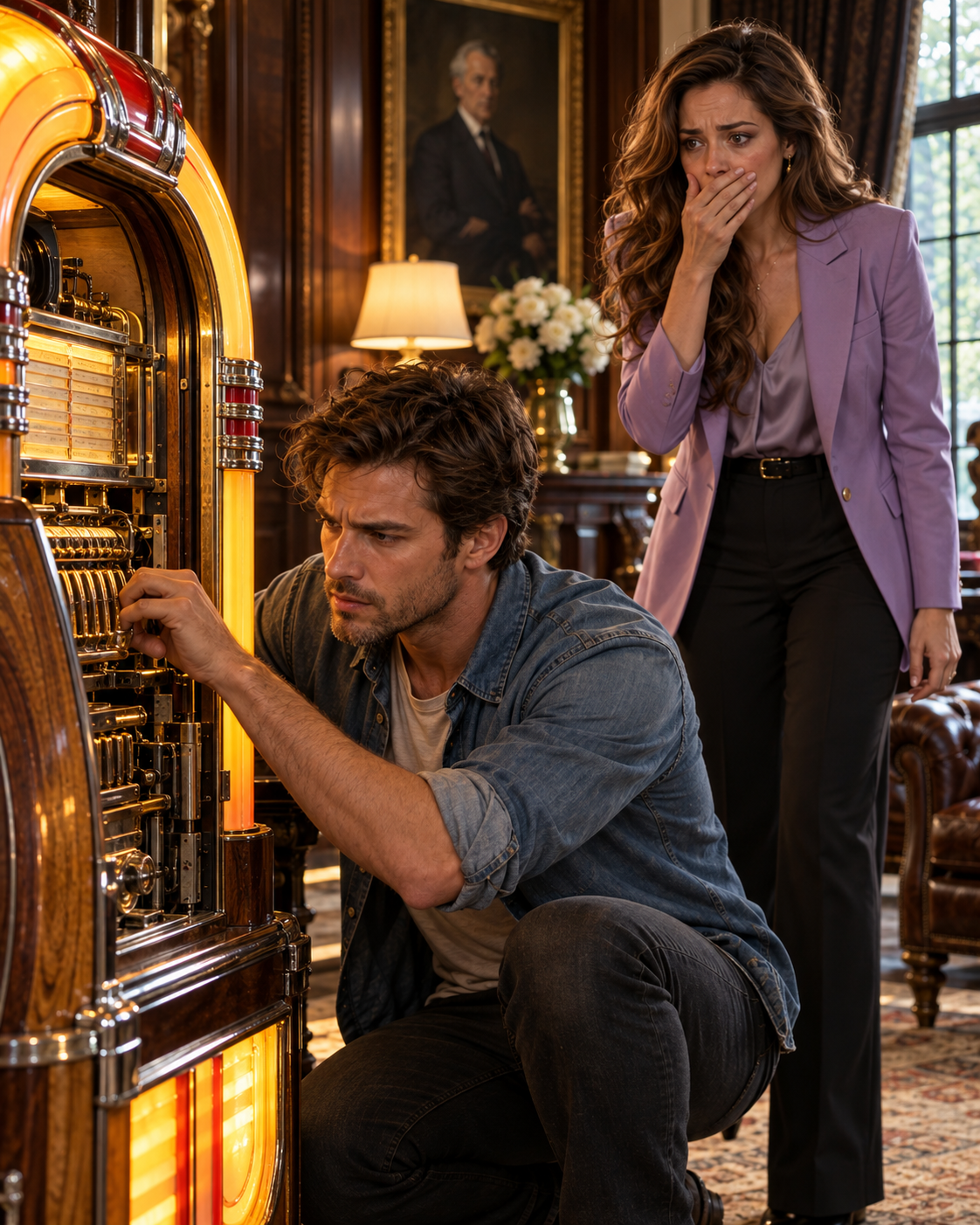
“Maybe remembering someone honestly is harder than remembering them perfectly,” I said.
She looked at me, and for a moment the executive disappeared. I saw a daughter trying to understand a father she had loved and lost.
I finished shaping the brass piece shortly after nine. The replacement wasn’t pretty, but it was precise. I polished the contact surfaces, secured the ground wire, and checked the connections twice before closing the casing. When I finally plugged the machine in, Eleanor stood up so quickly that her chair scraped against the floor.
A low hum rose from inside the cabinet.
The turntable shivered, paused, then began to rotate. Behind the cloudy glass, a row of colored lights flickered awake. The selector mechanism clicked once, then again, moving with the hesitant rhythm of someone stepping back into a room after years away.
Neither of us spoke.
Then the jukebox chose a record.
A warm, slightly crackling melody spilled into the lounge, filling the polished room with a sound that seemed to belong to another world. It was an old love song, one of the kind that made people think of kitchen dances, handwritten letters, and promises spoken before anyone knew how difficult keeping them could be.
Eleanor pressed her fingers to her lips. Tears gathered in her eyes, and she didn’t try to hide them.
“My father used to play this,” she whispered. “He played it every year on my mother’s birthday.”
The song continued, fragile and imperfect, and for the first time in twenty-three years, the lounge felt alive.
Then a voice came from the doorway.
“Where did you find that record?”
An elderly man stood beneath the entrance light, one hand gripping a cane. His silver hair was combed neatly back, but his face had gone pale as paper. I recognized him from photographs displayed throughout the building: Arthur Sterling, Edward’s younger brother and one of the last surviving members of the family that had founded the company.
He stared at the jukebox as if he had seen a ghost. Then his gaze moved to me.
“Who are you?” he asked.
“Daniel Carter. Maintenance department.”
The cane slipped slightly in his hand.
“Carter?” he repeated. “What was your father’s name?”
“Thomas Carter.”
Arthur closed his eyes. For several seconds, he seemed unable to breathe. When he opened them again, the fear in his expression had become something heavier: shame.
“Thomas’s son,” he murmured. “Dear God. I never thought I’d see you here.”
Eleanor stepped toward him. “Uncle Arthur, what are you talking about?”
He ignored her question and looked directly at me. “Does your father ever tell you about a man named Edward Sterling?”
I felt the floor shift beneath me, though I was standing perfectly still.
“No. Not by that name.”
Arthur sank into the nearest chair. The song played on while he explained that, decades earlier, Thomas Carter had been Edward Sterling’s original engineering partner. My father had helped design the foundational control system that made Sterling Dynamics’ early manufacturing equipment faster, safer, and more reliable. Edward had been the visionary who attracted investors, but Thomas had built much of the mechanism that turned that vision into a working system.
“They were friends,” Arthur said. “Not just colleagues. Your father could understand a machine from the inside out. Edward trusted him more than anyone.”
“Then why have I never heard his name?” Eleanor asked.
Arthur looked at her, and his eyes filled with a grief that had waited far too long for permission to speak.
“Because the investors wanted one founder, not two. They worried that recognizing a partner without a university pedigree or family influence would complicate the ownership structure and weaken the company’s public story. Your grandfather was told that Thomas’s name should be left off the patent paperwork. He agreed, believing he could make things right later.”
My fingers tightened around the edge of my toolbox.
“And he never did?” I asked.
Arthur shook his head. “He intended to. He kept the original sketches, letters, and early design notes. But the longer he waited, the harder it became. The company grew. The patents were renewed. New executives came in. Eventually, the truth became an embarrassment everyone preferred not to touch.”
Eleanor looked as though someone had pulled the foundations out from beneath her feet. “My father let a man’s contribution disappear.”
“He regretted it,” Arthur said. “The note you found was part of his private record. He was trying to remind himself what he’d done. But regret isn’t the same as courage, and he ran out of time.”
I wanted to be angry. Some part of me was angry, so fiercely that I could feel it burning behind my eyes. My father had worked, created, and sacrificed without ever telling me that his name belonged beside the name of the man whose company I now helped maintain. He had carried that silence into his grave, perhaps because he had believed that his work mattered even if no one knew who had done it.
But I also remembered him at our kitchen table, helping me repair a broken toy while my mother cooked dinner. He had never spoken bitterly about the people who overlooked him. He had simply said that doing good work was its own kind of dignity.
That didn’t make the injustice acceptable. It made it harder to know what to do with the pain.
Eleanor turned toward me. “Daniel, I am sorry.”
I looked at her, at the tears she hadn’t wiped away, and at the machine my hands had brought back to life.
“You didn’t do it,” I said. “But now you know.”
She glanced at the note, then at Arthur. “Where are the original documents?”
“In a locked archive at the old Sterling estate,” he answered. “Your father left instructions that they should remain together. I thought they were only personal papers. I never imagined the extent of what was inside.”
Eleanor straightened. The grief remained, but something else had joined it: resolve.
“Then we’re going to retrieve them,” she said. “And tomorrow, the board is going to hear the whole story.”
The jukebox reached the end of the record and clicked softly into silence. No one moved to turn it off. For the first time, I understood that the machine had not merely been waiting for a repair. It had been waiting for someone to listen.
Part 3
The next morning, I entered Sterling Dynamics’ boardroom wearing the same dark work trousers I had worn the night before, though I had replaced my shirt and scrubbed the grease from beneath my fingernails. The long table shone beneath the lights, and a row of executives watched me with the guarded expressions of people who had expected a routine meeting and discovered an inconvenient truth instead.
Eleanor stood at the head of the table. Beside her lay a stack of original engineering sketches, correspondence, and patent drafts retrieved from her father’s archive. Arthur sat near the window, his cane resting against his chair. He looked older than he had the night before, as if finally speaking had lifted one burden only to reveal the weight of all the years spent carrying it.
Eleanor began without a speech about family tradition or corporate values.
“My father built this company with the help of a man whose name we erased from its foundation,” she said. “We have celebrated the invention while hiding the inventor. That ends today.”
A board member adjusted his glasses. Another leaned back in his chair.
“Are you suggesting the company’s patents are invalid?” one of them asked.
“No,” Eleanor replied. “I’m saying our public history is incomplete, and our private records show that Thomas Carter made a substantial contribution to the original control system. We will have independent counsel and historians examine the documents. We will correct our records wherever the evidence requires it.”
The room filled with murmurs. One executive warned that revisiting the past could invite legal complications. Another questioned whether the company should be exposing an old internal dispute when it was trying to reassure investors about its future.
Eleanor listened without interrupting. Then she placed her father’s handwritten note in the center of the table.
“This company cannot preach accountability to its employees while refusing to practice it ourselves,” she said. “If our legacy cannot survive the truth, then it was never as strong as we claimed.”
I sat quietly, my hands folded together. I had not come to ask for money or a title. I had come because my father deserved to be remembered accurately, and because the thought of his work disappearing a second time was more than I could bear.
When Eleanor invited me to speak, I rose slowly.
“I can’t tell you exactly what happened in those meetings decades ago,” I said. “I wasn’t there. But I know the kind of man my father was. He believed that good work should make life better for the people who came after you. He didn’t need to be called a genius. He just wanted what he built to work, and he wanted people to be safe using it.”
I looked around the room, at the expensive suits and carefully controlled expressions.
“If his work helped create this company, then acknowledging him doesn’t take anything away from Edward Sterling. It gives both men the truth they were denied. We don’t have to destroy one man’s legacy to make room for another man’s name.”
No one interrupted me.
The board agreed to commission an independent historical review and preserve the original documents. Eleanor also proposed a permanent foundation in Thomas Carter’s honor, dedicated to technical education, apprenticeships, and scholarships for young people who wanted to build things with their hands and minds. After further discussion, the board approved the proposal, with funding and oversight to be established transparently.
When the meeting ended, one of the older directors approached me. He offered his hand and apologized for having assumed that a maintenance technician had little to contribute to a discussion about the company’s future.
I shook his hand, but the apology didn’t erase the years of silence. I had learned that recognition could heal something without undoing what had happened.
Outside the boardroom, Eleanor caught up with me.
“I know this doesn’t give your father back the years he lost,” she said. “And it doesn’t give you the chance to ask him what he wanted.”
“No,” I answered. “But it gives other people the chance to learn his name.”
She nodded, her eyes bright. “I want to make sure the foundation does real work, not just put his name on a plaque. Will you help us build it?”
I thought of Chloe, of the future I wanted her to inherit, and of my father teaching me how to file a rough edge until it fit properly. “I’ll help,” I said. “But make sure the people who teach there get paid fairly, and make sure the scholarships reach kids who need them. Don’t let it become a monument to a promise nobody keeps.”
For the first time, Eleanor smiled without reservation. “I wouldn’t expect anything less.”
In the months that followed, the foundation began offering paid apprenticeships and scholarships to students from working-class families. Chloe attended one of the first planning events and spent the entire ride home asking questions about gears, motors, and whether she could build a robot for her science fair. I laughed so hard that I nearly missed our turn.
But the story did not end with a scholarship or a corrected plaque. Sterling Dynamics was still a living company, and the people who worked there still faced problems that couldn’t be solved by admitting an old mistake.
Late that summer, our manufacturing division began falling behind schedule. A series of production delays threatened a major contract, and rumors spread across the factory floor that layoffs might be coming. Managers blamed suppliers, operators blamed outdated equipment, and the executives demanded a recovery plan before the end of the week.
I was conducting a routine maintenance inspection when I noticed a recurring vibration in one of the main assembly lines. It appeared only under heavy load, then disappeared when the machine slowed. The standard diagnostic system reported normal operating conditions, but the bearings were showing uneven wear, and the drive assembly was running hotter than it should.
I spent the afternoon tracing the fault through the system. The problem wasn’t a failed motor or a careless operator. It was a design flaw in a control sequence that caused two mechanical stages to engage slightly out of sync whenever production reached its highest speed. Each stage worked correctly on its own. Together, they fought each other, creating stress that eventually forced the line to stop.
The existing proposal called for replacing the entire drive assembly. It would cost hundreds of thousands of dollars, require weeks of downtime, and leave dozens of workers uncertain about their jobs.
I believed I could solve the problem with a simpler mechanical interlock and a small adjustment to the control timing. It wasn’t a revolutionary invention. It was a practical correction that allowed the stages to engage in the right order and prevented the system from loading itself incorrectly.
My supervisor studied the sketches I had drawn on a clipboard.
“You’re proposing we change the sequence without replacing the drive?” he asked.
“I’m proposing we fix the reason it’s failing instead of replacing everything around it.”
He stared at the diagram for another moment, then sent it upstairs.
Two hours later, I was summoned to the strategy room, where Eleanor sat with the chief operating officer, the head of engineering, and several managers who looked as though they had been preparing to explain why the deadline could not be met.
I laid my drawings on the table and explained the failure in plain language. I described how the vibration developed, why the sensors missed the early warning signs, and how the interlock would keep the two stages from engaging out of sequence. I also outlined a cautious test plan, with safety checks and a rollback procedure if the adjustment failed.
The head of engineering studied my notes. “Why wasn’t this identified in the original design review?”
“Because the original design worked within its tested limits,” I said. “The problem appears under sustained peak demand. We increased production, but the control sequence wasn’t adjusted to account for the additional load.”
Eleanor glanced at me. “And you’re confident this is the root cause?”
“Confident enough to test it under controlled conditions. Not confident enough to skip the safety checks.”
That answer seemed to matter more than a bold promise would have. The engineering team approved a controlled trial, and we tested the change during a scheduled maintenance window. The line started, reached operating speed, and held steady. The vibration dropped. Temperatures remained within limits. After repeated cycles, the system continued to run without the old failure.
The plant manager called it a breakthrough. I called it a problem that had finally been understood.
Production recovered over the following weeks, the contract stayed on track, and the company avoided the layoffs everyone had feared. More importantly, the operators who had been blamed for the delays were invited to help improve the maintenance checks, because they were the ones who had heard the strange vibration long before anyone in the boardroom understood what it meant.
A week later, Eleanor asked me to meet her in her office. On her desk lay a formal offer for a management position overseeing equipment reliability and maintenance strategy. The salary was more than I had ever expected to earn, and the title represented a kind of recognition I had never pursued.
I read the offer twice before looking up.
“There’s one condition,” I said.
Eleanor leaned back. “I had a feeling there would be.”
“I want to spend one day every month on the factory floor, doing inspections and talking to the technicians and operators. No special tour, no cameras, no prepared reports. I want to keep working beside the people who actually use the systems we’re responsible for.”
“Why?”
“Because if I stop hearing what they hear, I’ll eventually start believing the reports are the whole story. And because I don’t want to become the kind of manager who forgets how much it costs someone to make a mistake they weren’t given the tools to prevent.”
Eleanor looked at the offer, then back at me. “One day a month,” she said. “It’s part of the job description.”
I accepted.
The promotion changed our lives in practical ways. I could finally replace the failing roof on our house without calculating every dollar twice. Chloe got braces without my worrying about how to cover the next bill, and I started putting money aside for her education. Yet I kept my father’s old toolbox in my office, not as a decoration but as a reminder that the smallest overlooked component could bring an entire system to a halt.
The year passed more quickly than I expected. The historical review confirmed the importance of my father’s contribution, and Sterling Dynamics formally amended its internal records to recognize him as a co-developer of the original control system. The company also published a detailed account of the partnership, acknowledging that the omission had been wrong. It could not rewrite every document from the past, but it could stop repeating the lie in the present.
Eleanor changed, too. She began asking more questions before issuing decisions. She spent time with apprentices, listened to production workers, and learned to say “I was wrong” without treating the words like a defeat. She still demanded high standards, but the people around her no longer had to guess whether she valued them only when they were useful.
Then came the opening of the Thomas Carter Community Workshop, a year after that rainy Thursday when I had first opened the jukebox. The foundation had converted an unused building near the old factory into a bright, practical space filled with workbenches, safe power tools, training equipment, and donated machines waiting to be repaired. The first group of students had already begun building small engines, testing circuits, and learning how to turn an idea into something they could hold in their hands.
Chloe stood beside me at the opening, taller than she had been a year earlier, her hair falling across her face as she tried to see everything at once. Eleanor stood on my other side, holding a small framed copy of my father’s original engineering sketch. Arthur had come, too, moving slowly with his cane but refusing to sit down until he had greeted every apprentice in the room.
At the center of the workshop stood the restored jukebox. Its chrome had been polished, its red panels repaired, and the handwritten note from Edward Sterling had been placed in a protective display beside it. We had chosen not to hide the note’s uncomfortable message. It belonged there, not as an accusation, but as a reminder that even good people could fail others when fear became more important than honesty.
Eleanor addressed the gathered students and families. She spoke about her father’s vision, my father’s engineering, and the cost of allowing pride to silence the truth. She did not describe the company as a flawless success story. She described it as a work in progress, built by people whose names were sometimes recorded and sometimes forgotten, but whose labor had always mattered.
When she finished, she turned toward me and nodded.
I placed my hand on the jukebox’s polished edge. For a moment, I thought of my father in our old garage, sleeves rolled up, explaining that every mechanism had a purpose and every failure had a cause. I thought of Sarah, who had believed in my ability to build a good life even when grief made the future seem impossible. I thought of Chloe waiting for me at home that rainy Thursday, confident that I would finish the repair because broken things deserved a chance.
I pressed the selection button.
The machine clicked, hummed, and chose a record. That same old melody floated through the workshop, warm and slightly imperfect, filling the room with a sound that seemed to connect everyone there to someone they had loved, lost, or failed to understand in time.
Chloe slipped her hand into mine.
“Do you think Grandpa would like this place?” she asked.
I looked at the students gathered around the workbenches, at the teachers showing them how to handle tools safely, at Eleanor standing beside the history her family had finally begun to face, and at Arthur wiping his eyes when he thought no one was watching.
“He’d love it,” I said. “Not because his name is on the door, but because people are learning here.”
The song continued, and Chloe leaned against my shoulder. I could not give her mother back. I could not return the years my father had spent without the recognition he deserved, and I could not make Eleanor’s father choose differently when he still had the chance. There were things no repair could restore.
But I could choose what happened next. I could raise my daughter to know that dignity did not depend on a title, that honest work deserved respect, and that admitting a wrong was not the end of a legacy but the beginning of a better one. I could help build a workplace where the people closest to a problem were trusted to speak, and a community where children who had never been handed an opportunity could learn to create their own.
As the last notes drifted through the workshop, I finally understood what my father had meant all those years ago. Repairing something was never just about returning it to the condition it had been in before it broke. Sometimes the damage revealed what had been missing all along. Sometimes the only way forward was to open the casing, follow the fault, and tell the truth about what you found.
I had spent much of my life believing that success meant carrying every burden alone and never letting anyone see how tired I was. That night, surrounded by people who had chosen to help rather than look away, I understood something different. A good life was not built by rising above everyone else. It was built by reaching back, holding the door open, and making sure the next person had a fair chance to do meaningful work.
The jukebox played on, no longer a forgotten relic in a silent executive lounge, but the living heart of a room where people came to learn, to create, and to begin again. And as my daughter held my hand, I felt my father’s lesson settle into me with a quiet certainty: sometimes a life begins to heal when someone finally listens to the story that everyone else has left unheard.