The CEO fired me in front of an entire room because I refused to approve a private jet that I believed could put hundreds of lives at risk.
THE FLIGHT I REFUSED TO APPROVE — PART 3: THE TRUTH THAT BROUGHT AN ENTIRE COMPANY TO ITS KNEES
The board member slowly placed the document on the table.
Nobody moved.
It was a financial authorization record, dated three weeks before I had discovered the flight-control warnings.
At first, I couldn’t understand why a financial document had anything to do with an aircraft safety investigation. Then the board member turned it toward the CEO.
“Before we continue,” he said, “I think everyone in this room needs to understand who was really benefiting from that aircraft being cleared for departure.”
The CEO picked up the document.
Her eyes moved across the page. Then her face changed.
“What is this?” she whispered.
The board member took a breath.
“It’s the approval for an additional payment to a maintenance contractor. A payment that was contingent on the aircraft being certified as flight-ready before the end of the quarter.”
The COO shifted in his chair.
I recognized the contractor’s name immediately.
AeroVantage Technical Services.
It was the company that had performed the most recent maintenance inspection on the jet.
The same company whose technicians had supposedly resolved the sensor warnings.
But there was something else.
The payment was nearly four times the amount listed in the original maintenance contract.
“Why was this payment authorized?” the CEO asked.
Nobody answered.
Then the board member looked directly at the COO.
“Because the contractor was owned by a company registered to your brother.”
The room erupted.
The COO stood so quickly that his chair scraped backward across the floor.
“That’s ridiculous. You’re making accusations based on paperwork you don’t understand.”
The board member remained calm.
“Then explain the financial transfers.”
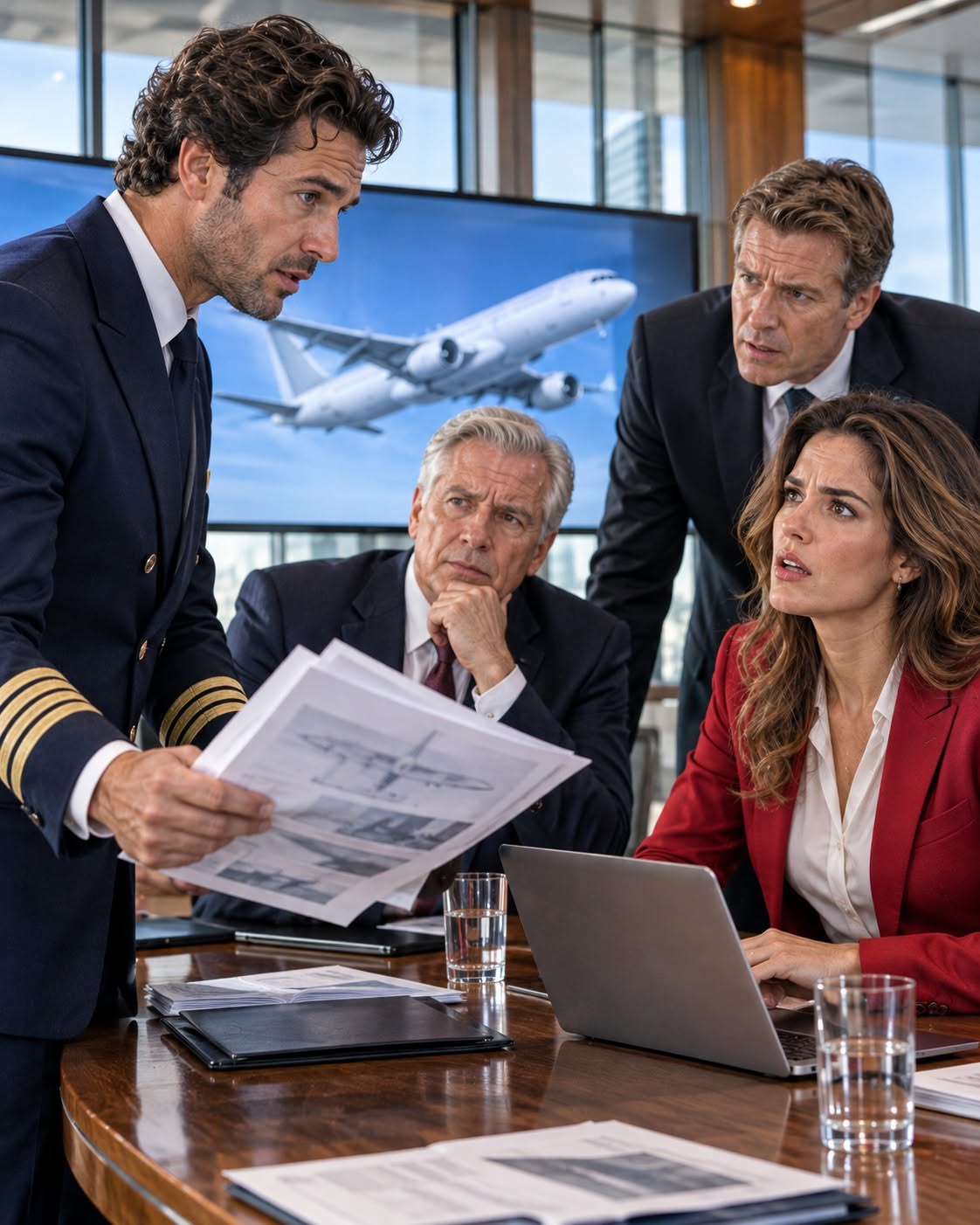
He placed another document on the table.
This one showed several payments moving through two intermediary companies before reaching an account connected to the COO’s family.
I watched the man’s confidence disappear.
For the first time since I had worked for the company, he looked genuinely afraid.
But the worst revelation hadn’t come yet.
The CEO turned toward Tessa.
“How did you find all this?”
Tessa swallowed.
“I wasn’t looking for financial misconduct. I was trying to understand why the original safety report disappeared.”
She opened another file on her laptop.
“While reviewing the administrative logs, I found that the original report had been accessed from an executive-level account. The same account later authorized the altered version.”
The CEO leaned forward.
“Whose account?”
Tessa looked down at the screen.
“Your account, ma’am.”
Silence.
I felt the room change around me.
The CEO slowly shook her head.
“That is impossible. I never opened that report.”
“I believe you,” Tessa said quietly. “But someone used your credentials.”
The CEO looked at the COO.
He didn’t look back.
For several seconds, the only sound in the room was the ventilation system humming above us.
Then the board chairman spoke.
“Before anyone leaves this room, I want the complete access history preserved. We are suspending all related administrative privileges, and this matter is being referred to independent investigators.”
The COO laughed nervously.
“You can’t do that. This company has operations scheduled. We have clients waiting. You can’t shut down the entire aviation division over an internal disagreement.”
The chairman turned toward him.
“This stopped being an internal disagreement when someone manipulated an aircraft safety record.”
Two security officers entered the room.
The COO looked at me as they approached him.
“You think you’ve won?” he said.
I didn’t answer.
He pointed a finger in my direction.
“You have no idea what you’ve just done.”
I looked him in the eyes.
“Actually, I think I’m beginning to understand.”
He was escorted out.
But the meeting didn’t end there.
The board chairman asked everyone except Tessa, the CEO, and me to remain outside.
When the doors closed, he placed both hands on the table.
“Captain, I owe you an explanation.”
I folded my arms.
“I’d appreciate one.”
He opened a folder containing several internal communications.
The first email was dated two days before my termination.
It came from the COO to the CEO.
The subject line read: Departure Authorization — Urgent.
The message explained that the aircraft was expected to transport several high-profile investors to an international business meeting.
A delay would trigger financial penalties and potentially jeopardize a major acquisition.
Then I saw another message.
This one was from the COO to the company’s maintenance director.
It contained a sentence that made my blood run cold.
If the captain refuses to sign, use the alternate approval route. We cannot afford another delay.
The chairman continued.
“We now know the COO had been pressuring the maintenance department to certify the aircraft despite unresolved warnings. But there’s another problem.”
He slid a second folder toward me.
Inside was a list of previous aircraft inspections.
There were seventeen entries.
Seventeen separate occasions when technical warnings had been marked as resolved without supporting maintenance documentation.
Some involved minor issues.
Others involved systems that should never have been cleared without proper verification.
I stared at the dates.
They stretched back almost two years.
“How many aircraft?” I asked.
“Six,” the chairman replied.
“How many flights?”
“We’re still determining that.”
I slowly closed the folder.
All those years, I had believed my job was to protect the people aboard one aircraft at a time.
Now I was looking at evidence that the problem might have been much larger.
The chairman leaned forward.
“We need your help.”
I almost laughed.
“You fired me.”
“I know.”
“You took my badge, canceled my access, and escorted me out in front of the people I had spent years protecting.”
He lowered his eyes.
“I know that too.”
“Then why should I help you?”
He didn’t answer immediately.
Finally, he said something I hadn’t expected.
“Because you were right, and we failed to listen.”
I looked at Tessa.
She hadn’t said a word.
I remembered her phone call. The uncertainty in her voice. The way she had insisted that evidence be preserved properly.
Then I looked back at the chairman.
“I’ll cooperate with the investigation,” I said. “But I have conditions.”
“Name them.”
“First, every aircraft connected to these records must undergo an independent safety review. No executive should be able to override a technical decision.”
The chairman nodded.
“Agreed.”
“Second, every employee who reports a safety concern must be protected from retaliation.”
“Agreed.”
“Third, nobody gets to quietly rewrite what happened to me.”
He looked at me carefully.
“What do you mean?”
“I want the truth documented. Not a private apology. Not a settlement designed to make everyone forget. The company publicly needs to acknowledge that I was terminated for refusing to approve an aircraft I believed was unsafe.”
The chairman nodded slowly.
“I think that’s fair.”
I wasn’t sure I believed him.
But I had learned something during my years in aviation.
Promises were easy.
Records were harder to manipulate.
And this time, I intended to make sure everything was recorded.
The investigation lasted eleven weeks.
Those eleven weeks were the longest of my professional life.
I spent hours with aviation safety investigators, forensic accountants, and legal teams.
Tessa became one of the most important witnesses.
She had saved copies of the original system logs before the administrative overrides were discovered. She also provided a detailed timeline showing when the warnings appeared, who accessed them, and how the official records had been changed.
The evidence grew stronger with every interview.
The maintenance contractor had been receiving unusually large payments for nearly two years.
In return, its technicians had been pressured to close certain maintenance findings without completing the required verification procedures.
The COO had coordinated the arrangement.
But he hadn’t acted alone.
The investigation uncovered a small network of employees who had been helping him.
A maintenance supervisor had approved incomplete work orders.
An IT administrator had provided unauthorized access to restricted records.
A finance manager had divided payments into smaller transactions to avoid triggering additional reviews.
And someone in the executive office had repeatedly used the CEO’s credentials.
The CEO herself was eventually cleared of knowingly manipulating the report.
However, that didn’t mean she escaped responsibility.
Investigators found that she had repeatedly ignored internal complaints about unrealistic operational targets and had allowed too much authority to concentrate in the COO’s office.
She had trusted the wrong people.
More importantly, she had built a workplace where challenging a senior executive could cost someone their career.
When the findings were finally presented, the company had no choice but to ground the six aircraft involved until independent inspections were completed.
Several flights were canceled.
Clients were furious.
The company’s stock value dropped after the investigation became public.
The COO and three other employees were dismissed and later faced criminal investigations related to fraud, falsified records, and obstruction of safety oversight.
The maintenance contractor lost its operating authorization.
But the discovery that affected me most came from an investigator named Daniel Reeves.
He called me one afternoon and asked me to come to his office.
He had been reviewing the aircraft’s technical history.
“Captain,” he said, “there’s something I think you should know.”
He turned his monitor toward me.
It showed the flight-control sensor warnings I had originally reported.
But beneath them was a maintenance entry I had never seen.
The aircraft had experienced an intermittent fault during an earlier test flight.
A technician had recorded that the warning returned after a reset.
The issue was supposed to be investigated further.
Instead, the work order had been closed.
“How serious was it?” I asked.
Daniel chose his words carefully.
“We can’t say that the aircraft would definitely have experienced a catastrophic failure. That’s not how technical investigations work. But the fault required proper diagnosis. It should never have been treated as resolved simply because the warning temporarily disappeared.”
I stared at the screen.
“So if I had signed the clearance…”
“The aircraft might have departed without the necessary maintenance verification.”
I leaned back.
For a moment, I couldn’t speak.
I had imagined the worst possibilities during those first days after my dismissal.
Now I was facing the reality that my signature could have helped conceal a problem that should never have been ignored.
Daniel closed the file.
“Your refusal triggered a chain of events that brought this to light.”
I shook my head.
“No. Tessa brought it to light. The investigators did the work. I simply refused to sign.”
He smiled faintly.
“Sometimes that’s where everything begins.”
Three months after my dismissal, I received a letter from the company’s board.
They wanted me to attend a formal meeting.
I almost declined.
I had no interest in returning to the same building where my career had been taken from me.
But Tessa called the evening before.
“You should come,” she said.
“Why?”
“Because something is changing. And I think you deserve to hear it directly.”
So I went.
The conference room looked exactly as I remembered.
Same glass walls.
Same long table.
Same polished floor.
But the atmosphere was different.
The COO’s chair was empty.
The maintenance director’s nameplate was gone.
The CEO sat at the far end, looking older than she had the last time I saw her.
The chairman stood when I entered.
“Captain, thank you for coming.”
I took a seat.
He opened the meeting by reading the findings of the independent investigation.
Then he announced that the board had approved a complete restructuring of the aviation division.
Every safety-critical maintenance record would be subject to independent review.
Administrative overrides would require documented justification and approval from more than one authorized individual.
Pilots would have direct access to an independent safety office.
And any employee reporting a legitimate safety concern would be protected by a formal anti-retaliation policy.
It was a meaningful start.
Then the chairman looked toward the CEO.
“There’s something else.”
She stood.
For a few seconds, she seemed unsure where to begin.
Finally, she faced me.
“Captain, I fired you because I allowed pressure from the wrong people to influence a decision that should have been based on safety. I didn’t investigate your concerns. I didn’t ask to see the technical evidence. I chose to believe an executive’s assurances over the judgment of the person responsible for the aircraft.”
Her voice trembled slightly.
“That was a failure of leadership. And I am sorry.”
I looked at her.
Part of me wanted to tell her that an apology couldn’t restore the years I had spent building my career.
It couldn’t erase the humiliation.
It couldn’t return the trust I had lost.
But another part of me recognized that she was finally acknowledging what had happened.
“Thank you,” I said. “But I hope you understand that the real apology isn’t for me. It’s for every passenger who trusted this company to put their safety first.”
She nodded.
“I do.”
Then the chairman made an announcement I hadn’t expected.
The board wanted to offer me my position back.
Not simply as chief pilot, but as director of flight safety, with independent authority to stop operations whenever a legitimate safety concern remained unresolved.
The salary was higher than before.
The contract included direct reporting to the board’s safety committee.
And my termination would be formally reversed.
For a moment, I said nothing.
It was everything I had lost.
And yet, I wasn’t sure I wanted it anymore.
“I appreciate the offer,” I finally said. “But I need time to think.”
The chairman nodded.
“Of course.”
I left the building without signing anything.
Outside, the afternoon sun was shining on the parking lot.
For the first time in months, I felt no anger.
Only clarity.
Two weeks later, I met Tessa for coffee.
She had been promoted to head of compliance and safety records.
She looked exhausted but happier.
“You turned down the job?” she asked.
“I did.”
She raised an eyebrow.
“Why?”
I stirred my coffee.
“Because I spent too many years believing that if I worked hard enough and followed every rule, I could keep the entire system honest.”
“And now?”
“Now I know that safety isn’t protected by one person’s integrity. It’s protected by a system that makes dishonesty difficult and speaking up possible.”
She smiled.
“That sounds like something you should put on a poster.”
I laughed.
“Please don’t.”
We sat quietly for a moment.
Then she asked whether I had decided what to do next.
I told her about an offer I had received from an independent aviation safety foundation.
They wanted me to help develop training programs for pilots, maintenance teams, and aviation executives.
The work would involve investigating safety failures, teaching people how to recognize warning signs, and helping organizations create systems where employees could raise concerns without fearing retaliation.
It wasn’t glamorous.
There would be no private jets waiting on the runway.
No executive dinners.
No impressive office overlooking an airport.
But there was something about the work that felt right.
I accepted the position the following Monday.
A year later, I was standing in a training room at a regional aviation conference.
In front of me were more than a hundred pilots, engineers, technicians, and airline managers.
On the screen behind me was a photograph of an aircraft sitting in a maintenance hangar.
I had chosen it carefully.
The plane looked ordinary.
No dramatic damage.
No smoke.
No emergency vehicles.
Just an aircraft waiting for someone to decide whether it was safe to fly.
I began my presentation with a question.
“How many of you have ever felt pressured to approve something you weren’t comfortable approving?”
Almost every hand went up.
I let the silence settle.
“How many of you have stayed quiet because the person applying that pressure had a bigger title, a larger office, or more influence over your career?”
More hands rose.
I nodded.
“That’s where many safety failures begin. Not necessarily with one broken component, but with a culture that teaches good people to ignore what they know.”
I told them about the aircraft, the altered report, the financial arrangements, and the board investigation.
I didn’t mention the company by name.
I didn’t need to.
The lesson was bigger than one organization.
When I finished, a young first officer approached me.
He couldn’t have been older than thirty.
“Captain,” he said, “I’m dealing with something similar at my company. Nothing as serious as what you described, but I’ve been told not to report a recurring technical warning because it would delay a scheduled flight.”
I looked at him carefully.
“Have you documented it?”
“Yes.”
“Have you followed the approved reporting process?”
“Yes.”
“Then keep doing that. Preserve the records. Seek guidance through the appropriate safety channels. And don’t certify something you cannot honestly certify.”
He hesitated.
“But what if they fire me?”
I remembered the day my badge had been taken.
The humiliation.
The uncertainty.
The months of wondering whether I would ever work in aviation again.
Then I answered him.
“Your career matters. Your livelihood matters. But neither is worth placing other people’s lives at risk. And if your organization punishes you for raising a legitimate safety concern, that tells you something important about the organization, not about your integrity.”
He nodded slowly.
“Thank you.”
As he walked away, I realized something.
For years, I had measured success by the number of flights completed without incident.
Now I measured it differently.
By the number of people willing to speak up before an incident happened.
I didn’t return to the company.
I never regretted that decision.
The board eventually appointed a new CEO, and the aviation division underwent a complete overhaul. Several former executives were prosecuted, and the company agreed to cooperate with regulators and strengthen its reporting systems.
The CEO who fired me resigned months later.
Before leaving, she sent me a handwritten letter.
It contained only a few paragraphs.
She wrote that she had spent years believing leadership meant making difficult decisions quickly and confidently.
She now understood that sometimes leadership meant stopping everything, admitting uncertainty, and listening to the person who had the courage to say no.
I kept the letter.
Not because I had forgiven every decision she made, but because it reminded me that even powerful people could learn from their failures—if they were willing to face them.
As for Tessa, she continued working in aviation compliance.
We remained friends.
Every few months, we would meet for coffee and talk about the cases she was reviewing or the training programs I was developing.
One afternoon, she asked me whether I ever wondered what would have happened if I had simply signed the clearance that morning.
I looked through the café window.
An aircraft was climbing into the sky, leaving a thin white trail behind it.
“Sometimes,” I admitted.
“Does it keep you awake?”
I thought about it.
“No. Because I know what happened when I refused.”
She smiled.
Then I added something I had learned through the hardest experience of my life.
“People often think courage is standing up in front of a crowd and making a speech. But sometimes courage is much quieter. It’s a signature you refuse to give. A report you refuse to delete. A question you insist on asking when everyone else wants to move on.”
Tessa nodded.
“And sometimes,” she said, “it’s a phone call from someone who refuses to let the truth disappear.”
We both laughed softly.
That evening, I returned to my apartment.
My old company badge was still in a drawer.
I took it out and turned it over in my hand.
For months, I had thought of it as a symbol of everything I had lost.
Now I saw it differently.
It was a reminder that a job title could be taken away.
An office could be emptied.
A career could be interrupted.
But the principles that made someone trustworthy could not be canceled with a computer command.
I placed the badge back in the drawer.
Then I opened my laptop and began preparing the next training session.
The title of the presentation was simple:
THE MOST IMPORTANT FLIGHT IS THE ONE YOU REFUSE TO TAKE.
And beneath it, I wrote one final sentence:
No schedule is worth more than a human life. No executive is above accountability. And no act of integrity is wasted simply because it costs you something.
I saved the document.
Outside, the evening sky was darkening.
Somewhere in the distance, another aircraft was preparing for departure.
I hoped the people responsible for clearing it understood the weight of their decisions.
Because every passenger who boards an aircraft places an extraordinary amount of trust in strangers.
They trust the pilot.
They trust the engineers.
They trust the technicians.
They trust the people who sign the paperwork.
And that trust should never be treated as a business expense.
I had lost my job because I refused to approve one aircraft.
But in the end, I had helped expose a system that could have endangered hundreds of people.
I hadn’t saved the company.
I hadn’t become a hero.
I had simply done the job I had promised to do decades earlier.
Protect the people who couldn’t see what was happening behind the cockpit door.
And if I had to make that same decision again, knowing exactly what it would cost me, I would still refuse to sign.
Every single time.
THE END.