The admiral watched Dr. Austin call me “just a floor nurse” in front of a room full of dying soldiers
Part 2
The second operator was younger than the master sergeant, perhaps twenty-seven, with a wedding ring hanging from a chain around his neck and a photograph tucked beneath the plastic identification sleeve on his uniform.
His name was Daniel Reeves.
A medic reported that he had suffered a penetrating chest injury during the ambush, followed by a sudden collapse in circulation.
“Pulse is thready,” she said. “Pressure’s dropping despite initial resuscitation.”
Austin moved toward the ultrasound machine.
“Let’s establish the diagnosis before we start making assumptions.”
I watched Daniel’s face turn an unnatural shade of gray.
His monitor showed a rhythm that looked deceptively organized, but the blood pressure tracing was barely there.
The veins in his neck were distended.
His heart was beating inside a chest that no longer allowed it to fill properly.
Cardiac tamponade.
Blood was collecting around his heart, squeezing it until each contraction became a desperate attempt to pump against an invisible fist.
The ultrasound image appeared on the screen.
The fluid was there.
So was the danger.
“Pericardial tamponade,” I said. “He’s obstructed. We need immediate intervention.”
Austin studied the screen, his jaw tightening.
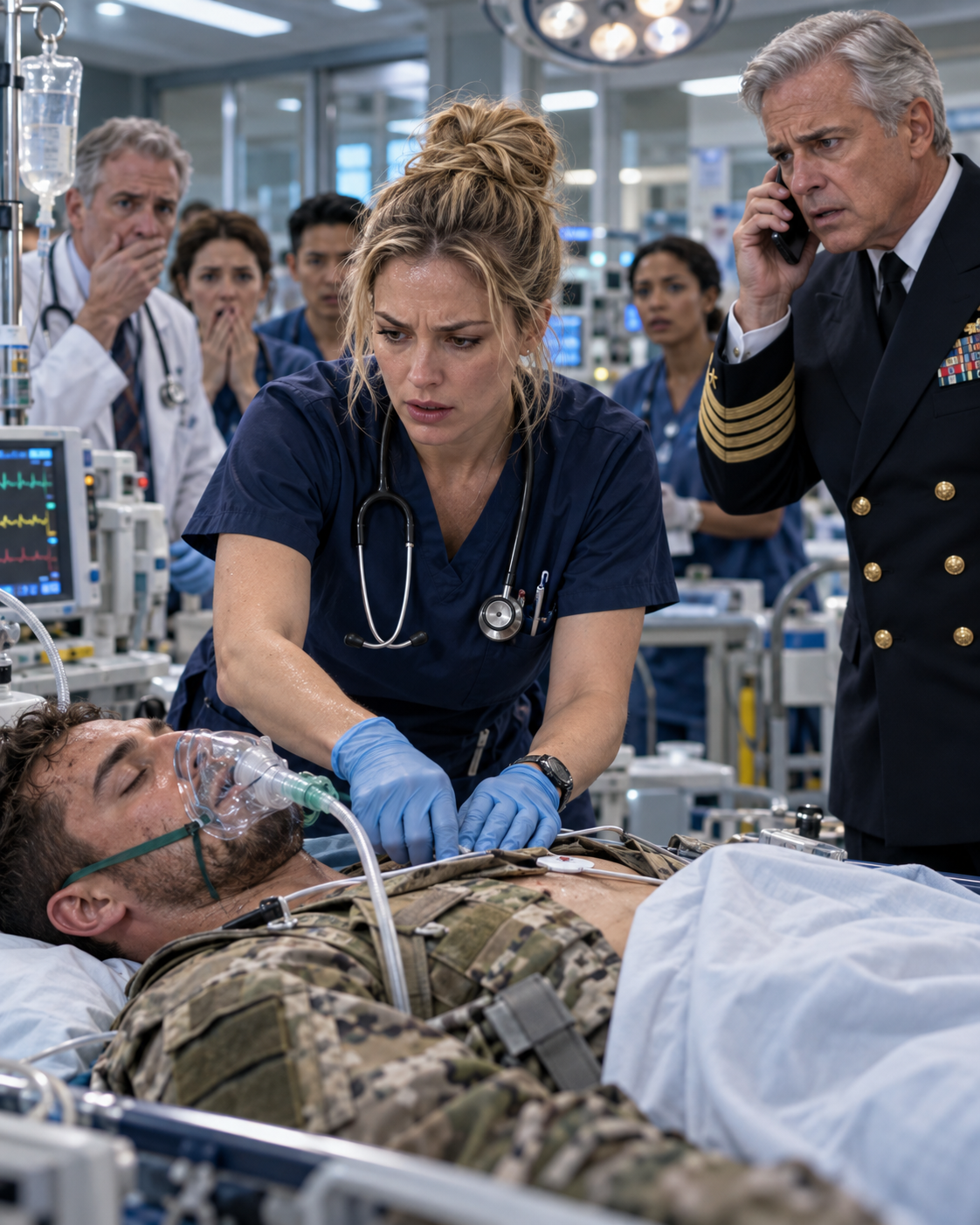
“We need cardiothoracic consultation and a controlled procedural setup.”
“We need a plan that accounts for the fact that he may arrest before that happens.”
“Do not tell me how to run my department.”
“I am telling you what his circulation is telling us.”
His eyes flashed.
“You are a staff nurse, not a surgeon.”
“I know exactly what I am.”
For the first time since the casualties arrived, my voice shook.
Not with fear.
With anger.
Because I had seen what happened when rank, title, and procedure became more important than the person trapped beneath them.
I remembered a young corporal in Afghanistan whose blood pressure had collapsed while an evacuation crew waited for authorization to change the plan.
I remembered the sound of a flight medic saying, “We have no time,” and the officer on the radio replying, “Stand by.”
The corporal had died before the next order came.
I had carried that memory for years.
I would not let it make another decision for me.
“Get the emergency team here,” I said. “Prepare the equipment for definitive treatment. I need the physician directing this patient’s care to act now.”
Austin looked as though I had slapped him.
Then Daniel’s monitor began to sound differently.
One alarm became two.
His heartbeat slowed.
The young operator’s eyes opened, unfocused and terrified.
“Am I dying?” he whispered.
I leaned close enough for him to see my face.
“Not if we can help it.”
The room moved at once.
Austin finally stepped into the emergency response, directing the physician-led team while another clinician prepared the necessary equipment.
I stayed at the bedside, calling out the changes in Daniel’s condition and helping coordinate the resuscitation.
When the physician performed the emergency pericardial drainage, dark blood entered the collection system.
Daniel’s blood pressure began to recover.
His pulse strengthened.
The monitor stopped screaming.
I exhaled for the first time in what felt like an hour.
Then I noticed my hands were trembling.
I folded them beneath the edge of the bed so nobody would see.
Vice Admiral Lester was standing just outside the trauma bay.
“How did you recognize the tamponade so quickly?” he asked.
I kept my eyes on Daniel while the team continued stabilizing him.
“The signs were there.”
“That isn’t an answer.”
“It is the answer I have.”
He studied me with an expression I couldn’t read.
Before he could speak again, the third patient arrived.
This one was conscious.
He was also trying desperately not to be.
Staff Sergeant Marcus Hill lay curled slightly on his side, his face tight with pain, his abdomen swollen beneath the torn fabric of his uniform.
“Blast injury,” the medic reported. “No obvious penetrating wound. He was walking at the scene, but his abdominal pain has increased during transport.”
Austin glanced at the initial observations.
“Stable blood pressure. No major external bleeding. Get labs, start the standard trauma assessment, and arrange imaging.”
Marcus gripped my sleeve.
“Something’s wrong,” he whispered.
I bent closer.
“Tell me where it hurts.”
“My stomach. It feels like it’s burning.”
He swallowed hard.
“Please don’t tell me it’s nothing.”
The words struck deeper than they should have.
I had heard them before, from men who were trying to convince themselves they were not afraid.
I examined his condition alongside the team and noticed the details that did not fit the comforting appearance of his initial numbers.
His pulse was climbing.
His skin was growing clammy.
His pain was becoming more diffuse, and his abdomen was increasingly rigid.
A blast could injure internal organs without leaving a dramatic wound on the outside.
The body could hide a catastrophic injury behind a few minutes of apparently reassuring observations.
“I’m concerned about an intestinal perforation,” I told Austin. “He needs urgent reassessment and surgical evaluation.”
Austin glanced at Marcus.
“His initial examination wasn’t conclusive.”
“His condition is changing.”
“We cannot send every abdominal pain case straight to surgery.”
“This is a blast casualty whose physiology is getting worse.”
He stared at me for a long moment.
Then he turned toward the attending physician.
“Repeat the examination. Get trauma surgery on the line and expedite the imaging.”
It was not an apology.
It was not trust.
But it was movement.
Marcus was taken for further assessment, and the findings confirmed what I had feared: a perforated bowel with contamination inside the abdomen.
The surgical team moved quickly.
Had we mistaken his early stability for safety, the consequences could have been devastating.
By the time the third patient was in the operating room, the fourth operator was already receiving care for extensive blast injuries and fractures.
I helped coordinate his monitoring and handoff, checking the details that could disappear in the noise of a crowded emergency department.
The room had changed.
People who had ignored me earlier were now asking what I saw.
People who had once considered my quietness a sign of inexperience were watching my hands.
And Austin, who had built his authority on the certainty that every emergency could be contained within a protocol, was standing beside the desk with a look I had never seen on his face before.
Uncertainty.
When the final stretcher had left the trauma bay, he approached me.
“Office. Now.”
I followed him past the nurses’ station, past the supply room, and into a small office with framed certificates on the wall.
He closed the door.
“Do you have any idea what you did out there?”
“I treated patients who were deteriorating.”
“You disregarded a direct instruction, challenged my authority, and performed beyond your assigned responsibilities.”
“Three men were in immediate danger.”
“You are not the only person who understands urgency.”
“No,” I said. “But urgency doesn’t disappear because the paperwork hasn’t caught up.”
His face reddened.
For a moment, I thought he might order me off the floor.
Instead, he sat down slowly.
“Your personnel file says you’ve worked in emergency nursing for several years. It says you have prior military medical experience, but the details are restricted.”
I said nothing.
“Who trained you?”
I looked at the certificates behind him.
Names.
Dates.
Qualifications that had taken years to earn.
None of them could explain what it felt like to keep a dying soldier alive while the helicopter carrying him shook under enemy fire.
“I was a combat trauma flight nurse.”
Austin’s expression changed.
Not dramatically.
Just enough.
“With which unit?”
I gave him the information he was cleared to hear.
He leaned back and studied me as though the woman who had stocked his trauma carts that morning had vanished, leaving someone he had never bothered to meet.
“Why would someone with that background take a position like yours?”
I thought about the drawer at home.
The flight wings.
The photograph I had turned facedown because I could not bear to look at the empty space beside me.
“Because I was tired of watching people die.”
His expression softened for the briefest moment.
“And now?”
I looked toward the closed door, beyond which the department continued its relentless work.
“Now I’m tired of watching people die because we pretend every emergency will wait for us to feel comfortable.”
Before he could answer, someone knocked.
Vice Admiral Lester entered without waiting for permission.
He held a thin folder in one hand.
“I’ve reviewed your service record,” he said.
My stomach tightened.
“Admiral—”
“Three combat evacuation commendations. Advanced trauma qualifications. Multiple deployments. And an operational citation that I suspect you haven’t discussed with anyone here.”
Austin stood.
“You’ve seen her full record?”
“Enough of it.”
Lester placed the folder on the desk and looked directly at me.
“Emily Carter, I need you to tell me why someone with your experience has been standing quietly beside a supply cabinet while this department trains its staff to manage battlefield casualties.”
I wanted to tell him it was none of his business.
I wanted to tell him that I had earned the right to be ordinary.
Instead, I heard my own voice asking a question I had avoided for three years.
“Admiral, do you want to know why I left?”
His expression grew solemn.
“Yes.”
I took a breath.
“Then you need to understand what happened on the mission that made me leave, because what happened here today is not the first time I’ve watched good people mistake a clean procedure for a safe outcome.”
For the first time that day, neither man interrupted me.
And I began to tell them about the soldier whose death had followed me home.
Part 3
His name had been Lieutenant Samuel Brooks.
He was twenty-nine, newly married, and so determined to appear fearless that he used to joke about every dangerous assignment before we took off.
During one evacuation, an explosion tore through the vehicle carrying his team.
We received several casualties in rapid succession, and the aircraft became a cramped, deafening world of blood, alarms, and shouted instructions.
Samuel was conscious when we reached him.
He had a penetrating injury and signs of internal bleeding, but he kept asking about the other men.
“Get them out first,” he told me.
I remember leaning close to his face.
“You don’t get to give orders from that stretcher.”
He laughed once.
Then his expression changed.
His condition deteriorated while we worked to get him to definitive care.
I had recognized the warning signs.
I had called for help.
I had done everything available to me within the time and resources we had.
But evacuation delays, limited resources, and the severity of his injuries had narrowed the choices until every option carried a terrible cost.
Samuel died before we reached the surgical team that might have saved him.
Afterward, I read every report.
I reviewed every minute of the evacuation.
I searched for the moment when a different decision might have changed the outcome.
There were things we could have improved.
There were delays we could have challenged.
There were lessons the system needed to learn.
But grief has a cruel way of making every imperfect decision look like a personal failure.
I left operational medicine because I could no longer distinguish between the responsibility I owed my patients and the punishment I had begun inflicting on myself.
“I thought if I moved far enough away from the battlefield, I’d stop hearing it,” I told Lester.
The admiral’s expression had become unreadable.
“Did you?”
“No.”
Austin sat very still.
I continued before either man could turn my confession into something neat and manageable.
“Today, the first patient needed immediate recognition of a life-threatening chest injury. The second needed a team prepared to respond to obstructive shock. The third needed us to recognize that a reassuring first examination didn’t mean his internal injuries were harmless.”
I looked at Austin.
“None of those cases was simple. But none should have required a patient’s condition to become catastrophic before we felt permitted to respond.”
Austin rubbed his forehead.
“I was trying to prevent unsafe interventions.”
“I know.”
The admission seemed to surprise him.
“I know you weren’t trying to hurt anyone,” I continued. “But safety isn’t the same as delay. Protocol should give people a reliable way to act, not teach them to ignore the moment when action becomes urgent.”
He looked down at his hands.
For the first time, I could see the fear beneath his anger.
He had been responsible for the department.
If someone made a mistake, he would answer for it.
If a procedure was performed without proper indication, he would answer for that, too.
He had built his career around preventing disaster, and I had challenged the foundation on which he believed that responsibility rested.
“I’ve spent twenty years learning how to keep an emergency department from descending into chaos,” he said quietly. “You walked into that room and made it look as though all my rules were useless.”
“They aren’t useless.”
“Then what was I missing?”
I considered my answer.
“The part where people have to recognize when the situation has changed.”
The silence that followed was different from the silence after the first decompression.
It was no longer a contest.
It was the beginning of a difficult conversation.
Lester opened the folder again.
“During my command, I’ve seen units receive excellent training for the missions they expect to face, then discover that the receiving hospital isn’t prepared for the injuries those missions produce.”
He looked at Austin.
“And I’ve seen hospitals with outstanding clinicians who have never practiced making time-critical decisions under battlefield conditions.”
Austin’s shoulders stiffened.
“Our staff are qualified.”
“I didn’t say they weren’t.”
“The department follows established standards.”
“Standards matter,” Lester replied. “So does what happens when the circumstances exceed the assumptions those standards were built around.”
Then he turned back to me.
“I don’t want you to repeat today’s events as a story about one nurse defying one doctor. That would be the easiest lesson, and the least useful.”
I felt the weight of his words settle over me.
“What do you want, Admiral?”
“I want us to find out why your experience was so difficult to recognize here, and why our existing training did not prepare the entire team to respond together.”
I glanced toward the emergency department.
A nurse passed the office window carrying a tray of supplies.
Someone laughed faintly at the nurses’ station.
The ordinary world was already trying to reclaim the room.
“I can’t promise I’ll go back to doing what I used to do,” I said.
“I am not asking you to become the person you were three years ago.”
Lester paused.
“I’m asking you to help us become better than we were this morning.”
The following week, a formal review began.
The three surviving operators remained under medical care while their teams and families received updates.
The master sergeant eventually sent a short message through the hospital liaison.
Tell the nurse with the steady hands I owe her a beer when I’m cleared to walk.
I read it twice.
Then I put the message away before anyone could see me cry.
Daniel Reeves recovered from his injury and later underwent further treatment and rehabilitation.
Marcus Hill faced a difficult recovery from abdominal surgery, but the injury had been identified and treated before the situation deteriorated beyond control.
The fourth operator required extensive care for his blast injuries and fractures.
His recovery would be long, and no one pretended otherwise.
I visited none of them without permission.
I had learned that saving a life did not make that life belong to you.
The internal review found no single villain and no magical solution.
It identified gaps in training, communication, and the way staff recognized rapidly changing trauma patterns.
It found that some personnel were confident with conventional emergency procedures but less practiced in the specific problems associated with blast injuries, penetrating trauma, and combat casualty handoffs.
It also found that staff sometimes hesitated to challenge an initial assessment, even when new evidence suggested that a patient’s condition was changing.
Austin read the findings himself.
When he called me into his office again, the report lay open between us.
“I owe you an apology,” he said.
I waited.
“I should have listened to your clinical concerns instead of treating your background as irrelevant because your current position didn’t reflect it.”
The words came slowly, as though each one had to pass through a narrow space.
“I was wrong to make your role in the department a reason to dismiss what you were seeing.”
I studied his face.
He looked older than he had a week earlier.
“I appreciate that,” I said.
“I also want you to know that I don’t believe every decision you made that day should become a standard practice. We need clear indications, defined responsibilities, and appropriate safeguards.”
“I agree.”
He seemed surprised again.
“Then perhaps we can work together.”
For the first time, I saw something in Austin that I had not seen during the crisis.
Not certainty.
Not authority.
A willingness to learn.
Two days later, Vice Admiral Lester offered me a position on a new trauma-readiness initiative involving the base hospital, military medical personnel, and experienced civilian clinicians.
The assignment was not glamorous.
It meant reviewing case studies, building simulation scenarios, coordinating instructors, and convincing exhausted professionals to practice situations they would rather believe could never happen to them.
It meant turning years of difficult experience into lessons that other people might use before the moment of crisis arrived.
It also meant opening the drawer at home.
My flight wings lay where I had left them, beneath old paperwork and a photograph of Samuel Brooks standing beside a helicopter with his crooked grin.
I held the wings in my palm for a long time.
I had thought leaving the battlefield meant leaving the responsibility behind.
Now I understood that responsibility did not always ask me to return to the place where I had been hurt.
Sometimes it asked me to carry what I had learned somewhere it could do more good.
I accepted the assignment.
The first training session took place six weeks later in a converted classroom beside the emergency department.
I stood before a group of nurses, physicians, paramedics, and military medics.
Some had decades of experience.
Others had never treated a major trauma patient outside a supervised clinical setting.
Austin sat in the front row.
Lester stood near the back, listening without interrupting.
On the screen behind me was a simple image of a patient monitor.
No explosions.
No dramatic battlefield footage.
Just a heartbeat, a blood pressure reading, and a set of vital signs beginning to change.
“This training isn’t about teaching you to ignore protocol,” I told them. “It’s about teaching you to recognize what protocol cannot decide for you.”
I watched several people exchange glances.
“It’s about communicating clearly, identifying deterioration early, knowing your role, and knowing when the situation requires immediate escalation. It’s about practicing together before the real patient arrives.”
I paused.
“And it’s about remembering that the person in front of you is not a diagnosis waiting to be entered into a chart.”
Nobody moved.
“That person may be someone’s husband. Someone’s daughter. Someone’s father. Someone who promised to come home.”
My voice caught on the last word.
I let it.
I was done pretending that professionalism required me to be untouched by the work.
The program grew over the following months.
We developed realistic trauma simulations, practiced difficult handoffs, and trained teams to reassess patients whose initial presentations could be misleading.
We invited experienced combat clinicians to share lessons without treating battlefield medicine as a substitute for sound clinical judgment.
We brought hospital staff and military medical teams together so they could understand one another’s constraints before meeting one another in a crisis.
Most importantly, we taught people that speaking up was not an act of disloyalty.
It was part of protecting the patient.
Austin became one of the program’s strongest advocates.
He never became careless, and I never wanted him to.
He still demanded documentation, evidence, and accountability.
But he began asking a different question when someone raised a concern.
“What are you seeing that I’m missing?”
Those words changed more than he realized.
Nearly a year after the four operators arrived, I stood in the same emergency department where I had once tried to disappear.
The supply cabinet was still there.
The white tiles had been replaced, and the trauma bays had new equipment, but the fluorescent lights still hummed overhead.
A framed certificate announcing the launch of our trauma-readiness program hung near the nurses’ station.
I rarely looked at it.
The work mattered more than the recognition.
Then a familiar voice came from behind me.
“Emily?”
I turned.
Master Sergeant Reeves stood in the doorway, moving carefully with a slight stiffness in his step.
His recovery had taken longer than he had expected, but he was alive, and his eyes were clear.
Beside him stood a woman holding his hand.
“My wife,” he said. “I told her I wanted her to meet you.”
She stepped forward, tears already gathering in her eyes.
“Thank you for giving him the chance to come home.”
For a moment, I could not speak.
The master sergeant looked uncomfortable with the emotion gathering between us, so he offered me a crooked smile.
“I still owe you that beer.”
I laughed, and the sound surprised me.
“You can buy the whole team coffee first.”
He nodded toward the framed certificate.
“I heard you helped build this.”
“I helped build a training program.”
“No,” he said gently. “You helped make sure the next person gets a chance, too.”
After they left, I remained beside the supply cabinet for a long time.
I thought about Samuel.
I thought about the three years I had spent trying to become invisible because I believed the only way to survive grief was to stop being the person who had carried it.
I had mistaken silence for healing.
I had mistaken distance for peace.
But the past did not have to remain a wound I hid from everyone.
It could become a lesson I shared, a warning someone remembered, or a skill that gave another family one more evening together.
I still missed the life I had lost on that mission.
I still remembered Samuel’s face.
Some nights, the old sounds returned, and I had to remind myself that I was no longer beneath a helicopter, counting seconds against a fading heartbeat.
Healing did not erase those memories.
It taught me what to do with them.
That evening, I walked into the training room and found a new group of clinicians waiting beside the simulation equipment.
Their expressions held the same mixture of confidence and uncertainty I had seen in countless medical teams.
I placed my old flight wings on the table.
“These aren’t proof that I always knew what to do,” I told them. “They’re a reminder that experience comes with a responsibility to teach, to listen, and to keep learning.”
I looked around the room, meeting each person’s eyes.
“One day, the patient in front of you may be the worst moment of someone else’s life. They will not care how impressive your credentials are. They will not care who has the highest rank. They will need you to notice what is happening, speak when something is wrong, and work together when every second matters.”
I picked up the first training scenario.
“Let’s begin.”
And for the first time in years, the memories I carried did not feel like ghosts pulling me backward.
They felt like voices reminding me why I had stayed.
Because I could not save every soldier.
I could not rewrite the moment when Samuel died.
But I could help build a world in which fewer people had to learn those lessons through loss.
And I could make sure that when the next wounded American came through those doors, no one mistook a quiet nurse for someone who had nothing left to teach.