That jacket is a disgrace to this uniform.” The wing commander’s voice cut across the Nellis briefing room.
“Did he ever tell you why he went back for me?”
The commander’s question hung in the briefing room.
I looked down at the silver falcon stitched into the lining of my jacket. For several seconds, I couldn’t bring myself to answer.
“No, sir,” I finally said. “He told me that some stories weren’t his to tell. He said you would have to hear the truth from him one day.”
The commander swallowed hard.
“Then why did he give you that jacket?”
“Because he knew I would eventually end up standing in a room like this, sir.”
Nobody moved.
I held out the envelope.
“He asked me to deliver this to you when the time was right.”
The commander reached for it, but his fingers stopped just short of the paper.
“What was his name?”
“Colonel Daniel Hayes, sir.”
The name seemed to strike him harder than anything else.
He closed his eyes.
“Danny,” he whispered.
For a moment, the wing commander was no longer the intimidating officer who had ordered me to remove my jacket. He was simply a man remembering someone he had spent thirty years trying to forget.
“Everybody out,” he ordered.
The pilots exchanged uncertain glances.
“Sir?”
“Did I stutter? Everybody out. Captain, you stay.”
Within seconds, the room emptied. The door closed, leaving only the two of us and the unopened envelope between us.
The commander lowered himself into a chair.
“Tell me something, Captain. Did he suffer?”
I considered lying. It would have been easier.
“No, sir. He didn’t suffer long.”
The commander pressed his lips together.
“And you were there?”
“Yes, sir.”
He looked at my jacket again.
“Then I suppose you know what happened.”
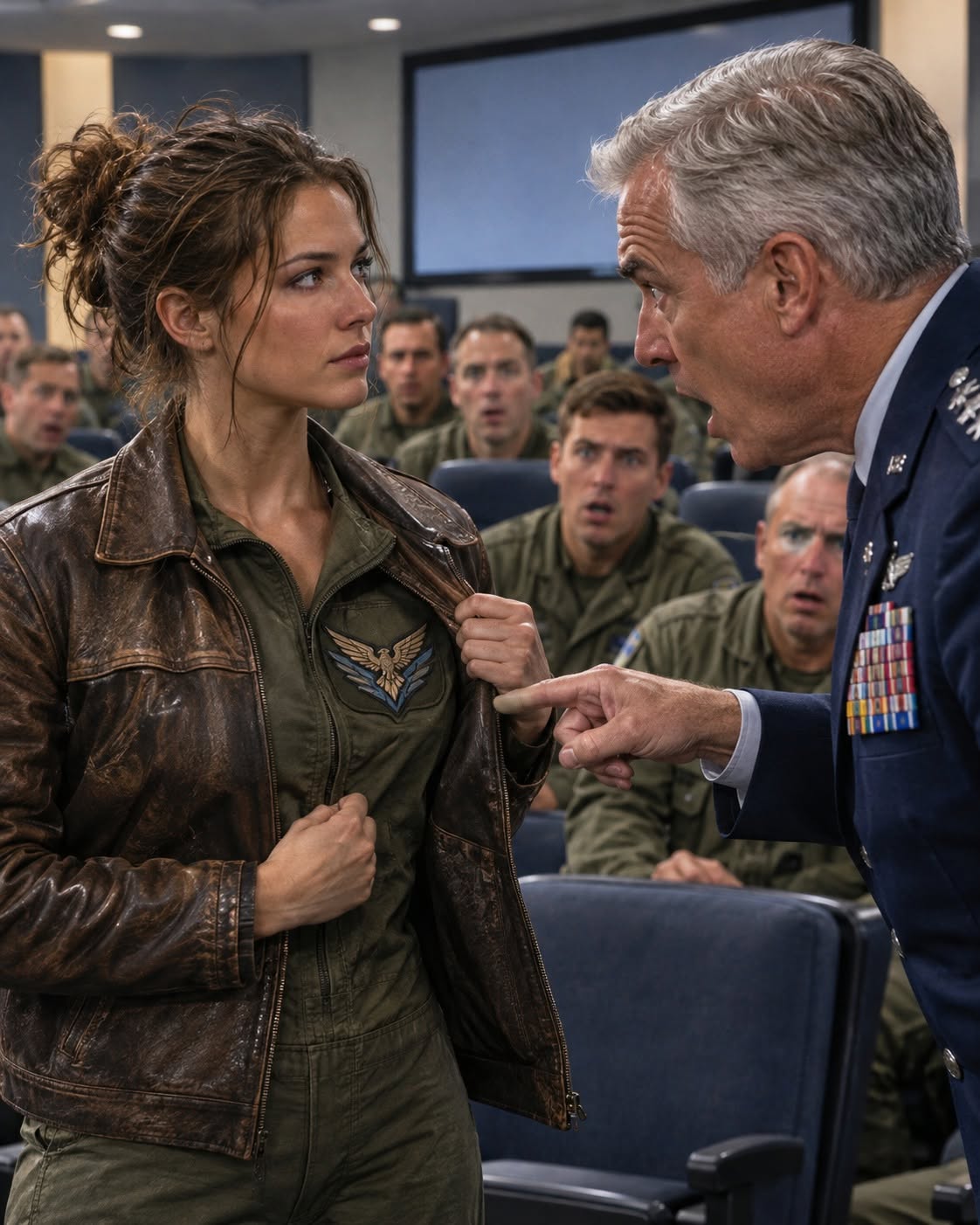
I nodded.
But before I could explain, he finally broke the seal.
Inside was a single handwritten letter, a faded photograph, and a small metal object wrapped in a piece of cloth.
The photograph showed three young pilots standing beside an aircraft. One was Daniel Hayes. Another was a younger version of the man sitting across from me.
The third was someone I recognized immediately.
My father.
The commander stared at the photograph.
“Where did you get this?”
“It was among Colonel Hayes’s personal belongings.”
He turned it over.
Three names were written on the back, followed by a date: September 17, 1998.
His hands began to shake.
“That was the night everything went wrong.”
I pulled out the chair opposite him.
“Yes, sir. I know.”
He unfolded the letter.
And then he began to read.
THE NIGHT THAT NEVER ENDED
September 17, 1998.
Thirty years earlier, the commander had been a young captain named Richard Mercer.
He was talented, ambitious, and widely considered one of the finest pilots in his squadron. He had a gift for reading the sky, making impossible decisions, and pushing aircraft beyond what other pilots believed they could handle.
Daniel Hayes was his instructor.
He was older, quieter, and far less interested in medals or recognition. He believed a pilot’s greatest responsibility wasn’t completing a mission.
It was bringing the people under his command home.
My father, Thomas Reed, was the third member of their small flight team.
The three had become inseparable.
They flew together, trained together, and spent countless nights arguing over maps, equipment, and the best way to keep inexperienced pilots alive.
Then came the night that changed everything.
Their aircraft were conducting a classified training exercise over rough terrain when an unexpected mechanical failure caused one aircraft to go down.
Mercer’s aircraft was badly damaged.
He managed to eject, but landed in a narrow valley surrounded by steep ridges. His radio was damaged, one leg was broken, and a storm was moving across the area.
Hayes was leading the formation.
The safest decision was to continue toward the designated recovery zone and report the incident.
But Mercer was still transmitting.
“Mayday. Mayday. This is Falcon Two. I’m down. Repeat, I’m down.”
Hayes heard him.
So did my father.
The weather was deteriorating. Their fuel was running low. The valley was nearly impossible to reach from the air.
Hayes ordered the formation to continue.
My father hesitated.
Then he asked, “And what about Mercer?”
“Rescue team is being dispatched,” Hayes answered.
But both men knew the rescue team would not reach the valley before the storm.
Mercer’s final transmission came through seconds later.
“Danny, if you can hear me, don’t come back. I don’t want another aircraft down here.”
Hayes looked at the radar.
Then he made a decision.
He turned around.
My father followed.
They descended into dangerous terrain, fighting violent winds and near-zero visibility. They found Mercer’s position, but landing was impossible.
Hayes managed to guide Mercer toward a relatively flat stretch of ground while my father coordinated the extraction.
Then disaster struck.
A sudden crosswind pushed Hayes’s aircraft dangerously close to the ridge. He managed to pull away, but not before the aircraft clipped a rocky outcrop.
The impact damaged the engine and sent debris into the cockpit.
Hayes was injured.
My father was forced to make an emergency landing farther down the valley.
For nearly two hours, the three men fought to survive.
Mercer was eventually pulled into my father’s aircraft.
Hayes, however, remained trapped near the ridge.
My father could have left.
He had already completed the extraction. His aircraft was damaged, the storm was worsening, and his chances of making it back were uncertain.
But he refused.
He climbed out, crossed the rocky ground, and reached Hayes.
He found his mentor bleeding beneath a broken section of the aircraft.
“Get up, Colonel.”
Hayes shook his head.
“Leave me, Tommy.”
My father grabbed his shoulder.
“You taught me never to leave a man behind.”
Hayes looked at him.
Then, despite his injuries, he laughed.
“That was supposed to be a lesson, not an excuse to get yourself killed.”
They tried to move toward the extraction point.
But before they reached it, another section of the damaged aircraft shifted.
A piece of metal struck Hayes’s leg, trapping him beneath the wreckage.
My father tried to free him.
He worked until his hands were bleeding.
Then Hayes looked at him and understood something.
There was only enough time for one of them to reach the extraction point.
“Tommy,” he said quietly. “You have a family.”
My father shook his head.
“So do you.”
“Listen to me. You’re going to make it out of here.”
My father refused.
Hayes reached into his flight jacket and pulled out a small silver falcon patch.
It was the squadron’s original insignia, something he had carried since his first combat deployment.
He pressed it into my father’s palm.
“Give this to your boy one day. Tell him that a uniform doesn’t make a man honorable. His decisions do.”
My father closed his fingers around it.
Then Hayes did something unexpected.
He grabbed the emergency beacon and activated it manually, directing the rescue team toward my father’s position rather than his own.
The rescue crew found my father and Mercer.
Hayes was never recovered alive.
The official report stated that he had died following an aircraft accident during a dangerous rescue operation.
Mercer survived.
But the report contained one additional sentence that changed the course of three lives.
It stated that Captain Richard Mercer had been the flight leader responsible for the failed operation.
That wasn’t true.
Hayes had been in command.
Mercer had been stranded.
But before the rescue, Hayes had made a request through the emergency channel.
He asked that Mercer not be blamed for the incident.
He knew the investigation would be brutal. He knew that a young pilot’s career could be destroyed by a single tragedy.
So he took responsibility.
And Mercer allowed it to happen.
Not because he was proud.
Because he was terrified.
He was afraid of losing his career, afraid of disappointing his family, and afraid of admitting that the man who had saved his life had paid for it with his own.
For thirty years, that silence followed him.
THE LETTER
The commander stopped reading.
His eyes were fixed on the final paragraph.
I watched his shoulders begin to tremble.
“What did I do?” he whispered.
I didn’t answer.
He continued reading.
“Danny knew?”
“Yes, sir.”
“Knew what?”
“That you had the chance to correct the report. He knew you stayed silent.”
Mercer looked up sharply.
“Then why would he leave me this letter?”
“Because he didn’t hate you.”
The commander stared at me.
I continued.
“My father told me that Colonel Hayes never spoke badly about you. Not once. He said you were young, frightened, and given a choice that no young pilot should ever have to face.”
Mercer looked back at the letter.
His voice broke as he read the final lines aloud.
“Richard, I never blamed you for surviving. I only hoped that one day you would understand that survival is not the same thing as living.
You spent years protecting the story that saved your career. I hope you will spend whatever years remain protecting the people who trusted you.
If you ever have the chance to tell the truth, do it.
Not for me.
Not for the record.
For the next young pilot who might believe that silence is the price of belonging.
Your friend,
Danny.”
The room was completely silent.
Mercer folded the letter carefully.
Then he looked at me.
“Your father was Thomas Reed?”
“Yes, sir.”
“Is he still alive?”
I shook my head.
“He passed away six years ago.”
Mercer looked down.
“I’m sorry.”
“He never regretted going back for Colonel Hayes,” I said. “Not once.”
The commander covered his face with both hands.
For a long time, neither of us spoke.
Then he asked something I hadn’t expected.
“Why didn’t you tell me all this when you first arrived?”
I looked at my jacket.
“Because I wasn’t wearing it to make a statement, sir.”
I paused.
“I was wearing it because my father asked me to keep it safe. Colonel Hayes gave it to him before he died. My father wanted the jacket to remind me that the best pilots aren’t remembered for how many missions they complete. They’re remembered for the people they refuse to abandon.”
Mercer looked at the silver falcon.
“And the blood?”
“Colonel Hayes’s. My father never had the heart to clean it.”
The commander slowly nodded.
Then his eyes moved toward the door.
“Bring everyone back.”
I stood.
“Sir?”
“Bring them back. They need to hear this.”
THE SECOND BRIEFING
The pilots returned one by one.
Nobody laughed this time.
Mercer stood at the front of the room with the photograph in one hand and the letter in the other.
He looked older than he had an hour earlier.
“Before we begin,” he said, “I owe this squadron an explanation.”
He placed the photograph on the table.
“This is Colonel Daniel Hayes. Some of you may have seen his name in our historical records. He was an exceptional pilot, an instructor, and a leader.”
He paused.
“But the official account of his final mission is incomplete.”
A murmur moved through the room.
Mercer told them everything.
He explained the failed extraction, the damaged aircraft, the decision to return to the valley, and the rescue that had cost Hayes his life.
Then he explained the report.
He didn’t soften his own part in it.
“I was the pilot who survived. I knew the report was wrong. I knew Colonel Hayes had taken responsibility for my mistakes and for the decisions made that night. I had the opportunity to correct it.”
His voice faltered.
“I didn’t.”
One of the younger pilots shifted uncomfortably.
Mercer continued.
“For thirty years, I told myself I was preserving the memory of a great man. The truth is, I was protecting myself.”
Nobody looked away.
“I let a dead man carry a burden that belonged to me.”
He placed the letter beside the photograph.
“That ends today.”
Then he turned toward me.
“Captain Reed, step forward.”
I walked to the front.
The commander looked at my jacket.
“Earlier, I told you that this jacket was a disgrace to the uniform.”
He took a breath.
“I was wrong.”
He faced the room.
“This jacket belonged to a man who understood the meaning of service better than I did. Its condition is not a reflection of disrespect. It is a reminder of sacrifice.”
Then he did something that made every pilot in the room sit straighter.
He saluted me.
Not because I outranked him.
Not because I had demanded an apology.
But because he knew whose memory I was carrying.
I returned the salute.
He lowered his hand.
“Captain, I owe you an apology.”
“Yes, sir.”
“I judged you by what I saw on the outside. I didn’t bother to ask what the jacket meant.”
He looked at the others.
“Let that be a lesson to every officer in this room. Rank gives you authority. It does not give you permission to humiliate someone.”
The pilots remained silent.
Then the youngest lieutenant raised his hand.
“Sir, may I ask something?”
Mercer nodded.
“Why did Colonel Hayes go back? Wasn’t there a protocol for that situation?”
The commander looked at him.
“There was. But protocols are written for situations we can predict. Leadership is tested when reality becomes more complicated than the checklist.”
He glanced at the photograph.
“Colonel Hayes didn’t go back because he believed he was invincible. He went back because he knew exactly what it meant to leave someone behind.”
The lieutenant lowered his hand.
I could see something changing in the room.
The pilots who had laughed at my jacket were now looking at it with a different kind of attention.
But the story wasn’t finished.
Not even close.
THE RECORD THAT HAD TO BE CHANGED
The next morning, Mercer submitted a formal request to reopen the investigation into the 1998 incident.
It was not a simple process.
The documents were old. Some witnesses had retired. Others had passed away. The original mission records were incomplete, and several classified files required special authorization.
His legal adviser warned him that the investigation could damage his career.
Mercer signed the request anyway.
Within a week, the matter reached senior command.
Within a month, he was called to a formal review.
I was asked to provide my father’s personal records, including the journal he had kept during his final years.
I had never read the entire journal.
My father rarely spoke about the night Colonel Hayes died. Whenever I asked, he would simply say, “There are things you carry because someone has to remember.”
Inside the journal was a page dated September 18, 1998.
It read:
“Danny is gone. Richard is alive.
I keep hearing people call it a successful rescue. They don’t understand.
We brought two men home, but we lost the one who taught us what home was worth.
Richard believes Danny died because of him. I told him that isn’t true.
Danny made his choice.
But I also told Richard that a man’s choice doesn’t erase his responsibility to tell the truth.
I hope he finds the courage before the years run out.”
The review board eventually confirmed what had happened.
Radio transmissions supported Hayes’s decision to return.
Maintenance records established the aircraft damage.
My father’s testimony and the newly discovered letter filled in the remaining gaps.
The official report was amended.
Colonel Daniel Hayes was recognized for his extraordinary leadership and sacrifice.
My father was formally commended for the rescue attempt and his refusal to abandon his instructor.
Mercer’s role was also corrected.
The record did not excuse his silence.
But it acknowledged his later decision to take responsibility and help establish the truth.
The commander received no public punishment.
He was, however, removed from consideration for a senior promotion while the review was underway.
Some people thought that was too lenient.
Others believed it was fair.
Mercer never argued about the outcome.
He said he had already received the only judgment that mattered.
He had spent thirty years knowing the truth.
And now everyone else did too.
THE LAST FLIGHT
Three months later, the squadron held a memorial ceremony at Nellis.
There were no elaborate decorations.
No expensive speeches.
Just a formation of pilots, a photograph, and three names engraved on a new memorial plaque.
DANIEL HAYES.
THOMAS REED.
RICHARD MERCER.
Mercer had insisted that his own name be included.
Not as a hero.
As a witness.
As a reminder that the truth had taken far too long to come out.
I stood before the plaque wearing the same battered jacket.
This time, nobody questioned it.
A young lieutenant approached me after the ceremony.
“Captain, can I ask you something?”
“Of course.”
“Why didn’t you ever replace the jacket?”
I smiled slightly.
“Because some things become more valuable with age.”
He looked at the faded sleeve.
“But wouldn’t it be better to preserve it somewhere? In a museum, maybe?”
I considered that.
“Perhaps one day. But not yet.”
He nodded.
Then he asked the question I had been expecting.
“Did your father ever regret what happened?”
I looked toward the runway.
“No. He regretted losing his friend. He regretted not being able to save him. But he never regretted going back.”
The lieutenant was quiet.
I continued.
“Your career will give you plenty of opportunities to prove how skilled you are. Your awards will tell people how well you performed. Your flight hours will show how much experience you’ve gained.”
I tapped the silver falcon beneath the collar.
“But none of those things will tell you what kind of person you are when someone needs you.”
He looked at the memorial.
“I understand, sir.”
“I hope you do.”
He saluted and walked away.
Across the tarmac, I saw Mercer standing alone.
He had retired from active command shortly after the investigation concluded. His decision had surprised many people, but he explained it simply.
He had spent too many years commanding others without first making peace with the man he had been.
Now he wanted to spend time with his family.
I approached him.
“Sir.”
He turned.
“Captain Reed.”
We stood together in silence.
Then he handed me something.
It was the original photograph.
“I think this belongs with you.”
I took it carefully.
“Thank you, sir.”
He looked at the picture for a long moment.
“Your father was a better man than I was.”
I shook my head.
“He wouldn’t have agreed with you.”
Mercer gave a faint smile.
“He would have argued with me, wouldn’t he?”
“Yes, sir. Probably for hours.”
For the first time, I saw the commander laugh without any bitterness in it.
Then his expression grew serious.
“There’s something I need to tell you.”
I waited.
“After Hayes died, I spent years wondering whether he would have survived if I’d made a different decision. I thought about it every night. I imagined a hundred different endings.”
He looked down at his hands.
“But the thing that haunted me most wasn’t the crash. It was the fact that I let his final act become a lie.”
I understood.
“Why are you telling me this?”
“Because I want you to know that you don’t owe me forgiveness.”
I looked at him.
“Sir, I don’t think my father would want me carrying your guilt.”
Mercer nodded slowly.
“And what do you want?”
I glanced at the jacket.
“I want the next generation to hear the real story.”
He looked toward the memorial.
“Then make sure they do.”
WHAT THE JACKET WAS REALLY FOR
A year later, I was assigned to lead a new group of young pilots.
On the first day of training, I walked into the briefing room wearing the same old jacket.
The leather was still cracked.
The sleeve was still faded.
The stain was still there.
But now, beneath the collar, I had added a small inscription.
Not a medal.
Not a rank.
Just four words:
BRING EVERYONE HOME.
One of the new pilots noticed it.
“Sir, is that your personal motto?”
I looked at the words.
“It belonged to three men before it belonged to me.”
I told them about Hayes, my father, and Mercer.
I told them about the night in the valley, the failed rescue, and the letter that had waited thirty years to be opened.
I didn’t tell the story to make them afraid of mistakes.
Mistakes happen.
Equipment fails.
Plans collapse.
Even the best pilots sometimes find themselves in situations they cannot control.
I told them because I wanted them to understand the difference between making a mistake and refusing to take responsibility for it.
I wanted them to know that courage wasn’t always about flying into danger.
Sometimes it meant admitting you were wrong.
Sometimes it meant returning to a conversation you had avoided for decades.
And sometimes it meant standing in front of a room full of people and telling the truth, even when doing so could cost you everything.
After the briefing, the youngest pilot stayed behind.
“Sir, do you think Colonel Hayes knew he wasn’t coming back?”
I looked at the silver falcon.
“I think he knew there was a chance.”
“Wasn’t he afraid?”
“Of course he was.”
The pilot seemed surprised.
I smiled.
“Being brave doesn’t mean you’re not afraid. It means you understand that something matters more than your fear.”
He nodded.
Then he glanced at my jacket.
“Sir, if you ever decide to retire it, I’d be honored to help preserve it.”
I studied him for a moment.
Then I reached up and removed the jacket.
He looked startled.
I placed it in his hands.
“Take care of it.”
His eyes widened.
“Sir, are you sure?”
“I’m sure.”
I pointed toward the inscription beneath the collar.
“Don’t preserve the leather. Preserve what it stands for.”
He held it carefully, almost reverently.
I walked toward the door.
Behind me, he asked one final question.
“Captain, what happened to the envelope?”
I stopped.
For a moment, I thought about the words written in Daniel Hayes’s handwriting.
Then I answered.
“It was placed in the squadron archives, alongside the corrected report and the photograph.”
“Why?”
“So nobody would ever have to wonder again why three men went back into that valley.”
I left him standing there with the jacket.
Outside, aircraft engines roared across the runway.
For years, I had believed I was carrying a piece of my father’s past.
But that day, I understood something different.
I wasn’t carrying his past anymore.
I was carrying his promise into the future.
And somewhere, in the quiet space between one generation of pilots and the next, the lesson of three men finally found its way home.
THE MEANING OF THE SILVER FALCON
People often think a uniform is made of fabric, insignia, and rank.
They believe respect comes from polished boots, perfect appearances, and the number of decorations displayed on a chest.
But a uniform is only clothing.
It cannot make a coward courageous.
It cannot make a selfish person honorable.
And it cannot turn a man into a leader simply because someone has pinned a star to his shoulder.
That takes something else.
It takes the willingness to accept responsibility when things go wrong.
The courage to tell the truth when silence would be easier.
And the strength to remember that the people beside you are never just names on a mission roster.
Years later, the silver falcon was placed in a glass case at the squadron memorial.
Beside it were three photographs and a copy of Daniel Hayes’s letter.
Underneath, a small plaque carried the words I had once found beneath the collar of an old flight jacket:
“THE TRUE MEASURE OF A PILOT IS NOT HOW HIGH HE CAN FLY, BUT HOW MANY PEOPLE HE REFUSES TO LEAVE BEHIND.”
And whenever a new pilot asked about the faded leather jacket, the old bloodstain, or the tiny silver bird, someone would tell them the story.
Not because the three men had been perfect.
They hadn’t.
One had made a sacrifice.
One had carried a painful truth.
And one had spent thirty years learning that the courage to admit a mistake can be just as important as the courage to face danger.
Their story survived because, eventually, someone chose to speak.
And that was the final lesson Colonel Hayes had left behind:
A leader is not remembered by the uniform he wears, the rank he holds, or the victories he claims. A leader is remembered by the people he protects, the truth he stands for, and the courage he shows when nobody is watching.