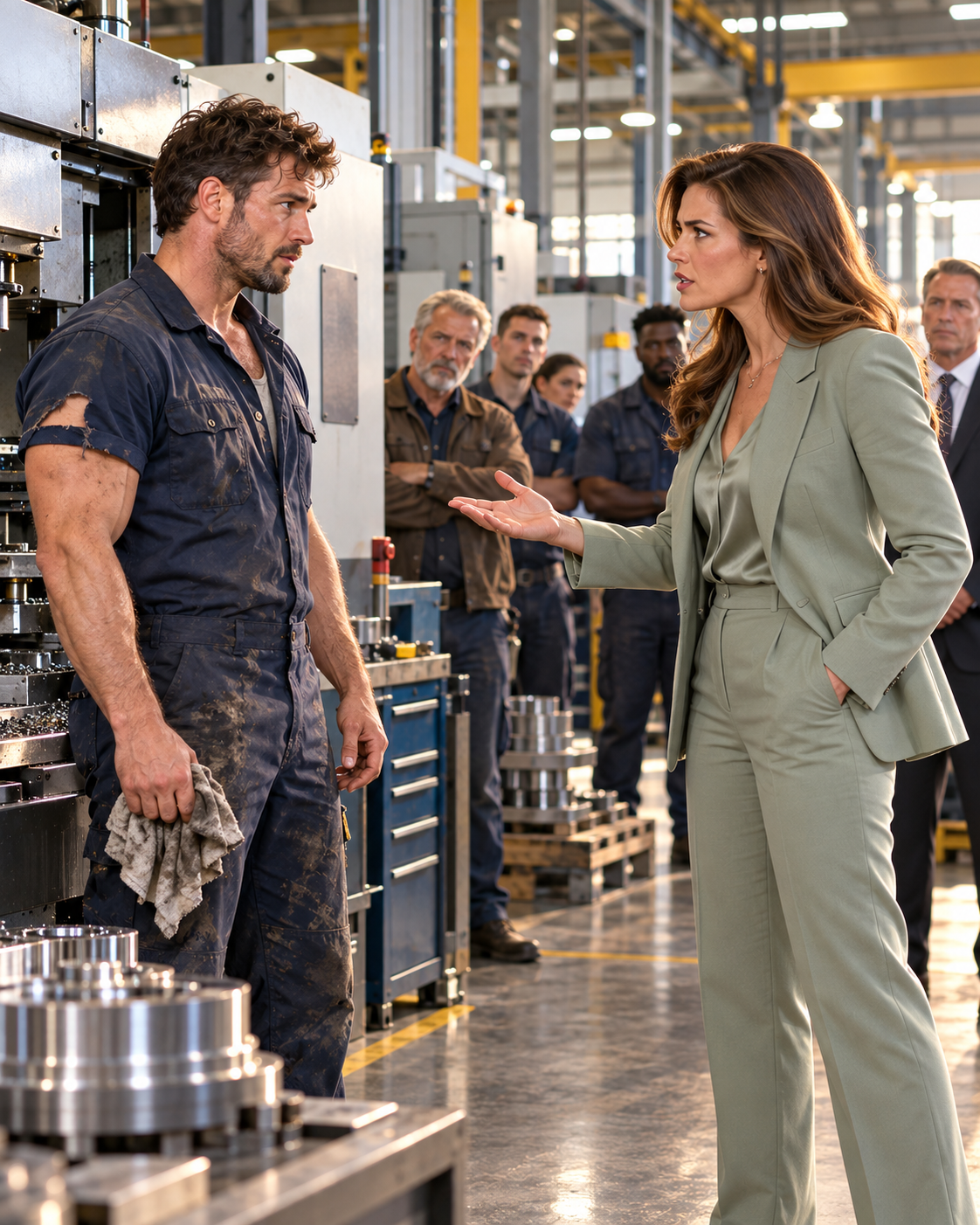
Standing in the polished marble lobby of our Columbus plant, I watched CEO Derek Vance point at my torn sleeve
Part 2
The next morning, I didn’t go home until sunrise.
I sat in my truck outside the plant with both hands resting on the steering wheel, watching the sky turn gray over the Columbus rooftops.
My body was exhausted.
My mind wouldn’t stop.
Two million dollars.
That number kept circling through my head.
Two million dollars was not a mistake.
It wasn’t a misplaced decimal.
It wasn’t someone ordering the wrong part by accident.
It was a trail.
And someone had been following it for a long time.
When I finally walked into my house, Chloe was sitting at the kitchen table in her pajamas.
She looked up from a bowl of cereal.
“You look terrible.”
“Good morning to you too.”
She smiled.
“Did you catch the machine?”
“The machine caught me.”
She laughed.
Then she noticed my face.
“What happened?”
I put my keys down.
“Work got complicated.”
She studied me for a moment.
“Are you in trouble?”
I thought about Derek’s expression.
“No.”
At least, I hoped not.
I kissed the top of her head and went upstairs.
Three hours later, Robert called.
“Come back to the plant.”
I did.
This time, I wore a clean shirt.
Robert was waiting in the same conference room.
There were two accountants beside him, along with the head of legal.
Derek wasn’t there.
Robert pointed to a chair.
“Sit.”
I sat.
He pushed a folder across the table.
“We traced the payments.”
My stomach tightened.
“How bad?”
“Bad enough that I’m glad you kept those records.”
The legal director opened another file.
“Northstar Industrial Supply was created four years ago.”
I listened.
“The registered owner is a man named Michael Rourke.”
I recognized the name.
“Michael Rourke?”
Robert nodded.
“You know him?”
“Not personally.”
But I knew the name.
Rourke had been mentioned once in the maintenance department.
Someone had said he was connected to Derek from college.
I looked at Robert.
“He’s Derek’s friend.”
“His former roommate.”
The room became silent.
The accountant spoke.
“Northstar charged Sterling Industrial premium prices for high-grade components.”
“And supplied cheaper components instead?”
“Exactly.”
“How did they hide it?”
“Through paperwork.”
The legal director slid several invoices toward me.
“On paper, the part numbers match.”
I studied them.
“They don’t match physically.”
“We know.”
He pushed another document forward.
“Someone inside the company approved every payment.”
“Who?”
Nobody answered immediately.
Then Robert said, “Derek.”
I looked down.
For a moment, I felt nothing.
Then something inside me sank.
I had worked nineteen years for that company.
I had believed that when the executives walked through the factory, they understood what was at stake.
Apparently, one of them understood only what he could take.
Robert continued.
“There are shell payments, consulting fees, and inflated freight charges.”
“How much?”
“Two point three million dollars so far.”
I stared at the number.
“And the failures?”
“The failures created a second stream of profit.”
I frowned.
The accountant explained.
“Every failed seal required emergency replacement.”
“So Northstar sold us the cheap parts, then sold us more parts when they failed.”
“Yes.”
I leaned back.
It was almost elegant in its cruelty.
They had built a machine that made money every time ours broke.
Robert looked at me.
“There’s more.”
I waited.
“The repeated failures also caused production delays.”
I nodded.
“And those delays were blamed on maintenance.”
My throat tightened.
“They made us look incompetent.”
“Yes.”
I thought about the maintenance crew.
Men and women who worked nights, weekends, holidays.
People who skipped family dinners to get production running again.
People who had been quietly blamed for failures they didn’t cause.
I suddenly understood why Derek had wanted me removed from that lobby.
He hadn’t been embarrassed by my clothes.
He had been afraid of my evidence.
Robert stood.
“I’ve contacted federal investigators and our outside auditors.”
Derek’s voice suddenly echoed from the hallway.
“You didn’t have the right.”
The door opened.
He walked in with a lawyer.
His face was pale, but he was trying desperately to look composed.
Robert didn’t sit.
“You stole from this company.”
Derek’s jaw tightened.
“That’s an accusation.”
“We have records.”
“You have assumptions.”
I stood.
“I have failed parts.”
Derek looked at me.
“You.”
The word came out like an insult.
“You think you understand all this because you changed a few seals?”
I didn’t answer.
He stepped closer.
“You have no idea how this company works.”
I looked at him.
“Maybe not from your office.”
His eyes narrowed.
“But I’ve spent nineteen years listening to machines tell us when something was wrong.”
I pointed toward the hallway.
“And for four months, they were telling us something was wrong with you.”
Nobody spoke.
Derek’s lawyer whispered something into his ear.
Robert turned toward security.
“Take Mr. Vance to his office.”
Derek stared at him.
“You can’t do this.”
Robert’s expression didn’t move.
“I founded this company.”
Then he added quietly,
“And I will not let you bury it.”
Derek was escorted away.
He didn’t look at me again.
The investigation lasted weeks.
Auditors pulled thousands of invoices.
Investigators interviewed employees.
Several people admitted they had noticed irregularities but were afraid to speak.
One supervisor confessed that Derek had threatened to fire anyone who questioned Northstar’s invoices.
Another said he had been told to blame maintenance for production losses.
The deeper they dug, the uglier it became.
Derek was terminated.
Northstar’s contract was canceled.
Michael Rourke disappeared from the supplier list before he could disappear from the investigation.
And the company finally began replacing the damaged components with the parts we should have been using all along.
The strangest part was what happened afterward.
Production stabilized.
The emergency repairs dropped.
The night shift stopped drowning in breakdowns.
And suddenly, people started noticing something they should have noticed years earlier.
The machines weren’t unreliable.
The system around them had been corrupted.
One Friday afternoon, Robert asked me to meet him privately.
His office looked different without Derek’s shadow hanging over everything.
He sat behind his desk.
“I owe you an apology.”
I shook my head.
“For what?”
“For not listening sooner.”
I looked at him.
“I don’t think you knew.”
“I should have.”
He opened a drawer.
Inside was a folder with my name on it.
I stared at it.
“What is that?”
“Your promotion.”
I almost laughed.
“Promotion?”
“Maintenance supervisor.”
I didn’t touch the folder.
Robert continued.
“You’ve spent nineteen years keeping this place alive.”
“You want me behind a desk now?”
“I want you leading the people who know this plant better than anyone.”
I thought about it.
Then I said,
“I’ll accept on one condition.”
Robert smiled slightly.
“I expected there would be one.”
“The night shift gets a direct voice.”
He leaned back.
“What do you mean?”
“Floor workers see problems first.”
I looked him straight in the eyes.
“They hear strange vibrations.”
“They smell overheated motors.”
“They notice parts that don’t look right.”
“They know when a line is being pushed too hard.”
I paused.
“But they don’t always speak.”
“Why?”
“Because they’ve learned that management doesn’t always listen.”
Robert was silent.
I continued.
“If someone on the floor sees something dangerous, I want them to have a direct path to report it.”
“No supervisor blocking it?”
“No.”
“No fear of retaliation?”
“No.”
“And no punishment for raising a concern in good faith?”
“Exactly.”
Robert nodded.
“Done.”
He stood and extended his hand.
I shook it.
That handshake meant more to me than the promotion.
Because for the first time in nineteen years, someone wasn’t just asking me to work harder.
Someone was asking me to speak.
Part 3
Six months later, I had a small office overlooking the production floor.
It had a desk.
A filing cabinet.
A computer I barely knew how to use.
And a window that looked directly at Press Seven.
I still wore the same work boots.
I still walked the floor every morning.
I still carried a flashlight in my pocket.
Some people thought a supervisor should spend most of his day sitting behind glass.
I disagreed.
Machines didn’t tell the truth through spreadsheets.
They told the truth through sound.
One afternoon, I was reviewing maintenance logs when the office door opened.
Chloe walked in.
She was wearing her school backpack and the expression of someone who had already decided her father was embarrassing.
She looked around.
“So this is your big supervisor office?”
“Apparently.”
She pointed at my sleeve.
“Dad.”
“What?”
“You still have grease on your clothes.”
I looked down.
She was right.
I laughed.
“Some things don’t change.”
She shook her head.
“You have a whole office now.”
“I know.”
“And you still look like you work here.”
“I do work here.”
She smiled.
Then she walked to the window.
She watched the machines below.
“Is that the one you fixed?”
“One of them.”
She was quiet for a moment.
Then she said,
“Grandma says you saved the company.”
I smiled.
“I just found something that was already wrong.”
Chloe turned toward me.
“That’s what saving something means sometimes.”
Her words caught me off guard.
I looked at my daughter.
Twelve years old.
Too young to understand corporate fraud.
Old enough to understand what it meant to stand up when something was wrong.
I reached for her backpack.
“Come on.”
“Where?”
“There’s something I want to show you.”
We walked through the production floor.
Workers waved.
Some called me by my first name.
Others asked about their schedules.
One mechanic stopped me to report a strange vibration on a conveyor motor.
I listened.
Then I told him I’d come look at it.
Chloe watched everything.
She didn’t see a supervisor.
She saw her dad.
We eventually reached the lobby.
She stopped.
“Dad.”
“What?”
She pointed toward the wall.
There was a large framed photograph.
Robert Sterling stood beside me in front of Press Seven.
Both of us were smiling.
Robert was wearing his dark sweater.
I was wearing my grease-stained coveralls.
My sleeve was still torn.
Someone had taken the picture the day the investigation ended.
Beneath it was a simple plaque.
“Integrity begins where the work is done.”
Chloe read it twice.
Then she looked at me.
“They put you on the wall.”
I shrugged.
“Looks like it.”
She smiled.
“You better not get famous.”
“I’ll try not to.”
She laughed.
Then she noticed something else.
“Why did they choose that picture?”
I looked at it.
Because there were dozens of better pictures.
Pictures of executives in suits.
Pictures of new machinery.
Pictures of ribbon cuttings.
Pictures of awards.
But Robert had chosen the one where my hands were dirty.
The one where my sleeve was torn.
The one where I looked exactly like the man Derek had tried to throw out.
“I think,” I said slowly, “they wanted people to remember something.”
“What?”
I looked at the photograph.
“That getting dirty doesn’t mean you don’t understand the value of what you’re touching.”
Chloe nodded.
Then she slipped her hand into mine.
We stood there quietly.
A few years earlier, I had believed my job was simply to keep machines running.
Then I learned that wasn’t true.
My job was to notice.
To listen.
To speak when something was wrong.
And, when necessary, to stand in a room where everyone else had decided not to see.
I thought about Derek.
About his expensive suit.
His polished shoes.
His contempt.
For a long time, I had believed he was ashamed of me because I was a laborer.
Now I understood.
He wasn’t ashamed of what I was.
He was afraid of what I knew.
That realization stayed with me.
Because there will always be people who measure your worth by your clothes, your title, your salary, or the room you’re allowed to enter.
They will look at grease under your fingernails and assume you have nothing valuable to say.
They will confuse quietness with ignorance.
They will mistake humility for weakness.
But the people who keep the lights on rarely receive applause for it.
The people who repair what breaks rarely get their names engraved on the building.
And sometimes the person everyone overlooks is the only person paying attention when something begins to crack.
That evening, Chloe and I walked out through the front doors.
She glanced back at the photograph one more time.
“Are you proud?”
I thought about the nineteen years.
The night shifts.
The missed dinners.
The broken machines.
The bills.
The fear.
The humiliation in that lobby.
The moment the elevator doors opened.
The moment Robert believed me.
I looked at my hands.
There was still grease beneath my fingernails.
I smiled.
“Yeah.”
Chloe squeezed my hand.
“Good.”
We walked toward the parking lot as the evening shift began arriving.
Behind us, the factory lights came alive one section at a time.
And for the first time in my life, I realized that pride had never been about wearing clean clothes or sitting in the biggest office.
It was about knowing that when something mattered, you had shown up.
It was about doing honest work when nobody was watching.
It was about having the courage to speak when silence would have been easier.
And sometimes, it was about walking into a room covered in grease, being told you didn’t belong, and discovering that the very thing they looked down on was the reason the truth finally came to light.
That photograph stayed on the lobby wall long after Derek Vance was gone.
And every morning, when the workers passed beneath it, they saw a man in torn coveralls standing beside the founder of the company.
Not because he was powerful.
Not because he was rich.
Not because he had the right title.
But because when everyone else looked at the numbers, he listened to the machine.
And when the machine told him something was wrong, he refused to look away.