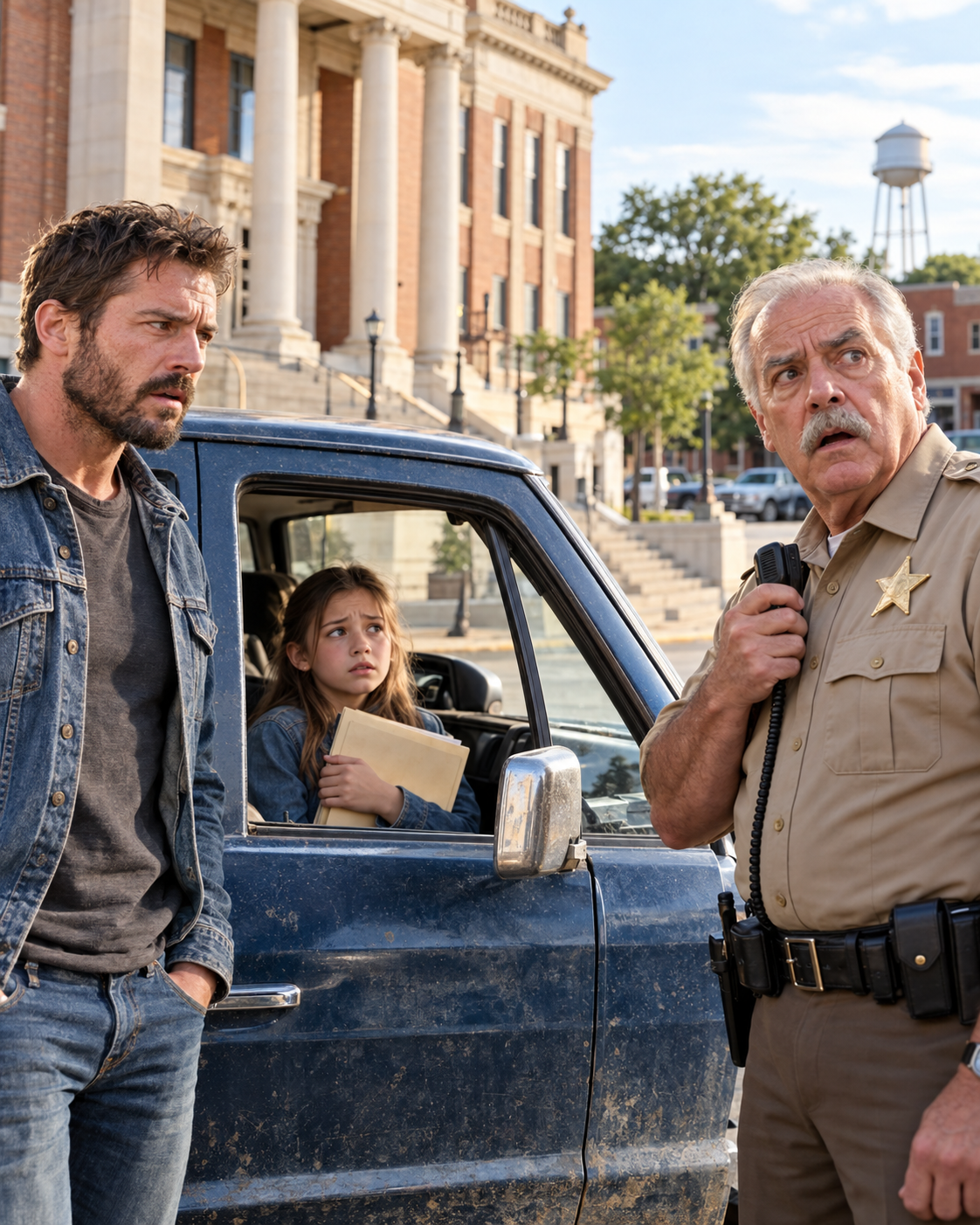
Sheriff Dale Vance humiliated me in front of the Red Creek courthouse, ordering me to leave town before sunset because of my LAST NAME
Henry didn’t move for several seconds, his eyes fixed on the letter as if the ink itself had begun to burn.
Outside, the last light of evening spilled through the workshop windows, illuminating the dust floating above the workbenches my father had built with his own hands.
Chloe stood beside me, holding a flashlight against her chest.
“What happened to the second set of records?” I asked.
Henry slowly lowered himself onto a stool.
“Arthur made a copy of everything before the fire investigation was closed,” he said. “He believed someone would eventually try to destroy the original evidence.”
“Someone did,” I replied.
He nodded. “But the copies disappeared before he could deliver them to the state investigators.”
I stared at the envelope again.
“Then why did he write your name?”
Henry looked away.
“Because I was the last person he trusted with them.”
The answer landed harder than I expected.
My father had spent the final years of his life carrying a disgrace that could have been lifted by a handful of documents, and the man who might have helped him had apparently kept silent.
“You knew he was innocent,” I said.
“I knew he had saved that worker. I knew the official report was wrong. But I didn’t know where the second records went, and I couldn’t prove who had altered the investigation.”
“That isn’t what I asked.”
Henry’s jaw tightened.
“No,” he admitted. “It isn’t.”
Chloe glanced at the old photograph of my father hanging above the tool cabinet.
“Did Grandpa ask you for help?”
Henry closed his eyes.
“He did.”
The room seemed to shrink around us.
“Then why didn’t you help him?” I demanded.
“Because I was afraid,” Henry said, his voice breaking. “I had a wife, two young children, and a mortgage. The department warned me that challenging the report would end my career. I told myself I needed more evidence. I told myself I’d speak when I had something they couldn’t deny.”
He rubbed his palms together, staring at the scars that crossed my father’s photograph.
“By the time I found the courage, Arthur had stopped asking.”
For years, I had imagined my father’s final days as a lonely battle against a town that refused to listen, but now I understood something worse: sometimes people didn’t abandon you because they hated you; sometimes they abandoned you because helping you would cost them something.
And their silence could hurt just as deeply.
“I can’t undo what I did,” Henry whispered.
“No,” I answered. “You can’t.”
I wanted to forgive him, partly because he had helped clear my father’s name and partly because I was exhausted from carrying anger that had never belonged to me.
But forgiveness wasn’t a switch I could flip just because the truth had finally arrived.
“Help me find those records,” I said. “Then we’ll decide what happens next.”
Henry nodded.
For the next three days, we searched the property from the cellar to the attic, opening cabinets, lifting floorboards, and examining every box my father had left behind.
We found old invoices, rusted tools, photographs, and letters he had written but never mailed.
One letter was addressed to me.
I sat alone at the workbench before opening it, suddenly afraid of hearing my father’s voice in a way I could never answer.
“Son,” it began, “if you’re reading this, I probably failed to make people understand what happened.”
I stopped, pressing my thumb against the paper.
He wrote that he had never regretted entering the warehouse, even when the burns left him unable to work for months.
He wrote that the man he rescued, a maintenance worker named Daniel Mercer, had survived but later left Red Creek after receiving threats from the company that owned the building.
And he wrote that the hardest part of being called a criminal wasn’t the insults.
It was watching his son grow up wondering whether there was something shameful in the blood they shared.
I lowered the letter and covered my face.
My mother had died when I was young, and my father had raised me as best he could, teaching me to change a tire, replace a furnace filter, and never leave a job unfinished.
He had never told me how much the accusations hurt him.
Perhaps he had thought silence was another way of protecting me.
Perhaps he had simply run out of strength.
The letter ended with words that felt like a hand resting on my shoulder.
“People may tell you who you are before they ever meet you. Don’t waste your life begging them to change their minds. Do the right thing, and let your work speak when your voice gets tired.”
I folded the letter carefully and placed it in my jacket pocket.
That night, Chloe found me sitting outside the workshop, looking at the dark windows.
“Are you sad because Grandpa died?” she asked.
“Partly.”
“Are you sad because people were mean to him?”
I nodded.
She sat beside me on the steps.
“Maybe he would be happy now.”
I looked at her.
“Why do you think that?”
“Because we’re fixing the place he left us.”
She leaned her head against my arm.
“And because you didn’t leave when the sheriff told you to.”
For the first time since returning to Red Creek, I understood that staying hadn’t just been about defending my family name.
It had been about showing my daughter that courage wasn’t the absence of fear; it was refusing to let fear make every decision for you.
The next morning, Henry arrived with an old address he had discovered in one of his retired department notebooks.
It belonged to Daniel Mercer, the warehouse worker my father had carried through the flames.
Daniel was living in a neighboring county, nearly two hours away.
We drove there that afternoon.
The house was small, with a sagging porch and a wind chime that rattled in the cold air. A gray-haired man opened the door, and when Henry introduced himself, Daniel’s expression changed immediately.
“I wondered when somebody would come asking about Red Creek,” he said.
He invited us inside.
A photograph of a young woman and two children stood beside his television, and a cane rested against the wall near his chair.
Daniel explained that he had survived the warehouse fire but suffered serious injuries that ended his career.
He had tried to tell investigators that my father saved him, but the company lawyers insisted that Arthur had caused the fire and panicked when it spread.
“They offered me a settlement if I signed a statement saying I couldn’t identify who pulled me out,” Daniel said. “They said it would protect my medical benefits.”
“Did you sign?” I asked.
His eyes filled with shame.
“Yes.”
The room went quiet.
“I was young, hurt, and terrified I’d lose everything. I told myself I wasn’t accusing Arthur directly. I told myself the truth would come out another way.”
He looked at me.
“Instead, I let him carry the blame.”
I thought of my father spending years watching neighbors cross the street to avoid him, and I struggled to keep my voice steady.
“Why didn’t you come forward later?”
“Because the company made sure I understood what would happen if I did. Then years passed, and the longer I stayed silent, the harder it became to admit what I’d done.”
He rose slowly and walked to a locked cabinet.
From inside, he took a thick envelope containing a carbon copy of his original statement, correspondence from the warehouse’s insurance company, and a letter from my father.
“I kept these because Arthur came to see me once,” Daniel said. “He didn’t ask me to clear his name. He only asked me to remember that he had tried to save my life.”
Daniel handed me the envelope.
“I’ve spent twenty-eight years trying to convince myself that surviving made me innocent of everything else. It didn’t.”
I wanted to tell him that he was forgiven, but I couldn’t offer forgiveness on behalf of a man who was no longer alive to receive his apology.
So I told him the truth.
“You can still tell people what happened.”
Daniel nodded, wiping his eyes.
“Then I’ll tell them.”
We returned to Red Creek with the documents, and Sheriff Vance arranged another public meeting at the courthouse.
This time, the room was packed.
People stood along the walls, including former warehouse employees, retired firefighters, and residents who had repeated the accusations against my father for years.
Vance stepped to the front without his usual uniform jacket.
“My father helped suppress evidence in the 1998 warehouse fire,” he said. “I grew up believing his version of events, and when I became sheriff, I allowed that belief to influence how I treated the Reed family.”
He paused, looking directly at me and Chloe.
“I used my office to repeat an accusation I had no right to make. I am sorry.”
No one applauded.
The silence was too heavy for applause.
Then Daniel Mercer stood and described the fire, the faulty electrical bypass, and the man who had dragged him through the smoke.
He admitted signing the false statement and explained why he had kept quiet.
Henry followed with his private notes, confirming that the original investigation had ignored evidence of electrical failure and that my father had tried repeatedly to challenge the official findings.
The documents did not erase every unanswered question, but together they established what the town had refused to consider: Arthur Reed had risked his life to save another man, and the evidence blaming him for the fire had been compromised.
An elderly woman in the front row began to cry.
“I told my children he was a coward,” she whispered. “They told their children the same thing.”
She looked at me.
“I am so sorry.”
I swallowed the lump in my throat.
“I can’t change what you told them,” I said. “But you can tell them the truth now.”
That was when the room finally began to change.
People who had avoided my father’s name started speaking it aloud, some with regret, others with disbelief, and a few with tears they made no effort to hide.
The town council voted to amend the public record and replace the memorial plaque, adding Arthur Reed’s name to the list of people who had risked their lives during the fire.
They also agreed to preserve the recovered evidence and refer the case to the appropriate authorities for further review.
Sheriff Vance made no attempt to present himself as the hero of the meeting.
He stood beside the door and listened while people confronted him about his father’s role and his own treatment of me.
Afterward, he approached us in the courthouse hallway.
“I don’t expect you to forgive me,” he said.
“Good,” I answered.
He accepted that without argument.
“But I want to help with the workshop,” he continued. “Not for publicity. I know how to repair old buildings, and there are kids in this town who need somewhere to go after school.”
Chloe studied him for a moment.
“Are you going to make them leave because of their last names?”
Vance looked down.
“No,” he said. “I won’t.”
“Then you can start by fixing the broken window in the back room.”
For the first time, the sheriff gave a small, genuine smile.
“Yes, ma’am.”
Reed Repair opened six weeks later.
We started with three teenagers, two donated toolboxes, and an ancient lawn mower that refused to run no matter how many times I cleaned the carburetor.
By the end of the first month, twelve students were attending regularly.
Some came because they wanted to become mechanics. Others wanted to learn how to fix things at home. One boy came simply because his house was loud and nobody there noticed when he disappeared.
I recognized that look in him.
I had worn it myself.
We taught the students how to diagnose problems rather than replace parts blindly, how to ask for help before a small mistake became a dangerous one, and how to admit when something had gone wrong.
Henry taught basic fire safety and showed them how to recognize electrical hazards.
Daniel came on Saturdays to tell them about his years as a maintenance worker, never hiding the decisions he regretted.
Sheriff Vance repaired the building’s windows, then built a sturdy workbench near the entrance.
He never asked us to forget what his family had done.
He simply kept showing up.
One afternoon, I found Chloe standing beneath my father’s handwritten sign, watching a young student struggle with a bicycle chain.
“Remember what Grandpa wrote?” I asked.
She nodded.
“Fix what you know is wrong.”
She smiled.
“I think that means more than fixing machines.”
I looked at the workshop around us, at the teenagers helping one another, the tools hanging neatly on the walls, and the old photograph of my father no longer hidden away.
“Yes,” I said. “I think it does.”
Months passed, and Red Creek slowly learned to live with a truth it had once refused to hear.
Not everyone apologized, and not everyone changed their minds, but the town no longer treated my family name as a warning.
One evening, after the students had gone home, I found Henry standing beside the memorial plaque outside the courthouse.
He was holding a small photograph of my father.
“I should have spoken sooner,” he said.
I stood beside him.
“Maybe.”
He waited, perhaps expecting me to offer the comfort he had been seeking for nearly three decades.
Instead, I looked at the plaque.
“But you spoke now. Make sure the next time someone needs you, fear doesn’t get the final word.”
Henry nodded slowly.
We stood there until the streetlights came on.
For years, I had believed clearing my father’s name would give me peace, as though the right words carved into stone could return the years he had lost.
They couldn’t.
I would never get to tell him that the town finally knew the truth. I would never hear him laugh when Chloe called him a hero, or watch him stand beneath his own sign while the next generation learned to repair what others had abandoned.
But I could make sure his life meant more than the lie that had followed him.
I could teach my daughter that a person’s worst moment should not erase every good thing they have done, and that a mistake becomes a deeper injustice when people protect it simply because admitting the truth would hurt their pride.
Most importantly, I could teach her that forgiveness does not require pretending nothing happened, and redemption is not something a person earns by saying sorry once.
It is the work they choose to do afterward.
On the anniversary of the warehouse fire, we held a small gathering at Reed Repair.
Daniel spoke first, then Henry, and finally Sheriff Vance, who publicly acknowledged his father’s role in the cover-up and his own failure to question the story he had inherited.
When it was my turn, I unfolded my father’s letter and read his final words aloud.
“Do the right thing, and let your work speak when your voice gets tired.”
Chloe slipped her hand into mine.
After the gathering, she helped me lock the front door, then turned to look through the glass at the workbenches, the donated tools, and the sign above them.
“Dad,” she said, “do you think Grandpa would be proud of us?”
I felt the old ache rise in my chest, but this time it carried something warm beside it.
“I think he would be proud of what we’re building.”
She smiled and started toward the truck.
I was about to follow when I noticed an unfamiliar envelope tucked beneath the workshop door.
There was no return address, only my father’s name written across the front.
My fingers went cold.
Inside lay a single photograph of the warehouse taken on the night of the fire, its timestamp visible in the corner.
On the back, someone had written: “Arthur saved Daniel, but Daniel wasn’t the only person inside that building.”
Beneath those words was a second sentence.
“Ask Sheriff Vance why his father ordered the rear exit locked.”
I stared at the photograph as the wind swept through the empty street.
Behind me, Chloe called my name, but I couldn’t answer.
The truth had restored my father’s honor, yet someone was telling me that the worst part of that night had never been uncovered.
And as I turned toward the courthouse, I realized that clearing my father’s name might have been only the beginning.
Because if another person had been trapped inside that warehouse, someone in Red Creek had spent twenty-eight years making sure their story stayed buried, too.