She had spent 26 years proving her father wrong—then one torn visitor pass brought every old wound rushing back.
The visitor pass tore with a small, insignificant sound.
Major General Valerie Vance looked down at the two pieces in her hand. The young Marine standing behind the security desk seemed almost relieved, as though destroying the pass had settled an argument he had never intended to have.
“Ma’am, I’ve already explained that you need proper authorization to enter this facility.”
Valerie lifted her eyes to him. “And I’ve explained that I’m expected here.”
“Then someone should have made arrangements for you.”
The words were ordinary. The tone was not.
For twenty-six years, Valerie had learned to recognize the difference between a closed door and a person who believed she had no right to knock.
She was forty-eight years old, wearing faded jeans, a dark windbreaker, and practical shoes. Her silver-streaked hair was pulled into a simple knot. No medals decorated her chest. No stars marked her shoulders. Her identification was in her bag, and the official orders confirming her appointment as the incoming commanding general of a major Marine Corps installation were folded inside a plain leather folder.
She had arrived early because she wanted to see Quantico before the ceremony, before the speeches, before the carefully arranged photographs.
She wanted to walk the grounds without anyone saluting her.
Instead, a young Marine had decided what she was worth before she had finished speaking.
“Would you please call your duty officer?” she asked.
The Marine sighed. “Ma’am, I’m trying to be polite, but you’re holding up the line.”
There was no line. Two vehicles waited beyond the gate, and neither driver appeared remotely impatient.
Valerie felt something old tighten beneath her ribs.
She could have ended the exchange in five seconds. One phone call. One identification card. One glance at the orders in her folder.
But the young man was looking at her with the same expression she had seen in a thousand rooms over twenty-six years: the assumption that authority belonged to someone who looked different.
Before she could answer, a black government sedan pulled up behind her.
A senior general stepped out, adjusting the cuff of his uniform as he approached the security station. He was Lieutenant General Marcus Hale, a man who had spent thirty-five years learning how to read a room before entering it.
He recognized Valerie immediately.
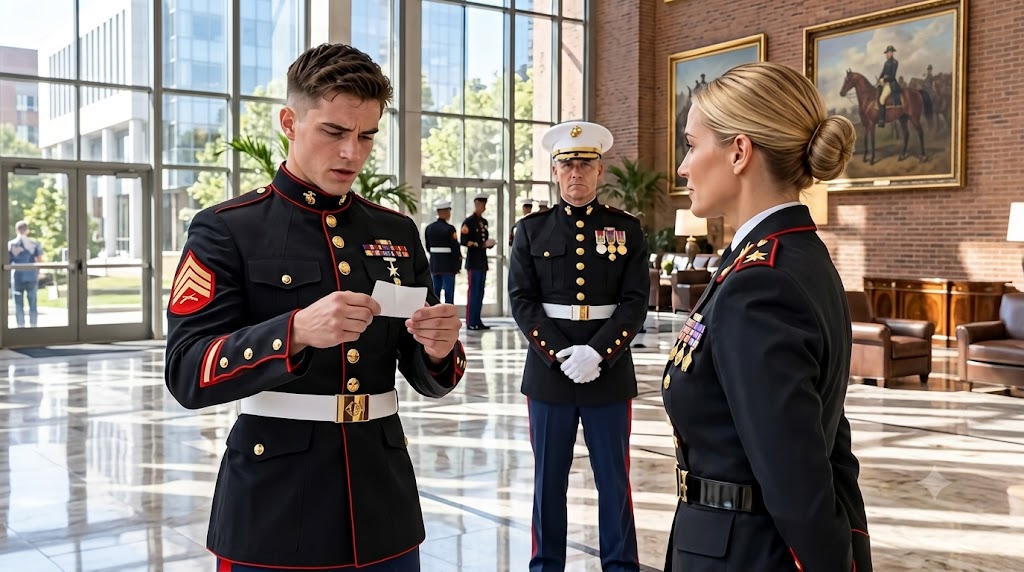
His expression changed.
“General Vance?”
The young Marine straightened so abruptly that his chair scraped the floor.
Valerie turned. “Good morning, General Hale.”
Hale’s gaze moved from her face to the torn visitor pass, then to the young Marine.
“What happened here?”
The Marine swallowed. “Sir, I was verifying access credentials.”
“And did you verify hers?”
“I was in the process of—”
“No,” Valerie interrupted quietly. “You were in the process of deciding that I didn’t belong here.”
Silence fell across the checkpoint.
Hale looked at the two pieces of the pass in her hand.
Then he did something the young Marine clearly hadn’t expected.
He did not apologize on the Marine’s behalf. He did not wave Valerie through and pretend the incident had never happened.
Instead, he asked, “General, would you like me to handle this?”
Valerie considered the question.
For one fleeting second, she wanted to say yes. She wanted someone senior enough to silence the room, someone whose rank would make the young Marine understand what he had done.
Then she remembered how many times she had waited for someone else to speak up for her.
“No,” she said. “I’d like him to explain his decision.”
Hale nodded once.
The Marine stared at Valerie, finally noticing the calm in her posture, the precision in her speech, and the complete absence of embarrassment in her expression.
“Ma’am,” he began, “I didn’t know who you were.”
Valerie looked at him.
“That is the problem, isn’t it?”
He opened his mouth, but nothing came out.
She reached into her bag, retrieved her identification, and placed it on the desk. The photograph, name, and rank were unmistakable.
Major General Valerie M. Vance.
Commanding General, effective that morning.
The Marine’s face drained of color.
“General, I—”
“Your duty officer,” she said. “Please.”
This time, he made the call.
Within minutes, the gate opened. Officers hurried out, and the first formal greetings began. The installation was ready to welcome its incoming commander.
Yet as Valerie walked past the checkpoint, she found herself thinking not about the Marine, not about the torn pass, and not even about the command awaiting her.
She was thinking about a man who had been dead for three years.
Her father.
Colonel Thomas Vance had believed the military was a world where strength could be measured, authority could be inherited, and a person’s worth could be established before they ever entered a room.
He had also believed that his daughter would never amount to much.
And somewhere deep inside Valerie, beneath twenty-six years of promotions, commendations, and impossible decisions, a little girl was still waiting for him to admit he had been wrong.
Her childhood home stood in a quiet Virginia neighborhood where the lawns were trimmed with military precision and the American flag outside her father’s front door was replaced whenever the edges began to fray.
Thomas Vance had served in the Marine Corps for thirty-one years. His uniforms were immaculate. His boots shone like black glass. His medals hung in a framed display in his study, arranged according to the order in which he had earned them.
His daughter had grown up learning that excellence was expected, but praise was optional.
When Valerie was twelve, she won a statewide mathematics competition. She carried the certificate home in both hands, imagining her father setting it beside his medals.
He studied it for three seconds.
“Good,” he said. “Now show me you can maintain that standard.”
When she was sixteen, she earned the highest mark in her class on a leadership assessment.
He asked whether the assessment had been difficult.
“No, sir,” she admitted.
“Then it doesn’t tell us much.”
When she was eighteen, she announced that she wanted to attend the Naval Academy and become a Marine officer.
Her father lowered his newspaper.
“No.”
Valerie thought she had misheard him. “No?”
“It’s a demanding profession. You’d be better suited to something that uses your intelligence without requiring you to prove yourself every day.”
“I want to lead Marines.”
“You want to wear my uniform.”
“No, sir. I want to earn my own.”
His jaw tightened.
“Leadership isn’t a rebellion, Valerie. And the Corps isn’t a place to settle personal scores.”
She remembered that sentence for years because he had delivered it as though he knew something about her that she did not know herself.
Perhaps he did.
Perhaps part of her really was angry. Perhaps every early ambition had carried the quiet hope that one day she would stand before him in a uniform and force him to look at her without disappointment.
But anger was not the only thing that brought her to the academy.
She loved the work. The discipline. The way a group of strangers could become a team capable of carrying one another through the worst conditions imaginable. She loved the idea that leadership meant taking responsibility when everyone else was looking for someone to blame.
Her father refused to sign the family acknowledgment on her academy paperwork.
Valerie found another way through the application process, relying on the required documentation and the support of mentors who believed in her. She earned her appointment on her own merits.
The morning she left, Thomas stood in the doorway of their home.
“You’ll come back when you realize how difficult it is,” he told her.
Valerie held her duffel bag against her hip.
“What if I don’t?”
He looked at her for a long moment.
“Then I suppose you’ll have made your choice.”
She waited for him to hug her.
He didn’t.
She waited for him to say he was proud of her.
He didn’t do that either.
So she climbed into the car, shut the door, and drove away with a heart full of determination and a small, painful certainty that she had already lost something she might spend the rest of her life trying to recover.
At Quantico, the morning moved forward whether Valerie was ready for it or not.
Her chief of staff, Colonel Daniel Brooks, met her outside headquarters. He was a broad-shouldered officer with a reputation for candor and a habit of asking questions that other people preferred to avoid.
“General, the command team is assembled. The ceremony is in forty minutes.”
“Good.”
Brooks studied her face.
“Something happened at the gate.”
“An access-control issue.”
“I heard the visitor pass was torn.”
Valerie glanced at him. “News travels quickly.”
“Not as quickly as a damaged security process should.”
That earned him the faintest smile.
“Let’s not turn one young Marine’s mistake into the defining event of his career,” she said. “We’ll address it properly.”
“Yes, ma’am.”
They walked through the headquarters building, past portraits of commanders whose names had become part of the institution’s history.
At the end of the corridor, a framed photograph caught Valerie’s attention.
Her father stood in the back row of a command group, younger than she remembered him, his face hard and unsmiling. She had seen the photograph before. Colonel Thomas Vance had served at Quantico for a time early in his career.
She stopped.
Brooks followed her gaze.
“Did you know him, General?”
Valerie’s fingers tightened around her folder.
“He was my father.”
Brooks said nothing for several seconds.
“I’m sorry, ma’am. I didn’t know.”
“Most people don’t.”
She continued walking.
She had not expected to find him here, not even in a photograph. But the sight of him had opened a door in her mind, and behind it waited every unfinished conversation they had never had.
There had been one call, six years earlier, after she made brigadier general.
Thomas had congratulated her in the clipped voice he used for professional acquaintances.
“You’ve done well,” he said.
Valerie sat alone in her quarters, holding the phone so tightly that her fingers hurt.
“Thank you, Dad.”
“Don’t let the promotion make you careless. People will expect more from you now.”
“I know.”
“And remember, rank can make a person arrogant.”
She had wanted to tell him that she was tired. That she had spent years trying to become someone no one could dismiss. That she had missed family dinners, birthdays, and funerals because the responsibilities he had once told her she couldn’t handle had demanded everything she had.
Instead, she said, “I’ll remember.”
He ended the call after another thirty seconds.
She never received another congratulations.
When he died three years later, Valerie was overseas.
She made it home too late to see him alive, and the funeral passed in a blur of black clothing, folded flags, and relatives telling her how proud her father had been.
She had nodded because correcting them would have required explaining a lifetime.
In the days that followed, she searched his study for letters, photographs, anything that might reveal a softer version of the man she had known.
She found nothing.
Or so she had believed.
The change-of-command ceremony began beneath a bright autumn sky.
Rows of Marines stood at attention. Flags moved in the breeze. Families watched from behind the designated seating area, and cameras waited to capture the moment when responsibility passed from one commanding general to another.
Valerie stood in full uniform, her stars catching the light.
As she looked across the formation, she felt the familiar weight of command settle onto her shoulders.
She had earned every promotion through long deployments, difficult assignments, and decisions that had left no room for indecision. She had led Marines through crises in which a single wrong choice could cost lives. She had sat with families who would never see their loved ones again. She had learned to listen before speaking and to make decisions even when no choice was clean.
Yet as the ceremony approached its final moments, the old question returned.
Would her father have been proud?
The thought angered her more than the gate incident had.
She had spent twenty-six years becoming the officer he said she could never be. She had become a major general, one of the most senior women in her service. She had earned the trust of people who had no reason to give it to her except that she had proved herself worthy.
Still, some part of her wanted a single sentence from a man who could no longer speak.
The presiding officer completed the formal remarks. The outgoing commander offered his farewell. The colors were transferred, and the assembled Marines saluted their new commanding general.
Valerie stepped to the microphone.
She had prepared a speech about readiness, accountability, and the responsibility leaders carried for the people entrusted to them.
She set the pages aside.
“Marines,” she began, “today I assume command of this installation. I understand the honor of that responsibility, and I understand its cost.”
The formation stood motionless.
“Some of you have been in the Corps longer than I have. Some of you are beginning careers that will take you farther than you can imagine. You will encounter leaders who see your potential before you do, and you will encounter others who make decisions about you before they know your name.”
Her voice remained steady.
“When that happens, you have a choice. You can spend your life trying to prove those people wrong, or you can decide what kind of leader you want to become.”
She paused.
“I spent a great deal of my career proving someone wrong. It gave me determination. It taught me to endure. But it also taught me something I had to unlearn: that achievement is the same thing as healing.”
For the first time, the prepared officers behind her looked uncertain.
Valerie continued.
“Your rank tells people what responsibilities you have been entrusted with. It does not tell them whether you are kind, whether you are fair, or whether you have the courage to admit when you are wrong. Those things are demonstrated in the smallest moments, often when you believe nobody important is watching.”
She thought of the torn visitor pass.
“A leader who judges a person before learning the facts can make a mistake in seconds. A leader who refuses to correct that mistake can spend years teaching others to repeat it.”
Her gaze swept across the formation.
“We will hold ourselves to high standards here. We will protect this installation, enforce its rules, and maintain the discipline our mission demands. But we will never confuse discipline with humiliation or authority with the right to disregard another person’s dignity.”
She took a breath.
“And if you ever find yourself working so hard to earn someone’s approval that you forget why you began, stop. Ask yourself whether the standard you’re chasing is worthy of the life you’re giving to it.”
She stepped back from the microphone.
The applause began slowly, then spread across the formation.
Valerie acknowledged it with a salute.
For the first time that morning, she felt the past loosen its grip—not disappear, but loosen.
She had spoken about herself without allowing her father’s judgment to define the entire story.
It was a beginning.
Not an ending.
Later that afternoon, Valerie requested a private meeting with the young Marine from the gate.
His name was Lance Corporal Ethan Cole.
He entered her office with his shoulders rigid and his eyes fixed somewhere above her left shoulder.
“At ease, Lance Corporal.”
He relaxed only slightly.
“General, I understand that my actions this morning were unacceptable. I am prepared to accept whatever disciplinary action you consider appropriate.”
Valerie gestured toward the chair across from her desk.
“Sit down.”
He obeyed.
She opened a folder containing the incident report. His account was factual, but it left out the part that mattered most.
“You wrote that you believed I was attempting to enter without authorization,” she said.
“Yes, ma’am.”
“Did you ask me for identification?”
“No, ma’am.”
“Did you contact your duty officer?”
“No, ma’am.”
“Then what made you certain I was unauthorized?”
He stared at his hands.
“I thought you were a visitor who didn’t understand the procedure.”
“Why?”
He hesitated.
“I don’t know, ma’am.”
“Try again.”
His face flushed.
“You weren’t wearing a uniform. You were dressed casually. And you seemed very certain that you should be allowed through.”
Valerie leaned back.
“So you mistook confidence for entitlement.”
“Yes, ma’am.”
“And you decided that tearing the pass would be more useful than verifying the information.”
“Yes, ma’am.”
“Why?”
He looked up, and for the first time she saw something other than fear in his expression.
“Because I didn’t want to look weak in front of the people behind you. I thought if I backed down, they would think I couldn’t do my job.”
Valerie was quiet for a moment.
There it was. The small, familiar human fear beneath the uniform.
“I see,” she said.
Cole swallowed.
“General, I know an apology doesn’t undo what I did. I should have followed the procedure. I should have treated you with respect regardless of who you were.”
“Yes.”
“I am sorry.”
Valerie closed the folder.
“Do you know what the most serious part of this incident is?”
“That I failed to verify your identity, ma’am?”
“That is part of it. The most serious part is that you believed your authority depended on never appearing uncertain.”
Cole said nothing.
“You were entrusted with protecting a gate. That requires judgment, not ego. If someone presents questionable credentials, you verify them. If someone challenges a procedure, you consult the appropriate authority. You do not invent certainty because you are afraid of looking inexperienced.”
She let the words settle.
“Now, I will not dismiss this incident. There will be appropriate corrective action and additional training. You will also submit a written account of the procedure you should have followed and explain how you will apply it in the future.”
“Yes, ma’am.”
“But I am not interested in making you an example simply because I can.”
His eyes lifted.
“Your mistake will not define you unless you refuse to learn from it.”
For the first time, his shoulders dropped.
“Understood, General.”
Valerie stood, signaling that the meeting was over.
Cole rose as well, then hesitated at the door.
“Ma’am?”
“Yes?”
“May I ask you something?”
“Go ahead.”
“When you knew I was wrong, why didn’t you just tell me your rank?”
She considered him.
“Because if I had needed to be a major general before you treated me fairly, you would have learned the wrong lesson.”
Cole looked down.
“I understand.”
“I hope you do.”
He left the office with his punishment still ahead of him, but without the certainty that one bad decision had made him a bad Marine.
Valerie watched the door close.
Then she sat alone and wondered when she had first learned the same lesson he had.
Perhaps she had learned it at home, in the rooms where love seemed to be another promotion she had to earn.
Perhaps that was why she had never stopped striving.
That evening, an aide delivered a small cardboard box from the family estate.
The contents had been found in a storage cabinet during the final clearing of her father’s house. The box had been sitting in a warehouse for three years, forgotten among old records and household items.
Valerie set it on her desk.
Inside lay a pair of worn leather gloves, a photograph of her mother, several service documents, and a sealed envelope with her name written in her father’s unmistakable handwriting.
She stared at it for a long time.
The paper had yellowed slightly at the edges. The seal was intact.
She sat down before opening it.
The letter was dated seven months before his death.
Valerie,
I have never been good at saying what I mean when it matters.
She stopped reading.
For a moment, the office seemed to tilt around her.
She put the letter down, stood, and walked to the window. The evening sky above Quantico was streaked with orange, and the silhouettes of trees darkened against the horizon.
She had imagined this moment so many times.
In some versions, her father apologized. In others, he confessed that he had been wrong all along. She had even imagined him writing that he had always been proud of her, that every harsh word had been an attempt to protect her from a world he knew could be cruel.
She returned to the desk.
When you first told me you wanted to become a Marine officer, I said no because I thought you were chasing my approval. I told myself that you were too young to understand what the profession would demand.
The truth is less flattering.
I knew how much the Corps had taken from me. I knew the mistakes I had made and the people I had failed. I believed that if I could keep you away from that life, you would never have to pay the same price.
Valerie’s eyes moved across the page.
But I made the mistake of believing that protecting you meant deciding for you. I confused my fear with wisdom.
She sat motionless.
When you left for the academy, I wanted to tell you that I was proud of you for having the courage to go. Instead, I told you that you would come back when you realized how difficult it was.
I told myself that if I withheld praise, you would become stronger. I did not understand that I was teaching you to believe that love must always be earned.
Her throat tightened.
She had waited twenty-six years to hear those words.
Now that they were finally here, they could not be spoken aloud by the man who had written them.
She continued.
I followed your career more closely than you know. I kept the newspaper articles. I saved the photograph from your promotion ceremony. I watched the recording of your speech when you became a brigadier general three times.
I wanted to call you afterward. I picked up the phone more than once.
Every time, I imagined you asking why I had never supported you. I had no answer that would make me look like the father I wanted you to believe I was.
So I stayed silent. I called it discipline. It was pride.
Valerie pressed her fingers against the paper.
She remembered the telephone call after her promotion, the brief congratulations followed by a warning about arrogance.
She had believed he had nothing more to say.
Perhaps he had had too much.
The letter continued.
I am proud of the officer you have become, but I know that saying so now does not erase the years when you needed to hear it.
I cannot ask you to forgive me. I have no right to demand that from you.
I only hope that you will not spend the rest of your life trying to prove that my doubts were wrong. You never needed my doubts to become the person you are.
If there is one thing I wish I had taught you, it is this: you do not have to keep winning an argument with a dead man.
You have your own life to lead.
Your father,
Thomas
Valerie reached the end of the letter and realized she was crying.
Not the restrained tears she had permitted herself at funerals, not the quiet grief she had hidden in hotel rooms after difficult deployments.
These were the tears of a daughter who had finally received the words she needed and could not decide whether they were a gift or another loss.
She read the letter again.
Then a third time.
The admission was not perfect. It did not explain every cruel remark or restore the years she had spent believing she was never quite enough. Her father had acknowledged his failures, but he had not been able to face her with them while he was alive.
And even now, she could not ask him why.
She could not tell him that she had loved him anyway.
She could not tell him how often she had wanted to be held instead of evaluated.
The letter gave her a truth she had never possessed before, but it did not give her the childhood she had lost.
For years, Valerie had thought that if her father finally approved of her, the wound would close.
Now she understood that his approval, even when it came, could not do that work for her.
She folded the letter carefully and placed it inside the folder with her command orders.
Outside the window, the last sunlight disappeared.
She remained at her desk until the room was dark.
For the first time in twenty-six years, she did not feel compelled to turn her grief into a plan.
She let herself feel it.
And when she finally stood, she left the letter on her desk rather than locking it away.
The following morning, Valerie arrived at the gate in uniform.
Lance Corporal Cole was not on duty. His training had begun, and his replacement stood at the security station with a clipboard and a clear view of the approaching vehicles.
The Marine checked her credentials, confirmed her authorization, and stepped aside.
“Good morning, General.”
“Good morning.”
Nothing dramatic happened. No one applauded. No one knew that a visitor pass had changed the course of a commander’s day.
That was how Valerie preferred it.
She continued toward headquarters, where the first meeting of her new command was already waiting.
She had plans for the installation: better training, stronger accountability, and a culture in which junior Marines could question assumptions without being punished for speaking honestly. She wanted high standards, but she also wanted those standards applied consistently.
She knew the work would be difficult.
Some people would resist. Some would mistake compassion for weakness. Others would assume that because she had spoken about dignity, she would hesitate when discipline was required.
They would learn otherwise.
Fairness did not mean lowering expectations. It meant refusing to let personal prejudice determine who had to meet them.
Over the following weeks, Valerie introduced a review of access procedures and leadership training for personnel assigned to security checkpoints. The changes were not designed to make everyone comfortable. They were designed to make the system reliable.
Cole completed his corrective training and submitted a written report that was more honest than his first account.
In it, he acknowledged that he had mistaken the appearance of authority for authority itself, and that his fear of embarrassment had led him to neglect the very procedure he had been assigned to enforce.
Valerie read the report and approved his return to regular duty.
She did not erase the incident from his record. Neither did she allow it to become the only thing anyone knew about him.
Months later, she saw him at a training exercise. He was briefing a group of Marines on access control, his voice firm but measured.
When a young corporal questioned a step in the procedure, Cole paused, checked the regulation, and admitted that the corporal had identified an inconsistency.
Valerie watched from a distance.
Cole corrected the instruction without defensiveness.
It was a small moment.
She knew how much work it could take to create one.
In the spring, Valerie traveled to Arlington National Cemetery.
She had been putting off the visit, telling herself that her schedule was too crowded and that there was no reason to return to a grave simply because she had found an old letter.
But she understood the truth now.
She was not going to see her father for answers.
She was going to say goodbye to the argument she had carried into every room since she was eighteen.
She stood before his headstone with her hands in the pockets of her coat. The cemetery was quiet, the rows of white markers stretching beneath the trees.
For a while, she said nothing.
Then she took the folded letter from her pocket.
“I read it,” she whispered.
The wind moved softly through the branches.
“I wish you’d told me when you were alive.”
Her voice trembled, and she let it.
“I wish you’d said you were proud of me. I wish you had asked what I needed instead of deciding what would make me stronger.”
She looked down at the letter.
“But I know you were afraid. And I know you tried, in your own way, to make me ready for the world.”
She took a breath.
“I loved you, Dad. Even when I was angry with you. Even when I told myself I didn’t need you.”
The words came slowly, stripped of the discipline she had used to protect herself for decades.
“I forgive you for the things I can forgive. The rest, I’ll have to keep working on.”
She placed the letter back in her pocket.
Then she straightened, not as an officer preparing to receive a salute, but as a daughter preparing to leave.
For the first time, she did not imagine what her father would say about the way she stood, the words she had chosen, or the career she had built.
She simply turned and walked away.
The grief remained. So did the love.
But the argument was over.
A year after taking command, Valerie returned to the security checkpoint where her visitor pass had been torn.
The desk had been replaced, the procedures updated, and a new sign reminded personnel to verify credentials before denying access. It was not a monument to the incident. It was a practical correction to a practical failure.
Cole, now more experienced, was supervising the morning shift.
He noticed her approaching and stood.
“Good morning, General.”
“Good morning, Lance Corporal.”
He checked the vehicle authorization, confirmed her identity, and opened the gate.
As she passed, he spoke again.
“General, may I say something?”
Valerie stopped.
“Yes.”
“I used to think the most important thing about leadership was making sure nobody questioned my decisions.”
“And now?”
“Now I think it’s making sure my decisions can survive being questioned.”
Valerie smiled.
“That is a much better place to start.”
She drove through the gate and continued toward headquarters.
The torn visitor pass was long gone. The young Marine’s mistake had become a lesson. Her father’s letter rested in a drawer in her office, no longer a secret she carried everywhere, but a piece of a complicated history she could finally look at without losing herself.
Valerie had once believed that success meant standing before the people who doubted her and making it impossible for them to deny what she had achieved.
She had spent twenty-six years gathering proof.
Now she understood that a life built entirely around proving someone wrong was still a life being directed by that person’s judgment.
Her father had been wrong about her.
But she no longer needed to spend every day demonstrating it.
She had Marines to lead, decisions to make, and people depending on her to see them clearly before deciding what they were worth.
That was the responsibility she had chosen.
That was the legacy she could shape.
And somewhere along the way, without ceremony or applause, Valerie Vance had finally earned something no promotion could give her.
Permission to stop proving she deserved to exist.
She had belonged all along.