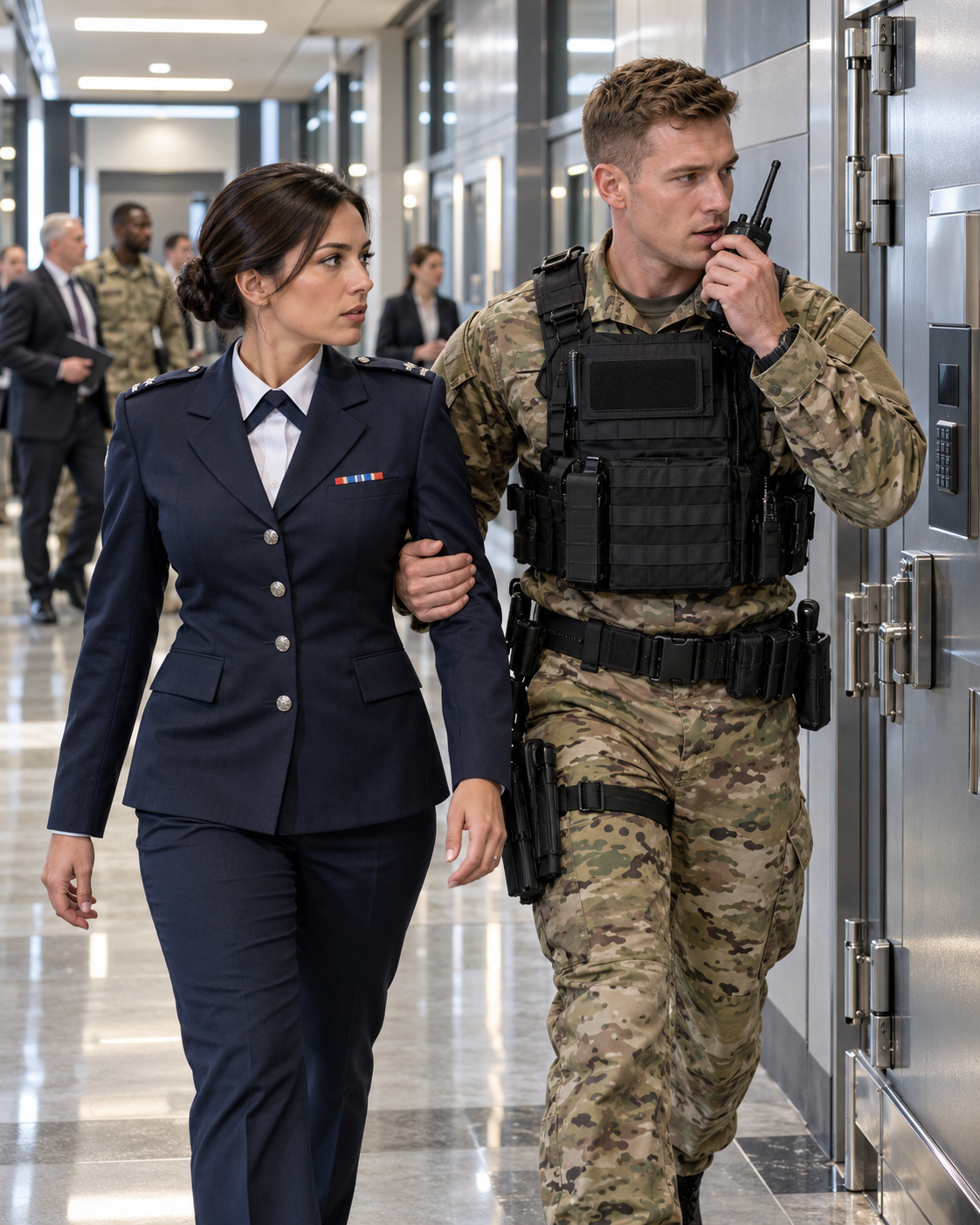
Sergeant Miller had my wrists locked in handcuffs outside the Pentagon Situation Room while my father watched with a cold
The unfinished mission began three weeks after my father finally admitted he had been wrong.
I was sitting alone in my office when Major Lauren Cruz entered without knocking.
She closed the door behind her.
“You need to read this.”
She placed a thin black folder on my desk.
There was no classification stamp on the outside, which was somehow more unsettling than if there had been one.
I opened it.
The first page contained a photograph.
My stomach tightened.
It was Nathan.
Not in his dress uniform.
Not in one of the family photographs Arthur proudly displayed.
He was standing beside a civilian man outside a hotel in Baltimore.
I looked at Lauren.
“When was this taken?”
“Six days ago.”
I turned the page.
There were dates, financial transfers, encrypted communications, and photographs of people I didn’t recognize.
At first, Nathan appeared only as a peripheral figure.
Then his name appeared again.
And again.
I felt something cold move through me.
“Is he compromised?”
“We don’t know.”
“You think he is?”
“We think someone is using him.”
I stared at the photograph of my brother.
For years, I had believed Nathan’s greatest weakness was insecurity.
Now I wondered whether someone had discovered exactly how to weaponize it.
Lauren pulled out a chair.
“There’s more.”
She slid another photograph across the desk.
This one showed Arthur.
My father was leaving a veterans’ conference with the same civilian man.
I stopped breathing for a second.
“When?”
“Two days before Nathan.”
“What did they discuss?”
“We don’t know.”
“Then why am I looking at this?”
Lauren hesitated.
“Because the man they’re meeting has been connected to a foreign intelligence network we’re tracking.”
The room seemed to shrink around me.
My father had spent decades teaching me that trust was earned through service.
Now his face was sitting in an intelligence file.
I closed my eyes.
“Is my family a target?”
Lauren’s answer came quietly.
“Your family may be the access point.”
I wanted to laugh.
Instead, I felt tired.
After everything I had endured, I had finally stopped needing their approval.
And now the people I had spent years protecting might actually be in danger.
“Does Arthur know?”
“No.”
“Nathan?”
“No.”
“Mom?”
“No.”
Lauren watched me carefully.
“You don’t have to handle this personally.”
I looked at her.
“That’s exactly what I was hoping you’d say.”
She smiled faintly.
“I knew you’d ignore me.”
That evening, I went home.
My mother was making soup.
Arthur was sitting at the kitchen table with a stack of unopened mail.
Nathan was there too.
For one brief moment, it looked like an ordinary family evening.
Then I noticed Nathan’s hands.
They were shaking.
“What’s wrong?” I asked.
“Nothing.”
Arthur looked at me.
“You always notice too much.”
It was almost a joke.
Almost.
I sat down.
Nobody spoke for several seconds.
Then Nathan looked directly at me.
“Did Dad tell you?”
“Tell me what?”
He looked at Arthur.
Arthur’s expression changed.
I understood immediately.
They had been keeping something from me.
“What happened?”
Nathan swallowed.
“Someone contacted me.”
Arthur slammed his palm against the table.
“Enough.”
I stood.
“No.”
Both of them looked at me.
“I’ve spent my whole life being told to stay out of things I was already quietly fixing, so we’re not doing that anymore.”
Arthur stared at me like he was seeing a stranger.
Maybe he finally was.
Nathan reached into his jacket.
He placed a small flash drive on the table.
“I was given this.”
I didn’t touch it.
“By whom?”
“I don’t know.”
“Why?”
“He said he knew what you really do.”
My pulse slowed.
“Who?”
Nathan shook his head.
“He said your family had been watching you for years.”
The room went silent.
My mother dropped the spoon she was holding.
Arthur stood.
“You’re going to give that to me.”
Nathan looked at him.
“No.”
Arthur stepped closer.
“You’re my son.”
Nathan’s voice cracked.
“That’s exactly why I can’t.”
I took the drive.
“Nobody touches this.”
Arthur looked furious.
For the first time, I saw something beneath his anger.
Fear.
Real fear.
Lauren’s team examined the device that night.
It contained no malware.
No obvious surveillance software.
Only one file.
A video.
I watched it alone.
The screen showed a dark room.
A man sat facing the camera.
I didn’t recognize him.
Then he spoke.
“Vanguard Actual.”
My skin went cold.
“We know who you are.”
The video paused.
A second message appeared.
“You have been protecting the wrong people.”
Then the screen changed.
Photographs began appearing.
My father.
My mother.
Nathan.
And finally me.
But the last photograph was not recent.
It showed me at nineteen years old, standing beside a military recruitment vehicle.
Someone had circled my face.
Underneath were three words.
“SHE WAS SELECTED.”
I stared at the screen.
For the first time in twenty years, I felt genuinely afraid.
Because I knew what that phrase meant.
Someone had been tracking me long before I understood why.
Lauren entered.
“What is it?”
I pointed at the screen.
She read the message.
Her face changed.
“That shouldn’t exist.”
“What does it mean?”
She sat down slowly.
“It means your recruitment may not have been random.”
I thought back to my first years in service.
The unusual aptitude tests.
The instructors who seemed to know more about me than my official records contained.
The assignments I had been given before I was technically qualified for them.
I had always assumed I was simply good at what I did.
Now I wondered whether someone had recognized something in me before I recognized it myself.
Then another file appeared.
It contained a name.
Not Arthur.
Not Nathan.
Not mine.
Evelyn.
My mother.
I stopped the video.
“Why would they have a file on Mom?”
Lauren didn’t answer.
I called her again.
No response.
I called twice more.
Nothing.
Then the office lights flickered.
A secure alarm sounded.
Lauren looked toward the door.
“Someone just breached the outer network.”
We moved quickly.
Within minutes, the building went into lockdown.
No one knew how they had entered.
No one knew what they wanted.
Then my phone vibrated.
A message from my mother.
“Please come home.”
Nothing else.
I called her.
The call went straight to voicemail.
We reached my parents’ house twenty minutes later.
The front door was open.
The kitchen light was on.
A cup of tea sat untouched beside my mother’s chair.
Arthur was standing in the hallway.
He looked pale.
“Where’s Mom?”
He pointed toward the living room.
Her purse was gone.
Her coat was gone.
Her medication was still on the counter.
Nathan arrived behind me.
“What happened?”
Arthur’s voice broke.
“She left with someone.”
“Who?”
“I don’t know.”
I stared at him.
Then I saw something on the floor.
A folded piece of paper.
My name was written on it in my mother’s handwriting.
I opened it.
There were only six words.
“Stop protecting me from the truth.”
My heart sank.
Because suddenly I understood.
My mother hadn’t been taken.
She had gone willingly.
And whatever she knew had been hidden from me for thirty-nine years.
Lauren looked at me.
“Vanguard, we need to know what you want to do.”
I folded the note.
“I want my mother.”
Three hours later, we found her.
She was sitting inside a small chapel outside Alexandria.
Alone.
Waiting.
Arthur and Nathan stayed in the car.
I walked inside.
Mom looked up.
She had tears in her eyes.
“I knew you’d come.”
I sat beside her.
“What have you been hiding?”
She stared at her hands.
“Your father wasn’t the only reason I kept you small.”
I said nothing.
“Before you were born, someone approached me.”
“Who?”
“An intelligence officer.”
She looked at me.
“He told me you had an unusual ability to recognize patterns, remember details, and solve problems faster than anyone your age.”
I felt a strange numbness.
“How would he know?”
“Because he tested you.”
“Without telling me?”
“Yes.”
I stood.
“Why?”
“Because they believed you could become something extraordinary.”
My mother began crying.
“And I was terrified.”
I sat again.
“You asked me to be smaller.”
She nodded.
“I thought if you became ordinary, nobody would come looking for you.”
My anger softened into something more painful.
“Did Dad know?”
“No.”
That answer broke something open inside me.
For all these years, I had blamed Arthur for making me invisible.
But Mom had helped build the disguise.
Not because she hated me.
Because she loved me badly.
“I am sorry,” she whispered.
I took her hand.
“I know.”
She squeezed mine.
“But someone is still coming for you.”
“I know.”
“And they believe the people around you can be used against you.”
I looked toward the chapel doors.
“Then they’ll have to learn something.”
“What?”
I stood.
“They picked the wrong family.”
The investigation that followed lasted eleven days.
The civilian man was arrested.
The financial network collapsed.
Nathan was cleared of intentional wrongdoing but admitted he had accepted money during a period when he was struggling financially.
Arthur had never betrayed the country.
He had simply been manipulated into believing his daughter’s secret life was nothing more than administrative work.
And then we discovered the worst truth.
The foreign network had not been trying to recruit me.
They had been trying to understand me.
For decades, they had watched the people around me, searching for the one person who could make Vanguard Actual emotionally vulnerable.
They assumed that person was Arthur.
They were wrong.
It was Mom.
Because she was the only person who had ever known why I became who I was.
The case eventually closed.
My mother recovered.
Nathan entered counseling.
Arthur stopped talking about medals.
But he never became a different man overnight.
Change doesn’t happen like that.
It happens quietly.
In small humiliating moments.
In apologies that arrive late.
In questions asked instead of judgments made.
One Sunday morning, Arthur came to my apartment alone.
He stood outside my door holding a cardboard box.
“I brought these.”
Inside were the photographs he had kept of Nathan.
There were hundreds.
Underneath them were several photographs of me.
Old ones.
School plays.
Graduation.
My first uniform.
Pictures I hadn’t known he kept.
“I should have taken more,” he said.
I looked at him.
“You still can.”
His eyes filled.
“I don’t know how.”
“Start by asking.”
He nodded.
Then he asked the simplest question.
“Are you happy?”
I thought about it.
For thirty-nine years, nobody had asked me that.
Not really.
I smiled.
“I think I’m finally learning how.”
Arthur sat across from me.
For the first time in my life, we talked without competing.
He told me he had been afraid that if he admitted I was extraordinary, it would mean Nathan wasn’t.
I told him my success had never required Nathan’s failure.
He cried.
I didn’t.
Not because I was stronger.
Because I had already cried for that version of us years ago.
Months later, I received one final envelope from the intelligence office.
Inside was a declassified summary of my career.
I wasn’t allowed to keep most of it.
But there was one page I could read.
At the bottom was a handwritten note from Admiral Vance.
“You spent your life proving you didn’t need anyone’s approval, but don’t mistake independence for isolation.”
I kept that sentence.
Not because it was an order.
Because it was true.
Being invisible had protected me.
Then it had imprisoned me.
There was a difference.
I had spent years believing strength meant carrying everything alone.
It didn’t.
Strength meant choosing who was allowed to stand beside you.
My family wasn’t perfect.
Maybe they never would be.
But they were finally learning to see me.
And I was finally learning that being seen did not have to mean being exposed.
Sometimes it simply meant allowing the people you loved to know the truth.
A year after the crisis, Arthur attended another military ceremony.
This time, he didn’t stand in the front.
He didn’t introduce himself as a general.
He stood beside my mother.
When someone asked who I was, he smiled.
“My daughter.”
Nothing more.
It was enough.
Later, as I walked away, Nathan caught up with me.
“You know Dad keeps your old picture in his wallet now.”
I laughed.
“Which one?”
“The one where you’re nineteen.”
I stopped walking.
“Why that one?”
Nathan smiled.
“He says that’s when he should have started paying attention.”
I looked back at my father.
He was watching us from across the room.
For once, there was no disappointment in his face.
Only pride.
Not the loud kind.
The quiet kind that doesn’t need witnesses.
I raised my hand.
He raised his.
And for the first time, I didn’t wonder whether I had finally become worthy in his eyes.
I knew I had been worthy all along.
The tragedy was that I had spent too many years waiting for someone else to tell me.
That was the real secret I carried out of the Pentagon.
Not that I had commanded classified missions.
Not that senior officials trusted me.
Not that my father had underestimated me.
It was this.
Sometimes the person you spend your life trying to prove yourself to is standing on the wrong side of a door you were never meant to keep knocking on.
I had spent thirty-nine years knocking.
Then one morning, I stopped.
And when I finally walked away, I discovered the door had never been locked.
It had only been waiting for me to choose myself.
I still work in places most people will never know exist.
There are still names I cannot say and missions I cannot describe.
But when I come home now, I don’t hide behind the word “administrative.”
I tell my family enough.
I let them ask questions.
I let them worry.
I let them love me.
And sometimes, late at night, I still think about that first morning in the Pentagon, when a young sergeant put handcuffs around my wrists and my father watched as though my life had finally fallen apart.
He thought he was witnessing my humiliation.
He was actually witnessing the moment I stopped living for his approval.
Years later, Sergeant Miller sent me a letter.
He wrote that he still remembered the corridor.
He said he had learned that following procedure was important, but understanding the human being standing in front of you mattered too.
I wrote back.
“Never stop following procedure.”
Then I added one more sentence.
“But never assume you know someone’s story.”
I sealed the envelope.
Outside my window, Washington was waking beneath another gray morning.
Somewhere across the city, people were beginning ordinary days.
They would never know how many invisible decisions kept those days peaceful.
For once, I didn’t need them to know.
I knew.
My family knew.
And that was enough.
Then my secure phone rang.
I looked at the screen.
One word appeared.
VANGUARD.
I answered.
“Go ahead.”
A voice on the other end said, “We found something in the old files.”
I stood slowly.
“What did you find?”
There was a pause.
Then the voice said, “Your name.”
I stared through the window as the city disappeared beneath the rising sun.
Some doors, apparently, never stay closed forever.