On the night my mother married Arthur in a candlelit country club, she threw my suitcase onto the porch
I stood behind the diner counter with the folded note pressed between my fingers, listening to the kitchen fan rattle above my head.
Cody was still sitting in the booth by the window, pretending to study the menu even though he had already ordered a milkshake he wasn’t drinking.
He was sixteen, thin as a fence post, and still young enough to believe that if he could keep everyone happy, our family might somehow become whole again.
I had once believed that too.
I walked over and slid into the seat opposite him.
“What exactly does Mom want me to sign?”
He looked toward the kitchen, then back at me.
“She said it’s just paperwork to help you manage Dad’s money.”
My stomach tightened.
“Did she show you the paperwork?”
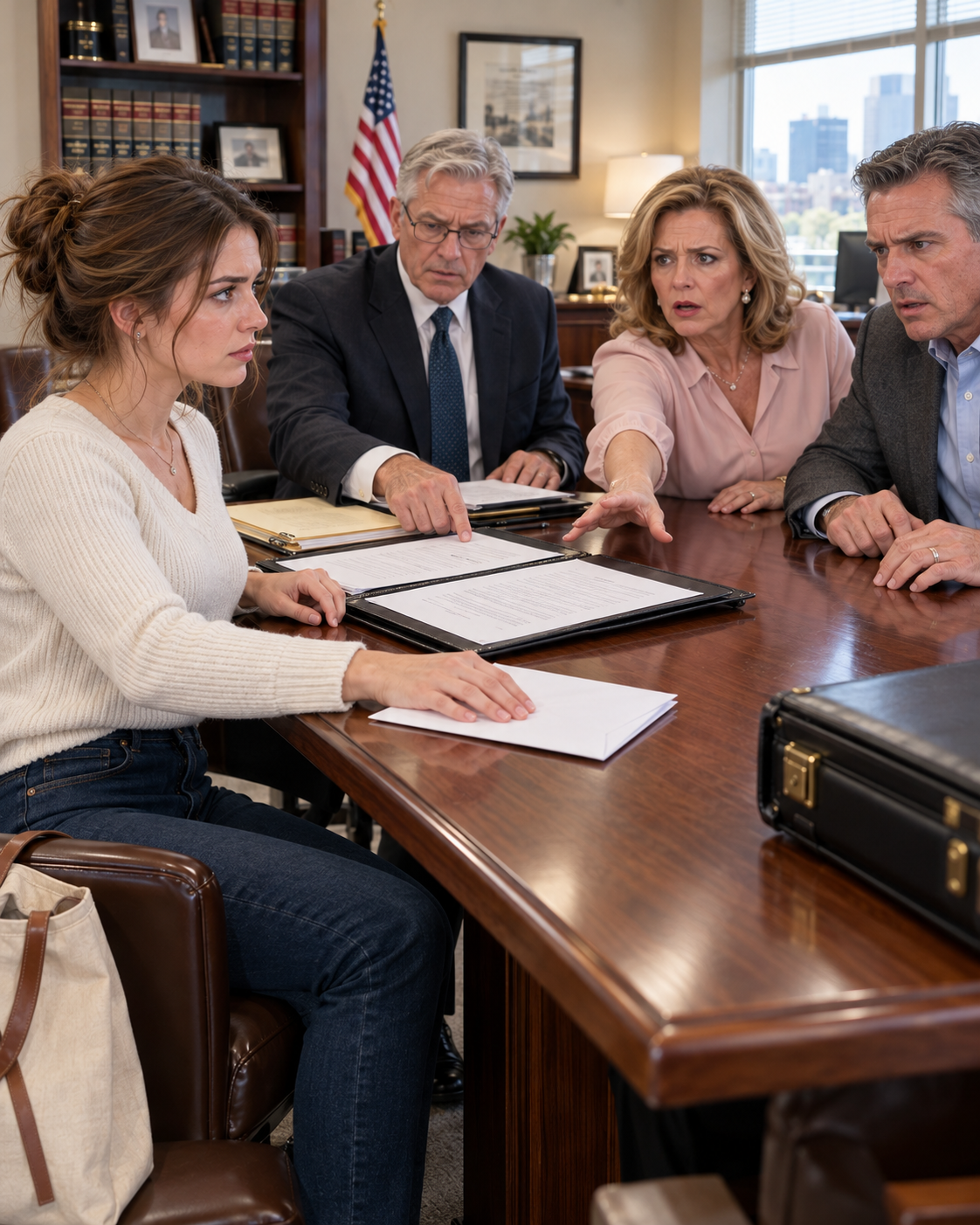
“No. Arthur had some documents in his briefcase. He told Mom that if you signed them, everything would be easier.”
“Easier for whom?”
Cody stared down at the table.
“I don’t know.”
I softened my voice.
“Did they tell you to bring me home?”
He nodded.
“Mom said she misses you.”
I wanted to believe him.
Despite everything, a part of me still remembered the mother who had sat beside my bed when I had pneumonia at nine, singing off-key until I fell asleep. I remembered her teaching me to drive in an empty parking lot, her hand gripping the dashboard every time I touched the brake.
Those memories were real.
So was the woman who had watched me leave with two suitcases.
“Did she say anything else?” I asked.
Cody hesitated.
“Arthur said you were being selfish by keeping money that should help the whole family.”
There it was.
Not concern.
Not regret.
Money.
I folded the note and slipped it into my pocket.
“Cody, listen to me. I love you, and none of this is your fault. But I won’t sign anything until my lawyer reviews it.”
His eyes filled.
“Are you never coming home?”
The question hurt more than anything my mother had said.
“I don’t know what home means anymore.”
He looked away, trying to hide his tears.
Before he left, I hugged him tightly and told him he could call me whenever he needed to talk, regardless of what our mother said.
Then I returned to the kitchen, washed my hands, and finished my shift.
That night, I called Thomas Reed.
He listened carefully as I explained Cody’s visit.
“Do not sign anything your mother or Arthur gives you,” he said. “Your father’s trust was established precisely to prevent anyone from taking control of your inheritance.”
“Why would they want power of attorney if the money already belongs to me?”
“Because authority over someone else’s finances can be valuable. Depending on the document, it may allow a person to manage accounts, pay bills, or conduct transactions on the person’s behalf. It doesn’t automatically make the money theirs, but it can create opportunities for abuse.”
I stared at the cracked ceiling above Aunt Rachel’s spare room.
“Could they take everything?”
“Not simply because they ask. The trust has safeguards, and we will protect them. But I need you to understand something, Emily: people who want control often describe it as help.”
I wrote that sentence in the notebook beside my bed.
For the next several days, I focused on school and work.
I had no interest in becoming wealthy overnight. I wanted to finish my degree, get a stable job, and stop calculating whether I could afford groceries after paying for textbooks.
The trust was not a lottery ticket.
It was my father’s way of making sure I could build a life without begging the people who had abandoned me.
Mr. Reed explained that the trust would pay my approved university expenses directly and provide other distributions under its written terms. The principal would remain protected, with independent oversight, and any requests outside the established rules would require review.
I could not simply withdraw everything whenever I wanted.
That was exactly how my father had designed it.
“Your father was very specific,” Mr. Reed told me during our next meeting. “He wanted you to have choices, not a pile of money that someone could pressure you into surrendering.”
I traced the edge of the folder.
“Why didn’t he tell me himself?”
The lawyer removed his glasses.
“Your father believed he had more time than he did.”
Then he told me the truth about Daniel Hayes.
My father had been diagnosed with an aggressive terminal illness months earlier. When he tried to contact me, my mother repeatedly told him I was too upset to speak to him and that I had asked for distance.
At the same time, she told me he was too ill to deal with family matters and eventually claimed he had chosen to disappear.
Neither story was entirely true.
My father had been seriously ill, but he had not abandoned me.
He had tried to arrange a meeting through his attorney, and my mother had repeatedly interfered with the messages.
“Do you have proof?” I asked.
Mr. Reed opened another folder.
“There are emails, returned letters, and records of attempted contact. We have preserved them.”
My hands trembled.
For months, I had been angry with my father for leaving me.
Now I had to grieve the fact that he had been reaching for me while I believed he no longer wanted me.
“Can I see him?”
Mr. Reed looked at me with quiet sadness.
“Yes. But Emily, his condition has deteriorated. I don’t want to frighten you, but you should go soon.”
I left his office and sat in my car for nearly twenty minutes.
Then I called the number he gave me.
My father answered after the fourth ring.
“Emily?”
His voice was weak, but it was unmistakably his.
I covered my mouth.
“Dad?”
For a moment, neither of us could speak.
Then he whispered, “I was afraid I’d run out of time before I heard your voice again.”
I began to cry.
“I thought you didn’t want me.”
“Oh, sweetheart. No.”
His breath caught.
“Never believe that.”
I drove to his hospice facility the following morning.
The room smelled faintly of clean linen and antiseptic. Sunlight rested on the windowsill beside a stack of books he could no longer read for long.
He looked smaller than I remembered.
His hair had thinned, and his face was drawn, but when he saw me, his eyes brightened.
I hurried to his bedside and took his hand.
“I’m sorry,” I whispered.
He squeezed my fingers.
“You have nothing to apologize for.”
“I should have called more.”
“You were given a story, Emily. You had no reason to know it was incomplete.”
I cried harder then, because he wasn’t blaming me.
He wasn’t asking me to explain why I had believed my mother.
He was simply glad I had come.
We talked for hours, with long pauses whenever he became tired.
He asked about my classes, my job, and whether I was eating enough. I told him about Aunt Rachel’s floor, the diner, and the night I had been thrown out.
His expression changed when I described the wedding.
“I should have made sure you were safe,” he said.
“You were sick.”
“I was your father.”
I held his hand tighter.
“You still are.”
He closed his eyes, and for a moment I thought he had fallen asleep.
Then he spoke again.
“There’s something else you need to know.”
I leaned closer.
“Your mother didn’t just keep my messages from you. She told me you wanted nothing to do with me, either.”
The room seemed to go silent.
“She said I was making your life harder. She told me you had asked her to stop giving me updates.”
I shook my head.
“I never said that.”
“I know that now.”
He opened his eyes.
“When I learned she had been lying, I tried to confront her. But by then, I was too ill to fight every battle. I decided the one thing I could still do was protect your future.”
I wanted to ask why he hadn’t found a way to reach me sooner.
I wanted to demand why he had let so many months pass while I suffered under a lie.
But looking at his exhausted face, I understood that illness had narrowed his world to the things he could still control.
He had chosen to protect me the only way he believed he could.
I leaned down and kissed his forehead.
“Thank you for finding a way to reach me.”
He smiled faintly.
“I should have found a better one.”
When I left that afternoon, I felt both lighter and more devastated than I had ever felt before.
My father was alive.
But I might not have much time left with him.
And the people who had kept us apart were beginning to realize that their control over my life was disappearing.
My mother called that evening.
Her voice was sweet, almost unrecognizable.
“Emily, darling. I heard you’ve been visiting your father.”
I stopped walking.
“How did you hear that?”
“People talk. I’m glad you’re reconnecting with him.”
I said nothing.
“I’ve been thinking about everything that happened,” she continued. “Arthur and I were under a lot of pressure during the wedding. We shouldn’t have asked you to leave like that.”
“You didn’t ask me to leave, Mom. You threw me out.”
A pause followed.
“Yes. And I regret how it happened.”
I waited for the apology to become specific.
It never did.
Instead, she said, “I think we should meet and discuss your father’s arrangements. There are some financial matters we need to coordinate.”
I closed my eyes.
“Mr. Reed is handling the trust.”
“He’s a lawyer, Emily. He doesn’t understand our family.”
“He understands the documents my father signed.”
Her voice sharpened.
“Don’t become arrogant because you have money.”
The words came so quickly that I almost laughed.
“I don’t have money to spend freely. I have a trust designed to pay for my education and protect my future.”
“That is exactly why you need family to help you manage it.”
“No, Mom. That’s why Dad arranged independent management.”
She hung up.
The next morning, Arthur sent an email asking me to sign a document authorizing him to communicate with the trustee on my behalf.
The document was written in dense legal language, and one section appeared to grant broader authority than his message suggested.
I forwarded it to Mr. Reed without replying.
His response arrived within the hour.
“Do not sign. The document grants powers far beyond routine communication, including authority to request certain financial actions. We have notified the trustee that you have not authorized anyone to act for you.”
A week later, the situation became more complicated.
A social worker contacted Aunt Rachel’s home after receiving a report that I was financially vulnerable, possibly being exploited, and unable to manage my affairs.
The report alleged that I had been sleeping in unsafe conditions and that an unknown individual was controlling my inheritance.
The claims were absurd.
I was an adult, enrolled in university, employed, and capable of making my own decisions.
Still, the social worker had a responsibility to assess the report, and Aunt Rachel welcomed her inside.
I answered every question calmly.
I showed her my enrollment records, work schedule, and the letter confirming that the trust was independently managed.
She reviewed the information, spoke privately with Aunt Rachel, and concluded that there was no evidence supporting the allegations.
Before leaving, she apologized for the distress.
“I have to take reports seriously,” she said. “But a report is not proof.”
I understood that.
What frightened me was not the visit itself.
It was the realization that my mother and Arthur were willing to use institutions meant to protect vulnerable people as weapons in a family dispute.
When I told Mr. Reed, he documented the incident and advised me to keep records of every unwanted contact.
“Do not retaliate,” he said. “Do not post accusations online. Let the evidence speak.”
I followed his advice.
Then Cody called.
He sounded frightened.
“Mom says you’re trying to destroy the family.”
“I’m not trying to destroy anyone.”
“Arthur says Dad’s money should have been shared.”
I leaned against the kitchen counter.
“Cody, Dad set up the trust for my education and future. It isn’t a family fund.”
“But Mom says he would have wanted us all to benefit.”
“Did Dad tell you that?”
Silence.
“That’s what I thought,” I said gently. “You don’t have to take sides, Cody. You can love Mom and still recognize that some things she’s doing are wrong.”
He began to cry.
“I just want everyone to stop fighting.”
“So do I.”
After we hung up, I sat with my phone in my lap and cried for my brother.
He was being asked to carry messages between adults who should have known better than to place him in the middle.
I couldn’t rescue him from every consequence of our family’s choices.
But I could make sure he knew that he had a place with me, no matter what happened between our mother and me.
Two weeks later, I moved into a modest studio apartment near campus.
The walls were bare, the kitchen was barely large enough for two people, and the radiator made an alarming clanking sound every morning.
But the key belonged to me.
On the first night, I sat on the floor surrounded by boxes and ate takeout from a paper container.
I had no expensive furniture, no grand inheritance to display, and no family gathered around me.
Still, when I locked the door, I felt safer than I had in years.
My father called the next afternoon.
“Have you found a place?”
“I have.”
“Is it comfortable?”
“The radiator sounds like a tank trying to escape.”
He laughed, a weak, breathless sound that made my chest ache.
“Then it’s officially your first apartment.”
I smiled through tears.
“Dad, it’s tiny.”
“Your first home doesn’t have to be impressive. It has to be yours.”
I wrote those words on a sticky note and put it beside my desk.
Over the next month, I visited him whenever my classes and work allowed.
Some days we talked about ordinary things. He asked about my exams, and I complained about professors who assigned more reading than anyone could finish.
Other days, he told me stories from my childhood that I had forgotten.
He remembered the blue bicycle I had crashed into a hedge, the science fair project that had failed spectacularly, and the afternoon I had insisted that a stray cat belonged to us because it had slept on our porch.
We laughed when he had the strength.
When he didn’t, I sat beside him and read aloud.
I learned that love could be quiet.
It could be a hand resting in yours, a cup of water held at the right moment, or someone remembering a small detail when the rest of the world had become difficult to navigate.
Meanwhile, my mother continued trying to regain access to the trust.
Her emails alternated between affection and accusation.
One day she called me her beloved daughter.
The next, she accused me of abandoning my family for money.
Arthur sent a message claiming that my refusal to cooperate would create unnecessary legal expenses.
Mr. Reed answered only when necessary, keeping every communication on record.
Eventually, the trustee formally rejected their requests for authority because neither of them had legal standing to control the assets.
The attempted financial transfers were also reviewed, and the trust’s safeguards remained intact.
Then came the letter that changed everything.
It arrived at my apartment on a gray Tuesday morning, addressed to me in my mother’s handwriting.
Inside was a single page.
She wrote that she was sorry I had been hurt, but insisted that her actions had been motivated by concern. She said Arthur had made mistakes, that she had been overwhelmed, and that she hoped we could return to being a family.
At the bottom, she asked me to meet her privately without lawyers.
I read the letter twice.
There was no mention of the false welfare report.
No acknowledgment that she had kept my father’s messages from me.
No apology for the document Arthur had tried to make me sign.
Only a request that I return to the relationship on her terms.
I placed the letter in my file.
Then I wrote a short response stating that I was willing to communicate respectfully, but that any financial or legal matter would continue through the appropriate representatives.
I did not agree to a private meeting.
For the first time, I understood that a boundary was not a punishment.
It was a door I could choose to close when someone repeatedly entered my life to take something from me.
My father grew weaker as winter approached.
One afternoon, while I was helping him adjust his blanket, he asked whether I hated my mother.
The question caught me off guard.
“I don’t know,” I admitted. “Sometimes I’m angry. Sometimes I miss who I thought she was.”
He nodded slowly.
“You don’t have to hate her to protect yourself.”
I looked at him.
“Did you ever hate her?”
He stared toward the window for a long time.
“I loved her once. Perhaps some part of me always will. But love doesn’t make every choice acceptable, and forgiveness doesn’t require you to put yourself back in danger.”
His words settled somewhere deep inside me.
I had spent months believing I needed to choose between loving my mother and defending myself.
My father was reminding me that those were not the same decision.
That evening, I asked him the question I had carried since the first day I learned about the trust.
“Why did you leave so much to me? Why not divide everything equally?”
He turned his head toward me.
“Because I wasn’t trying to reward you more than your brother. I was trying to protect the child who was being pushed out of her own life.”
My eyes filled.
“I didn’t want money to become another reason for you to fight.”
“Then why did you leave it in a trust?”
“Because I knew how easily people can confuse access with ownership.”
He squeezed my hand.
“I couldn’t guarantee that everyone would treat you fairly, Emily. I could only make sure that their choices didn’t decide your future.”
I bent my head over our joined hands.
For a long time, neither of us spoke.
Then he said, “Promise me something.”
“Anything.”
“Don’t spend your life proving to people who hurt you that you deserved better.”
I looked up.
“Spend it building something good.”
I promised.
My father died eleven days later, just before sunrise.
I was beside his bed when his breathing slowed, and I held his hand until the nurse gently told me he was gone.
There was no dramatic final speech.
No miraculous recovery.
Only the soft hum of the room and the unbearable quiet that followed the end of a life.
I cried until my throat hurt.
Then I remembered his promise, and I stayed.
I helped arrange the funeral with Mr. Reed’s assistance, choosing a simple service that reflected the man I had known rather than the complicated family story surrounding him.
Cody came.
He stood beside me at the graveside, his eyes red, his hands shoved deep into his coat pockets.
Our mother arrived with Arthur and approached us after the service.
For a moment, I thought she might embrace me.
Instead, she asked whether the trustee had released any funds for the funeral expenses.
I stared at her.
My father had been buried less than an hour earlier.
“His estate is being handled according to his instructions,” I said.
She looked wounded, as if my refusal to discuss money at that moment were an act of cruelty.
“Emily, I am still your mother.”
I felt the old instinct to apologize rise inside me.
Then it passed.
“Yes,” I said quietly. “And I am still your daughter. I needed you when you put me out of the house, and you chose not to help me. I needed you to tell me the truth about Dad, and you chose not to do that either.”
Her eyes filled.
“You’re making me sound like a terrible person.”
“I’m telling you what happened.”
Arthur stepped forward.
“This isn’t the place.”
For once, I agreed with him.
I turned away and walked with Cody toward the parking lot.
He followed me in silence until we reached my car.
Then he asked, “Can I visit you sometime?”
I looked at my little brother, who had been caught between adults and made to feel responsible for repairing damage he had never caused.
“Anytime,” I said. “You never have to earn a place in my life.”
He hugged me so tightly that I could barely breathe.
I held him for a long time.
After the funeral, my mother sent one final message asking me to reconsider our relationship and help Arthur stabilize his business.
I didn’t respond.
Instead, I met with Mr. Reed, finalized the remaining trust arrangements, and returned to my studies.
The money paid my approved tuition and helped cover essential expenses under the trust’s terms. I continued working part-time because I wanted the discipline, the routine, and the satisfaction of earning something myself.
I wasn’t interested in proving that I could live better than my mother.
I wanted a life in which her opinion no longer determined whether I felt safe.
Months later, I graduated.
Aunt Rachel sat in the front row, crying before my name was even called. Cody cheered loud enough to make the people beside him laugh.
I carried my diploma out into the sunshine and thought about the girl standing on the porch with two suitcases, wondering how she would survive the night.
I wished I could tell her that the floor she slept on would not be the end of her story.
That one day, she would have a home with a key of her own, a future she had chosen, and memories of her father that no one could take away.
I wished I could tell her that being abandoned did not mean she was unworthy of love.
It meant someone had failed to give it properly.
That evening, I returned to my studio and found a small package outside my door.
There was no return address.
Inside was a photograph of my father holding me as a baby, smiling at the camera while I gripped his shirt with both tiny hands.
On the back, he had written a sentence I had never seen before.
“Emily, if you’re reading this, someone has finally told you the truth.”
My breath caught.
Beneath the photograph was a second note, written in a different hand.
It said that my father had kept a sealed letter with instructions to be opened only after his death, and that the letter might explain why my mother had been so determined to keep us apart.
I called Mr. Reed immediately.
He was silent for several seconds after I explained what I had found.
Then he said, “Emily, I thought that letter had already been delivered.”
A chill moved through me.
“What letter?”
“I’ll check the file first thing tomorrow. Don’t contact your mother until we know what we’re dealing with.”
That night, I placed the photograph beside my father’s sticky note on the wall.
I had spent so long fighting to uncover the truth that I thought the hardest part was over.
Now I understood that there might still be pieces of my family’s story I had never been allowed to see.
But I was no longer the frightened girl on the porch.
I had learned that love without respect could become a cage, that money could expose the motives people tried to hide, and that family was not defined by who shared your name, but by who treated your life as something worth protecting.
Whatever the missing letter contained, I would read it when the time came.
Not to win an argument.
Not to punish my mother.
But because my father had spent his final months trying to give me something more valuable than an inheritance.
He had tried to give me the truth.
And this time, I was ready to hear all of it.