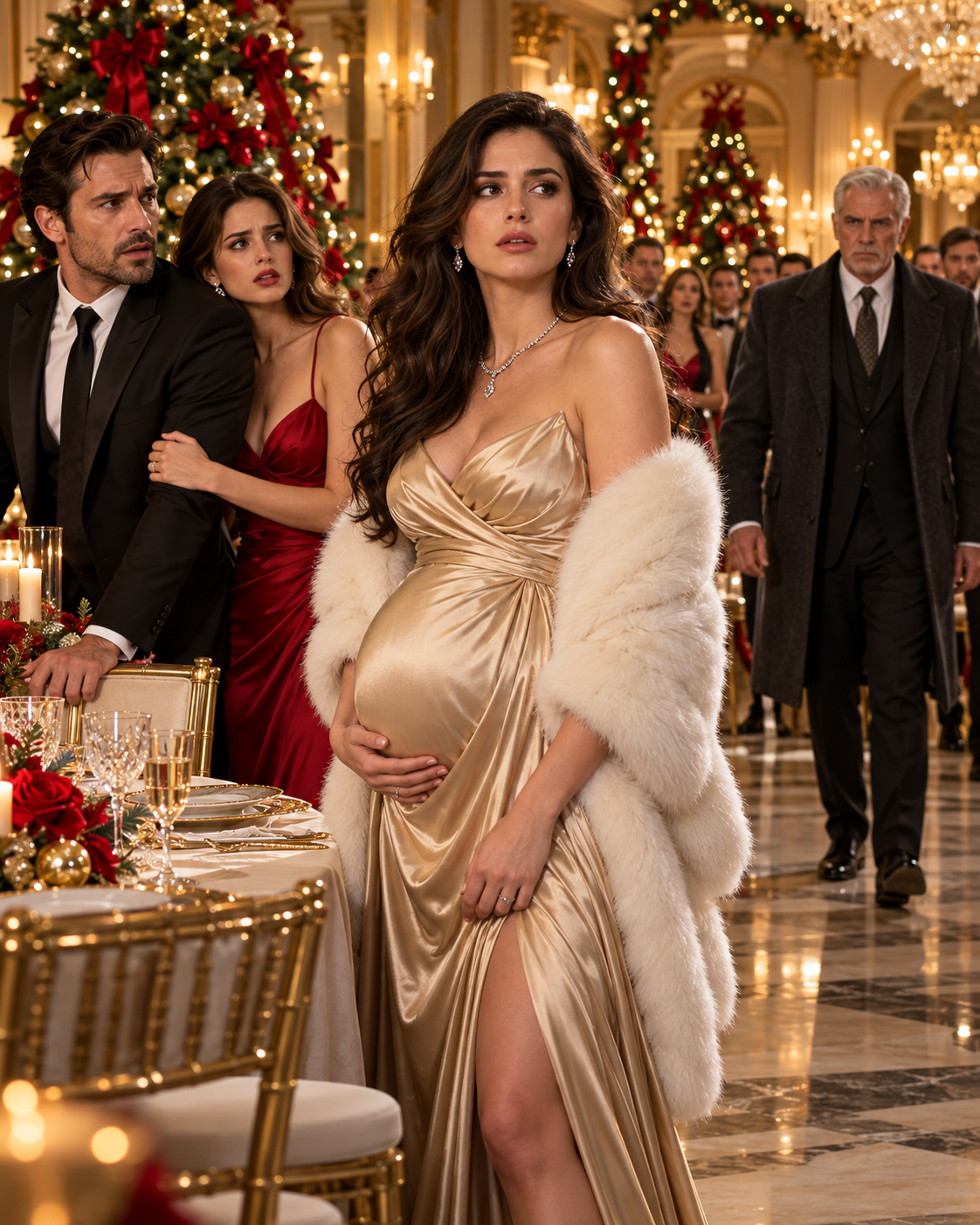
On New Year’s Eve, 29 weeks pregnant at the top of our Gold Coast mansion’s staircase, I watched my husband bring his MISTRESS
For several seconds, I couldn’t move.
The photograph on my phone showed the nursery at the Gold Coast mansion exactly as I remembered it, except someone had placed a small wooden rocking horse in the middle of the empty room.
Beneath the photograph, another message appeared.
“Ask Julian what happened the night your son was conceived.”
My stomach tightened.
In the living room, Cien stirred against Julian’s chest, made a tiny sound, and settled again.
I wanted to march into the room and demand answers, but the message had already accomplished what its sender intended: it had planted suspicion inside the one fragile moment of peace I had allowed myself.
I took a screenshot, blocked nothing, and forwarded the evidence to Detective Mara Ellis, the officer who had led the investigation into Bram’s conspiracy.
Then I walked into the living room.
“Julian, I need you to tell me the truth about something.”
He looked up immediately.
“What happened?”
I showed him the photograph.
The color drained from his face so quickly that I felt my heart sink before he spoke.
“Where did you get this?”
“Someone sent it to me.”
He read the message twice, then carefully transferred Cien into his crib.
“Listen to me,” he said. “Whatever this is, I need you to hear the whole story before you decide what it means.”
I folded my arms, suddenly aware of how familiar those words sounded.
For years, he had asked me to trust him before explaining anything, as if trust were a debt I owed him rather than something he had to earn.
“Then start talking.”
Julian sat down, but he didn’t reach for me.
“Eight months before New Year’s Eve, I discovered that someone inside the organization was selling information about our family’s movements. I suspected Bram, but I had no proof. I thought I could investigate quietly without frightening you.”
“You thought you could protect me by lying to me?”
“I thought I could solve it before it reached you.”
“And while you were solving it, you started an affair?”
He lowered his eyes.
“No. The affair was my choice, and it was wrong. I won’t use Bram to excuse it.”
His answer surprised me more than a denial would have.
He continued, explaining that Brynn had first approached him through a business project, offering access to contacts who might help him identify the leak. Their professional relationship had become personal, and instead of ending it or confessing, he had allowed himself to live in two separate worlds.
He had told himself he could control both.
He had been wrong.
“But the night Cien was conceived?” I asked.
Julian rubbed his palms together.
“That night, I was at the hospital with you after your first serious scare. I never left you.”
I remembered the evening.
I remembered his hand around mine, the antiseptic smell, and the way he had promised that he would never let anything happen to our baby.
I also remembered the nurse who had brought him a message, and how he had stepped into the corridor to answer it.
“You were gone for twenty minutes.”
“I was speaking to Bram. He said there was an immediate security problem.”
“And you never told me.”
“No.”
The word hung between us, small and ugly.
I wanted the story to become simple, to reveal one monstrous lie that could explain everything and allow me to make a clean decision.
Instead, I was facing the more painful truth: Julian had loved me in some ways and betrayed me in others, sometimes within the same hour.
My phone rang.
Detective Ellis had traced the latest message to a prepaid number activated less than two miles from the mansion.
“We’re checking nearby cameras,” she told me. “But there’s something you should know. Bram’s case is moving toward trial, and someone has been trying to contact two witnesses who disappeared after his arrest.”
“Who?”
“One is a former security contractor. The other is a woman named Vanessa Cole.”
Julian went completely still.
I noticed.
“Who is Vanessa Cole?” I asked after ending the call.
He stared at the floor.
“She was Bram’s financial assistant.”
“And why do you look as if you’ve seen a ghost?”
“Because Vanessa disappeared three weeks before New Year’s Eve. Bram told me she had left the country.”
“Did you believe him?”
“I wanted to.”
I laughed once, without humor.
“That seems to be your favorite way of living.”
He accepted the blow without defending himself.
The next morning, Detective Ellis arrived at my townhouse with a folder and two officers.
She showed us footage from a parking garage near the mansion. A woman in a gray coat had entered the garage shortly before the photograph was sent. Her face was obscured, but the vehicle she used belonged to a company connected to one of Julian’s old business partners.
The company had been dissolved six months earlier.
Its director was dead.
And its remaining accounts had been emptied by a series of transfers that led back to Bram.
“Someone is using money Bram hid before his arrest,” Detective Ellis explained. “That doesn’t mean he’s directing this from prison. It means someone else may have access to his old network.”
“Could it be Liam?” Julian asked.
The detective gave him a sharp look.
“You spent New Year’s Eve blaming him. Are you planning to repeat that mistake?”
Julian didn’t answer.
I watched him absorb the rebuke, and I understood how much his old instincts still controlled him. When fear entered a room, he searched for an enemy before considering what he might have done himself.
I had spent years living inside that reflex.
I wouldn’t raise Cien inside it.
“Find Vanessa,” I told the detective. “If she knows what Bram was planning, she may be the only person who can tell us whether this is another attempt to start a war.”
Detective Ellis nodded.
“But you need to understand something,” she added. “If this person knows your private schedule and can get near your home, we have to assume they may try to approach you directly.”
After she left, Julian offered to move into the townhouse’s guest room and arrange additional security.
“No,” I said.
His face tightened, but he waited.
“You can help me make a safety plan. You cannot move into my home because you’re frightened, and you cannot decide what happens here.”
He nodded slowly.
“All right. Tell me what you need.”
The difference was small, but it mattered.
For once, he had asked instead of assumed.
Over the following week, we changed our routines, installed a new security system, and established a code word with the people who cared for Cien.
I also returned to the hospital for additional shifts.
There was something grounding about the trauma ward. People arrived there on the worst days of their lives, frightened and angry, desperate to make sense of the pain that had found them. I could not promise them that everything would be fine, but I could hold their hands, explain what was happening, and help them survive the next hour.
For the first time in months, I felt useful without having to prove my worth to anyone.
Then, on a rainy Thursday afternoon, Detective Ellis called.
“We found Vanessa.”
She was staying at a small motel outside Milwaukee under a false name.
“She says she has information about the money and the New Year’s Eve operation,” the detective continued. “But she refuses to speak unless you come.”
“Why me?”
“She says Bram’s people believed you were the only person in the family who hadn’t been bought.”
I looked through the kitchen window at Cien sleeping in his stroller.
“I’m not going anywhere without protection.”
“Agreed,” Ellis said. “And Julian will not be involved unless you specifically request him.”
That evening, I met Vanessa in a secure interview room at the police station.
She was thinner than her photograph, with tired eyes and fingers that shook whenever the door opened.
“I didn’t know they were going to kill anyone,” she said before I had even sat down. “I swear to you, I thought it was about forcing Julian out.”
“Who are they?”
She looked at Julian’s empty chair.
“His uncle, Richard.”
I stared at her.
Julian’s uncle had supposedly retired from the family’s business years ago, after a public disagreement over control of its legitimate investments.
“He was helping Bram move money,” Vanessa continued. “Bram wanted Julian dead and Liam blamed. Richard wanted the organization divided so he could take over the businesses without having to fight for them.”
“Why would Richard want Julian gone?”
“Because Julian was preparing to sell several properties and move the family’s legitimate operations away from the old network. Richard believed he was weakening the empire.”
I thought of the mansion, the expensive cars, the guards, and the people who had spent years treating fear as a substitute for loyalty.
“What does any of this have to do with my baby?”
Vanessa’s eyes filled with tears.
“Richard knew Julian would do anything to protect you. Bram used that. They leaked your medical appointments and nursery plans so the threat would feel personal. They wanted Julian to panic, blame Liam, and start a war before anyone could question the evidence.”
“And the message I received last night?”
“I don’t know who sent it,” she whispered. “But I know Richard kept a copy of every file Bram collected. He believed information was more valuable than weapons.”
She reached into her bag and produced a small flash drive.
“This is what I managed to take before I ran.”
Detective Ellis secured the drive and sent it for forensic examination.
The first files contained financial records, internal communications, and photographs from the estate.
The last folder contained a scanned letter addressed to Julian.
Its date was three days before New Year’s Eve.
The letter instructed Bram to make the mansion appear vulnerable, create evidence implicating Liam, and ensure Julian was alone when the ballroom lights failed.
But one line made my blood run cold.
“If the wife becomes an obstacle, use the child. Julian will surrender anything when forced to choose.”
I pushed the folder away.
For a moment, I could not breathe.
Vanessa began to cry.
“I’m sorry.”
I wanted to hate her for staying silent, for allowing the plan to advance while I decorated a nursery and imagined a future.
But I saw the terror in her face, and I recognized the terrible arithmetic people perform when they believe speaking will cost them everything.
“I can’t forgive what you helped them do,” I said. “But I’m glad you finally told the truth.”
That night, Julian came to the townhouse after Detective Ellis informed him about Richard.
He stood in the doorway, pale with anger.
“I should have seen it.”
“Yes,” I said. “You should have.”
“He was family.”
“So was I.”
He closed his eyes.
I watched the words reach him, not as an accusation he could fight, but as a truth he had to carry.
“I’m sorry,” he whispered.
I had heard those words before, in expensive restaurants and quiet bedrooms, after arguments that ended with promises and changed nothing.
This time, I didn’t reassure him.
He didn’t ask me to.
“I want to help the investigation,” he said. “But I won’t make decisions for you. If you want me to stay away, I will.”
I studied him for a long moment.
“Then help the police. Tell them everything, including the things that make you look bad.”
He nodded.
The investigation moved quickly after that.
The flash drive connected Richard to shell companies used to finance Bram’s operation, while messages recovered from an old server showed that he had approved payments to the two men arrested in the wine cellar.
Richard was taken into custody at his lake house before dawn.
He denied everything until detectives showed him the letter.
Then he asked for a lawyer.
The danger should have ended there.
Instead, two days later, a courier delivered a sealed envelope to my hospital locker.
Inside was a photograph of Cien sleeping in his crib.
It had been taken through the window of my townhouse.
On the back, someone had written, “Richard was the money. Bram was the plan. You still haven’t found the person who opened the door.”
I called Detective Ellis immediately.
She arrived within twenty minutes, accompanied by two officers.
The photograph had been taken from the sidewalk, but the image was clear enough to show that whoever took it knew which room belonged to Cien.
We reviewed the townhouse’s security recordings.
At 2:13 that morning, a figure wearing a maintenance uniform had approached the side entrance and used a key to enter the building.
The figure left four minutes later.
The building manager swore he had not authorized any maintenance visit.
Then Detective Ellis froze the footage.
The person turned toward the camera while adjusting a cap.
I recognized the face.
So did Julian, when I called him and sent the still image.
It was Martin Shaw, the security consultant who had helped us select the townhouse’s original alarm system.
He had been recommended by Bram.
For a moment, neither of us spoke.
Then Julian said, “I’m coming over.”
“No,” I replied. “You’re calling Detective Ellis, and you’re staying where you are until she tells you otherwise.”
A pause followed.
“All right.”
It was the first time I had ever given Julian an order that mattered and watched him obey without trying to negotiate.
The police traced Martin to a rented storage unit in the city.
Inside, they found copies of our security plans, a burner phone, and a list of addresses connected to Julian’s legitimate businesses.
They also found a sealed envelope bearing my name.
Detective Ellis called before I could reach the station.
“Don’t open it,” she said. “We need to photograph and process everything.”
“What does it contain?”
“We don’t know yet. But there’s something else. Martin has agreed to cooperate.”
By midnight, the outline of the final betrayal had emerged.
Martin had not been working for Richard alone. He had been paid by a former business associate of Julian’s who believed our separation had left the family vulnerable.
That man wanted control of several properties and had assumed that, with Julian distracted by guilt and me distracted by motherhood, nobody would notice the transfers.
The threats were not only about revenge.
They were about money, power, and the belief that a woman rebuilding her life would be too exhausted to defend it.
The sealed envelope contained copies of forged documents intended to make it appear that I had secretly transferred ownership of my townhouse to one of Julian’s companies.
If the scheme succeeded, the man could challenge my ownership, freeze several accounts, and force us into a public legal battle that would make our private lives a weapon once again.
But the documents were forged, and the original purchase records were in my name.
I had kept the townhouse independent for a reason.
For the first time, I understood that the decision I had made during my pregnancy had protected more than my peace.
It had protected my future.
The case lasted months.
Julian testified about the affair, the security failures, and his own decisions to conceal information. His honesty cost him relationships and damaged his standing among people who had once admired his authority.
He did not blame me.
He did not ask me to defend him.
When the trial finally concluded, Bram and Richard were convicted on multiple charges connected to the conspiracy, and Martin’s cooperation helped prosecutors dismantle the remaining network.
The court could punish what they had done.
It could not return the nights I had spent afraid, the trust I had lost, or the years I had wasted believing that love meant enduring whatever someone called protection.
Those things required a different kind of work.
Julian continued therapy.
He attended every scheduled visit with Cien, paid his share of expenses without using money to demand influence, and learned that being a father meant showing up even when nobody praised him for it.
Some weeks, we spoke only about our son.
Other weeks, we managed a conversation about ourselves without reopening every wound.
There were setbacks.
Once, Julian arrived late and began explaining how an urgent meeting had delayed him.
I reminded him that Cien had been waiting by the window.
He looked at our son, then put his phone away.
“You’re right,” he said. “I should have called.”
It was a small moment, almost painfully ordinary.
But trust is often rebuilt from moments too small for anyone else to notice.
By the following spring, I had accepted that I might never want the marriage we once had.
That realization no longer frightened me.
I could love the man Julian was trying to become without promising to become his wife again.
I could give Cien a father without giving up the boundaries that kept our home safe.
And I could forgive pieces of the past without inviting them to govern my future.
One evening, after Julian had taken Cien to the park, I found a folded drawing in the pocket of our son’s little jacket.
It showed three stick figures standing beneath a crooked yellow sun.
Cien had begun calling us his family, though he was still too young to understand why we lived in different homes.
For a long time, I studied the drawing.
Then I placed it on the refrigerator.
It did not mean Julian and I were destined to reunite.
It meant our son could love both of us without carrying the burden of our mistakes.
That November, the first snow fell over Lincoln Park.
Julian arrived with takeout, as he had the year before, but this time he brought no promises and asked for nothing.
He sat on the rug while Cien pushed wooden blocks into his hands, laughing whenever the tower collapsed.
I watched from the kitchen doorway and felt something quiet settle inside me.
Not certainty.
Not the old, blinding hope that had once convinced me love could excuse anything.
Something steadier.
When Julian looked up, he did not ask whether I was ready to forgive him.
He simply smiled at our son.
Later, after Cien had fallen asleep, Julian stood by the door with his coat over one arm.
“Thank you for letting me be here,” he said.
“You don’t have to thank me for being his father.”
“I know.” He hesitated. “I’m learning that there are things I have a right to do, things I have a responsibility to do, and things I have no right to ask of you.”
I felt my throat tighten.
“That’s a good place to start.”
He nodded and stepped into the hallway.
For a moment, I thought about calling him back.
Not because I was lonely, and not because I believed one gentle evening could erase everything, but because I could finally imagine a future in which choosing love did not require abandoning myself.
Then my phone vibrated.
Detective Ellis had sent an update about the final evidence recovered from Martin’s storage unit.
One file remained encrypted until that afternoon.
It contained a recording made inside the mansion on New Year’s Eve, minutes before the ballroom lights failed.
The recording showed Bram entering the study, speaking to someone who had been standing outside the camera’s field of view.
The audio was imperfect, but one sentence came through clearly.
“She still believes the invitation was her idea.”
I replayed it.
Then I looked at the date.
Three days before the anonymous threat had arrived, I had received a handwritten note suggesting that Liam might be the only person powerful enough to protect my family.
I had believed I made the decision to contact him alone.
Now I wondered who had placed that thought in my mind.
The recording ended before the other person spoke.
Detective Ellis had sent one final message.
“We’re identifying the voice. Until we know who it belongs to, don’t assume the conspiracy ended with the convictions.”
I walked to Cien’s bedroom and watched him sleep beneath his soft blue blanket.
For a long time, I had believed that surviving meant reaching a day when nothing could frighten me again.
Now I understood that survival was something else: knowing fear could return without being allowed to make my decisions.
I had lost my marriage as I once understood it.
I had lost the illusion that wealth, security guards, and a grand house could protect the people I loved from betrayal.
But I had not lost myself.
I had my son, my work, my home, and the right to decide who would be allowed into the life we were building.
Whatever the recording revealed, I would meet it with my eyes open.
Because the greatest lesson of that terrible New Year’s Eve was not that everyone could be trusted, nor that nobody could.
It was that love without honesty becomes control, protection without respect becomes a cage, and forgiveness without boundaries becomes another way of disappearing.
I turned off the hallway light and returned to the living room, where the last of the snow glimmered beyond the window.
For the first time, the future did not feel like a promise someone else could steal from me.
It felt like a door I held the key to.
And whatever waited on the other side, I would be the one to decide when it opened.