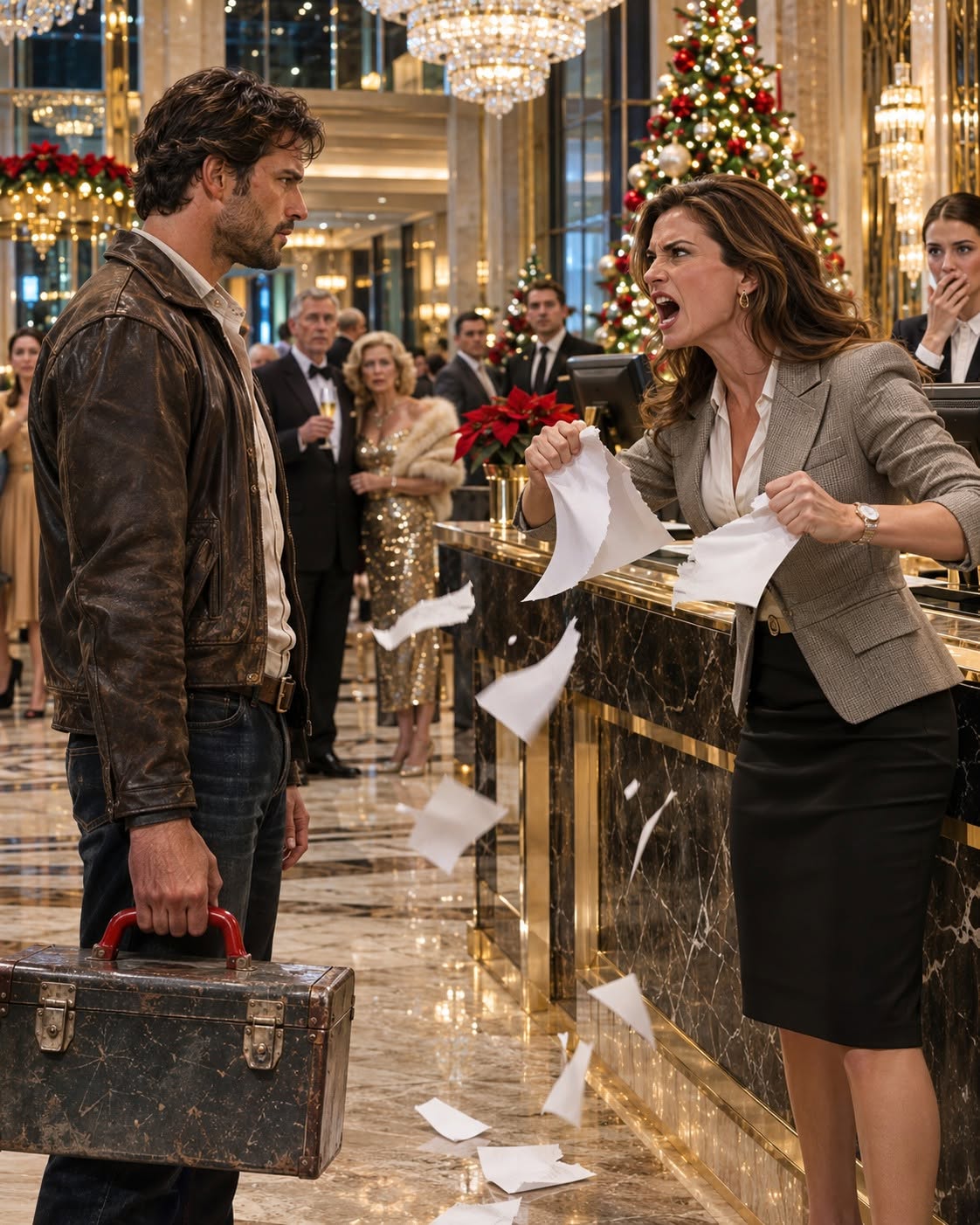
On Christmas Eve, the CEO of a five-star hotel tore up my invoice in front of dozens of wealthy guests. Hours later, she would be begging me to come back.
The owner turned toward me.
“Before we make any decisions, there’s something we need to ask you about what happened this morning.”
He opened another document and began reading.
“At 10:42 a.m., you submitted a written inspection report identifying a critical failure in the hotel’s automatic transfer switch. At 10:47 a.m., you submitted a second notification stating that the emergency power system should be considered unreliable until further testing and repairs were completed.”
He paused and looked directly at the CEO.
“At 10:51 a.m., someone from your management office acknowledged receiving that warning.”
The CEO folded her arms.
“I don’t see what that has to do with the current situation. We were dealing with an electrical issue. These things happen.”
The owner didn’t respond immediately.
Instead, he turned another page.
“Then perhaps you can explain why, at 11:16 a.m., you instructed the maintenance department to proceed with the Christmas reception as planned, despite the electrician’s written recommendation that the backup system was unsafe.”
The CEO’s face lost some of its color.
“That wasn’t my decision alone.”
“Interesting,” the owner replied. “Because the maintenance supervisor says you personally gave the instruction.”
For the first time that night, I saw her look genuinely frightened.
I stood a few feet away, still wearing my work jacket, with my emergency equipment resting beside me.
I wasn’t enjoying the situation.
I was angry, certainly. But anger wasn’t going to restore the hotel’s electricity or help the frightened guests.
“Excuse me,” I said. “Before we continue this discussion, I need to know whether the emergency distribution equipment has been isolated. We cannot start resetting anything until we know exactly what failed.”
The owner nodded.
“Please do whatever is necessary to keep everyone safe.”
I turned toward the hotel’s maintenance supervisor, a tired-looking man named Daniel who had worked at the property for nearly twenty years.
“Daniel, I need the electrical room secured. Nobody touches the main switchgear without authorization. Has anyone checked for overheating or signs of an electrical fire?”
He shook his head.
“Not yet. We’ve kept everyone away from the room.”
“Good. Let’s keep it that way.”
We moved through the service corridor while the hotel security team directed guests away from the affected areas.
The situation was worse than I had initially expected.
The main supply had failed after a fault developed in one of the hotel’s distribution circuits. The automatic transfer system should have detected the loss of normal power and initiated the emergency sequence.
But it hadn’t.
The generators were available mechanically, yet the automatic transfer equipment had failed to send the correct start and switching signals.
Even worse, the emergency control system had not been properly maintained.
I asked Daniel for the most recent maintenance records.
He hesitated.
“Honestly, I don’t know where they are.”
“What do you mean?”
“The last maintenance contractor was replaced several months ago. Since then, we’ve been handling most of the inspections ourselves.”
“Do you have the manufacturer’s testing documentation?”
He looked down.
“I’ll have to check.”
That answer worried me more than anything else.
A hotel with hundreds of rooms, multiple elevators, commercial kitchens, and a crowded reception could not afford to treat emergency power as an optional maintenance expense.
I asked Daniel to bring me every available document while I coordinated with the qualified electrical response team already on site.
We weren’t going to attempt a dangerous shortcut just because the CEO was panicking.
The generators eventually required a controlled manual intervention by the specialist team, but the damaged transfer equipment first had to be isolated and assessed.
Meanwhile, the hotel was becoming increasingly chaotic.
A woman in an evening gown approached me in the corridor.
“Excuse me. My husband is diabetic, and his medication is upstairs. We can’t get the elevator to work.”
I immediately called the hotel’s emergency response coordinator.
“Please arrange an escorted stairwell transfer for anyone who needs assistance. We need to identify guests with medical needs and prioritize them.”
Another staff member reported that several elderly guests were still inside the ballroom.
Security began organizing a controlled evacuation from the affected areas.
The hotel’s Christmas decorations, which had looked magnificent only hours earlier, now seemed almost absurd.
Thousands of tiny lights were dark.
The enormous Christmas tree stood like a black silhouette in the lobby.
The music had stopped, and the grand staircase was crowded with guests trying to understand what was happening.
I noticed a little boy sitting on the steps, holding a wrapped present.
He looked up at me.
“Is Christmas canceled?”
I stopped for a moment.
“No, buddy. We’re just having a little problem with the lights. The grown-ups are working on it.”
He nodded solemnly and held his present closer.
That small conversation reminded me why I had returned.
Not for the CEO.
Not for the money.
For the people who had trusted the hotel to keep them safe.
At 1:17 a.m., the electrical specialists completed their initial assessment.
The generators themselves were not the primary problem.
The automatic transfer equipment had suffered a serious control failure, and one of its associated components showed signs of previous overheating.
The team determined that the affected equipment needed replacement rather than another temporary reset.
After a controlled isolation procedure and the necessary safety checks, they were able to establish a limited, temporary emergency supply through an approved alternative arrangement.
It wasn’t enough to restore every hotel service.
But it was enough to support essential emergency lighting, critical safety systems, and other prioritized loads while the permanent repair plan was developed.
By 2:05 a.m., the hotel’s emergency lighting was stable.
The emergency response team was finally beginning to regain control.
Guests were being accounted for, medical needs were being addressed, and the hotel had arranged alternative accommodations for those who couldn’t safely remain.
I wiped my forehead and leaned against the corridor wall.
I hadn’t realized how exhausted I was until that moment.
Daniel approached me with a bottle of water.
“You saved us a lot of trouble tonight,” he said.
I took the bottle.
“I didn’t save anyone by myself. Your team did the work, too.”
He gave a tired laugh.
“You’re too modest.”
Then his expression changed.
“There’s something you should know.”
I looked at him.
“What?”
He glanced toward the conference room where the CEO and ownership representatives were waiting.
“She knew about the transfer equipment before you arrived.”
I straightened.
“What are you talking about?”
Daniel looked uncomfortable.
“Three weeks ago, we received a report from the previous maintenance contractor. They identified problems with the automatic transfer switch and recommended replacing several components. The estimate was expensive.”
“How expensive?”
“Just under eighty thousand dollars.”
I stared at him.
“And what happened?”
“Management postponed the work. They said the hotel couldn’t afford another major expense before the holiday season.”
“Did anyone test the system after that?”
He shook his head.
“They told us to keep monitoring it.”
My stomach tightened.
“Who approved that?”
Daniel didn’t answer.
He didn’t need to.
I returned to the conference room.
The CEO was sitting at the head of the table, her expensive evening dress now wrinkled and her carefully styled hair beginning to fall apart.
The two ownership representatives were reviewing documents.
One of them, a silver-haired man named Richard Hale, looked up when I entered.
“You’re back. Is everything stable?”
“For now, essential emergency power has been restored through a temporary arrangement. But the failed transfer equipment needs proper replacement and testing. The hotel should not return to normal operation until the responsible engineers and safety authorities confirm that it is safe.”
Richard nodded.
“Understood.”
I placed my updated report on the table.
“There’s another issue. Daniel just informed me that a previous contractor had already identified the transfer equipment failure three weeks ago.”
Richard stopped turning the pages.
“What?”
I explained what Daniel had told me.
The other representative, a woman named Margaret, immediately looked toward the CEO.
“Did you know about this?”
The CEO sighed.
“We had a number of maintenance recommendations. Not all of them were urgent.”
“Was this one of them?” Margaret asked.
“It was a recommendation. We had to prioritize spending.”
Richard slowly closed the folder.
“An eighty-thousand-dollar repair was considered too expensive, but you approved a Christmas reception costing more than half a million dollars?”
The CEO raised her voice.
“That reception is important to our brand! We have investors, business partners, and international guests. We cannot simply cancel everything because an electrician thinks something might go wrong!”
Richard’s expression hardened.
“An electrician did not invent the problem. He documented it.”
She turned toward me.
“Don’t pretend you understand the pressure of running a hotel like this.”
I looked at her for several seconds.
“You’re right,” I replied. “I’ve never had to manage a five-star hotel. But I do understand electricity, and I understand what happens when emergency systems fail.”
Nobody spoke.
I continued.
“Today, I gave you information that could have prevented this situation. You didn’t have to like the invoice. You didn’t have to agree with my pricing. But you had an obligation to take the safety warning seriously.”
The CEO looked away.
For a moment, I thought she might finally apologize.
Instead, she said something that surprised everyone.
“He was only brought in to repair the electrical panel. He had no authority to interfere with our event.”
Richard leaned forward.
“That’s enough.”
His voice wasn’t loud, but it ended the argument.
“Your authority as CEO does not include the right to ignore documented safety risks or intimidate contractors who report them.”
He turned to Margaret.
“Please contact our legal department. I want an independent investigation started immediately.”
Margaret nodded.
“And notify the board.”
The CEO stood abruptly.
“You’re not seriously suggesting that I should be blamed for a power outage?”
Richard looked at her.
“I’m suggesting that we establish exactly what happened, who knew what, and who made which decisions.”
Then he added something that made the room completely silent.
“Because this isn’t the first time we’ve received concerns about your management.”
I looked at Daniel.
He seemed just as surprised as I was.
Richard opened another folder.
“We’ve had three complaints in the past six months from employees and outside contractors. Each one involved safety recommendations being dismissed because they interfered with operating schedules or budgets.”
The CEO’s mouth fell open.
“Those were minor disagreements.”
“One involved a faulty fire door. Another concerned a refrigeration system that wasn’t maintaining safe temperatures. And the third involved an employee who was threatened after refusing to sign off on an incomplete inspection.”
The CEO sank back into her chair.
I realized then that the electrical failure was only one part of a much larger problem.
The outage had simply made it impossible to hide.
At 3:10 a.m., Richard asked me to join him and Margaret in a separate meeting room.
“We want to offer you a formal contract,” he said.
I was surprised.
“What kind of contract?”
“An immediate independent review of the hotel’s electrical infrastructure, followed by a full assessment of its emergency systems.”
I shook my head.
“I appreciate the offer, but I need to be clear about something. I won’t work under the same conditions that led to today’s situation.”
Richard nodded.
“That’s reasonable. What would you require?”
“First, I need direct communication with ownership or an independent safety representative. Second, every critical defect must be documented and acknowledged. Third, I won’t sign any certificate or report claiming equipment is safe unless it has actually been tested and meets the applicable requirements.”
Margaret wrote everything down.
“Anything else?”
“Yes. Your maintenance staff need proper support. Daniel and his team shouldn’t be forced to take responsibility for equipment they aren’t qualified or authorized to repair.”
Richard looked at me for a moment.
Then he smiled faintly.
“You’re not asking for a bigger office or a better title.”
“No. I’m asking for the freedom to do the job properly.”
He nodded.
“Then I believe we can work together.”
I wasn’t ready to agree immediately.
I told them I would consider it after the emergency was fully resolved.
At 4:00 a.m., the hotel’s ownership group issued its first internal announcement.
The CEO was being placed on temporary administrative leave while an independent investigation took place.
The hotel would remain closed to new guests until the critical safety systems had been inspected and cleared.
The Christmas reception had officially ended.
Guests were being transported to other properties, and staff members were helping families collect their belongings.
I was preparing to leave when I saw the CEO standing alone near the lobby entrance.
She had removed her expensive necklace and was holding it in one hand.
For the first time, she looked less like an untouchable executive and more like an exhausted person who had lost control of everything.
“Wait,” she called.
I stopped.
She walked toward me.
“Can we talk?”
I checked the time.
“I have about five minutes.”
She looked down at the floor.
“I owe you an apology.”
I didn’t say anything.
She continued.
“I shouldn’t have ripped up your invoice. I shouldn’t have dismissed your report. And I shouldn’t have spoken to you the way I did.”
“You’re right.”
She swallowed.
“I was under pressure. The owners expected this event to be perfect. We had important clients arriving, and the hotel was already behind its quarterly targets.”
I listened.
“But that doesn’t excuse what I did,” she added.
“No, it doesn’t.”
She looked surprised that I hadn’t tried to comfort her.
Then she asked the question I had been expecting.
“Will you come back and help us finish the repairs?”
I considered my answer.
“I’ll help complete the work if ownership formally authorizes it and the necessary safety arrangements are in place.”
“Of course.”
“And I won’t accept instructions to bypass safety procedures, regardless of who gives them.”
She nodded.
“I understand.”
I looked at her.
“Do you?”
She didn’t answer.
I continued quietly.
“Because the problem wasn’t that you tore up my invoice. Paper can be replaced. The problem was that you tore up a warning that could have protected hundreds of people.”
Her eyes filled with tears.
For a moment, she looked as though she wanted to say something else.
Instead, she whispered, “I’m sorry.”
I nodded.
Then I picked up my equipment and walked toward the exit.
I had no desire to humiliate her.
I simply wanted her to understand that an apology did not automatically erase the consequences of a decision.
The following morning, I went home and slept for nearly ten hours.
When I woke up, my phone was full of missed calls.
Some were from the hotel’s ownership group.
Others were from local contractors who had heard about the incident.
But one message caught my attention.
It was from Daniel.
“Just wanted to say thank you. The owners have asked us to document every maintenance issue without fear of punishment. I think things might finally change here.”
I smiled.
That message meant more to me than any offer of money.
Three days later, I attended a formal meeting with the ownership group.
They had completed their initial review of the incident.
The evidence was difficult to ignore.
The previous contractor’s warning had been received and filed.
The repair estimate had been postponed.
The maintenance department had been instructed to continue operating without completing the recommended work.
My own inspection report had been acknowledged.
And the CEO had personally ordered security to remove me after I raised concerns.
But there was something else.
Security footage from the morning showed the CEO tearing my invoice into pieces.
More importantly, audio from the reception area captured her saying, “We don’t need some electrician telling us how to run our hotel.”
The ownership representatives watched the recording in silence.
Then Richard turned to me.
“There’s one final detail we need to discuss.”
He placed a document on the table.
It was an internal email dated two days before Christmas Eve.
The CEO had sent it to the hotel’s finance director.
The subject line read: HOLIDAY EVENT — FINAL COST REDUCTIONS.
In the email, she had instructed the finance department to postpone several maintenance expenses until after the holiday season.
One line stood out.
“Do not allow nonessential technical concerns to interfere with the Christmas event. We cannot afford negative publicity this quarter.”
The finance director had replied with a warning that some of the postponed work involved critical safety equipment.
The CEO’s response was only four words.
“I’ll take responsibility.”
Richard looked at me.
“She made that promise. Unfortunately, she didn’t take responsibility when the consequences arrived.”
The investigation continued for several weeks.
Eventually, the ownership group announced that the CEO would not return to her position.
The decision wasn’t based on one power failure or one argument with a contractor.
It was based on a pattern of poor judgment, ignored warnings, and a management culture that treated safety as an inconvenience.
Several other employees came forward during the investigation.
A maintenance technician explained that he had repeatedly been told to delay repairs.
A housekeeping supervisor described being instructed to keep certain areas open despite reporting damaged electrical outlets.
Even the former maintenance contractor provided copies of earlier reports that had never been properly addressed.
The hotel was forced to confront something much bigger than a broken electrical system.
It had developed a culture in which people were afraid to speak up.
That was the real failure.
Not the generators.
Not the switchgear.
The failure was the belief that protecting a company’s reputation mattered more than protecting the people inside it.
Meanwhile, the ownership group followed through on its offer.
They appointed an independent engineering firm to inspect the entire property.
Critical systems were repaired or replaced, including the automatic transfer equipment.
The emergency generators underwent full operational testing under controlled conditions.
The fire alarm interfaces, emergency lighting, electrical distribution boards, and other essential systems were reviewed.
The maintenance department received additional training and proper resources.
And Daniel was promoted to facilities manager.
When I heard about his promotion, I called to congratulate him.
He laughed.
“Apparently, all I needed was for the entire hotel to go dark.”
“Don’t say that,” I replied. “You did the hard work. You just needed someone to listen.”
He became quiet.
Then he said, “I wish someone had listened sooner.”
So did I.
About six weeks after Christmas Eve, I signed a new agreement with the hotel’s ownership group.
This time, the terms were clear.
I would provide independent electrical maintenance and emergency-system assessments.
My reports would go directly to the ownership group’s safety committee.
Any critical defect would trigger an immediate review.
And no manager, regardless of position, could order me to certify equipment that hadn’t passed the required inspections.
The first project was a complete electrical safety review.
The second was a new emergency response plan.
The third was something I hadn’t expected.
Richard asked me to help establish a confidential reporting system for hotel employees and contractors.
He explained that people had remained silent because they believed speaking up would cost them their jobs.
I told him that a reporting system would only work if employees could trust that their concerns would be taken seriously.
He agreed.
Several months later, I returned to the hotel for the first time since the incident.
The lobby looked different.
The enormous Christmas tree had been replaced by a simple arrangement of fresh flowers.
The lights were warm, the elevators were operating, and the reception area was filled with guests.
But something else had changed.
Near the staff entrance was a framed notice.
It read:
“Safety concerns are never an inconvenience. Every warning deserves attention. Every person has the right to speak up.”
I stood there reading it when Daniel approached.
“Looks familiar, doesn’t it?” he said.
I smiled.
“Someone finally listened.”
He laughed.
Then he handed me a folder.
Inside was a copy of the hotel’s new emergency maintenance policy.
At the bottom of the final page was a sentence that caught my attention.
“No event, deadline, financial target, or management instruction shall override established safety requirements.”
I read it twice.
Then I closed the folder.
“That’s a good policy,” I said.
Daniel nodded.
“Richard insisted on that wording.”
We walked toward the main reception area.
As we passed the grand staircase, a little boy ran toward his parents carrying a toy airplane.
I recognized him.
It was the same boy who had asked me whether Christmas was canceled during the blackout.
His mother recognized me, too.
“Excuse me,” she said. “Weren’t you the electrician who helped everyone that night?”
I nodded.
She smiled warmly.
“I never got the chance to thank you. My son still talks about the night the lights went out.”
The boy looked up at me.
“You’re the man who fixed Christmas!”
I laughed.
“Not exactly. A lot of people helped that night.”
His mother smiled.
“Well, we’re grateful.”
After they walked away, I stood quietly for a moment.
I thought about the torn invoice.
The CEO’s angry voice.
The frightened guests.
The darkness.
And the question I had asked when she called me at midnight.
“Did the backup generators turn on?”
That question had changed everything.
But not because I had been right.
It had changed everything because the truth had finally become impossible to ignore.
A few weeks later, I received an unexpected letter.
It came from the former CEO.
I almost left it unopened.
But curiosity got the better of me.
The letter was only one page.
She wrote that after leaving the hotel, she had spent several weeks reviewing the decisions she had made during her time there.
She admitted that she had become so focused on revenue, appearances, and pleasing investors that she had stopped listening to the people responsible for keeping the business running.
She also acknowledged that she had mistaken authority for the right to dismiss anyone who challenged her.
One sentence stood out.
“I used to believe that leadership meant having the final word. I now understand that sometimes leadership means being the first person willing to admit you are wrong.”
At the bottom, she had written:
“I’m sorry I treated you as though your work had no value. I hope you continue speaking up, even when the person standing in front of you has more power than you do.”
I folded the letter and placed it in my desk drawer.
I didn’t know whether her apology came from genuine regret or from the consequences she had experienced.
Perhaps it was a little of both.
But I hoped she had learned something.
As for me, I learned something, too.
That night had reminded me that professionalism isn’t measured by how much money someone offers you, how impressive their title sounds, or how politely they treat you when everything is going well.
It’s measured by what you do when doing the right thing becomes uncomfortable.
I had returned to that hotel after being insulted, publicly humiliated, and thrown out.
Not because I wanted revenge.
Not because I wanted to watch someone important lose their position.
I returned because hundreds of people were depending on a system that had failed them.
And because a warning is only useful when someone is willing to stand behind it.
Today, I still keep a copy of that original inspection report in my office.
Not as a trophy.
Not as proof that I was right.
But as a reminder of the responsibility that comes with my profession.
Sometimes, people ask me whether I regret going back that night.
My answer is always the same.
“No.”
Then they ask whether I would work for that hotel again.
I tell them that I already do.
But under one condition.
No matter how expensive the building is, how wealthy the guests are, or how powerful the person in charge might be, safety comes first.
Because a five-star hotel can survive a damaged reputation.
It can replace expensive equipment.
It can hire a new CEO.
It can even rebuild its entire electrical system.
But it cannot put a price on the lives of the people who trust it.
And that Christmas Eve taught me something I will never forget:
The most dangerous failure in any building isn’t always the one inside the electrical panel. Sometimes, it’s the failure of the people in charge to listen when someone tells them something is wrong.