My patient was choking on a toy wheel when Dr. Julian Mercer shoved me aside in front of the entire trauma bay
Part 2
The gunshot left the room stunned for half a second.
Then training, fear, and instinct collided.
Vance pointed toward Hunter’s gurney.
“Nobody moves.”
Julian raised both hands.
“We can cooperate.”
I looked at him.
His face was white.
His shoulders had disappeared inside his immaculate white coat.
For the first time, he looked exactly like what he was.
A doctor with no idea what to do when the room stopped obeying him.
Vance’s eyes moved across the trauma bay.
“Kill the monitors.”
One of his men began advancing toward Hunter.
I saw the emergency console three yards away.
I saw the locked linen cart beside it.
I saw the only clear corridor leading back to the doors.
And I saw the emergency lockdown switch.
My heart began pounding.
Not from fear.
From recognition.
The world narrowed.
Angles.
Distance.
Hands.
Weapons.
Cover.
My old life was not something I remembered anymore.
It was something my body knew.
I slipped sideways behind an operating cart while everyone’s attention stayed on Vance.
My palm hit the linen cart.
I shoved.
The heavy metal wheels screamed across the floor.
The cart slammed across the corridor, blocking the cleanest escape route.
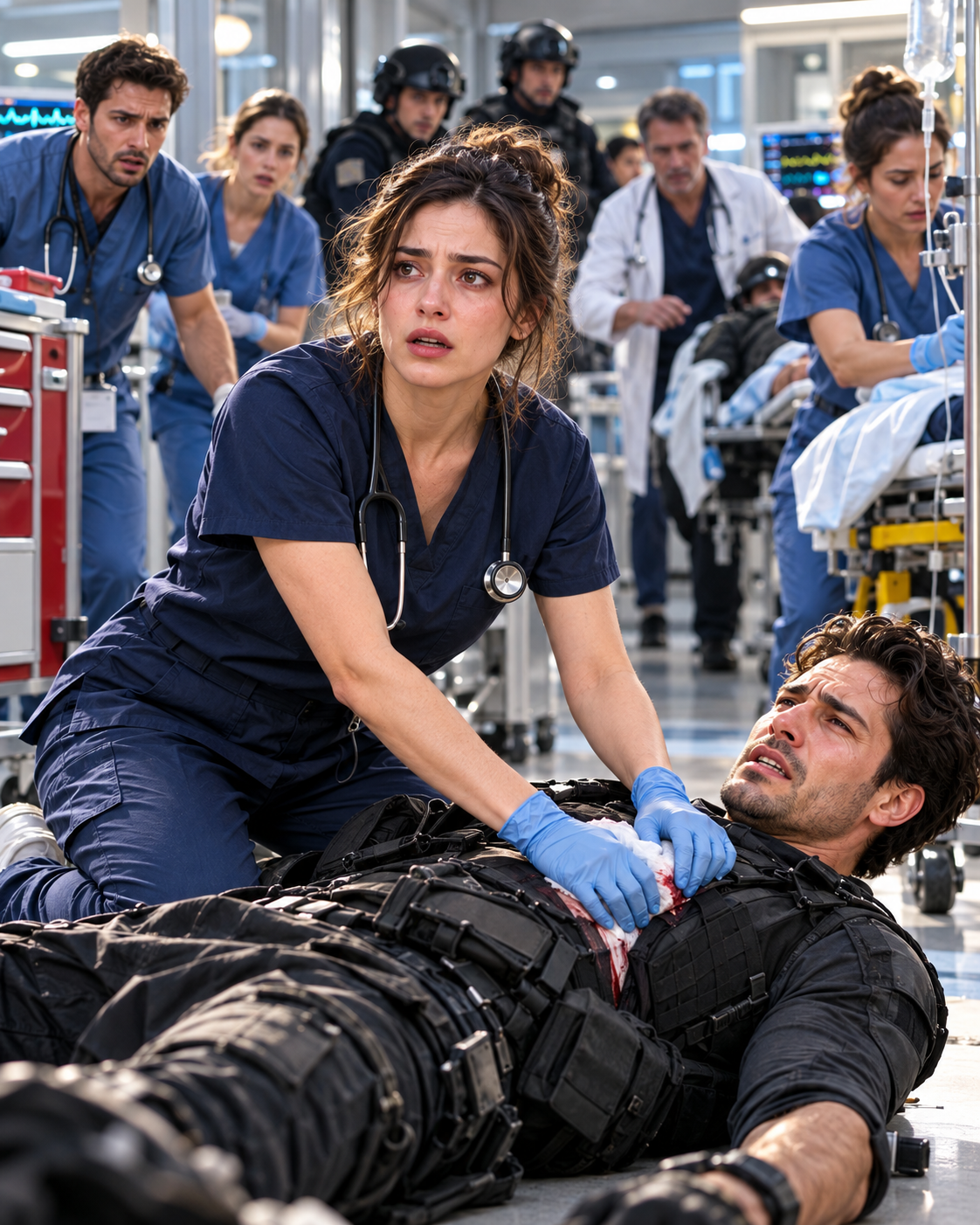
Vance turned.
“What are you doing?”
I hit the emergency lockdown.
The department exploded into red light.
Blast shutters dropped over the trauma exits.
Magnetic locks engaged.
The sound was deep and final.
Nobody was getting through those doors quickly.
Vance shouted, “Get that switch!”
I dropped behind a gurney.
“Everyone down!”
The command came out of me with a voice I had not heard since I was Chief.
Nurses dropped instantly.
Two patients crawled behind beds.
A mother pulled her child beneath a gurney.
Julian just stared.
I pointed at him.
“Get the children under cover.”
He blinked.
“What?”
“Move.”
Something in my voice finally broke through his panic.
He grabbed two terrified kids and pushed them beneath the nearest gurney.
Across the room, Hunter’s guardian, Brock, looked at me.
He was older than I remembered, broader too, but the eyes were the same.
He knew something was happening that the others could not see.
I pointed toward the service partition.
“Three men on the right.”
Brock nodded.
“Two?”
“Three.”
He motioned to his team.
Vance shouted again.
“Bring me Hunter.”
One gunman stepped forward.
I waited.
One second.
Two.
Three.
He crossed the line of sight.
I moved.
I caught his wrist before he could raise the pistol.
I rotated under his arm, drove my shoulder into his chest, and stripped the weapon free.
His body hit the floor hard.
The entire exchange lasted less than four seconds.
Brock’s men opened fire from controlled positions.
The impostors scattered.
I shouted directions through the chaos.
“Left corridor!”
“Behind the anesthesia cart!”
“Don’t let the rear door open!”
Every command came naturally.
Too naturally.
Julian watched me as if I had suddenly become a stranger.
Maybe I had.
Maybe the nurse he had mocked for weeks had never been the real woman at all.
One attacker rushed Brock.
Brock dropped him with two precise strikes.
Another tried to circle behind the nurses.
I cut him off.
He saw my face and hesitated.
That hesitation saved me.
I stepped inside his reach, redirected his weapon, and drove him into the wall.
His pistol skidded beneath a trauma bed.
Someone screamed.
Someone else was praying.
The alarms kept pulsing red.
The air smelled like metal and antiseptic.
For a moment, the whole department felt like a battlefield hidden inside a hospital.
Then there were only two men left.
Vance.
And one gunman near Hunter.
I looked toward Hunter.
He was conscious now.
Barely.
Blood had soaked through his dressing.
He looked at me and gave the smallest nod.
He was not asking who I had become.
He was reminding me who I used to be.
The last gunman moved toward him.
I stepped forward.
He fired.
The bullet struck the monitor beside my head.
Glass exploded.
I ducked.
Brock returned fire.
The gunman collapsed.
Vance swore and grabbed Hunter’s gurney.
He dragged it into the open.
Then he pressed his pistol against Hunter’s skull.
“Nobody move.”
Everything stopped.
Even Brock froze.
Vance looked directly at me.
“I know you,” he said.
My stomach turned.
“You were supposed to disappear.”
Hunter looked at me again.
I knew then that this had been planned long before anyone entered St. Jude.
This was not a random attack.
It was a cleanup operation.
Vance had come because someone had told him Hunter could identify him.
And now he had found someone else who could identify the operation.
Me.
Vance pressed the barrel harder against Hunter’s head.
“You should have stayed retired, Falcon.”
The old call sign hit me like a door slamming open inside my skull.
For a second, I smelled dust.
Heard gunfire.
Felt the weight of a wounded man against my shoulders.
3:00 a.m.
Two bodies left behind.
My watch stopping.
The world moving on without them.
Then a monitor behind Vance began screaming.
A sharp, repetitive alarm.
He flinched and glanced toward the screen.
That was all I needed.
I struck his gun arm sideways.
Brock moved at exactly the same instant.
He hit Vance from behind and drove him into the floor.
The pistol spun away.
Brock pinned his wrists.
I kicked the weapon beneath the bed.
Vance thrashed.
“You have no idea who you’re dealing with.”
I looked down at him.
“I know exactly who I’m dealing with.”
The blast shutters began rising.
Real federal officers flooded the department.
Behind them came Captain Miriam Shaw.
She stopped when she saw me standing over Vance.
Her eyes narrowed.
Then she looked at Brock.
Then Hunter.
Then the bodies of the men who had entered pretending to be law enforcement.
“What happened?”
Nobody answered at first.
Then Brock pointed at me.
“She happened.”
Captain Shaw looked confused.
Brock’s expression changed.
Not admiration.
Not surprise.
Recognition.
“Chief Nicole Barrett,” he said.
The room went silent.
Julian slowly turned toward me.
Brock continued.
“Naval Special Warfare combat medic.”
Someone behind me whispered, “Chief?”
I could hear my own heartbeat.
The secret I had guarded for years was no longer mine.
Captain Shaw looked at the scar over my brow.
“I thought you were medically retired.”
“I am.”
“Then why are you here?”
I looked toward Hunter.
Then toward Leo’s empty room.
Then toward the trembling nurses who were beginning to stand.
“Because people still need saving.”
Captain Shaw held my gaze for a long moment.
Then she looked toward the surveillance monitor.
“Pull the footage.”
The screen came alive.
There I was, moving through the chaos with a calm that did not belong to a rookie nurse.
There was Julian standing frozen as Vance fired.
There was me locking down the department.
There was me directing Brock.
There was me disarming the gunman.
There was Julian hiding behind a gurney while I stood between armed men and the patients.
Nobody spoke.
The truth was playing itself back in real time.
Captain Shaw turned toward Julian.
“Doctor Mercer, step away from the trauma area.”
Julian swallowed.
“Captain, I was trying to protect my staff.”
A nurse laughed bitterly.
It was the first sound in the room that felt human again.
Captain Shaw did not smile.
“We have footage.”
Julian’s face collapsed.
He had spent weeks calling me incompetent.
Now the cameras had recorded exactly who had been protecting whom.
Real federal officers led Vance away.
Hunter was rushed into surgery.
The nurses gathered around Leo’s mother when she returned from the pediatric unit.
And I stood alone beside the emergency console, staring at my reflection in its dark glass.
I barely recognized the woman looking back.
Part 3
Brock found me there.
He leaned against the wall, arms crossed.
“You always did hate being noticed.”
I almost smiled.
“That was the point.”
He looked at the watch on my wrist.
“Still stopped?”
“Still stopped.”
He nodded.
“I knew you were alive.”
“Most days, I wasn’t sure.”
He did not answer that.
He did not need to.
Some people understand grief without requiring it to be explained.
Captain Shaw approached us a few minutes later.
She told me the federal case against Vance was bigger than Hunter.
There were names.
Transfers.
Leaked routes.
False credentials.
Orders that had been buried under layers of bureaucracy.
Hunter had survived the ambush because someone on the inside had decided to protect him.
That someone had also recognized my old call sign.
The enemy had not accidentally found me at St. Jude.
They had followed a trail.
A trail I had thought ended years ago.
Captain Shaw asked what I wanted done next.
There were offers on the table before I even finished answering.
A formal commendation.
A command position.
Administrative promotion.
A return to field medicine.
More than one medal was mentioned.
I shook my head.
“I don’t want any of it.”
Captain Shaw studied me.
“Chief, you saved a federal witness, neutralized four armed men, and prevented a mass casualty event.”
“I know.”
“Then why refuse?”
I looked through the glass toward the nurses station.
One of the new nurses was helping an elderly patient drink water.
Another was laughing softly with a child.
The ordinary sounds felt more valuable than any ceremony.
“Because I already spent enough of my life trying to be the person everyone needed in a crisis.”
I touched my cracked watch.
“I want to be the person who stays when the crisis is over.”
Captain Shaw’s expression softened.
“You want to remain bedside.”
“Yes.”
She nodded once.
“Then remain there.”
Later that afternoon, Julian was officially removed from the trauma service pending investigation.
I never watched him leave.
I did not need the satisfaction.
For weeks, I had wanted him to know he was wrong.
When the moment came, I realized I no longer cared.
That night, I sat alone in the hospital locker room.
I opened the old wooden box I had kept hidden inside my apartment.
Inside were two photographs.
Two dog tags.
And a folded piece of fabric from a uniform that no longer fit me.
I touched the photographs carefully.
“I made it,” I whispered.
The room stayed silent.
“I kept going.”
For the first time, saying those words did not feel like betrayal.
It felt like permission.
Permission to live after surviving.
Permission to remember without becoming trapped inside the memory.
Permission to stop punishing myself for something no human being could have undone.
The next morning, Leo’s mother came back with a drawing.
It showed a hospital.
A little boy.
And a woman with giant hands.
At the top, in crooked blue letters, he had written, “Thank You, Nurse Falcon.”
I stared at it for so long that Leo’s mother smiled.
“He wouldn’t let me change it.”
I folded the drawing and held it against my chest.
“Then I won’t.”
That afternoon, I finally did something I had avoided for years.
I walked into a small jewelry shop three blocks from the hospital.
The jeweler took my watch in both hands.
“That’s an old military piece.”
“Yes.”
“You want it running again?”
I hesitated.
Then I nodded.
“Yes.”
He opened the back.
Inside, the mechanism was damaged but not destroyed.
He cleaned the gears.
Replaced a tiny broken spring.
Adjusted the hands.
Then he wound the crown.
Tick.
I froze.
Tick.
The sound was almost unbearable.
Tick.
For years, 3:00 a.m. had been the final moment of my life as I understood it.
I had treated that frozen dial like a grave marker.
But when the second hand moved past twelve, then one, then two, I felt something inside me loosen.
The jeweler looked up.
“Good as new?”
I smiled.
“Not new.”
I listened again.
“Just alive.”
Outside, the city was moving.
Cars crossed the intersection.
A woman hurried toward a bus.
A father held his daughter’s hand.
The world had never stopped for my grief.
I had simply stopped walking through it.
I returned to St. Jude before the evening shift.
My badge still said Nurse Barrett.
I left it that way.
Titles mattered less to me now.
So did explanations.
The people who needed to know had learned.
The people who mocked me had seen the truth.
And the people I had lost would never require proof that I remembered them.
Before entering the trauma bay, I stood for a moment in the hallway and looked at my reflection in the glass.
For the first time, I did not see a frightened woman hiding beneath oversized scrubs.
I saw someone who had survived.
Someone still carrying scars.
Someone still capable of trembling.
Someone who had learned that courage was not the absence of fear.
It was choosing to move while your hands were shaking.
I touched the watch.
Tick.
Then I stepped through the doors.
No one applauded.
No one saluted.
No music played.
There was only a monitor beeping in Room Six and a nurse asking for help with a dressing change.
And somehow, that ordinary moment felt more like victory than every medal I had ever earned.
I walked toward the sound.
My past was still behind me.
The men I lost were still gone.
The scar above my brow would never disappear.
But the hands on my watch were moving again.
And so was I.