My parents told me I wasn’t welcome at my own brother’s wedding. Then they sent me an invitation with a note asking for money instead.
“Your brother is family,” my mother said. “And family doesn’t keep score. You’ve always been the one who’s financially responsible, and frankly, it’s time you started acting like the successful son you are. Miles needs $85,000 to get himself back on his feet. We thought you could transfer it before the end of the month.”
I stared at my phone.
Eighty-five thousand dollars.
Not a small loan. Not a temporary favor. Eighty-five thousand dollars.
I glanced at Maya, who had stopped stirring her coffee. She didn’t say anything, but I could see the question in her eyes.
Was my mother really asking this?
I took a slow breath.
“Mom, let me make sure I understand. You excluded me from my brother’s wedding because there wasn’t enough room, but now there’s enough room in your life for my bank account?”
Silence.
Then Martha sighed dramatically.
“Oh, don’t start with that again. That was months ago. You need to let things go. Your brother made a mistake with the wedding expenses. He’s young, he’s building a life. You have a stable career. You don’t have children yet. What exactly do you need that much money for?”
Something inside me went very still.
There it was.
The same old argument. My accomplishments were never really mine. They were simply resources my family believed they were entitled to use.
I looked at Maya again.
She quietly reached across the table and took my hand.
I knew what I had to say.
“I’m not giving Miles eighty-five thousand dollars.”
My mother’s voice immediately changed.
“Excuse me?”
“I said no.”
“You cannot be serious.”
“I am.”
“You’re going to let your own brother suffer when you could help him?”
“I wasn’t important enough to attend his wedding, Mom. I don’t see why I’m suddenly important enough to finance the consequences.”
Her breathing became sharp.
“Your father and I raised you. We sacrificed everything for you. Is this how you repay us?”
I closed my eyes.
For years, that sentence had been enough to make me feel guilty about almost anything.
But this time, it didn’t work.
“I’m not discussing this anymore.”
I ended the call.
For several seconds, neither Maya nor I spoke.
Then she squeezed my hand.
“I’m proud of you.”
I smiled weakly.
“Why do I feel like I’ve just committed a crime?”
“Because you’ve spent your whole life being taught that having boundaries is the same as hurting people.”
She was right.
But I had no idea how much worse things were about to become.
THE FIRST WARNING
Three days later, I received a message from Miles.
It was the first time he’d contacted me directly since the rehearsal dinner.
His message was short.
I hope you’re happy. Mom told me you refused to help. I honestly never thought you’d become this kind of person.
I read it twice.
Then I replied.
What kind of person?
His answer arrived almost immediately.
The kind who watches his own family struggle while sitting comfortably in a nice house.
I put my phone down.
Maya read the exchange over my shoulder.
“Does he know what he’s asking for?” she asked.
“I doubt it.”
“Then perhaps it’s time he learned.”
I didn’t respond to Miles.
Instead, I went back to work.
I had a major bridge rehabilitation project approaching its final inspection, and the last thing I needed was family drama interfering with years of professional effort.
For the next week, I heard nothing.
Then Julian called.
He sounded uncomfortable.
“Hey, man. I think you should know something.”
“What happened?”
“Your parents are telling everyone you promised to help Miles and then changed your mind.”
I sat upright.
“What?”
“Apparently, Martha told Aunt Denise that you offered to pay off the wedding debt but suddenly decided you didn’t want to. She’s making it sound like you’re the reason Miles is in trouble.”
I rubbed my forehead.
“That’s not even close to what happened.”
“I know. That’s why I’m calling.”
Julian paused.
“There’s something else. Miles and Clara aren’t just struggling with wedding expenses. They have a much bigger problem.”
I asked him to explain.
Apparently, Miles had financed much of the wedding through several personal loans and credit cards. He had also borrowed money from a private lender to cover additional expenses after the original budget was exhausted.
The drone show, the luxury transportation, the designer decorations, the elaborate floral arrangements—none of it had been paid for entirely.
Worse, Miles had apparently told Clara that our parents would cover the remaining balance.
But Arthur and Martha had already contributed far more than they could comfortably afford.
They had even taken money from an account they had been saving for retirement.
“Does Clara know?” I asked.
Julian hesitated.
“Not everything.”
That was when I realized the problem was bigger than a spoiled brother asking for money.
Miles had built an entire life around pretending he could afford things he couldn’t.
And my parents had spent years protecting that illusion.
“Thanks for telling me,” I said.
“Just be careful,” Julian replied. “Your mom is getting desperate.”
I thanked him and hung up.
I thought about what he had said for the rest of the evening.
Then Maya made a suggestion.
“Perhaps you should stop thinking about what your family wants you to do and start thinking about what you actually want.”
I looked at her.
“What do you mean?”
“You don’t owe Miles eighty-five thousand dollars. But if there’s something genuinely dangerous happening, you can still choose to help someone without becoming responsible for their life.”
I considered that.
It was a distinction I had never learned growing up.
Helping someone was not the same as rescuing them.
And love was not supposed to require financial surrender.
THE UNEXPECTED VISITOR
The following Saturday, someone knocked on our front door.
I opened it and found Clara standing on the porch.
She looked exhausted.
Her eyes were swollen, and her hair was pulled into a loose ponytail. She wore a simple sweater and held her handbag tightly with both hands.
“Can I talk to you?”
I stepped aside.
“Of course.”
Maya appeared from the kitchen and immediately offered her some tea.
Clara sat on our sofa, looking around the room as though she had never been inside a normal home before.
After a few minutes, she finally spoke.
“I know you probably hate me.”
I frowned.
“Why would I hate you?”
“Because I was part of the wedding that excluded you.”
I leaned back.
“Was that your decision?”
She looked down.
“No. Martha told me there was a limit on guests. She said you weren’t close to Miles anymore and that inviting you would create unnecessary tension.”
I almost laughed.
My mother had apparently invented a new version of our relationship to make excluding me easier.
Clara continued.
“I didn’t question it enough. I thought it was a family disagreement. I didn’t realize how much it hurt you.”
I didn’t know what to say.
Then she opened her handbag and took out a folded sheet of paper.
“I came because I need to ask you something. Not for money. Just the truth.”
She handed me the document.
It was a copy of a loan application.
My name was printed near the bottom.
For a moment, I couldn’t understand what I was looking at.
Then I saw the words.
GUARANTOR: DANIEL HARRISON.
My name.
My home address.
My occupation.
Even my estimated annual income.
I looked up.
“What is this?”
Clara swallowed.
“Miles told me your parents had arranged for you to guarantee part of the wedding financing. He said you had agreed before the wedding, but you weren’t comfortable discussing it with us because of the family disagreement.”
I stared at the paper.
“I never signed this.”
“I know.”
“How do you know?”
“Because the lender called me yesterday. They said there was an issue with the guarantor information. I told them I had no idea what they were talking about.”
My stomach tightened.
“Did you sign anything?”
“No. Miles handled everything.”
I looked at Maya.
Her expression had changed completely.
“Is this a real loan?” she asked.
Clara nodded.
“It is. And there are several others.”
I examined the document again.
The signature at the bottom looked vaguely like mine.
It wasn’t mine.
Someone had copied my name.
My hands began to shake, not from fear but from anger.
“How much is this loan?”
“Forty thousand dollars.”
“And the others?”
Clara looked away.
“I don’t know the full amount. Miles won’t show me everything.”
I stood up and walked toward the window.
For the first time in months, I understood why my mother had been so determined to get eighty-five thousand dollars from me.
She wasn’t simply trying to rescue Miles.
She was trying to make me pay before I discovered what had happened.
I turned around.
“Does my brother know you’re here?”
“No.”
“Does he know you found this document?”
She shook her head.
“Please don’t tell him yet. I need to understand what I’m dealing with.”
I nodded.
“You did the right thing coming here.”
Clara began to cry.
“I thought I was marrying someone who was responsible. Someone who wanted to build a future with me. But I don’t even know which parts of our life are real anymore.”
Maya sat beside her and gently placed a hand on her shoulder.
We spent the next hour going through the papers she had brought.
There were credit card statements, loan notices, overdue invoices, and several letters from collection agencies.
The numbers were frightening.
But one detail was even worse.
Some of the documents appeared to have been submitted using my personal information.
Someone had used my identity to make Miles’s financial situation look safer than it really was.
I took photographs of everything and told Clara not to confront anyone until she had secured copies of all relevant documents.
Then I made a decision.
I was no longer going to treat this as a family disagreement.
It was a legal matter.
THE TRUTH BEHIND THE MONEY
On Monday morning, I contacted a lawyer.
I explained the situation, provided copies of the documents, and asked what steps I should take to protect myself.
His advice was direct.
Report the suspected identity fraud. Notify the relevant financial institutions. Place fraud alerts on my credit reports. Preserve every message and document.
He also advised me not to sign anything or make any payment that could be interpreted as accepting responsibility for the loans.
I followed his instructions.
Then I called my parents.
Arthur answered.
“Daniel. Finally. Your mother has been waiting for you to come to your senses.”
“I need to ask you something.”
“What?”
“Did you or Mom give Miles my personal information to use on his loan applications?”
Silence.
Then he said, “What are you talking about?”
“Someone used my name as a guarantor on a forty-thousand-dollar loan.”
Arthur exhaled sharply.
“Oh, that.”
My blood ran cold.
“Oh, that?” I repeated.
“Your brother was trying to get the best possible rate. Your mother gave him some information. He said you wouldn’t mind.”
“Did you know he was signing my name?”
“No one signed anything on your behalf.”
I stared at the wall.
“The signature is forged.”
Arthur’s voice became defensive.
“Don’t use words like that. He’s your brother.”
“Did you know?”
“We were only trying to help him.”
“By putting my name on a loan I never agreed to?”
“Your brother was desperate. He had a wedding to pay for, and your mother thought you would eventually come around.”
I felt something cold settle in my chest.
“So the eighty-five thousand dollars wasn’t just to help him. You wanted me to cover the loans you helped him obtain using my identity.”
“That’s not fair.”
“Then explain it.”
My father said nothing.
Finally, he spoke.
“Your mother thought that if you helped him now, we could avoid involving lawyers and making this a bigger family problem.”
I almost couldn’t believe what I was hearing.
“You knew about this before you called me?”
“We didn’t think it would become such a serious issue.”
“Someone forged my signature, Dad.”
“Daniel, please. Don’t destroy your brother’s life over a misunderstanding.”
I laughed once, without humor.
“I’m not destroying his life. I’m refusing to let him destroy mine.”
I ended the call.
For the next several days, everything moved quickly.
The lender opened an investigation. I submitted a formal identity theft report and provided documentation showing that I had never authorized the loan.
Clara hired her own attorney after discovering additional financial irregularities.
And then came the phone call I had been expecting.
My mother.
She was crying before I even said hello.
“What have you done?”
I remained silent.
“They’re calling your brother a fraudster! Do you understand what you’ve done to this family?”
“I reported a loan application that used my identity without permission.”
“You could have handled it privately!”
“Mom, I asked Dad if you gave Miles my information. He admitted you did.”
She started sobbing.
“We were trying to protect him.”
“From what?”
“From losing everything!”
I closed my eyes.
“And what about me?”
She didn’t answer.
“Did you ever stop to think about what could happen to my credit, my home, or my career if that loan went unpaid?”
“You have a good job. You could have handled it.”
There it was again.
My success was being treated as an unlimited emergency fund.
I spoke quietly.
“I need you to understand something. I am not responsible for the consequences of choices I never made.”
She began to cry harder.
Then she said something I will never forget.
“If you continue with this, don’t expect us to be your parents anymore.”
I looked at the framed photograph of Maya and me on our bookshelf.
For the first time, the threat didn’t frighten me.
“Mom, I think you stopped being my parents a long time ago. I just finally stopped pretending.”
I hung up.
THE FAMILY MEETING
Two weeks later, my aunt Denise called.
She asked if I would attend a family meeting at my parents’ house.
I initially refused.
But then she explained that Clara wanted to tell everyone the truth.
“I think people need to hear it from her,” Denise said. “Not from Martha. Not from Arthur. From the person who has been living with Miles.”
I discussed it with Maya.
She asked whether I wanted to go.
I thought for a moment.
“Yes. But not to apologize.”
So we went.
When we arrived, the living room was already full.
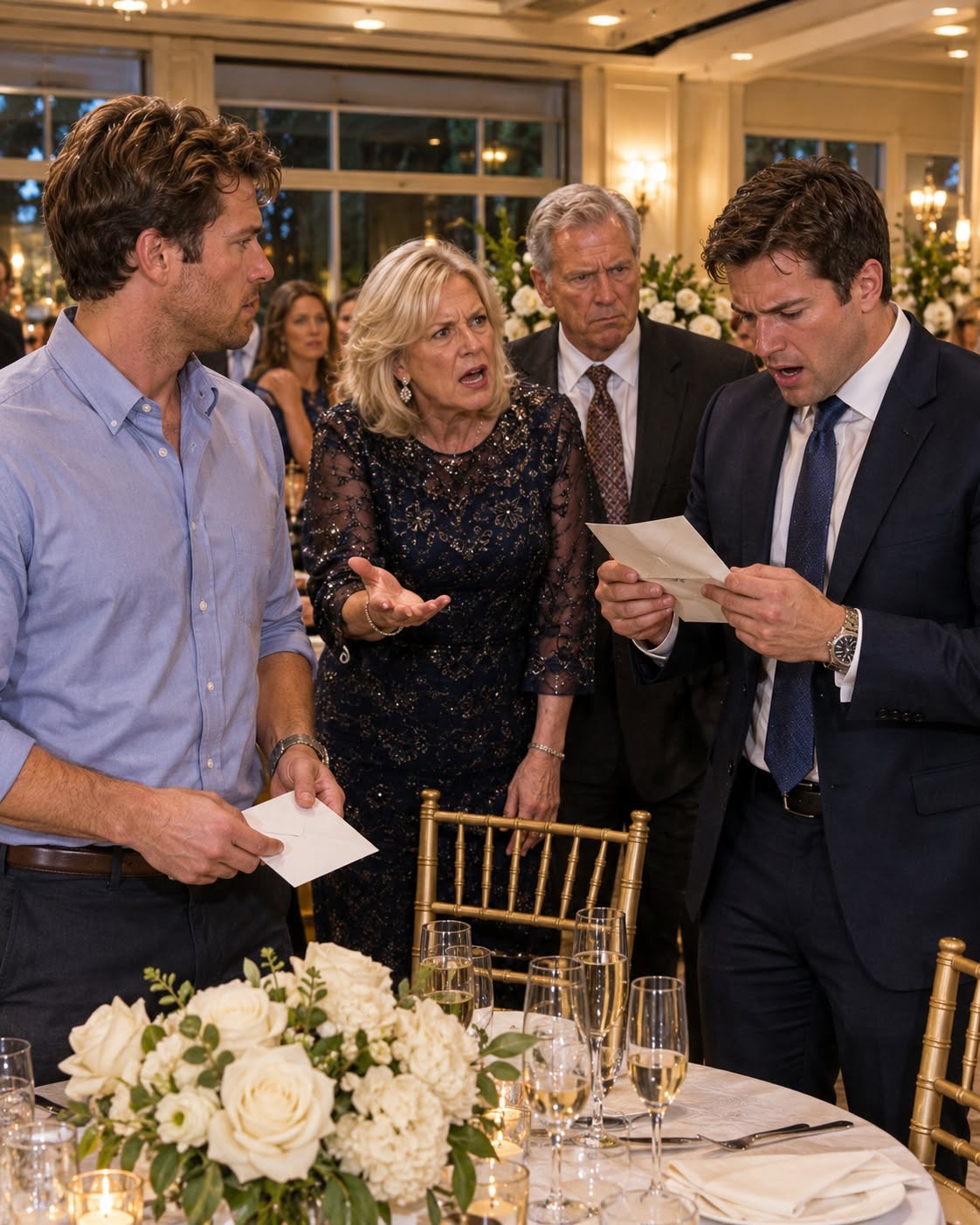
My parents were sitting on the sofa. Miles stood near the fireplace, arms folded. Clara sat beside Julian, looking pale but determined.
Aunt Denise and two other relatives were present.
The atmosphere was suffocating.
My mother looked at me as though I had walked into the house carrying a weapon.
“Daniel,” she said coldly.
I nodded.
“Mom.”
Miles immediately spoke.
“So you’re here to finish ruining my life?”
I didn’t answer.
Clara stood.
“No, Miles. He’s here because I asked him to come.”
Miles turned toward her.
“Why are you doing this?”
“Because I’m done lying.”
She placed a thick folder on the coffee table.
Then she looked at everyone.
“I need you to understand what happened.”
She began explaining the wedding expenses.
The venue had cost far more than Miles originally admitted. The flowers had been upgraded without her approval. The entertainment package had been expanded. The honeymoon had been booked on credit.
Every time she questioned the spending, Miles told her that his parents had everything under control.
But they didn’t.
Then Clara revealed something even more disturbing.
Miles had told her that I had agreed to guarantee several loans.
He had shown her a message supposedly written by me.
It read:
Don’t worry about the money. I’ll make sure the bank gets paid. Just enjoy the wedding.
I had never sent it.
My mother suddenly stood up.
“This is getting out of hand. Clara, you don’t understand how families work.”
Clara turned toward her.
“I understand perfectly. I understand that you knew Daniel never agreed to any of this. I understand that you encouraged Miles to use his information. And I understand that you expected him to pay eighty-five thousand dollars afterward.”
Arthur shifted in his seat.
“That isn’t what happened.”
Clara opened another folder.
“Then explain this.”
She handed the papers to Aunt Denise.
They were copies of messages between Martha and Miles.
My mother had apparently sent him my address, employment information, and several details about my financial situation.
One message stood out.
Your brother has more than enough. He won’t let you fall. Just make sure the paperwork gets through before he changes his mind.
The room went completely silent.
I looked at my mother.
She couldn’t meet my eyes.
Miles began pacing.
“Mom, why would you show her those messages?”
Martha looked horrified.
“I was trying to help you!”
“No,” Clara said. “You were helping him avoid consequences.”
Then she turned toward Miles.
“And you let me believe we were building our marriage on honesty.”
Miles rubbed his face.
“I was going to fix everything.”
“With what money?”
“I had a plan.”
“What plan?”
He didn’t answer.
Clara’s voice trembled.
“You told me your brother was helping us. You told me the loans were covered. You told me I didn’t need to worry.”
Miles finally shouted.
“Because I didn’t want you to panic!”
Clara stared at him.
“You didn’t want me to know.”
He looked away.
For several seconds, nobody spoke.
Then my father stood.
“Enough. We are not going to solve anything by attacking each other.”
I looked at him.
“Then let’s talk about the truth.”
I took a folded document from my jacket.
It was a letter from my lawyer confirming that I disputed the loan and had no contractual responsibility for it.
“I never guaranteed Miles’s loans. I never agreed to pay his wedding expenses. And I will not be paying his debts.”
My mother began shaking her head.
“You can’t leave your brother with this.”
“I didn’t put him here.”
“You have the ability to help him!”
I looked directly at her.
“I also have the ability to say no.”
Miles suddenly stepped toward me.
“You think you’re better than me?”
“No.”
“You have the career, the house, the perfect relationship. You always had to make me look like the failure.”
I felt an unexpected sadness.
Because beneath his anger, I could hear something familiar.
Insecurity.
The same insecurity our parents had spent years covering with praise, money, and excuses.
“I never needed you to fail, Miles,” I said. “I just needed you to stop expecting me to pay for your mistakes.”
His face changed.
For a moment, I thought he might apologize.
Instead, he said, “You’re still the selfish one.”
I nodded.
“Then I suppose there’s nothing left to discuss.”
Maya took my hand.
We walked toward the door.
Behind us, my mother called my name.
I stopped, but I didn’t turn around.
“Daniel, please. We’re still family.”
I stood there for a moment.
Then I answered.
“Being family should have meant something before you needed my money.”
And I walked out.
THE CONSEQUENCES
The following months were difficult.
The investigation confirmed that my signature had been forged on the loan application. The lender removed me from the account after completing its review, and my credit record was corrected.
The other applications were examined as well.
Not all of them involved my identity, but several contained misleading financial information.
Miles eventually admitted that he had submitted the documents.
He claimed he never intended to leave me responsible for the debt. He had only wanted the bank to approve the loan.
That explanation did little to change what he had done.
The lender pursued the people who had actually borrowed the money.
Miles and Clara separated.
At first, Clara tried to save the marriage. She attended counseling with him and offered to work through the financial problems together.
But another discovery ended her efforts.
Miles had taken out a separate personal loan without telling her, using their shared savings account as part of the application process.
He had been hiding debts even after the wedding.
Clara moved into a small apartment and eventually filed for divorce.
She didn’t ask me for money.
She didn’t ask me to take sides.
Sometimes she sent Maya pictures of her new apartment or told us about a weekend trip she had taken with friends.
She was rebuilding her life, just as I was.
Miles, meanwhile, moved back in with our parents.
His expensive car was repossessed. The luxury lifestyle disappeared almost overnight.
For the first time, he had to confront the difference between looking successful and actually being responsible.
My parents also suffered financially.
They had to sell their vacation property to cover the money they had borrowed for the wedding.
Arthur retired earlier than planned, and Martha took a part-time job at a local office.
I heard about these developments through Julian.
I didn’t celebrate them.
I didn’t feel victorious.
I simply understood that actions have consequences, even when people spend years avoiding them.
Then, about six months after the family meeting, something unexpected happened.
A large envelope arrived at our house.
There was no return address.
Inside was a handwritten letter from Miles.
I recognized his handwriting immediately.
I sat at the kitchen table and read it slowly.
Daniel,
I don’t know how to begin this. I’ve spent a lot of time being angry with you, but I think I was mostly angry because you were right.
I grew up believing that if I wanted something badly enough, someone would find a way to make it happen. Mom and Dad always did. When I wanted something, they found money. When I made mistakes, they found excuses.
I thought that was what being loved meant.
When I started planning the wedding, I wanted everything to look perfect. I wanted people to see that I had made something of myself. I didn’t want anyone to know how much I was struggling.
Mom told me you would help. I believed her because I had spent my entire life believing that you would always clean up whatever mess I made.
I used your information. I copied your signature. I told Clara you had agreed. I knew it was wrong, but I convinced myself I would fix it before you found out.
I was wrong.
I don’t expect you to forgive me. I don’t even know whether I deserve to ask. But I want you to know that I’m sorry.
Not because I lost the car or the house or the marriage I thought I was going to have.
I’m sorry because I treated you like a resource instead of a person.
I hope one day I can become someone you don’t have to protect yourself from.
Miles.
I read the letter twice.
Then I folded it and placed it on the table.
Maya looked at me.
“What do you think?”
I took a long breath.
“I think it’s the first honest thing he’s said in years.”
“Do you believe him?”
“I don’t know.”
And that was the truth.
An apology could be sincere, but sincerity didn’t erase consequences.
I decided not to respond immediately.
For the first time, I allowed myself to take as much time as I needed.
THE SECOND LETTER
Three weeks later, another letter arrived.
This one was from my father.
Unlike Miles’s letter, it was short.
Daniel,
Your mother and I would like to meet with you. We know things have gone too far. We miss you. We miss the family we used to have.
Your mother hasn’t been sleeping well. She keeps asking whether you will ever come home again.
Please consider giving us another chance.
Dad.
I showed it to Maya.
She read it carefully.
“What do you want?”
I looked out the kitchen window.
I remembered being ten years old, standing in the hallway while my parents praised Miles for winning a school competition.
I remembered being seventeen, receiving a scholarship and hearing my mother say, “That’s nice, but Miles has bigger things ahead of him.”
I remembered graduating from college and receiving a quick congratulations before the conversation turned back to my brother.
And I remembered that wedding invitation.
The one that had told me there wasn’t enough room for me, but somehow there was room for my money.
“I want them to understand that I can’t go back to how things were.”
“Then tell them that.”
So I wrote a reply.
I told my parents I was willing to meet them, but only if the conversation wasn’t about money, guilt, or demands.
I also made one thing clear.
If they wanted a relationship with me, it would have to be built on honesty and respect.
Not obligation.
They agreed.
A week later, we met at a small café halfway between our homes.
Martha looked older than I remembered. Her hair had become almost entirely gray. Arthur seemed quieter, his shoulders slightly hunched.
For the first twenty minutes, we discussed ordinary things.
The weather.
Work.
The house.
Then my mother placed her cup down.
“I suppose you want an apology.”
I looked at her.
“I want you to understand what happened.”
She frowned.
“We made mistakes.”
“More than mistakes, Mom.”
Her eyes filled with tears.
“Daniel, we were trying to help your brother.”
“And you thought that meant you could use my identity?”
“We didn’t think—”
“That’s the problem. You never thought about what any of this would cost me.”
My father stared at the table.
Then he finally spoke.
“Your mother and I always worried about Miles. He was more outgoing, more sensitive to criticism. We thought he needed encouragement.”
“And what did you think I needed?”
Neither answered.
I continued.
“I learned very early that I could take care of myself because nobody was going to pay much attention if I didn’t. I worked hard. I built a career. I made a life. But somehow, all of that became evidence that I didn’t need anything from you.”
My mother’s lips trembled.
“We never meant to make you feel unwanted.”
“But you did.”
She looked down.
For the first time, she didn’t argue.
Then Arthur said something I hadn’t expected.
“I think we made your brother believe the world would always forgive him. And we made you believe you had to earn your place in it.”
I stared at him.
It was the first time my father had ever acknowledged the difference between us.
He rubbed his hands together.
“We were wrong.”
My mother began crying quietly.
“I don’t know how to fix this.”
I looked at her.
“You can’t fix the past. But you can decide what happens next.”
She nodded.
Then, after a long silence, she asked, “Would you ever come to dinner?”
I thought about it.
“Maybe. But not because you need something from me.”
She nodded again.
We finished our coffee.
There were no dramatic embraces. No instant reconciliation. No promise that everything would return to normal.
But there was something I hadn’t expected.
For once, my parents listened without demanding that I make them feel better.
It wasn’t enough to restore what had been broken.
But it was a beginning.
ONE DOLLAR
Almost a year after the wedding, Maya and I were invited to a small dinner at Julian’s house.
Clara was there.
She had finalized her divorce and started working for a nonprofit organization that helped people recover from financial abuse.
Miles wasn’t invited.
Neither were my parents.
We spent the evening talking, laughing, and enjoying a meal without anyone trying to prove anything.
At one point, Julian raised his glass.
“To fresh starts.”
Everyone smiled.
Then Clara looked at me.
“I still think about that one-dollar check.”
I laughed.
“Honestly, I thought it would make a point.”
“It did.”
She paused.
“But I don’t think it was the money that changed everything. I think it was the first time you stopped pretending you were okay with being treated that way.”
I considered her words.
Maybe she was right.
That one dollar hadn’t been a solution.
It hadn’t repaired years of favoritism.
It hadn’t stopped my parents from making excuses or Miles from making terrible decisions.
But it had been the first time I refused to participate in a relationship that only worked when I sacrificed myself.
Later that night, when Maya and I returned home, I found myself thinking about the wedding.
I wondered what would have happened if I had simply sent the eighty-five thousand dollars.
Maybe the wedding debt would have disappeared.
Maybe my parents would have praised me for being generous.
Maybe Miles would have thanked me.
But I knew the truth.
There would have been another emergency.
Another request.
Another expectation.
And eventually, I would have been back where I started.
Only poorer.
I walked into the kitchen and opened the drawer where I kept old documents.
At the bottom was a copy of that original one-dollar check.
I had saved it without really knowing why.
The memo line read:
For the privilege of being excluded.
I smiled faintly.
Then I placed it back in the drawer.
It no longer felt like a symbol of anger.
It felt like a reminder.
THE LAST PHONE CALL
A few months later, Miles called.
I almost let it go to voicemail.
But something made me answer.
“Hello?”
“Hey, Daniel.”
His voice was quieter than I remembered.
“Hey.”
There was an awkward pause.
“I heard you got promoted again.”
“I did. Thank you.”
“Congratulations.”
“Thanks.”
Another pause.
Then he said, “I’m working at a construction supply company now. Nothing glamorous. But it’s steady.”
“That’s good.”
“I’m paying off the debts. Slowly. I moved into a small apartment. It’s not much, but it’s mine.”
I listened.
“I wanted to tell you something,” he continued. “I used to think you were lucky because you had everything figured out. But I think I was just watching you from a distance and assuming your life was easy.”
I said nothing.
“You worked for what you have. I kept expecting other people to make things happen for me.”
His voice cracked slightly.
“I don’t expect you to forgive me. I just wanted you to know that I finally understand.”
I leaned back in my chair.
For a long moment, I didn’t know what to say.
Then I answered.
“I’m glad you’re taking responsibility, Miles.”
“Yeah.”
“Keep doing that.”
He gave a small laugh.
“I will.”
Before hanging up, he asked whether we might have coffee sometime.
I told him we could consider it.
Not next week.
Not tomorrow.
But perhaps someday.
And for the first time, the possibility didn’t feel impossible.
WHAT I LEARNED
People sometimes confuse love with access.
They believe that because they are family, they are entitled to your time, your energy, your forgiveness, and even your money.
They believe that boundaries are punishments.
They believe that saying no means you have stopped caring.
But none of that is true.
I still loved my parents.
I still hoped my brother would build a better life.
I even hoped that one day we might have a relationship that didn’t revolve around old wounds.
But I no longer confused loving someone with accepting everything they did.
Maya and I eventually bought a small piece of land outside the city. We planted trees, built a garden, and spent weekends imagining the home we wanted to create there.
We adopted another dog to keep Barnaby company.
Our lives became quieter, happier, and more intentional.
My parents occasionally joined us for dinner. Sometimes things were awkward, but they were learning.
Miles continued paying his debts and rebuilding his life. We spoke occasionally, although trust remained something he would have to earn over time.
And Clara found happiness in a way none of us had expected.
She started dating someone who valued simplicity as much as she did. They took small trips, cooked at home, and celebrated ordinary moments.
She once told me that her favorite part of her new life was never having to wonder whether a beautiful evening would eventually arrive as a bill she couldn’t afford.
I understood that feeling.
One evening, while cleaning out an old box, I found another copy of my parents’ original wedding invitation.
I held it for a moment.
The words were still there.
Unfortunately, due to limited seating, we won’t be able to accommodate everyone.
And beneath them, the request for a cash contribution.
I didn’t feel the old anger anymore.
I simply folded the paper and placed it in the recycling bin.
Then I walked outside.
Maya was sitting on the porch with Barnaby curled beside her. The evening sunlight stretched across the yard.
She looked up and smiled.
“Everything okay?”
I nodded.
“Yeah. Everything’s okay.”
She reached for my hand.
And I realized something.
For most of my life, I had been trying to earn a seat at a table where the people sitting around it had already decided my worth.
I had spent years believing that if I worked harder, gave more, stayed quieter, and asked for less, eventually someone would notice.
But the moment I stopped begging for a place at that table, I discovered something far better.
I could build my own.
A table where nobody had to compete for love.
Where nobody’s mistakes were hidden behind someone else’s sacrifices.
Where generosity was freely given, not demanded.
And where a person was welcome simply because they mattered.
That was worth more than eighty-five thousand dollars.
More than any extravagant wedding.
More than a lifetime of trying to prove myself.
I had sent my family a check for one dollar because I wanted them to understand what their invitation had really meant.
But in the end, that dollar taught me something I hadn’t understood before.
Sometimes the most expensive thing you can give away is your self-respect.
And sometimes the greatest gift you can give yourself is the courage to stop paying for a place in someone else’s life.
THE END