My mother demanded that I pay rent to sleep in my own basement so my older brother and his wife could have my bedroom for free.
“Brenda,” he said quietly, “do you understand what your son has done?”
The entire room went silent.
My mother blinked, then forced a nervous laugh.
“What are you talking about, Otis? Those papers are about Grandpa’s care. We’re trying to help this family.”
Otis didn’t answer immediately. He picked up the moving estimates and examined them again.
“These estimates are dated four months before Ruth’s accident.”
Marcus shifted in his chair.
“So what? I was planning ahead. Someone had to think about the future.”
“Planning ahead for what?” I asked.
He shot me a warning look.
“Don’t start.”
I opened my folder and pulled out another document.
“Four months ago, you contacted three moving companies to estimate the cost of moving your belongings into Grandma’s house. You also requested measurements for the master bedroom, the garage, and the downstairs living room.”
Claire stared at her husband.
“Marcus, you told me those were just ideas.”
He rubbed his forehead.
“They were. I was trying to figure out what would be best for everyone.”
“Everyone?” I repeated. “Or just you?”
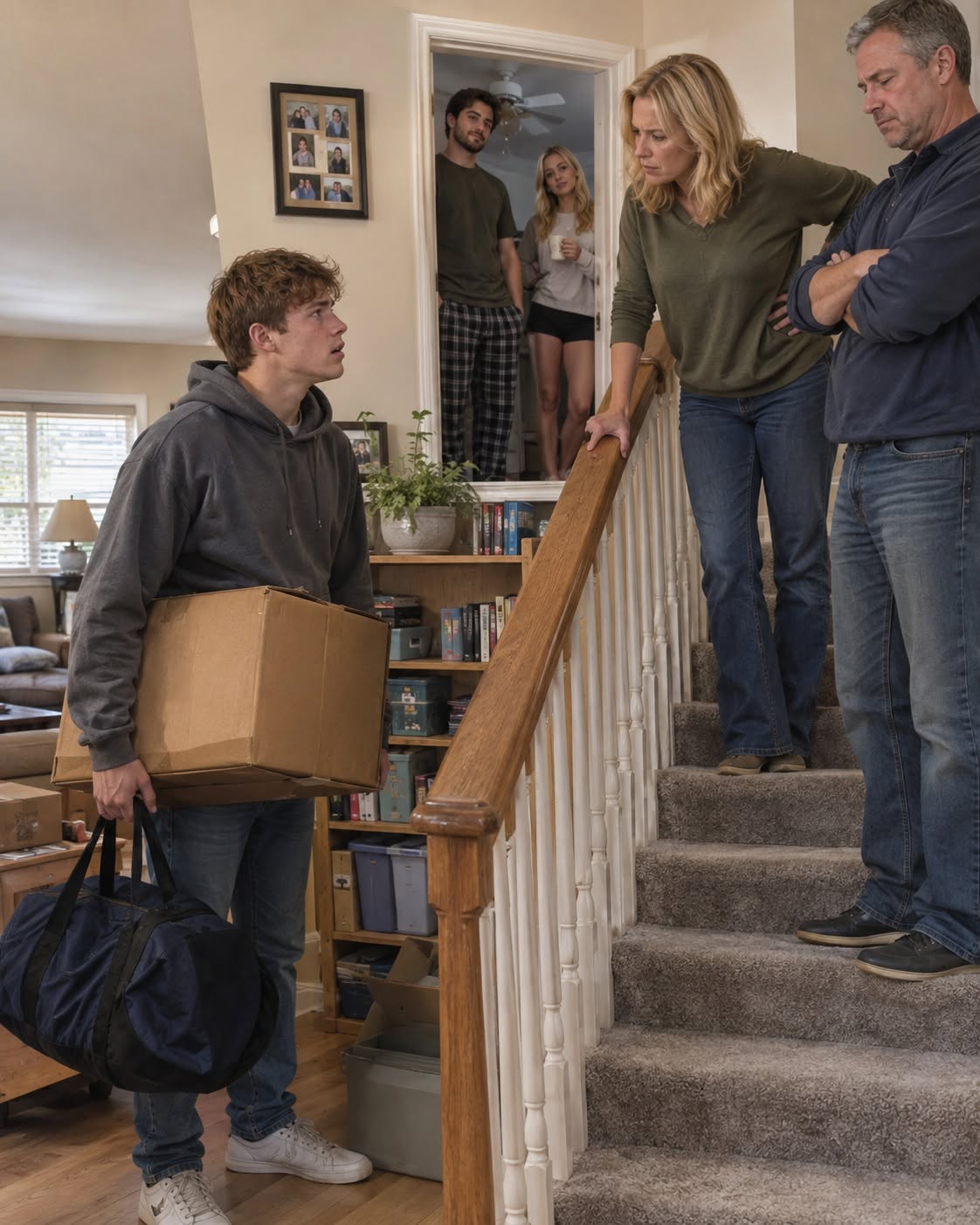
Mom slammed her palm against the table.
“Enough! This is a family matter. You don’t get to come in here and humiliate your brother.”
I looked at her.
“Funny. You had no problem humiliating me when I was seventeen.”
Her expression hardened.
“Don’t bring up the past.”
“I didn’t bring it up. You did when you decided my brother deserved my bedroom for free while I had to pay rent to sleep in the basement.”
Marcus scoffed.
“Oh, here we go. Still playing the victim.”
Otis raised one hand.
“Marcus, I suggest you stop talking until you’ve heard everything.”
That was when I placed the final document on the table.
It was a bank statement.
Not one of mine. Not one of Grandpa Walter’s.
It belonged to Grandma Ruth.
For the first time that evening, Marcus looked genuinely frightened.
“Where did you get that?”
“Grandma gave me permission to review her financial records before her fall. She was worried because the money in her account wasn’t adding up.”
Mom’s eyes widened.
“Ruth gave you her bank statements?”
“She asked me to help her understand where her money was going.”
I turned the statement toward Otis.
“Over the last eleven months, there were repeated cash withdrawals from Grandma’s account. Most happened shortly after Marcus collected her grocery money.”
Otis adjusted his glasses.
“How much?”
I swallowed.
“Just over fourteen thousand dollars.”
Claire slowly turned toward Marcus.
“What?”
He shook his head immediately.
“That’s ridiculous. I bought groceries. I paid for things around the house.”
“Then show us the receipts,” I said.
He stared at me.
I continued.
“Grandma gave you roughly four hundred dollars every week for groceries and household necessities. Tara told me you often returned with only a few bags of food. When she asked why, you told her prices had gone up.”
Claire’s face had gone pale.
“Marcus, where did the money go?”
He pushed his chair backward.
“This is insane. You’re all listening to someone who has hated me since childhood.”
I didn’t raise my voice.
“I don’t hate you. I just stopped protecting you.”
For a moment, nobody moved.
Then Otis reached into his briefcase and removed his reading glasses.
“Before I sign anything tonight, I want to understand the legal authority behind this petition.”
Mom immediately interrupted.
“Otis, we discussed this already. Walter is no longer capable of making decisions. Brenda and Marcus are his children. We should be the ones handling everything.”
Otis looked at her.
“Walter appointed a guardian while he still had the legal capacity to do so. That appointment was reviewed by an attorney and properly executed. His diagnosis does not automatically erase his previously established wishes.”
He turned toward me.
“Have you brought the original documents?”
I nodded and handed him the certified copies.
He studied them carefully.
Then he looked at my mother.
“Your father named this young man as his guardian. He also established specific protections for the house and his financial affairs. Why are you asking him to surrender those responsibilities without a court review?”
Mom’s mouth opened, but no answer came.
Marcus finally spoke.
“Because he’s not qualified! He works at a hospital moving patients around. What does he know about managing money?”
I looked at him.
“Apparently enough not to spend Grandma’s grocery allowance on a golf cart.”
Claire covered her mouth.
Otis closed the folder.
“I will not notarize these papers tonight.”
Mom stood so quickly her chair nearly fell over.
“You can’t do this to us!”
“I’m not doing anything to you, Brenda. I’m refusing to participate in something that may be fraudulent.”
Marcus pointed at me.
“You planned this! You wanted to take the house!”
I shook my head.
“If I wanted the house, I could have tried to force a sale. I haven’t. I’ve been paying for repairs, arranging Grandpa’s appointments, and making sure Grandma has everything she needs.”
“Because you want to look like the good one!”
“No, Marcus. Because they’re my grandparents.”
That sentence seemed to hit him harder than anything else.
But the evening was far from over.
Otis asked everyone to remain seated while he reviewed another page from the folder.
It was a copy of a power of attorney document that Marcus had apparently prepared for Grandma Ruth.
The document listed Marcus as her financial agent.
There was one problem.
Grandma’s signature appeared on the bottom, but the date was three weeks after her hospitalization.
And according to her medical records, she had been heavily medicated and unable to understand complicated financial decisions during that period.
Otis looked at Marcus.
“Who witnessed this?”
Marcus said nothing.
“Who notarized it?”
Still nothing.
Then Claire whispered something that made everyone turn toward her.
“I did.”
My stomach dropped.
She looked terrified.
“I didn’t know what it was. Marcus said it was just paperwork so he could pay Grandma’s bills. He told me to sign because we were already married and it was only a formality.”
Otis leaned forward.
“Did you personally witness Ruth sign this document?”
Claire began crying.
“No. Marcus brought it home already signed.”
Mom turned toward her.
“Claire, be quiet. You don’t understand what’s happening.”
But Claire was no longer listening to Brenda.
She was staring at her husband as if she were seeing him for the first time.
“You told me we were helping them,” she said. “You told me we would move in temporarily because Grandma couldn’t manage the house alone.”
Marcus grabbed his phone.
“I’m leaving.”
“Sit down,” Otis ordered.
For the first time that night, my brother looked like the frightened teenager he had once accused me of being.
He left anyway.
Claire stayed.
And when the front door slammed, she finally told us the truth.
Marcus had been planning to move into Grandma’s house for months. He had told Claire that the property would eventually belong to him because he was the oldest son.
He had also convinced her that I was only listed on the deed as some kind of temporary arrangement.
She believed him.
He had shown her photographs of the house and talked about renovating the kitchen, converting the garage into a workshop, and selling some of Grandma’s furniture to pay for the work.
He even promised her they could use the house as collateral for a loan.
But that wasn’t all.
Claire reached into her handbag and pulled out a small envelope.
“I found these in his desk last week,” she whispered.
Inside were copies of loan applications, a draft rental agreement, and several emails between Marcus and a mortgage broker.
My hands went cold as I read them.
Marcus had been trying to borrow money against Grandma’s property.
He had described himself as the future owner.
He had also written that the current guardian would be easy to remove because he was young, inexperienced, and financially vulnerable.
That guardian was me.
One sentence in particular made my stomach turn.
Once the transfer is completed, the house can be liquidated. The old people won’t need a property this large anyway.
I put the paper down.
For a few seconds, I couldn’t speak.
These weren’t just selfish plans.
He had been treating two elderly people who trusted him as obstacles to be removed.
And he had been preparing to do it long before Grandma fell.
Mom reached for the envelope.
“Give me that.”
Claire pulled it away.
“No.”
“Claire, you’re upset. You don’t know what you’re doing.”
“I know exactly what I’m doing. I’m done lying for him.”
Mom looked around the table, searching for someone who would take her side.
Nobody did.
That night, I drove straight to the rehabilitation center where Grandma Ruth was recovering.
I didn’t tell her everything immediately.
She had been through enough.
I sat beside her bed and held her hand.
She looked at me for a long moment.
“Did they make you sign something?”
I felt my throat tighten.
“No, Grandma.”
She closed her eyes.
“Good.”
Then she said something I would remember for the rest of my life.
“Your brother came to see me before the fall. He kept asking whether I would let him have the house.”
I leaned closer.
“What did you tell him?”
“I told him it wasn’t mine to give away while Walter was still alive. And even after that, it wasn’t his just because he wanted it.”
She opened her eyes again.
“He became angry. He said I was being unfair.”
I squeezed her hand.
“Why didn’t you tell me?”
“Because I thought I could handle it. I didn’t want another fight in the family.”
She looked toward the window.
“Sometimes, dear, the hardest thing about getting old isn’t losing your strength. It’s discovering that the people you raised are not always the people you thought they would become.”
I had no answer.
She gently touched my cheek.
“Walter knew. That’s why he trusted you.”
I looked down, fighting tears.
Grandpa had understood something I hadn’t.
He hadn’t chosen me because I was the most successful grandchild, the oldest, or the most financially secure.
He had chosen me because he knew I would protect the people he loved even when there was nothing in it for me.
The next morning, I contacted an attorney who specialized in elder law.
I brought every document I had collected, including the moving estimates, bank statements, suspicious power of attorney, and emails Claire had given us.
The attorney’s name was Margaret Collins.
She listened without interrupting.
When I finished, she folded her hands.
“I want you to understand something,” she said. “Being appointed guardian is not a prize. It is a legal responsibility. You must act in your grandfather’s best interests, not your own.”
“I understand.”
“And adding your name to the deed does not mean you can simply do whatever you want with the property. We need to review the ownership structure and the recorded documents carefully.”
I nodded.
She continued.
“If the evidence is accurate, there may be serious questions about financial exploitation, attempted fraud, and improper use of your grandmother’s assets.”
“What should I do?”
“Preserve everything. Do not confront your brother alone. And do not sign any document your family presents without independent legal advice.”
That afternoon, Margaret contacted the appropriate authorities and began reviewing the property records.
A few days later, she discovered something even more disturbing.
Marcus had already submitted preliminary paperwork to a lender, claiming he had permission to use the house as security.
The loan had not been approved, but the application contained information that made it look as if Grandma Ruth had agreed.
Someone had even attached a copy of the suspicious power of attorney.
The lender had flagged the application because the ownership records did not match Marcus’s claims.
That was probably the only reason he hadn’t succeeded.
But the worst discovery came from Grandma’s bank.
Several withdrawals had been made through a debit card issued in Marcus’s name.
Some were legitimate grocery purchases.
Others were cash withdrawals at locations nowhere near Grandma’s neighborhood.
There were also payments for golf equipment, restaurant meals, and a deposit toward the golf cart.
Margaret helped arrange a formal review of the transactions.
Meanwhile, I focused on my grandparents.
I visited Grandpa Walter every afternoon after my hospital shift.
Some days he remembered me immediately.
Other days, he looked at me with confusion.
One evening, he asked whether I was the young man who used to fix the old theater’s broken seats.
I smiled.
“That’s me, Grandpa.”
He nodded.
“Good boy. Always fixing things other people break.”
Then he reached for my hand.
“Don’t let them take the house.”
My chest tightened.
“I won’t.”
He looked toward the hallway.
“Your brother thinks everything belongs to him.”
I didn’t know whether he understood the entire situation or was remembering something from years earlier.
But his next words were perfectly clear.
“Being born first doesn’t make you the owner of someone else’s life.”
I sat beside him for another hour.
For the first time, I realized that protecting my grandparents wasn’t about winning a fight with Marcus.
It was about making sure they could live their remaining years with dignity.
Three weeks later, the legal situation changed dramatically.
Margaret received notice that Marcus had been contacted about the financial investigation.
He immediately hired an attorney.
Then he began calling me.
The first call came at midnight.
“You’ve gone too far,” he said.
I was sitting in my kitchen, exhausted after a double shift.
“I’m not discussing this without the attorneys.”
“You think you’re better than me now?”
“No.”
“You’ve always wanted Mom and Dad to choose you.”
I closed my eyes.
“Marcus, this isn’t about who they choose. It’s about Grandma’s money.”
He laughed bitterly.
“She doesn’t even remember what day it is half the time. What does she need fourteen thousand dollars for?”
I felt something inside me go still.
“She needs it because it’s hers.”
He went quiet.
Then he said, “You have no idea what I’ve been through.”
I almost laughed.
He had spent years telling everyone how difficult his life was while expecting everyone else to pay for it.
But I didn’t argue.
I simply ended the call.
The next morning, Margaret informed me that Marcus had been ordered to stop accessing Grandma’s accounts while the investigation continued.
The bank froze the card.
The lender withdrew the preliminary application.
And the court scheduled a hearing to review the guardianship arrangements and the disputed documents.
My mother was furious.
She came to the hospital during my lunch break.
“You’ve destroyed your brother’s life,” she said.
I put down my sandwich.
“He did that himself.”
“He has a wife. He has responsibilities. He was only trying to secure a future for his family.”
“So was I when I was seventeen. Remember?”
She looked away.
“Must you bring that up every time?”
“Mom, you charged me rent to sleep in my own basement so Marcus could have my room for free.”
“You were old enough to work.”
“He was older than me.”
“He needed the space.”
“And I didn’t need a home?”
She had no answer.
I stood up.
“I spent years believing that if I worked hard enough, helped enough, and asked for nothing, eventually you would treat me like your son.”
My voice shook, but I kept going.
“I don’t need that anymore. But I’m not going to let you use Grandma and Grandpa the way you used me.”
Her eyes filled with tears.
“You’re being cruel.”
“No, Mom. I’m finally setting a boundary.”
She left without another word.
The court hearing took place two months later.
Marcus arrived in an expensive suit, looking confident.
Mom sat beside him.
Claire came separately and sat with Margaret and me.
She had moved out of their apartment shortly after the family dinner.
She wasn’t proud of what she had signed, but she had voluntarily provided the original emails and agreed to cooperate with the investigation.
The judge reviewed Grandpa’s original guardianship appointment, the property deed, and the evidence of Grandma’s financial losses.
Marcus’s attorney argued that my brother had only been trying to help.
Margaret responded with dates, bank records, and the mortgage application.
Then the judge asked Marcus a simple question.
“Did you have permission to withdraw this money for personal purchases?”
Marcus shifted in his seat.
“I was taking care of Grandma. I thought it was reasonable to be compensated.”
“Were you compensated?”
“No, Your Honor.”
“Did you tell her that you were using her grocery money to purchase a golf cart?”
Marcus hesitated.
“I don’t remember.”
The judge looked at the bank statements.
“You seem to remember the purchases quite well when describing them as family expenses.”
Marcus said nothing.
Then came the power of attorney.
The judge asked whether Grandma had personally signed it in his presence.
Marcus said he believed she had.
Claire’s testimony contradicted him.
So did the medical records.
The judge ordered the disputed document preserved for further investigation and confirmed that the existing guardianship arrangement would remain in place pending the required reviews.
My appointment was not expanded into unlimited control. Instead, the court required regular financial reporting and independent oversight to protect Grandpa’s interests.
The judge also directed that Grandma’s accounts remain under protective arrangements until the investigation was complete.
Marcus was ordered to provide an accounting of the money he had withdrawn and repay any funds determined to have been misused.
He was also prohibited from contacting the lender or attempting to transfer any interest in the property.
As the hearing ended, my mother leaned toward me.
“You got what you wanted.”
I looked at her.
“No, Mom. I got what Grandma and Grandpa needed.”
She shook her head and walked away.
I thought that would be the end of it.
I was wrong.
Several weeks later, Claire contacted me with another piece of information.
Marcus had admitted to her that the golf cart wasn’t the only thing he had purchased with Grandma’s money.
He had also used some of it to pay overdue credit card bills.
Worse, he had borrowed money from several people, telling them that he would soon inherit the house.
When the lender rejected his application, he panicked.
He had hoped to get the guardianship transferred before anyone discovered how much money was missing.
Claire gave Margaret copies of the messages.
That evidence became part of the ongoing financial investigation.
Marcus eventually agreed to a repayment arrangement through his attorney. The amount was determined after a complete review of the records, and the repayment was structured over time rather than treated as a quick settlement.
The authorities continued examining the suspicious paperwork.
I won’t pretend that everything was suddenly fixed.
The money couldn’t all be recovered immediately.
The trust between family members was broken.
And Grandma Ruth still needed help.
But at least the truth was no longer buried beneath excuses.
Then something unexpected happened.
Dale and Valerie, the couple who had taken me in when I was seventeen, visited Grandma at the rehabilitation center.
They brought flowers and a small box of homemade cookies.
Grandma recognized Valerie immediately.
“You’re the woman who gave my grandson a place to sleep.”
Valerie smiled.
“He was a good young man. We were lucky to have him.”
Grandma looked at me.
“I always wondered who helped you when we didn’t.”
I swallowed.
“They did.”
She reached for Valerie’s hand.
“Thank you for loving him when we forgot how.”
Valerie’s eyes filled with tears.
“You don’t have to thank me. He became family a long time ago.”
That afternoon, Grandma asked me to bring her a notebook from the drawer beside her bed.
Inside were handwritten notes about the house, the garden, the furniture, and the little traditions she and Grandpa had built over forty years.
There was a page about the old oak tree in the backyard.
Another described the kitchen where she used to teach me how to make apple pie.
And then I found a letter.
It was addressed to me.
My hands trembled as I opened it.
My dear boy,
If you are reading this, something has probably happened to me or your grandfather. I hope you understand that we never chose you because we thought you were better than anyone else.
We chose you because you never made us feel like loving us was a burden.
Your brother has always believed that the world owes him something. Your mother has spent too much of her life trying to keep him happy. We cannot change them.
But we can make sure the people we love are protected.
This house is not a reward for you. It is a responsibility. If one day you decide to sell it, rent it, or use it for something else, do so only after considering what is best for everyone involved.
And please remember that you deserve a home, too. You have spent too much of your life making room for people who never made room for you.
With all our love,
Grandma Ruth and Grandpa Walter.
I read the letter twice.
Then I sat beside her and cried.
Not because I had won.
Because for the first time, someone had told me I deserved a place in the world without demanding that I earn it.
Grandma’s condition improved slowly.
She eventually returned home with additional support, and Grandpa continued receiving care under the guardianship arrangements.
I made sure the house was safe, installed better lighting, arranged for regular assistance, and hired someone to help with the yard.
I kept working at the hospital.
I never considered quitting.
There was something meaningful about my job that I hadn’t fully appreciated before.
Every day, I helped people through some of the hardest moments of their lives.
I didn’t have to be wealthy to make a difference.
I just had to show up.
Six months after the family dinner, Marcus appeared at my apartment.
He looked different.
His expensive clothes were gone.
His hair was uncombed, and he seemed exhausted.
I opened the door but didn’t invite him inside.
“What do you want?”
He looked down.
“I need to talk.”
“About what?”
He swallowed.
“I’m sorry.”
I waited.
He rubbed his hands together.
“I know you probably don’t believe me.”
“I don’t know what to believe anymore.”
He nodded.
“Claire left. Mom won’t answer my calls. The bank is after me. I’ve had to sell the golf cart.”
I almost smiled at the irony, but I didn’t.
He continued.
“I thought I could fix everything once I got the house. I thought if I had something valuable, all my problems would disappear.”
“And Grandma’s money?”
“I was going to put it back.”
“When?”
He didn’t answer.
I stepped back from the doorway.
“Marcus, you didn’t borrow from Grandma. You took money from someone who trusted you.”
“I know.”
“You called me a parasite when I was a teenager because I needed somewhere to sleep. But while you were living comfortably in my room, I was working, saving, and trying to build a life without taking anything from anyone.”
His eyes reddened.
“I know.”
“No, I don’t think you do. You still talk about how much you’ve lost. Have you ever thought about what Grandma lost? Her peace? Her trust? Her sense of safety in her own home?”
He looked away.
For a moment, I saw the older brother I had once admired.
Then he said something I hadn’t expected.
“I was jealous of you.”
I frowned.
“What?”
“You left. You built something. You had Dale and Valerie. You had your own life. I stayed here, and Mom kept telling me I was the one who deserved everything.”
He laughed weakly.
“I thought being the favorite meant I was supposed to get more.”
I didn’t know what to say.
He looked at me.
“I don’t expect you to forgive me.”
“Good.”
He nodded.
“But I want to make things right.”
I took a breath.
“Then start by repaying Grandma. Every dollar. And stop trying to convince people that your mistakes are someone else’s responsibility.”
He agreed.
I didn’t hug him.
I didn’t invite him in.
And I didn’t promise that everything would return to normal.
An apology was a beginning, not a receipt that erased years of harm.
Over the following months, Marcus made payments according to the arrangement established through the legal process. He also began attending counseling after Claire insisted that he needed to confront his behavior if he ever hoped to rebuild his relationships.
Mom took longer.
She sent me several messages, mostly explaining how difficult things had become for her.
Eventually, she asked to meet.
We met at a small coffee shop near the hospital.
She looked older than I remembered.
For several minutes, she stirred her coffee without drinking it.
Then she said, “I think I made a mistake when you were young.”
I waited.
“I thought Marcus needed more help. He always had problems. You were independent. You never complained.”
I looked at her.
“So you decided I didn’t need you.”
Her eyes filled.
“I suppose I did.”
“You didn’t just decide I didn’t need you. You made me feel like I was a burden.”
She wiped her eyes.
“I know.”
I wanted to feel triumphant.
Instead, I felt tired.
“Mom, I don’t want revenge. I don’t want you to suffer. But I can’t go back to being the boy who accepts whatever you give him just because he’s afraid of losing his family.”
She nodded.
“Can we start again?”
“Maybe. But it has to be different.”
She reached across the table.
I didn’t pull away, but I didn’t reach for her hand either.
Some wounds need more than an apology.
They need time, honesty, and consistent change.
A year after that first family dinner, Grandma Ruth and Grandpa Walter celebrated their wedding anniversary at home.
The house was full of familiar faces.
Dale and Valerie came.
Tara came with Claire.
Even Mom attended, although she sat quietly near the kitchen.
Marcus arrived late and brought a small gift for Grandma.
He had started making regular payments toward the money he owed, and he was no longer allowed to manage her finances.
Grandma accepted his gift but didn’t pretend nothing had happened.
She simply said, “Thank you, Marcus.”
It was a small moment.
But perhaps that was how rebuilding trust had to begin.
After dinner, Grandpa asked me to take him outside.
We sat beneath the old oak tree.
He looked at the house for a long time.
“Still standing,” he said.
“Yes, Grandpa.”
“Good.”
Then he looked at me.
“Do you remember when you used to sleep in the basement?”
I smiled faintly.
“Of course.”
He shook his head.
“Your grandmother and I should have noticed sooner.”
I squeezed his shoulder.
“You gave me something better than a bedroom.”
He turned toward me.
“What was that?”
“A reason to believe that family doesn’t have to be perfect to be real.”
He smiled.
For a moment, his eyes were clear and full of recognition.
“Your grandmother always said you had a good heart.”
I looked toward the kitchen, where Ruth was laughing with Valerie.
“I learned from her.”
That night, after everyone left, I walked through the quiet house.
The bedroom Marcus once occupied was now being used as a comfortable guest room.
The basement had been renovated into a small recreation area for Grandpa, with family photographs on the walls and a reading corner for Grandma.
And my old room?
Grandma had kept the little wooden shelf I built when I was twelve.
She had placed a framed photograph of me beside it.
It was a picture from my first year working at the hospital.
I stood there for a long time.
For years, I had thought the worst thing my family had taken from me was a bedroom.
But I finally understood that it was never about the room.
It was about being treated as though my needs mattered less simply because I was easier to disappoint.
Marcus had mistaken entitlement for love.
Mom had mistaken silence for strength.
And I had mistaken sacrifice for the price of belonging.
I couldn’t change the past.
I couldn’t force my brother to become an honest man or my mother to become the parent I once needed.
But I could decide what happened next.
I kept my grandparents’ house safe.
I kept my job.
I continued visiting Dale and Valerie, who had become the family I chose rather than the family I was born into.
And eventually, I allowed myself to build a home of my own.
Not a mansion.
Not a place anyone would envy.
Just a small, peaceful house with a comfortable bedroom, a kitchen big enough for friends, and a spare room that would always be available to someone who needed a safe place to stay.
One evening, while helping Grandma water her garden, she asked me whether I was happy.
I thought about it.
Then I smiled.
“Yes. I think I finally am.”
She patted my hand.
“Good. That’s all your grandfather and I ever wanted.”
I used to believe the real parasite in my family was the person who took money, space, and opportunities from everyone else.
But I learned something more important.
A parasite isn’t simply someone who needs help.
Everyone needs help sometimes.
The real problem is someone who takes without gratitude, exploits trust, and believes other people’s sacrifices are their birthright.
And the saddest part is that such people often don’t recognize what they’ve become until the people they depend on finally stop giving.
Marcus lost the house he thought he was entitled to.
He lost his wife’s trust.
He lost access to the money he had treated as his own.
But I didn’t win because he lost those things.
I won because I stopped measuring my worth by whether my family chose me.
At seventeen, I left home believing I had nowhere to go.
Years later, I discovered that the people who truly loved me had never needed me to pay rent for a place in their lives.
And that was the greatest inheritance my grandparents ever gave me.
A home is not something you earn by making yourself useful to others. It is a place where you are safe, respected, and loved. And sometimes, the bravest thing you can do is walk away from the people who keep asking you to prove that you deserve one.