My grandmother stopped our entire holiday dinner with one question: “So, who’s been renting out your seaside cottage?”
The email was printed in black and white, but every word seemed to burn through the page.
I leaned forward and began reading.
“Regarding the applicant, I strongly advise against hiring her. She has a history of emotional instability, poor financial judgment, and an inability to handle responsibility. She has also demonstrated dishonesty in personal matters. I would consider employing her a significant liability to any organization.”
I stopped breathing for a moment.
At the bottom was my father’s full name, followed by his personal email address.
There was another email behind it. Then another.
Seven companies.
Seven opportunities.
Seven doors I had believed simply hadn’t opened because I wasn’t good enough.
My fingers tightened around the paper.
“Dad,” I whispered. “You did this?”
He didn’t look at me.
Instead, he stared at Mr. Vance as though the attorney had personally betrayed him by bringing the evidence into the room.
“This is being taken completely out of context,” he said.
Mr. Vance adjusted his glasses.
“Then perhaps you can explain the context. You contacted seven prospective employers using an email address that identified you as the applicant’s father. In three messages, you specifically stated that you were providing information about her character that she had failed to disclose.”
“I was protecting the family,” Dad snapped.
The words hit harder than I expected.
Protecting the family.
Not protecting me.
Not helping me.
Protecting the family.
I turned toward him.
“From what? A job?”
He finally looked at me.
“You don’t understand what was happening. Your grandmother had given you a valuable property, and you were already struggling to manage your life. We knew you would make mistakes. We were trying to prevent you from making bigger ones.”
“By stealing my rental income?”
“We didn’t steal anything!”
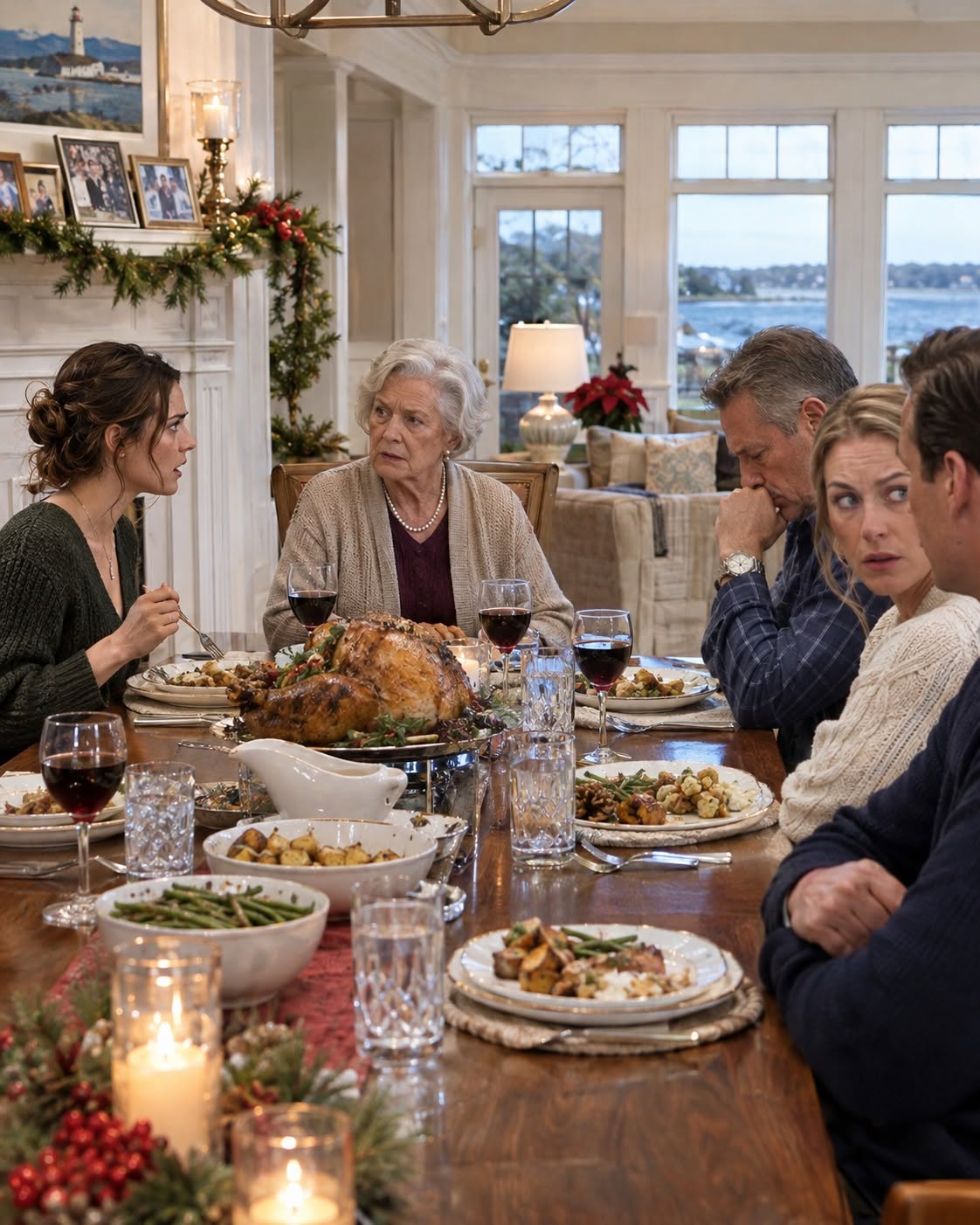
Brenda suddenly spoke, her voice trembling with anger.
“Don’t act like we were sitting around doing nothing. We handled the guests, the cleaners, the repairs, the bookings. Someone had to manage the property.”
Grandma calmly folded her napkin.
“And someone had to receive the money.”
Silence.
Mr. Vance opened another document.
“The rental income was deposited into an account controlled by Arthur and Brenda. According to the records, the property generated approximately $186,000 in gross rental revenue over the past two years.”
My mouth fell open.
One hundred and eighty-six thousand dollars.
I thought about the nights I’d gone to bed hungry because I couldn’t afford groceries until payday.
I remembered wearing the same winter coat for four years because buying another one felt irresponsible.
I remembered calling my father once to ask for help with a $400 emergency car repair.
He had told me that adulthood meant learning to stand on my own two feet.
Apparently, he had been standing on mine.
“Where is the money?” I asked.
Brenda looked at Dad.
Dad looked at Brenda.
Grandma noticed.
“That’s interesting,” she said quietly. “Neither of you seems particularly surprised by the question.”
Dad pushed his plate away.
“Mom, you have no idea what this family has been through. Your health was deteriorating. You needed someone to handle things. We had expenses. We had responsibilities.”
Grandma’s expression hardened.
“I transferred that cottage to my granddaughter. Not to you. Not to Brenda. To her.”
“I know what you did,” he muttered.
“Then explain why you told her she had nothing.”
He didn’t answer.
For the first time in my life, I watched my father run out of excuses.
But Brenda wasn’t finished.
She suddenly stood up, knocking her chair backward.
“This is unbelievable! Everyone is acting like I’m some criminal. I was the one who took care of the house. I spent weekends answering guests, arranging maintenance, dealing with complaints. She never even asked about the property!”
I looked at her.
“How could I ask about something I didn’t know existed?”
“You should have known!”
The room went still.
Grandma slowly raised her head.
“What exactly does that mean, Brenda?”
My sister’s face changed.
She opened her mouth, then closed it.
Mr. Vance reached into his folder and removed a document I hadn’t seen before.
“There is one more issue,” he said. “The management agreement is not the only document we examined.”
He placed a photocopy in front of Grandma.
It was a bank authorization form.
My name appeared at the top.
My signature appeared at the bottom.
Except I had never seen the form before.
“This document was used to establish a line of credit secured against the cottage,” Mr. Vance explained. “The lender was informed that the owner had authorized the transaction.”
My stomach turned.
“How much?”
He paused.
“Eighty-four thousand dollars.”
Grandma closed her eyes.
I looked at my father.
“Did you borrow money against my house?”
He rubbed his forehead.
“It was temporary.”
“For what?”
“Business expenses.”
“What business?”
He didn’t answer.
Brenda suddenly sat down.
That small movement told me more than any confession could have.
Mr. Vance continued.
“The loan is currently in arrears. More importantly, the bank’s records indicate that the application included identification documents that appear to have been altered.”
I felt the room tilt.
I wasn’t just looking at a family argument anymore.
I was looking at something much bigger.
Forgery.
Financial fraud.
And a house that had apparently been used as collateral without my knowledge.
Grandma reached across the table and took my hand.
“I’m sorry, sweetheart.”
Those three words nearly broke me.
For two years, I had blamed myself for every disappointment.
I had wondered whether I was lazy, incapable, unlucky, or simply not as intelligent as my sister.
I had spent months in therapy trying to understand why I felt so small whenever my family praised Brenda.
And now I was discovering that the people who were supposed to protect me had deliberately built a life in which I would remain dependent, confused, and financially vulnerable.
“Why?” I asked.
My father finally looked at me.
For a moment, I thought he might tell the truth.
Instead, he said something that made me understand everything.
“Because Brenda needed the money more than you did.”
I stared at him.
Brenda began crying.
“Dad, don’t.”
But he continued.
“Her business was failing. She had debts. She was going through a difficult time. You were young. You didn’t have children or a mortgage. We thought you could manage without the rental income.”
I almost laughed.
Not because anything was funny.
Because the explanation was so unbelievably cruel.
“So you decided I didn’t deserve the money Grandma gave me?”
“It wasn’t like that.”
“Then what was it like?”
He looked down.
“We were going to pay you back.”
“When?”
“When things improved.”
“When I was homeless? When I was too old to work? When?”
Nobody answered.
Grandma slowly withdrew her hand from mine and stood.
“I have spent seventy-two years believing that family means something,” she said. “Tonight, I discovered that some people use the word family as an excuse to do whatever they please.”
She turned to Mr. Vance.
“Proceed.”
He nodded.
Then he placed a final envelope on the table.
“This is a notice of revocation of management authority, a formal demand for accounting, and a preservation notice concerning all relevant financial records. We will also be notifying the lender and the appropriate authorities about the suspected forged documents.”
My father stood so abruptly that his chair fell backward.
“You can’t do this to me!”
Grandma looked at him without blinking.
“I didn’t do this to you, Arthur. You did it to yourself.”
Brenda began sobbing openly.
“Grandma, please. You can’t ruin our lives over a misunderstanding.”
Grandma’s voice softened, but only slightly.
“A misunderstanding is forgetting someone’s birthday. This was a series of deliberate decisions.”
Then she turned to me.
“The cottage belongs to you. Every legal document says so. But I want you to understand something before we leave this table. You do not have to forgive anyone tonight. You do not have to protect anyone from the consequences of what they’ve done.”
I nodded, unable to speak.
That evening, I left my father’s house with the envelope under my arm and a feeling I couldn’t quite describe.
I wasn’t happy.
I wasn’t even relieved.
I was grieving.
Because the truth had given me back my property, but it had taken away the family I thought I had.
The following morning, I woke up to thirty-seven missed calls.
Twenty-two were from Brenda.
Nine were from my father.
The remaining six were from relatives who had apparently received a very different version of the previous evening.
My aunt had sent a message saying, “Your father is devastated. Whatever happened, please don’t destroy the family.”
My cousin wrote, “Brenda says you’re trying to take her house away.”
Her house.
I sat on the edge of my basement bed and stared at the messages.
Then I opened the first one from Brenda.
“Please call me. Dad isn’t doing well. Grandma is confused and Mr. Vance is manipulating her. We need to talk before you make a terrible mistake.”
I didn’t respond.
A second message arrived.
“You know I always looked after you. Don’t let money change who you are.”
I put my phone face down.
For once, I didn’t feel obligated to explain myself.
Over the next several weeks, the investigation moved forward.
Mr. Vance arranged for an independent accountant to examine the rental income, expenses, and loan records. A handwriting specialist provided a preliminary report stating that the signatures on the management agreement and bank authorization were inconsistent with my verified handwriting.
The bank temporarily froze further activity connected to the disputed loan while its fraud department reviewed the application.
Meanwhile, I learned that my father’s financial situation was much worse than he had admitted.
Brenda’s boutique had been losing money for almost three years. She had accumulated credit card debt, unpaid supplier invoices, and overdue rent.
Dad had used money from the cottage to keep the business operating.
At first, the transfers had been small.
Then they became larger.
Eventually, he had begun using the property itself to obtain credit.
The money wasn’t simply helping Brenda survive.
It was funding a lifestyle neither of them could afford.
Vacations.
A new SUV.
Expensive furniture.
Private school tuition for Brenda’s son.
I found photographs online of Brenda standing in front of a luxury hotel overseas during the same month I had been eating instant noodles to make my rent.
I stared at the pictures for a long time.
Then I closed the page.
I didn’t want to become someone who measured her worth by what other people had taken.
Still, there was one thing I needed to know.
Why had my father contacted prospective employers?
Mr. Vance arranged for copies of all seven emails to be delivered to me.
I read them one by one.
Some were short.
Others were disturbingly detailed.
In one, Dad claimed I had a gambling problem.
In another, he suggested I had previously been dismissed for mishandling company funds.
Neither statement was true.
But the seventh email was different.
It had been sent to a regional property management company where I had interviewed for an administrative position.
The email said:
“My daughter is not emotionally equipped to handle financial responsibilities. She has a tendency to challenge family decisions and may become confrontational when questioned. I strongly advise against placing her in a position where she could access confidential accounts.”
I read that paragraph three times.
Then I noticed the date.
It had been sent the morning after I told my father I was considering applying for a better job.
He hadn’t just been trying to stop me from earning more money.
He had been trying to stop me from becoming independent.
I finally understood the pattern.
If I remained broke, I would never ask difficult questions.
If I remained dependent, they could continue controlling the cottage.
And if I believed I was incapable of managing my own life, I would probably never challenge them.
The worst part was that it had worked.
For a while.
But not anymore.
A month after the holiday dinner, I received an unexpected phone call from the regional property management company.
The woman on the other end introduced herself as the hiring director.
“We recently discovered that some information provided about you during our recruitment process was inaccurate,” she said. “We wanted to apologize personally.”
I sat upright.
She explained that the company had reopened my application after reviewing the circumstances surrounding the email.
Then she said something I hadn’t expected.
“We still have the position available. If you’re interested, we’d like to invite you for a second interview.”
I almost cried.
Not because I desperately needed that particular job, although I did.
Because someone had finally looked at me without believing the lies my father had written.
I accepted the interview.
Two weeks later, I got the job.
It wasn’t glamorous.
The salary was modest, and the office was forty minutes from my apartment.
But it was mine.
Every paycheck represented something my family had tried to take away.
My independence.
My confidence.
My right to decide what kind of life I wanted.
Meanwhile, the legal situation continued.
The accountant determined that approximately $143,000 of rental revenue had been diverted into accounts controlled by my father and sister. Some money had been spent on legitimate maintenance, but a substantial portion had no connection to the cottage.
The disputed loan was also being investigated.
Dad initially insisted that I had verbally approved everything.
Then he claimed Grandma had given him permission.
When neither explanation matched the documents, his story changed again.
He said he had acted out of desperation.
Mr. Vance made it clear that desperation did not create legal ownership.
Eventually, Dad agreed to a settlement that required him and Brenda to repay a significant portion of the diverted funds, with the remaining amount subject to further proceedings. The lender pursued its own investigation into the disputed authorization, and the property was protected through a formal legal process.
The exact outcome took months.
There were no dramatic courtroom confessions or instant victories.
There were meetings, affidavits, account statements, uncomfortable conversations, and days when I felt exhausted from having to prove that I had never agreed to any of it.
But I kept going.
For the first time, I was fighting for myself rather than waiting for someone else to decide whether I deserved help.
Brenda was the first to reach out with something resembling an apology.
She came to my basement apartment on a rainy Thursday evening.
I almost didn’t open the door.
She stood in the hallway holding a paper bag.
“I brought you something,” she said.
Inside was a loaf of banana bread from a bakery.
I nearly smiled at the absurdity of it.
She had taken hundreds of thousands of dollars in revenue from a seaside cottage and now appeared to believe that baked goods could repair the damage.
“Can we talk?” she asked.
I stepped aside reluctantly.
She sat on the only chair in my apartment and looked around.
Her eyes moved toward the small kitchenette, the narrow window, and the old heater that made a clicking sound every few minutes.
“Is this where you’ve been living?”
“Yes.”
“For two years?”
“Yes.”
She lowered her head.
“I didn’t know it was this bad.”
I looked at her.
“You didn’t know because you never asked.”
She began crying.
“I was scared. The business was failing, and Dad said the money was only temporary. He told me Grandma had agreed that you weren’t ready to handle the property.”
“And when you saw me struggling?”
She wiped her cheeks.
“I thought you were exaggerating.”
“Why?”
“Because Dad said you had money problems. He said you were always asking people for help.”
I stared at her.
“I asked him for help once. For a car repair. He told me to grow up.”
Brenda covered her face.
For several minutes, neither of us spoke.
Then she said, “I know I don’t deserve forgiveness. But I want you to know I didn’t forge your signature.”
I believed she might be telling the truth.
The investigation had shown that Dad had prepared the original management agreement and arranged the disputed bank paperwork. Brenda had signed as a witness on one document, but there was no conclusive evidence that she had personally created the false signature.
That didn’t make her innocent.
She had received the money.
She had known I didn’t know about the property.
And she had repeatedly allowed Dad to tell people I was irresponsible.
“Did you ever consider telling me?” I asked.
She nodded slowly.
“Once.”
“When?”
“The first summer. I saw you at Grandma’s birthday party. You were talking about how you couldn’t afford to move out of your apartment.”
My throat tightened.
“What did you do?”
She looked down.
“Nothing.”
That was the moment I realized I could understand her fear without accepting her excuses.
“Brenda, I don’t hate you,” I said. “But I don’t trust you. And I don’t know if I ever will again.”
She nodded.
“I understand.”
She left the banana bread on the table and walked out.
I didn’t eat it.
Not that night.
Several months later, I finally visited the cottage.
I had seen photographs, but photographs hadn’t prepared me for the reality.
The house stood on a quiet stretch of coastline, with pale blue shutters, white wooden railings, and a small garden that sloped toward the beach.
The ocean stretched endlessly beyond it.
I stood on the porch holding the original property deed.
The keys felt heavy in my hand.
Grandma had insisted on coming with me.
She walked slowly through the front door, touching the familiar furniture.
“I remember the first time I saw this place,” she said. “Your grandfather and I had almost no money. We bought it because he wanted somewhere where the children could run barefoot.”
She smiled sadly.
“Your father loved this house once.”
I looked toward the staircase.
“Do you think he knows what he did?”
Grandma took a moment to answer.
“I think he knows what he lost. Whether he understands what he did to you is another question.”
We walked into the kitchen.
The refrigerator hummed softly.
There was a framed photograph on the windowsill of my grandparents standing on the beach decades earlier.
Grandma picked it up.
“Your grandfather always said a house should be a place where people feel safe.”
She looked around.
“I hope you can make it that again.”
I wasn’t sure what to say.
For two years, I had imagined that receiving this property would solve every problem in my life.
But standing there, I realized that the cottage wasn’t going to erase what had happened.
It wouldn’t return the jobs I had lost.
It wouldn’t give me back the confidence I had spent years rebuilding.
It wouldn’t turn my father into the man I had believed he was.
What it could give me was a beginning.
I decided not to sell it.
Instead, I hired a legitimate property manager, opened a separate business account, and arranged for an independent accountant to review every transaction.
The cottage would continue operating as a vacation rental, but this time the income would belong to the rightful owner.
I also decided to reserve several weeks each year for myself.
The first time I stayed there alone, I woke before sunrise.
The sky was a soft shade of pink, and the ocean was almost completely still.
I made coffee, wrapped myself in a blanket, and sat on the porch.
For the first time in years, I wasn’t calculating how many days remained until rent was due.
I wasn’t worrying about whether I could afford groceries.
I wasn’t trying to convince myself that I was worth less than my sister.
I was simply there.
And it felt extraordinary.
About eight months after the holiday dinner, my father requested a meeting.
He sent a handwritten letter through Mr. Vance.
It was only one page.
He wrote that he was ashamed of how things had unfolded. He admitted that he had made decisions he couldn’t defend and that he had convinced himself he was helping the family when he was really protecting his own pride.
He said he missed me.
He said he wanted to start again.
For several days, I left the letter on my kitchen table.
Part of me wanted to call him immediately.
The little girl inside me still wanted her father to say he was proud of her.
But another part remembered the email describing me as unstable, dishonest, and unfit for employment.
I remembered the years of silence.
Eventually, I agreed to meet him at a small café.
He looked older than I remembered.
His hair had turned almost completely gray, and the confidence he usually carried seemed to have disappeared.
He stood when I approached.
“Thank you for coming.”
I sat down.
He ordered coffee for himself but didn’t ask what I wanted.
That small detail reminded me that some habits were harder to change than others.
For a while, he talked about his business, his debts, and how difficult the last few months had been.
Then he finally said, “I know I hurt you.”
I waited.
“I was under pressure. Brenda was desperate. I thought I could fix everything before anyone found out.”
“You had two years.”
He nodded.
“I know.”
“You watched me struggle.”
His eyes filled.
“I know.”
“You told people I was incapable of working. You tried to stop me from getting jobs. You used my name to borrow money.”
He lowered his head.
“I know.”
I leaned forward.
“Then tell me something, Dad. At what point did you stop seeing me as your daughter and start seeing me as an obstacle?”
He looked up.
For the first time, I saw genuine shame in his face.
“I don’t know,” he whispered. “Maybe when I realized you were becoming independent. Maybe I was afraid you’d discover what I’d done. Maybe I couldn’t admit that I’d made such a terrible mess of things.”
I looked at him for a long time.
Then I said something I had practiced in my head many times.
“I hope you become a better person. But I can’t make your recovery my responsibility.”
He began crying.
I didn’t reach across the table.
Not because I wanted him to suffer.
Because I had finally learned that compassion didn’t require me to abandon my own boundaries.
“I won’t stop you from being part of the family,” I continued. “But there will be no access to my property, my accounts, or my decisions. If we ever rebuild a relationship, it will happen slowly, and it will happen because of consistent actions. Not promises.”
He nodded.
“I understand.”
I finished my coffee and left.
It wasn’t the reconciliation I had once dreamed about.
But it was honest.
And sometimes honesty is the only beginning worth having.
A year after Grandma revealed the truth, we gathered again for the holidays.
This time, dinner was at the cottage.
The dining table was smaller than the one in my father’s house, but the windows overlooked the ocean, and the room was filled with the smell of roasted chicken, fresh bread, and Grandma’s favorite apple pie.
Mr. Vance joined us for dessert.
My father had been invited, but he declined.
Brenda sent a card.
Inside, she had written:
“I know I cannot undo what happened. I’m trying to become someone who would never make those choices again. I hope someday you will believe that.”
I placed the card in a drawer.
I didn’t throw it away.
I didn’t write back.
I simply allowed the future to remain undecided.
After dinner, Grandma and I walked outside.
The wind carried the smell of salt and pine, and the waves rolled gently toward the shore.
She slipped her arm through mine.
“Are you happy now?” she asked.
I considered the question.
I had a job I enjoyed, an apartment I could afford, and a property that generated enough income to give me security.
But happiness wasn’t quite the right word.
I was still healing.
Some days, I felt angry.
Other days, I missed the family I thought I had.
And occasionally, I still heard my father’s voice in my head telling me I wasn’t capable.
The difference was that I no longer believed him.
“I think I’m getting there,” I answered.
Grandma smiled.
“That’s enough.”
We stood watching the ocean until the sky darkened.
Then she said something I would remember for the rest of my life.
“Never let anyone convince you that being easy to control is the same thing as being easy to love.”
I turned toward her.
She squeezed my hand.
“People who truly love you want you to grow, even when your growth means you no longer need them.”
I felt tears gathering in my eyes.
For so long, I had believed love meant keeping the peace.
It meant forgiving quickly.
It meant accepting explanations, swallowing disappointment, and making myself smaller so everyone else could remain comfortable.
But that wasn’t love.
It was fear dressed up as loyalty.
The cottage had given me financial security, but that wasn’t the greatest thing it had given me.
It had forced me to see the difference between people who wanted me to succeed and people who needed me to remain dependent.
It had taught me that family could be complicated, forgiveness could take time, and boundaries weren’t acts of cruelty.
Most importantly, it had taught me that my worth had never depended on how much money I earned, how successful my sister appeared, or whether my father approved of my choices.
I had spent two years living in a basement, believing I was failing at life.
All along, I had been fighting a battle I didn’t even know I was in.
And when the truth finally came out, I discovered something unexpected.
I hadn’t needed to become a different person to deserve a better life.
I had only needed the chance to live my own.
That night, before going to bed, I opened the cottage’s front door and listened to the waves.
The house was quiet.
The rooms were warm.
The keys were on the kitchen counter, exactly where I had left them.
And for the first time, when I looked at the place, I didn’t see a stolen inheritance, a family betrayal, or a painful reminder of everything I had lost.
I saw home.
My home.
The following morning, I received a text from Grandma.
It contained a photograph of the two of us standing on the porch, smiling with the ocean behind us.
Underneath, she had written:
“Your grandfather would have been proud of the woman you became.”
I read it twice.
Then I saved the photograph.
I couldn’t change the past.
I couldn’t recover every opportunity that had been stolen from me.
And I couldn’t force the people who hurt me to become the people I had needed them to be.
But I could decide what happened next.
So I made a promise to myself.
I would never again confuse silence with peace, obedience with love, or someone else’s approval with my own worth.
Because sometimes the greatest inheritance isn’t a house, a bank account, or a piece of land by the ocean.
Sometimes, it’s the moment you finally realize that you are allowed to stand up, tell the truth, and build a life that nobody else gets to control.