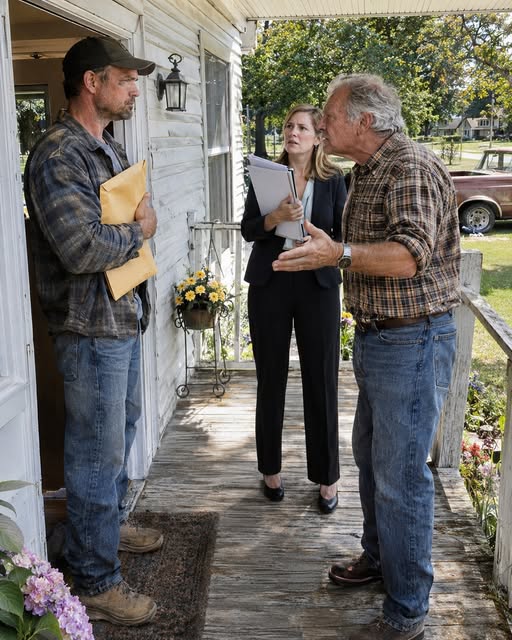
My father showed up at my door with a real estate agent and papers for me to sign. He expected me to hand over my late mother’s house without asking questions.
I looked at my father, then at the realtor, who was already gathering her documents.
“I’ll help my brother,” I said. “But I’m not giving him this house.”
My father froze.
For a moment, I thought he hadn’t heard me correctly.
“What did you just say?”
“I said I’ll help him. I’ll give him a chance to get back on his feet. But this house stays in my name.”
My father let out a bitter laugh.
“That’s not helping. He needs money, not another lecture from you.”
I looked at him carefully.
“Then maybe he needs to learn how to live without spending someone else’s money.”
The realtor lowered her eyes, clearly wishing she were somewhere else.
My father slammed his palm against the table.
“Your brother is drowning in debt! He could lose everything! And you’re sitting here protecting an empty house like it’s some kind of treasure!”
I glanced toward the hallway.
That house had never been empty to me.
It held the sound of my mother’s laughter, the smell of Sunday dinners, and the memories of a little boy who once believed his family would always protect him.
I took a breath.
“I’m willing to let him live there for six months, rent-free, while he gets his finances under control. I’ll also help him find work. But he won’t sell the house, borrow against it, or make any decisions about the property.”
My father stared at me.
Then he said something that made my stomach tighten.
“Your mother would be ashamed of you.”
I felt those words land like a punch.
For years, that sentence had been enough to make me apologize, open my wallet, and do whatever my father wanted.
But this time, something inside me had changed.
“No,” I replied quietly. “I think she’d be ashamed of what you’ve been doing.”
His face turned red.
He grabbed his jacket and stormed toward the door.
Before leaving, he pointed at me.
“This isn’t over.”
The realtor followed him outside, offering me a brief, uncomfortable nod.
I watched their car disappear down the road.
Then I sat alone at the kitchen table with my mother’s letter.
I read it again.
And for the first time since her funeral, I allowed myself to cry.
But what happened three days later would make me realize that my mother’s letter had only revealed half the truth.
Three Days Later
My brother, Daniel, called me just after six in the morning.
I was sitting in my truck at a rest stop outside Indianapolis, drinking coffee and checking my delivery schedule.
His voice sounded different.
Not angry.
Not demanding.
Just exhausted.
“Dad told me what happened.”
I rubbed my eyes.
“Then you know the house isn’t for sale.”
There was a long silence.
“Is it true Mom left it to you?”
“Yes.”
“Why didn’t she tell me?”
I looked through the windshield at the gray morning sky.
“Maybe she wanted to avoid a fight. Maybe she thought you’d understand eventually. I don’t know.”
He exhaled.
“Dad says you’re refusing to help me.”
“That’s not what I said.”
“He said you offered to let me stay for six months, but only if I followed your rules.”
“Those aren’t my rules, Daniel. They’re basic conditions for living in someone else’s house.”
He laughed bitterly.
“Must be nice to have everything handed to you.”
I almost dropped my coffee.
Everything handed to me?
I had spent twenty years driving through snowstorms, sleeping in truck stops, missing birthdays, and taking extra routes because somebody in our family always needed money.
I had paid for his failed landscaping business.
I had covered his credit card payments.
I had even sent him money after he told me his daughter needed emergency dental treatment.
And now he thought I had everything handed to me.
“Daniel,” I said, keeping my voice steady, “do you remember the money Dad said he borrowed from you to pay for the roof?”
“Yeah.”
“I paid for that roof.”
Silence.
“What?”
“I gave Dad the money. He told me you were struggling and couldn’t contribute.”
Daniel didn’t answer.
I continued.
“Do you remember the insurance money I was supposed to receive when my bicycle was stolen?”
He hesitated.
“That was years ago.”
“Exactly. I was twelve. Dad told me the money had been delayed. I found out later that it had been used to pay one of his debts.”
“You’re making that up.”
“I wish I were.”
He hung up.
I sat there for several minutes, staring at my phone.
I didn’t feel victorious.
I felt tired.
Because I was beginning to understand that my father hadn’t simply taken money from me.
He had spent years telling different versions of the same story to keep his family divided.
The First Crack
When I returned home the following week, I found Daniel waiting on the porch of the old house.
He looked thinner than I remembered.
His clothes were wrinkled, and there were dark circles beneath his eyes.
He stood when he saw me.
“Can we talk?”
I unlocked the door.
Inside, everything looked exactly as Mother had left it.
The floral curtains.
The old wooden clock.
The framed photograph of my grandparents above the fireplace.
Daniel walked slowly through the living room.
“She kept everything.”
“She liked things the way they were.”
He stopped in front of a photograph taken when we were children.
I was holding a fishing rod. Daniel was standing beside me, missing one front tooth.
“Remember that summer?” he asked.
“We caught nothing.”
He smiled faintly.
“Mom told everyone we caught the biggest fish in the lake.”
For a moment, we were just two brothers remembering their mother.
Then Daniel sat down.
“Dad told me you were the one who offered to pay for my business equipment. He said you didn’t want me to know because you didn’t want me feeling indebted.”
I frowned.
“What equipment?”
“The lawnmowers. The trailer. Everything when I started my company.”
I stared at him.
“Daniel, I never bought those.”
He looked up.
“What?”
“I sent Dad money because he said you were behind on your mortgage and needed help. He told me your business was already failing.”
Daniel covered his face with both hands.
We sat in silence.
Then he told me something I hadn’t expected.
Two months before Mother died, he had visited her at the hospital.
She had asked him to promise something.
“She told me that if Dad ever tried to sell the house, I shouldn’t believe anything he said without checking it myself.”
I leaned forward.
“Why didn’t you tell me?”
“Because Dad said she was confused. He told me the medication was making her suspicious of everyone.”
Daniel looked toward the fireplace.
“She also asked me whether I still had the birthday postcards you sent her.”
I blinked.
“What postcards?”
“The ones from the highway exits. She kept them in a blue box. She said they reminded her that even when you were far away, you never forgot her.”
My throat tightened.
I had thought those postcards were a small thing.
Apparently, they had meant more to her than I knew.
Daniel lowered his voice.
“She said you were the only person who never asked her to prove she deserved to be loved.”
I looked away.
For several seconds, neither of us spoke.
Then Daniel asked the question I had been avoiding.
“Do you think Mom knew Dad was stealing from us?”
I didn’t answer immediately.
Instead, I remembered the letter.
Her words about protecting the house.
Her warning about my father’s pressure.
And the way she had carefully arranged everything before she died.
“I think she knew more than we realized.”
The Blue Box
The next morning, Daniel helped me search the house for the blue box.
We found it in the bottom drawer of an old writing desk in Mother’s bedroom.
Inside were dozens of postcards.
Every single one I had sent her.
Some were faded from sunlight. Others had little notes written on the back in her handwriting.
Exit 142. He remembered my birthday again.
Exit 67. My boy is somewhere in Pennsylvania tonight. I hope he’s warm.
Exit 209. He says the mountains are beautiful. I wish I could see them with him.
I sat on the floor, holding one postcard against my chest.
Daniel was reading another.
Then he found an envelope tucked beneath the cards.
It had both our names written on it.
My brother opened it carefully.
Inside was a letter dated six weeks before Mother’s death.
It began:
My dear boys,
If you’re reading this together, then perhaps something has finally brought you into the same room without your father standing between you.
Daniel stopped reading.
I continued.
I love you both. I have never wanted one son to have more than the other. But love does not mean allowing someone to destroy what others have worked to preserve.
Your father has made choices that I cannot excuse. I have tried for years to keep the peace, often at the expense of the truth. I am sorry for that.
The house belongs to your brother because he has promised to protect it. But Daniel, you are not being abandoned. You have your own life to build, and you are capable of building it without taking what belongs to someone else.
Then came a paragraph that changed everything.
There is another reason I placed the house in his name. Your grandfather did not leave it to me without conditions. He made me promise that it would remain in our family as a home, not become a source of money for someone else’s debts. I have kept that promise. I hope you boys will understand why.
At the bottom, she had written:
Your father knows about the promise. He also knows there is something in the old deed that makes selling this property more complicated than he wants you to believe.
I looked at Daniel.
“What does that mean?”
He shook his head.
“I have no idea.”
We searched the desk again.
Beneath a false bottom, we found an older document.
It was a copy of my grandfather’s original deed.
Attached to it was a legal agreement establishing a family preservation covenant.
I didn’t understand all the language, but one section was clear.
The property could not be sold for speculative purposes without satisfying certain conditions established by my grandfather.
There were also provisions concerning the property’s use as a family residence.
I photographed every page and sent them to an attorney.
For the first time, I wondered whether my father’s sudden urgency had a reason beyond my brother’s debts.
The Man Who Knew Too Much
The attorney, a woman named Margaret Collins, called me two days later.
She had reviewed the beneficiary deed and the older agreement.
“Your ownership is properly documented,” she said. “But there’s something else you need to know.”
I sat down at my kitchen table.
“What?”
“Someone contacted the county office several weeks before your mother’s death, asking whether the property could be transferred without your knowledge.”
My stomach tightened.
“Who?”
“Your father.”
I closed my eyes.
Margaret continued.
“He was informed that he had no authority to transfer the property. Shortly afterward, he asked about obtaining a power of attorney from your mother.”
“Was one issued?”
“No. Your mother had already revoked an older financial authorization and made it clear that she wanted you handling the property after her death.”
I looked at the documents spread across my table.
There was another question.
“Why would Dad be so desperate to sell it?”
Margaret paused.
“That is something you may want to ask your brother.”
I called Daniel immediately.
He came over that evening.
When I told him what the attorney had discovered, he looked as though he might be sick.
Finally, he spoke.
“Dad owes money to someone.”
“Who?”
“A private lender. He borrowed against his own house last year. Then he borrowed more to pay off the first loan.”
I stared at him.
“How much?”
“About a hundred and forty thousand dollars.”
I leaned back.
“How does selling Mom’s house help him?”
Daniel looked at the floor.
“He told me he’d give me enough to pay off my business debts. But most of the money was supposed to go toward his loan.”
The room went quiet.
My brother rubbed his forehead.
“I thought he was helping me.”
“Maybe he was using you.”
Daniel nodded slowly.
Then he admitted something else.
He had signed a document authorizing our father to negotiate with potential buyers on his behalf.
It wasn’t a deed, and it didn’t give Dad ownership, but it explained why the realtor had arrived with a folder.
My father had presented Daniel as someone who had a legitimate interest in the property.
He had been trying to make the sale appear like a family agreement.
Suddenly, the entire scene at my door made sense.
My father hadn’t forgotten that the house belonged to me.
He had been hoping I would never look closely enough to realize it.
The Unexpected Visitor
Three evenings later, someone knocked on my door.
It was my father.
He stood alone this time.
No realtor.
No folder.
Just a man who suddenly looked older than I remembered.
“Can I come in?”
I hesitated.
Then I stepped aside.
He sat at the kitchen table and looked around.
His eyes landed on the blue box.
For the first time, I saw genuine fear in his expression.
“You found her letters.”
“Yes.”
He nodded.
“I knew she’d kept those things.”
“Why did you try to sell the house?”
He rubbed his hands together.
“I was trying to help your brother.”
“That’s not what Daniel told me.”
My father looked up sharply.
“He’s been talking to you?”
“Yes. And I know about the money you owe.”
He stared at the table.
For a while, he said nothing.
Then he finally admitted it.
He had borrowed money to invest in a friend’s construction company.
The business collapsed.
He borrowed again to cover the first loan.
Then again.
By the time he realized how serious things had become, he was trapped.
He had convinced himself that selling the house would solve everything.
“I thought your mother would have wanted us to keep the family together,” he whispered.
I felt anger rising in my chest.
“You used that sentence every time you wanted something from me.”
He looked wounded.
“I was your father.”
“And I was your son.”
That silenced him.
I leaned forward.
“When I was twelve, you took the insurance money for my bicycle. When I worked overtime to pay for the roof, you told me Daniel was struggling. You let me believe I was helping my family, when really you were moving money around and hiding things from everyone.”
He shook his head.
“I made mistakes.”
“These weren’t mistakes. They were decisions.”
His eyes became wet.
“I never thought you’d hold all this against me.”
I almost laughed.
That was the problem.
He had never thought I would.
For most of my life, he had mistaken my silence for permission.
I stood up and walked toward the window.
“Mom left me this house because she trusted me to protect it. I’m not going to sell it to cover your debts.”
“I understand.”
“No, Dad. I don’t think you do.”
I turned around.
“Daniel can stay here while he gets his life together. I’ll help him find a job. But you cannot use this property as collateral, negotiate a sale, or come here expecting me to fix your financial problems.”
He looked down.
Then he asked quietly:
“Can I still visit?”
I didn’t answer right away.
Because I wanted to say yes.
I wanted the kind of father who came over for coffee, asked about my routes, and remembered the little things about his children.
But I couldn’t pretend that man had been sitting across from me all those years.
“You can visit when you’re ready to be honest with us.”
He nodded.
Then he left.
I watched him walk down the driveway.
I didn’t feel happy.
But I felt free.
The Night Everything Fell Apart
For a few weeks, things seemed to settle.
Daniel moved into the house.
He found a job at a local equipment rental company and began making payments on his outstanding debts.
I helped him put together a realistic budget.
We agreed that he would contribute toward utilities and repairs once he was earning enough.
He didn’t complain.
In fact, he seemed grateful.
Then, one Friday night, my phone rang at 11:38 p.m.
It was Daniel.
“Get over here. Dad’s outside.”
I was in my truck, parked at a warehouse in Ohio.
“What happened?”
“He’s trying to get into the garage.”
I heard a loud bang through the phone.
I immediately called the police and contacted Margaret.
By the time I reached the house the next morning, my father was gone.
But the garage door had been damaged.
A wooden cabinet had been forced open.
And the blue box was missing.
I stood in the garage, staring at the empty shelf.
Daniel looked pale.
“He was asking about the old papers.”
“Did he take anything else?”
“I don’t think so.”
I walked through the house.
The original deed was still in my locked filing cabinet.
But the letters were gone.
For a moment, I felt something close to panic.
Then I remembered the most important part.
The legal documents had already been copied and verified.
The letters mattered to me personally, but my ownership didn’t depend on them.
Still, I couldn’t understand why my father had risked breaking into the house over a box of postcards and old letters.
Margaret helped us file a police report.
The officers treated the incident seriously, especially after reviewing the earlier attempted sale.
That afternoon, Daniel received a text from our father.
It read:
Tell your brother I have the original agreement. He should call me before things get worse.
Daniel showed it to me.
I read it twice.
Then I smiled without humor.
“He thinks he has something we need.”
“Does he?”
“No.”
I called Margaret.
She explained that even if my father had taken the original document, the recorded deed and certified county copies remained valid.
But she suggested we avoid direct confrontation and let the authorities handle the property dispute.
That night, I barely slept.
I kept thinking about my mother.
About the postcards.
About how she must have felt knowing the people she loved most were slowly turning against one another.
And then I remembered something she had written in the final letter.
Your father knows there is something in the old deed that makes selling this property more complicated than he wants you to believe.
We had found the covenant.
But perhaps there was another reason she had been so careful.
The Last Page
A week later, Margaret called.
She had located the attorney who had prepared my grandfather’s original estate documents.
The woman was retired, but she remembered the family.
More importantly, she still had a copy of an additional memorandum signed by my grandfather and my mother.
Margaret emailed it to me.
I opened the file.
There, in black and white, was a clause I had never seen.
My grandfather had established a small trust connected to the property.
It contained a modest reserve intended for essential repairs and preservation of the house.
The money had never been meant for personal spending.
My mother had been its administrator until her death.
After that, responsibility had passed to the person named to preserve the property.
Me.
The trust wasn’t a fortune.
It held a little over thirty thousand dollars.
But it explained why my father had been so desperate to obtain the original papers.
He had apparently learned about the reserve and believed it could be accessed to pay his debts.
It couldn’t.
Margaret confirmed that the money was restricted to property maintenance and preservation expenses.
There was another detail.
My mother had left instructions for the remaining funds to be used for a small annual scholarship in my grandfather’s name once the house was secure and properly maintained.
The scholarship was intended for local young people entering vocational trades.
I stared at the screen.
My grandfather had been a carpenter.
My mother had spent her life believing that honest work deserved respect.
And now I understood what she had been trying to protect.
It wasn’t just a building.
It was a promise.
A place where the next generation could have a chance to build something of their own.
I called Daniel.
He listened quietly.
Then he said:
“Maybe that’s why Mom never wanted Dad touching the house.”
“Maybe.”
He paused.
“I need to tell you something.”
My stomach tightened.
“What?”
“I knew Dad was planning to sell it before he came to your place.”
I closed my eyes.
Daniel continued.
“He told me you had already agreed. He said you just needed to sign the final documents. I didn’t know he was going to bring a realtor to your door.”
“Why didn’t you call me?”
“I was scared.”
His voice cracked.
“I knew he was lying, but I owed him money. He had been paying some of my bills, and I thought if I refused, he’d stop helping me.”
I felt disappointment settle heavily in my chest.
“You let him use your name.”
“I know.”
“You let him put me in that position.”
“I know.”
For a moment, I wanted to remind him of every dollar I had ever sent.
But then I looked at the old postcard on my desk.
The one from Exit 209.
My mother had written beneath it:
Even from far away, my boys are always coming home.
I took a deep breath.
“Daniel, I can’t change what happened. But I need you to understand something. If we’re going to be brothers again, we can’t keep protecting Dad from the consequences of his choices.”
“I understand.”
“Do you?”
“Yes.”
He was crying now.
“I don’t want to be like him.”
That was the first honest thing he had said in a long time.
And I believed him.
The Meeting
The police eventually recovered the blue box.
My father had left it with a relative after realizing that taking the documents would not give him any legal control over the property.
The relative returned it voluntarily.
Some of the postcards were bent.
One had a torn corner.
But the letters were still there.
The investigation also uncovered messages between my father and the realtor.
He had repeatedly told her that the family had agreed to the sale.
She had no reason to suspect otherwise until I showed her the beneficiary deed.
She cooperated with the authorities and provided copies of the communications.
My father eventually agreed to meet with us at Margaret’s office.
He arrived looking exhausted.
For once, there was no anger in his expression.
Margaret explained the legal situation.
The house was mine.
The preservation trust was restricted.
The original agreement could not be overridden by a private arrangement between family members.
And any further attempt to sell or encumber the property without proper authority would have serious consequences.
My father stared at the papers.
Then he looked at me.
“I didn’t know it would come to this.”
I shook my head.
“You knew enough to know you were doing something wrong.”
He looked at Daniel.
“Your brother was supposed to be the one benefiting from this.”
Daniel stood up.
“No, Dad. You were supposed to be helping me. Instead, you made me part of something I didn’t understand.”
My father looked stunned.
Daniel continued.
“You told me he didn’t care about me. You told me Mom had promised me the house. You made me believe he was stealing something that should have been mine.”
My father opened his mouth.
Daniel raised his hand.
“Don’t.”
The room became silent.
Then Daniel said the words I had never expected to hear.
“I don’t want the house. I want my brother back.”
I looked at him.
For the first time in years, I saw the little boy from the fishing photograph.
My father sat motionless.
Finally, he whispered:
“I was trying to save myself.”
Margaret closed her folder.
“That may explain your decisions, but it doesn’t excuse them.”
My father nodded.
He signed an agreement confirming that he had no ownership interest in the property and would not attempt to sell, transfer, or use it as security.
He also agreed to return all remaining documents.
The financial problems he had created were still his responsibility.
No one at that table offered to pay them.
For once, he would have to face the consequences himself.
What We Built From the Ruins
Spring arrived slowly that year.
Daniel and I spent weekends repairing the house.
We fixed the garage door.
Replaced damaged shelves.
Repainted the kitchen.
I took fewer long-distance jobs and started accepting more regional routes so I could be home more often.
Daniel worked during the week and helped with the house on Saturdays.
Sometimes we talked.
Sometimes we argued.
But we kept showing up.
One afternoon, while cleaning the attic, Daniel found a small wooden box behind an old suitcase.
Inside was a photograph of our grandfather standing in front of the house when it was first completed.
He was holding a hammer.
On the back, Mother had written:
Everything worth keeping requires someone willing to care for it.
Daniel read the words aloud.
Then he looked at me.
“Do you think we can make this place mean something again?”
I smiled.
“It always meant something. We just have to remember why.”
A few months later, we used the preservation trust according to its terms.
The roof was repaired.
The heating system was replaced.
The old porch was restored.
And with the house secure, we established the first scholarship in our grandfather’s name.
The first recipient was a young man from our town named Ethan.
His father had left when he was nine.
His mother worked two jobs.
Ethan wanted to become an electrician but couldn’t afford the tools and training materials.
When we handed him the scholarship letter, he stared at it for a long time.
“Why are you doing this?” he asked.
I thought about my grandfather.
About my mother.
About all those years when I had believed that being a good son meant giving until there was nothing left.
“Because somebody once built something that made this possible,” I told him. “And we want to help you build something of your own.”
Ethan smiled.
Daniel stood beside me.
His eyes were wet.
For the first time, I understood that protecting a family legacy didn’t mean keeping everything for yourself.
It meant making sure something good could continue.
The Birthday Postcard
On Mother’s next birthday, I drove my truck along a familiar highway.
I stopped at a rest area near Exit 142.
The sky was clear.
The trees were beginning to turn gold.
I bought a postcard from the little shop near the parking lot.
It showed a quiet country road with an old wooden house in the distance.
I sat at a picnic table and wrote:
Happy birthday, Mom.
The roof is fixed. The porch looks beautiful. Daniel is doing better. We started Granddad’s scholarship, and the first student has already begun his training.
I still wish I could call you and tell you everything.
I think about your words more often than you know.
I finally understand that protecting something doesn’t mean letting people hurt you to keep it. And loving someone doesn’t mean saying yes to everything they ask.
I miss you.
Your son.
I placed the postcard in the blue box when I got home.
Daniel was in the kitchen preparing dinner.
He glanced at it and smiled.
“Another one?”
“Always.”
He put two plates on the table.
We ate together, just like we had when we were children.
After dinner, my phone rang.
It was my father.
I stared at the screen for a long moment before answering.
“Hello?”
His voice was quieter than I remembered.
“I heard about the scholarship.”
“Yes.”
“Your mother would have liked that.”
I looked at the photograph above the fireplace.
“I think she would.”
There was a pause.
Then he said:
“I’m working now. At a warehouse. It’s not much, but I’m paying down what I owe.”
“That’s good.”
“I wanted to apologize.”
I didn’t respond immediately.
He continued.
“I know I’ve said that before, but I never really understood what I was apologizing for. I thought I was sorry because things didn’t work out the way I wanted.”
His voice trembled.
“But I took advantage of you. I made your brother distrust you. And I tried to take something your mother trusted you to protect.”
I closed my eyes.
For years, I had imagined this conversation.
I had imagined him admitting everything.
I had imagined feeling relieved.
But the truth was more complicated.
An apology could open a door.
It couldn’t erase what had happened.
“I appreciate you saying that,” I told him.
“Do you think someday we could have dinner?”
I looked at Daniel.
He was washing dishes at the sink, humming a song our mother used to sing.
“Maybe,” I said. “But it will take time.”
“I understand.”
We ended the call.
Daniel dried his hands and walked over.
“Was that Dad?”
“Yes.”
“What did he want?”
“To apologize.”
Daniel nodded.
“Do you forgive him?”
I thought about it.
Then I looked toward the blue box.
“I don’t know yet.”
And that was the honest answer.
I didn’t need to hate my father to protect myself from him.
I didn’t need to pretend the past hadn’t happened to move forward.
And I didn’t need to hand him the keys to my life just because he had once given me my last name.
One Year Later
The following year, we held the scholarship ceremony in the backyard of the old house.
There were folding chairs beneath the oak tree, homemade food on the tables, and photographs of our grandfather displayed along the porch.
Ethan arrived wearing a clean shirt and carrying a folder.
He had completed his first year of training and wanted to thank everyone who had helped him.
Daniel stood beside me as the young man spoke.
Then Ethan said something that stayed with me.
“My dad wasn’t around much. For a long time, I thought that meant I had to figure everything out alone. But this house showed me that family isn’t always about who gives you something. Sometimes it’s about who believes you can become something.”
I looked at Daniel.
He was smiling.
After the guests left, we sat on the porch.
The evening breeze moved through the trees.
Daniel handed me a small envelope.
“What’s this?”
“Something I should have given you a long time ago.”
Inside was a check.
It wasn’t a fortune.
It was the first payment toward the money he had borrowed from me over the years.
I stared at it.
“You don’t have to do this all at once.”
“I know. But I want to.”
He looked toward the garden.
“I spent years thinking you were the lucky one. The responsible one. The one Mom trusted more. I was angry because I thought you had everything.”
He swallowed.
“But I finally understand that you were carrying things I never even knew about.”
I folded the check and placed it back in the envelope.
“Just keep making good decisions, Daniel. That’s worth more to me than the money.”
He nodded.
Then he leaned back in his chair.
“Do you think we’ll ever have a normal family?”
I looked at the old house.
At the windows glowing warmly in the fading sunlight.
At the wooden clock visible through the living room window.
“Maybe not the family we thought we had,” I said. “But we can still build something better.”
Daniel smiled.
And for the first time, I believed it.
That night, I went inside and opened the blue box.
I placed the new scholarship photograph beside Mother’s postcards.
Then I found the very first one I had ever sent her.
I was seventeen when I wrote it.
The postcard showed a stretch of highway disappearing into the mountains.
On the back, I had written:
Made it through another long drive. Wish you were here to see this view. Love you, Mom.
Her handwriting was still visible beneath mine.
I don’t need to see the whole world, sweetheart. Knowing you’re out there and thinking of me is enough.
I held it for a long time.
Then I carefully returned it to the box.
My father had spent years teaching us that family meant sacrifice, even when the sacrifice was unfair.
My mother had tried to teach us something different.
That love should make a person feel safe, not indebted.
That forgiveness should never require surrendering your dignity.
And that the most valuable things we inherit aren’t always made of wood, stone, or land.
Sometimes they’re promises.
Sometimes they’re memories.
And sometimes they’re the courage to stop repeating the mistakes of the people who came before us.
I still drive long highways.
I still sleep in truck stops.
I still send postcards on my mother’s birthday.
But now, when I pass a small town and see an old house with warm lights shining through the windows, I think about the place my grandfather built and my mother protected.
I think about Daniel, who finally learned to stand on his own.
And I think about the lesson that took me nearly a lifetime to understand:
You can love your family without allowing them to use you. You can forgive someone without giving them permission to hurt you again. And sometimes, the greatest thing you can do for the people you love is to protect what they taught you was worth preserving.
My mother left me a house.
But what she really left me was something far more important.
The strength to finally know the difference between being a good son and being someone else’s safety net.
And every year, when I send that birthday postcard, I make the same promise.
No matter how far the road takes me, I’ll never forget the way home.