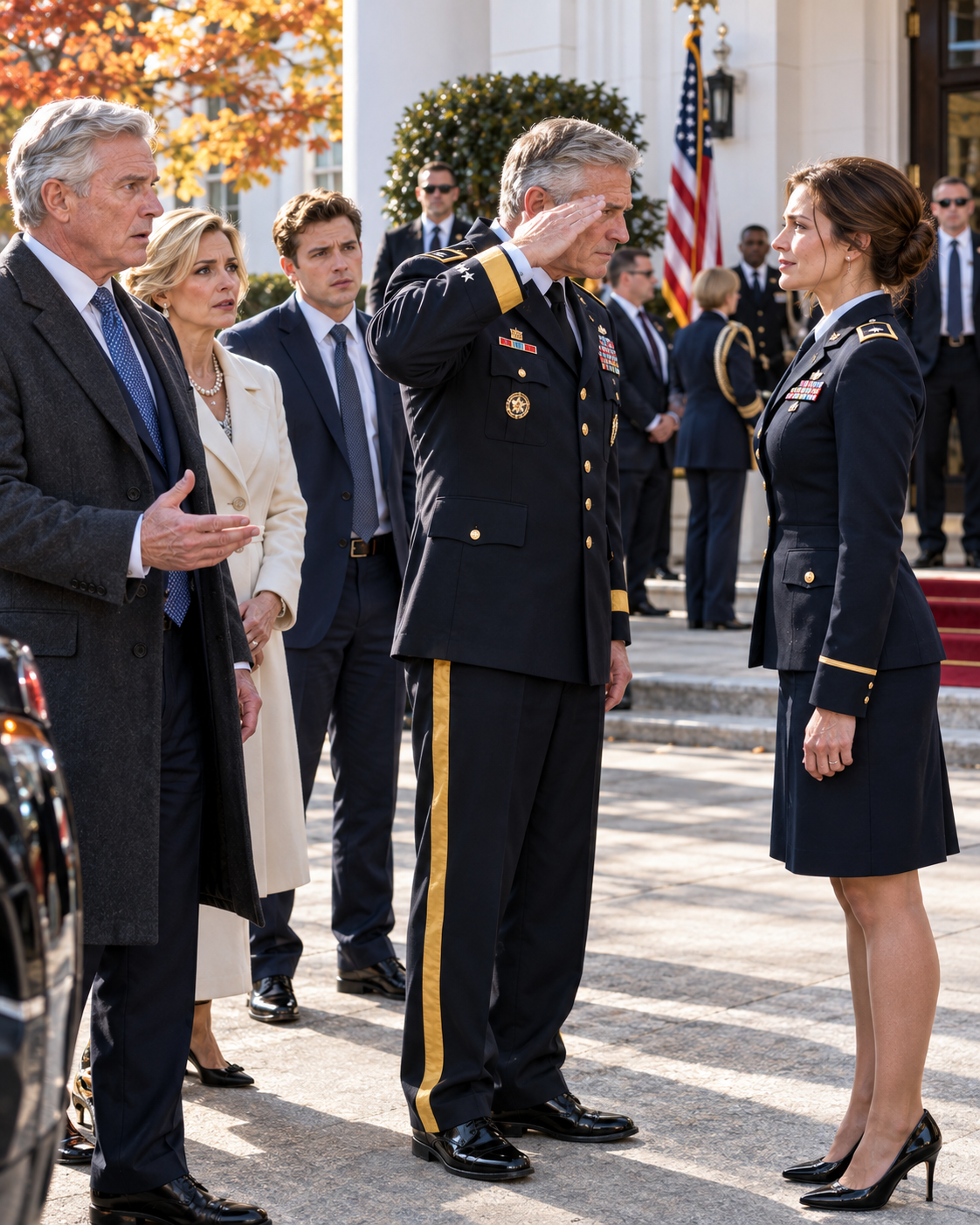
My father ordered me to pretend I was a STRANGER outside the White House, sneering that a decorated Army colonel like me
I read the sentence three times, hoping the words would rearrange themselves into something less terrible.
They did not.
The envelope contained a preliminary intelligence report, several pages of financial records, and a photograph of my father standing beside a man I recognized immediately.
Victor Hale had once been the senior executive responsible for Sterling Defense Systems’ most ambitious communications contract.
He had also been the person who publicly blamed my mother for a financial scandal that nearly destroyed the company eighteen years earlier.
My father had always insisted that Eleanor had mishandled the family foundation’s accounts during the final months of her life.
He had called it a tragedy, a betrayal, and an embarrassment, depending on who was listening.
I had been too young, too devastated, and too desperate to believe that my parents’ marriage had ended in anything other than the slow collapse everyone claimed to have witnessed.
Now, standing beneath the White House portico with my medal against my chest, I discovered that the report connected the foundation’s missing funds to a classified technology transfer.
The transfer had occurred three days before my mother’s death.
My fingers tightened around the papers.
“What is this?” I asked the aide.
“General Delaney can explain the portions that are no longer restricted, Colonel.”
“Why give it to me?”
He hesitated.
“Because your name appears in the original investigation, and because the general believes you deserve to know what happened before anyone asks you to make a decision.”
“What decision?”
Before he could answer, my phone vibrated.
An unfamiliar number appeared on the screen.
I almost ignored it, but the message beneath the number made my heart stumble.
Morgan, it’s Blake. Please don’t trust Dad. He knows they’ve found the original file.
I stared at the words.
Blake had mocked me outside the White House less than two hours earlier.
Now he was asking me to distrust the man he had spent his entire life trying to impress.
A second message arrived.
Mom says if you open the safe, everything ends.
I looked back toward the White House doors.
My father was still inside, probably shaking hands and smiling for photographs, already constructing a version of the afternoon in which he had graciously reconciled with his decorated daughter.
I called General Delaney.
He answered before the first ring had finished.
“Colonel.”
“Sir, I received the envelope.”
“I assumed you would.”
“There’s a connection to my mother’s death.”
Silence settled over the line.
“There is,” he finally said. “But the report isn’t complete, and some of the original evidence was removed before the investigation concluded.”
“Removed by whom?”
“We’re still establishing that.”
“Sir, my father is named in the file.”
“I know.”
The words landed harder than I expected.
“You knew about him?”
“I knew his company had been involved in a procurement investigation. I did not know the full circumstances of your mother’s death until recently.”
“Then why wasn’t I told?”
“Because the original case was classified, several witnesses had withdrawn their statements, and the evidence available at the time did not establish what happened to your mother.”
I closed my eyes.
My mother had died believing I would eventually understand why she had spent her last months frightened of a man she had once loved.
And I had spent eighteen years believing that asking questions would dishonor her memory.
“What do I do now?” I asked.
“Come to my office tomorrow morning. Bring the envelope and every message you receive. Do not confront your father alone.”
The line went quiet.
For the first time that day, my medal felt heavy.
I went back to my hotel instead of attending the private dinner scheduled for the award recipients.
I laid the papers across the desk, removed my mother’s watch, and examined its scratched silver back.
She had worn it every day I could remember.
When I was little, I used to sit beside her while she repaired the loose clasp, watching her hands move with patient precision.
“Some things are worth fixing,” she used to say. “Other things only become more dangerous when you pretend they’re whole.”
I had always thought she was talking about broken watches.
That evening, I began to suspect she had been talking about our family.
At 9:17 p.m., someone knocked on my hotel door.
I checked the peephole and found Blake standing alone in the hallway, his expensive jacket hanging open and his face pale beneath the fluorescent lights.
I opened the door but kept the security latch engaged.
“How did you find me?”
“Dad’s assistant booked the hotel for the ceremony. I saw the reservation on his tablet.”
“What do you want?”
He looked over his shoulder before answering.
“I need you to listen before you decide I came here to manipulate you.”
“You laughed when he told me to pretend I didn’t know him.”
“I know.”
“You called my uniform a costume.”
“I know.”
His eyes dropped.
“I’m sorry.”
The apology sounded clumsy, almost painful, and I wondered whether he had ever offered one without expecting something in return.
I released the latch.
He stepped inside, noticed the medal on the desk, and stared at it longer than I expected.
“You really did save those soldiers,” he said.
“Yes.”
“Dad said your project only worked because the government wasted money on it.”
“Your father says a lot of things.”
Blake nodded slowly.
“That’s what I’m starting to understand.”
He reached inside his jacket and produced a small flash drive.
“Mom keeps a locked cabinet in her study. I found these files on her computer while looking for something else.”
“What files?”
“Payments. Emails. Old scanned documents. She told Dad she had deleted them, but she kept copies.”
My pulse quickened.
“Why would she keep evidence against him?”
“Because she thinks he might go to prison if anyone finds it.”
“That doesn’t explain why she kept it.”
Blake looked at me.
“Because she thinks he might go to prison if anyone finds it before he has a chance to destroy it.”
I took the flash drive but did not plug it into my laptop.
“Why bring it to me?”
He swallowed.
“Because I heard them arguing last night. Dad said the original file had resurfaced and that the person carrying it could ruin everything.”
“Did he mention me?”
“Not by name at first. Then he said, ‘If Morgan sees what Eleanor left behind, she’ll never stop digging.'”
The room seemed to shrink around us.
“What exactly did your mother say?”
Blake rubbed his face.
“She told him he should have handled you years ago.”
A cold stillness moved through me.
“Handled me how?”
“I don’t know. I swear I don’t.”
He looked genuinely frightened now.
“I thought Dad was angry because you embarrassed him. But tonight he told Mom that you were never supposed to be at the White House.”
That sentence changed the shape of everything.
My father had not merely been surprised to see me.
He had feared what my presence might mean.
I put the flash drive into the envelope with the documents and called General Delaney again.
This time, I did not wait for him to explain the danger.
“Sir, I have a possible source of evidence connected to the original investigation.”
“Do not access it on a personal device,” he said immediately. “I’ll arrange for an authorized forensic team to receive it.”
“There’s one more thing. Blake says my father knew I might uncover the file.”
“Then we will proceed carefully.”
After the call, I turned toward Blake.
“Why didn’t you tell someone sooner?”
His expression crumpled.
“Because I spent my whole life thinking he was right about you.”
He sat down, elbows on his knees, staring at the carpet.
“He said you abandoned the family. He said you were bitter because you didn’t get the inheritance. Every time I heard your name, it came with some story about how you had disappointed him.”
I remembered the boy who had once followed me around our father’s house, asking questions about the Army uniform in my closet.
I had barely known him before Robert taught him to see me as an enemy.
“I believed him,” Blake whispered. “It was easier than wondering why a father would talk about his daughter that way.”
I sat across from him.
“Believing someone doesn’t make you guilty of everything they do, Blake. But once you know they’re hurting people, what you do next matters.”
He nodded, wiping his eyes with the heel of his hand.
For the first time, I saw him not as my father’s chosen heir but as another person shaped by the same house that had broken something in me.
The next morning, I arrived at General Delaney’s office before sunrise.
The flash drive was transferred to an authorized investigative team, and the envelope was placed under controlled review.
I was instructed not to contact Robert Sterling or discuss the documents outside the investigation.
I followed those instructions.
It was the hardest order I had received in years.
For the next forty-eight hours, I worked through a maze of interviews, technical records, and carefully reconstructed timelines.
The evidence revealed that Sterling Defense Systems had once pursued a government contract involving a secure communications platform.
My father’s company had promised capabilities its equipment could not reliably deliver.
When independent testing exposed the failures, the company faced losing the contract and millions of dollars in anticipated revenue.
The files suggested that Victor Hale had arranged unauthorized access to preliminary testing results, hoping to give Sterling Defense Systems time to disguise its deficiencies.
My mother, who had served as an independent financial adviser to the family foundation, discovered irregular payments connected to the arrangement.
She refused to approve the transactions.
Then the threats began.
One email showed my father warning Victor that Eleanor had become a liability.
Another suggested that money had been transferred through a foundation account to conceal payments to a consultant involved in the procurement process.
Neither message alone proved that my father had caused my mother’s death, but together they painted a picture of a man willing to destroy reputations to protect his empire.
The most painful discovery was a letter my mother had written but never sent.
It was addressed to me.
“Morgan,” it began, “if you are reading this, then I have failed to protect you from the truth.”
I had to stop.
For several minutes, I could not make myself continue.
Then I unfolded the rest of the letter.
“Your father has convinced himself that everything he does is necessary. He calls his fear ambition and his cruelty discipline. He believes that if he can control the story, he can control the consequences.”
My eyes blurred.
“I know you love him, even when he gives you every reason not to. Do not let that love make you responsible for his choices.”
I pressed the letter against my chest.
The next lines were written shakily.
“I am afraid that something terrible will happen if I refuse to cooperate. If it does, remember that I chose to tell the truth because I want you to grow up in a world where doing the right thing is still possible.”
The letter ended with a sentence I read until I could no longer see the ink clearly.
“You were never the child who failed this family, Morgan. You were the one who refused to become what it was.”
I had imagined a thousand conversations with my mother since she died.
In none of them had I expected to receive her forgiveness for something that had never been my fault.
But the investigation was not finished.
A financial analyst discovered that a substantial payment had been made to a private security firm shortly before my mother’s death.
The firm had later dissolved.
Its former director, a retired investigator named Thomas Reed, was located in Virginia.
When federal agents interviewed him, he admitted that he had been hired to follow Eleanor after she threatened to report the irregularities.
He claimed he had never been ordered to harm her.
He also revealed that the night she died, he had seen Victor Hale’s vehicle near the road where her car had crashed.
The official ruling had attributed her death to an accident on a wet stretch of highway.
There was no reliable evidence at the time that another vehicle had been involved.
Now, investigators had reason to examine the crash again.
They retrieved archived photographs, reviewed maintenance records, and interviewed witnesses who had never been questioned in the original inquiry.
One former employee remembered receiving a call from Victor Hale on the evening of the crash.
Another recalled that Robert Sterling had arrived at the company’s headquarters before dawn the following morning and ordered several accounting files removed.
Those accounts were troubling, but they were not yet proof of murder.
General Delaney made that distinction clear when I met him in his office.
“We will not turn suspicion into certainty because the person under investigation is your father,” he told me.
“I wouldn’t ask you to.”
“I know. That’s why you’re here.”
He studied me for a moment.
“Colonel, the government is also reviewing whether the evidence suggests an attempt to influence the procurement process surrounding your communications program. Your personal connection makes this difficult, but it does not disqualify you from cooperating as a witness.”
“Then I’ll cooperate.”
“Even if the evidence leads somewhere you don’t want it to go?”
I thought of my mother’s letter.
“Especially then.”
Three days later, Robert called.
I let it ring twice before answering.
“Morgan,” he said, his voice smooth and measured. “We need to talk.”
“About what?”
“Your mother.”
My hand tightened around the phone.
“I thought we had agreed not to know each other.”
“Stop playing games.”
The old command in his voice stirred something familiar in me, but it no longer had the power to make me smaller.
“What do you want, Robert?”
He went silent at the sound of his first name.
Then he spoke more quietly.
“I know you’ve received documents that could be misunderstood.”
“Misunderstood by whom?”
“People who don’t know the pressures I was under. People who have no idea what it takes to build something important.”
“Did you know Mom was afraid?”
A long pause followed.
“Your mother was emotional. She didn’t understand the business.”
“Did you know she was being followed?”
“I cannot answer questions based on rumors.”
“Did you remove the financial records after she died?”
His breathing changed.
“Who told you that?”
I closed my eyes.
He had answered without answering.
“I want to see you,” he said. “Privately. No lawyers, no investigators, no generals. Just us.”
For a fleeting moment, I was eighteen again, standing in his office with my duffel bag at my feet, waiting for him to tell me he was proud of me.
Then I remembered the White House steps.
“I won’t meet you privately while an investigation is underway.”
“You owe me more than that.”
“No,” I said. “I owe Mom the truth.”
His voice hardened.
“You have no idea how much I sacrificed for you.”
“You sacrificed nothing for me that I ever asked you to sacrifice.”
He hung up.
That afternoon, Blake called to tell me that Robert had ordered him to leave the house.
Vanessa had discovered that he had copied files from her computer, and the argument had escalated until security escorted him off the property.
“I thought he’d calm down,” Blake said. “He’s never been this scared before.”
“Where are you staying?”
“At a friend’s place.”
“Send me the address. I’ll have someone make sure you’re safe.”
He hesitated.
“Why are you helping me?”
“Because you told the truth when it became difficult.”
It was not forgiveness, not yet.
But it was a beginning.
Two weeks later, the investigators obtained a warrant to search Sterling Defense Systems’ archived records.
The operation uncovered duplicate ledgers, correspondence with Victor Hale, and evidence that several employees had been pressured to alter the company’s testing reports.
A separate forensic review linked the questionable payments to the security firm that had monitored my mother.
The findings still did not establish who had caused the crash, but they destroyed the story Robert had told for eighteen years.
Eleanor had not stolen from the foundation.
She had refused to help conceal a scheme.
The missing money had been part of an attempt to disguise payments tied to a procurement arrangement that investigators now believed may have compromised government testing.
And my father’s company had not merely failed to meet technical standards.
It had attempted to conceal why it failed.
The communications program I had built was suddenly at the center of a broader review.
Investigators needed to determine whether my father’s company had tried to obtain restricted technical information about my work, and whether any of its executives had attempted to influence the program’s evaluation.
My clearance was reviewed, my professional records were examined, and I answered every question put to me.
Some nights, I returned to my apartment too exhausted to remove my uniform before sitting on the edge of the bed.
I had spent twenty-six years learning to recognize threats, but I had never prepared for the possibility that the man who taught me to tie my shoes might have spent years hiding the truth about my mother’s death.
The hardest part was not anger.
It was grief for the father I had spent my whole life hoping he might become.
One afternoon, General Delaney summoned me to his office.
“The investigation has reached a significant point,” he said. “Victor Hale has agreed to cooperate.”
“What does that mean?”
“He has provided testimony and records concerning the procurement scheme, the payments to the security firm, and the removal of documents after your mother’s death.”
“Does he admit that he caused the crash?”
“No. He denies involvement in the collision. His statements establish a troubling pattern of conduct, but we are still investigating the circumstances of Eleanor’s death.”
I nodded, forcing myself to accept the uncertainty.
The general leaned back.
“There is another matter. The government has decided to preserve your communications program as the standard for future coalition interoperability testing. Your work will continue to protect service members.”
For the first time in days, I felt something other than dread.
“Thank you, sir.”
“You earned that recognition long before your father walked into the White House.”
I looked down at my mother’s watch.
“I wish she could have seen it.”
“Perhaps she would have been proud that you kept going.”
I almost smiled.
“She would probably have told me to stop polishing my medals and eat something.”
The general laughed softly.
“Then I suggest you follow orders.”
A week later, Robert Sterling was formally notified that his company was facing a federal investigation into suspected procurement fraud, falsified testing records, and obstruction-related conduct.
Several contracts were suspended pending review.
His board placed him on administrative leave, and the business pages that had once celebrated his success began asking questions about the empire behind the polished photographs.
He tried to portray the investigation as a personal vendetta.
It did not work.
Too many records had survived.
Too many witnesses had begun speaking.
And too many people had seen him turn away from his daughter outside the White House before watching a four-star general salute her.
Then came the day he asked to see me.
The request arrived through his attorney, who made it clear that the meeting would take place under the supervision of the appropriate authorities.
I agreed.
Not because I wanted an apology, but because I had finally learned that refusing to face the past was not the same as escaping it.
We met in a quiet conference room with two chairs separated by a small table.
Robert looked older than I remembered.
His hair had thinned, the skin beneath his eyes had darkened, and his suit seemed too large across the shoulders.
For the first time, he looked less like an empire and more like a tired man who had run out of places to hide.
He studied my uniform.
“I always knew you were stubborn.”
“I learned from you.”
A brief, painful smile crossed his face.
“I suppose I deserved that.”
Neither of us spoke for several seconds.
Then he said, “I didn’t kill your mother.”
I held his gaze.
“I didn’t ask you that.”
“I know what they’re investigating.”
“Then you know why the truth matters.”
He rubbed his hands together, an unfamiliar nervous gesture.
“I made mistakes. I trusted Victor. I allowed things to happen because I thought the company would collapse if I stopped them.”
“Mom tried to stop them.”
“She didn’t understand what was at stake.”
“She understood that people were being deceived.”
His jaw tightened.
“You think everything is simple because you wear a uniform and follow orders.”
“No. I think difficult choices are still choices.”
For a moment, I saw the anger rise in him, ready to become the old familiar weapon.
But it faded.
“I was afraid,” he admitted.
It was the first honest sentence I had heard from him in years.
“Of losing the company?”
“Of losing everything.”
“You lost me long before this investigation.”
He lowered his eyes.
“I know.”
I had imagined this moment so many times that I expected my anger to erupt the instant he acknowledged what he had done.
Instead, I felt a deep, quiet sadness.
“I wanted you to be proud of me,” I said. “Even after I stopped needing your money, I wanted you to look at me and see your daughter.”
His eyes filled, though I could not tell whether the tears came from regret, fear, or the collapse of the life he had built.
“I was proud of you,” he whispered.
“No, Robert. You were proud when other people praised me. You were ashamed when I chose something you couldn’t control.”
He opened his mouth, then closed it again.
I stood.
“I hope you tell the truth about Mom. Not because it will save you, but because she deserved better than the story you told about her.”
I walked to the door.
“Morgan.”
I stopped but did not turn around.
“Can you ever forgive me?”
The question hung between us.
“I don’t know,” I said honestly. “Forgiveness isn’t a way to erase what happened. If I ever find it, it will have to come after the truth, not instead of it.”
I left him alone with the consequences he had spent eighteen years trying to outrun.
Months passed.
The investigation continued, and the evidence concerning the procurement scheme resulted in criminal charges against several former executives, including Victor Hale.
Robert was charged in connection with the suspected financial scheme and the concealment of records, though the inquiry into my mother’s death remained unresolved.
He denied ordering anyone to harm her.
The authorities never presented me with proof that he had arranged her death, and I refused to let grief turn suspicion into a verdict.
That uncertainty was its own kind of burden.
I could accept that my father had lied, that he had helped protect a corrupt arrangement, and that he had allowed my mother’s reputation to be damaged.
I could not claim to know every choice he had made on the night she died.
I learned to live with the difference between what I knew and what I feared.
Blake eventually moved into a small apartment near his university and began working part-time for a nonprofit that helped veterans transition into civilian life.
He called me once a week, usually with a question he could have answered himself, as though he needed an excuse to keep the connection alive.
One evening, he asked if I hated him for what he had said outside the White House.
I thought about the young man who had laughed because his father was watching.
“No,” I told him. “But I need you to understand why it hurt.”
“I do.”
“Then don’t let shame become another reason to hide from the truth.”
He promised he wouldn’t.
I believed him, though I knew promises were only the beginning of becoming someone different.
On the anniversary of my mother’s death, I visited her grave.
The sky was pale, and the wind moved through the trees with a sound like distant rain.
I wore my uniform, but I left my medals at home.
I brought the silver watch instead.
For years, I had thought the watch represented everything I had lost: my childhood, my mother, and the possibility that my father might someday become the man I needed.
Now I understood that it also represented what she had left me.
The courage to choose a life that was mine.
The patience to wait for evidence instead of surrendering to suspicion.
The strength to refuse cruelty even when it came from someone I loved.
I placed a small bouquet beside her headstone and rested my hand against the cold stone.
“I finally know what you were trying to tell me,” I whispered.
The words did not undo the past.
They did not bring her back.
But for the first time, I did not feel as though I was speaking to her through a wall of unfinished questions.
I was simply her daughter, remembering her.
My phone vibrated as I turned toward the path.
It was a message from General Delaney.
The review board has completed its assessment. Your program has been approved for expanded deployment. Call me when you can. There is also a new development in the Sterling investigation.
I stared at the screen.
For a moment, the old fear returned, sharp and immediate.
Then I slipped the phone into my pocket and looked once more at my mother’s name.
Whatever came next, I would face it without allowing anyone else to decide what the truth was worth.
That evening, I called the general.
He told me that investigators had recovered a final document from an archive thought to have been destroyed years earlier.
It was a handwritten note, dated the night before my mother’s crash.
The note had been authenticated, but its recipient had not yet been identified.
“What’s in it?” I asked.
The general paused.
“It suggests your mother knew she was in danger. More importantly, it indicates she was trying to protect someone.”
“Who?”
“We’re working to establish that.”
I looked at the silver watch on my wrist, its face catching the last light of the setting sun.
For eighteen years, I had believed the past was a locked room, and that my only choice was to live outside it.
Now the door was open, but I still could not see what waited in the darkness beyond.
I asked the general to send the document through the proper channels.
Then I stood by my window and watched the city lights appear one by one.
My father had taught me that power meant controlling what people believed.
My mother had taught me that character meant telling the truth even when it cost you everything.
For most of my life, I had mistaken those two lessons for a choice between family and duty.
I finally understood that the real choice had always been between fear and courage.
I did not know whether I would ever forgive Robert Sterling.
I did not know whether the investigation would ever explain every detail of my mother’s death.
But I knew I would not sacrifice my integrity to purchase an answer.
The next morning, I put on my uniform, fastened my mother’s watch, and prepared to return to work.
My medal rested in its case on the shelf, no longer a symbol of the approval I had once wanted from my father, but a reminder of the people who had trusted me when their lives depended on it.
I had spent twenty-six years proving that I could serve something larger than myself.
Now I had to learn how to live without letting the wounds of my family define the rest of my life.
As I reached for the door, my phone rang again.
This time, the number was unfamiliar, and the voice on the other end was a woman I had never met.
“Colonel Vance,” she said quietly, “my name is Claire Donovan. I worked with your mother before she died, and I have something she asked me to keep until you were ready.”
I froze.
“What did she leave you?”
The woman took a shaky breath.
“Not a letter. Not money. Something much more dangerous.”
I glanced at the watch on my wrist.
“What is it?”
Her answer came in a whisper.
“The name of the person who was in the other car that night.”
For a moment, the world seemed to stop.
Then she added one final sentence.
“And Colonel, your mother didn’t leave that name to expose your father. She left it because she was afraid of what would happen to you if you ever learned it.”
I stood motionless, the phone pressed to my ear, feeling the past rise around me like a tide.
The truth had already taken my childhood, my family, and the comforting lie that time could heal every wound.
Whatever came next, I knew one thing with absolute certainty.
I was no longer the frightened girl waiting for her father to choose her.
I was Colonel Morgan Vance, and I was finally ready to hear what my mother had tried so desperately to protect me from.