My dead work truck sat smoking on the shoulder of I-71 outside Columbus while a state trooper watched me struggle
Part 2
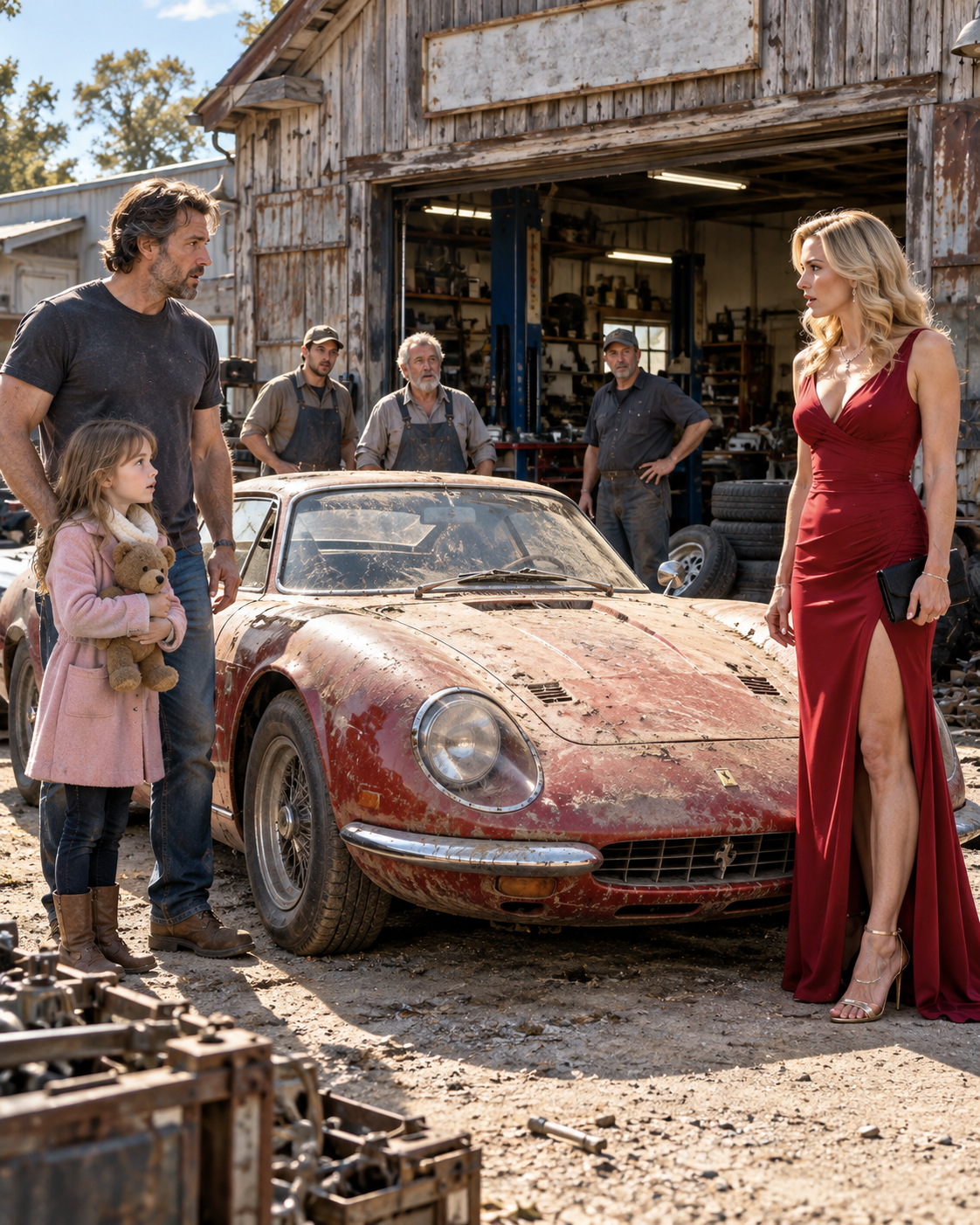
Elena arrived that afternoon without warning.
She stood in my garage for nearly a minute without saying anything.
Then she walked slowly around the prototype.
“I haven’t seen it since I was a little girl,” she whispered.
“You knew what it was?”
“No.”
She touched the fender.
“I knew my father loved it.”
I told her about Victor.
Her face went pale.
“My father hated the Sterlings.”
That sentence changed everything.
We drove back to her father’s estate that evening.
Arthur Vance had left behind an office no one had touched since his death.
Dust covered the desk.
Old engineering drawings filled the shelves.
A dead telephone sat beside a wooden tape recorder.
Elena opened a drawer and found three leather journals.
The first pages were ordinary.
Engineering notes.
Meetings.
Financial records.
Then the handwriting changed.
Arthur had written about investors pressuring him to inflate the value of the company.
He wrote about forged inspection reports.
He wrote about insurance policies.
And then he wrote the name Sterling.
I read the next page twice.
Arthur had discovered a plan to deliberately destroy the prototype, collect an inflated insurance payout, and bury the company’s financial losses.
The people behind it were connected to Victor Sterling’s family.
Arthur had taken the car without telling anyone.
He drove it away in the middle of the night and hid it.
He believed that if the prototype survived, someday the truth might survive with it.
Then Elena found the cassette.
Her hands shook as she pressed play.
Static filled the room.
Then Arthur’s voice emerged from fifty years earlier.
“If you’re hearing this, I failed to keep this secret forever.”
Elena covered her mouth.
Arthur continued.
“I didn’t steal this car for money.”
His voice cracked.
“I stole it because they were going to destroy the evidence.”
He named the investors.
He named the insurance scheme.
And then he said something that made Elena cry.
“One day, my daughter may wonder why I disappeared into that garage every night.”
The tape hissed.
“Tell her I was trying to leave her something more valuable than money.”
The recording ended.
For several seconds, neither of us moved.
Then Elena sat down and cried like a daughter who had spent years believing her father had simply chosen machines over his family.
“He never told me,” she whispered.
“He was protecting you.”
She looked at me.
“No.”
She wiped her eyes.
“He was protecting the truth.”
The next morning, Victor called.
“You have seventy-two hours,” he said.
“To do what?”
“Accept my offer.”
“And if I don’t?”
There was a long silence.
“Then other people will become interested.”
He was right.
Elena’s younger brother Julian appeared two days later.
He was drowning in debt and furious that the car might be worth millions.
He filed for an emergency injunction, claiming he had a legal interest in the estate.
I couldn’t blame him entirely.
Poverty makes people desperate.
But then Elena’s attorney, Miriam Cole, discovered something worse.
Victor had been contacting Julian privately.
He had offered him money to help seize the prototype before the evidence became public.
Miriam looked at me across her conference table.
“We can fight this,” she said.
“But we need to decide what we’re actually fighting for.”
I knew the answer.
“Not the money.”
“The truth?”
I nodded.
“The truth.”
We contacted the Detroit Automotive Museum.
Its director, Dr. Evelyn Reed, flew in personally.
She spent six hours examining the car.
When she finally stood up, she looked almost stunned.
“This isn’t just a prototype,” she said.
“This is a missing chapter in American automotive history.”
We gave her Arthur’s journals.
We gave her the cassette.
We gave her the serial numbers.
She brought in historians, engineers, and forensic specialists.
Piece by piece, the story became undeniable.
The car was real.
Arthur had hidden it.
The insurance fraud had been real.
And the Sterling connection was documented.
Victor made one final offer.
Fifteen million.
Not nine.
He wanted silence badly enough to raise the price.
I refused.
Then Julian came into Miriam’s office carrying a folder.
He looked exhausted.
“I need to tell you something,” he said.
He placed a recording on the table.
Victor had promised him money.
He had instructed Julian to lie about ownership.
Julian had recorded the conversation because he was afraid.
“I was going to take the deal,” he admitted.
“I know.”
He looked at Elena.
“I was wrong.”
She stared at him for a long time.
Then she hugged him.
Not because everything was forgiven.
Because he had finally chosen to stop lying.
The lawsuit collapsed.
The museum announced that the prototype would be consigned to a public historic auction.
Victor tried to stop it.
He failed.
For the first time in fifty years, Arthur Vance’s story would be heard in public.
And for the first time in my life, I realized that doing the right thing did not always mean walking away with nothing.
Sometimes, it meant refusing to let someone else’s lie decide what your future was worth.
Part 3
The auction took place in Detroit beneath enormous lights.
The prototype sat behind glass.
People came from across the country to see the car that had vanished in 1972.
Maya stood beside me wearing a little blue dress and holding her colorful tape recorder.
She had brought it because she wanted to record the auction.
“Are you nervous?” she asked.
“Very.”
“Why?”
“Because our life might change today.”
She looked at the car.
“I think it already changed.”
She was right.
The bidding began slowly.
Then it climbed.
Four million.
Six.
Eight.
Ten.
My palms were sweating.
At thirteen million, the room became silent.
One final bidder raised his paddle.
The auctioneer looked around.
“Thirteen point eight million dollars.”
The hammer fell.
The Detroit Automotive Museum had bought it.
I didn’t hear the applause at first.
I was looking at Maya.
She was crying.
So was I.
Under our agreement with Elena, the proceeds were divided fairly after the estate and legal obligations were settled.
More than five million dollars came to Maya and me.
Enough to buy a house without fear.
Enough to rebuild my business.
Enough to make sure my daughter never had to wonder whether the electricity would be shut off again.
But the money was never the part I remembered most.
Months later, federal and state investigators formally confirmed the fraudulent insurance scheme Arthur had exposed.
His name was cleared.
His journals became historical evidence.
His story was preserved.
And the museum created a permanent exhibit around the prototype.
They displayed Arthur’s engineering notes.
They displayed photographs from the estate.
They displayed the cassette recording.
And beside the car, behind protective glass, they placed Maya’s colorful tape recorder.
When I saw it there, I laughed.
Maya looked embarrassed.
“Dad, why did they put my recorder next to a million-dollar car?”
“Because,” I told her, “sometimes history isn’t just about the machine.”
She looked through the glass.
“What is it about?”
I thought about Arthur.
I thought about Elena.
I thought about Julian admitting the truth when lying would have been easier.
And I thought about Victor standing in my garage, offering me nine million dollars to bury a story that had already waited half a century to be told.
“It’s about what people choose to do when nobody is watching.”
Our lives changed after that.
I expanded my electrical contracting business.
I bought new trucks.
I hired people I trusted.
For the first time, I could come home from work without wondering whether one broken alternator would destroy everything.
But I never forgot the night before the auction.
I had sat at my kitchen table with Maya asleep upstairs.
The money was already almost within reach.
All I had to do was sign.
Nobody would have blamed me for choosing security.
Nobody would have known.
Except me.
And someday, Maya would have known too.
That was the part that mattered.
I didn’t want to leave my daughter a fortune built on a secret.
I wanted to leave her a story she could tell without lowering her voice.
Years later, Maya asked me whether I regretted not taking Victor’s nine million dollars.
I looked at the woman she had become.
She was holding a framed photograph of the prototype.
“No,” I said.
“Not even once?”
“Not even once.”
She smiled.
Then she pointed toward the museum exhibit.
“You know what Grandpa Arthur left us?”
I shook my head.
“Proof that doing the right thing can take fifty years and still be worth it.”
I hugged her.
Outside, Detroit was glowing beneath the evening sky.
Inside, Arthur Vance’s car sat beneath the lights, no longer hidden, no longer owned by fear, and no longer carrying a secret that could be bought.
I had once believed the greatest thing I could give my daughter was money.
I was wrong.
The greatest gift was showing her that when the world offers you a fortune to look away, you can still choose to keep your eyes open.
And sometimes, years later, your child will look back at the choice you made and understand that you weren’t just trying to build a better life for her.
You were trying to become the kind of father she could believe in.