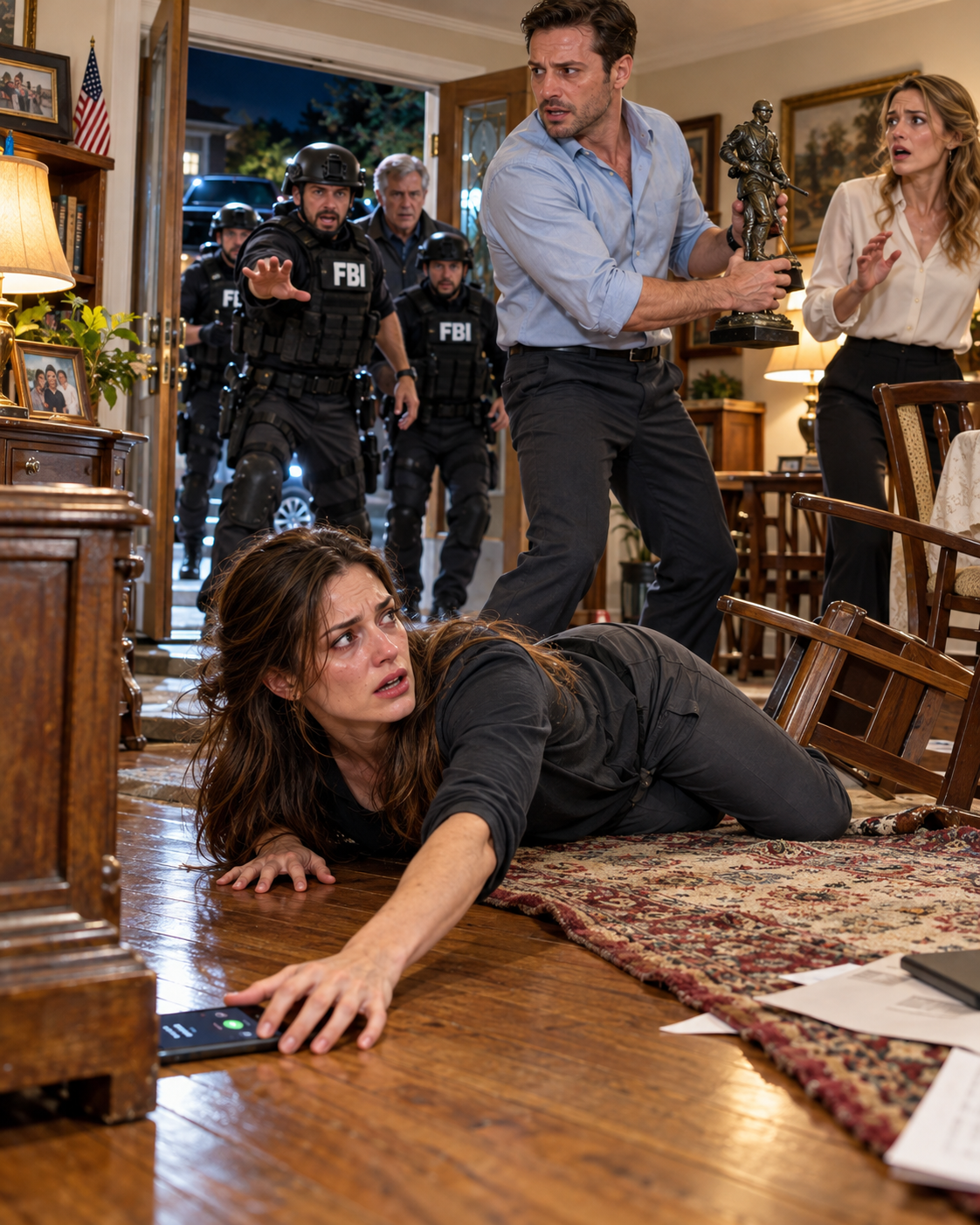
My brother stood over me on the oak floor of our father’s house, raising a bronze military statue to crush my skull
The name on the envelope was Daniel Cole.
My father’s name.
I stared at the handwriting, unable to understand why Colonel Voss looked as though she were preparing to deliver news of another death.
“What does this mean?” I asked.
She glanced at the paramedic tightening a bandage around my head.
“Not here. You need a hospital, and this conversation deserves more than five minutes in an ambulance.”
I wanted to argue, but the pain in my ribs made every breath feel like a punishment.
As the doors closed, I caught one final glimpse of the house through the rain.
Blue lights flashed against the windows.
Agents carried boxes from Dad’s study, while Ethan sat handcuffed beside a federal vehicle, his expensive shirt stained with dust from the floor where he had tried to kill me.
Evelyn stood nearby, crying into her hands.
For years, I had imagined what it might feel like to finally make Ethan face the consequences of his actions.
I had never imagined feeling so empty when it happened.
At the hospital, doctors confirmed three fractured ribs, a concussion, and a deep cut above my eye.
They kept me overnight for observation.
Colonel Mara Voss arrived the following morning with two cups of coffee and the sealed envelope.
She placed it on the bedside table.
“Your father asked me to give you this only after the evidence had been secured and you were out of immediate danger.”
I studied her face.
“How long have you known about all of this?”
“About the investigation? Nearly two years. About your brother’s involvement? We had suspicions, not proof.”
“And Dad?”
“He suspected more than he could demonstrate. He wanted to protect you without interfering with the investigation.”
I looked at the envelope again.
“Why didn’t he tell me?”
“Because he was your father before he was a source of information. He was afraid that knowing too much would put you in danger.”
That answer hurt more than I expected.
Dad had always believed that protecting someone meant carrying the frightening parts of life alone.
Apparently, I had inherited that habit.
I opened the envelope carefully.
Inside was a handwritten letter, several photocopied documents, and a small brass key.
The letter began with the words, My dear Nathan.
I had to stop reading for a moment.
I hadn’t heard Dad’s voice in months, yet the words seemed to bring him into the room more vividly than any photograph.
He wrote that he had discovered irregular transfers connected to Ethan’s company after an old business associate contacted him with concerns about suspicious technology exports.
At first, Dad had believed Ethan was merely making reckless investments.
Then he found evidence that the company had been used to route restricted equipment and technical data through a chain of shell businesses.
Victor Sawyer was the broker who coordinated the transactions.
Ethan’s company provided the commercial cover.
Dad had confronted Ethan privately, hoping to persuade him to cooperate with investigators before the situation became irreversible.
Ethan denied everything.
Later, he accused Dad of trying to ruin his future.
The final pages were harder to read.
Dad admitted that he had begun to fear his own son.
Not because Ethan had always been cruel, but because he had learned to justify every terrible decision by telling himself that he deserved to win.
The house contained more than evidence.
It contained the original correspondence that connected Sawyer’s network to the people who had financed the operation.
Dad had hidden copies in the study, but the brass key opened a second compartment in an old metal cabinet stored in the basement.
At the end of the letter, he had written something that made my eyes burn.
I left you the house because I trust your judgment, not because I want you to fight your brother. If you can save him from the worst version of himself without sacrificing the truth, try. But never mistake protecting someone for helping them escape responsibility.
I lowered the letter.
For years, I had thought Dad’s will was his final statement about which son he loved more.
Now I understood that he had been trying to protect something far more important than property.
He had been trying to protect the truth without abandoning the possibility that Ethan might still choose to do the right thing.
Colonel Voss waited quietly while I finished reading.
“What happens now?” I asked.
“The evidence you transmitted gives us probable cause to pursue the trafficking case. The arrest teams also recovered devices from Sawyer’s vehicle. We’ll need your cooperation to establish the chain of custody and explain the material your father preserved.”
“And Ethan?”
“He’ll face charges related to the assault, as well as any offenses supported by the financial and communications evidence. The prosecutors will determine what can be proved.”
I looked down at the letter.
“Can I speak to him?”
Voss studied me.
“You can, but I want you to understand something. He may apologize. He may blame you. He may do both in the same sentence. You don’t owe him a conversation simply because you share a father.”
“I know.”
But I wasn’t sure I did.
When I was discharged two days later, I returned to the house with a protective detail and an ache that seemed to reach deeper than my injuries.
The front door had been damaged during the raid.
A section of the oak floor was marked where the bronze statue had struck it.
I stood in the living room for a long time.
Dad’s favorite armchair remained beside the fireplace.
His reading glasses sat on the side table where he had left them.
I could almost hear him asking whether I planned to stand there all day or make myself useful.
I laughed once, then covered my face as grief overwhelmed me.
The house had been the place where Ethan and I learned to ride bicycles in the driveway, where Dad taught us to repair a broken fence, and where our mother used to sing while cooking Sunday dinner.
It had also become the place where my brother decided my life was worth less than his debts.
Both truths existed beneath the same roof.
That was what made the betrayal so difficult to understand.
The following week, investigators searched the basement cabinet with the brass key.
Inside, they found a second encrypted drive, original contracts, handwritten transaction logs, and correspondence that connected Sawyer to a network of intermediaries in several countries.
Some documents appeared to show that Ethan had known the company was being used to conceal restricted exports.
Others suggested he had initially believed the transactions were legal, then continued after discovering serious irregularities.
The distinction mattered legally, but it did not erase what he had done.
He had concealed records.
He had threatened his father.
He had tried to force me to surrender the property.
And he had raised a heavy bronze statue over my head when he believed nobody could stop him.
The investigation expanded.
Sawyer’s arrest led to searches of offices, warehouses, and financial accounts.
Several executives were questioned.
A former employee agreed to testify about how the network had used legitimate contracts to hide the movement of restricted technology.
My father’s records helped investigators reconstruct transactions that had appeared unrelated for years.
For the first time, I saw how patiently he had worked.
He had not been a man who chased criminals through dark alleys or shouted accusations in public.
He had collected receipts, recorded dates, saved emails, and asked questions that people assumed an old veteran had no reason to ask.
His greatest weapon had been patience.
It was a lesson I had overlooked because I had always associated strength with the ability to endure pain.
A week after the raid, I received a message from Ethan’s attorney.
My brother wanted to speak with me.
I considered refusing.
Then I remembered Dad’s letter.
If you can save him from the worst version of himself without sacrificing the truth, try.
I agreed to one meeting, with an attorney present and no promises about what would follow.
Ethan entered the conference room wearing a plain gray shirt.
Without his expensive watch and carefully tailored jacket, he looked strangely like the boy I remembered from childhood.
He sat across from me and stared at the table.
“You look terrible,” he said.
It was such an ordinary, familiar thing to say that for one absurd second, I nearly laughed.
“Three broken ribs will do that.”
His mouth tightened.
“I didn’t think you would survive.”
The words settled between us.
I had expected an apology.
Instead, he had given me the truth in its ugliest form.
“You knew what you were doing,” I said.
“I was angry.”
“You raised a statue over my head.”
“I know.”
“You told Evelyn to help you force me to sign away the house. You threatened me. You lied to Dad. You put your company above everything.”
He finally looked up.
“I thought I could fix it.”
“You’ve been saying that for years.”
His eyes reddened.
“When Dad left you the house, I felt like he had chosen you over me. I thought he believed you were the better son.”
I stared at him.
“This was never a competition.”
“It was to me.”
The confession explained something, but it did not excuse anything.
Ethan had spent his life measuring love as if it were a limited resource, something he could lose whenever another person received attention.
Dad had tried to teach him that family wasn’t a contest.
Somewhere along the way, Ethan had decided that being loved meant being entitled to win.
“I was drowning,” he continued. “The company was failing. Sawyer had people threatening me. I owed money I couldn’t repay. I thought if I got the house, I could settle everything.”
“You could have told me.”
“You would have called the police.”
“Yes.”
He looked down.
“That was why I didn’t tell you.”
I felt a strange, hollow sadness.
Even now, he was admitting that the reason he had hidden the truth was that he knew I would refuse to help him do something wrong.
“You weren’t afraid I’d misunderstand you, Ethan. You were afraid I’d understand you perfectly.”
He flinched.
For a moment, neither of us spoke.
Then he whispered, “I’m sorry.”
I waited, but no explanation followed.
It was the first apology he had ever offered me without immediately attaching a defense to it.
I wanted to believe that meant something.
“Are you sorry you hurt me,” I asked, “or are you sorry you got caught?”
He looked at me for a long time.
“I don’t know how to answer that without sounding like a liar.”
“Then start by telling the truth, even when it makes you look terrible.”
He nodded slowly.
“I was sorry when I saw you on the floor. I was terrified. But I was also angry that everything had gone wrong. I think part of me was still blaming you because you wouldn’t give me what I wanted.”
His voice cracked.
“I don’t know what that says about me.”
“It says you have a lot of work to do.”
I stood carefully, wincing as my ribs protested.
“I won’t lie for you. I won’t ask the prosecutors to ignore what happened. And I won’t give you the house.”
He closed his eyes.
“But if you decide to become someone who doesn’t hurt people whenever he’s afraid, that choice is still yours.”
I left before either of us could turn the conversation into another argument about the past.
Evelyn’s case unfolded separately.
Investigators found messages showing that she had helped conceal financial records and had encouraged Ethan to intimidate me into surrendering the property.
She had not merely watched the assault; her own words, captured by my phone, became part of the evidence.
When her attorney contacted me, she requested that I tell investigators she had acted out of fear.
I remembered her standing beside the fireplace while Ethan raised the statue.
I remembered her telling him to do it.
I declined to change my statement.
Fear could explain why someone felt trapped.
It could not transform a deliberate act of cruelty into an innocent mistake.
Months passed before the cases reached their next stage.
I returned to work gradually, following my doctors’ instructions and learning to live with the dull ache that accompanied sudden movements.
My colleagues treated me with a tenderness that sometimes embarrassed me.
I had spent years believing that accepting help made me a burden.
After the attack, I finally understood how much energy I had wasted trying to prove I needed nobody.
Colonel Voss visited once, bringing an update about the investigation and a small box recovered from my father’s study.
Inside was a collection of old photographs.
There was Dad in uniform, younger than I had ever known him.
There was Ethan and me sitting on his shoulders at a county fair.
And there was a photograph of our mother, taken before she died, holding both our hands while we stood beside the old house.
On the back, Dad had written, Two sons, one family. Never let the world convince you that love must be earned by winning.
I sat with that photograph for a long time.
Perhaps Dad had known that Ethan would struggle with jealousy.
Perhaps he had simply hoped that love would eventually teach us both what pride could not.
I placed the photograph on the mantel beside the bronze statue, which investigators had returned after documenting it as evidence.
The statue no longer looked like a symbol of military glory.
It looked like a piece of metal that had nearly ended my life.
I considered putting it away.
Instead, I left it where it was, not as a monument to what Ethan had done, but as a reminder that family history could not make violence acceptable.
The legal proceedings took nearly a year.
Sawyer’s network was dismantled through a series of coordinated prosecutions, and the evidence my father had preserved helped establish the full scope of the operation.
Ethan ultimately admitted to his role in concealing transactions and attempting to coerce me into surrendering the property.
He also pleaded guilty to charges arising from the assault.
Evelyn faced consequences for her own actions.
Neither of them received the clean escape they had once assumed money and persuasion could buy.
At sentencing, Ethan stood before the court and spoke without looking at me.
He admitted that he had turned his resentment into entitlement and his fear into cruelty.
He said he had spent so long believing Dad loved me more that he had failed to notice how much of his own life he had sacrificed trying to prove he deserved to be loved most.
“I thought winning would make me feel secure,” he said. “Instead, I kept needing someone else to lose.”
I listened without moving.
His words were painful because they sounded sincere.
They were also years too late to protect me from what he had done.
When the hearing ended, he turned toward me.
I did not approach him.
I did not smile or offer forgiveness for the sake of making the room more comfortable.
I simply met his eyes and gave a small nod.
It wasn’t reconciliation.
It was acknowledgment that he had finally told the truth in a place where he could no longer control the consequences.
Afterward, I kept the house.
I repaired the back door, refinished the damaged section of oak flooring, and repainted the living room.
I converted Dad’s study into a small library and kept the original documents in secure custody with the investigators.
For a while, every creak in the hallway made me turn toward the entrance.
Healing was not as simple as surviving the attack.
My body recovered faster than my trust.
There were nights when I woke remembering the weight of the statue above me, the cold expression on Evelyn’s face, and the terrible certainty that my last moments might be spent begging my own brother to stop.
I sought counseling and learned to speak about the things I had buried beneath discipline and silence.
I learned that being strong did not mean pretending the attack had left no mark.
It meant allowing myself to be helped without feeling ashamed.
One autumn afternoon, I invited several friends from the hospital to the house for dinner.
We ate at the long dining table where Dad used to insist that every family disagreement be settled before dessert.
Someone laughed so hard that a glass nearly tipped over.
For a moment, the house sounded the way it had before everything changed.
I looked toward the mantel and felt the ache of missing Dad rise through me.
But beneath it, I felt gratitude.
His final gift had not been the property or the evidence hidden inside its walls.
It had been the chance to understand that loyalty and accountability could exist together.
I could love my brother without protecting him from the truth.
I could remember the good parts of our childhood without pretending the terrible parts had never happened.
And I could honor my father without repeating his habit of carrying every burden alone.
A year after the attack, a letter arrived from Ethan.
It had been reviewed by his attorney and contained no request for money, no demand that I change my statement, and no attempt to use our shared childhood as leverage.
He wrote that he had begun counseling and was trying to understand why he had treated every disagreement as a threat to his worth.
He did not ask me to forgive him.
He said he knew that any relationship between us would have to be built slowly, if it could be built at all.
I read the letter twice and placed it in the drawer beside Dad’s.
I wasn’t ready to answer.
Maybe I never would be.
But I no longer needed to decide the rest of my life in a single moment.
That evening, I walked outside and stood beneath the old oak tree where Dad had taught us to tie fishing knots.
The wind moved through the branches, scattering dry leaves across the driveway.
I thought about the man who had raised two sons and hoped that both would grow into people who understood the difference between power and strength.
Ethan had chosen power when he was afraid.
I had chosen silence when I was hurt.
Neither choice had saved us from pain.
But I could choose differently now.
I could speak before resentment hardened.
I could set boundaries without apologizing for them.
I could offer compassion without handing someone the means to hurt me again.
And I could stop treating survival as a debt I owed to the people I had lost.
Before going inside, I looked once more at the house.
It was no longer simply the property my father had left me, or the scene of the worst night of my life.
It was a place where the truth had finally come into the light, where the people who had done harm were forced to face it, and where I could begin building a future that did not depend on anyone else’s approval.
I had once believed that family meant standing beside someone no matter what they did.
Now I understood that real love could not demand the surrender of your safety, your dignity, or your conscience.
Sometimes loving someone meant offering another chance.
Sometimes it meant walking away.
And sometimes it meant refusing to lie for them, even when the truth broke your heart.
I still missed the brother Ethan had been before resentment consumed him.
I didn’t know whether that boy was still somewhere inside the man he had become.
But I knew I could not rescue him by allowing him to destroy me.
Dad had left me the house because he trusted me to protect what mattered.
For a long time, I thought that meant protecting the walls, the documents, and the family name.
Now I understood that the most important thing I had protected was the possibility of living without fear.
And every morning when I opened the front door, I reminded myself of one simple truth: being a good son never required me to become a victim, and being a good brother never required me to excuse a crime.
The house was quiet again.
The oak floor had been repaired.
The bronze statue stood beside the fireplace.
But I no longer looked at it and thought about the moment my brother tried to kill me.
I thought about the moment I finally stopped letting his choices define my worth.
And somewhere beyond the walls of the house, the world continued moving, carrying its own secrets, its own betrayals, and its own chances for redemption.
I could not control what Ethan would become.
I could only decide what I would allow into the life I had fought to keep.
For the first time in years, that felt like enough.