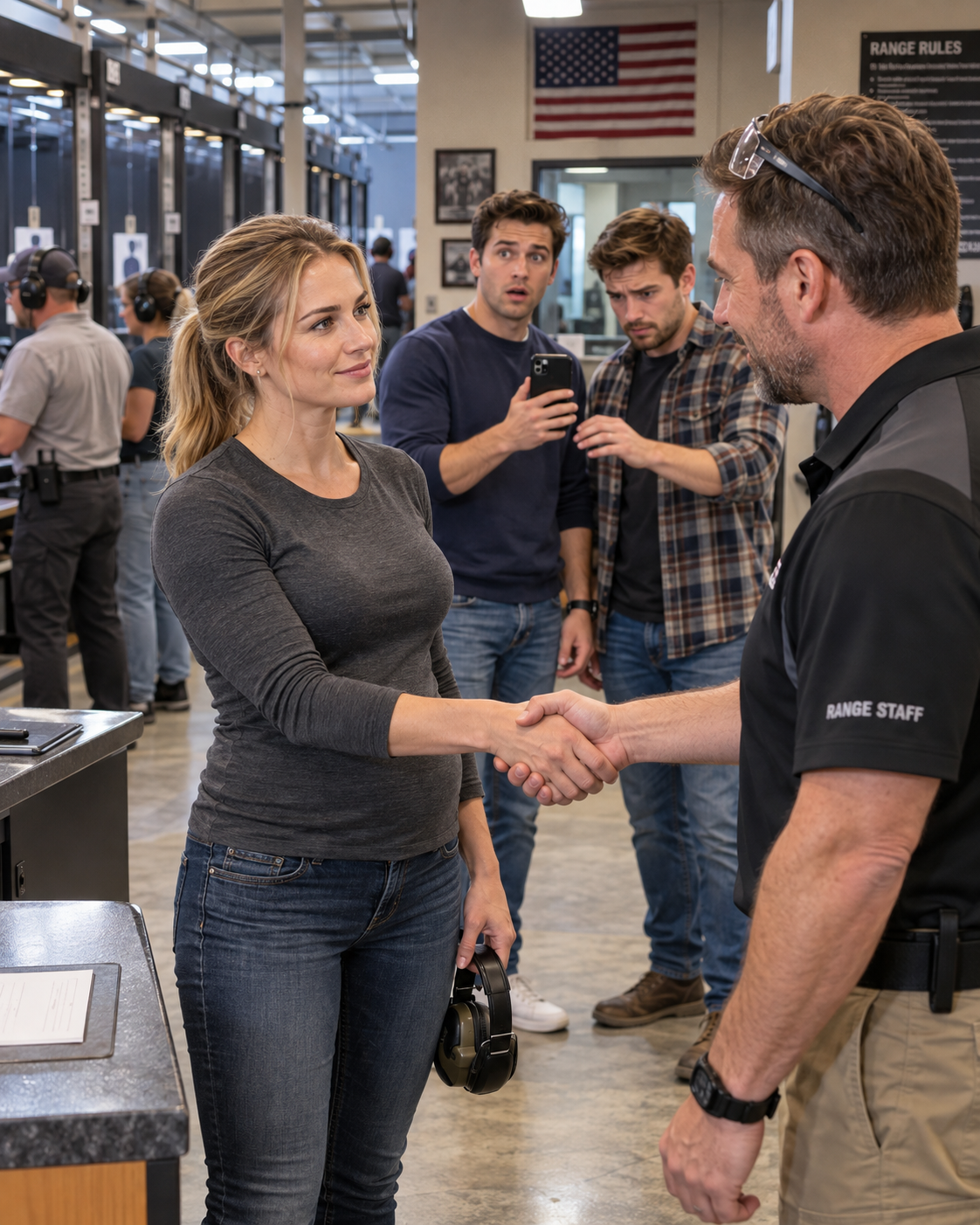
My brother laughed as he filmed me struggling at an indoor shooting range in Fayetteville, telling his friends I was about to embarrass
For several seconds, I couldn’t move.
The envelope felt impossibly light in my hands, yet the words on its hidden seal carried the weight of every sleepless night I had spent remembering Sergeant Daniel Mercer.
My mother stood beside the fireplace, watching me with the frightened expression of someone who had guarded a secret for too long.
Jackson took one step toward me, then stopped.
“Olive, what does it mean?”
I ran my thumb along the edge of the smaller seal without breaking it.
“I don’t know.”
That was the truth, and it frightened me more than anything else.
Daniel had been my teammate, my friend, and the closest thing I had to a brother who understood the parts of me that my family never saw.
He had a crooked smile, an awful sense of humor, and a habit of saving the last cup of coffee for whoever looked the most exhausted.
During our final deployment together, he had pulled me aside one evening and said something I had never forgotten.
“Promise me something, Captain.”
“What?”
“If anything happens to me, don’t let people turn my life into a story that makes them comfortable.”
I had laughed at the time because I thought he was being dramatic.
Two weeks later, Daniel was dead.
The Army’s official account described a dangerous operation, an unexpected escalation, and a team that had acted under difficult circumstances.
I had never questioned the men and women who made those decisions, because I had seen how quickly tragedy could become tangled in details outsiders could never fully understand.
But I had also spent three years wondering why certain records remained incomplete, why a final report had been delayed, and why Daniel’s family had received so few answers.
My father’s hidden letter suggested that he knew something I didn’t.
“Mom,” I whispered, “how long have you had this?”
She lowered her eyes.
“Since the week before your father died.”
The room seemed to tilt.
“He gave it to you three years ago?”
She nodded, tears gathering at the corners of her eyes.
“He told me not to open it, and he made me promise that I would give it to you when you were ready.”
“Ready for what?”
“I don’t know, Olive. I swear to you, I don’t know.”
Jackson looked from our mother to me, his face pale.
For once, he didn’t interrupt with a joke or try to take control of the room.
He simply waited.
I slipped the smaller envelope into my pocket.
“I need to speak with Colonel Reeves before I open this.”
Mom reached for my hand.
“Please don’t let this take you somewhere you can’t come back from.”
I squeezed her fingers gently.
“Mom, I’ve already been there.”
That night, I barely slept.
I sat at my kitchen table with the two letters in front of me, listening to the refrigerator hum and watching headlights pass across the ceiling.
My father’s first letter had been an apology, a confession of love, and an admission that he had spent years understanding me better than I realized.
The second letter was different.
It felt like a door someone had locked from the outside.
At six the next morning, I called Colonel Reeves.
He answered immediately.
“Captain Fulton.”
“Sir, I received a sealed letter from my father. It refers to Daniel Mercer and suggests he knew something about the circumstances surrounding his death.”
The silence on the other end lasted long enough for me to hear his breathing change.
“Did your father mention a document?”
“No, sir. Only that I should open the letter when I was ready to learn what happened to Daniel.”
“I want you to bring it to my office. Don’t photograph it, circulate it, or make any assumptions about what it means.”
His tone was careful, not dismissive.
“Understood.”
“And Olive?”
“Yes, sir?”
“If this involves information connected to an official investigation, we’ll handle it through the appropriate channels.”
I looked at the envelope.
“That’s all I want.”
When I arrived at the installation later that morning, Colonel Reeves was waiting with a folder on his desk.
He did not reach for the letter.
Instead, he asked me to sit and told me something I had not expected.
“Your father contacted the Army several months before his death.”
My stomach tightened.
“About Daniel?”
“About a discrepancy he believed he had discovered in a set of records. He was not a member of the unit, and he had no access to classified operational details, but he had been helping Daniel’s family organize correspondence and personal documents.”
I stared at him.
“Daniel’s family never told me that.”
“Because they didn’t know the full extent of your father’s involvement.”
Colonel Reeves folded his hands.
“He provided information to the appropriate office. The matter was reviewed, and certain administrative questions were reopened. I cannot tell you more until we establish what your father left behind and whether it relates to that review.”
My throat felt tight.
“So Daniel’s death is being investigated again?”
“Some aspects of the record have been examined. That doesn’t mean anyone has established wrongdoing.”
He said it plainly, and I appreciated that he refused to offer me a dramatic answer merely because I wanted one.
Then he slid a second folder across the desk.
Inside was the commendation dossier he had brought to the range, along with a personal letter from Daniel’s mother.
She had written that Daniel spoke of me often, not as the officer who gave orders, but as the person who reminded him that courage and kindness could occupy the same heart.
I read the letter twice.
For three years, I had remembered the last operation through fragments: dust in the air, hurried voices, the terrible instant when everything changed, and the empty space where Daniel should have been.
I had carried guilt because survival can feel like an accusation when someone you love doesn’t come home.
Colonel Reeves seemed to understand.
“Captain, an investigation may clarify a record, but it cannot rewrite the loss. Don’t make the mistake of believing you need to solve every unanswered question before you are allowed to grieve.”
I looked down at my hands.
“I know, sir.”
But I wasn’t sure I did.
That afternoon, I returned to my mother’s house with the smaller envelope in my pocket.
Jackson was already there.
He had brought groceries, repaired the loose kitchen cabinet, and made coffee without asking whether anyone wanted it.
It was such an ordinary gesture that I almost cried.
When he saw me, he stood.
“I owe you an apology.”
I set my bag down.
“You’ve said that.”
“I know. But I’ve been thinking about what happened at the range, and I realized I wasn’t embarrassed because I had been wrong about you.”
He swallowed.
“I was embarrassed because everyone else finally saw what I refused to see.”
I studied him.
For years, Jackson had been the loudest person in our family, the one who filled silence with jokes and turned every gathering into a contest he needed to win.
I had mistaken his confidence for strength.
Now I wondered whether some of it had been fear.
“Why did you film me?” I asked.
He looked at the floor.
“Because I knew you hated being the center of attention. I thought everyone would laugh, and for once I’d be the person who made the room laugh instead of the person everyone expected to have everything figured out.”
“You wanted to humiliate me because you were afraid of looking ordinary?”
His face crumpled slightly.
“When you put it that way, I sound pathetic.”
“You don’t need me to make it sound better.”
He nodded, accepting the blow instead of defending himself.
“I deleted the video. Mason deleted his copy too. I told everyone in the group chat that I had been an idiot and that nobody should share anything.”
“Thank you.”
It was not forgiveness.
It was the beginning of something that might eventually deserve it.
He sat across from me at the kitchen table while Mom placed three cups between us.
“I spent years thinking you had the easier life,” he admitted. “You went to work, came home, and never complained. I thought you didn’t have the courage to take risks.”
I watched steam rise from my coffee.
“I didn’t tell you because I wanted you to sleep at night. I wanted Mom to sleep at night. And because some things weren’t mine to explain.”
“I know that now.”
“No, Jackson. You know a piece of it now.”
He nodded again.
For the first time, he seemed willing to learn without demanding that I make the lesson comfortable.
I took the envelope from my pocket and placed it on the table.
Mom covered her mouth.
Jackson didn’t touch it.
“Do you want me to leave?” he asked.
I looked at him, surprised by the question.
“No. But you need to understand that whatever is inside belongs to me, and I decide what happens next.”
“Okay.”
I broke the seal.
The paper inside was folded twice, and my father’s handwriting looked weaker than it had in the first letter.
My hands trembled as I unfolded it.
Olive,
If you are reading this, then I have failed to find a way to tell you what I learned without making you carry another burden.
I never knew the details of Daniel’s final operation, and I will not pretend that I did. What I found was a contradiction in the paperwork sent to his family, a date that did not match another document, and a statement that seemed to leave out a conversation Daniel had written about in a letter.
I asked questions because I could not bear the thought of a good man’s memory being reduced to a convenient explanation.
Someone told me to stop looking.
My breath caught.
The next line was darker, as though Dad had pressed the pen harder against the paper.
I cannot prove that anyone acted with bad intentions. I cannot tell you that there was a conspiracy, and I will not ask you to believe something simply because I feared it.
But I kept copies of the documents I found, along with Daniel’s letter. They are in a small metal box in the back of my study, beneath the loose floorboard near the bookcase.
I wanted to give them to you while I was alive. Then my heart began to fail, and I became afraid that I would leave you with questions I could no longer help you answer.
I am sorry.
I am sorry that I let people call you quiet when you were carrying more than they could imagine. I am sorry that I praised your brother for being bold while forgetting that your strength often looked like patience.
Do not mistake my fear for certainty, Olive. Find out what the documents mean before you decide what story they tell.
And remember that Daniel was more than the circumstances of his death. He was a son, a friend, a man who loved life. Whatever you discover, do not let the search take that away from him.
Love, Dad.
I lowered the letter.
Mom was crying openly now, and Jackson had gone completely still.
Dad had left us an apology, a warning, and a responsibility he had never intended to place entirely on my shoulders.
For a moment, I wanted to tear the letter apart and throw the pieces into the fireplace.
I wanted my father back.
I wanted Daniel back.
I wanted to be a daughter and a sister for one day without discovering another reason that love could hurt.
Instead, I stood and walked to Dad’s study.
The room still smelled faintly of cedar and old paper.
His books remained on the shelves, his reading glasses beside the lamp, and the framed photograph of our family sat on the desk.
I knelt near the bookcase and found the loose floorboard exactly where he had described.
Beneath it sat a small metal box.
Jackson appeared in the doorway but did not enter.
“Do you want me to get Mom?”
“No. Just stay there.”
I lifted the box and carried it to the desk.
The lock was old, but the key was taped beneath the bottom of the wooden drawer, just as Dad had taught us to hide spare keys when we were children.
Inside lay several copies of official-looking documents, a handwritten list of dates, and a letter folded inside a plastic sleeve.
The handwriting belonged to Daniel.
I recognized it immediately.
My fingers went cold.
The first page was personal, addressed to someone named Thomas, with no surname.
Daniel wrote about a conversation he had overheard before the operation, a discrepancy he believed should be clarified, and his concern that a decision had been made without everyone receiving the same information.
He never accused anyone of deliberately causing harm.
He only asked that the record be accurate.
The final page contained a sentence that made my heart pound.
If anything happens, make sure Olive knows I didn’t blame her for what happened that night.
I stopped breathing for a moment.
Jackson came closer.
“Olive?”
I pressed the letter to my chest.
Daniel had known that I might blame myself.
He had understood the burden I would carry before I understood it myself.
And my father had kept his words safe, hoping that one day I might finally hear them.
I sat in Dad’s chair and cried, not with the controlled restraint I had practiced for years, but with the raw grief of someone who had run out of places to hide it.
Mom knelt beside me.
Jackson stood behind her, one hand resting on the chair, unable to offer a joke or an easy solution.
Nobody asked me to stop crying.
Nobody told me to be strong.
For the first time in years, I did not have to earn the right to fall apart.
The following morning, I contacted Colonel Reeves and explained what I had found.
He arranged for the documents to be reviewed through the appropriate channels, emphasizing that copies needed to be preserved carefully and that no conclusions should be drawn from incomplete records.
I followed his instructions.
I did not post photographs online.
I did not accuse anyone publicly.
I did not turn Daniel’s final letter into ammunition against people whose actions I could not yet understand.
The review would take time, and some questions might never receive complete answers.
That uncertainty was painful, but Dad’s final warning had been clear: truth was not something I could manufacture from grief.
While the documents were being examined, I visited Daniel’s mother.
Her house was small and filled with photographs, including one of Daniel standing beside me after a training exercise, both of us exhausted and smiling beneath a sky that looked impossibly blue.
She held my hands when I showed her the personal letter.
“He knew you would blame yourself,” she whispered.
I nodded.
“I thought I should have done something differently.”
She looked at me with the quiet authority of a mother who had buried a child.
“Maybe there are things you will always wish had gone differently. But wishing is not the same as being responsible for everything that happened.”
She asked me to read Daniel’s words aloud.
When I finished, she closed her eyes.
For a long moment, neither of us spoke.
Then she asked if I would help her create a small memorial scholarship for young people who wanted to serve their communities but lacked the resources to begin.
I agreed.
It would not explain every mystery surrounding Daniel’s death, and it would never replace the future his family had lost.
But it would preserve something more important than the final hours of his life: the kindness he had shown when nobody was watching.
Months passed.
The review clarified some discrepancies in the paperwork and confirmed that certain records had been incomplete, though it did not establish the dramatic explanation I had once feared might be waiting in the box.
There were still unanswered questions, and I learned to live with them without allowing them to consume everything else.
My father’s letter remained on my desk.
Daniel’s letter stayed beside it.
Jackson changed more slowly, as people usually do when the work is real.
He stopped introducing me as the quiet sister who worked in an office.
When relatives asked about my life, he told them I served in the Army and let me decide how much I wanted to share.
He never again pointed a camera at me to make someone else laugh.
One evening, he came to my apartment carrying two coffees and a photograph from our childhood.
We were standing beside our father at a county fair, Jackson grinning at the camera while I held Dad’s hand.
“I used to think Dad was always proudest of me,” he said.
I studied the picture.
“Maybe he was proud of both of us in different ways.”
Jackson shook his head.
“He knew you were doing something dangerous, didn’t he?”
“He knew enough to worry.”
“And he still let me make jokes about you.”
I took a slow breath.
“He didn’t always know how to protect me without hiding what scared him. Neither did I.”
Jackson looked at the photograph again.
“I don’t want to be that person anymore.”
“Then don’t be. Not because you feel guilty today, but because you decide tomorrow to treat people differently.”
He nodded, and this time I believed he understood the difference.
On the anniversary of Daniel’s death, I stood before a small gathering at the memorial we had created in his honor.
His mother sat in the front row.
Colonel Reeves attended in uniform, and Jackson stood beside Mom, holding a folded program in both hands.
I spoke about Daniel’s humor, his loyalty, and the way he could make an exhausted teammate feel human again with a cup of terrible coffee and a ridiculous story.
I did not pretend that grief had made me fearless.
I told them that some losses leave questions behind, and some wounds heal without ever becoming invisible.
Then I placed Daniel’s photograph beside the memorial plaque.
For once, I did not feel that my silence was a burden I had to defend.
It was simply part of who I was, alongside my courage, my mistakes, my love, and the life I had chosen.
After the gathering, Mom handed me a final note she had found tucked inside the back of Dad’s old desk drawer.
It contained only two sentences.
I hope you have forgiven yourself for surviving.
If you haven’t, please don’t wait until you are as old as I was to begin.
I read those words beneath the afternoon sun and understood that my father had not left me a perfect explanation for everything that hurt.
He had left me permission to stop treating pain as proof that I had failed.
That evening, I returned home, placed his note beside Daniel’s letter, and stood for a long time looking at the two pieces of paper.
I thought about the girl I had once been, the one who swallowed every correction, accepted every joke, and believed that being loved meant making herself easy to overlook.
I wished I could tell her that one day she would stand in a room full of people and no longer need to convince them that she deserved to be there.
Not because they would finally recognize her rank.
Not because a colonel would call her Captain or a range owner would remember her achievements.
But because she would understand that her worth had never depended on their recognition.
The next morning, Jackson called to tell me that our mother had found another box in the attic, one that Dad had labeled with my name but never mentioned in either letter.
He had not opened it.
Neither had Mom.
I sat very still, listening as Jackson described the small brass key taped to its lid.
For the first time, the thought of another secret did not make me feel trapped.
It made me feel ready.
“Bring it over,” I said.
And when I hung up, I looked at Daniel’s photograph and whispered the promise I had made years earlier.
“I won’t let them reduce you to the way you died.”
Outside, the morning light spread across the floor, quiet and steady.
I had spent years believing courage meant carrying every burden alone, never trembling, never asking anyone to see how much it cost.
Now I understood that courage could also mean opening the door, telling the truth, and allowing the people who loved you to stand beside you while you faced what waited on the other side.
Whatever was inside that final box, I would meet it as myself.
Not the sister Jackson had invented.
Not the daughter my father had worried over.
Not even the captain whose uniform had finally forced people to pay attention.
Just Olive Fulton, a woman who had survived terrible things, loved people who were imperfect, and finally learned that being seen was not a privilege anyone else had the right to grant.
For the first time in my life, I was no longer waiting for permission to be whole.