Marcus Reed was already sitting in the discharge chair at Riverdale Memorial when Dr. Sterling coldly told me to stop delaying his release
Part 2
Everything happened at once.
The orthopedic team was called back.
The operating room was alerted.
Blood was drawn.
Consent forms appeared.
People who had been moving calmly through the department suddenly started moving with purpose.
Marcus sat there staring at everyone.
“Am I going to lose my leg?”
The question cut through the room.
Emily began crying silently.
I crouched beside him.
“We’re doing everything we can to prevent that.”
“That’s not an answer.”
“No,” I said. “It isn’t.”
He looked terrified.
I couldn’t blame him.
Compartment syndrome is one of those diagnoses that sounds abstract until you’re the person lying beneath the lights with your leg swelling from the inside.
A muscle compartment is enclosed by a tough layer of tissue called fascia.
When bleeding or swelling occurs inside that closed space, the pressure can rise.
As the pressure increases, tiny blood vessels become compressed.
Then nerves begin to suffer.
Then muscle.
And if the pressure isn’t released, tissue can die.
The cruel part is that the skin can still look deceptively normal.
The X-ray can still look clean.
The CT scan can still look reassuring.
A pulse can still exist until late in the process.
The body can be quietly losing the battle while the chart continues to look respectable.
Marcus had what we called a silent presentation.
His injury had not announced itself loudly enough.
His scans had not exposed it.
His earlier examinations had not caught the progression.
But his body had been trying to tell us.
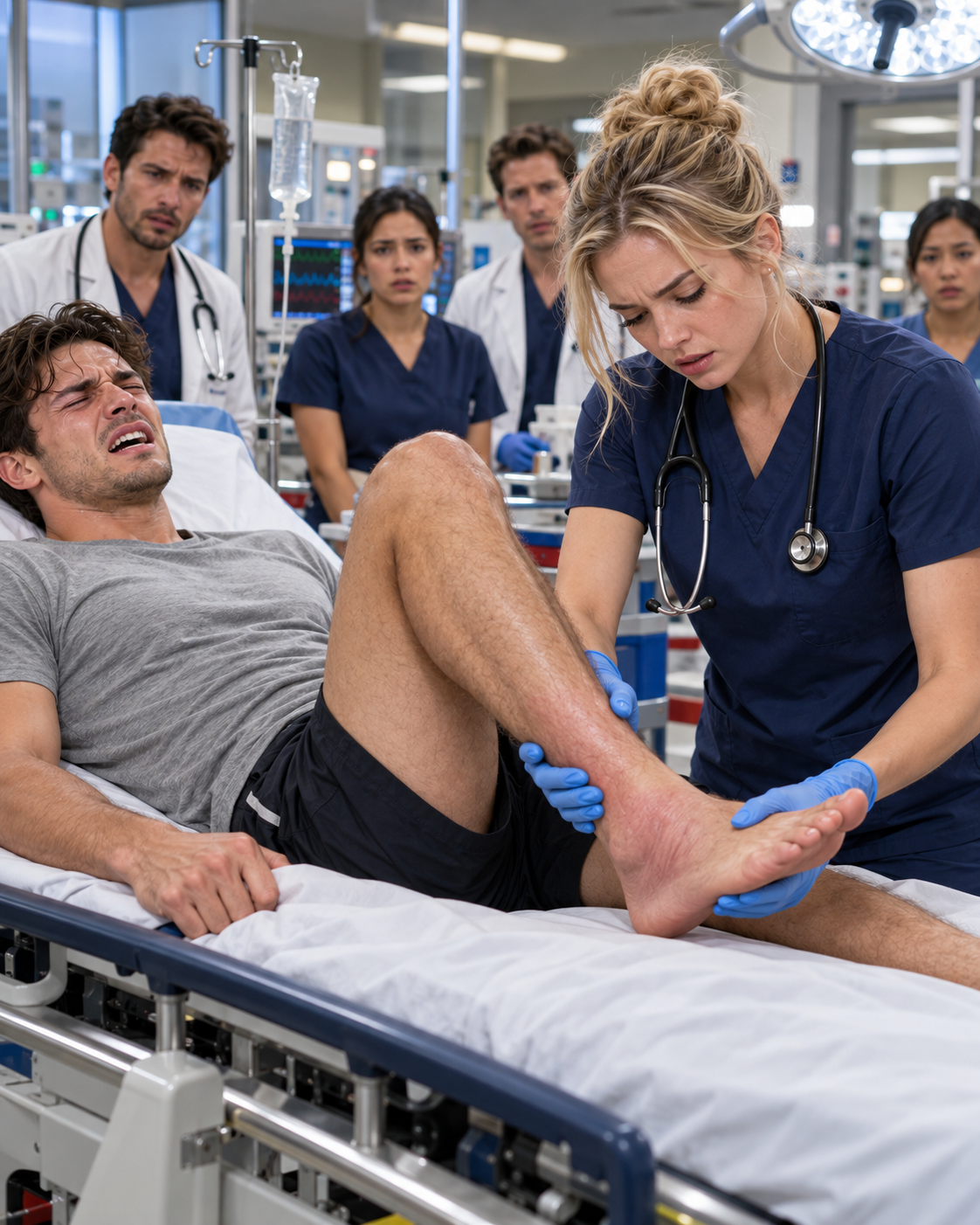
The worsening pain.
The pain when I barely touched his foot.
The weakness in his toes.
The changing pulse.
The falling oxygen saturation in his toes.
And finally, the pressure of forty-two.
That number changed everything.
Dr. Adebayo arrived at the bedside.
He looked at the monitor.
Then at Marcus.
Then at me.
“How long has the pain been increasing?”
Marcus answered.
“About an hour.”
Dr. Adebayo nodded slowly.
“Okay.”
He didn’t waste another second.
“We’re going to the OR.”
Emily looked at him.
“Is he going to be okay?”
Dr. Adebayo paused.
“We caught it.”
Those three words were the closest thing to reassurance anyone could honestly give her.
Marcus looked at me.
“Did you think this was going to happen?”
I shook my head.
“No.”
“Then how did you know?”
I looked down at his foot.
“I didn’t know.”
I touched his shoulder gently.
“I just knew something didn’t feel right.”
His eyes closed.
For a second, he looked like a child.
Not a twenty-six-year-old motorcycle rider.
Not a man who had spent the morning making jokes about going home.
Just someone’s son.
Someone’s boyfriend.
Someone who suddenly understood how quickly an ordinary morning could become the worst day of his life.
As they rolled him toward the operating room, Emily walked beside the bed.
She kept one hand on his shoulder.
Marcus looked at her.
“If something happens…”
“Don’t.”
“If something happens, I need you to—”
“No.”
Her voice cracked.
“You are going to wake up.”
He stared at her.
She leaned down and kissed his forehead.
“You are going to wake up.”
The doors closed.
I stood in the hallway for a moment, staring at them.
Then I looked down at my gloves.
They were still on my hands.
I could feel the imprint of his skin beneath them.
For seventeen years, I had learned how to keep moving after difficult cases.
You had to.
Emergency medicine didn’t give you time to sit with every emotion.
There was always another monitor beeping.
Another patient arriving.
Another family waiting.
Another crisis demanding your hands.
But that morning, I couldn’t stop thinking about the number on the monitor.
Forty-two.
And the sentence Dr. Sterling had said earlier.
We’ve ruled out the dangerous stuff.
I knew he hadn’t meant anything cruel.
He had trusted the evidence in front of him.
So had the other doctors.
They had done what medicine trains us to do.
Look at the imaging.
Review the vitals.
Examine the patient.
Compare findings.
Make a decision.
But medicine is not a machine.
A patient is not a scan.
And a body doesn’t always follow the neat logic of a medical record.
Nearly three hours passed before the operating room doors opened.
I saw Dr. Adebayo first.
His surgical cap was still on.
He looked exhausted.
But he was smiling.
I stood immediately.
“How did it go?”
He nodded.
“We got to him in time.”
My knees almost gave out.
“How bad?”
“Bad enough.”
He sat down for a moment.
“The pressure was severe. There was a lot of swelling.”
I swallowed.
“And the muscle?”
“Viable.”
That word meant everything.
Alive.
Not dead.
Not beyond saving.
Viable.
“What did you do?”
“Fasciotomy.”
He explained that he had made deep incisions along the affected compartments to release the pressure and allow the swollen muscle room to expand.
“He’s going to need close monitoring,” he said.
“Of course.”
“And probably more surgery depending on how the swelling behaves.”
I nodded.
Then Dr. Adebayo looked at me.
“You were right to stop the discharge.”
I looked away.
“I just didn’t feel comfortable.”
He smiled faintly.
“That’s not just being uncomfortable.”
I didn’t answer.
He leaned back.
“Six physicians saw that man today.”
I looked at him.
“We all looked at his scans.”
He paused.
“You looked at him.”
That sentence stayed with me.
Not because it made me feel important.
It didn’t.
If anything, it made me uncomfortable.
Because I knew how easily the story could have gone the other way.
If Marcus had left.
If he had gotten into Emily’s car.
If they had driven home.
If he had gone to bed believing the pain was normal.
If the pressure had continued rising.
There might have been no second chance.
The thought made my stomach turn.
I went to the recovery area.
Marcus was still asleep.
Emily sat beside him.
She looked like she hadn’t moved in hours.
When she saw me, she stood.
“Is he okay?”
“He made it through surgery.”
She covered her mouth.
“Thank God.”
I sat beside her.
For several minutes, neither of us spoke.
Then she whispered, “You saved him.”
I shook my head.
“The surgical team saved him.”
“But you stopped him from leaving.”
I didn’t know what to say.
So I said the truth.
“I just listened to what I was seeing.”
Emily looked through the glass toward Marcus.
“I don’t think we’ll ever forget you.”
I smiled sadly.
“I hope you don’t have to.”
She laughed through her tears.
It was the first laugh I’d heard from her that didn’t sound forced.
Then Marcus moved.
His eyes opened.
His lips parted.
“Emily?”
She rushed to him.
“I’m here.”
His eyes moved around the room.
Then he looked at me.
For a moment, confusion crossed his face.
Then recognition.
“You’re the nurse.”
I smiled.
“Yes.”
He tried to move.
“Don’t,” I said gently. “Take it easy.”
He looked down toward his leg.
Then he moved his toes.
One.
Two.
Three.
Four.
Five.
All five moved.
He stared at them.
Then he started crying.
Not loudly.
Not dramatically.
Just silent tears running down his face.
Emily bent over him.
“You’re okay.”
Marcus shook his head.
“No.”
She looked at him.
“I’m okay because she stopped me.”
Part 3
Three hours later, when Marcus was fully awake, Dr. Adebayo came into the recovery room.
He pulled up a chair.
Marcus looked at him.
“Doctor.”
“How are you feeling?”
“Like I got hit by a motorcycle.”
Dr. Adebayo smiled.
“Fair answer.”
Marcus looked down at his leg.
“Will I walk?”
“We’re optimistic.”
“Will I ride again?”
Dr. Adebayo hesitated.
“That’s a conversation for much later.”
Marcus nodded.
Then his expression became serious.
“What happened?”
Dr. Adebayo looked toward me.
Then back at Marcus.
“You developed acute compartment syndrome.”
Marcus frowned.
“But the scans were clear.”
“They were.”
“And the doctors said I could go home.”
“They did.”
Marcus looked confused.
Dr. Adebayo didn’t avoid the uncomfortable truth.
“Six doctors evaluated you.”
Marcus glanced at me.
“Six?”
“Yes.”
He swallowed.
“Then how did nobody catch it?”
Dr. Adebayo took a breath.
“Because your condition was changing.”
He looked directly at him.
“And because sometimes a clean scan tells you what isn’t broken, but it doesn’t tell you everything that is going wrong.”
Marcus was quiet.
Dr. Adebayo continued.
“Your nurse noticed the pain was out of proportion to what we were seeing.”
He looked at me again.
“She noticed your motor function had changed.”
Marcus stared at his toes.
“She noticed your pulse was weaker.”
Dr. Adebayo leaned forward.
“And she refused to let you leave.”
The room became silent.
Marcus’s eyes filled again.
“I almost walked out.”
“Yes.”
“I was actually excited to go home.”
“I know.”
Marcus looked at me.
“What would have happened?”
Nobody answered immediately.
Dr. Adebayo finally said, “If the pressure had continued long enough, you could have suffered permanent nerve damage, muscle death, paralysis, or potentially required amputation.”
Marcus closed his eyes.
Emily began crying again.
But this time, they were tears of relief.
Marcus whispered, “So the motorcycle didn’t almost take my leg.”
Dr. Adebayo shook his head.
“No.”
He glanced toward the chart.
“Your silence almost did.”
That sentence hit me harder than I expected.
Because that was the real danger.
Not the crash.
Not the broken wrist.
Not the road rash.
It was the assumption that because the dramatic injuries had been ruled out, nothing serious remained.
Marcus reached for my hand.
I took it.
“Thank you.”
His voice broke.
“I don’t know what else to say.”
“You don’t need to say anything.”
“I do.”
He squeezed my fingers.
“You saved my leg.”
I shook my head.
“I listened.”
He looked at me.
“Same thing.”
I smiled.
“No.”
I looked at his foot.
“It isn’t.”
He frowned.
“What do you mean?”
“Saving someone isn’t always about being the smartest person in the room.”
I paused.
“Sometimes it’s about being willing to stop the room.”
He stared at me.
I continued.
“Doctors have expertise I will never have.”
“They make decisions I would never make.”
“But every person on a medical team has a responsibility to speak when something doesn’t make sense.”
Marcus nodded slowly.
I looked toward the hallway.
“The worst mistake isn’t always not knowing.”
“Sometimes it’s knowing what you expect to see and ignoring what you’re actually seeing.”
Dr. Adebayo nodded.
“Exactly.”
Later that afternoon, Dr. Sterling came by.
He stood at the doorway for a few seconds before entering.
His expression was different.
Less certain.
More human.
“Marcus.”
Marcus looked at him.
“Doctor.”
Dr. Sterling pulled up a chair.
“I owe you an apology.”
Marcus said nothing.
Dr. Sterling looked toward me.
“And I owe Sarah one.”
I shook my head.
“You don’t.”
“Yes, I do.”
He looked at Marcus.
“I was too focused on the tests that told me you were safe.”
He paused.
“I didn’t give enough weight to the fact that your condition was changing.”
Marcus looked down.
“Would you have sent me home?”
Dr. Sterling didn’t hesitate.
“Yes.”
The honesty hurt.
But it mattered.
“And Sarah stopped it.”
“Yes.”
Marcus nodded.
For a long moment, nobody spoke.
Then Dr. Sterling said something I never expected.
“That’s what a good emergency department is supposed to be.”
He looked at me.
“People challenging each other when something doesn’t fit.”
I smiled faintly.
“Even when the person challenging you is a nurse.”
He nodded.
“Especially then.”
Months later, Marcus came back to Riverdale Memorial for a follow-up appointment.
He walked slowly.
Not perfectly.
Not yet.
But he walked.
He had a scar running along his leg that would probably stay with him for the rest of his life.
He brought Emily with him.
She carried a small paper bag.
Marcus handed it to me.
Inside was a photograph.
It showed five toes sticking out from beneath a hospital blanket.
Underneath the picture, he had written one sentence.
“You listened when my body couldn’t speak.”
I stood there holding the photograph for a long time.
I didn’t know what to say.
So I hugged him.
He laughed.
Then Emily hugged me too.
Before they left, Marcus stopped at the door.
“I sold the motorcycle.”
I smiled.
“Good.”
He laughed.
“But I’m not giving up on riding forever.”
I raised an eyebrow.
“Talk to your surgeon.”
“I already did.”
“And?”
“He said, ‘Absolutely not yet.'”
We all laughed.
It was a small moment.
Ordinary.
Almost forgettable.
But I knew better.
Because ordinary moments are often the ones we never realize we are about to lose.
That morning, Marcus had almost walked out of our hospital believing he was safe.
His scans had looked clean.
His chart had looked reassuring.
Six physicians had signed their names.
And still, something was wrong.
I have thought about that case many times since.
Not because I believe nurses are always right.
We’re not.
Doctors aren’t.
Surgeons aren’t.
No one in medicine is.
We’re human.
We miss things.
We make assumptions.
We become tired.
We trust patterns.
We trust technology.
We trust the experience that has saved us countless times before.
But patients are not patterns.
And medicine is not just a collection of numbers, images, signatures, and protocols.
Sometimes the most important piece of evidence is a patient’s face when you touch the place that hurts.
Sometimes it is a hand that suddenly feels colder.
A toe that moves less than it did an hour ago.
A pulse that feels weaker beneath your fingertips.
A sentence that doesn’t belong in the chart.
“I don’t know.”
“I can’t explain it.”
“Something feels wrong.”
Those words deserve attention.
Because the body often whispers before it screams.
And sometimes the person who hears that whisper is the only thing standing between a patient and a tragedy nobody can undo.
Years have passed since that morning.
The photograph Marcus gave me is still in the drawer of my locker.
The edges are slightly bent now.
The ink has faded.
But I keep it there.
Not as proof that I saved someone.
As a reminder that I could have been wrong.
That is the part people forget.
Courage in medicine isn’t always knowing the answer.
Sometimes courage is admitting you don’t have one.
It is asking another question.
It is taking one more pulse.
It is touching the injured place again.
It is stopping a discharge when every signature tells you to keep moving.
And sometimes, it is simply refusing to let a quiet warning become a silent catastrophe.
Marcus came into Riverdale Memorial after a motorcycle crash.
He left with scars, a long recovery ahead, and five toes that still moved when he asked them to.
I walked back into the emergency department that night and heard the monitors beeping just as they always did.
Patients were waiting.
Phones were ringing.
Doors were opening.
Another shift was beginning.
And somewhere beneath all that noise, another body was quietly trying to tell us something.
I listened.
Because after seventeen years, I have learned the hardest lesson of emergency medicine.
The loudest emergency is not always the most dangerous one.
Sometimes the life you save is the one nobody else realizes is disappearing.