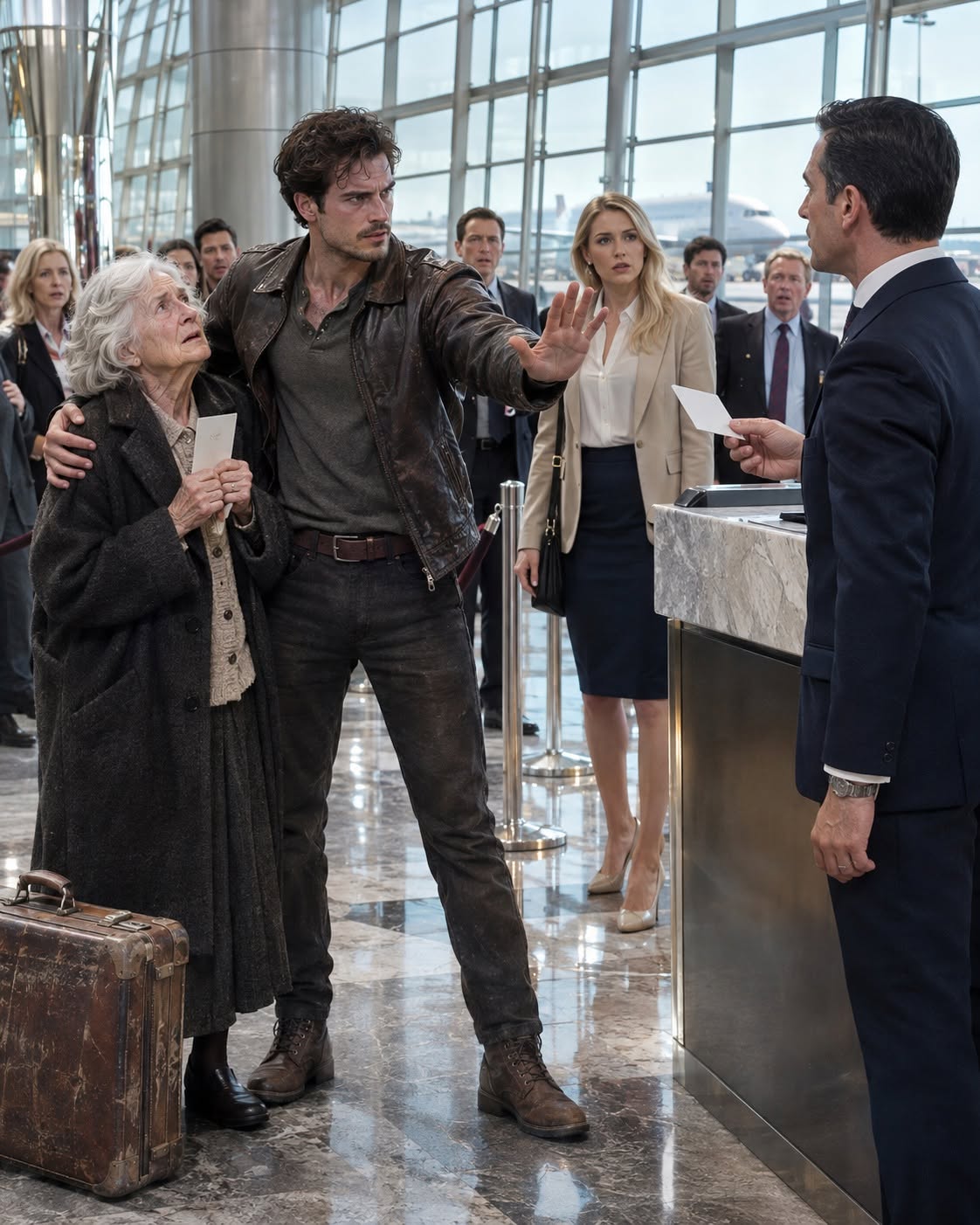
“Ma’am, you clearly don’t belong in this line. Step aside before I call security.”
Margaret opened the folder.
At first, I expected to see a collection of complaint letters, perhaps a few printed emails or photographs. But as she placed the documents on the counter, I realized this was something much bigger.
There were passenger statements, photographs, internal reports, copies of emails, and handwritten notes organized by date.
The supervisor leaned forward.
“Ma’am, what exactly are we looking at?”
Margaret looked at him without blinking.
“Evidence.”
The single word seemed to drain the color from his face.
She pulled out the first document.
“Three months ago, an elderly man traveling alone was denied access to the priority boarding lane. His ticket was valid, but your employee told him he looked like someone who had purchased a fraudulent ticket. He missed his flight.”
She placed another paper on top.
“Six weeks ago, a woman recovering from cancer was asked to prove she was entitled to use priority assistance. She was forced to explain her medical situation in front of strangers.”
Another document followed.
“A veteran traveling with his wife was publicly accused of trying to steal a seat upgrade. His wife recorded the incident because nobody believed him.”
The supervisor swallowed.
“These matters were investigated internally.”
Margaret tilted her head.
“Were they?”
She opened a separate envelope and removed a printed email.
“Because I have copies of the internal investigation reports. In three of these cases, the complaints were closed without speaking to the passengers. In two others, the employees involved received no disciplinary action whatsoever.”
The supervisor glanced toward the gate employee.
The young man who had humiliated her was now standing completely still.
“Ma’am,” the supervisor began, “I understand that you’re upset, but there may be some misunderstanding about the information you’ve received.”
Margaret gave a faint, humorless smile.
“That’s an interesting choice of words. When ordinary passengers complain, you call their experiences misunderstandings. When someone with money and influence complains, suddenly everybody wants to investigate.”
Nobody answered.
I looked at Emily.
Her expression had changed. She was no longer checking the departure board or worrying about our flight. She was listening to every word.
Margaret turned another page.
“Do you know why I started collecting these complaints?”
The supervisor shook his head.
“Because five months ago, a little girl named Sophie wrote me a letter.”
Margaret reached into the folder and removed a small, folded piece of paper.
It was decorated with uneven purple hearts and a drawing of an airplane.
“She was nine years old. She and her mother were flying to another state to attend her grandmother’s funeral. Her mother had purchased two first-class tickets using money she’d saved for years. At the gate, an employee questioned whether the tickets were genuine because the mother was wearing work clothes.”
Margaret paused.
“The mother was a hotel housekeeper. She had come straight from work.”
She unfolded the letter.
“Sophie wrote that her mother cried in the airport bathroom because she thought everybody was laughing at them.”
The terminal had become unusually quiet.
Margaret continued.
“She said, ‘My mommy works very hard, and she deserves to sit wherever she paid to sit. Please tell people not to be mean to her.’”
Margaret gently folded the letter again.
“I have read that sentence more times than I can count.”
For the first time, her voice trembled.
“I built my company from almost nothing. My father worked in a factory. My mother cleaned offices at night. There were years when we couldn’t afford a vacation, let alone a plane ticket. I remember exactly what it feels like when people decide your worth before they know your name.”
She looked at the employee.
“Today, you made the same mistake.”
The employee lowered his head.
“I’m sorry, ma’am.”
Margaret didn’t respond immediately.
Instead, she looked toward me.
“Sir, may I ask you something?”
“Of course.”
“Why did you step forward when everyone else remained silent?”
I glanced at Emily, then back at her.
“Because I imagined someone treating my mother that way. I wouldn’t have wanted her to stand there alone.”
Margaret nodded slowly.
“That’s a good answer. But I hope you’ll remember something. People shouldn’t need to imagine their own mother in someone else’s position before deciding to show kindness.”
Her words stayed with me.
Then she turned toward the supervisor.
“I want you to call your regional director. Now.”
The supervisor hesitated.
“Ma’am, the regional director is not scheduled to be on-site today.”
“Then he can answer his phone.”
He stepped aside and made the call.
While we waited, the gate employee approached Margaret.
He looked younger than I had first noticed. Perhaps twenty-five. His hands were shaking.
“Ma’am, I know an apology doesn’t fix what happened, but I really am sorry.”
Margaret studied him.
“What made you think I didn’t belong in that line?”
He looked down.
“I was trying to move people through quickly. I saw your clothes, and I assumed—”
“Assumed what?”
He struggled to find the words.
“That you couldn’t have purchased a first-class ticket.”
Margaret nodded.
“Thank you for being honest. Now tell me something else. If my boarding pass had shown economy, would that have made it acceptable to humiliate me?”
“No, ma’am.”
“Would you have spoken to me that way if I were wearing an expensive suit?”
He didn’t answer.
Margaret’s expression softened slightly, but her voice remained firm.
“That’s the problem. Respect should never be something people have to purchase.”
The supervisor returned with his phone.
“The regional director is on the line.”
Margaret took the phone.
“Good morning, Richard. This is Margaret Whitmore.”
A pause followed.
“Yes. I’m at Gate 42.”
Another pause.
“No, Richard. I’m not calling to discuss my investment portfolio.”
She glanced at the folder.
“I’m calling because your company has a serious problem, and I believe you’ve known about it for some time.”
She listened.
Then her face hardened.
“I’m going to send you the records. I want an independent review, not an internal report written by the same people who ignored these complaints.”
She ended the call and handed the phone back.
The supervisor looked increasingly uncomfortable.
“What happens now?” he asked.
Margaret closed the folder.
“Now, we stop pretending this is one employee having a bad morning.”
She turned toward the surrounding passengers.
“Before anyone boards, I want to ask a question. How many of you have ever been treated differently because of your clothes, your age, your accent, or the way you look?”
At first, nobody moved.
Then a middle-aged man near the windows raised his hand.
A woman holding a toddler followed.
Then an older couple.
Within seconds, more than a dozen people had stepped forward.
One woman explained that she had been repeatedly questioned about her business-class ticket because she traveled wearing a religious head covering.
A young man said an employee had once accused him of being in the wrong boarding group simply because he had a backpack instead of a suitcase.
An elderly passenger quietly described being left behind when he couldn’t walk quickly enough through the priority lane.
The stories kept coming.
The supervisor looked around as though he had suddenly discovered an entirely different airport.
Emily leaned toward me.
“Dad, I had no idea this happened so often.”
I nodded.
“Most people don’t. Not until they stop looking away.”
A few minutes later, a man in a dark navy suit hurried toward us.
He introduced himself as Richard Cole, the airline’s regional director.
He shook Margaret’s hand with both of his.
“Ms. Whitmore, I sincerely apologize. I assure you this situation will be handled immediately.”
Margaret looked at him.
“I hope so. But I don’t want another apology that disappears as soon as I leave.”
Richard glanced at the folder.
“Of course. We’ll conduct a full investigation.”
“Not just into this gate.”
“Yes, ma’am.”
“Not just into this airport.”
He hesitated.
“Understood.”
“I want a review of every major terminal where your company operates. I want passengers interviewed independently. I want employees trained to recognize their own assumptions. And I want a system that allows people to report mistreatment without fearing retaliation.”
Richard nodded repeatedly.
“We can make that happen.”
Margaret studied him.
“Can you?”
The question was quiet, but it carried more weight than a shout.
Richard stopped nodding.
“Yes,” he said finally. “We can.”
Then something unexpected happened.
The employee who had insulted Margaret stepped forward again.
“Sir,” he said to Richard, “I need to tell you something.”
Richard looked irritated.
“Not now, Daniel.”
“It matters.”
Margaret raised a hand.
“Let him speak.”
Daniel took a deep breath.
“Three weeks ago, I reported that our gate team was being instructed to keep certain passengers out of the priority line unless they looked like frequent flyers or business travelers.”
Richard’s face changed.
“What?”
Daniel continued.
“Our supervisor told us that passengers who looked out of place slowed down boarding and made premium customers uncomfortable. He said we should use our judgment before scanning tickets.”
The supervisor immediately interrupted.
“That is completely false.”
Daniel looked at him.
“You said it during the morning briefing. You said we needed to protect the image of the airline.”
Richard turned toward the supervisor.
“Did you give those instructions?”
The supervisor shook his head.
“No. He’s misunderstanding what I said.”
Daniel reached into his pocket.
“I kept a copy of the briefing notes.”
He handed Richard a small notebook.
Margaret’s eyes narrowed.
“Is that true?”
Daniel nodded.
“I didn’t know what to do. I needed this job. I have a young son, and I’m supporting my mother. I thought if I complained again, I’d be fired.”
Richard examined the notebook.
The supervisor’s face had turned pale.
For a moment, nobody spoke.
Then Margaret said something I hadn’t expected.
“Daniel, I appreciate that you came forward. But I also want you to understand that following an unfair instruction doesn’t make the harm disappear.”
“I know,” he whispered.
“You had a responsibility to question it. You chose not to until today.”
He nodded, tears gathering in his eyes.
“I did. And I’m ashamed.”
Margaret looked at him for a long moment.
“Then let this be the day you start doing better.”
Richard called security, not to remove Margaret or Daniel, but to preserve the records and begin a formal investigation.
The supervisor was placed on administrative leave pending review.
Daniel was also temporarily removed from gate duties, but Margaret insisted that his cooperation be protected and that his actions be assessed fairly.
She refused to let the airline turn the situation into a simple story of one villain and one hero.
“Accountability is not revenge,” she told Richard. “It is making sure people understand what they did and preventing it from happening again.”
Eventually, the boarding announcement sounded.
Our flight was delayed by twenty minutes while the airline arranged additional staff.
Margaret looked at her boarding pass.
“Looks like we should finally get going.”
She smiled at me.
“Thank you again for speaking up.”
I shook my head.
“You were the one who did the hard part.”
“Perhaps,” she replied. “But sometimes one person speaking up gives another person permission to do the same.”
She turned toward Emily.
“And you, young lady, remember that silence is a choice, too.”
Emily looked embarrassed.
“Yes, ma’am. I will.”
Margaret boarded before us.
As she walked down the jet bridge, I noticed that she was still carrying the same small handbag and wearing the same worn shoes.
Nothing about her appearance had changed.
But the way people looked at her had.
And that bothered me more than I could explain.
On the flight, Emily sat beside the window, unusually quiet.
After nearly an hour, she finally spoke.
“Dad, can I ask you something?”
“Sure.”
“Would you have stood up for her if you hadn’t found out she was a billionaire?”
I turned toward my daughter.
The question caught me off guard.
“Why do you ask?”
“Because everyone suddenly respected her after they learned who she was. The employee was sorry. The supervisor became polite. The regional director practically bowed.”
She looked down at her hands.
“But before that, she was just an old woman to them.”
I considered her question.
“That’s exactly why I stood up. She shouldn’t have needed to be anyone important.”
Emily nodded slowly.
“I was afraid people would think we were causing trouble.”
“Sometimes doing the right thing makes people uncomfortable. That doesn’t automatically mean you’re doing the wrong thing.”
She looked out the window.
“I think I was embarrassed.”
“By me?”
“By the situation. I didn’t want strangers looking at us. I wanted everything to go smoothly.”
I smiled sadly.
“There’s nothing wrong with wanting a peaceful day. But there’s a difference between avoiding an argument and ignoring someone who needs help.”
Emily was silent for a while.
Then she said something that surprised me.
“When I get to my meeting tomorrow, I’m going to remember this.”
I raised an eyebrow.
“What does your meeting have to do with it?”
She hesitated.
“I’m interviewing candidates for a senior management position. One of the applicants has been with our company for twenty years. He’s older, doesn’t have a fancy degree, and doesn’t present himself very well. I was already leaning toward someone younger because he seemed more polished.”
I looked at her.
“Does the older candidate have the qualifications?”
“Actually, he has more experience than the other applicant.”
“Then perhaps you should look at what he can do instead of how he looks.”
She smiled.
“That’s what I was thinking.”
I leaned back in my seat.
For the first time that day, I felt that something meaningful had happened beyond the airport terminal.
But Margaret’s folder had one more surprise waiting.
Two weeks later, the airline announced that it had launched an independent investigation into passenger discrimination and inappropriate gate procedures.
The announcement included a commitment to publish the findings and establish a new passenger treatment policy.
A journalist contacted Margaret, hoping to interview her about the incident.
She agreed, but with one condition.
She would not discuss her wealth.
She wanted the interview to focus on ordinary passengers and the stories that had been ignored.
The resulting article went viral.
It was titled:
“THE WOMAN THEY THOUGHT COULDN’T AFFORD FIRST CLASS.”
Millions of people read it.
But what happened next was even more powerful.
Passengers began sending their own stories.
Some were heartbreaking.
Some were infuriating.
Others described moments when an employee had quietly stepped in to help them.
One letter came from a retired teacher named Helen.
She wrote that she had been traveling to visit her dying sister when a gate employee had helped her through a crowded terminal, carried her bag, and refused to accept a tip.
She had never learned his name.
Margaret arranged for the airline to recognize him.
Another letter came from Sophie, the nine-year-old girl whose original message had inspired Margaret’s investigation.
Her mother had kept the letter Margaret sent in response.
Sophie now wanted to know if the airline had changed anything.
Margaret personally wrote back.
She told Sophie that change was beginning, but it would take time, courage, and people willing to speak up.
She also included a photograph of herself standing beside the little girl’s original letter.
At the bottom, she wrote:
“Your words helped more people than you will ever know.”
Three months after the airport incident, the airline released its investigation findings.
The results were worse than anyone expected.
The problem was not limited to one airport or one supervisor.
Several terminals had informal practices that encouraged employees to judge passengers by their appearance.
Some managers had even tracked boarding efficiency using standards that rewarded staff for moving certain groups of passengers faster than others.
The airline admitted that its previous complaint process had failed many customers.
Several managers were dismissed, others were disciplined, and the company introduced mandatory training and a new independent review system.
Passengers could now report mistreatment through a confidential channel.
More importantly, the airline began measuring employee performance not only by boarding speed but also by passenger feedback and respectful service.
Daniel, the gate employee, was eventually reinstated after completing additional training and cooperating fully with the investigation.
He received a written warning for his treatment of Margaret and was required to participate in a customer care program.
He also volunteered to help train new employees.
I heard about him again when Margaret sent me a handwritten note.
It included a small photograph of a training session.
Daniel was standing in front of a group of new employees, holding a boarding pass.
On a whiteboard behind him were six simple words:
“CHECK THE TICKET. NOT THE PERSON.”
Margaret had written beneath the photograph:
“Sometimes the people who make mistakes can become part of the solution, provided they accept responsibility.”
I kept that note.
Not because it came from a billionaire, but because it reminded me that real change requires more than punishing someone.
It requires people willing to confront the behavior, correct the system, and make sure the same harm doesn’t happen to someone else.
A month later, Emily called me.
Her voice sounded excited.
“Dad, remember that candidate I told you about?”
“The older gentleman?”
“Yes. I hired him.”
I smiled.
“Congratulations.”
“He turned out to be the strongest candidate. He even suggested a way to improve our entire department’s workflow.”
“Sounds like you made the right decision.”
She laughed.
“I almost didn’t. I was so focused on how impressive the other applicant looked that I nearly overlooked someone who had actually done the work.”
She paused.
“Do you know what he said when I offered him the position?”
“What?”
“He told me that after twenty years in the industry, this was the first time someone had asked him what he could contribute instead of why he didn’t have a certain degree.”
I felt a warmth in my chest.
“I’m proud of you, sweetheart.”
“I’m proud of you, too, Dad.”
“For what?”
“For being willing to look foolish in front of strangers.”
I laughed.
“I wasn’t trying to look foolish.”
“I know. That’s what made it important.”
Several months passed.
Then, on an ordinary Tuesday morning, I received an unexpected phone call.
It was Margaret.
“Good morning,” she said. “I hope I’m not interrupting anything.”
“Not at all. How are you?”
“I’m well. I’m calling because I’d like to invite you and Emily to something.”
She explained that the airline was opening a passenger advocacy office at its main headquarters.
The office would review complaints, monitor patterns of unfair treatment, and give passengers a direct voice in company decisions.
She wanted ordinary travelers to participate in its advisory council.
“I’d like you to join,” she said.
I was surprised.
“Margaret, I’m not an expert in aviation.”
“Neither was I when I first started asking questions. What I need is someone who remembers what it feels like to stand in a crowded terminal and wonder whether anyone will help.”
I accepted.
Emily joined as well.
At the first meeting, I met passengers from different backgrounds.
There was a nurse who traveled frequently to care for her father, a construction worker who had once been denied assistance, a university student who had witnessed discrimination, and a retired military officer who had been ignored while requesting wheelchair support for his wife.
Their experiences were different, but their message was the same.
They wanted to be treated like human beings.
During the meeting, Margaret made an announcement.
She was donating a significant portion of her annual shareholder dividends to fund an independent passenger assistance program.
The money would support staff training, accessibility improvements, and emergency assistance for travelers who needed help.
Richard Cole, the regional director, was present.
He stood and thanked her.
“Your leadership has given this company an opportunity to rebuild its reputation.”
Margaret shook her head.
“Don’t thank me for spending money. Thank the passengers who trusted us enough to tell us the truth.”
Then she looked around the room.
“And remember, a company doesn’t prove its values with what it prints on a poster. It proves them through the way its employees treat people when nobody important is watching.”
Those words became the foundation of the new program.
But the moment I remember most happened after the meeting.
A young woman approached Margaret carrying a small envelope.
She was wearing a hotel uniform.
Her name was Sophie.
The little girl from the letter had grown older, but I recognized her immediately from the photograph Margaret had shown me.
She was now a teenager.
Her mother stood beside her, looking nervous.
“Ms. Whitmore,” Sophie said, “I wanted to give you something.”
Margaret opened the envelope.
Inside was a new letter.
This time, the handwriting was more confident.
Sophie had written about her dream of working in aviation one day. She wanted to help create airports where elderly people, children, and families who couldn’t afford expensive services never felt unwelcome.
At the bottom, she had written:
“I used to think people with important jobs were the ones who could change things. Now I think ordinary people can change things, too, if they don’t stay quiet.”
Margaret read the sentence twice.
Then she looked at Sophie.
“Would you like to help us?”
Sophie’s eyes widened.
“Really?”
“Really. We have a youth advisory project starting next month. We need people who remember why this work matters.”
Sophie’s mother covered her mouth.
The girl began to cry.
Margaret gently hugged her.
I stood a few feet away, watching the scene unfold.
It struck me that everything had begun with a simple misunderstanding at Gate 42.
An elderly woman had been judged by her clothes.
A man had decided to speak up.
A daughter had learned that silence could hurt someone.
And a little girl who had once written a letter had found a way to turn her disappointment into something meaningful.
Before we left, Margaret approached me.
“Do you remember what you said that morning?”
I smiled.
“Which part?”
“You said everyone was watching, but nobody was helping.”
I nodded.
“I remember.”
She looked toward the young passengers and employees gathering around Sophie.
“Today, more people are helping.”
We stood quietly for a moment.
Then Margaret reached into her handbag and handed me something.
It was a small silver pin shaped like an airplane.
“I want you to have this.”
“What’s it for?”
“A reminder.”
“Of what?”
She smiled.
“That you never know who needs someone to speak up for them. And you never know how far one small act of courage might travel.”
I accepted the pin.
On our way home, Emily asked if I planned to wear it.
“Of course,” I said.
She smiled.
“Even if people think it looks strange?”
I laughed.
“Especially then.”
She shook her head affectionately.
We walked toward the parking garage together.
For a moment, I thought about that morning at the airport.
I remembered the worn shoes, the knitted hat, the trembling hands holding a boarding pass.
I remembered the whispers, the laughter, and the uncomfortable silence.
But most of all, I remembered Margaret’s question:
Would you have treated me differently if I weren’t wealthy?
I still don’t have a perfect answer for why people behave the way they do.
Some are careless.
Some are afraid.
Some have learned to measure human worth using the wrong things.
But I know this much.
A person’s dignity doesn’t depend on their bank account, their clothes, their age, or the seat they occupy on an airplane.
And kindness shouldn’t require proof of importance.
The next time you see someone being humiliated, ignored, or treated as though they don’t belong, remember that you don’t need to be powerful to make a difference.
You don’t need a title.
You don’t need money.
You don’t need an audience cheering you on.
Sometimes all you need is the courage to say:
“Please check the facts before you judge this person.”
Because the greatest test of someone’s character isn’t how respectfully they treat a billionaire.
It’s how they treat the person they believe has nothing to offer them.