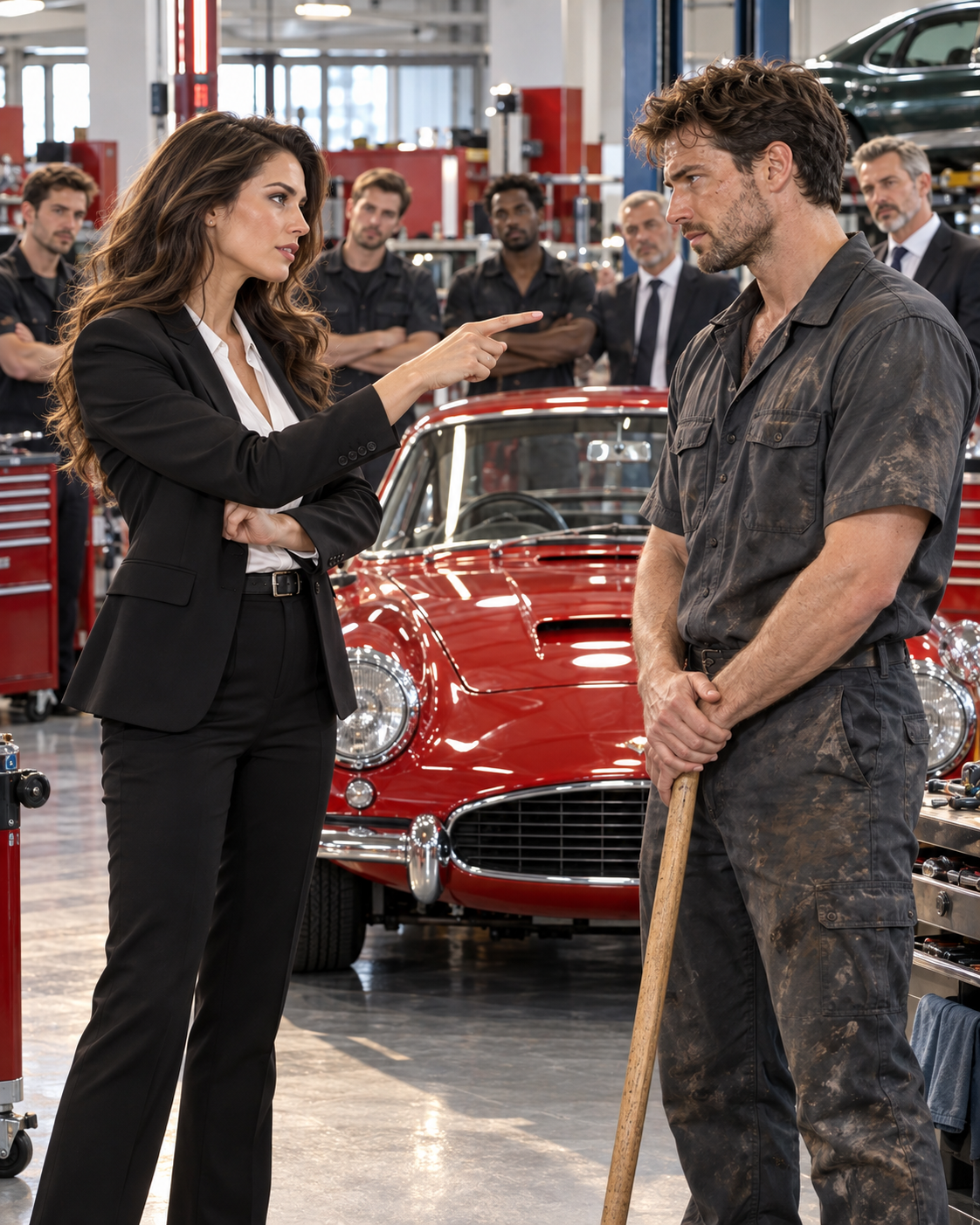
In front of seventeen world-class specialists, I pointed at a humble janitor and gave him forty-eight hours to fix my dead father’s $2 million Ferrari
For several seconds, nobody moved.
The Ferrari idled beneath the workshop lights, its twelve cylinders producing a deep, uneven growl that seemed to vibrate through the soles of my shoes.
I had imagined this moment so many times that I had forgotten what it might actually feel like.
In my fantasies, I had thrown my arms around the nearest technician, called my father’s old friends, and celebrated the resurrection of a machine that had become the center of my life.
Instead, I stood beside the workbench, staring at a photograph of a man I had never heard of and wondering what else my father had kept from me.
“Turn it off, please,” Isaac said.
Adrian reached for the ignition, but Isaac stopped him.
“Not yet. Let it settle naturally.”
He listened to the engine for another minute, then nodded toward Adrian.
Only when the V12 had fallen silent did Isaac step away from the car.
Cameron was the first to speak.
“I need to see exactly what you changed.”
Isaac wiped his hands.
“You can inspect it.”
“I mean the mechanism.”
“I know what you mean.”
Cameron looked embarrassed by the calmness of the answer.
For five years, he had been the person in the room whose opinion carried the most weight, and now a maintenance contractor had accomplished what an international team of specialists could not.
But the engine was running, and pride could not make it silent again.
I picked up the photograph.
“Isaac, you said my father left another man behind. Who was Daniel?”
He hesitated.
“Daniel Mercer was a mechanic and racing engineer. He was also your father’s closest friend.”
“Why have I never heard of him?”
“Because their friendship ended badly.”
“How badly?”
Isaac looked toward the Ferrari.
“Badly enough that your father spent the rest of his life pretending the man had never existed.”
I felt an old ache open inside me.
My father had been a reserved man, a gifted architect who could design a building from a blank sheet of paper but struggled to explain why he sometimes woke in the middle of the night and stood alone in the kitchen.
When I was a child, I had assumed his silences were simply part of being an adult.
After his death, I discovered how much of his life had been built around things he refused to discuss.
I had thought the Ferrari was the final piece of that puzzle.
Now it seemed to be another locked door.
“Tell me everything you know,” I said.
Isaac glanced at Adrian, then at Cameron.
“I would rather tell you privately.”
Cameron stiffened.
“Why?”
“Because I don’t know which parts of this story your company has already heard.”
The remark landed with unexpected force.
I looked at him.
“Are you accusing someone here of hiding something?”
“No,” Isaac replied. “I’m saying I learned a long time ago that a room full of experts isn’t necessarily a room full of people who know the whole story.”
I asked Adrian and Cameron to leave us.
Cameron opened his mouth to object, but Adrian touched his shoulder.
“Come on,” he said. “The car can wait.”
When the doors closed, Isaac sat down beside the workbench.
He looked suddenly older, not because of his age but because of the memory he was preparing to carry into the room.
“My father repaired machinery in a small garage outside Detroit,” he began. “I grew up sweeping floors, sorting bolts, and listening to engines before I understood what half the parts were called.”
He explained that his father had known Daniel Mercer through the American amateur racing circuit of the early 1960s.
Daniel was a brilliant engineer with a gift for understanding how mechanical systems behaved under stress.
My father, then a young architectural draftsman with an obsession for racing cars, had become fascinated by the way Daniel approached engineering.
Where other men chased more horsepower, Daniel wanted to know why a machine behaved the way it did.
He believed that every mechanism carried the history of the person who built it.
Sometimes, that history was obvious.
Sometimes, it was hidden in a worn bearing, a handmade linkage, or a tiny change in resistance that no replacement part could reproduce.
“My father taught me that you should never call something broken until you understand what it was designed to do,” Isaac said.
I looked at the photograph again.
“And my father?”
“He learned the same lesson.”
Isaac explained that Richard Bennett and Daniel Mercer had spent several years working on experimental racing modifications, including mechanical safeguards that prevented certain systems from activating unless the operator followed a deliberate sequence.
The idea was not magic or advanced technology.
It was craftsmanship: a carefully designed relationship between components that could be understood only by someone who knew how they had been fitted together.
The mechanism in my Ferrari had been custom-built by my father and Daniel.
It had been designed to preserve a particular configuration and prevent careless interference with it.
Over the decades, the original system had been mistaken for an undocumented fault.
Restoration specialists had replaced components, traced the obvious circuits, and tested the engine’s mechanical condition, but nobody had questioned the assumption that the car should start like any other Ferrari.
They had been trying to solve a problem that did not exist.
“Why would my father make it so complicated?” I asked.
Isaac rubbed his thumb across a scar on his left hand.
“Because the car meant more to him than speed.”
He told me that in 1963, Daniel had been preparing a prototype for a private endurance event.
The car had developed a dangerous failure during testing, and Daniel had blamed Richard for approving a modification without adequate verification.
Richard believed Daniel had ignored a warning he had given him.
Neither man could prove his version of events, and their argument became so bitter that they stopped working together.
Then Daniel disappeared from the racing circuit.
Some people said he had gone overseas.
Others claimed he had suffered an accident.
My father never explained what happened.
“But you knew him,” I said.
Isaac nodded.
“I met him years later, when I was working at a restoration shop. He was older and no longer racing, but he could still hear a problem in an engine before anyone else noticed it.”
“Did he tell you about my father?”
“He asked whether Richard was still building things.”
I swallowed.
“What did you say?”
“I told him your father had become an architect and that he had a daughter.”
Isaac’s expression softened.
“He smiled when I mentioned you.”
That small detail hurt more than I expected.
I had spent years believing my father’s life was a closed book, and now a stranger was telling me that someone I had never met had remembered me.
“What happened to Daniel?”
Isaac looked away.
“He died eight years ago.”
The workshop seemed colder.
“Then why did you say my father left another man behind?”
“Because your father left Daniel behind long before Daniel died.”
Isaac reached into his pocket and produced a small envelope, yellowed at the edges.
“I found this among some papers when the garage where I worked closed. Daniel asked me to keep it until I found someone who would understand why it mattered.”
He placed it on the table.
My name was written across the front in my father’s unmistakable handwriting.
Not my full name, just Emily.
I stared at it.
“How long have you had this?”
“Almost twelve years.”
“Why didn’t you contact me?”
“I tried.”
He explained that he had sent a letter to my father’s architectural firm, but it was returned unopened after the company relocated.
Later, he learned that Richard had retired from active work and was living quietly outside the city.
By the time Isaac found the courage to approach him, my father had been diagnosed with a serious illness.
“I thought giving him the letter would force him to confront something he wasn’t ready to face,” Isaac said. “I made the wrong choice.”
I studied him.
“You could have tried again.”
“Yes.”
“You could have told me.”
“Yes.”
His willingness to accept blame made my anger harder to hold.
“I can’t change that now,” he added. “But I can tell you what I know.”
I opened the envelope.
Inside was a short letter, written on thick cream paper.
My father’s handwriting was neat at first, then increasingly uneven toward the bottom.
Emily,
If you are reading this, then someone has finally listened to the car instead of trying to overpower it.
I owe you an explanation for the years I spent treating silence as though it were the same thing as peace.
When I was young, I believed that being right was more important than being kind. Daniel believed that being honest was more important than being right. We both thought the other man was the problem.
We built things together that neither of us could have built alone, but when we made a mistake, I chose to protect my pride instead of protecting our friendship.
I told myself that time would settle the matter. It didn’t. Time simply made the silence easier to maintain.
The Ferrari was meant to remind me of the work we did together. Eventually, it became a reminder of everything I refused to repair.
I left you the car because I hoped you would be more patient with it than I had been with myself.
If it never runs, do not let its silence convince you that it has nothing left to give.
If it does run, remember that making something work is not the same as making things right.
I love you more than I ever managed to say.
Dad.
I read the letter twice.
The second time, I had to stop halfway through.
For years, I had resented my father for leaving me so little explanation of himself.
Now I was holding proof that he had understood exactly what his silence had cost him.
It did not erase the hurt.
It made the hurt more human.
I folded the letter carefully.
“Why did you wait until now to show me this?”
Isaac looked at the Ferrari.
“Because I thought the car had to run first.”
“Why?”
“Because Daniel once told me that Richard would only be ready to face the past when he stopped trying to force the machine to behave like something it wasn’t.”
He gave a faint, sad smile.
“I don’t know whether he was right. I only know that I should have tried harder to find you.”
The following morning, I returned to Meridian Motor Works with the letter in my bag.
The Ferrari had been moved into a quieter bay, where Adrian was checking the engine under supervision.
Cameron stood beside him, holding a diagnostic report.
When he saw me, he put it down.
“I owe you an apology,” he said.
I waited.
“I dismissed Isaac because I assumed his job told me what he was capable of. I also dismissed your attachment to the car as sentimentality.”
He looked genuinely uncomfortable.
“I was wrong about both.”
I studied him for a moment.
“Do you know what bothered me most about what you said?”
He shook his head.
“You weren’t wrong that the project had become expensive. You were wrong to believe that the money gave you the right to decide what mattered to me.”
Cameron nodded.
“I understand.”
“I hope you do.”
Adrian approached us, holding a small component removed during the earlier restoration.
“We found something else,” he said.
He showed me a section of metal with a hand-engraved mark hidden beneath an old mounting plate.
Two initials were cut into it: R.B. and D.M.
Below them was a date from 1963.
The mark had been covered during an earlier repair and never documented.
“Your father and Daniel signed their work,” Adrian said. “Not for recognition. Just so that someone would know who had made it.”
I ran my finger close to the engraving without touching it.
For the first time, the Ferrari felt less like an expensive object and more like a conversation between two men who had once trusted each other completely.
And I had inherited the unfinished part.
Over the next few weeks, I made a decision that surprised everyone at the firm.
I stopped authorizing cosmetic work.
Instead, I asked Adrian to document every original component, every handmade fitting, and every mark that had survived the decades.
I hired an archivist to research the car’s racing history and invited Isaac to help interpret the mechanical details.
Cameron offered to oversee the restoration records, this time working directly with Isaac rather than treating him as someone beneath his attention.
At first, the arrangement was awkward.
Cameron had spent years building his professional identity around being the person with the answers.
Isaac had spent years learning that the best answer often began with admitting what you did not know.
They clashed over terminology, documentation, and how much of the old mechanism should be preserved.
But gradually, something changed.
Cameron began asking questions instead of making pronouncements.
Isaac began explaining his reasoning rather than assuming nobody would understand.
One afternoon, I found them leaning over the same workbench, arguing about a worn linkage with the enthusiasm of two men who had forgotten they were supposed to dislike each other.
I smiled before they noticed me.
The car was teaching us all a lesson my father had taken a lifetime to learn.
Expertise was not the same as wisdom, and humility was not the absence of knowledge.
Sometimes, humility was what allowed knowledge to become useful.
Three months later, we held a small gathering at Meridian Motor Works to celebrate the Ferrari’s return to working condition.
I invited the restoration team, a few close friends, and several people who had known my father.
There were no reporters, no extravagant speeches, and no attempt to turn the event into a spectacle.
I wanted the moment to belong to the people who had helped bring it back.
Isaac stood near the rear of the car, wearing the same gray uniform he had worn on the day I first asked him to look at it.
I handed him a small box.
Inside was a framed copy of the 1963 photograph, with the original kept safely in an archive.
Beneath the photograph, I had engraved a line from my father’s letter.
Making something work is not the same as making things right.
Isaac stared at it for a long time.
“You didn’t have to do this,” he said.
“I know.”
He looked up.
“Then why?”
“Because you saw something everyone else had stopped looking for.”
He shook his head.
“Your father built it. Daniel helped him. I only listened.”
“And sometimes listening is the part everyone forgets.”
When the guests had gathered, I climbed into the driver’s seat.
For a moment, my hand rested on the steering wheel, and I imagined my father sitting there decades earlier, younger than I had ever known him, with a friend beside him and a future that still seemed endless.
I followed the sequence Isaac had shown me.
The small mechanical click sounded beneath the dashboard.
I turned the ignition.
The V12 awakened with a deep, confident roar.
People smiled and applauded, but I barely heard them.
I thought about the years my father had spent carrying his regret, the friend he had lost, and the daughter who had mistaken his silence for indifference.
Then I understood why he had left the car to me.
He had not expected me to solve every mystery.
He had hoped I might learn to ask better questions.
After the gathering, I drove the Ferrari a short distance around the private test road beside the workshop.
The autumn air moved through the open window, carrying the scent of leaves and warm metal.
For the first time, the car felt free of the burden I had placed upon it.
It did not need to prove my father had been brilliant.
It did not need to justify the money I had spent.
It did not need to become a monument to grief.
It was simply a machine built by people who had cared deeply about their work, made imperfect by time, and restored by people willing to learn from what remained.
When I returned to the workshop, Isaac was waiting near the door.
“Would you like to keep helping us?” I asked.
He glanced at his mop leaning against the wall.
“I suppose that depends on whether you still need someone to clean the floor.”
I laughed.
“I think we can find something more suitable for you.”
He smiled, but there was sadness in it.
“Don’t give me a title just because you feel grateful, Emily. Give me work that needs doing.”
So I did.
We established a small preservation program at Meridian, focused on documenting original craftsmanship before restoration erased the evidence of how things had been made.
Isaac became its first technical adviser.
Cameron helped develop the inspection standards, and Adrian trained younger restorers to recognize the difference between a damaged part and an unfamiliar design.
We also began offering apprenticeships to people who had practical ability but lacked the credentials that opened doors in our industry.
Some had learned in family garages.
Others had repaired agricultural equipment, maintained industrial machinery, or worked for years in jobs where their skill was invisible to the people who depended on it.
I wanted them to have the chance Isaac had almost never received: the chance to be heard before someone decided what they were worth.
A year after the Ferrari first roared to life, I visited my father’s grave with the original letter folded in my coat pocket.
I told him about the car, about Isaac, and about the way a single hidden mechanism had changed the course of our lives.
I told him that I still wished he had spoken to me more often, that I still missed the ordinary conversations we had postponed, and that forgiveness did not make the lost years disappear.
Then I thanked him for leaving me something that had finally taught me how to listen.
Before I left, I placed a small photograph beside his headstone.
It showed the Ferrari beneath the workshop lights, with Isaac, Adrian, Cameron, and me standing beside it.
On the back, I had written: We got it running, Dad. We’re still learning what you wanted us to hear.
I thought that would be the end of the story.
It wasn’t.
Two weeks later, a registered package arrived at my office from an attorney handling Daniel Mercer’s estate.
Inside was a sealed envelope addressed to Richard Bennett, along with a second photograph of the two men standing beside the Ferrari in 1963.
The attorney’s letter explained that Daniel had left instructions for the envelope to be delivered to my father if the car was ever restored to working condition.
If Richard had already died, it was to be delivered to his daughter.
I opened it with shaking hands.
Daniel’s letter was brief.
He wrote that he had forgiven Richard years earlier, but had never known how to approach him without reopening the argument that had destroyed their friendship.
He had heard that Richard had a daughter and hoped she would inherit not only the car but also the truth.
Then came the sentence that made me sit down.
Richard did not build the sequence lock to keep strangers away from the Ferrari. He built it because I asked him to protect something I could not bring myself to destroy.
Beneath the letter was a small brass key and a handwritten address for a storage facility that had closed decades earlier.
I called Isaac immediately.
When he arrived, he examined the key without touching its teeth.
His face changed.
“I’ve seen one of these before,” he said.
“Where?”
He looked at the photograph, then back at me.
“Daniel kept a second workshop. Your father never mentioned it because he promised Daniel he would never reveal its location.”
I looked down at the address.
“What was inside?”
Isaac shook his head.
“I don’t know. But if Daniel left this key for you, he believed whatever was there still mattered.”
For several minutes, we stood in silence.
The Ferrari was running.
My father’s letter had been read.
His old friend had finally been heard.
I had thought the mystery was over because the engine had started.
Now I understood that the engine had only opened the first door.
I slipped the brass key into my pocket and looked toward the workshop, where the Ferrari rested beneath its white lights.
For the first time, I was not afraid of what the past might reveal.
I was afraid of how much of my father I had yet to discover.
And somewhere, behind a door that had remained locked for more than sixty years, another part of his story was waiting for someone patient enough to listen.