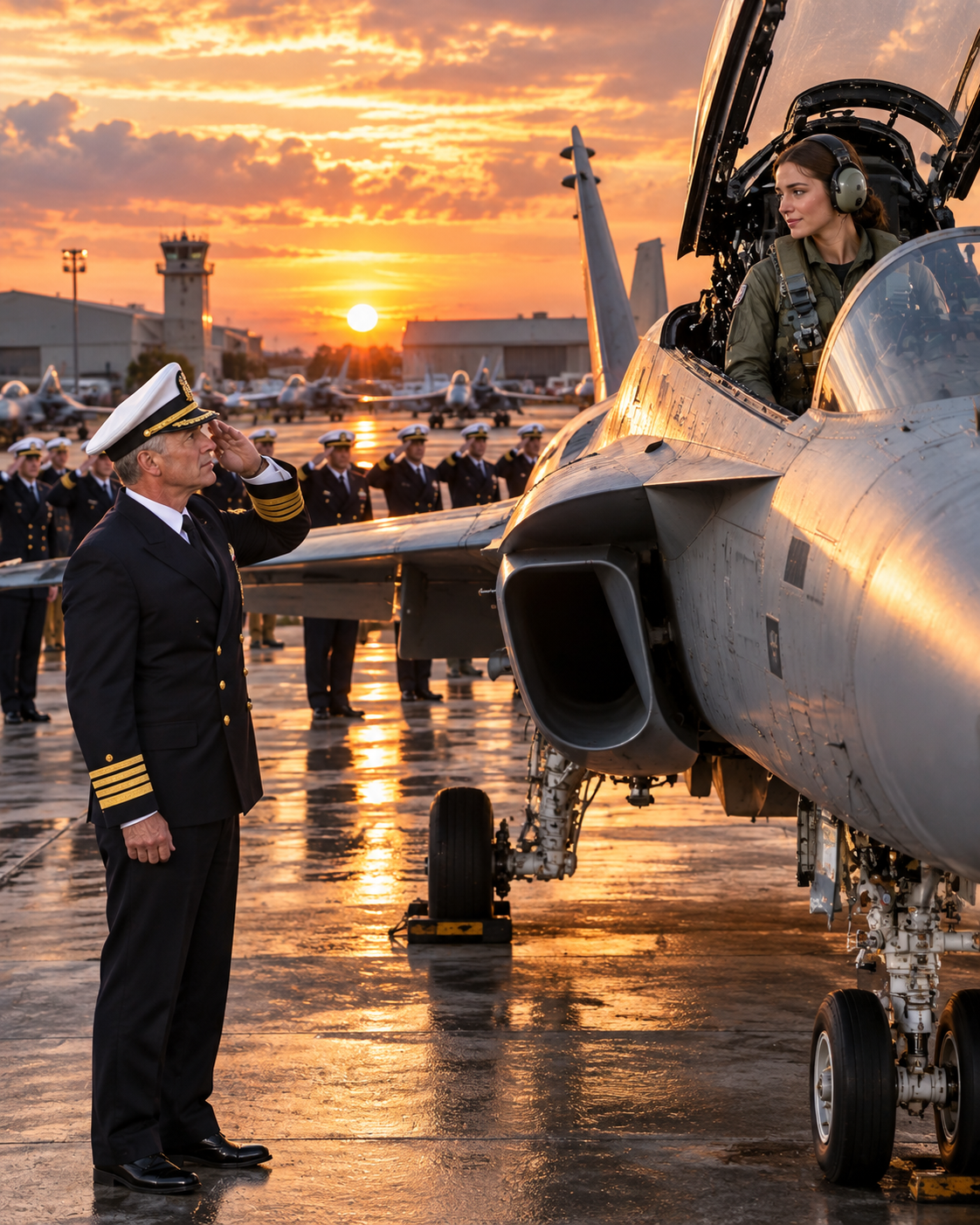
In front of hundreds of military personnel on the active tarmac at Naval Air Station Fallon, Admiral Arthur Vance mocked me
For several seconds, I couldn’t hear anything except the blood rushing through my ears.
The envelope felt impossibly heavy in my hands, although it contained only a few sheets of paper.
I looked at Admiral Vance.
“Who wrote this?”
“I don’t know.”
“You’re telling me you served with my father, you knew his final flight report was questionable, and now someone has sent you a warning with his name on it?”
Vance didn’t flinch.
“I’m telling you that for twenty years, I believed I understood what happened to Daniel Cruz, and now I’m afraid I never did.”
The anger that rose inside me was sharp enough to hurt.
“You had twenty years to tell me something was wrong.”
“Yes.”
“Twenty years.”
“I know.”
He didn’t defend himself, and somehow that made it worse.
I wanted him to blame regulations, classification rules, or a superior who had threatened his career. I wanted a villain whose name I could write down and whose face I could hate.
Instead, I saw an exhausted man standing in front of me, carrying the consequences of a decision he had made long before I was old enough to understand it.
“Why now?” I asked.
“Because someone accessed your father’s archived flight records three days ago, and yesterday, someone tried to access your training file using credentials belonging to a retired naval officer.”
My fingers tightened around the envelope.
“Do you know who?”
“Not yet.”
“Then find out.”
“I intend to.”
I looked toward the runway, where another fighter jet was preparing for departure.
Only hours earlier, I had believed my hardest battle would be learning to fly.
Now I was beginning to understand that the most dangerous thing my father had left me wasn’t his talent.
It was a question somebody had spent twenty years trying to bury.
That night, I sat alone in my quarters and unfolded the papers inside the envelope.
The first was a copy of my father’s final flight evaluation, including handwritten notes in the margins.
The second was a maintenance discrepancy report concerning the aircraft he had flown on the day he died.
The third was a photograph of my father standing beside Admiral Vance and another officer, a tall man with silver hair and a cold, unmistakable stare.
His name was written on the back.
Captain Richard Hale.
I recognized it immediately.
Hale had become a senior defense official after retiring from active duty, and his face occasionally appeared in news reports about military aviation modernization.
He had once been praised for overseeing a program designed to improve aircraft readiness and reduce maintenance delays.
According to my father’s handwritten note, Hale had been the officer responsible for approving the disputed maintenance procedure before the accident.
Beneath his name, my father had written a sentence.
“Never confuse a clean report with a safe aircraft.”
I read it again and again.
My father had always taught me that mistakes happened, even to the most experienced people. What mattered was whether you acknowledged them before they became tragedies.
But the report in front of me contained discrepancies that should have triggered a formal investigation.
A warning had been recorded.
A technician had raised a concern.
The aircraft had been cleared for flight anyway.
And my father had died.
The next morning, I took the documents to Admiral Vance.
He studied them without speaking, his face growing paler with each page.
“Where did you get this?”
“Your envelope.”
He looked up sharply.
“That isn’t possible.”
“What isn’t?”
“The maintenance report in that envelope was never included in the official investigation.”
He turned the page toward the light, examining the handwritten signature.
“I remember this discrepancy. Daniel brought it to me before the flight.”
My stomach tightened.
“What did he say?”
“That the aircraft wasn’t ready.”
“Then why did he fly it?”
Vance closed his eyes briefly.
“Because the aircraft was reassigned, the schedule was under pressure, and the people responsible assured us the issue had been resolved.”
“Did my father believe them?”
“No,” he said. “He believed the paperwork. That was the mistake he never forgave himself for.”
I sat down slowly.
For years, I had imagined my father as fearless, a man who could control anything if he knew enough about it.
Now I wondered how often he had climbed into a cockpit while trusting people he could not see.
“Did he tell you he was worried?”
“Yes. He asked me to delay the flight until the discrepancy could be independently reviewed.”
“Did you?”
Vance stared at the report.
“No.”
The word landed between us like a dropped weapon.
“I was told the problem was administrative, not operational. I accepted assurances from people whose judgment I should have questioned.”
“And when he died?”
“I accepted the investigation’s conclusion.”
I stood up.
“You let them call it an accident.”
“I did.”
My eyes burned.
“My father wasn’t a line in a report.”
“I know.”
“No, Admiral. You know his name. You know what happened to his aircraft. You don’t know what it was like to be sixteen years old and watch people lower his coffin into the ground while everyone insisted there was nothing more to ask.”
He absorbed every word.
Then he reached into his desk and took out a small, worn notebook.
“Daniel gave me this two nights before the flight. I kept it because I couldn’t bring myself to destroy it, and I couldn’t bring myself to read it again.”
He placed it in front of me.
“I should have given it to you years ago.”
I opened the cover.
My father’s handwriting filled the first page.
“Arthur, if anything happens to me, don’t let them turn a preventable failure into a story about fate.”
I pressed my fingers against the paper.
The next pages contained dates, maintenance observations, names, and notes about repeated pressure to approve aircraft that had unresolved discrepancies.
One entry mentioned Captain Hale.
Another mentioned an upcoming readiness inspection.
The final entry was dated the evening before my father’s death.
“Someone changed the status of the fault without completing the required verification. I have asked for an independent review. If they refuse, I will make sure the record survives.”
I looked at Vance.
“Who else knew?”
“Possibly several people. But we need evidence before we accuse anyone.”
For the first time, I understood why my father had taught me to study systems rather than simply memorize procedures.
Systems were made of people.
And people could make mistakes, hide them, or convince themselves that protecting an institution was more important than protecting the lives inside it.
Vance contacted the appropriate investigative authority and requested an independent review of the archived records. He also instructed the security office to preserve access logs and prevent further unauthorized changes.
I was told not to conduct my own investigation, contact suspected individuals, or interfere with evidence.
I agreed.
But agreement didn’t quiet the questions.
Three days later, I received an anonymous message on my military account.
“Your father knew when to stop. You should learn the same lesson.”
I reported it immediately.
The security team traced the message to a temporary account routed through a public network, but they couldn’t identify the sender.
The threat frightened me more than I wanted to admit.
Not because I believed someone would necessarily hurt me, but because the message revealed something chilling.
Someone knew I had found the documents.
Someone was watching the investigation.
And someone believed fear could make me surrender what my father had tried to preserve.
My first instinct was to prove I couldn’t be intimidated.
I asked for extra simulator hours, stayed late reviewing flight systems, and pushed myself through training with a severity that worried my instructors.
When an evaluator told me I was rushing through a checklist, I argued that I knew the procedure.
He looked at me steadily.
“Knowing the procedure isn’t the same as following it.”
The words struck deeper than he could have known.
I left the simulator furious, then returned twenty minutes later to apologize.
He accepted without judgment.
“You’re trying to outrun something,” he said. “Whatever it is, the aircraft doesn’t care. It will punish the mistake, not the reason you made it.”
That evening, I called my mother.
She had spent years avoiding conversations about my father’s final flight, insisting that remembering him should mean remembering the good parts.
When I told her about the notebook, she went silent.
Then I heard her crying softly.
“There was something he gave me before that flight,” she said. “I never told you because I promised him I wouldn’t open it unless someone questioned the official account.”
My heart began pounding.
“What was it?”
“A small memory card. He said it contained copies of documents he couldn’t keep in his official files.”
“Mom, where is it?”
“In the box with his medals.”
I barely slept that night.
The following morning, I drove home between training obligations and found my mother waiting at the kitchen table.
The medal box sat between us.
She lifted the lid and removed a small plastic case from beneath a folded American flag.
“I was afraid that opening it would bring everything back,” she whispered.
I took her hand.
“It never really went away.”
We brought the memory card to the investigators through the proper chain of custody.
They made a forensic copy and began examining its contents.
Most of the files were mundane maintenance records, correspondence, and technical documents. But one folder contained an audio recording dated two days before my father’s death.
My father’s voice came through the speaker, quiet but unmistakable.
“The aircraft is not cleared in my judgment. The fault may be intermittent, but intermittent does not mean harmless.”
Another voice answered.
“Captain, the system shows green. We have a schedule, and the inspection is complete.”
My father’s response was immediate.
“A screen can show green while the underlying problem remains.”
Then came a pause.
The second man spoke again.
“You’re making this bigger than it is.”
“No,” my father said. “I’m trying to keep it from becoming bigger than any of us can manage.”
The recording ended before the second man’s identity was established.
But a separate file contained an email chain in which a maintenance discrepancy had been marked resolved before an independent verification was documented.
The investigators compared timestamps, access records, and signed authorizations.
Several details contradicted the original accident report.
The evidence did not yet prove that anyone had deliberately caused my father’s death, but it raised serious questions about whether the investigation had overlooked or concealed critical failures.
For the first time in twenty years, the official story began to crack.
Then Captain Richard Hale requested a meeting with me.
The request came through official channels, and Admiral Vance advised me not to attend alone or discuss the evidence outside the investigation.
I agreed to meet only if the investigators approved and were present.
Hale arrived in a dark suit, carrying no briefcase.
He looked older than the photographs, but his expression was unchanged.
“Airman Cruz,” he said. “Your father was an exceptional pilot.”
“Then why was his warning ignored?”
His eyes narrowed slightly.
“I understand you’ve found some old paperwork. Old paperwork can be misleading.”
“Can it change the time a fault was marked resolved?”
“Records are complicated.”
“Can it make an aircraft safe when nobody has verified the repair?”
He leaned back.
“You have his stubbornness.”
“And you have his records.”
For the first time, the polished expression slipped.
“Your father believed the entire system could be corrected by refusing to compromise,” Hale said. “He didn’t understand the pressures involved.”
“Was the aircraft safe?”
He paused.
“At the time, I believed it was.”
“Did you verify that yourself?”
“I relied on the reports provided to me.”
“Then why was the report changed before the verification?”
The investigators watched him carefully.
Hale’s jaw tightened.
“I cannot explain every clerical decision made twenty years ago.”
“Did you ask anyone to change it?”
“No.”
His answer came too quickly.
The meeting ended without an admission, but the investigators had what they needed to pursue further interviews and compare his statement against the preserved records.
As Hale left, he stopped beside me.
“You should think about your future, Airman. You have a promising career.”
I met his gaze.
“My future isn’t a bargaining chip.”
He walked away without replying.
That night, I finally understood the difference between courage and recklessness.
Courage wasn’t charging at a powerful man because anger made me feel invincible.
It was telling the truth carefully enough that nobody could dismiss it as emotion, and then allowing evidence to speak even when the process moved slower than my heart could bear.
Weeks passed.
The investigation expanded beyond my father’s accident to examine whether similar maintenance discrepancies had been improperly closed elsewhere.
Some personnel cooperated.
Others denied remembering anything.
A few admitted that they had felt pressured to protect schedules and readiness statistics rather than delay operations for additional inspections.
The evidence suggested a culture in which inconvenient warnings could be treated as obstacles instead of safeguards.
Captain Hale was removed from his advisory duties while the inquiry continued.
He was not publicly declared guilty, and the investigators made no promise that every unanswered question would receive a satisfying answer.
Admiral Vance testified about his own decisions and acknowledged that he had failed to insist on independent verification.
He didn’t ask for sympathy.
He didn’t try to protect his reputation.
When I watched the recording of his testimony, I saw a man finally accepting that responsibility meant more than carrying rank on his shoulders.
Several months after the investigation began, I was summoned to a small briefing room.
My mother sat beside me.
Admiral Vance stood near the window, while the lead investigator placed a folder on the table.
“We have confirmed that the original investigation omitted material maintenance records and failed to resolve discrepancies in the approval timeline,” she said. “Those failures warrant formal corrective action and a reopened review of the accident.”
I gripped my mother’s hand.
“Have you determined whether someone deliberately caused it?”
“Not conclusively. We have evidence of improper record handling and failures in oversight, but we will not claim intent without proof.”
It wasn’t the complete answer I had dreamed of.
It was, however, the first honest answer we had received in twenty years.
The investigator turned another page.
“Your father’s warnings were documented. They were not properly addressed, and his concerns were not fully represented in the original findings.”
My mother began to cry.
I stared at the folder until the words blurred.
For years, strangers had praised my father as a hero while the official report reduced his final flight to an unfortunate accident.
Now the record would show that he had recognized a danger and tried to prevent it.
It would not bring him home.
But it would return something that had been taken from him.
The truth.
After the briefing, Admiral Vance walked with me toward the hangar.
“I owe you an apology,” he said.
“You’ve already given one.”
“Not for the salute. For the years before it.”
I stopped beside the aircraft that had changed my life.
“Why did you salute me that day?”
He looked across the tarmac.
“At first, I thought it would be a harmless joke. Then you accepted the challenge without boasting, and you treated the aircraft with a respect I recognized immediately. When you completed the procedure, I wasn’t saluting a trick or a talent. I was saluting the discipline your father had taught you.”
He swallowed.
“And I was saluting the person I should have listened to twenty years earlier.”
I felt the old anger rise, but it no longer controlled me.
“I can’t forgive what happened just because you finally told the truth.”
“I wouldn’t ask you to.”
“But I don’t want to spend the rest of my life carrying your guilt or mine.”
He nodded slowly.
“That’s more grace than I deserve.”
“No,” I said. “It’s a choice I deserve.”
By then, my training had advanced beyond the first evaluations.
I had learned to manage pressure, accept criticism, and trust my fellow aviators enough to speak up when something felt wrong.
I had also learned that a cockpit was not a place to prove your worth.
It was a place where your decisions could affect every person who depended on you.
On the day I received confirmation that I had passed another major flight evaluation, my mother came to the base carrying my father’s old photograph.
She handed it to me before I left for the flight line.
“Your father would be proud,” she said.
I looked at his smiling face.
“I wish he could see it.”
“Maybe he does, in the way you keep choosing to do things the right way.”
I slipped the photograph into my locker and headed toward the aircraft.
Admiral Vance was waiting near the hangar entrance.
He saluted.
This time, there was no crowd, no joke, and no challenge.
I returned the salute, then turned toward the runway.
The engine started, the instruments settled into their proper indications, and the familiar vibration moved through the airframe.
I checked each item deliberately.
Not because I was afraid of the aircraft, but because I understood how dangerous it was to mistake confidence for certainty.
When the tower cleared me for departure, I advanced the throttle and felt the aircraft gather speed beneath me.
The runway rushed backward.
The nose lifted.
And the ground fell away.
Above the coastline, the world opened into blue distance, and for the first time since my father’s death, I could think about him without hearing the sound of a telephone ringing in the middle of the night.
I imagined telling him about the investigation, about the records, and about the people who had finally admitted that his warnings mattered.
I imagined him correcting my flying technique before allowing himself to smile.
“I understand now,” I whispered.
I understood that his legacy wasn’t simply the ability to operate a powerful machine.
It was the willingness to question an answer that seemed convenient, to respect evidence more than authority, and to remember that every aircraft carried human lives.
When I landed, my mother was waiting behind the safety line.
She held the photograph against her chest as I approached.
I hugged her, and neither of us tried to hide our tears.
That evening, I returned to my quarters and found a message from the investigative team.
The reopened review had uncovered another archived communication connected to the original accident.
It had been sent shortly before my father’s final flight and was addressed to a senior officer whose name had been redacted from the first release.
The message contained a single sentence.
“Daniel Cruz has refused to sign the clearance; proceed only if the authorization is corrected.”
Attached beneath it was a second document bearing a signature that had not appeared in any of the earlier reports.
I stared at the name until my hands began to shake.
It belonged to someone who had continued serving in the Navy long after my father’s death.
Someone whose face I had seen at ceremonies, briefings, and memorials.
Someone who had stood only a few feet away when Admiral Vance saluted me on the tarmac.
I immediately forwarded the message to the investigators and made no attempt to contact the person named in the document.
Then I sat in the quiet room with my father’s photograph beside me, realizing that the truth had not finished unfolding.
For years, I had believed the worst thing that could happen to a family was losing someone they loved.
Now I knew there was another kind of loss: being told to accept a version of that death that protected everyone except the person who was gone.
I had spent my life trying to become worthy of my father’s legacy.
At last, I understood that he had never asked me to be fearless, famous, or perfect.
He had asked me to pay attention.
To question what needed questioning.
To speak when silence would be easier.
And to remember that the most dangerous failures are often the ones everyone agrees to ignore.
I folded the message, placed it beside his photograph, and looked toward the distant runway lights.
Tomorrow, I would fly again.
And when the next question came, I would not turn away from it.
Not because I knew where the truth would lead, but because my father had taught me that the right question could save a life, even when the answer arrived too late to save his.
Somewhere inside the records still waiting to be examined was the name of the person who had helped bury his warning.
I no longer needed to guess.
I only needed to be patient enough to let the evidence speak.
And this time, no one would convince me that silence was the same thing as loyalty.