I watched Lieutenant Colonel Theron Hayes take my A-10 mission away from me in front of the entire Bagram briefing room
I kept the aircraft low and circled away from the ridge, listening to the static in my headset while Spartan 4’s final transmission replayed in my mind.
Someone had changed the coordinates.
That meant the enemy hadn’t simply anticipated our arrival. Someone had given them a reason to expect us.
“Spartan 4, this is airborne support. Repeat your last transmission. Who changed the map?”
Only static answered.
I tried again.
“Spartan 4, identify your source. Do you copy?”
A weak voice came through.
“Captain, this is Sergeant Cole. We’ve got two wounded who can’t move without assistance. We found the original map in a locked office inside the compound. The coordinates don’t match the briefing packet.”
“Where’s your team leader?”
“Trying to keep the western entrance from collapsing. Captain, there’s writing on the back of the map.”
I adjusted my heading, keeping the aircraft clear of the most exposed approach.
“What does it say?”
Cole hesitated.
“It’s a call sign and a time. The time is ten minutes before the first shots were fired.”
My mouth went dry.
“Read me the call sign.”
Another burst of static swallowed his answer.
I tried to raise the team again, but the channel had gone quiet.
Below me, the valley looked almost peaceful from altitude. Sunlight touched the rocky slopes, and dust hung over the compound like smoke from a distant brushfire.
I knew better than to trust appearances.
“Operations, this is Captain. I need the original mission packet, every revision, and the name of the officer who approved the final coordinates.”
The response came from Bagram.
“Understood. General Reed is requesting the same information.”
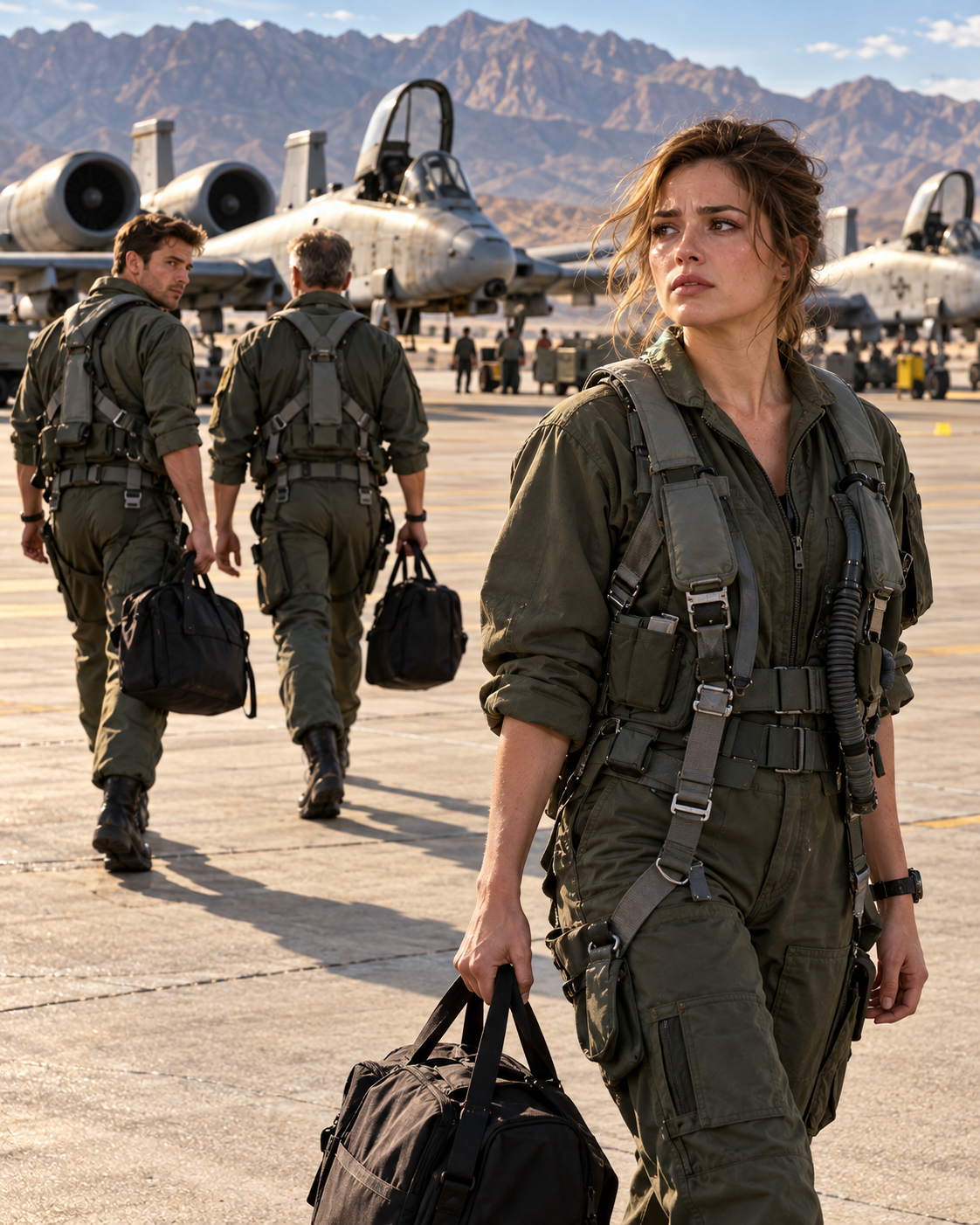
That was the first reassuring thing I’d heard all morning.
I turned back toward the hostile positions, but I didn’t fire immediately. Spartan 4 was still moving, and the last thing I needed was to mistake their position for an enemy target.
I identified a hostile group advancing along a narrow trail and reported their location to the team. When they confirmed they had visual contact, I made another controlled pass to suppress the threat and give them room to move.
The radio came alive with Cole’s voice.
“That helped. We’re moving the wounded now.”
“Keep to the rock wall. Don’t cross the open ground unless your team leader confirms it’s clear.”
“Copy.”
For the next several minutes, my world narrowed to terrain, radio calls, and the small figures moving between patches of shadow.
I wasn’t going to save anyone by letting anger make my decisions.
Then Hayes broke into the channel.
“Captain, I’m south of the valley. I’ve got worsening control response and an engine temperature warning.”
“Maintain your current heading. Rescue personnel are being alerted. Don’t attempt another approach.”
“You need to get me out of here.”
“I’m working the ground threat and coordinating your recovery. Keep your aircraft stable.”
He exhaled sharply.
“Listen, I know you’re angry about the mission. But this isn’t the time to make a point.”
I stared through the canopy at the mountains ahead.
“You think this is about my mission?”
“I think you’ve wanted my job for a long time.”
For a moment, I had no answer.
Then I remembered the folded map beneath his coffee cup, the missing threat assessment, and the way Mitchell had looked at me before climbing into the aircraft.
“Hayes, I don’t care about your job. I care about the men who were sent into that valley with the wrong coordinates.”
He didn’t respond.
I returned my attention to Spartan 4.
The team had reached a small depression near the western wall. Two members were supporting a third between them. Another soldier covered their rear while the team leader moved ahead to check the route.
Then Cole called again.
“Captain, we found something else in that office.”
“What?”
“A radio log. Somebody recorded a transmission before the mission started.”
“Can you read it?”
“Not all of it. The paper’s damaged. But there’s a name at the bottom.”
I waited.
“Hayes.”
The name hung between us.
I felt the muscles in my jaw tighten.
“Are you certain?”
“It’s signed, Captain. Lieutenant Colonel Theron Hayes.”
Before I could ask another question, the team leader took the radio.
“Captain, Sergeant Cole is right. We have a signed copy of a transmission authorization. We don’t know what it means yet, but it appears to have been issued before we entered the valley.”
“Keep the document secure. Don’t transmit any details over an open channel. I’ll arrange for an authorized recovery team to meet you.”
“Understood.”
A fresh call came from Bagram.
“Captain, General Reed wants you to return as soon as the ground team is secure. He says the original coordinates have been located.”
“Who changed them?”
“We don’t know yet.”
I glanced at the fuel indicator.
“Then make sure nobody touches the records until I get back.”
The next stretch of the mission passed in a series of tense, careful exchanges. Spartan 4 continued toward a more defensible position while the support team coordinated their recovery.
I stayed overhead until they confirmed that their wounded were being evacuated and that no immediate threat remained along their route.
Only then did I turn south.
Hayes was already on the ground when I landed back at Bagram. His damaged A-10 had been brought in under emergency procedures, and maintenance personnel were surrounding it.
He stood beside the hangar with his flight helmet tucked beneath one arm.
His face looked gray beneath the dust.
General Reed waited inside the operations building.
“Captain, come with me.”
He led me into a small conference room where the original mission packet lay beside a laptop. Two intelligence officers were reviewing a set of printed logs.
Hayes entered behind us.
Nobody offered him a chair.
General Reed pointed at the map.
“These are the original coordinates. The version issued to the aircrew and the ground team differs by nearly two miles.”
“Who authorized the change?” I asked.
“That’s what we’re determining.”
One of the intelligence officers turned the laptop toward us.
“We recovered the revision history from the mission planning system. The change was entered under Lieutenant Colonel Hayes’ credentials at 0217.”
Hayes stared at the screen.
“That doesn’t prove I entered it.”
“No,” Reed replied. “It proves the change was made using your credentials.”
“I left my terminal unlocked earlier in the morning. Several officers had access.”
“Did you report that?”
Hayes said nothing.
The silence stretched.
I studied the document on the table. The original route crossed the western side of the valley, away from the suspected weapons positions. The revised route brought the aircraft closer to the eastern ridge.
The route I had warned him about.
“Why was the threat assessment missing from the briefing?” I asked.
Hayes looked at me.
“I don’t know.”
“You folded the map over it. You told Mitchell he had everything he needed when the report was still in my hand.”
His eyes flicked toward General Reed.
“I was trying to get the mission moving.”
“Then why change the coordinates?”
“I didn’t change them.”
Reed placed another sheet on the table.
“This is a record of the briefing-room access log. Your credentials were used to approve the route, and your terminal was accessed again twelve minutes later.”
Hayes rubbed his forehead.
“I told you, someone else could have used my account.”
“Then help us establish who.”
For the first time since I’d known him, Hayes looked less angry than exhausted.
He lowered himself into the chair.
“I was under pressure to get Spartan 4 into the compound before the insurgents moved their equipment. Intelligence said the window was closing.”
“That doesn’t explain the route,” Reed said.
“No. It doesn’t.”
The door opened, and a communications officer stepped inside carrying a sealed evidence envelope.
“Sir, the recovered radio log has arrived from the ground team. Spartan 4’s leader confirmed the signature.”
Reed opened the envelope and read the first page.
His expression hardened.
“Lieutenant Colonel, did you authorize a change to the air-support timing?”
Hayes looked up sharply.
“No.”
“Did you tell anyone that Captain’s aircraft would be unavailable?”
“No.”
“Did you know First Lieutenant Mitchell would be assigned to the mission?”
“I approved the roster.”
Reed set down the page.
“Then you will remain here while this investigation proceeds. You are relieved of operational command pending review.”
Hayes opened his mouth, then closed it.
As the general escorted him out, Hayes paused beside me.
“You think you know what happened,” he said quietly. “You don’t.”
“Then tell me what I missed.”
He looked toward the door.
“I can’t tell you what I don’t know.”
He walked away before I could respond.
For the next several hours, the investigation moved through access logs, radio records, and mission revisions. Nothing established that Hayes had deliberately sent Spartan 4 into an ambush, but the evidence showed that he had approved a dangerous route without ensuring the pilots received the updated threat information.
That alone was serious.
But it still didn’t explain the radio log.
Near dusk, General Reed returned to the operations room carrying a second document.
“We have a preliminary finding,” he said. “The coordinate change originated from a terminal assigned to mission planning. Hayes’ credentials approved it, but the system records show another person was physically present.”
“Who?”
“First Lieutenant Mitchell.”
I stared at him.
“Mitchell was in the aircraft.”
“At the time of the mission, yes. But the revision was entered before takeoff. The access log shows his badge at the terminal.”
I remembered his shaking hands, the apologetic look he’d given me, and the way he’d avoided my eyes.
“Have you spoken to him?”
“He’s being interviewed now.”
General Reed pulled out a chair.
“Captain, I need you to understand something. We have evidence of negligence, but we don’t yet have proof of intent. We will not decide what happened based on rank, reputation, or suspicion.”
I nodded.
It was the right answer.
It was also the hardest one to accept.
The following morning, I was called into another interview room. Mitchell sat at the far end of the table, his hands clasped so tightly that his knuckles had gone pale.
He looked as if he hadn’t slept.
When I entered, he stood.
“Captain.”
“Sit down, Mitchell.”
He obeyed.
For a few seconds, neither of us spoke.
Then I asked the question I’d been carrying since the briefing room.
“Why were you at the planning terminal?”
He stared at the table.
“I was checking the route.”
“At 0217?”
“Yes.”
“Did you change the coordinates?”
His shoulders rose with a slow breath.
“I changed one waypoint.”
“Why?”
“Because Lieutenant Colonel Hayes told me to.”
The words came out so quietly I almost missed them.
“Did he explain why?”
“He said the intelligence team had updated the target location and the old route would waste time. He told me to enter the revision, then said he’d review it before the briefing.”
“Did he review it?”
Mitchell shook his head.
“He came in later, looked at the map, and told me everything was fine.”
“Did you see the threat assessment?”
“I saw part of it.”
“Which part?”
“The page listing the possible anti-aircraft positions.”
I leaned back.
“And you still flew the route?”
Mitchell’s eyes filled, though he fought to keep his voice steady.
“I was afraid that if I challenged him, he’d report me as unfit for combat. I’d spent two years trying to get this assignment. I thought he knew something I didn’t.”
“Did you tell him you were uncomfortable?”
“Yes.”
“What did he say?”
Mitchell swallowed.
“He said combat wasn’t the place for people who needed their hands held.”
I looked away for a moment.
There it was: the kind of pressure that could turn an inexperienced officer’s uncertainty into a dangerous decision.
It didn’t make the decision harmless.
“Why did you release your ordnance?”
Mitchell’s face crumpled.
“I saw the missile launch. The aircraft shook, the warning lights came on, and I thought we were going down. I released everything because I thought the extra weight might help us get clear.”
“Then you left Spartan 4 without support.”
“I know.”
His voice broke on the last word.
“I know what I did.”
He pressed both hands against his eyes.
“I heard them asking for help, Captain. I heard the team leader calling for support, and I couldn’t make myself turn back. I kept thinking about the engine, the warning lights, the fact that I might not make it home.”
He lowered his hands.
“I was scared. I was so scared I couldn’t think.”
I had imagined confronting him a dozen times.
In none of those imagined conversations had I expected to feel sorry for him.
But sympathy couldn’t erase what had happened.
“Fear doesn’t make you a bad person, Mitchell,” I said. “But what you do when you’re afraid still matters.”
He nodded, staring at the table.
“I’ll testify to everything.”
That afternoon, the formal inquiry began.
The evidence showed that Mitchell had entered the waypoint change under Hayes’ direction, while Hayes had approved the revised plan and failed to ensure that the aircrew received the complete threat assessment. Investigators also found that the original mission map had been removed from the briefing room and that the intelligence report had been separated from the final flight packet.
There was no reliable evidence that Hayes had knowingly coordinated with the enemy.
The radio log, however, revealed something important.
The transmission recorded before Spartan 4 entered the valley had warned that the revised route exposed the team to a known hostile observation point. The warning had been acknowledged at mission planning but never passed to the ground commander.
That failure had cost the team its advantage.
It had also helped create the conditions for the ambush.
Hayes was suspended from flight operations while the inquiry continued. Mitchell was removed from combat flying pending additional training and a review of his actions. Neither outcome could undo the injuries suffered by Spartan 4.
I visited the hospital that evening.
Sergeant Cole was sitting upright in bed, his leg immobilized, a paper cup of coffee cooling on the table beside him.
When he saw me, he tried to stand.
“Don’t,” I told him. “I’m not here for a salute.”
He smiled faintly.
“Good. I don’t think my leg would cooperate.”
I pulled a chair beside his bed.
“How’s the team?”
“Two are still recovering. The others are asking when they can get back to work.”
“That sounds like them.”
Cole studied me for a moment.
“We heard you came back for us.”
“I was assigned to provide support.”
“That’s not what I asked.”
I looked at the floor.
He continued before I could answer.
“We heard the first aircraft was pulling out. We thought we’d been left.”
The words settled between us.
I remembered the tiny figures on the drone feed, moving through dust while the radio carried their requests for help.
“I wasn’t going to leave you there,” I said.
Cole nodded once.
“I know.”
He picked up the paper cup, then set it down without drinking.
“Captain, there’s something I want you to understand. We didn’t need someone to be fearless. We needed someone to keep making decisions when things got bad.”
I stayed with him until the nurse came to check his bandages.
On my way out, I passed Mitchell in the corridor.
He was waiting to speak with the medical officer about one of the injured men. When he saw me, he stepped aside.
“Captain, I wanted to apologize.”
I stopped.
“I know you do.”
“I should have challenged the route. I should have listened when you warned us.”
“Yes,” I said. “You should have.”
He flinched, but I didn’t soften the answer.
Then I added, “The next time someone tells you that asking a question makes you weak, remember what happened here.”
He nodded.
“I will.”
I left him standing in the corridor, not forgiven and not beyond redemption.
Weeks passed before the inquiry reached its final conclusions. Hayes was formally censured for mishandling the mission plan, failing to communicate a known threat, and exercising poor judgment in assigning an inexperienced pilot without adequate safeguards. His claim that his credentials had been misused remained under investigation, but it did not excuse the decisions he had personally made.
Mitchell was removed from operational flying duties and required to complete further training before any return to combat operations could be considered.
The report also identified failures in the planning system that allowed a critical route revision to be approved without an independent verification.
Those failures were corrected.
The men of Spartan 4 recovered at different speeds. Some returned to duty; others needed more time. Sergeant Cole eventually walked without assistance, though he told me he intended to complain about the hospital food for the rest of his life.
I visited him one final time before he left Bagram.
“You ever figure out who first changed the route?” he asked.
“The inquiry established who entered the revision and who approved it. It couldn’t prove that anyone intended to lead us into an ambush.”
He considered that.
“Sometimes people make a mess because they’re trying to look certain.”
“Sometimes.”
“And sometimes they make it worse because they can’t admit they were wrong.”
I thought of Hayes standing beside the damaged aircraft, still insisting that I didn’t understand what had happened.
“Sometimes,” I repeated.
Cole held out his hand.
I shook it.
“Take care of yourself, Captain.”
“You too, Sergeant.”
When I returned to the flight line, my A-10 had been repaired and cleared for duty. The maintenance crew had replaced the damaged components, inspected the systems, and signed off on every requirement.
I climbed the ladder and paused beside the cockpit.
For a while, I’d thought the worst part of that morning was being publicly removed from a mission I knew I could handle. I had believed that Hayes’ decision was an insult aimed at me personally.
Now I understood that the insult was the smallest part of it.
The real damage had begun when people stopped questioning a plan simply because it came from someone with more authority. It continued when an inexperienced pilot mistook obedience for professionalism and when an experienced commander treated a warning as a challenge to his status.
None of us had been entitled to a perfect outcome.
We had been responsible for making the best decisions we could with the information available.
I climbed into the cockpit, settled into the seat, and placed my hands on the controls.
The morning air was cool, and the mountains beyond the runway were only faint outlines against the rising sun.
I thought of Spartan 4, of Mitchell’s trembling hands, and of the map folded beneath Hayes’ coffee cup.
Then I began the checklist, one item at a time.
This time, every warning would be read, every coordinate verified, and every question answered before the aircraft left the ground.