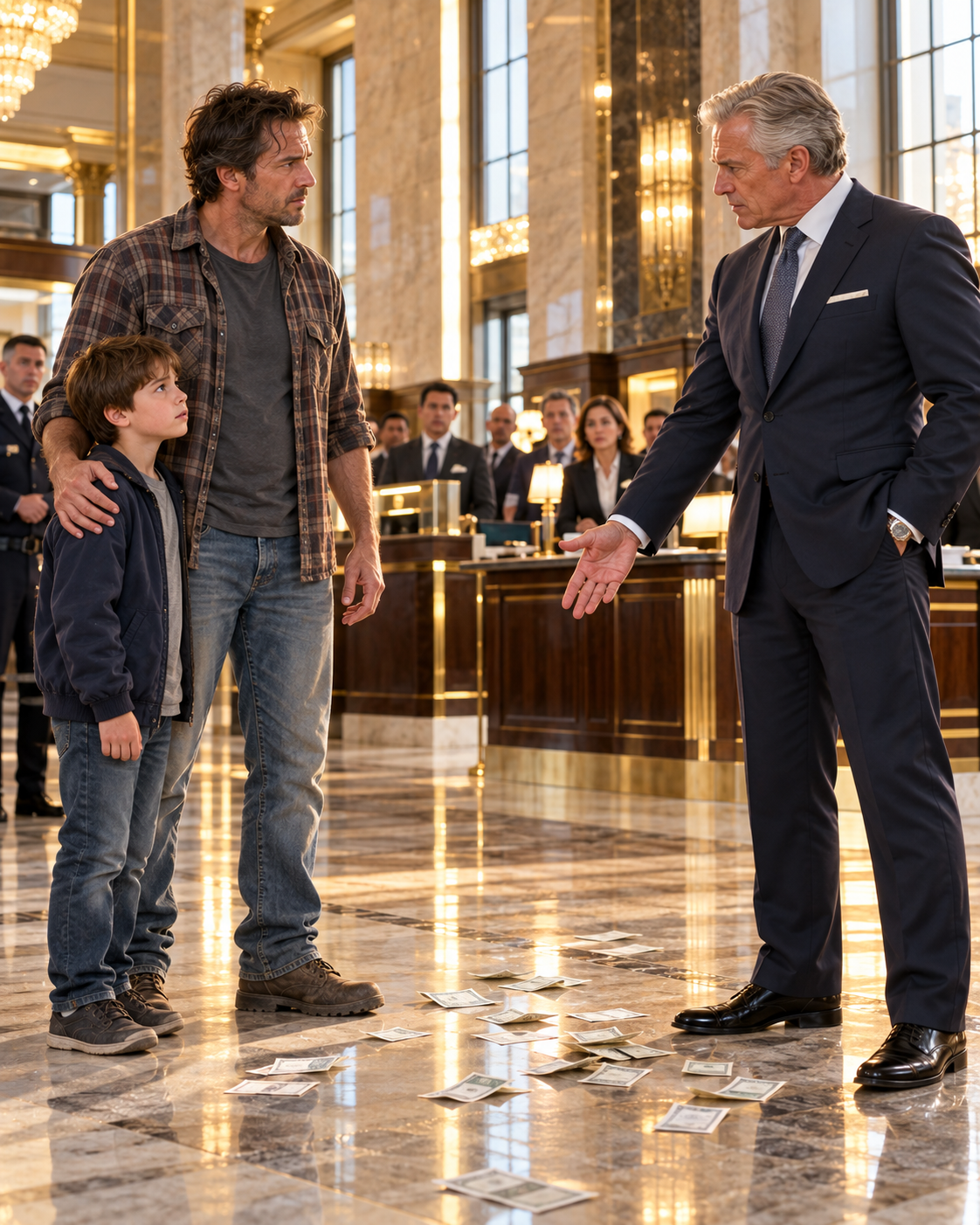
I watched a $500 bill skid across the marble floor of Granite Hollow Savings Bank while its chairman told me to feed my exhausted eight-year-old son
By the time George called that evening, Toby and I were sitting in a small diner three miles from home, sharing a plate of fries while rain tapped softly against the window.
Toby had finally started smiling again.
He was telling me about a science project involving magnets when my phone vibrated across the table.
George.
I answered.
“Nathan, are you somewhere private?”
I looked at Toby.
“Give me a minute.”
I stepped outside beneath the diner’s awning.
“What’s wrong?”
George was silent for several seconds.
Then he said, “You were right to come today.”
I leaned against the brick wall.
“What happened?”
“I reviewed something after you left.”
His voice had changed.
There was fear underneath it.
“Something you need to see before you sign anything.”
I straightened.
“Send it.”
“I can’t.”
“Why?”
“Because if I’m right, someone inside the bank is monitoring my communications.”
The rain seemed suddenly louder.
“What did you find?”
“Come to my office tomorrow morning.”
“George.”
“Please, Nathan.”
Then the line went dead.
I stood beneath the awning for a moment, staring at the wet parking lot.
When I went back inside, Toby looked up from his fries.
“Is everything okay?”
I forced a smile.
“Just business.”
He studied me with the kind of quiet intelligence children sometimes have when adults think they are hiding things.
“Was it the bank?”
I nodded.
He reached across the table and squeezed my hand.
“Then don’t let them trick you.”
I smiled despite myself.
“I’ll try.”
That night, I barely slept.
At six the next morning, I drove to Granite Hollow.
The bank looked different in the gray morning light.
Less impressive.
More fragile.
George was waiting in a conference room with the blinds closed.
He locked the door behind me.
On the table were three folders.
“These are internal loan files,” he said.
I opened the first.
A development company called Vance Meridian Properties had received nearly $80 million in loans from Granite Hollow over the previous four years.
The second folder contained another company.
Then another.
Different names.
Different addresses.
The same lawyers.
The same directors.
The same ultimate owner.
Richard’s family.
I looked at George.
“How much?”
“One hundred and thirty-two million in related-party exposure.”
My jaw tightened.
“And these loans were classified as independent?”
“On paper.”
I turned another page.
Several loans had been extended despite missed payments.
Collateral values had been inflated.
Some properties were worth less than half what the bank’s records claimed.
“Richard knew?”
George looked at me.
“Richard approved most of them.”
The room suddenly felt very small.
“Why didn’t you report this?”
“I tried.”
His voice cracked.
“Twice.”
He opened the third folder.
Inside were copies of emails.
One from a regional executive.
One from an outside auditor.
One from George himself.
All warning that Granite Hollow’s exposure to the Vance family could trigger a catastrophic liquidity crisis.
Then I saw the responses.
“Keep this internal.”
“Do not alarm the board.”
“Chairman has approved.”
“Delay classification until after the capital raise.”
I closed the folder.
“They weren’t planning to use my money to save the bank.”
George swallowed.
“They were planning to use your money to hide what they’d done.”
For the first time since I entered that marble lobby, I felt genuine anger.
Not the hot kind.
The quiet kind that settles deep.
The kind that makes you stop before you act.
“How many people know?”
“I don’t know.”
“Who prepared these files?”
George looked toward the locked door.
“Someone in the chairman’s office.”
Before I could respond, footsteps approached outside.
George’s face tightened.
Someone tried the handle.
Once.
Then again.
We didn’t move.
A voice came through the door.
“George?”
Richard.
George looked at me.
I shook my head.
He remained silent.
After a few seconds, the footsteps disappeared.
We waited another minute.
Then George whispered, “Now you understand why I called.”
I nodded.
“I do.”
That afternoon, I called my legal team and suspended negotiations.
No money would move.
No contracts would be signed.
No rescue package would close until every related-party loan was independently reviewed.
Word spread through Granite Hollow within hours.
Employees began whispering.
Branch managers started calling one another.
And Richard Vance walked into my office that evening without an appointment.
He looked exhausted.
The confidence was gone.
“You suspended the deal.”
“Yes.”
“You can’t do that.”
“I just did.”
He shut the door.
“George has been filling your head with lies.”
I pushed the three folders across the desk.
His eyes landed on them.
For several seconds, he didn’t speak.
Then he sat down.
“Those loans were necessary.”
“For what?”
“To keep the bank alive.”
I stared at him.
“You used the bank’s depositors to protect your family’s investments.”
He shook his head.
“You don’t understand.”
“Then explain it.”
He looked toward the window.
“My grandfather built Granite Hollow during the Depression.”
“I know.”
“He promised employees they’d never lose their jobs.”
His voice softened.
“Every decision I made was about keeping this institution alive.”
“Even if you had to bury the truth?”
He looked at me.
“I thought I could fix it.”
That answer was more painful than a denial.
Because for the first time, I believed him.
Not entirely.
But enough to understand that corruption rarely begins with someone deciding to become evil.
Sometimes it begins with fear.
Fear of failure.
Fear of shame.
Fear of becoming the person who destroyed what his family built.
Then fear becomes justification.
Justification becomes secrecy.
And secrecy becomes a machine that destroys everyone inside it.
Richard stood.
“What do you want?”
“The truth.”
“I’ve told you.”
“No.”
I opened the folder.
“I want every document.”
He stared at me.
“And then?”
“Then I decide whether Granite Hollow deserves to survive.”
His face collapsed slightly at those words.
“You said the deal could continue.”
“It could.”
“Under conditions.”
“Those conditions were before I knew this.”
He nodded slowly.
“What happens now?”
“We find out how deep it goes.”
The following week became a storm.
Auditors arrived.
Federal examiners were notified.
Independent investigators began reviewing every major loan.
Branch managers were interviewed.
Employees were given confidential reporting channels.
And for the first time in decades, people inside Granite Hollow began speaking without looking over their shoulders.
One branch manager admitted she had been ordered to approve a commercial loan with incomplete documents.
A loan officer revealed that appraisal values had been altered.
Another employee confessed that she had been instructed to move delinquent accounts between categories to make the quarterly report look healthier.
Then someone handed investigators a flash drive.
It contained thousands of files.
And one folder was labeled simply:
“Cross.”
My name.
I opened it myself.
Inside were photographs of me.
At conferences.
Outside my office.
Getting into my car.
Standing beside Toby at a school event.
There were notes about my investment history, my family, my habits, even the truck I drove.
Someone had been studying me long before I entered that bank.
I felt a coldness move through me.
George stood beside me.
“They knew you were coming.”
“No.”
I pointed to the dates.
“They knew I was considering the investment.”
George’s face went pale.
“Then someone inside this bank knew about the negotiations before they were supposed to.”
We searched deeper.
The files showed private messages between a senior executive and an unknown person using an encrypted account.
One message stopped me cold.
“If Cross walks, the bank dies.”
Another followed.
“Then make sure he doesn’t walk.”
I read it twice.
George whispered, “Nathan…”
I closed the laptop.
“We need security.”
That evening, I picked Toby up from school myself.
He ran toward the truck carrying a paper model of the solar system.
“Dad!”
I smiled.
“How was school?”
“Great.”
He climbed inside.
Then he noticed my expression.
“Something happened.”
I looked at him.
“Why do you always notice everything?”
“Because you make the same face when you’re worried.”
I laughed quietly.
“That’s not fair.”
He held up his model.
“I made Earth blue.”
“Looks good.”
He studied me.
“Are we safe?”
The question struck harder than anything I’d heard all week.
I turned off the engine.
“Yes.”
It was only partly true.
But children should not carry adult fears unless there is no other choice.
I drove home.
Two nights later, my office alarm went off at 2:13 a.m.
Security found no one inside.
But one cabinet had been opened.
Nothing valuable was missing.
Except the Granite Hollow investigation files.
I stood in the dark office staring at the empty drawer.
Someone wasn’t trying to steal money.
They were trying to erase evidence.
The next morning, Richard came to see me.
He looked older than he had a week earlier.
“I know about the files.”
I didn’t answer.
“I know someone has been trying to destroy records.”
“Who?”
“I don’t know.”
“Do you suspect anyone?”
He hesitated.
“Yes.”
“Who?”
“My son.”
I stared at him.
Richard’s son, Daniel Vance, was the bank’s chief operating officer.
He had been groomed for the chairman’s position for years.
“Why?”
“Because Daniel handled most of the restructuring.”
Richard lowered his voice.
“He told me the bank needed aggressive decisions.”
“Did he know about the loans?”
“I think he created some of them.”
That was the moment I realized the story wasn’t about one arrogant chairman.
It was about an entire family protecting a legacy that had become more important to them than the people the legacy was supposed to serve.
We brought Daniel in.
He arrived confident.
Almost amused.
He looked at me across the conference table.
“So you’re the mysterious investor.”
“I suppose.”
“I’ve heard a lot about you.”
“Likewise.”
He smiled.
“You’ve caused quite a disruption.”
“I found fraud.”
“You found accounting disagreements.”
“One hundred thirty-two million dollars worth?”
His smile disappeared.
He leaned back.
“You don’t understand banking.”
“Maybe.”
I slid a document across the table.
“Then explain this.”
It was a transfer between two Vance-controlled companies.
Daniel stared at it.
“That’s legitimate.”
“Why did the receiving company pay your personal investment firm the same day?”
Silence.
Richard closed his eyes.
Daniel looked at his father.
Then at me.
“You don’t know what you’re doing.”
I stood.
“Actually, Daniel, I think I finally do.”
He left without another word.
That night, George called again.
“I found the missing piece.”
“Where?”
“In your original investment proposal.”
I frowned.
“That document never left my office.”
“Exactly.”
He sent me a scan.
Someone had altered the projected use of the $300 million.
Instead of strengthening Granite Hollow’s reserves, almost half the money had been allocated to purchasing Vance-controlled assets.
They hadn’t simply planned to hide the losses.
They planned to make my rescue money purchase their bad investments at full value.
It was a breathtaking scheme.
And if it had worked, thousands of depositors would have believed the bank was saved while the Vance family quietly walked away with hundreds of millions.
I called the authorities.
By sunrise, investigators were at Granite Hollow.
Daniel was taken into custody that afternoon.
Several executives resigned.
Two outside consultants were charged.
And Richard Vance?
He sat alone in his office while investigators removed boxes from the shelves.
I found him there after sunset.
He was holding an old photograph.
A young man stood beside the first Granite Hollow branch.
His grandfather.
Richard looked at the picture.
“He’d hate me.”
I sat across from him.
“Maybe.”
He looked surprised.
“I thought you’d say he would understand.”
“I don’t know your grandfather.”
Richard gave a tired smile.
“But I know what he wrote on the bank’s first ledger.”
He turned the photograph over.
There was a handwritten sentence on the back.
“Never make a person feel small because you have more than they do.”
Richard stared at those words.
“I forgot.”
I shook my head.
“No.”
He looked at me.
“You remembered the wrong thing.”
For a long time, neither of us spoke.
Then he asked, “Will you still save the bank?”
I looked toward the dark lobby.
Megan was there, closing her station.
The same young teller who had tried to help Toby.
The same woman who had watched a $500 bill slide across the marble.
“The bank can be saved.”
Richard’s shoulders loosened.
“But not the way you imagined.”
“What does that mean?”
“It means the Vance family loses control.”
His eyes closed.
I continued.
“The rescue money becomes a true restructuring package.”
“Independent oversight.”
“Public accountability.”
“Employee protections.”
“Customer-first policies.”
“And you?”
“I’ll stay involved long enough to make sure it works.”
Richard looked down at the photograph.
“Then maybe my grandfather’s bank has a chance.”
“It does.”
“But only if you stop trying to preserve the past.”
The next month, Granite Hollow changed.
The marble stayed.
The chandeliers stayed.
The brass doors stayed.
But something underneath them changed.
A customer service charter was posted in every branch.
Complaints could no longer disappear into management offices.
Frontline employees could report misconduct without risking their jobs.
Managers were evaluated not only on revenue, but on customer treatment.
And once a month, Richard Vance stood behind a teller window.
The first day, he looked uncomfortable.
By noon, he looked exhausted.
By three, he looked humbled.
An elderly woman approached his window with a savings book that had belonged to her late husband.
She was confused about a transaction.
Richard spent nearly twenty minutes helping her.
When she finally thanked him, he simply nodded.
After she left, he looked toward me.
“I never knew.”
“That’s the point.”
Megan eventually became the branch’s customer experience director.
She kept the $500 bill framed above her desk.
Not as a trophy.
As a reminder.
One afternoon, Toby and I visited her.
She smiled when she saw him.
“How’s school?”
“Good.”
“And your science project?”
“I got an A.”
She laughed.
I looked at the framed bill.
“You kept it.”
“I almost didn’t.”
“Why?”
“Because I thought it represented the worst day I’ve ever had at work.”
She touched the frame.
“Then I realized it represented the day everything changed.”
I nodded.
Toby looked at the bill.
“Was this the money my dad got?”
Megan glanced at me.
I smiled.
“Something like that.”
Toby thought for a moment.
“Did that man become nicer?”
Megan laughed.
“He’s trying.”
We left the bank shortly afterward.
Outside, the afternoon sun hit the glass doors.
Toby slipped his hand into mine.
“Dad?”
“Yeah?”
“Why didn’t you tell him who you were?”
I thought about it.
“Because if I had, I would’ve learned nothing.”
He nodded as though that made perfect sense.
Then he asked the question I would remember for the rest of my life.
“What if nobody important had been there to help us?”
I stopped walking.
That question was the entire story.
I looked down at my son.
“Then we should still treat people with kindness.”
He smiled.
“Even if they can’t help us?”
“Especially then.”
We walked toward the truck.
Behind us, Granite Hollow stood exactly as it always had.
But the people inside were different.
The bank survived.
Thousands of depositors kept their savings.
Employees kept their jobs.
And the $300 million rescue became something larger than a financial transaction.
It became a warning.
Money can rebuild a balance sheet.
Power can protect a reputation.
Lawyers can bury a mistake.
But none of those things can repair the moment when a person decides another human being is beneath them.
Months later, I received a letter from Richard.
There was no bank stationery.
No title.
No corporate language.
Just a handwritten page.
It said he had finally understood something his grandfather knew from the beginning.
A bank was never really built from stone, steel, money, or numbers.
It was built from trust.
And trust was earned one human interaction at a time.
At the bottom, he had written one final sentence.
“I hope the next person who walks through our doors in dirty boots never has to prove that he deserves to be treated like a human being.”
I folded the letter and placed it in my desk.
Then I looked out the window at Toby playing in the yard.
The storm that had started all of this had long passed.
The barn roof had been repaired.
The bank had survived.
And Richard Vance had learned the lesson I had wanted him to learn that first afternoon.
But there was one thing I never told him.
When George first called me from that locked conference room, I had already suspected Granite Hollow was in trouble.
I just hadn’t known how deep the corruption went.
And somewhere inside those files, buried beneath millions of dollars in fraudulent loans, altered appraisals, and secret transfers, was one final name that investigators still hadn’t identified.
A name that appeared only once.
A name attached to the very first decision to target Granite Hollow.
I still have a copy of that page.
I keep it locked away.
Because the bank was saved.
The family was exposed.
The employees were protected.
But sometimes, late at night, I still wonder who was really pulling the strings from the beginning.
And whether the person who nearly destroyed Granite Hollow ever walked through those marble doors looking poor, ordinary, and completely invisible.
Because if they did, I may have already met them.
And they may have been watching me the entire time.