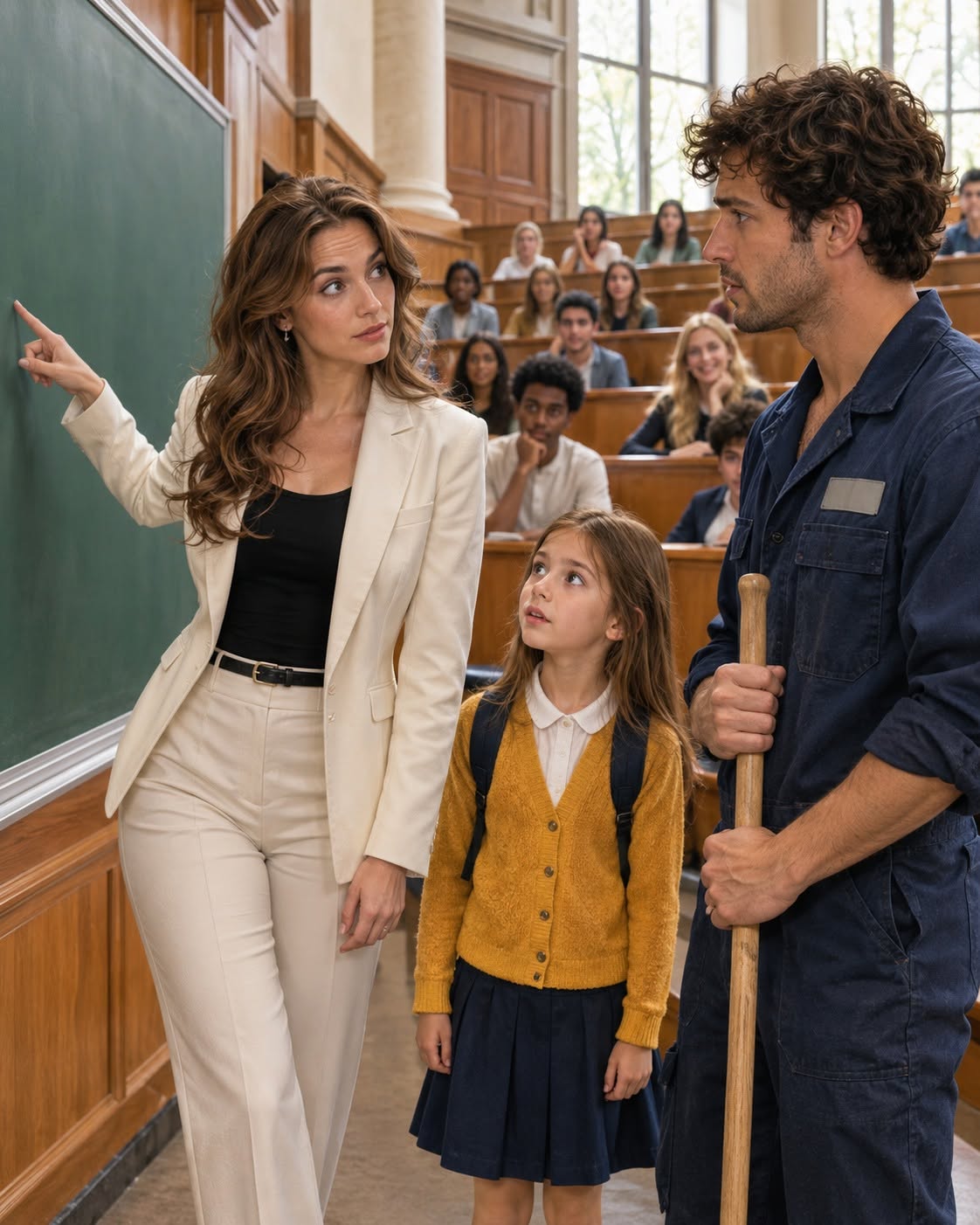
I was working as a janitor in a university maintenance department when a professor pointed at me in front of a packed lecture hall and said
The first time I realized that accepting Professor Hayes’s offer might have been a mistake, I was standing outside a hospital emergency department at 11:47 on a Thursday night.
My phone was vibrating in my pocket.
It was a message from Victoria.
“Daniel, I need you to come in tomorrow morning. Something has happened with the disaster delivery project. We need to talk before the university makes any decisions.”
I read it twice.
Then I looked through the glass doors at the hospital, where my six-year-old daughter was sleeping in a chair beside her grandmother.
I had no idea that the decision I made that night would put everything I had worked so hard to rebuild at risk.
But I’m getting ahead of myself.
Three months had passed since I officially joined Professor Hayes’s research team.
For the first time in nearly a decade, I had an office with my name on the door. It wasn’t particularly impressive. The desk was old, the computer was slow, and the heating system made a strange clicking sound every fifteen minutes.
Still, I loved it.
I loved opening mathematical models in the morning, arguing over assumptions with graduate students, and watching an idea slowly become something useful.
Most importantly, I could work from home when Lily needed me.
She had even started telling her classmates that her father was a scientist.
Every time she said it, I felt something inside me heal.
Then came the Thursday evening that changed everything.
Lily had been complaining about a headache after school. I assumed she was tired, but by dinner she had developed a fever. I took her to the hospital when she started vomiting and became unusually quiet.
The doctors eventually diagnosed her with a severe kidney infection.
It wasn’t life-threatening, they assured me, but she needed treatment and observation.
I stayed beside her bed all night.
At 11:47, Victoria sent her message.
I didn’t respond immediately.
Instead, I watched Lily sleep, her small hand wrapped around two of my fingers.
I had already lost my wife to an illness I couldn’t stop. I wasn’t going to make my daughter feel that she had to compete with my work for my attention.
I typed a short reply.
“My daughter is in the hospital. I can’t come in tomorrow morning. I’ll contact you when I know more.”
Victoria responded almost immediately.
“I’m sorry. Take care of Lily. I’ll handle the meeting.”
That was the last message I expected to receive from her that night.
But at 6:30 the next morning, another message arrived.
“Daniel, please call me. The university has suspended the project.”
I stared at the screen.
Suspended?
I called her.
Her voice sounded exhausted.
“Someone has reported a serious flaw in the revised model,” she said. “The university’s research oversight committee has opened an investigation.”
“What kind of flaw?”
“A problem with the emergency allocation algorithm. They’re claiming the model could systematically send supplies away from the communities with the greatest need.”
I sat down beside Lily’s hospital bed.
“That doesn’t make sense. We corrected the original constraints.”
“I know,” Victoria said. “But the preliminary report suggests the problem appeared after the last update.”
“Who made the update?”
There was a pause.
“The research group submitted it under my supervision.”
I felt my stomach tighten.
“Victoria, did you review the changes?”
“Of course I did.”
“Then why are they investigating?”
She exhaled.
“Because the person who submitted the complaint is Dr. Richard Coleman.”
I knew the name.
Richard Coleman was a senior professor in the university’s engineering department. He had been publicly critical of Victoria’s research for years. He believed her emergency distribution project was too theoretical and had never hidden his opinion that she was wasting university funding.
But he was also a respected researcher.
If he had found a genuine problem, the university would take it seriously.
“What does he say happened?” I asked.
“He claims our revised model contains a hidden weighting error. He says it favors hospitals with better infrastructure rather than those facing the greatest shortages.”
I closed my eyes.
That was a serious accusation.
The entire purpose of our project was to prevent exactly that.
“Send me the latest version,” I said.
“Daniel, you should be with Lily.”
“I can do both. I’ll look at it when she sleeps.”
Victoria was quiet for a moment.
Then she said something that surprised me.
“I think someone deliberately changed the model.”
I looked toward the hospital corridor.
“What makes you think that?”
“Because I remember the version we approved. The equation in the complaint doesn’t match the one we submitted.”
I felt a familiar chill run through me.
I had seen that kind of discrepancy before.
And I knew it rarely happened by accident.
Over the next two days, I reviewed every version of the model from the previous six weeks.
I worked from the hospital cafeteria while Lily slept. I compared archived files, checked formulas, examined timestamps, and reconstructed the sequence of changes.
On Saturday afternoon, I found it.
The original model was correct.
The revised version was correct.
But a third version had been created between them.
It contained a seemingly harmless adjustment to a normalization coefficient. The adjustment changed how the algorithm calculated urgency when several communities requested supplies simultaneously.
By itself, the change looked reasonable.
But combined with another condition, it caused the system to prioritize locations with higher reporting capacity rather than greater medical need.
Someone had introduced a mathematical distortion that would be difficult to notice during ordinary testing.
I immediately called Victoria.
“I found the problem.”
She sounded relieved.
“Can you explain?”
“Someone changed the normalization coefficient after the approved version was completed. The new coefficient creates a bias when demand exceeds available supply.”
“Can you prove it?”
“I can prove the mathematical consequences. I can’t yet prove who changed it.”
“That’s enough to start.”
“No,” I said. “Not this time. We need the complete history. If we accuse someone without evidence, the investigation will become a battle of reputations instead of facts.”
Victoria agreed.
On Monday morning, I returned to campus.
I hadn’t slept properly in three nights, and Lily was still recovering at home with my mother.
When I entered the research building, I noticed something immediately.
People stopped talking.
A graduate student who usually greeted me looked down at his coffee.
Another closed his laptop as I passed.
I eventually understood why.
An anonymous email had been sent to several faculty members claiming that Victoria had allowed an unqualified maintenance worker to influence a major research project.
The email also suggested that my appointment had been an attempt to hide her earlier mistakes.
I read the message twice.
For a moment, I felt as if I had been transported back to that lecture hall.
The same assumptions.
The same judgment.
The same quiet laughter from people who believed they already knew who I was.
I could have walked away.
I had done it once before.
But this time, I had a reason to stay.
Not for my title.
Not for my reputation.
For the communities that might eventually depend on the research we were doing.
I went straight to Victoria’s office.
She was standing by the window, holding a printed copy of the email.
“I am sorry,” she said.
“You didn’t write it.”
“No, but I created the environment where someone thought they could treat you this way.”
I put my bag down.
“Then let’s not waste time discussing the email.”
She almost smiled.
“That’s exactly what I needed to hear.”
We requested access to the university’s version-control records.
The information revealed that the altered coefficient had been introduced using an account belonging to one of our senior graduate researchers, a man named Ethan Brooks.
Ethan had been part of the project from the beginning.
He was talented, ambitious, and often frustrated that Victoria relied so heavily on my mathematical judgment.
He also had a promising academic career ahead of him.
When Victoria asked him to explain the change, he denied making it.
He claimed someone must have used his account.
The university’s technology department began investigating.
Meanwhile, Richard Coleman requested a public hearing.
He wanted the research project suspended permanently until the university could establish whether the findings were trustworthy.
Victoria was furious.
I understood why.
But I asked her not to fight him.
“Let him ask every question he wants,” I said. “If the model is sound, we should be able to demonstrate that. And if something is still wrong, we need to find it.”
The hearing was scheduled for Friday.
On Thursday evening, Lily climbed onto my lap while I was reviewing the mathematical analysis.
“Daddy, are you working again?”
“A little.”
“Are you fixing something?”
I smiled.
“I’m trying.”
She looked at the equations on my screen.
“Why are there so many numbers?”
“Because numbers help us understand things.”
She thought about that.
“Can numbers tell you if someone is being mean?”
I stopped typing.
“Not always.”
“Then how do you know?”
I brushed a strand of hair away from her face.
“Sometimes you have to look at what people do when they think nobody is watching.”
She nodded as if that explained everything.
Then she went to get her stuffed rabbit.
I watched her walk away and realized how much I wanted to give her a simple world.
A world where hard work was rewarded, where people told the truth, and where nobody was judged by the clothes they wore or the job they performed.
But the world wasn’t always like that.
And I couldn’t protect her by pretending otherwise.
The next morning, the university’s conference room was packed.
Faculty members, graduate students, administrators, and representatives from the emergency medical planning office had gathered to hear the findings.
Richard Coleman sat near the front.
Ethan was beside him.
Victoria sat at the table with me.
Before the hearing began, she leaned toward me.
“Whatever happens, I want you to know I believe you.”
I nodded.
Then Richard stood.
He presented his concerns carefully.
He showed charts, projections, and several examples where the revised algorithm produced allocations that appeared inconsistent with actual medical demand.
His argument was persuasive.
If I hadn’t examined the model myself, I might have agreed with him.
Then he made his final point.
“This project is too important to be managed by individuals who lack the appropriate qualifications and oversight,” he said.
His eyes briefly moved toward me.
I felt the old humiliation rise in my chest.
But I stood anyway.
“I agree with one part of what Professor Coleman said,” I began. “This project is too important for anyone to be careless.”
I walked to the screen.
“I’d like to show you three versions of the same model.”
The first version was our original formulation.
The second was the corrected version approved by the team.
The third was the version that had been used in the complaint.
I placed them side by side.
Then I explained the difference.
The normalization coefficient had been changed in a way that distorted the relationship between reported demand and actual medical urgency.
But there was something else.
I had discovered that the complaint used a set of test conditions that had never appeared in our official simulations.
Those conditions were mathematically valid, but they had been selected to exaggerate the impact of the altered coefficient.
In other words, the model had been changed, and the evidence against it had been constructed around the changed version.
I didn’t accuse anyone.
I simply demonstrated the facts.
When I finished, a woman from the university’s research oversight committee raised her hand.
“Dr. Miller, can you explain why the original model would not produce the same allocation error?”
I walked through the equations again.
This time, I used a simplified example involving three hospitals and a limited supply of emergency medication.
The result was clear.
The original model prioritized medical urgency.
The altered version prioritized reporting capacity under certain conditions.
The difference wasn’t subtle.
A graduate student in the back raised his hand.
“Could this have happened because of a programming mistake?”
“Yes,” I answered. “It’s possible. That’s why we need to investigate the revision history before drawing conclusions.”
Richard looked uncomfortable.
He stood again.
“You’re assuming the original formulation was correct.”
“No,” I replied. “I’m demonstrating the conditions under which it produces valid results. If you have a counterexample, I’d genuinely like to examine it.”
The room became quiet.
For several seconds, nobody spoke.
Then the university’s technology director entered the room carrying a folder.
He whispered something to the committee chair.
She looked toward Victoria.
“Before we continue, we have received additional information concerning the altered file.”
The director explained that the file had not simply been modified through Ethan’s account.
The account had been accessed remotely using a secondary authentication device.
The device was registered to a university office.
Not Ethan’s.
Not Victoria’s.
It belonged to Richard Coleman.
A wave of murmurs spread through the room.
Richard stood abruptly.
“This is absurd. I have no involvement in their internal files.”
The technology director continued.
The access logs showed that the altered coefficient had been inserted shortly after Richard requested a copy of the model for independent review.
His university account had accessed the file repeatedly.
And the original complaint had been submitted less than an hour after the final alteration.
Richard’s expression changed.
He turned toward Ethan.
“You told me the access history had been cleared.”
Nobody moved.
Ethan went pale.
The sentence hung in the room.
Richard seemed to realize what he had said.
He tried to recover.
“I meant the previous access history. I was referring to an unrelated matter.”
But it was too late.
The committee chair asked him to remain seated.
Ethan began speaking.
At first, his voice was barely audible.
He admitted that Richard had approached him several weeks earlier, offering to help him secure a prestigious research fellowship.
In exchange, Ethan had provided access to the project files.
Richard had told him that Victoria’s work was fundamentally flawed and that exposing the problem would force the university to reconsider its funding.
Ethan claimed he had not understood the full consequences of the changes.
But he had known that the model was being altered.
The committee suspended the hearing and ordered an independent investigation.
Richard was removed from the project review.
Ethan’s fellowship recommendation was withdrawn, and his access to the research files was suspended pending a formal review of his conduct.
Victoria sat beside me, staring at the table.
After everyone had left, she finally spoke.
“I almost lost everything because I trusted the wrong people.”
I looked at her.
“You also gave someone a second chance. That doesn’t make you foolish.”
She shook her head.
“I should have seen the warning signs.”
“Maybe. But I should have noticed that the revision process wasn’t as secure as it needed to be. We both have things to learn.”
She gave a tired laugh.
“You always manage to turn a disaster into a mathematical problem.”
“It’s easier than turning it into an argument.”
For the first time in weeks, she smiled.
But the story didn’t end with Richard’s removal.
The university’s investigation uncovered something even more troubling.
Richard had been trying to discredit Victoria’s project for months because he wanted its funding redirected toward a different research initiative he was leading.
He had deliberately exaggerated weaknesses in the original model and encouraged others to question the legitimacy of the team.
His actions had delayed the emergency planning project and damaged the university’s relationship with several medical organizations.
The university eventually issued a formal statement acknowledging the misconduct.
Richard resigned from his administrative responsibilities and faced disciplinary proceedings.
Ethan received a suspension from the research program.
Victoria was cleared of wrongdoing, but the committee required the entire project to undergo independent mathematical and technical review.
It would take months.
Some members of the team wanted to abandon the work.
The university’s funding was uncertain.
And the medical organizations that had been waiting for our findings were losing patience.
One afternoon, Victoria called me into her office.
“I’ve been thinking,” she said. “We should rebuild the project from the ground up.”
I looked at the documents on her desk.
“That will take time.”
“I know.”
“And we’ll need independent reviewers.”
“I know.”
“And we should include people who actually work in emergency logistics. Not just mathematicians and engineers.”
She smiled.
“That’s why I called you.”
For the next four months, we worked harder than I ever had during my graduate studies.
We invited emergency medical technicians, hospital administrators, supply coordinators, and disaster response workers to review the assumptions behind the model.
Some of their observations were surprisingly simple.
One ambulance coordinator explained that a hospital could report a shortage of medication without having enough staff to receive a delivery.
A rural doctor pointed out that a community might have a low reported demand simply because its communication systems had failed.
A logistics supervisor explained that a road could be technically open but practically unusable for a heavy delivery vehicle.
These details changed our approach.
We began treating uncertainty as a central part of the model rather than an inconvenience to be averaged away.
Instead of assuming that every community could report its needs accurately, we designed a system that considered incomplete information and adjusted allocations as new evidence became available.
The mathematics became more complicated.
But the results became more realistic.
One evening, while reviewing a new simulation, I noticed that our model had identified a small rural clinic as the highest-priority destination.
The clinic had reported only a moderate shortage.
However, the model recognized that its communication network had been damaged and that its actual medical demand was probably much higher.
I stared at the result for several seconds.
“Victoria,” I said, “look at this.”
She leaned over my computer.
The simulation showed that a revised delivery route would reach the clinic before its emergency medication supply ran out.
She looked at me.
“That’s what we were trying to achieve from the beginning.”
I nodded.
But I was thinking about something else.
For years, I had believed that mathematics was about finding the most elegant solution to a problem.
Now I understood that the most elegant solution meant very little if the problem itself had been misunderstood.
The following spring, the university approved a pilot program.
Our system would be tested using simulated disaster scenarios and historical emergency response data.
The first results were encouraging.
Then, during the second month of testing, a real disaster struck.
A powerful storm caused severe flooding across several counties in Pennsylvania.
Roads were closed.
Power lines were down.
Several smaller medical facilities lost access to their normal supply routes.
The university’s emergency planning partners contacted our team.
They asked whether the model could help coordinate deliveries of essential medical supplies.
Victoria called me at 5:20 in the morning.
“Daniel, this is what we’ve been preparing for.”
I was already awake.
Lily had climbed into my bed during the storm because thunder frightened her.
I kissed her forehead and called my mother to come stay with her.
Then I drove to campus.
The operations room was filled with maps, laptops, and people speaking into phones.
Emergency officials had provided us with updated information about hospital supplies, road conditions, and available delivery vehicles.
Our model began processing the data.
At first, everything looked manageable.
Then a major bridge was closed unexpectedly.
The closure cut off the most direct route to two medical facilities.
The model recalculated.
But the new allocation created another problem.
A small community clinic had become isolated.
Its medication supply was lower than expected, and its backup generator was running out of fuel.
A conventional allocation system would have prioritized the larger hospital nearby.
Our model initially did the same.
I examined the data.
Something was wrong.
The clinic’s reported demand was too low.
I asked the emergency coordinator to verify the latest information.
She checked her records and looked concerned.
“The clinic’s communications equipment failed last night,” she said. “They haven’t been able to send a complete report.”
I looked at Victoria.
“This is exactly the situation we built the uncertainty adjustment for.”
She nodded.
“Can the model account for it?”
“It can. But I need to change the confidence level assigned to the missing data.”
I worked through the adjustment.
The model recalculated.
This time, it prioritized the clinic.
But the revised route would delay a delivery to a larger hospital by nearly forty minutes.
The operations director hesitated.
“Are we certain this is the right decision?”
“No,” I said. “We’re not certain. That’s why we’re using real-time information and keeping human oversight in the process. But based on the available evidence, this is the safer allocation.”
The director looked at Victoria.
She nodded.
“Run the recommendation past the medical coordinator. Then we make the decision.”
A few minutes later, the delivery was approved.
The vehicle reached the clinic just before noon.
Later that afternoon, the clinic’s medical director called to report that the supplies had arrived in time to support several patients who needed urgent treatment.
Nobody in the operations room cheered.
We were too exhausted.
But I leaned back in my chair and closed my eyes.
For the first time, I understood that the equations I had spent years studying were no longer just equations.
They had become part of a decision that mattered to real people.
That evening, I returned home to find Lily waiting by the front door.
“Daddy!”
She ran into my arms.
I lifted her and held her close.
“Did you fix it?” she asked.
I smiled.
“We helped some people today.”
“Were they sick?”
“Yes.”
“Did they get their medicine?”
“They did.”
She thought about that for a moment.
“Then you did a good job.”
I kissed her forehead.
That was the only evaluation I needed.
A few weeks later, the university held a special ceremony to recognize the emergency response team.
I wasn’t particularly interested in attending.
I had never enjoyed standing on stages, and I still felt more comfortable in a quiet office with a notebook.
But Victoria insisted.
“You need to be there,” she said.
“Why?”
“Because the university needs to recognize the people who made this possible.”
On the day of the ceremony, I wore the only suit I owned.
It was slightly too tight around the shoulders.
Lily came with me, wearing a blue dress and carrying her stuffed rabbit.
When we entered the auditorium, I noticed several familiar faces.
Students from the lecture where Victoria had challenged me were sitting near the front.
Some of them smiled when they saw me.
Others looked surprised.
Victoria spoke first.
She described the project’s early failures, the investigation, the rebuilding process, and the successful emergency deployment.
Then she said something I hadn’t expected.
“Several months ago, I made a mistake. I assumed that a person’s professional title and current job told me the limits of their knowledge. Daniel Miller taught me that expertise does not disappear simply because life takes someone in a different direction.”
She paused.
“I also learned that being intelligent is not the same as being wise. Wisdom requires listening, especially when the person speaking is someone we would not normally expect to hear.”
Then she invited me to the stage.
I walked forward.
The applause was louder than I expected.
I looked at Lily.
She was clapping with both hands, her stuffed rabbit tucked under one arm.
I stood at the microphone.
“I spent several years believing that leaving academia meant I had lost an important part of myself,” I began.
“But I eventually realized that knowledge doesn’t belong to an office, a university, or a job title. It belongs to the person who continues learning and is willing to use what they know.”
I looked toward the students.
“Never assume that the person repairing your classroom has nothing to teach you. Never assume that the person standing at the front of the room has nothing left to learn. And never confuse someone’s circumstances with their abilities.”
The room became quiet.
I continued.
“I also want to thank the people who do work that rarely receives recognition. The maintenance staff, the delivery drivers, the cleaners, the nurses, the technicians, and everyone who keeps institutions running while others receive the attention. Important work doesn’t always happen in the spotlight.”
When I finished, the applause continued.
But the most meaningful moment came afterward.
A young woman approached me near the auditorium doors.
She was one of the students who had laughed during the original lecture.
“I wanted to apologize,” she said.
I looked at her.
“For what?”
“For laughing when Professor Hayes challenged you. I thought you were just a maintenance worker who wanted attention.”
She looked embarrassed.
“I was wrong.”
I considered her words.
“It’s good that you recognize that.”
She nodded.
“Can I ask you something?”
“Of course.”
“Do you think it’s too late for someone to change the direction of their life?”
I smiled.
“No. But I think you have to be honest about what you want, and you have to accept that the path may look different from the one you originally imagined.”
She thanked me and walked away.
That evening, Lily and I stopped at a small ice cream shop on the way home.
She chose strawberry.
I chose chocolate.
While we sat together, she asked, “Daddy, are you a professor now?”
I laughed.
“Not exactly.”
“Then what are you?”
I thought about the question.
I was a father.
A researcher.
A widower.
A man who had spent years fixing pipes, lights, and broken equipment.
I was all those things.
“I suppose I’m just Daniel,” I said.
She smiled.
“I like being Lily.”
I laughed again.
“That’s a pretty good answer.”
Several months later, I received an offer from another university to lead a research group.
The position came with a generous salary, a prestigious title, and opportunities to publish internationally.
For a moment, I was tempted.
It was everything I had once imagined for myself.
But the position required frequent travel and long periods away from home.
I asked whether the university could offer flexible working arrangements.
They couldn’t.
I declined.
Victoria thought I was making a mistake.
“You’ve earned the opportunity,” she said.
“I know.”
“Are you sure?”
I looked at the photograph on my desk.
It showed Emily holding Lily when she was only a few months old.
“I spent too many years believing success meant returning to the life I had before,” I said. “I don’t want to spend the rest of my life chasing a version of myself that no longer exists.”
Victoria didn’t argue.
Instead, she helped me negotiate a permanent research position at our university with a schedule that allowed me to remain actively involved in Lily’s life.
I also volunteered to help establish a small program for university employees who wanted to return to education.
The program offered evening classes, mentoring, and opportunities for staff members to contribute to research projects when their experience was relevant.
The first person to enroll was a maintenance technician named Robert.
He had been repairing university buildings for twenty-two years.
One afternoon, he approached me holding a notebook.
“I heard you used to be a researcher,” he said.
“I did.”
“I studied engineering before I had to leave school. I’ve always wanted to finish.”
I looked at him.
“Then let’s see what we can do.”
Over the next year, the program grew.
A cafeteria worker began taking accounting courses.
A security guard enrolled in computer science.
A laboratory assistant returned to graduate school.
None of them had the same story.
But they shared something important.
They had never stopped being curious.
And that, I came to understand, was worth protecting.
On the anniversary of my first lecture hall encounter with Victoria, I returned to the same room.
The projector was working perfectly.
I stood near the back while a new group of students discussed an optimization problem.
This time, Victoria was sitting among them rather than standing at the front.
A student raised his hand.
“Professor Hayes, I think there’s an assumption in this model that doesn’t hold under real conditions.”
Victoria smiled.
“Interesting. Would you like to explain?”
The student hesitated.
Then he stood and walked toward the board.
Nobody laughed.
I watched him begin writing.
For a moment, I thought about Emily.
She had always believed that people were capable of more than their circumstances suggested.
Before she became ill, she used to tell me that the most important thing I could teach Lily was not how to succeed, but how to remain open to possibility.
I wished she could have seen what happened.
I wished she could have stood beside me at the ceremony, watched Lily grow, and laughed when our daughter proudly announced that her father was a scientist.
But life doesn’t always give us the chance to share every achievement with the people we love.
Sometimes, we have to carry their memories into the lives we continue building.
As the lecture ended, Lily appeared at the doorway with my mother.
She ran toward me, holding a drawing.
“Daddy, look!”
It was a picture of three people standing beside a large building.
One was Lily.
One was me.
The third was a woman with long brown hair.
I recognized her immediately.
“Who’s this?” I asked, although I already knew.
“Mommy,” Lily said. “I drew her because she should be there too.”
I swallowed.
“It’s beautiful, sweetheart.”
She pointed toward the building.
“And I wrote something here.”
At the bottom of the paper, in uneven letters, were the words:
MY DADDY FIXES THINGS.
I smiled.
Then I noticed something else.
Beneath those words, she had written a second sentence.
MY DADDY ALSO HELPS PEOPLE.
I hugged her.
For years, I had believed that my life had been divided into two parts: the person I was before Emily died and the person I became afterward.
I had thought the second part was somehow smaller.
I was wrong.
I hadn’t lost my ability to be a researcher when I became a father.
I hadn’t lost my intelligence when I became a janitor.
And I hadn’t lost my future when grief forced me to take a different road.
I had simply been living a chapter I never expected to write.
Professor Hayes once challenged me to prove that I belonged in a lecture hall.
But the truth is, I never needed to prove that.
I belonged wherever I could use what I knew to make something better.
And so did the people who worked quietly behind the scenes.
The world is full of people whose abilities remain hidden because life has placed them somewhere others don’t think to look.
A job title cannot measure a person’s intelligence.
A difficult chapter cannot determine the value of an entire life.
And a second chance is not always about returning to where you started.
Sometimes, it’s about discovering that you can build something meaningful from where you are.
That night, after Lily fell asleep, I placed her drawing beside Emily’s photograph.
I looked at both for a long time.
Then I opened my old graduate-school notebook.
On the first blank page, I wrote a sentence:
A person’s potential is not defined by the position they occupy, but by what they are still willing to learn, create, and give.
I closed the notebook.
For the first time in years, I didn’t feel that I was trying to recover my old life.
I was grateful for the life I had.
And tomorrow morning, I would drop Lily off at school, drive to the university, and continue doing what I had always done.
Fixing things.
Only now, I understood that some of the most important things worth fixing were never broken machines or complicated equations.
They were the assumptions we made about one another.
And sometimes, all it took to change a life was one person willing to look beyond them.