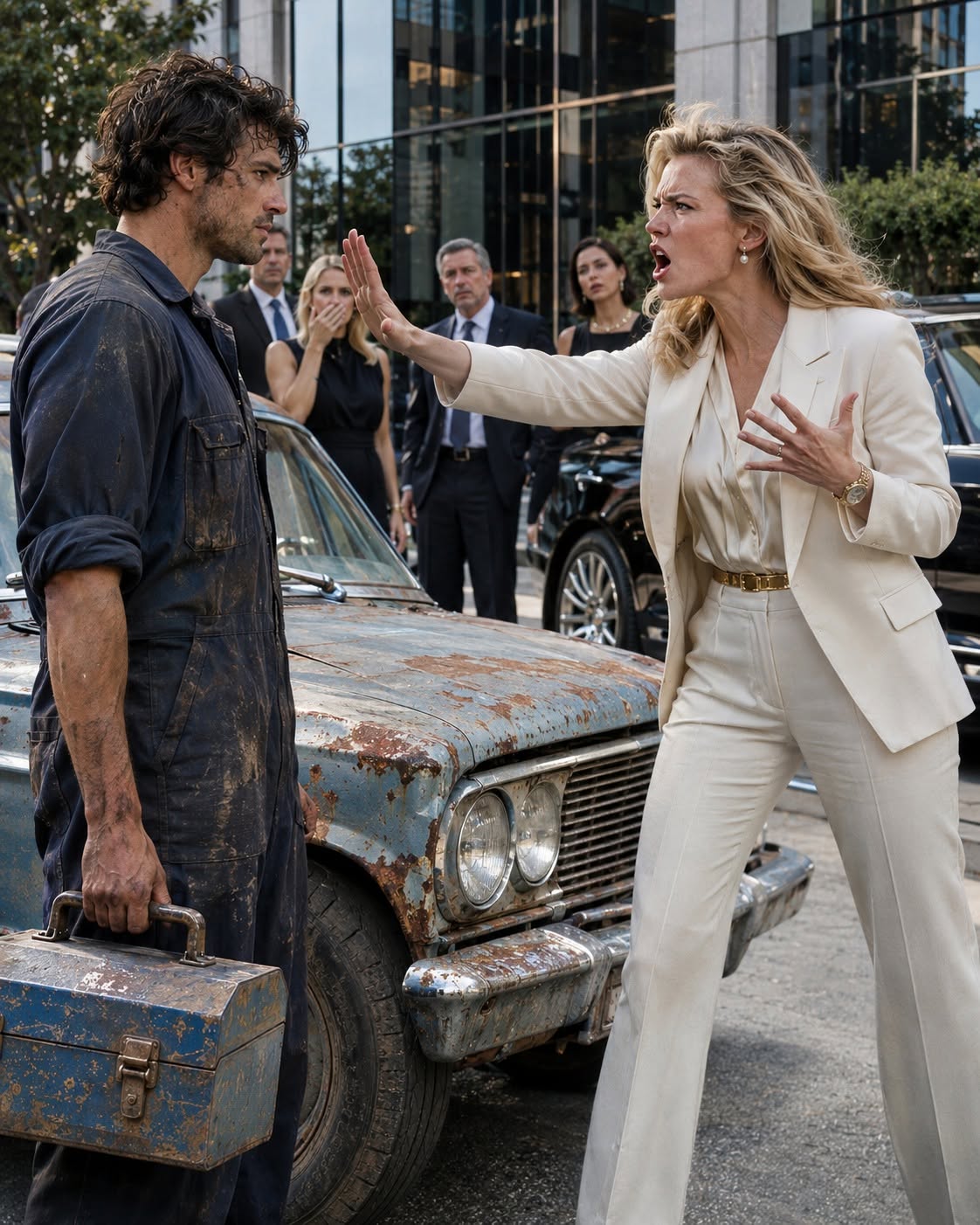
I was told to scrap the ugliest car in the company garage. But when I turned its engine over for the first time in decades
The following morning, I arrived at work earlier than usual.
I barely slept the night before. Every time I closed my eyes, I saw the CEO standing beside that restored prototype, holding her father’s letter with trembling hands.
I had worked at the company for eleven years. In all that time, I had never been summoned to the CEO’s office.
People like me didn’t usually get invited upstairs unless something had gone wrong.
And considering I’d spent several weeks secretly restoring a vehicle I’d been ordered to destroy, I couldn’t help imagining the worst.
Maybe I was about to lose my job.
Maybe security would escort me out.
I had a daughter to raise, bills to pay, and no savings large enough to survive an extended period without work.
Still, I wouldn’t change what I’d done.
That car deserved better than a scrapyard.
At exactly nine o’clock, my phone rang.
“Mr. Carter? Ms. Whitmore is ready to see you.”
I straightened my work jacket and walked toward the executive elevators.
When the doors opened on the thirty-second floor, everything felt different. The floors were polished marble, the walls were lined with awards, and people spoke in quiet voices as they passed.
A receptionist led me into a spacious office overlooking the city.
Victoria Whitmore stood beside the window.
She was the kind of CEO whose photograph appeared in business magazines. Confident, sharp, and famously difficult to impress.
But that morning, she looked exhausted.
There were two coffee cups on her desk, a stack of documents, and her father’s old letter lying open beside them.
“Please, sit down, Daniel.”
I sat.
For several seconds, neither of us spoke.
Then she picked up the letter.
“I read this three times last night,” she said.
“Was there something important in it?”
She gave a small, almost sad smile.
“Everything.”
She walked to her desk and turned a framed photograph toward me.
It showed a younger man standing beside a beautiful silver sports car. He had one hand resting proudly on its hood, and a little girl stood beside him.
I recognized the vehicle immediately.
It was the prototype.
The man was her father, Richard Whitmore.
And the little girl was Victoria.
“I was eight years old when this photograph was taken,” she explained. “My father spent almost four years designing that car. He called it the Phoenix.”
I leaned forward.
“Phoenix?”
“Because he believed it represented a new beginning for our company. He wanted to build something revolutionary. A vehicle that would prove an American manufacturer could create something beautiful, affordable, and environmentally responsible without sacrificing performance.”
She paused.
“Back then, my father wasn’t the powerful businessman people remember. He was an engineer who spent more time in the workshop than in his own house.”
I looked at the photograph again.
“What happened?”
Her expression hardened.
“His project was canceled. The board considered it too expensive, too ambitious, and too risky. They told him to abandon it.”
She picked up the letter.
“But he never did.”
According to Victoria, her father had secretly continued developing the prototype with a small team of engineers.
He believed the car was years ahead of its time.
It had an experimental lightweight frame, an innovative hybrid power system, and several safety features that were considered too expensive to manufacture in the late 1980s.
He had even developed a system that could recover energy during braking and store it for later use.
“Why was it left in the garage?” I asked.
“Because my father died before he could finish the project.”
Her voice became quieter.
“After his death, the company changed leadership. The new board wanted to erase everything connected to his failed experiment. They labeled the prototype obsolete and ordered it stored until someone decided what to do with it.”
She looked down at the letter.
“And eventually, everyone forgot it existed.”
I thought about the dust, the rust, and the years that car had spent hidden beneath the building.
“Your father must have loved that machine.”
“He loved it,” she replied. “But not because it was expensive or beautiful. He believed it could change people’s lives.”
She turned the letter around and pointed to a paragraph near the bottom.
“There’s something else.”
I read the handwriting carefully.
Richard had written that the Phoenix was never supposed to become his personal achievement. He wanted the engineers who helped build it to receive recognition, and he wanted the company to preserve their work for future generations.
Then I noticed one sentence underlined twice.
“One day, someone will understand what we were trying to build. When that happens, don’t ask what the machine is worth. Ask what it can still teach us.”
I looked up.
Victoria was watching me.
“Daniel, do you know why I ordered that car destroyed?”
I shook my head.
“Because I thought it was an embarrassing reminder of my father’s biggest failure.”
She took a breath.
“For years, I believed he had wasted millions on a project that could never work. I spent my childhood hearing people say he had sacrificed his family for an impossible dream. When I became CEO, I wanted to prove I could make decisions he couldn’t.”
Her eyes moved toward the photograph.
“I didn’t realize I was destroying the one thing he had hoped I would protect.”
I didn’t know what to say.
Then she opened a drawer and removed a folder.
“There’s a reason I asked you here.”
She slid it across the desk.
Inside was a formal proposal.
The company wanted to establish a special restoration and engineering division dedicated to preserving its forgotten prototypes and investigating technologies that had been abandoned too early.
And she wanted me to lead it.
I stared at the document.
“Me?”
“You brought the Phoenix back to life. You identified mechanical problems that our current engineers couldn’t diagnose. You found the hidden compartment, recovered the letter, and most importantly, you understood that the car was worth saving before you knew anything about its history.”
I swallowed.
“Ms. Whitmore, I’m a maintenance technician. I don’t have an engineering degree.”
“I know.”
“Then why would you trust me with something like this?”
She leaned back.
“Because degrees tell me what someone has studied. They don’t always tell me what someone can accomplish. Your work told me something your résumé never could.”
For a moment, I imagined accepting.
A better salary. More security for my daughter. A chance to do something meaningful.
Then I remembered the retired mechanic who had helped me restore the car.
“There’s someone else who deserves to be here.”
“Who?”
“Frank Miller. He’s a retired mechanic. He taught me everything I know. He spent years working on engines when nobody cared about the people repairing them. He helped me restore the Phoenix without asking for a single dollar.”
Victoria nodded.
“Then bring him in.”
I smiled.
But before I could accept, she added something that changed the entire conversation.
“There’s another reason I need your help. Someone has been asking questions about the Phoenix.”
“Who?”
“Our chief financial officer, Robert Hayes.”
I recognized the name.
Hayes had been with the company for almost twenty years. He was known for being ruthless, but his reputation for financial discipline made him one of the most influential people in the organization.
“What does he want?”
“To sell it.”
I frowned.
“Sell it? Why?”
“Apparently, a private collector has offered several million dollars for the prototype. Hayes believes the money would be better used elsewhere.”
“Does he know about the letter?”
Victoria hesitated.
“He knows my father left something behind. He doesn’t know what it says.”
She closed the folder.
“And I have reason to believe he doesn’t want anyone examining the car too closely.”
That was when I understood.
The Phoenix wasn’t simply an old prototype anymore.
It was connected to something someone was afraid of.
Before I could ask another question, Victoria’s office door opened.
Robert Hayes walked in without knocking.
He was a tall man in his early sixties, wearing an expensive navy suit and carrying a leather folder.
His eyes moved from Victoria to me.
“Am I interrupting?”
“Yes,” Victoria answered. “We’re having a private meeting.”
Hayes ignored her response.
“I heard you were discussing the old prototype. I thought it might be useful to clarify a few things.”
He looked at me.
“So this is the mechanic who brought that museum piece back to life.”
“His name is Daniel Carter,” Victoria said.
“Of course.”
Hayes smiled, but there was no warmth in it.
“Daniel, I appreciate your enthusiasm. But you need to understand something. This is a corporation, not a sentimental project for people who enjoy repairing old cars.”
I remained silent.
He placed his folder on the desk.
“The collector’s offer expires Friday. I recommend we accept it.”
Victoria didn’t even look at the documents.
“The sale is canceled.”
Hayes’s smile disappeared.
“Excuse me?”
“The Phoenix is staying here.”
“Victoria, that vehicle is a liability. It has no commercial value, and the restoration will cost us more money.”
“Then we can afford to spend it.”
Hayes looked at me again.
“I assume you’ve explained to her what you found?”
I frowned.
“What do you mean?”
He didn’t answer.
Instead, he turned to Victoria.
“Perhaps you should read the original project report before making an emotional decision.”
He pushed a second document across the desk.
I noticed a familiar name printed near the bottom.
Richard Whitmore.
But there was another name beside it.
Robert Hayes.
Victoria looked at him.
“You were involved in the Phoenix project?”
Hayes adjusted his cuff.
“I was a junior financial analyst at the time. I remember it very well.”
“Then why didn’t you tell me?”
“Because it was an unsuccessful project.”
He picked up his folder and left.
But something about his reaction bothered me.
That afternoon, I returned to the underground garage.
The Phoenix sat beneath the bright workshop lights, its restored silver body reflecting the ceiling.
I opened the driver’s door and examined the dashboard again.
The hidden compartment had already been emptied, but I remembered the small metal panel beneath the wiring.
I ran my fingers along its edge.
Something felt wrong.
There was a tiny screw that didn’t match the others.
I removed it.
Behind the panel was another narrow space.
And inside it was a small metal box.
My heart started beating faster.
The box was locked, but the mechanism was old. Frank had once shown me how to open similar locks without damaging them.
I worked carefully until I heard a click.
Inside were three things.
A small brass key.
A photograph.
And a folded sheet of paper covered in handwritten numbers.
The photograph showed Richard Whitmore standing beside three engineers.
One of them was Frank Miller.
I immediately called him.
“Frank, I need you to come down here.”
Twenty minutes later, he arrived wearing his old work jacket.
When I showed him the photograph, his face went pale.
“Where did you find this?”
“Inside the Phoenix.”
He stared at the picture for a long time.
Then he sat down on an overturned toolbox.
“I wondered when somebody would find it.”
“Frank, what is this?”
He rubbed his forehead.
“Your boss’s father wasn’t the only person who believed in that car. We all did.”
He explained that the Phoenix had been developed by a small group of engineers who believed the company was capable of building something extraordinary.
But as the project progressed, they began noticing strange financial irregularities.
Money allocated for research was disappearing.
Some components were being replaced with cheaper materials without the engineers’ approval.
And several safety tests were being reported as completed even though they had never taken place.
“Your father—Richard—started investigating,” Frank said. “He discovered someone was diverting money from the project and using the prototype as a cover.”
“Who?”
Frank looked at the photograph.
“Robert Hayes.”
I felt a chill run down my spine.
“He was stealing from the company?”
“More than that. He was selling technical information to a competing manufacturer. Richard found evidence, but before he could expose everything, the board shut the project down.”
“Why didn’t he report Hayes?”
“He tried. But Hayes had friends in powerful positions. They accused Richard of mismanaging the project and threatened to destroy his reputation. Richard was already dealing with a serious heart condition. He couldn’t fight everyone.”
Frank picked up the photograph.
“He told us to keep copies of the original documents. He said the truth would eventually matter.”
I looked at the brass key.
“What’s this for?”
Frank turned it over.
A tiny number was engraved on one side.
“That’s the old archive room key.”
The following morning, I showed Victoria everything.
She listened without interrupting.
When Frank finished explaining, she looked as if the floor had disappeared beneath her.
“My father was trying to expose a crime?”
“Yes,” Frank answered.
“And you knew?”
“We suspected. But we never had enough evidence to prove it.”
Victoria picked up the sheet of numbers.
“Then let’s find out what these mean.”
We spent the next several hours searching through the company’s old records.
The archive room was located in a forgotten section of the original factory building.
It smelled of paper, dust, and damp concrete.
Rows of metal cabinets stood beneath flickering lights.
Frank recognized the filing system immediately.
“Richard kept everything in chronological order,” he said.
We searched until we found a cabinet labeled PHOENIX DEVELOPMENT.
Inside were dozens of folders.
Some contained design drawings, others contained financial reports and technical evaluations.
Then Victoria found a document with her father’s signature.
It was a report addressed to the board of directors, dated three weeks before the Phoenix project was canceled.
The report detailed suspicious payments made to a company that did not appear on any approved supplier list.
The payments totaled more than twelve million dollars.
Attached were copies of invoices, bank transfers, and internal correspondence.
But the most shocking discovery was a memorandum signed by Robert Hayes.
It instructed a supplier to deliver experimental components to a competing automotive company.
In exchange, Hayes would receive a percentage of the profits.
Victoria read the document twice.
“He’s been working here all these years,” she whispered.
Frank nodded.
“He knew Richard had evidence. He probably believed the car would eventually be destroyed and the documents would disappear with it.”
Suddenly, footsteps echoed outside the archive room.
The door opened.
Robert Hayes stood there with two security officers.
His expression was no longer polite.
“What exactly do you think you’re doing?”
Victoria stepped forward.
“Looking for the truth.”
Hayes glanced at the open folders.
Then his eyes settled on the brass key in my hand.
For the first time, I saw genuine fear in his face.
“Give me those documents.”
“No,” Victoria replied.
“You have no idea what you’re getting yourself into.”
“I think I do.”
Hayes turned toward the security officers.
“Remove these materials. They’re confidential company property.”
The officers hesitated.
Victoria took out her phone.
“Before you do anything, you should know that our general counsel and the external audit committee have already received copies of everything we found.”
That wasn’t entirely true.
She had only sent a message to the general counsel asking for an urgent meeting.
But Hayes didn’t know that.
His face changed.
“You wouldn’t dare.”
“I would.”
He stepped closer.
“Victoria, listen to me. Your father was a brilliant engineer, but he was also a terrible businessman. He was going to destroy this company with his obsession.”
“Was that why you stole from him?”
Hayes said nothing.
“Was that why you convinced the board to cancel his project? Was that why you spent years trying to make sure nobody ever looked at the Phoenix again?”
His silence became an answer of its own.
Then he made one final mistake.
He looked at Frank.
“You should have stayed retired, Miller. You were paid to keep your mouth shut.”
Frank slowly stood up.
“I was never paid to lie.”
Hayes turned and walked out.
But the confrontation wasn’t over.
Within an hour, the company’s legal department had arrived.
By lunchtime, an emergency board meeting had been scheduled.
I was asked to remain available as a witness.
Frank was asked to provide a formal statement.
Victoria spent the next several hours reviewing documents with investigators.
At one point, she came into the workshop and found me cleaning the Phoenix’s engine.
“You know,” she said, “I used to think the most difficult part of being CEO was making decisions nobody else wanted to make.”
I wiped my hands.
“What do you think now?”
“Knowing when the people around you have been making those decisions for you.”
She looked at the car.
“My father trusted the wrong people. I spent years blaming him for it.”
She paused.
“And I nearly made the same mistake.”
The investigation lasted several weeks.
At first, Hayes denied everything.
He claimed the documents were fabricated and accused Frank of holding a personal grudge.
But the evidence kept growing.
Auditors discovered several shell companies connected to Hayes.
Bank records revealed years of fraudulent payments.
Former employees came forward with information they had been too afraid to share.
One of them was a retired purchasing manager who still possessed original correspondence showing that Hayes had ordered the destruction of several project files.
Eventually, the company’s board voted to suspend Hayes.
A few months later, authorities announced that he was facing multiple charges related to fraud, embezzlement, and corporate espionage.
The company also agreed to reopen an investigation into the treatment of Richard Whitmore and the engineers who had worked on the Phoenix.
For Victoria, the truth brought relief.
But it also brought grief.
One evening, she visited the workshop alone.
I was preparing the car for another test drive when she approached.
“I found something else in my father’s belongings,” she said.
She handed me a small notebook.
Its leather cover was worn, and several pages were stained with oil.
“His personal engineering journal.”
I opened it.
The first few pages contained sketches of the Phoenix.
Later pages described modifications, failed experiments, and ideas that had never been tested.
Then I found a short entry written in a different style.
It was dated only a few days before his death.
Richard had written about his daughter.
He said he hoped she would one day understand that success wasn’t measured by how much money a person made or how many people knew their name.
He wanted her to build something that would make life better for ordinary people.
At the bottom, he had written:
“If Victoria ever finds this, tell her I was proud of her long before she became successful.”
Victoria covered her mouth.
For a moment, neither of us spoke.
Then she looked at me.
“I spent twenty years believing he was disappointed in me.”
“He wasn’t.”
She nodded, wiping her eyes.
“I know that now.”
The next few months changed my life in ways I never expected.
The company officially launched the Phoenix Heritage Project.
It wasn’t just a restoration department anymore.
It became a research and innovation center dedicated to preserving old engineering ideas and finding ways to adapt them to modern technology.
Victoria appointed me director of the restoration workshop.
Frank was offered a position as senior technical adviser.
He accepted on one condition.
“Don’t put me behind a desk,” he told her. “I still know how to turn a wrench.”
She laughed and agreed.
We hired young technicians, mechanical apprentices, and engineers who wanted to learn from the company’s history.
Some came straight from technical schools.
Others had spent years working in repair shops without ever receiving recognition for their abilities.
I made sure everyone understood one rule.
Nobody was too important to clean a machine, and nobody was too inexperienced to ask a question.
But the biggest surprise came six months after the Phoenix returned to the road.
Victoria called me into her office again.
This time, there was no folder on her desk.
Instead, she placed a photograph in front of me.
It showed the Phoenix parked outside the original factory, surrounded by engineers and technicians.
My daughter stood in the center, holding a little silver model of the car.
She was smiling so widely that her cheeks looked ready to burst.
“She came to the open house last weekend,” Victoria said.
“She hasn’t stopped talking about it.”
I smiled.
“She thinks the car is magical.”
“Perhaps it is.”
Victoria opened a second document.
It was a proposal to fund scholarships for children of company employees who wanted to pursue careers in engineering, mechanics, and skilled trades.
The program would be named after Richard Whitmore.
Then she placed another paper beside it.
A smaller scholarship, established in honor of Frank Miller.
I looked at her.
“Frank doesn’t even have children.”
“I know,” she said. “But he has spent his entire life teaching people who needed someone to believe in them.”
I didn’t know what to say.
Then she handed me a final document.
It was a letter of appointment confirming my permanent position as director of the Phoenix Heritage Project, along with a salary that would finally allow me to stop worrying about every unexpected expense.
I thought about the nights I’d spent in the garage.
The broken tools.
The scraped knuckles.
The times I’d wondered whether restoring an old car was worth the effort.
And I thought about my daughter asking the same question every evening.
“Daddy, did you make it run today?”
I looked up at Victoria.
“Thank you.”
She shook her head.
“No, Daniel. Thank you. You reminded me that a company isn’t just its buildings, its profits, or its executives. It’s the people who care enough to keep something meaningful alive.”
A year after the Phoenix roared back to life, we organized a public exhibition at the company’s original factory.
The car stood beneath a glass canopy.
Its silver body had been restored to its original finish, but we deliberately left one small patch of the old paint untouched beneath the rear hood.
Frank insisted on it.
“People should see what it looked like before we saved it,” he explained. “Otherwise, they’ll think the hard part was making it shine.”
Visitors walked around the vehicle, reading the history of the project and examining its original engineering features.
Former employees came forward with stories about Richard.
Some had worked with him.
Others had simply admired him from a distance.
Victoria gave a short speech.
She spoke about her father, the people who had been forgotten, and the importance of learning from mistakes.
Then she invited me onto the stage.
I wasn’t comfortable speaking in front of hundreds of people, but I accepted the microphone.
I looked toward my daughter in the front row.
She waved at me.
I smiled.
“I used to think my job was fixing broken machines,” I began. “When I found the Phoenix, I thought I was simply saving an old car. I didn’t know I was uncovering a story that had been buried for decades.”
I glanced at Frank.
“He taught me that a machine is only as good as the people who build it. And sometimes, the most important thing we can repair isn’t metal, wiring, or an engine.”
I paused.
“Sometimes, it’s the truth.”
The audience applauded.
But the moment I remember most happened after the exhibition ended.
My daughter walked up to the Phoenix and gently touched its front fender.
“Daddy,” she said, “is this the car that made everyone happy again?”
I crouched beside her.
“It helped.”
She studied the vehicle for a moment.
“Then I’m glad you didn’t throw it away.”
I wrapped my arms around her.
“Me too, sweetheart.”
That evening, after everyone had gone home, I returned to the workshop.
The Phoenix stood quietly beneath the lights.
I turned the key.
The engine came alive with the same deep, steady sound I’d heard that first evening.
Frank, who was locking the tool cabinets, looked over and smiled.
“Still sounds beautiful.”
“Better than the first time.”
He nodded.
“That’s what happens when you give something a second chance.”
I shut off the engine and stood there for a moment.
For years, I had measured my worth by how much I could earn, how quickly I could fix something, and how well I could provide for my daughter.
I had never imagined that a simple decision in an underground garage could change the direction of so many lives.
But the Phoenix had taught me something I would never forget.
People often throw things away because they can no longer see their value.
They do it with old machines, forgotten ideas, struggling businesses, and sometimes even with other human beings.
Yet beneath the rust, there may still be something worth saving.
And sometimes, all it takes is one person willing to look closer.
The following morning, my daughter found a small envelope on the kitchen table.
Inside was a photograph of her standing beside the Phoenix.
On the back, I had written:
“To my little girl. Never let anyone convince you that something is worthless just because it has been forgotten. Keep learning. Keep asking questions. And never be afraid to give broken things a chance to shine again.”
She carried that photograph in her backpack for years.
And whenever someone asked her why, she told them the story of the ugliest car in her father’s company garage.
But she always ended it with the same words:
“Everyone thought it was junk. My dad just hadn’t given up on it yet.”
As for Victoria, she eventually placed her father’s original letter in a glass display beside the Phoenix.
Not because it was worth millions.
Not because it helped bring down a dishonest executive.
But because its final message had become the foundation of everything the company was trying to build.
The message was simple:
Never measure the worth of something by the moment you find it. Measure it by what it still has the potential to become.
And every time I walk past that old silver car, I remember that the most valuable things in life are rarely the ones that shine the brightest.
Sometimes, they’re the ones someone else has already given up on.
Sometimes, they’re the people standing quietly in the background, waiting for someone to notice what they can do.
And sometimes, the greatest thing you can ever restore is not a machine.
It’s someone’s faith that their work, their dreams, and their life still matter.