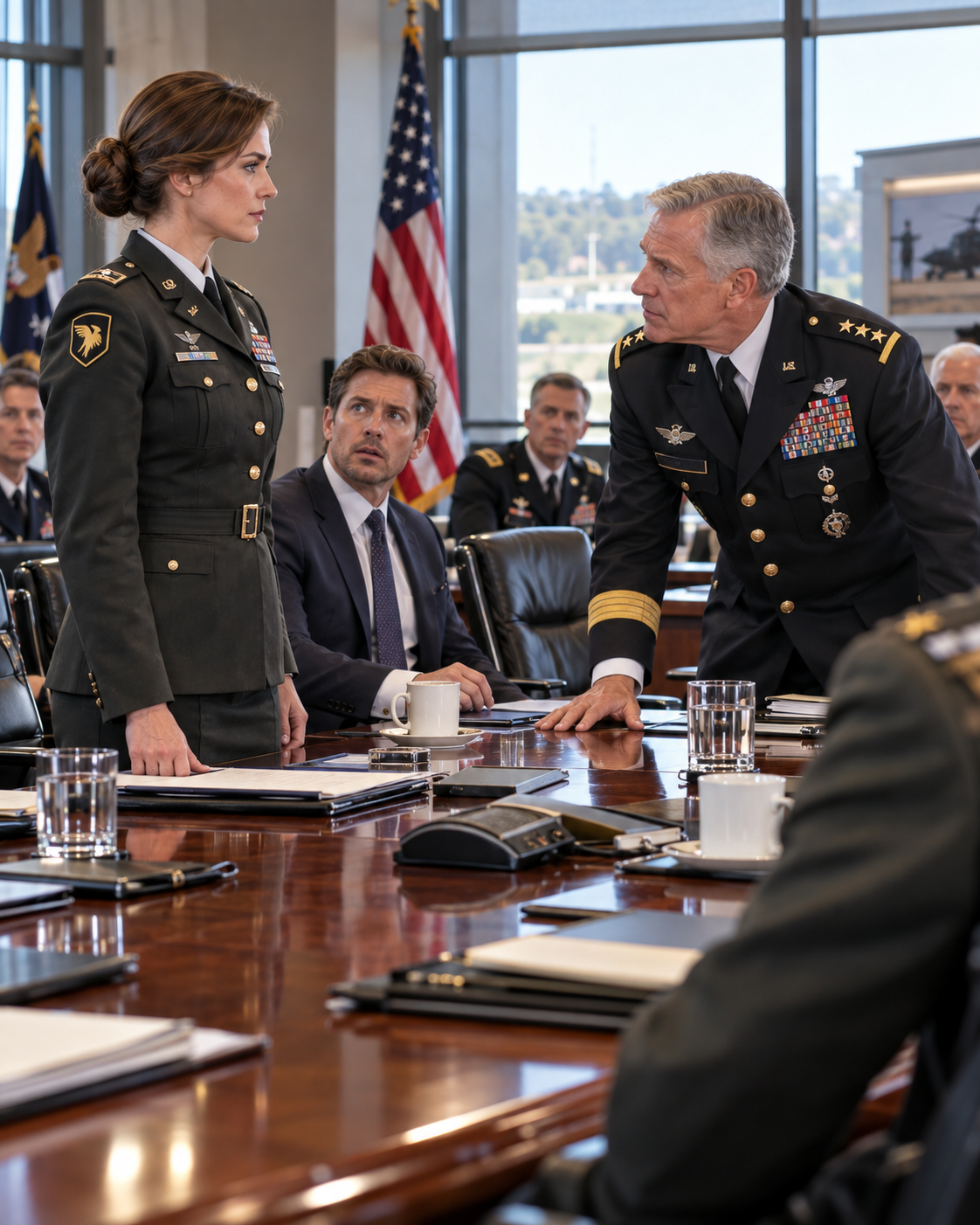
I was stopped at the secure briefing room in wrinkled fatigues, a Marine Major sneering that people like me did not belong there
The envelope felt strangely warm in my hand, though the evening air around Master Sergeant Harlan Price’s porch had already turned cold.
I stared at my name written across the front, the letters uneven and deliberate, and for several seconds I could not bring myself to break the seal.
Price watched me from his old wooden chair.
He had aged since I last saw him in uniform, but his eyes had not changed.
They still had that unnerving ability to make me feel seventeen years old again.
“What is it?” I asked.
“Something I should have given you a long time ago.”
“Why didn’t you?”
He looked toward the road.
“Because you weren’t ready.”
I almost laughed.
“I’ve commanded combat units, survived two wars, briefed presidents, and just took over an intelligence directorate.”
“I know.”
“Then what could possibly make me not ready?”
His expression hardened.
“The truth.”
I looked down at the envelope again.
For thirty-three years, I had believed Price’s greatest lesson was about humility.
Now I wondered whether I had misunderstood him.
I carefully broke the seal.
Inside was a single handwritten page, a photograph, and a photocopied document stamped with a classification marking from an era I barely remembered.
The photograph stopped me first.
It showed a younger Price standing beside three soldiers outside a communications facility.
One of them was me.
Not the general.
Not the decorated officer.
Just a scared teenager with oversized fatigues, a crooked haircut, and an expression that looked almost painfully hopeful.
I had forgotten the photograph.
Price had not.
I unfolded the letter.
“Valerie, if you’re reading this, then you have become exactly what I hoped you would become, but probably not for the reason you think.”
I read the sentence twice.
My throat tightened.
The letter explained that thirty-three years earlier, when I had first arrived at the installation as an uncertain young recruit, Price had noticed something unusual in my aptitude evaluations.
I had an instinct for patterns.
Not numbers alone.
People.
Contradictions.
Things that did not belong together.
A report that used one word differently in three places.
A guard roster with a signature that looked almost right.
A maintenance schedule that could not physically fit the movements of the people who supposedly followed it.
Price had quietly recommended me for an intelligence assessment.
But there was more.
The photocopied document contained a name I recognized immediately.
Gregory Ward.
I stopped breathing for a moment.
The document was dated thirty-three years earlier.
Ward had been a junior officer assigned to an internal security investigation involving a suspected leak.
Price had been one of the investigators.
The investigation had apparently centered on a missing intelligence file.
The file had never been recovered.
The investigation had been closed.
But Price had written one sentence across the bottom of his copy.
“Wrong man.”
I looked up.
“Who was accused?”
Price’s jaw tightened.
“Me.”
The porch suddenly seemed much smaller.
“You?”
“They thought I had stolen the file.”
“Did you?”
“No.”
“Then why did they blame you?”
He looked at the envelope.
“Because I was the easiest person to sacrifice.”
I felt something cold move through me.
“What did Ward have to do with it?”
Price did not answer immediately.
Instead, he reached for his cane and slowly stood.
“Come inside.”
His house smelled like old books, coffee, and the faint cedar scent of military trunks that had been opened and closed too many times.
He led me into a small room I had never seen before.
One wall was covered with photographs.
Most were military.
Some showed Price with commanders I recognized.
Others showed people I didn’t.
In the center hung a faded photograph of the communications facility from 1993.
A red circle had been drawn around one window.
Price handed me a magnifying glass.
“Look.”
I leaned closer.
At first I saw nothing.
Then I noticed a figure reflected in the glass.
A man standing behind the photographer.
Young.
Uniformed.
Watching.
“Who is that?”
Price’s voice was barely above a whisper.
“Gregory Ward.”
I stared at the photograph.
“Why was he there?”
“That’s what I spent thirty-three years trying to prove.”
The room seemed to tilt.
I thought about Ward standing in the hallway months earlier, dismissing me with a single glance because my clothes did not match his expectations.
Suddenly, his arrogance looked less like personality and more like habit.
“Did General Mitchell know?”
Price shook his head.
“Not then.”
“And now?”
“That’s why I gave you the envelope.”
I looked at him.
“Why now?”
His answer came quietly.
“Because the people who buried the truth are still alive.”
The next morning, I returned to headquarters before sunrise.
I said nothing about the envelope.
I said nothing about Ward.
I simply asked Captain Althea Rhodes to pull every historical intelligence case involving compromised access, missing files, or internal investigations from the previous thirty-five years.
She stared at me.
“That’s a lot of records.”
“I know.”
“Is there something specific you’re looking for?”
“Yes.”
“What?”
“A pattern.”
Her expression changed.
She had learned by then that when I used that word, I usually already suspected something.
Within forty-eight hours, Rhodes brought me a preliminary stack.
There were seventeen incidents.
Different years.
Different units.
Different commanders.
Different classifications.
But every case had something in common.
The initial suspect was always a junior person.
A clerk.
A driver.
A guard.
An enlisted analyst.
Someone with little power and no influential friends.
And in nine of the seventeen cases, Gregory Ward’s name appeared somewhere in the administrative chain.
I sat silently for nearly a minute.
Rhodes watched me.
“Ma’am?”
“Who authorized the original investigations?”
She checked the files.
“Mostly Ward.”
“Who closed them?”
“Usually someone above him.”
“Who benefited?”
She stopped.
That was the question.
Not who touched the information.
Who benefited from the information disappearing?
We traced the cases deeper.
The pattern became uglier.
Sensitive intelligence had repeatedly been redirected toward private contractors, foreign intermediaries, and politically connected organizations.
No single transaction was large enough to trigger immediate suspicion.
No single breach was catastrophic.
But together they formed something far more disturbing.
A system.
A machine built to move small pieces of information through gaps nobody thought important.
And someone had spent decades making sure the people blamed for those gaps were always people nobody powerful would defend.
Then we found the name that changed everything.
Bradley Vance.
I stared at the screen.
Rhodes whispered, “The Major?”
“Not just the Major.”
His father had been Gregory Ward’s commanding officer decades earlier.
His grandfather had served in the same intelligence network.
Three generations.
Three sets of records.
And suddenly the incident in the briefing room no longer felt random.
I remembered Major Vance’s words.
“This briefing is for people who matter.”
At the time, I had thought he was simply arrogant.
Now I wondered who had taught him that some people mattered more than others.
I ordered a discreet review.
No accusations.
No arrests.
No dramatic confrontation.
Just facts.
That was when Bradley Vance came into my office unexpectedly.
He closed the door behind him.
“I heard you’re reviewing old investigations.”
I studied his face.
“Who told you?”
He hesitated.
“People talk.”
“That’s not what I asked.”
His shoulders stiffened.
“I don’t know.”
I gestured toward the chair.
“Sit.”
He remained standing.
“I owe you an apology.”
“You already gave me one.”
“This is different.”
He reached into his pocket and placed a small folded paper on my desk.
“I found this in my father’s effects.”
I unfolded it.
It was an old handwritten note.
The ink had faded, but the words were clear.
“Never let Thorne see the Price file.”
My pulse slowed.
“Where did you get this?”
“My father died six years ago.”
I looked up.
“Why are you giving it to me now?”
Vance’s face had lost its usual certainty.
“Because when you stood in that hallway, I thought you were nobody.”
He swallowed.
“Then I realized I had spent my whole career becoming exactly the kind of man I hated when I was younger.”
I said nothing.
He continued.
“I thought I was protecting standards.”
“You were protecting status.”
His eyes closed briefly.
“Yes.”
For the first time, I saw something beneath the arrogance.
Fear.
Not fear of me.
Fear of what he might discover about himself.
“Major,” I said, “did you know your father was involved?”
“No.”
“Did you suspect?”
He hesitated.
“Sometimes.”
“That’s not enough.”
“I know.”
I pushed the paper back toward him.
“Then help me find the truth.”
He stared at me.
“Even if it destroys my career?”
“Especially then.”
Three weeks followed.
The investigation became a maze of old files, sealed archives, retired personnel, and memories that had been buried beneath decades of institutional dust.
We discovered that Price had been right.
The missing intelligence file from 1993 had not been stolen by him.
It had been removed by someone with authorized access.
That person had altered the access log and redirected suspicion toward Price.
But there was another surprise.
Ward had not been the mastermind.
He had been a participant.
A young officer who had been frightened into obedience by senior leadership.
He had spent decades covering his involvement because admitting the truth would have destroyed everyone above him.
And those people had protected him in return.
The corruption had survived because every generation inherited the silence.
Then came the final piece.
A retired civilian analyst named Margaret Ellis agreed to meet me in a quiet diner outside Baltimore.
She was eighty-two and walked with a silver cane.
She placed an old cassette recorder on the table.
“I’ve waited a long time for someone to ask.”
“Ask what?”
“Who ordered the file moved.”
She pressed play.
A man’s voice filled the booth through static.
The recording was thirty-three years old.
I recognized the voice immediately.
Gregory Ward.
But what he said shocked me.
“I don’t want Price blamed.”
Another voice answered.
“Then give them someone else.”
“Who?”
“Someone nobody will protect.”
The recording ended.
I sat motionless.
Ward had not initiated the cover-up.
He had tried to resist.
Then I heard the final sentence.
“Your choice is simple, Lieutenant Ward: protect the organization, or become the next casualty.”
I looked at Margaret.
“Who was the other voice?”
She stared at me.
“That’s why I called you.”
She pushed a second tape across the table.
“He was the highest-ranking officer in the room.”
I took the tape.
“Who?”
Margaret lowered her voice.
“General Mitchell Vance.”
For several seconds, I heard nothing but the diner around us.
Coffee cups.
Silverware.
A child laughing somewhere near the counter.
The ordinary sounds of life continuing while my understanding of the past collapsed.
I went back to headquarters and locked the office door.
General Mitchell Vance had personally welcomed me months earlier.
He had introduced me as the new Director of Intelligence.
He had watched Ward’s face turn pale.
He had watched Bradley tremble.
And not once had he told me that he knew Price’s name.
I called him.
“Sir, I need to speak with you.”
There was a pause.
“Come to my office.”
When I arrived, he was standing beside the window.
He looked older than he had that morning months earlier.
“How much do you know?”
I stopped.
That answer told me everything.
“Enough.”
He nodded.
“I wondered when you’d find it.”
“Did you order the file moved?”
“Yes.”
The admission landed without drama.
Almost worse because of it.
“Why?”
“Because we had a leak.”
“Price wasn’t the leak.”
“No.”
“Then who was?”
He looked at me.
“I was.”
I could not speak.
He continued.
“Not for money.”
“Then why?”
“Because intelligence had become political.”
He explained that the missing file contained evidence of a covert operation that senior officials feared would expose a diplomatic crisis.
They needed the information buried.
Price had discovered the deception.
Ward had been ordered to redirect suspicion.
Mitchell had signed the order.
He had believed sacrificing one career would prevent something larger.
He had been wrong.
And the system had learned the wrong lesson.
It learned that people could be sacrificed whenever truth became inconvenient.
“Why did you bring me here?” I asked.
“Because you were the first person I saw in thirty years who reminded me of Price.”
I felt anger rise in my chest.
“You knew.”
“I knew what they had done to him.”
“You knew what they had done to me before I even arrived.”
“No.”
His voice broke slightly.
“I knew what this institution could do to you if nobody changed it.”
I looked at him for a long time.
“Then why didn’t you tell me?”
“Because I was ashamed.”
That answer hurt more than an excuse would have.
I wanted to hate him.
It would have been easier.
Instead, I saw an aging man carrying the consequences of a decision he had once convinced himself was necessary.
“What happens now?” he asked.
I thought about Price.
I thought about Miller at the roster desk.
I thought about Vance’s trembling hands.
I thought about every person who had been told, in one way or another, that they did not matter.
“We tell the truth.”
The investigation became public within weeks.
Not every detail could be released, but enough could.
Price’s name was formally cleared.
Ward resigned before disciplinary proceedings could remove him.
Major Bradley Vance stayed.
He requested reassignment to a training command where he could teach young officers how easily authority could become arrogance.
I approved it.
Senior Airman Jason Miller received his training opportunity and eventually became an instructor himself.
At his graduation, I watched him pin on a new rank.
He found me afterward.
“Ma’am, I almost didn’t speak up that day.”
“Why did you?”
He smiled nervously.
“Because the roster was right.”
I smiled back.
“No.”
I placed a hand on his shoulder.
“Because you were.”
Months later, I returned to Price’s porch.
He looked thinner.
Weaker.
But when he saw me, he smiled.
“You opened it.”
“Yes.”
“And?”
I sat beside him.
“You were right.”
He laughed softly.
“I usually am.”
I handed him a copy of the official letter clearing his name.
He stared at it for a long time.
Then he folded it carefully.
“I never needed this.”
“I know.”
“That’s why it matters.”
The sun disappeared behind the trees.
For a while, neither of us spoke.
Then Price asked, “Did you forgive them?”
I thought about General Vance.
Ward.
Bradley.
Even myself.
“I don’t know.”
He nodded.
“Good answer.”
“Why?”
“Because forgiveness isn’t pretending nothing happened.”
He looked at me.
“It’s deciding what happens next.”
I carried those words back to headquarters.
The next morning, I walked through the same secure entrance where I had once been stopped.
A young civilian contractor stood at the desk.
She looked exhausted, nervous, and completely out of place.
Her badge scanner wasn’t working.
The guard behind her sighed impatiently.
“Step aside.”
She looked embarrassed.
“I’ve been cleared for the meeting.”
“I said step aside.”
I stopped walking.
For a moment, I saw myself in her.
Wrinkled clothes.
Travel bag.
No obvious authority.
Nobody important.
I approached the desk.
“What’s your name?”
She looked startled.
“Emily.”
I smiled.
“Emily, let’s check the roster.”
The guard stiffened.
“Ma’am, I can handle it.”
“I know.”
I looked at him.
“That’s exactly why I’m asking you to handle it correctly.”
He checked the system.
Her authorization appeared.
She belonged there.
She had belonged there all along.
I stepped aside and let her pass first.
She looked back at me.
“Thank you.”
I nodded.
Then I watched the doors close behind her.
That was when I finally understood what Price had spent thirty-three years trying to teach me.
Leadership was not the moment when everyone discovered your rank.
It was the moment when someone with no rank at all felt safe enough to speak.
It was not making powerful people afraid of you.
It was making powerless people believe their dignity mattered.
And sometimes the hardest victory was not exposing the person who humiliated you.
Sometimes it was refusing to become them.
Years later, people would remember the briefing room incident.
Some would call it a lesson in humility.
Others would call it a story about a general who humbled an arrogant major.
They would be wrong.
The real story happened afterward.
It happened in every hallway where a gatekeeper stopped looking at uniforms and started looking at people.
It happened every time a young airman raised a concern without fearing punishment.
It happened whenever someone in authority remembered that credentials prove access, but character determines how that access is used.
And every October, on the anniversary of the day Price gave me that envelope, I received a plain white letter with no return address.
The first one contained a single sentence.
“The work isn’t finished.”
The second said,
“They still don’t know everything.”
The third contained only a photograph.
It showed the old communications facility from 1993.
I stared at it for several minutes before noticing something I had never seen before.
There were four people in the photograph.
Not three.
One figure stood in the far window, half-hidden behind the reflection.
A person we had never identified.
A person who had apparently been watching Price, Ward, and the young version of me all those years ago.
On the back of the photograph, someone had written seven words.
“You were never the one they were watching.”
I looked toward the closed door of my office.
For the first time in years, I felt that familiar chill I had known as a teenager.
Not fear.
Recognition.
Somewhere inside the institution I had spent my life serving, there was still a secret powerful enough to survive three decades, three generations, and every investigation we had conducted.
And whoever had been watching us in 1993 had just reminded me that they were still watching.
I turned the photograph over again.
At the bottom, beneath the old handwriting, was a date.
Tomorrow.