I was stopped at the San Francisco federal courthouse by my own father, who told the guard my work was nothing important
I didn’t answer immediately.
For years, I had imagined what my father’s apology might sound like, and every version in my head had been dramatic.
He would finally understand.
He would finally admit he had been wrong.
He would finally say he was proud of me.
Instead, all I heard was his breathing on the other end of the phone.
Then he said, “I don’t know how to talk to you anymore.”
I sat at my kitchen table in the dark.
“You never really tried.”
“I know.”
That answer unsettled me.
Arthur Bennett never said I know.
He argued.
He corrected.
He explained.
He commanded.
But he didn’t surrender ground.
“I don’t expect you to forgive me tonight,” he said.
“I wasn’t planning to.”
“I figured.”
There was another silence.
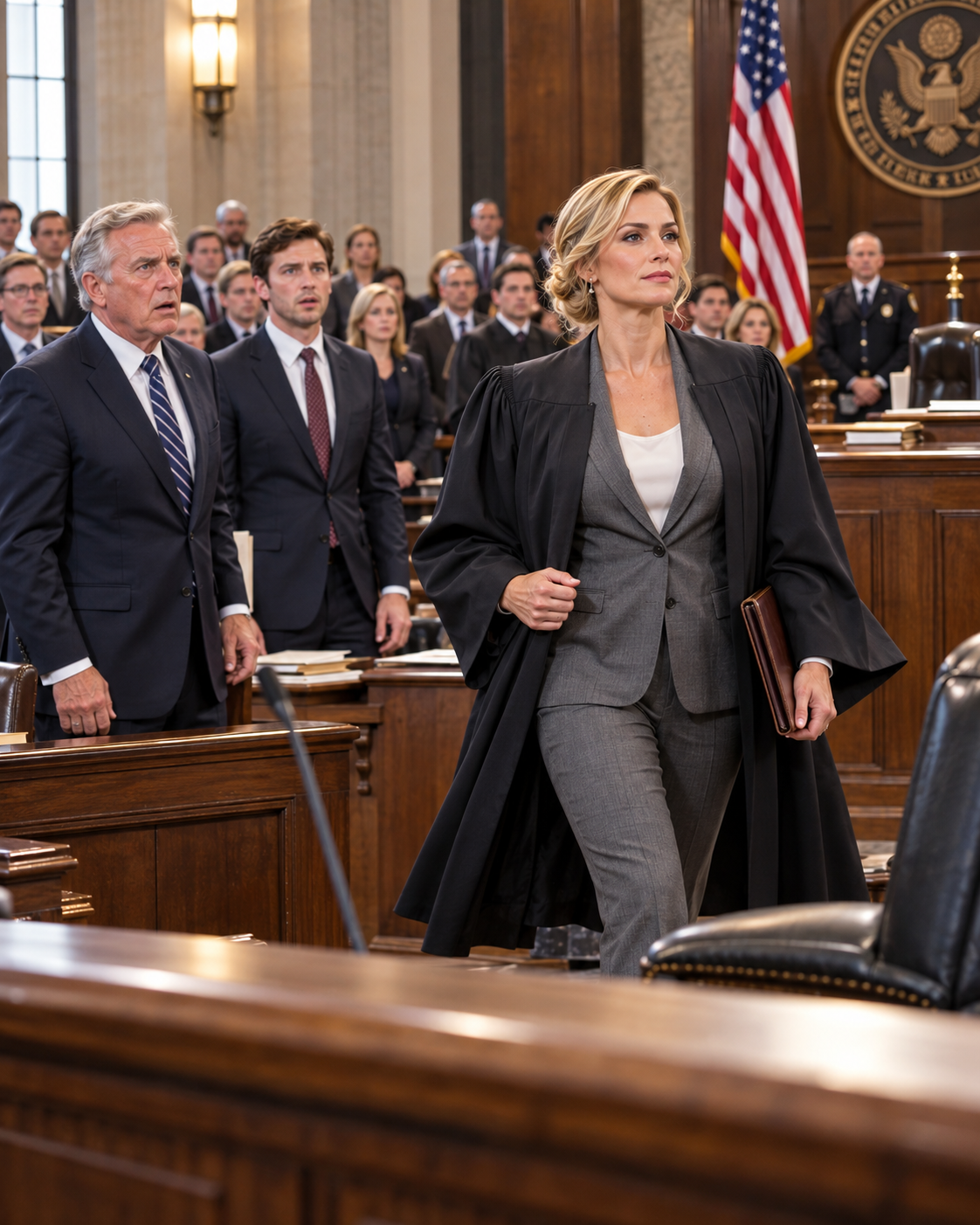
Then he said, “Can I see you tomorrow?”
I looked at the judicial credentials still lying on the counter.
“Why?”
“Because there’s something I should have told you years ago.”
The line went quiet.
My stomach tightened.
“What?”
“I can’t explain it over the phone.”
He hung up before I could answer.
I barely slept.
By morning, I had convinced myself it was nothing.
Maybe guilt.
Maybe embarrassment.
Maybe the shock of seeing his daughter sitting behind a federal bench had finally cracked something inside him.
But when I arrived at chambers the next morning, a message was waiting.
My father had requested a private meeting.
Not through the court.
Not through anyone official.
Just a handwritten note delivered by a staff member.
Please.
That single word bothered me more than anything else.
I had spent years believing my father didn’t need me.
Now I was beginning to wonder whether he needed something from me.
He arrived at noon.
Without his military jacket.
Without his usual posture.
He looked older than he had the day before.
“Sit,” I said.
He sat.
For several seconds, neither of us spoke.
Then he placed a thin envelope on my desk.
“I should have given you this a long time ago.”
I didn’t touch it.
“What is it?”
“Something your mother left.”
My chest tightened.
My mother had died when I was twenty-three.
For years, I had remembered her as the one person in our house who noticed things Arthur didn’t.
She noticed when I stayed up late studying.
She noticed when I cried after my first rejection from a clerkship.
She noticed when Jeremy needed encouragement.
She noticed everyone.
Except, apparently, she had left something behind that I had never seen.
“Why didn’t you give it to me?”
My father looked down.
“Because I was angry.”
“At me?”
“No.”
He swallowed.
“At myself.”
I opened the envelope.
Inside was a letter written in my mother’s handwriting.
My hands started shaking before I even read the first line.
My dear Claire,
If you’re reading this, your father finally decided you deserved the truth.
I stopped.
I looked up.
“My name isn’t Claire,” I said.
My father nodded.
“She wrote it before your name was changed.”
I stared at him.
“What are you talking about?”
He leaned back and closed his eyes.
“When you were born, your mother wanted to name you Claire Elizabeth Bennett.”
“Why was it changed?”
“Because I changed it.”
My heart began pounding.
“Why?”
He looked at me.
“Because I wanted you to become strong.”
I almost laughed.
Instead, something colder moved through me.
“That’s your explanation?”
“No.”
His voice cracked.
“It isn’t.”
He pushed the letter closer.
“Read it.”
I did.
My mother wrote that my father had been obsessed with making our family look perfect after returning from deployment.
He believed sons carried names forward.
He believed daughters needed protection.
And after Jeremy was born, his attention shifted almost completely toward him.
But there was something else.
Something my mother had warned me about.
She had written that Arthur had once found an acceptance letter from Harvard addressed to me and had hidden it for several days because he thought law school would pull me away from the family.
I stared at the page.
“I knew I got into Harvard,” I whispered.
“Yes.”
“But you didn’t tell me about the letter.”
“I gave it to your mother.”
I looked at him.
“What?”
“She found it before I could destroy it.”
My throat tightened.
“You were going to destroy my acceptance?”
He nodded.
“I was afraid.”
“For what?”
“For losing you.”
I stood so quickly my chair rolled backward.
“You spent eleven years pretending my career didn’t exist because you were afraid of losing me?”
He didn’t defend himself.
That was somehow worse.
“I thought if I made you feel like you didn’t need me,” he said quietly, “you would eventually come back and prove that I still mattered.”
I stared at him.
The logic was so broken it almost hurt to breathe.
“You punished me because you loved me?”
“No.”
He shook his head.
“I punished you because I didn’t know how to love you without controlling you.”
The room became completely still.
I sat down again.
For the first time, I could see the frightened man underneath the colonel.
Not the authority.
Not the medals.
Not the voice that could silence a room.
Just a father who had spent years mistaking control for love.
“Why Jeremy?” I asked.
His face changed.
That question had finally reached somewhere he didn’t want to go.
“Because Jeremy was easy.”
I waited.
“He needed me,” Arthur said.
“You didn’t.”
I looked away.
“No,” he whispered.
“You were always going to leave.”
I thought about Harvard.
The Ninth Circuit.
The years of federal prosecution.
The nomination.
The confirmation.
Every milestone I had secretly wished he would notice.
“You made me feel like leaving was betrayal.”
“I know.”
“And Jeremy?”
“I made him feel like staying was success.”
My eyes burned.
Neither of us spoke for a long time.
Then I noticed something written at the bottom of my mother’s letter.
There was a second page.
I turned it over.
The handwriting became shakier.
There is one more thing your father must tell you.
I looked at Arthur.
His face had gone pale.
“What is it?”
He didn’t answer.
“Arthur.”
He rubbed both hands over his face.
“Your mother knew she was sick.”
I froze.
“How long?”
“Almost a year.”
“You told me it was sudden.”
“It was.”
“That’s not what I asked.”
He looked at the floor.
“She knew she was dying.”
My voice disappeared.
“Why didn’t she tell me?”
“Because I asked her not to.”
The room seemed to tilt.
“Why?”
He took a breath.
“Because you had just started law school.”
I stared at him.
“You let me leave without knowing my mother was dying.”
“I thought I was protecting you.”
“No.”
The word came out quietly.
“You were protecting yourself.”
He didn’t argue.
And somehow, that was the moment I finally understood how deep the damage went.
He hadn’t only hidden my accomplishments.
He had hidden grief from me.
He had decided what I could handle.
What I deserved.
What I should know.
What I should become.
My entire childhood had been a series of decisions made on my behalf by someone who believed love gave him the right to control the truth.
I folded the letter carefully.
“I need you to leave.”
He stood.
At the door, he stopped.
“I never told Jeremy either.”
I looked up.
“Told him what?”
“That I knew you were going to Harvard.”
He gave me a tired smile.
“He thinks you simply disappeared into your career.”
Then he left.
For the rest of the afternoon, I couldn’t concentrate.
Every case file blurred.
Every legal argument sounded distant.
That evening, I called Jeremy.
He answered immediately.
“Hey.”
“Did Dad ever tell you about Harvard?”
There was a pause.
“What about it?”
I told him.
Not everything.
Just enough.
When I finished, he was silent.
Then he said, “There’s something I need to tell you too.”
My stomach dropped.
“What?”
“Dad called me after the ceremony.”
I waited.
“He told me I had to decide whether I wanted to be like him.”
I frowned.
“What did he mean?”
“He said you were better than both of us at something.”
“What?”
“Walking away from applause.”
I closed my eyes.
Jeremy continued.
“He said he spent my whole life teaching me how to impress people, and your whole life teaching you how to survive without him.”
I didn’t know what to say.
“He sounded scared,” Jeremy said.
“He should.”
“Maybe.”
There was another silence.
Then Jeremy said, “Claire, I’m sorry.”
I smiled sadly.
“You knew my name wasn’t Claire.”
He laughed softly.
“You’re impossible.”
For the first time in years, it sounded like we were siblings.
Not competitors.
Not the golden child and the overlooked daughter.
Just brother and sister.
Over the next few weeks, something strange happened.
Arthur stopped trying to repair everything at once.
He didn’t send flowers.
He didn’t make dramatic speeches.
He didn’t call every day.
Instead, every few days, he sent a short message.
Hope your hearing went well.
Saw an article about the court today.
Proud of the work you’re doing.
Sometimes I didn’t respond.
Sometimes I wrote back.
Slowly, carefully, we began rebuilding something neither of us knew how to name.
Jeremy changed too.
He stopped talking about prestige.
He started asking questions.
Hard questions.
He wanted complex litigation.
He wanted cases that required patience.
He wanted to become a good lawyer instead of merely looking like one.
One Saturday afternoon, he called me from his office.
“I turned down the position.”
“What position?”
“A private firm offered me a partnership track.”
“That’s a big decision.”
“I know.”
“Why?”
He laughed.
“Because I finally realized Dad taught me to chase rooms where important people might notice me.”
He paused.
“I’d rather become someone worth noticing.”
I smiled.
“That’s a better reason.”
Months passed.
Then came the day I received an envelope from my father.
Inside was a photograph.
It showed me at twelve years old, sitting at the kitchen table with a stack of books.
My mother stood behind me, smiling.
Arthur was in the corner.
Watching.
I turned the photograph over.
On the back, in my father’s handwriting, were six words.
I was proud before I knew how to say it.
I stared at those words for a long time.
Then my phone rang.
Arthur.
I answered.
“Hi.”
“Hi.”
He sounded nervous.
“I wanted to ask you something.”
“What?”
“Would you come to the house for Thanksgiving?”
I almost said no.
The old instinct rose immediately.
Protect yourself.
Keep distance.
Don’t give him another chance to hurt you.
But then I thought about my mother’s letter.
About the years we had lost.
About how easily pride can become a wall when nobody is willing to be the first to lower it.
“I’ll come,” I said.
There was silence.
Then he whispered, “Thank you.”
Thanksgiving came cold and bright.
Jeremy was already there when I arrived.
Arthur opened the door himself.
No uniform.
No medals.
No performance.
Just my father in an old sweater, standing awkwardly in his own doorway.
“You’re early.”
“I know.”
He smiled.
“I made too much food.”
“That sounds familiar.”
He laughed.
For the first time, I saw his shoulders relax.
Dinner was imperfect.
The turkey was dry.
Jeremy burned the vegetables.
Arthur told a story about his military days that none of us had heard before.
And when he caught himself turning the story into a lesson, he stopped.
“Sorry,” he said.
Jeremy grinned.
“You’re getting better.”
Arthur laughed.
After dinner, I found him alone in the kitchen.
He was washing dishes.
I took the towel beside him.
“You don’t have to do that.”
“I know.”
He handed me a plate.
“I just wanted to.”
We stood together in silence.
Then he said, “Your mother would have been proud of you.”
I looked down.
“I know.”
He swallowed.
“I wish I’d told you while she was alive.”
“So do I.”
“I can’t fix that.”
“No.”
“I know.”
I looked at him.
“But you can stop hiding things.”
He nodded.
“I can.”
Then he reached into his pocket and handed me another envelope.
My heart stopped.
“What is this?”
“I found it last week.”
I opened it carefully.
Inside was a photocopy of a document I had never seen.
It was dated eleven years earlier.
The letter was from a federal judge recommending me for a position I eventually received.
At the bottom was a handwritten note from my father.
I read it twice.
Then a third time.
My hands began to shake.
“What is this?”
Arthur looked away.
“Something I should have shown you years ago.”
The note was short.
She doesn’t know I know.
But I’m proud of her.
I looked at him.
“Why didn’t you give me this?”
He took a breath.
“Because I thought if I admitted I was proud, I’d have to admit how badly I’d failed you.”
I didn’t answer.
He continued.
“I was afraid that once you knew I was proud, you wouldn’t need me anymore.”
I folded the paper.
“Maybe I didn’t need you.”
He nodded.
“But I wanted you.”
His eyes filled.
That sentence broke something open in both of us.
He looked down.
“I don’t deserve that.”
“Maybe not.”
I stepped closer.
“But you can still be my father.”
He looked at me for a long time.
Then he hugged me.
It was awkward.
Careful.
Almost unfamiliar.
But I didn’t pull away.
For years, I had believed the most powerful moment of my life would be the day I took the federal bench.
I was wrong.
The most powerful moment was standing in my father’s kitchen, no audience watching, no titles protecting either of us, and realizing that authority had never been what I was searching for.
I had wanted to be seen.
Not as a judge.
Not as a Harvard graduate.
Not as a former prosecutor.
Just as his daughter.
The courthouse had taught me something my father never could.
A title can make a room stand when you enter.
It cannot make anyone love you.
That has to be earned in quieter places.
In apologies that arrive years late.
In doors that finally open.
In conversations where nobody wins.
And sometimes, in the courage to admit that the person who hurt you was also a person who was hurting.
I still don’t know whether my relationship with my father will ever become what it should have been.
Maybe some wounds don’t disappear.
Maybe forgiveness isn’t forgetting what happened, but refusing to let what happened decide everything that comes next.
What I do know is this.
The next time Arthur Bennett walks into a federal courthouse, he won’t tell anyone which entrance I should use.
And if he ever forgets who I am, I won’t hand him my credentials.
I’ll simply tell him my name.
Because after everything we lost, I finally understood that the greatest victory wasn’t proving my father wrong.
It was becoming someone who no longer needed him to admit I was right.
And just before I left that Thanksgiving night, Arthur called my name from the doorway.
I turned around.
He was holding my mother’s letter.
“There was one last page,” he said.
My heart stopped.
He looked at me with tears in his eyes.
“And I think you’re finally ready to read it.”
He held out the envelope.
I took it.
But I didn’t open it.
Not yet.
Some truths arrive like storms.
Others wait quietly until you’re strong enough to hear them.
And as I stood beneath the porch light with my father’s unfinished apology in my hands, I realized there were still things about my mother, my father, and the eleven years between us that I had never been told.
This time, though, I wasn’t afraid of what the truth might cost me.
I was finally ready to know.